




Abstract
Background:
Avulsion fractures of the sublime tubercle of the ulna are a cause of medial elbow pain and instability in overhead athletes.
Purpose:
To compare outcomes after sublime tubercle avulsion fracture managed as a fracture (with cast immobilization) versus a soft tissue injury (without immobilization and with early range of motion [ROM]) to determine how to achieve the best outcomes for these injuries in adolescent throwing athletes.
Study Design:
Cohort study; Level of evidence, 3.
Methods:
A multicenter retrospective review using an institutional database query of radiology reports to identify sublime tubercle fractures between July 2005 and December 2020 was performed. Inclusion criteria were baseball players aged ≤19 years, fracture identified on ≥1 imaging study (radiograph, computed tomography, or magnetic resonance imaging), and ≥24 months of follow-up (unless failure of management occurred earlier). Fractures were classified as simple or complex injuries and then grouped according to management strategy: cast or early ROM. Data collected included patient characteristics, clinical presentation (injury mechanism and acuity), initial treatment, and outcomes (complications, final ROM, patient-reported symptoms, radiographic union, and return to activities or sport).
Results:
A total of 13 baseball players (6 in the cast cohort and 7 in the early ROM cohort) with a mean age of 16.5 years (range, 15-19 years) met the inclusion criteria, with a mean follow-up of 4.1 years (range, 2.0-6.7 years) in the cast cohort and 3.8 years (range, 2.1-7.4 years) in the early ROM cohort. All injuries were classified as simple fractures. Five patients (83%) in the cast cohort achieved radiographic union, return to sports, and symmetric ROM, compared with only 2 patients (29%) in the early ROM cohort who achieved the same without having to undergo ulnar collateral ligament reconstruction (P = .026).
Conclusion:
The present study demonstrated that, whereas management of sublime tubercle avulsion fractures in adolescents via early ROM had a high failure rate, a mean of 4 weeks of immobilization led to a high rate of return to sports with successful union of the avulsed fragment. Unlike purely ligamentous injuries, bony avulsions may not necessarily require surgical intervention for adolescent patients to return to baseball.
Ulnar collateral ligament (UCL) injuries are seen in throwing and overhead athletes due to the supraphysiologic valgus stresses seen in the late cocking and early acceleration phases of throwing activities. The primary soft tissue constraint to this stress is the UCL. Valgus overload can cause acute rupture or attritional attenuation and rupture of the UCL, leading to valgus insufficiency and pain. This ligamentous injury and its treatment have been well described in the literature. Injury to this structure may occur at many locations along the course of the ligament but was historically described as predominately midsubstance. 3 Valgus load has less commonly been shown to cause an osseous failure at the distal bony attachment of the UCL, the sublime tubercle of the ulna.
Sublime tubercle fractures have been shown to occur most often with throwing athletes in late adolescence and young adulthood.1,4,6 The diagnosis of this injury can be made with patient history, physical examination, and plain radiographs. Additionally, computed tomography (CT) scans can better define bony anatomy, and magnetic resonance imaging (MRI) can be utilized to investigate the possibility of concomitant ligamentous injury. Stress radiographs can also be used to define laxity in the subacute phase. The therapeutic approach to this injury is not as simple as the diagnosis. To our knowledge, there is only 1 series evaluating the treatment of these injuries. Salvo et al, 7 in a retrospective series of 8 avulsion fractures of the sublime tubercle in competitive adolescent throwing athletes, reported failure after nonoperative treatment with residual medial elbow pain in 6 of the fractures. Their conclusion was that surgery was required in most cases to achieve a return to preinjury level of activity; however, the initial nonsurgical protocol was 1 week of immobilization followed by early range of motion (ROM). Management of these fractures with prolonged immobilization (3-6 weeks) has not been previously studied.
The purpose of this study was to add additional data to the literature and help characterize injury pattern, treatment, and outcomes for sublime tubercle avulsion fractures in adolescent throwing athletes. Our primary aim was to determine whether those managed with casting could return to sport without the need for subsequent surgical intervention. Our hypothesis was that managing these avulsion injuries more like a fracture (in a cast), rather than a soft tissue injury (none or brief immobilization), would lead to reduced failure rates in management, with improved rate of fracture union and limited risk for residual elbow stiffness.
Methods
After receiving institutional review board approval, we conducted a multicenter retrospective review of sublime tubercle avulsion fractures between July 2005 and December 2020 by querying surgical registries as well as radiology reports. Inclusion criteria were patients ≤19 years old with a sublime tubercle avulsion fracture identified on ≥1 radiologic study (radiograph, CT, or MRI). Excluded were patients with enthesopathy changes at the sublime tubercle, those with concomitant medial UCL injury indicated on MRI, those with <24 months of follow-up (unless failure of initial management occurred earlier), those managed initially with extracorporeal shock wave therapy, and those patients who were nonthrowing athletes at the time of injury. Demographic data collected included sex, age, and sport. Clinical presentation data included mechanism of injury, associated injuries, acuity, and initial treatment. Fractures were classified according to the only classification system available for this fracture type (type 1: simple fractures with an isolated sublime tubercle avulsion; type 2: complex fractures with other associated fractures, including avulsions of the medial epicondyle). 5 Outcomes included complications, final ROM, patient-reported symptoms, radiographic union, and return to activities or sports. Treatment was not homogeneous, as some patients had initiated treatment at an outside facility before being evaluated by us.
The total cohort of included patients was divided into management strategy cohorts: cast cohort (3-6 weeks of immobilization) and early ROM cohort (activity modification, sling, or removable brace at their index visit). The 2 cohorts were then assessed to confirm that they were similar regarding age, sport/position played, mechanism of injury, acuity, and fracture classification. The outcomes of management were then compared between the 2 groups, particularly the need for subsequent surgical intervention, rate of fracture union, limitations in ROM, and return to sports. Failure of management was defined here as either the need for subsequent surgery or for failure to return to sports (as some patients may have elected against surgical intervention).
The cast cohort underwent casting for a prescribed duration based on standard of care for most childhood fractures (3-6 weeks pending age and provider comfort regarding risk for elbow stiffness). Out of plaster images were obtained, but union of the fracture was not utilized to initiate ROM protocols. Radiographs were obtained at various intervals based on follow-up patterns, and therefore duration until union was not recorded, as the interval weeks were not assessed fully. Union was determined on only plain film, as a healing fracture was readily identified subsequent to index management even when the initial injury was not always identifiable by plain film.
The early ROM cohort had no period of immobilization, except two patients who had either a sling or removable brace to allow a reduction in swelling and acute pain symptoms for 1 and 2 weeks, respectively. Everyone in this cohort were prescribed activity modification (not playing baseball or similar throwing activity), and instead began a period of rehabilitation without further radiographic assessment of the fracture avulsion. Further radiographic assessment was undertaken if their symptoms failed to improve or they unsuccessfully returned to baseball.
Both treatment cohorts began a period of rehabilitation after their early treatment period. After treatment and before return to throwing, all patients gained full ROM (≥6 weeks) and then started on a progressive throwing program (≥3-4 months, but dependent on individual patient needs regarding progression with distance and velocity). If they were able to return to unrestricted throwing without pain, they were released to full activity. If they stalled out improvement with continued pain during the throwing program, they were offered the possibility of surgical intervention (at ≥3 months after index treatment). Union of the fragment was not necessarily a criterion for advancement with the throwing program.
Descriptive statistics were calculated. Continuous data were compared between groups utilizing nonparametric Mann-Whitney U test. Categorical data were compared between groups using the Fisher exact test or chi-square test. Significance was set at P < .05, and analyses were performed using SPSS (Version 28; IBM).
Results
In total, 40 patients were identified with sublime tubercle avulsion fractures during the collection period between the 2 centers but only 14 were baseball players within that cohort (13 patients were contact injury and 13 were other throwing mechanism such as softball and water polo). Only 13 adolescents with a mean age of 16.5 years (range, 15-19 years) met criteria concerning follow-up duration, with a mean of 4.1 years (range, 2.0-7.4 years). Two of the 13 players required advanced imaging with MRI to identify the avulsion injury; otherwise, the fractures were seen on plain radiography. All athletes were initially managed nonoperatively, with 6 patients in the cast cohort and 7 patients in the early ROM cohort (2 patients in the early ROM cohort started their limited immobilization before being referred into 1 of the 2 study institutions, and the remainder initiated management at 1 of the 2 facilities). There was no difference in demographic findings at the time of injury between the 2 cohorts (Table 1), and all fractures were classified as type 1: simple. Of the 13 patients, 9 sustained injury either acutely or in an acute-on-chronic setting during a single identifiable throwing or pitching event. Radiographs often demonstrated overgrowth of the fragment in the more chronic injuries but without evidence of overlying enthesopathy, which was an exclusion criterion. There was no group difference in the duration of symptoms before initiating treatment (Table 1). The remaining 6 patients who presented with either a subacute or a chronic complaint did not have an identifiable event and instead described chronic insidious onsets.
Baseline Characteristics of the Study Cohorts a
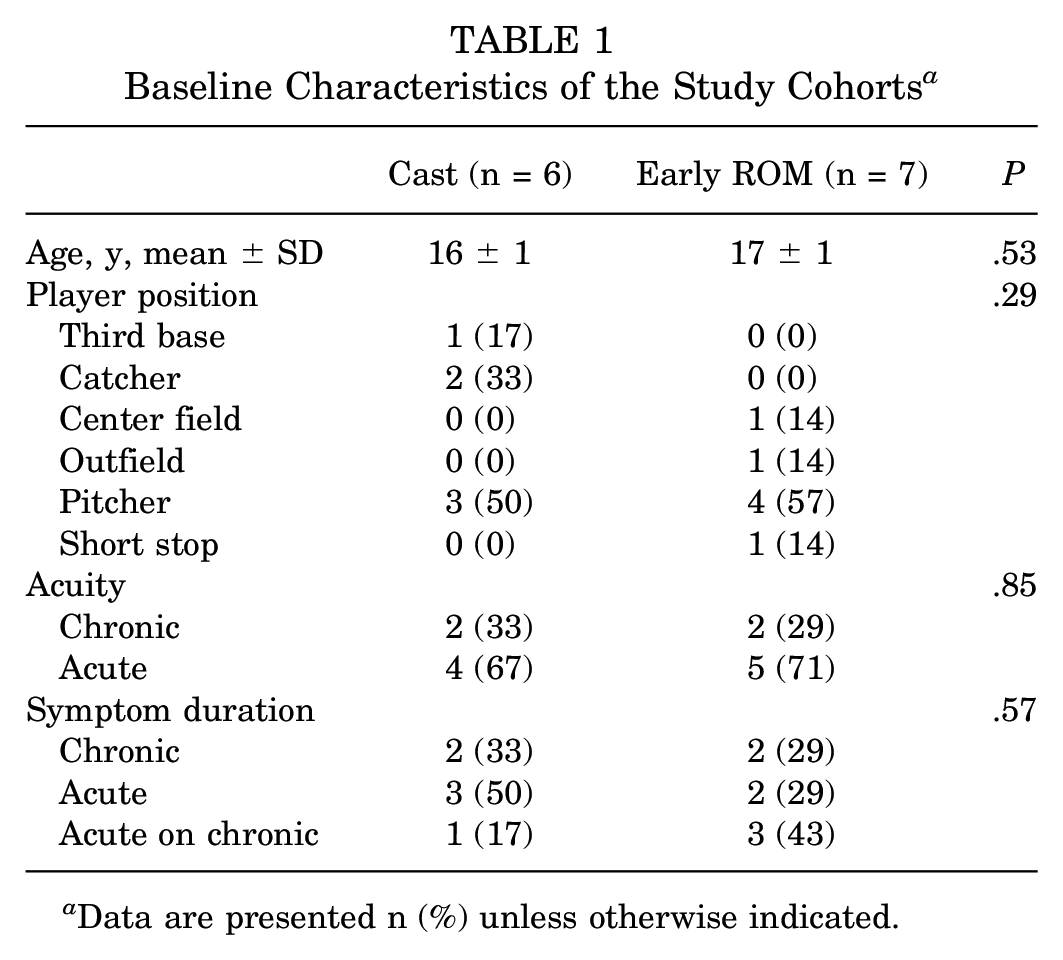
Data are presented n (%) unless otherwise indicated.
Outcomes between the study cohorts are compared in Table 2. The mean follow-up was 4.1 years (range, 2.0-6.7 years) in the cast cohort and 3.8 years (range, 2.1-7.4 years) in the early ROM cohort (p=0.6). Patients in the cast cohort were managed in a cast for a mean of 4.1 weeks (range, 3-6 weeks). Five of the 6 athletes (83%) had favorable outcomes with casting and were able to return to sports between 3 and 6 months after initial management; 1 teenager had a reinjury at 10 months from index presentation (having returned to previous level of play), developed pain and ulnar nerve symptoms shortly thereafter, and was unable to resume his previous level of play, but declined operative management. This was the single patient from the cast group designated as a failure, and his primary complaint after reinjury was ulnar neuropathy. The recommended surgery was UCL reconstruction with ulnar nerve transposition. Moreover, the 2 patients managed with casting who presented with chronic symptoms also achieved successful return to sports. At final follow-up, no patient reported any stiffness, and all patients had symmetric ROM compared with the contralateral elbow.
Comparison of Outcomes Between the Study Cohorts a

Data are presented as mean ± SD or n (%). Boldface P values indicate statistically significant difference between groups (P < .05). ROM, range of motion.
Defined as physical therapy or delayed casting.
Defined as need for surgery or inability to return to sport.
Of the 7 athletes in the early ROM cohort, 2 (29%) were successfully able to return to sports without additional intervention. For those in the early ROM cohort who failed initial management, 1 teenager had persistent pain yet declined surgery, and the other 4 patients elected to proceed with surgical management via UCL reconstruction. None of the early ROM cohort had stiffness or limitations in motion at the conclusion of management. For the athletes who underwent surgery, 2 elected to undergo the reconstruction for continued pain and presumed instability as part of the UCL complex, 1 for nonunion of a displaced sublime tubercle, and 1 for a reinjury 10 months after achieving union upon returning to sports. All patients who underwent UCL reconstruction were able to return to their previous level of throwing postoperatively.
Overall successful management, defined by having achieved radiographic union, return to sports, and symmetric ROM, was seen in 5 patients (83%) in the cast cohort compared with only 2 patients (29%) in the early ROM cohort (P = .026).
Discussion
Although there have been several reports in the literature concerning the osseous avulsion of UCL at the sublime tubercle,1,4,6 none of these have thoroughly investigated the treatment of these injuries, particularly in the adolescent baseball player. The present study advances our understanding by creating 2 cohorts of nonsurgical management and demonstrating improved outcomes when managed like a fracture with a 3- to 6-week period of casting (Figure 1). The findings further demonstrate that early ROM is more likely to fail without eventual surgical intervention. The period of immobilization helps achieve fragment union, but a dedicated rehabilitation program with a stepwise throwing program to minimize risk for future injury is important to successfully returning these athletes to sports.

Top: Anteroposterior radiographs of a sublime tubercle fracture on initial presentation (left) and after 3 weeks of immobilization in a long-arm cast (right) with evidence of fracture consolidation (arrow). Bottom: Anteroposterior radiographs of another sublime tubercle fracture on initial presentation (left) and after 8 weeks of immobilization in a long-arm cast (right) with evidence of fracture healing (arrow).
Salvo et al 7 reported on a series of 8 patients and concluded that nonoperative treatment was often unsuccessful in returning these athletes to their preinjury level of activity due to continued symptoms. In their series, they managed the teenagers with immobilization in an ROM brace locked at 90° for 7 to 10 days followed by 6 weeks of brace wear in an unlocked position to allow for active and passive ROM exercises. The throwing program was then started and advanced from week 8 to week 12 to full velocity. With that protocol, they saw a failure of management (defined in their study as conversion to surgery, whether UCL reconstruction or fracture nonunion fixation) in 6 patients (75%). The management protocol was more akin to an ankle sprain with an associated bony avulsion, rather than a true fracture protocol that is usually defined by a longer duration of immobilization. Our study had a similarly protected cohort with early ROM and physical therapy, with a similar failure rate (71.4%), but we also included a more traditional cast cohort that underwent 1 month of immobilization and saw a significantly lower failure rate in these patients (16.7%).
Mitchell et al 5 reported on a mixed cohort of athletic and injury patterns in adolescents, of whom 26 had type 1 simple fractures. Similar to the present study, there was a mix of initial management, with 56% starting with immobilization. They had only 4 of the 26 require future surgical intervention due to pain or failure to return to sports, and only 1 of those was in the immobilization group. These findings suggest that nonbaseball athletes may not require immobilization in order to resume normal function of the elbow; this contrasts with the present study's findings, which demonstrate a significant difference in ability to return to sports based on initial management in baseball players.
Another potential challenge of nonoperative management in this young patient population is compliance with treatment. The only patient in which we attempted immobilization and stabilization with a removable brace was noncompliant (this patient was included in the early ROM cohort since he did not undergo casting), as he began unrestricted throwing against medical advice and without evidence of complete radiographic healing. Cast placement is a means to control for this aggressive athleticism seen in youth. Although casts can be removed at home, it is much less common to see a lack of treatment compliance when they are used to achieve immobilization, as seen in our small cohort. For the early ROM cohort, the lack of immobilization likely was prohibitive to osseous union of the fragment, which must contribute to a sense of instability, in the form of pain symptoms, that precludes a successful outcome without UCL reconstruction to restore stability of the medial elbow.
One of the concerns with prolonged immobilization, particularly peri-elbow, is residual stiffness and loss of ROM. Historically, children have been managed with prolonged casting for elbow fractures without significant long-term effects on ROM.2,8 Our results support the use of a long-arm cast for 4 weeks, as none of those teenagers were found to have elbow stiffness at the conclusion of their care—even though 2 of them required physical therapy to assist the process. All patients attended physical therapy for appropriate advancement through a throwing program. Even with casting, radiographic union was not always obtained within 6 weeks, with some patients taking multiple months to finally achieve radiographic union. Thus, there is more to the overall success of the casting patients than just the duration of casting itself. Perhaps it changes the mindset of the family and child regarding the expectations and/or the severity of the injury when a cast is recommended over a week of protected motion followed by a rehabilitation program? In our small cohort, we found that the most successful management appeared to be follow-up CT scan to determine radiographic union, a resumption of full ROM, medial scapular strengthening, and then a return to a throwing program. These rehabilitation steps set up the adolescent to have appropriate throwing mechanics. Patients who substantially deviated from this algorithm appeared to show a greater need for surgical intervention, or a return to clinic with recurrent injury.
We strongly advocate prevention of medial-sided elbow injuries in adolescents by encouraging proper mechanics and avoiding overuse, along with appropriate rest. However, if a young thrower presents with symptoms, the possible diagnosis of avulsion fracture of the sublime tubercle should be considered and evaluated with plain radiographs (with the potential need for advanced imaging to identify these injuries). It seems that baseball players are most prone to having type 1 simple fractures. 5
Limitations
The limitations of this study are related to the retrospective design and an inability to standardize each cohort's management routine and to obtain objective outcomes at any of the time points. However,our two cohorts were relatively consistent within themselves and yet resulted in a significant clinical and statistical difference when using failure of management as an endpoint. Moreover, none of the surgical patients underwent a UCL repair with suture tape augmentation, as this management type had not yet been popularized during the treatment period. It could be argued that an avulsion injury of the sublime tubercle could be a good candidate for this surgical modality given the ability to obtain osseous healing and potentially a faster return to sports over the conventional reconstruction modality. Our sample size was also relatively small, even if equal between the cohorts, but for a relatively uncommon injury pattern, the sample size of this study is almost double that of the previous treatment study published. 7
Conclusion
Our results challenge the historical finding that the majority of sublime tubercle avulsion fractures fail nonoperative management, and they highlight the role for a diligent nonoperative protocol with casting, which led to better outcomes than early ROM in this study. It seems that a cast portends a more successful outcome with a lower risk of conversion to surgery in teenage baseball players who sustain sublime tubercle avulsion fractures.
Footnotes
Final revision submitted April 14, 2024; accepted April 23, 2024.
One or more of the authors has declared the following potential conflict of interest or source of funding: E.W.E. has received education payments from Elevate Surgical and nonconsulting fees from Arthrex. J.F. has received education payments from ImpactOrtho. B.T.L. has received education payments from ImpactOrtho and honoraria from Encore Medical. A.T.P. has received education payments from ImpactOrtho and SportsTek Medical and consulting fees from OrthoPediatrics. AOSSM checks author disclosures against the Open Payments Database (OPD). AOSSM has not conducted an independent investigation on the OPD and disclaims any liability or responsibility relating thereto.
Ethical approval for this study was obtained from University of California, San Diego (ref No. 171732).
