




Abstract
Background:
Restoring shoulder strength after arthroscopic rotator cuff repair (ARCR) is critical, but there is limited understanding as to what patients consider satisfactory postoperative strength.
Purpose:
To determine the Patient Acceptable Symptom State (PASS) values for the Constant score strength parameter and internal rotation (IR) strength in patients who underwent ARCR for rotator cuff tears involving the subscapularis (SSC) muscle and evaluate for associations between preoperative and intraoperative patient characteristics with PASS achievement.
Study Design:
Case-control study; Level of evidence, 3.
Methods:
A retrospective analysis was conducted on prospectively collected data for 278 patients with an SSC tear (isolated or combined) who underwent ARCR and had minimum 2-year follow-up data. Functional outcomes (patient-reported outcomes, range of motion, Constant strength, and IR strength) were assessed preoperatively and at the latest follow-up. The overall, male, and female PASS values for postoperative strength measures were evaluated using receiver operating characteristic analysis. Correlation and logistic regression analyses were used to evaluate the relationship between preoperative variables and PASS achievement for Constant and IR strengths.
Results:
The mean follow-up time was 72.8 months. The overall, male, and female PASS values were 9.9 lb (4.5 kg), 14.5 lb (6.6 kg), and 8.5 lb (3.9 kg), respectively, for Constant strength and 15.2 lb (6.9 kg), 20.7 lb (9.4 kg), and 12.1 lb (5.5 kg), respectively, for IR strength. Older age, high fatty infiltration of the SSC tendon (Goutallier grades 3 and 4), and failure of SSC healing correlated negatively with PASS attainment for the strength measures. High fatty infiltration of the supraspinatus and infraspinatus muscles correlated negatively with Constant strength. Decreased coracohumeral distance (CHD) and larger SSC tears correlated negatively with achieving PASS for IR strength. Workers’ compensation, high supraspinatus and SSC fatty infiltration, and the use of knotted suture anchors were predictors of not achieving the overall Constant strength PASS, while lower SSC fatty infiltration and high CHD were predictors of achieving the overall IR strength PASS.
Conclusion:
This study established the PASS values for Constant and IR strengths for patients after ARCR involving the SSC tendon. Workers’ compensation, high supraspinatus and SSC fatty infiltration, and the use of knotted suture anchors were predictors of not achieving the overall Constant strength PASS, while lower SSC fatty infiltration and high CHD were predictors of achieving the overall IR strength PASS.
Approximately one-third of rotator cuff tears undergoing repair have involvement of the subscapularis (SSC) tendon. 13 The SSC tendon plays a crucial role in the internal rotation (IR) of the glenohumeral joint and helps balance forces in the horizontal and frontal planes. Tendon tearing can disrupt this transverse force balance while leading to shoulder dysfunction and a loss of strength. 19
Arthroscopic rotator cuff repair (ARCR) generally leads to improved shoulder strength, but clinically relevant thresholds remain unclear. 2 This gap can be addressed by establishing the Patient Acceptable Symptom State (PASS). The PASS for shoulder strength represents the threshold value for any strength measure necessary to reflect patient satisfaction. 30 While multiple studies have assessed the effectiveness of ARCR in terms of achieving statistically significant postoperative improvement in strength, there is a limited understanding of what degree of postoperative strength is regarded as meaningful for patients.8,16,29
The primary aim of this study was to determine the PASS values for Constant and IR strengths after ARCR involving the SSC tear (isolated or combined) at short- to midterm follow-up. In addition, associations between preoperative and intraoperative patient characteristics as well as the achievement of these PASS values were evaluated.
Methods
Study Design
This retrospective study on prospectively collected data was carried out at a single institution between 2011 and 2021. Institutional review board approval was obtained before this study’s inception. We included patients with an SSC tear (isolated or combined) who underwent primary ARCR, with a minimum 2-year postoperative follow-up. Patients were excluded if there was a history of previous rotator cuff repair, proximal humerus fracture, glenoid fracture, an incomplete physical examination, or incomplete intraoperative records.
Operative Technique and Arthroscopic Findings
All procedures were performed by a single surgeon (P.J.D.). Patients were placed in the lateral decubitus position, and conventional portals were used. SSC tendon integrity was evaluated from the posterior viewing portal. SSC tear type was documented intraoperatively according to the Lafosse classification, and the cephalocaudal tear size was reported as a percentage.25,34 The width of the subcoracoid space was evaluated. Coracoplasty was performed if there was a narrowed subcoracoid space (<7 mm) or if a coracoid spur was present. SSC repair was performed with a single- or double-row technique based on the tear pattern and tendon mobility. In cases with posterosuperior cuff tears, limited acromioplasty was routinely conducted with preservation of the coracoacromial ligament. The mobility of the posterosuperior cuff was assessed, and an anterior interval slide was performed when necessary. After release and adequate mobilization, the freed distal edges of the posterosuperior cuff were secured to the greater tuberosity using suture anchors in a double-row repair when possible. Alternatively, single-row repair was performed if it was determined that a double-row construct would create too much tension. Both knotless and knotted sutures were used. All tears were fully repaired at the time of surgery.
Postoperatively, patients were immobilized in a sling for 4 to 6 weeks to maintain neutral rotation and slight abduction. After sling discontinuation, patients were permitted to engage in passive ER and forward flexion (FF). Strengthening exercises and passive IR were initiated at 3 months postoperatively, with a full return to activity, including sports activities, at 6 months.
Strength Measurements
Isometric strengths were measured at the latest postoperative follow-up using a manual muscle testing dynamometer with the patient in the standing position. To determine the Constant strength (ie, the strength component of the Constant score), the patient’s arm was positioned in the required position: at 90° of FF in the plane of the scapula with the elbow fully extended and the forearm in a half-pronation position. Constant strength was measured with a handheld dynamometer placed on the dorsal aspect of the forearm, 2 cm proximal to the ulnar styloid process. The strength of the SSC muscle was evaluated using the belly-press test, with the elbow flexed to 90° and the palm on the upper abdomen. During the test, the patient was instructed to press the handheld dynamometer between the palm and abdomen. For each participant, the mean strength in pounds of the 3 independent measurements was taken.
PASS Assessment
To calculate the overall, male, and female PASS for the strength measures, patients were queried during their final follow-up by a single investigator (A.I.K.) regarding satisfaction with their overall condition, considering activities of daily living, pain levels, and functional impairment. Satisfaction was assessed dichotomously: satisfied or unsatisfied. The PASS threshold was determined with the Youden index using receiver operating characteristic (ROC) curve analysis.9,22,30 The area under the ROC curve (AUC) indicates the predictive validity of the binary classifier test in determining whether a patient would achieve the PASS. Predictive models are considered reasonable if the AUC is >0.7 and excellent if >0.8. 4 Patients were divided into 2 groups based on whether they achieved the overall PASS for any of the strength measures: PASS or no PASS.
Study Variables
Patient characteristics including age, sex, body mass index, tobacco use, Charlson Comorbidity Index, workers’ compensation, and length of follow-up were collected. Active range of motion (ROM), belly-press test results, bear-hug test results, and patient-reported outcomes (PROs) were documented at baseline and postoperatively at a minimum 2-year follow-up. ROM measurements included FF, ER at the side, and IR; IR was numerically scaled based on the nearest spinal level achieved with the thumb (T10 = 10, T12 = 12, L2 = 14, L4 = 16, S1 = 18, hip = 20). PROs included the American Shoulder and Elbow Surgeons (ASES) score, the visual analog scale (VAS) score for pain, and the Subjective Shoulder Value (SSV). Complications, revision surgeries, and overall satisfaction with overall shoulder symptoms and function were all recorded for analysis.
Fatty infiltration was assessed and documented preoperatively for each rotator cuff muscle using the Goutallier classification by a single high-volume fellowship-trained shoulder surgeon (P.J.D.) based on T1-weighted sagittal magnetic resonance imaging (MRI) scans using the lateral-most image where the scapular spine connects with the body of the scapula. 39 The Goutallier classification consists of 5 grades: 0, absence of fat; 1, presence of some fatty streaks; 2, higher proportion of muscle compared with fat; 3, equal presence of fat and muscle; and 4, higher proportion of fat compared with muscle. Grades 3 and 4 were considered high fatty infiltration. The SSC tendon was also divided into the upper half and the lower half for grading based on the division described by Collin et al. 10 The coracohumeral distance (CHD) was evaluated by measuring the narrowest distance between the cortical border of the coracoid and the cortical border of the humeral head on T2-weighted axial MRI scans.27,32 The axial images were set at the point where the subcoracoid space was at its narrowest. Measurements were made by a single shoulder surgeon (P.J.D.). Three measurements were recorded, and the mean was taken for analysis.
SSC tendon healing was graded from 1 to 5 using the Barth modification of the Sugaya classification for ultrasound assessment of ARCR, 3 where grade 1 designates sufficient thickness and normal structure, grade 2 indicates sufficient thickness with partial hypoechogenicity, grade 3 indicates insufficient thickness without discontinuity, grade 4 demonstrates minor discontinuity in the tendon, and grade 5 demonstrates major discontinuity. Repairs graded as 1, 2, or 3 were considered healed. The assessment was performed once at the final follow-up by an orthopaedic surgeon (A.I.K.) who was trained in musculoskeletal ultrasound and blinded to the outcome.
Statistical Analysis
Continuous data are reported as means with standard deviations, and group comparisons were performed with the Student t test or Mann–Whitney U test according to normality. Categorical data are reported as frequencies and percentages, with comparisons performed using the chi-square test. To evaluate the correlation between independent variables and PASS achievement for the strength measures, Pearson, Spearman, and point-biserial correlation coefficients were calculated for continuous, noncontinuous, and dichotomous variables, respectively. Logistic regression analyses using odds ratios were conducted to determine factors affecting PASS achievement for Constant and IR strengths. Significant demographic, tendon-related, and intraoperative factors derived from correlation analysis, excluding sex, were inputted using the stepwise forward method. All statistical analyses were conducted using SPSS (Version 25; IBM Corp). The threshold for statistical significance was set at P < .05.
To ensure adequate statistical power, an a priori power analysis was performed. The analysis indicated that to detect a minimum moderate correlation (r > 0.3) with an α of .05 and 80% power, a minimum sample size of 146 patients was required.
Results
A total of 1031 rotator cuff tears involving the SSC tendon were repaired during the study period, with 278 patients meeting the study criteria (Figure 1). The mean patient age at the time of surgery was 61.9 ± 9 years, and there was a male predominance (61%; n = 170). Only 42 (15%) patients had an isolated SSC tear, 164 (59%) patients had a combined SSC tear involving the supraspinatus muscle, and 72 (26%) patients had a combined SSC tear involving both the supraspinatus and infraspinatus muscles. The mean follow-up time was 72.8 ± 30.2 months. Baseline characteristics are summarized in Table 1.

Flowchart of patient inclusion in the study. SSC, subscapularis.
Baseline Characteristics of the Study Patients (N = 278) a

Data are reported as mean ± SD or n (%) unless otherwise indicated. ASES, American Shoulder and Elbow Surgeons; BMI, body mass index; CHD, coracohumeral distance; ER, external rotation; FF, forward flexion; IR, internal rotation; MRI, magnetic resonance imaging; PRO, patient-reported outcome; ROM, range of motion; SSC, subscapularis; SSV, Subjective Shoulder Value; VAS, visual analog scale.
Defined as Goutallier grade 3 or 4.
Type 1, partial tear of the superior third of the SSC tendon; type 2, complete tear of the superior third of the SSC tendon; type 3, complete tear of the superior two-thirds of the SSC tendon; type 4, complete tear of the entire SSC tendon with a well-centered humeral head and fatty infiltration grades 1 to 3; type 5, complete tear of the entire SSC tendon with subluxation of the humeral head and fatty infiltration grade 4 or 5.
Detailed postoperative outcomes and rates of PASS achievement are shown in Table 2. The overall, male, and female PASS values were 9.9 lb (4.5 kg), 14.5 lb (6.6 kg), and 8.5 lb (3.9 kg), respectively, for Constant strength and 15.2 lb (6.9 kg), 20.7 lb (9.4 kg), and 12.1 lb (5.5 kg), respectively, for IR strength. The PASS for Constant strength was achieved by 71% of patients, and the PASS for IR strength was achieved by 67% of patients. The AUC derived from the ROC curve analysis to determine the PASS was 0.81 for Constant strength and 0.78 for overall IR strength (Figure 2); the AUC values for men and women were 0.8 and 0.77 for Constant strength, respectively, and 0.76 and 0.78 for IR strength, respectively. Men were stronger than women in both Constant strength (16.1 ± 6.8 lb [7.3 ± 3.1 kg] vs 9.7 ± 4.0 lb [4.4 ± 1.8 kg]) and IR strength (23.4 ± 7.3 lb [10.6 ± 3.3 kg] vs 13.9 ± 4.1 lb [6.3 ± 1.9 kg]) (P < .001 for both). There were no sex-related differences in terms of achieving the PASS for the respective strength measures.
Postoperative Outcomes and PASS Achievement (N = 278) a
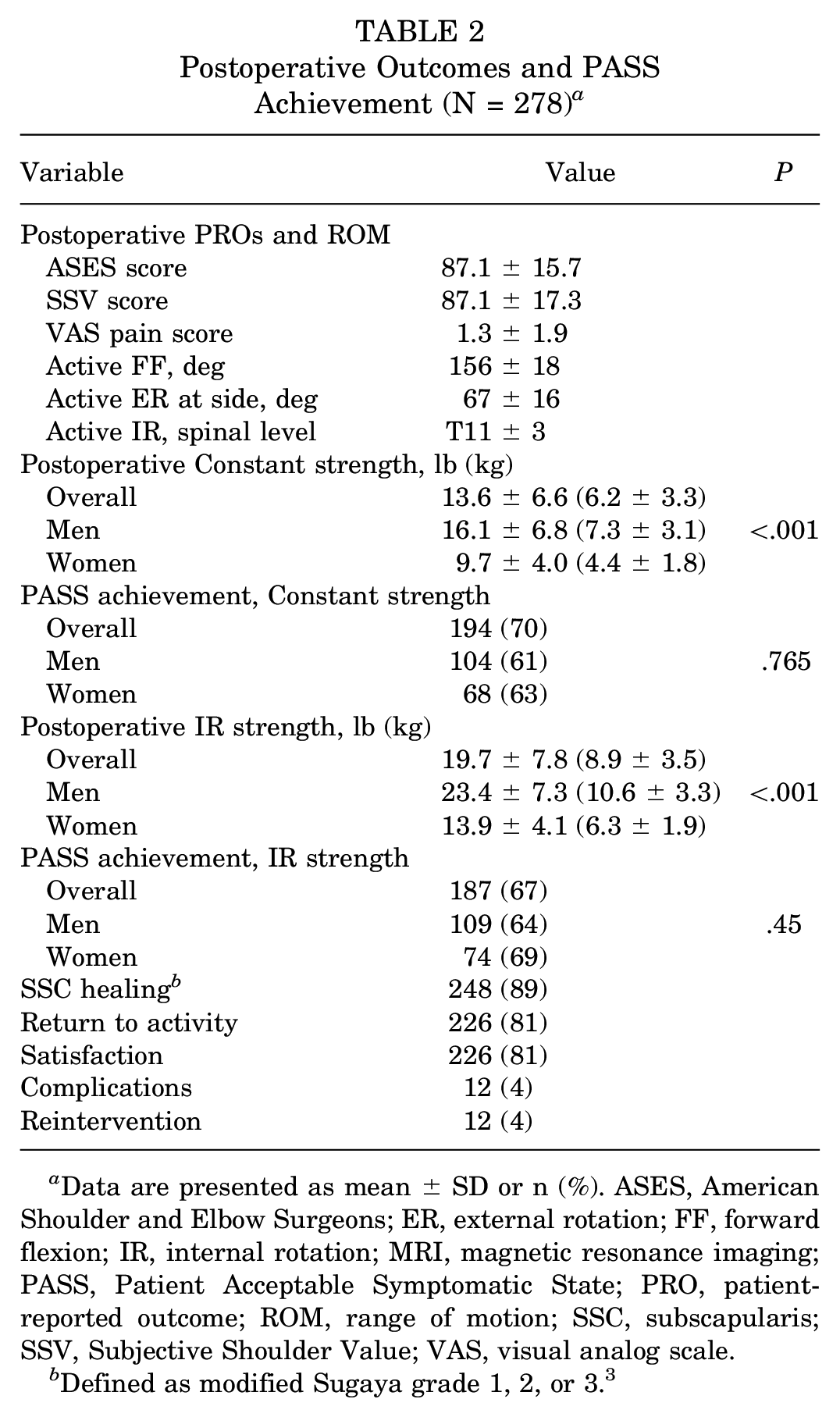
Data are presented as mean ± SD or n (%). ASES, American Shoulder and Elbow Surgeons; ER, external rotation; FF, forward flexion; IR, internal rotation; MRI, magnetic resonance imaging; PASS, Patient Acceptable Symptomatic State; PRO, patient-reported outcome; ROM, range of motion; SSC, subscapularis; SSV, Subjective Shoulder Value; VAS, visual analog scale.
Defined as modified Sugaya grade 1, 2, or 3. 3

Receiver operating characteristic (ROC) curve analyses for threshold scores required for achieving the Patient Acceptable Symptom State (PASS) for Constant and internal rotation (IR) strengths.
Older age was negatively correlated with PASS achievement for the strength measures. Although women had lower postoperative strength than men, both sexes achieved their respective strength PASS at similar rates. High fatty infiltration of the supraspinatus and infraspinatus muscles was negatively correlated with PASS achievement for Constant strength (supraspinatus muscle: r = −0.232, P < .01; infraspinatus muscle: r = −0.256, P < .01). High fatty infiltration of the SSC tendon was negatively correlated with PASS achievement for both Constant strength (r = −0.141; P < .05) and IR strength (r = −0.205; P < .01). CHD was positively correlated with PASS achievement for IR strength (r = 0.205; P < .01), and cephalocaudal tear size and SSC tear type (Lafosse classifications 4 and 5) were negatively correlated with PASS achievement for IR strength (r = −0.149, P < .05 and r = −0.178, P < .01, respectively). The use of knotless suture anchors, postoperative PROs, ROM, and SSC healing were correlated with achieving the PASS for both strength measures. Detailed comparison of the PASS and no-PASS groups and correlation analyses are summarized in Tables 3 and 4.
Comparison of PASS and No-PASS Groups and Correlation Analysis of Preoperative Variables According to Constant and IR Strengths a
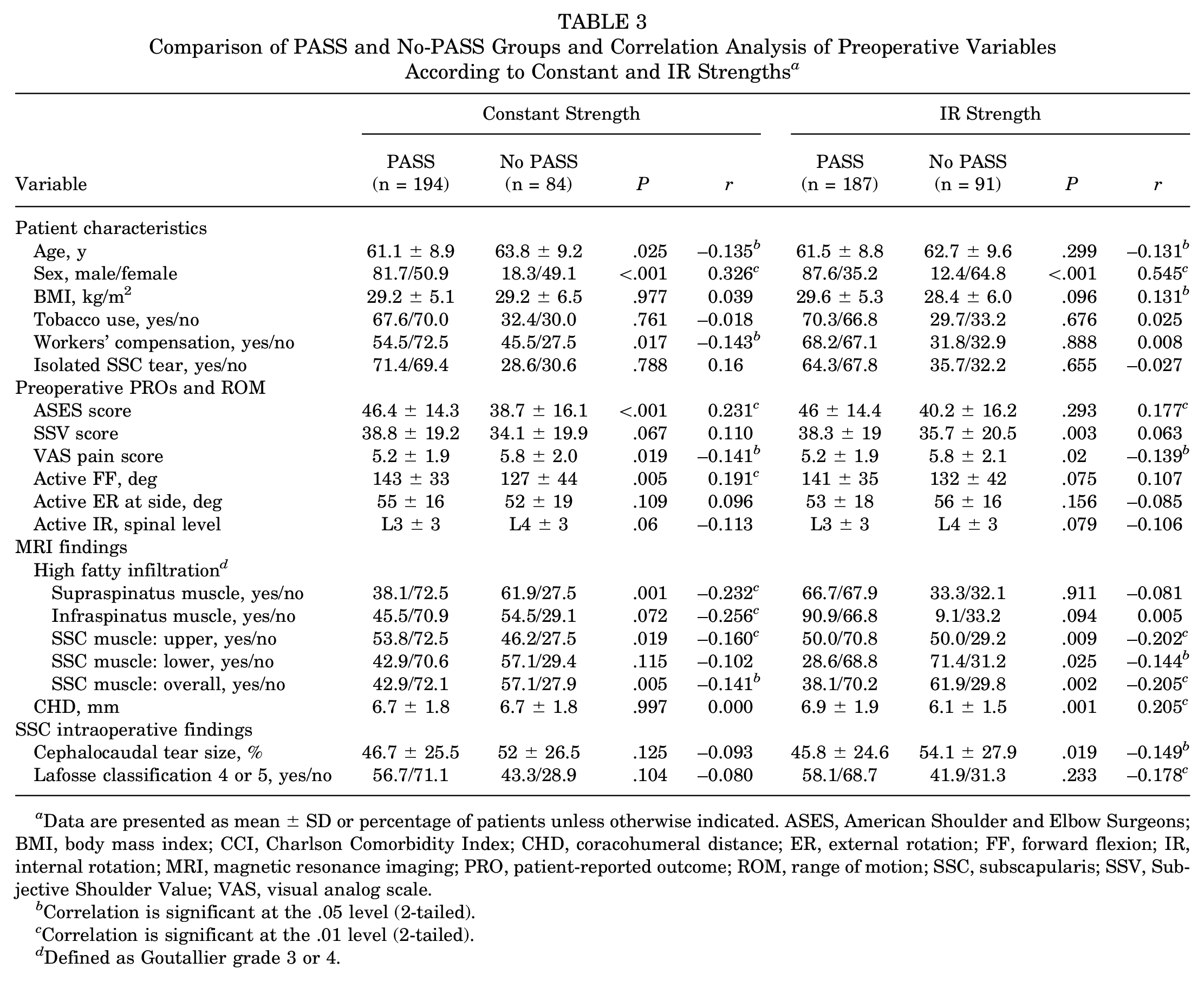
Data are presented as mean ± SD or percentage of patients unless otherwise indicated. ASES, American Shoulder and Elbow Surgeons; BMI, body mass index; CCI, Charlson Comorbidity Index; CHD, coracohumeral distance; ER, external rotation; FF, forward flexion; IR, internal rotation; MRI, magnetic resonance imaging; PRO, patient-reported outcome; ROM, range of motion; SSC, subscapularis; SSV, Subjective Shoulder Value; VAS, visual analog scale.
Correlation is significant at the .05 level (2-tailed).
Correlation is significant at the .01 level (2-tailed).
Defined as Goutallier grade 3 or 4.
Comparison of PASS and No-PASS Groups and Correlation Analysis of Intraoperative and Postoperative Variables According to Constant and IR Strengths a
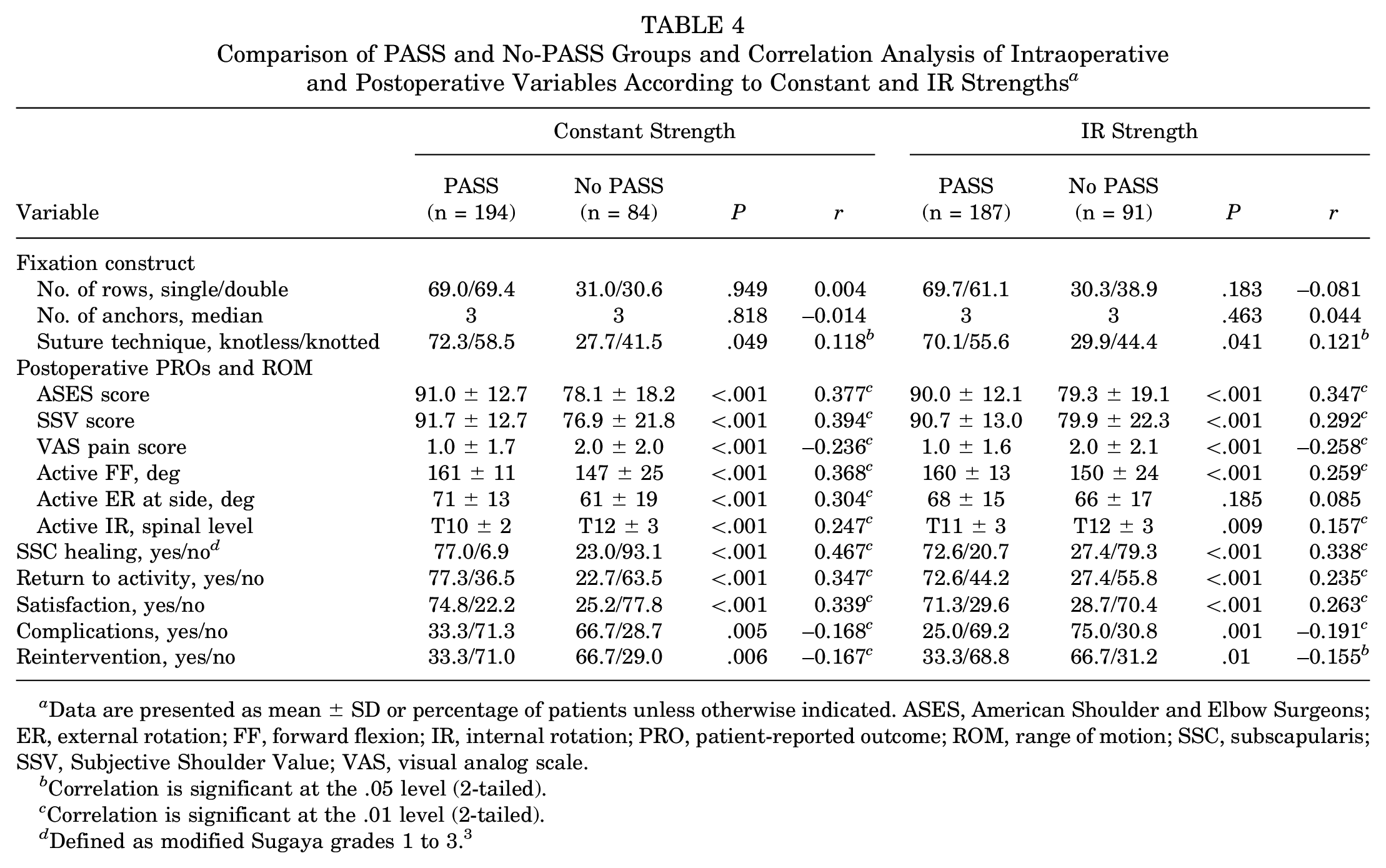
Data are presented as mean ± SD or percentage of patients unless otherwise indicated. ASES, American Shoulder and Elbow Surgeons; ER, external rotation; FF, forward flexion; IR, internal rotation; PRO, patient-reported outcome; ROM, range of motion; SSC, subscapularis; SSV, Subjective Shoulder Value; VAS, visual analog scale.
Correlation is significant at the .05 level (2-tailed).
Correlation is significant at the .01 level (2-tailed).
Defined as modified Sugaya grades 1 to 3. 3
The results of the logistic regression analyses are presented in Table 5. The analysis revealed a significantly negative association between PASS achievement for Constant strength and workers’ compensation insurance status (OR, 0.39; 95% CI, 0.18-0.84) as well as high fatty infiltration for both the supraspinatus (OR, 0.28; 95% CI, 0.1-0.76) and SSC (OR, 0.32; 95% CI, 0.12-0.85) muscles. In contrast, a positive significant association was observed between PASS achievement for Constant strength and the use of knotless suture anchors (OR, 2.13; 95% CI, 1.05-4.31). The logistic regression analysis also revealed a significantly negative association between PASS achievement for IR strength and SSC fatty infiltration (OR, 0.29; 95% CI, 0.11-0.77), and a significantly positive association was observed between achieving the PASS for IR strength and CHD (OR, 1.27; 95% CI, 1.07-1.51). The Hosmer-Lemeshow goodness-of-fit test yielded nonsignificant P values of .755 and .892 for Constant and IR strengths, respectively, indicating that the logistic regression models fit the data well. The Nagelkerke R2 values were 0.144 and 0.115 for Constant and IR strengths, respectively, indicating a low level of explained variance by the model.
Logistic Regression Analysis of Factors Associated With Achieving the PASS for Constant or IR Strength a

Boldface P values indicate statistical significance (P < .05). CHD, coracohumeral distance; IR, internal rotation; SSC, subscapularis.
Defined as Goutallier grade 3 or 4.
Discussion
This study established the overall, male, and female PASS values for Constant and IR strengths in patients who underwent ARCR involving the SSC. Most patients reported satisfaction and achieved the PASS in at least 1 strength measure at the mean 6-year follow-up. Factors that correlated with achieving the PASS for both strength measures were younger age, lower fatty infiltration, use of knotless suture anchors, and SSC healing. Workers’ compensation, lower supraspinatus and SSC fatty infiltration, and the use of knotless suture anchors were predictors of achieving the PASS for overall Constant strength, while lower SSC fatty infiltration and high CHD were predictors of achieving the PASS for overall IR strength. Achieving the PASS for the strength measures correlated with higher scores in both ROM and PROs. The findings from our study establish thresholds for clinical significance in shoulder strength after surgical repair, which provides valuable parameters for future clinical studies. Factors associated with failing to achieve clinical significance can be considered before surgical intervention to guide preoperative counseling and patient expectations.
Several baseline factors have been associated with rotator cuff strength.8,16,29 We found that women exhibited lower strength compared with men, and this was reflected in lower PASS values. Despite this difference, women were equally as likely as men to achieve the PASS for the shoulder strength measures. Interestingly, workers’ compensation insurance status was a predictor for achieving the PASS in Constant strength but not in IR strength. This suggests a potentially more pronounced submaximal effort during the Constant strength assessment.
We also found a weak negative correlation between age and PASS achievement for the strength measures. Similarly, Cofield et al 8 reported that older age was associated with reduced postoperative Constant strength (r = −0.23; P = .02) and ER strength (r = −0.22; P = .03) after a mean follow-up of 13.4 years. One possible explanation is that there is a general decrease in strength with aging. In addition, older patients tend to have larger tears, muscle atrophy, and fatty muscle infiltration, which are known to be correlated with poorer outcomes, function, and strength after ARCR.6,16,17 Consistent with this, our findings reveal that while both fatty infiltration and older age correlated negatively with PASS achievement, only high fatty infiltration emerged as a predictor for not achieving the PASS for Constant or IR strength. This suggests that age alone may not be a reliable predictor of poor postoperative outcomes, underscoring the relevance of the rotator cuff condition influencing not only strength but also likely overall postoperative outcomes.16,17
Previous studies comparing repair outcomes of isolated versus combined SSC tears showed no differences in clinical outcomes.15,31,38 Meshram et al 31 reported similar postoperative ASES (93.7 ± 8.9 vs 92.0 ± 13.6; P = .517) and VAS (0.5 ± 1.2 vs 1.3 ± 2.5; P = .093) scores for isolated SSC and anterosuperior rotator cuff repair, respectively. Although the number of isolated SSC tears was considerably lower than that for combined tears in the current study, we found no differences between these subgroups in terms of PASS achievement for any strength values, consistent with previous studies.
Lower CHD correlated negatively with achieving the PASS for IR strength. Park et al 33 found that increasing CHD through coracoplasty in patients with a CHD <6 mm significantly increased IR ROM and IR strength compared with a control group with a CHD <6 mm that did not undergo coracoplasty (8.3 ± 2.9 vs 6.1 ± 2.2 kg; P = .001). This emphasizes the role that CHD has on subcoracoid impingement and its impact on IR strength. 33 This is supported by our findings from the logistic regression, which indicated that the probability of achieving the PASS for IR strength increased with a higher preoperative CHD. Additionally, CHD is considered a predictor of both the presence of SSC tears and their size. 27 We found that larger tear size correlated negatively with PASS achievement for IR strength as well. In contrast, Edwards et al 14 and Hasler et al 20 demonstrated that SSC tear size did not significantly correlate with functional outcomes according to Constant score or SSV. This suggests that patients with larger tear sizes could still functionally benefit from SSC repair despite experiencing compromised strength.
Apreleva et al 1 proposed that a larger contact area between the tendon and bone could enhance the healing process, resulting in a more stable repair. Subsequently, Lo and Burkhart 28 developed a double-row repair technique aimed at restoring a larger portion of the anatomic footprint. Our results did not show differences between the single- and double-row groups in terms of achieving the PASS for any strength measure. Grasso et al 18 found similar results in Constant strength when comparing single- versus double-row suture groups (12.7 ± 5.7 vs 12.9 ± 7.0 lb; P = .382). Similarly, Burks et al 7 did not find differences between single- and double-row groups in ER strength (17.2 ± 7.7 vs 16.7 ± 7.5 N·m; P = .862) or IR strength (28.1 ± 13.8 vs 28.8 ± 14.4 N·m; P = .687). Despite these studies emphasizing strength outcomes, they did not stratify outcomes based on size. Storti et al 36 analyzed Constant, ER, and IR strengths after single- versus double-row repairs in rotator cuff tears measuring <3 cm or >3 cm. The authors found significantly lower Constant strength in the larger rotator cuff tears (3.98 ± 2.24 vs 6.39 ± 2.73 kg; P = .003). 36
Likewise, biomechanical studies support the idea that the strength of ARCR can be enhanced by increasing the number of anchors and sutures used.11,21 We used a variable number of anchors as indicated on a case-by-case basis with the objective of achieving a robust repair construct, without finding any correlation between the number of suture anchors and PASS achievement on any strength measure. Interestingly, we found an association between knotless suture use and achievement of PASS; however, it served only as a predictor for achieving Constant strength. A recent systematic review by Prasathaporn et al 35 found that type 2 retear rates were significantly greater after knotted repair (OR, 3.15; 95% CI, 1.70-5.83; P = .003). One possible explanation for this is that knotless sutures may minimize irritation to surrounding tissues due to their smoother profile while improving the contact area with the footprint. 12 This effect could be more pronounced for supraspinatus repairs; however, we do not have a clear explanation for our findings regarding suture type and the achievement of a strength PASS. Additionally, the disparity in the rates of knotless and knotted sutures might be linked to selection bias. Further research may be necessary to draw definitive conclusions. Nevertheless, surgeons can tailor their repair methods to their expertise and patient characteristics (eg, tear size and degree of muscle atrophy).
The measurement of shoulder rotation strength provides reliable information about the functional integrity of the rotator cuff muscles, which significantly relates to patients’ function and quality of life. 29 Our postoperative results reflected this, as patients who achieved PASS for any strength measure had significantly higher scores in both ROM and PROs compared with the no-PASS group. These results show that attaining clinically significant strength translates into meaningful improvements in quality of life and well-being.
Almost 90% of SSC repairs healed, which is consistent with rates in other studies ranging from 83% to 100%.23,24 Boileau et al 5 found that Constant strength was significantly higher in healed supraspinatus repairs compared with unhealed repairs (7.3 ± 2.9 vs 4.7 ± 1.9 kg; P = .001). Similarly, we found that only one-fifth of patients with an unhealed SSC tendon achieved the PASS for any strength measure. This finding is noteworthy, as it underscores the broader implications of SSC healing on shoulder function. The internal rotators provide anterior stability to the shoulder, and weakness in these muscles can result in excessive forward gliding of the humeral head. This may be associated with impingement and loss of strength. 26 This relationship may elucidate how repairing the SSC tendon can enhance overall shoulder strength by ensuring balanced force couples. Alternatively, SSC healing failure might also indicate poor tendon biology and make successful healing of the posterosuperior cuff less likely. This emphasizes that strength evaluation may be considered an indirect measure of tendon healing, as it has a significant correlation with the structural integrity of the rotator cuff.
In our series, most patients were satisfied at a mean 6-year follow-up. Patients who did not achieve the PASS for strength reported greater dissatisfaction. However, it is worth noting that, as PASS values were established based on satisfaction status, the correlation found between achieving the PASS and satisfaction does not offer insightful information. A 2017 study analyzed patients’ desired outcomes and expectations after ARCR. 37 The authors examined the subjective importance of postoperative pain relief and strength and found that patients gave strength significantly higher importance than pain relief both preoperatively (9.2 ± 2.1 vs 8.6 ± 2.3; P = .02) and at the 5-year follow-up (8.9 ± 1.9 vs 8.2 ± 3.1; P = .03). This finding highlights the significance of recovering strength for patients’ quality of life and overall satisfaction. Comprehending desired outcomes and expectations, along with the consideration of factors that may hinder or facilitate (eg, adherence to postoperative physical therapy) the achievement of PASS for any strength measure, can be valuable in preoperative counseling. This helps set realistic patient expectations before surgery and ultimately enhances patient satisfaction.
Limitations
This study has several limitations. First, the study’s retrospective nature may have increased the risk of selection and information biases. Second, the absence of preoperative or unoperated shoulder strength measures prevented us from calculating other clinically relevant thresholds (eg, minimal clinically important difference or substantial clinical benefit) for strength. 30 Third, despite an adequate Hosmer-Lemeshow test indicating good model calibration for predicting the PASS, the low Nagelkerke R2 values suggest that the models explained a limited portion of the variance in PASS achievement. This implies that other influential factors not included in the models likely contributed to achieving the PASS. For example, there was a negative correlation between postoperative pain and PASS achievement, likely attributed to limitations in exerting maximal effort during strength assessments due to pain. Fourth, the generalizability of our findings may be limited since all surgeries were performed by a single, high-volume shoulder surgeon at a single institution. Fifth, the preoperative imaging assessment conducted by the surgeon, without multiple graders and an interrater correlation analysis, is susceptible to biases. Finally, this study focused on rotator cuff tears with SSC involvement, ranging from isolated SSC tears to combined rotator cuff tears, but we did not investigate correlations with factors related to the supraspinatus and infraspinatus tendons. This might make it challenging to generalize our results to all rotator cuff tear patterns and combinations.
Conclusion
This study established the PASS values for Constant and IR strengths for patients after undergoing ARCR involving the SSC tendon. Workers’ compensation, high fatty infiltration of the supraspinatus and SSC muscles, and the use of knotted suture anchors were predictors of not achieving the overall Constant strength PASS, while lower SSC fatty infiltration and high CHD were predictors of achieving the overall IR strength PASS. Understanding patients’ desired outcomes and expectations, along with the consideration of patient factors that may affect strength, helps set realistic patient expectations before surgery and ultimately enhances patient satisfaction.
Footnotes
Final revision submitted March 14, 2024; accepted April 4, 2024.
One or more of the authors has declared the following potential conflict of interest or source of funding: M.B.N. has received education payments from Rock Medical Orthopedics. L.A.G. has received education payments from Arthrex and hospitality payments from Stryker. M.E.M. has received education payments from Arthrex, consulting fees from Arthrex, and hospitality payments from Encore Medical, Stryker, Medical Device Business Services, and Smith & Nephew. P.J.D. has received education payments from Steelhead Surgical; consulting fees from Arthrex, Pacira Pharmaceuticals, and Integer Holdings; nonconsulting fees from Arthrex; and royalties from Arthrex. AOSSM checks author disclosures against the Open Payments Database (OPD). AOSSM has not conducted an independent investigation on the OPD and disclaims any liability or responsibility relating thereto.
Ethical approval for this study was obtained from the Southern Oregon Institutional Review Board (reference No. 22-008).
