




Abstract
Background:
Softball pitchers experience high shoulder distraction forces, and increased stride lengths are associated with upper extremity pain. Therefore, it is important to consider the influence of stride mechanics on shoulder distraction force in softball pitchers.
Purpose:
To determine the relationship between stride mechanics and shoulder distraction force in collegiate softball pitchers.
Study Design:
Descriptive laboratory study.
Methods:
A total of 63 collegiate softball pitchers (age, 20.1 ± 1.3 years; height, 173.3 ± 7.4 cm; weight, 79.7 ± 11.7 kg) were included in this study. Each pitcher threw 3 maximum-effort fastballs for a strike, and kinematic data were collected using an electromagnetic tracking system with a sampling frequency of 100 Hz. A forward regression analysis was used to determine the relationship between stride parameters at foot contact (stride length, stride-foot progression angle, and stride-foot position) and shoulder distraction force.
Results:
Regression analysis revealed a significant and positive relationship between stride length and shoulder distraction force (R2 = 0.11; F(1, 61) = 7.338; P = .009), where stride length accounted for 11% of the variation in shoulder distraction force. Specifically, shoulder distraction force increased by 0.94 N/kg for every 10% increase in stride length normalized as a percentage of body height.
Conclusion:
A positive relationship was found between stride length and peak shoulder distraction force during the acceleration phase of the softball pitch. Alternatively, no relationship was found between the other stride parameters (stride position and stride-foot progression angle) and shoulder distraction force.
Clinical Relevance:
Coaches should be aware of the potential negative implications of increasing stride length during softball pitching. Although prior research has shown that greater stride length may positively affect performance, this may also increase stress at the shoulder.
The windmill softball pitch requires energy generated at the lower extremities to be efficiently transferred through the pelvis, trunk, and finally to the upper extremities immediately before ball release to reduce stress on the upper extremity.26,28,30,34,36,42 Softball pitchers are 2.5 times more likely to sustain an upper extremity injury than position players, with approximately 60% of these injuries occurring at the shoulder. 35 Of the shoulder injuries, the most common mechanisms were found to be noncontact and overuse, primarily resulting in tendinitis and muscle strain. 35 This may be partially attributed to the repetitive nature of the pitch, which results in high distraction forces at the shoulder near ball release.1,28,30,42 Shoulder distraction force (force directed away from the shoulder along the upper arm) is reported to be as high as 149% of body weight in softball pitching.28,30,42 There have been 2 studies examining the mechanics related to shoulder distraction force or upper extremity pain in softball pitchers.28,30 However, there is a paucity of literature determining the influence of lower extremity mechanics, especially stride parameters, on shoulder distraction force.
It is known that stride mechanics are related to upper extremity kinetics during baseball pitching.19,24 Longer stride lengths are associated with higher pitch speed and upper extremity kinetics; for every 10% increase in stride length, ball velocity has been found to increase by 0.9 m/s. 23 Further, a more open stride position (stride foot closer to first base relative to the rear foot for a right-handed pitcher) is suggested to result in greater shoulder compressive forces and decreased stride length.4,12,13,22,39 Last, the stride-foot progression angle has been found to be related to increased elbow valgus torque and altered pelvic positions.12,22,39 Specifically, a closed stride-foot progression angle (stride foot rotated toward third base for a right-handed pitcher) results in reduced pelvic rotation angle throughout a baseball pitching motion. 40 Although these studies investigating the influence of stride mechanics on upper extremity kinetics have shown a relatively small variance, stride mechanics will alter knee, pelvic, and trunk kinematics through the kinetic chain, which have been suggested as significant kinematic parameters contributing to upper extremity load,31,37 and ultimately injury in baseball pitching.3,37 Thus, it is worth investigating its relationship with pelvic, trunk kinematics, and shoulder distraction force during softball pitching in an attempt to mitigate susceptibility to upper extremity injury.
Although limited studies have investigated stride mechanics in softball pitching, longer stride lengths have been associated with higher pitch volumes, 6 increased pitch speeds,9,30,42 and greater vertical ground-reaction forces. 32 Although the relationship between stride length and upper extremity stress is unknown, a 2019 examination of National Collegiate Athletic Association (NCAA) softball pitchers found that those with upper extremity pain displayed greater stride lengths compared with those without pain. 28 The study also indicated that a more posteriorly shifted center of mass (toward the drive leg) at foot contact resulting from an exaggerated stride was related to upper extremity pain. Overall, existing research shows that softball pitchers experience high shoulder distraction forces and that increased stride length is associated with upper extremity pain.28,30 Given the importance of the proximal kinetic chain during softball pitching, it is imperative that practitioners consider the influence of stride mechanics on shoulder distraction force in softball pitching.18,29,32,33,36
Several studies have examined the pitching mechanics in windmill softball; however, there is a paucity of data regarding the relationship between stride mechanics and shoulder distraction force. Therefore, the purpose of this study was to examine the influence of stride mechanics (stride length, stride-foot progression angle, and stride-foot position) on shoulder distraction force in collegiate softball pitchers. Based on prior research, it was hypothesized that shoulder distraction force would increase with a longer stride length, a more open stride position, and a closed foot progression angle.
Methods
Data for this study were obtained from our laboratory database, which contains data spanning from 2016 to 2023. A total of 63 Division I NCAA softball pitchers were included. Inclusion criteria required participants to be actively competing on a collegiate team roster as a pitcher as well as being injury- and surgery-free for the past 6 months. All testing procedures were approved by the institutional review board of our university.
Kinematic data were collected at 100 Hz with an electromagnetic tracking system (trackSTAR; Ascension Technologies Inc) synched with The MotionMonitor XGen software (Innovative Sports Training). A total of 14 electromagnetic sensors were attached to the participants using previously established standards.30,41 Sensors were secured at the following locations: (1) first thoracic vertebra (posterior); (2) pelvis, first sacral vertebra (posterior); (3–4) acromion of bilateral scapula; (5–6) bilateral deltoid tuberosity (lateral upper arm); (7–8) bilateral distal forearm (posterior); (9) third metacarpal of the pitching hand (dorsal); (10–11) bilateral upper leg (lateral); (12–13) bilateral lower leg (lateral); and (14) second metatarsal (stride foot) (Figure 1). The measurement system has been previously validated (intraclass correlation coefficient >0.96). 21 Position and orientation of body segments were consistent with International Society of Biomechanics recommendations. 43

The locations of the 14 electromagnetic sensors used for collecting kinematic data.
The laboratory reference frame was defined as the positive y-axis in the vertical direction. Anterior/posterior of the y-axis in the direction of movement was the positive x-axis, and orthogonal to the x-y axes and to the right was the positive z-axis. The kinematic parameters analyzed at foot contact included stride length normalized to percentage of body height (%BH), stride-foot position, and stride-foot progression angle. Stride length was defined as the distance in the x position of the stride-foot ankle relative to the drive-foot ankle at the initiation of the pitch. Stride-foot position was defined as the difference in the z position of the stride-foot ankle relative to the drive-foot ankle at the initiation of the pitch. A positive or negative stride-foot position denoted a closed or open position, respectively. Initiation of the pitch was defined when the center of mass velocity exceeded 1 m/s in the x direction. Stride-foot progression angle was defined using a vector between ankle and toe (the tip of second distal phalanx) relative to the long axis of the global coordinate system. A positive or negative progression angle indicated closed or open angle, respectively (Figure 2A). Joint forces were calculated using inverse dynamics methods in The MotionMonitor software (Innovative Sports Training). 17 Shoulder distraction force was defined as the force along the y-axis of the segment coordinate system at the glenohumeral joint (Figure 2B). The peak shoulder distraction force during the acceleration phase of the pitch (foot contact to ball release) (Figure 3) was normalized to body mass (N/kg) and used for analysis. A force plate (Bertec Corp) was used to determine the instance of foot contact.

(A) Defining the stride-foot progression angle, where positive (+) indicates a closed position and a negative (–) angle indicates an open position. The labratory coordinate system was defined the x-axis in the anterior, y-axis in the vertical, and z-axis in the lateral direction. (B) The segment coordinate system at the glenohumeral joint. The x-axis points in the anterior, the y-axis points in the vertical, and the z-axis points in the lateral direction.

Acceleration phase of the windmill softball pitch (foot contact to ball release).
After sensor attachment, participants were given an unlimited amount of time to warm up their fastball pitch type.2,7,8,10,11,14-16,25 Once deemed ready, the participants threw 3 maximum-effort fastball pitches for strikes to a catcher at regulation distance (13.11 m). The mean of the 3 pitches thrown for strikes was used for analysis.
Statistical Analysis
All statistical analyses were performed with SPSS Statistics (Version 29; IBM Corp). The data were determined to be approximately normally distributed based on visual inspection of histograms and Q-Q plots. Pearson product-moment correlations were used to examine bivariate associations between stride mechanics (stride length, stride-foot angle, and stride-foot position), and shoulder distraction force. A forward multiple linear regression was used to determine the relationship between stride mechanics and shoulder distraction force. Statistical significance was set a priori to P < .05.
Results
Of the 63 study participants (mean age, 20.1 ± 1.3 years), 51 were right-handed pitchers. The mean pitch speed was 55.2 ± 3.34 mph (88.8 ± 5.3 kph). The participant characteristics are reported in Table 1. Kinematic and kinetic data are provided in Table 2. Bivariate correlations are indicated Table 3.
Participant Demographics (N = 63)

Kinematic and Kinetic Data a

%BH, percentage body height.
Bivariate Correlations of Stride Mechanics Variables and Shoulder Distraction Force a
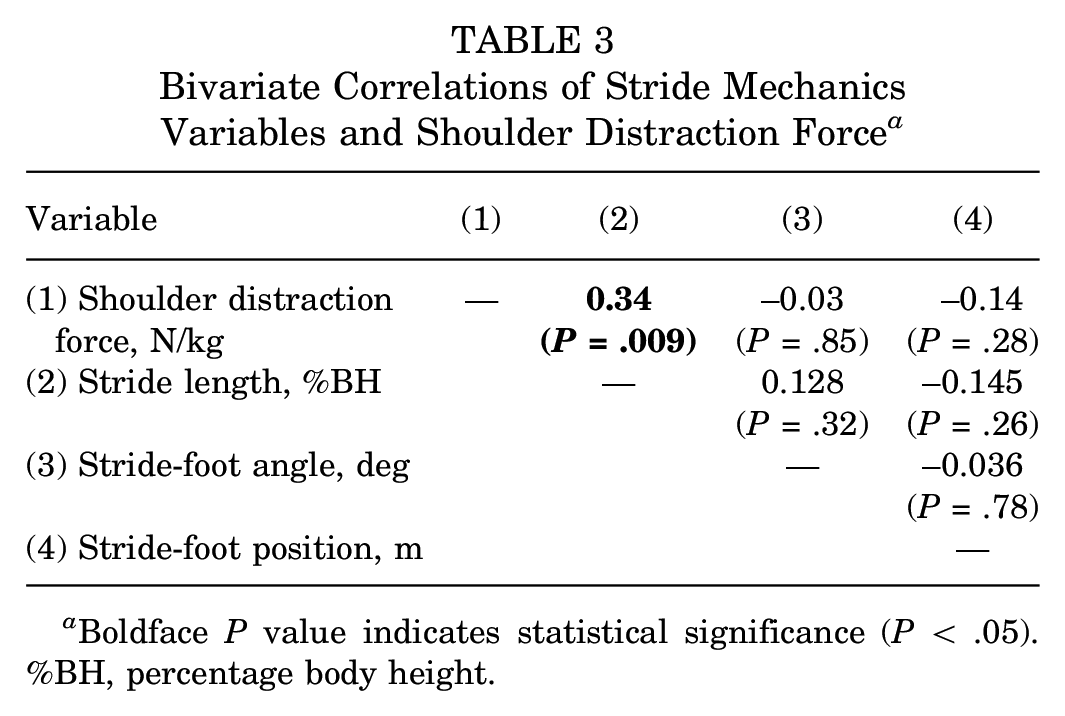
Boldface P value indicates statistical significance (P < .05). %BH, percentage body height.
Multiple regression analysis revealed a significant, small, and positive relationship between stride length and shoulder distraction force (R2 = 0.11; F(1, 61) = 7.338; P = .009), where stride length accounted for 11% of the variation in shoulder distraction force. Specifically, shoulder distraction force increased by 0.94 N/kg for every 10% increase in stride length normalized as a percentage of body height. The result of the final model is shown in Table 4. Foot position (β = −0.092; P = .46) and foot angle (β = −0.068; P = .58) were eliminated from the final model with the entry criterion threshold of P < .05.
Multiple Regression Analysis Results a

The dependent variable is shoulder distraction force. Boldface P value indicates statistical significance (P < .05). %BH, percentage body height.
Discussion
During pitching motion, utilization of the lower extremities affects the linked body segments’ kinetics and kinematics through the kinetic chain. However, the influence of foot mechanics on the stress at the shoulder is poorly understood in softball pitching. The current study aimed to examine the influence of stride mechanics (stride length, stride-foot position, and stride-foot progression angle) on peak shoulder distraction force during the acceleration phase in collegiate softball pitchers. The results showed a positive association between stride length and shoulder distraction force. Specifically, shoulder distraction force increased by 0.94 N/kg for every 10% increase in stride length normalized as a percentage of body height.
Prior softball studies have indicated that longer stride lengths are associated with upper extremity pain, high pitch speeds, and greater pitch volumes during softball pitching.9,28,30,42 Specifically, there is an association between stride length and upper extremity kinetics during baseball pitching. 12 However, the current study is the first to connect the relationship between increased stride length and increased shoulder distraction force during softball pitching. This finding is significant because longer stride lengths are also associated with upper extremity pain in collegiate softball pitchers.28,30 Therefore, considering the results of this study and prior research collectively, longer stride lengths have a positive impact on pitching performance but also increase stress on the shoulder, which may be associated with the likelihood of experiencing upper extremity pain.5,9,30,42 However, it should be noted that the association of foot placement and upper extremity pain has yet to be confirmed. Therefore, coaches and clinicians should be aware of the potential impact of greater shoulder stress when increasing stride length to optimize performance. Further, clinicans should be aware that stride length accounted for only 11% of the variation in shoulder distraction force. Although this is still clinically worth noting, future research should continue investigating other factors to determine those that have the strongest relationship with shoulder distraction force.
The lack of association between stride-foot position and shoulder distraction force in this study was surprising based on what has been reported in baseball pitchers. One possibility for this discrepancy is the lack of a relationship between stride-foot position and stride length. Previous research on baseball pitching demonstrated that a more open stride-foot position is associated with a shorter stride length, which can increase the stress on the upper extremity.4,13 In the current study, the correlation between stride length and foot position was not significant; the softball pitchers maintained their stride length regardless of whether their stride foot was in an open or closed position. Another possibility is the influence of stride-foot position on pelvic and trunk kinematics, since Lin et al, 20 in their study on baseball pitching, indicated that a more open trunk position may be related to decreased shoulder abduction angle before ball release. Further, a decreased shoulder abduction angle is related to greater shoulder distraction force in baseball pitching.22,38 However, the results of the current study indicated that an altered stride-foot position may not have the same impact on pelvic and trunk kinematics (and ultimately, on the stress placed on the shoulder) in softball pitchers. Thus, it is unknown whether the differing mechanics of the trunk and upper extremity during baseball and softball would give insight to the lack of agreement with altered foot placement between the 2 sports.
To summarize, coaches should be aware of the potential negative implications of increasing stride length during softball pitching. Although prior research suggests that a longer stride length may enhance performance, it may also result in increased stress at the shoulder and susceptibility to upper extremity pain. Additionally, altered stride-foot mechanics may influence shoulder kinetics differently based on the difference between baseball and softball pitching mechanics. Further investigation of foot placement, upper extremity kinematics, and pain is warranted to gain a better understanding of the underlying mechanism associating foot mechanics and shoulder stress. This would provide detailed information for clinicians to take into softball pitching practice.
Limitations
There are several limitations to the current study. First, the relationship between foot mechanics and pelvic, trunk, and upper extremity kinematics was not investigated. Additional research is required to fully understand the mechanism behind how stride mechanics such as stride length may affect shoulder distraction force. A second limitation is we only analyzed the fastball pitch type. Prior research suggests that kinematics 9 and kinetics 27 differ across pitch types during collegiate softball pitching; therefore, the results from the current study may not be consistent across all pitch types. Last, the results of the multiple regression should be interpreted with caution considering there was a small effect size when referring to the amount of variation (11%) in shoulder distraction force that was explained by stride length. Although this still has clinical relevance, it should not take away from the 89% of variance not explained by stride length. Future research should continue investigating factors that influence shoulder distraction force in an attempt to reduce susceptibility to upper extremity pain and overuse injury in collegiate softball pitchers.
Conclusion
Study findings indicated a positive relationship between stride length and peak shoulder distraction force during the acceleration phase of the softball pitch. Alternatively, no relationship was found between the other stride parameters (stride position and stride-foot progression angle) and shoulder distraction force.
Footnotes
Final revision submitted March 21, 2024; accepted April 5, 2024.
The authors declared that there are no conflicts of interest in the authorship and publication of this contribution. AOSSM checks author disclosures against the Open Payments Database (OPD). AOSSM has not conducted an independent investigation on the OPD and disclaims any liability or responsibility relating thereto.
Ethical approval for this study was obtained from Auburn University (reference No. 18-121 EP 1803).
