




Abstract
Background:
Although fastpitch softball participation continues to rise, there is a lack of established pitch count guidelines, potentially putting young female athletes at risk of overuse injuries. In addition to coaches, caregivers’ ability to recognize and employ safe pitching guidelines plays an important role in athlete safety.
Purpose/Hypothesis:
The purpose of this study was to assess caregivers’ knowledge of their child’s pitching practices and their familiarity with softball pitching recommendations. We hypothesized that caregivers would be unaware of safe pitching recommendations in youth fastpitch softball.
Study Design:
Cross-sectional study.
Methods:
A 30-question survey was distributed to caregivers of youth fastpitch softball pitchers in age groups 10U (ie, ≤10 years), 12U, 14U, 16U, and 18U. The survey included questions on the demographic characteristics of caregivers and athletes, caregivers’ knowledge of safe pitching recommendations, and athletes’ pitching background and throwing habits. Comparisons of responses between the age groups were conducted using the chi-square test, Fisher exact test, or 1-way analysis of variance, as appropriate.
Results:
A total of 115 caregivers completed the survey. Of the respondents, 84% were between 31 and 50 years, and 81.7% had a degree beyond high school. Only 28.1% of caregivers reported participating in youth sports. When asked to estimate the number of pitches they considered a safe amount during a single outing, 28.7% of caregivers (n = 33) did not provide a limit, 4.3% (n = 5) stated no limit was needed, 32.2% (n = 37) suggested 25 to 80 pitches, 21.7% (n = 25) suggested 81 to 100 pitches, 12.2% (n = 14) suggested 100 to 150 pitches, and 0.9% (n = 1) suggested that >150 pitches were acceptable. These data emphasized that only 14.8% of the caregivers were aware of any pitching guidelines. However, 93% of caregivers acknowledged that they would adhere to recommendations if guidelines were made available.
Conclusion:
The study findings demonstrated that a majority of caregivers are unaware of current youth fastpitch softball pitching recommendations.
Fastpitch softball is one of the most popular sports among female athletes in the United States, having grown from 203,569 participants in the 1988-1989 season to 362,038 in the 2018-2019 season. 27,29 Additionally, approximately 300,000 participants between the ages of 4 and 16 years participate in fastpitch softball in over 25 countries. 25 With increased participation and competitiveness of the sport, increased injury prevalence is a necessary consideration. Multiple epidemiologic studies have reported the incidence of injuries in youth and high school softball pitchers. 38,40 Over the past 6 years, according to the National Electronic Injury Surveillance System, US emergency departments have seen an 11.7% increase in softball-related injuries in athletes ≥7 years of age. 8 In a study by Shanley et al, 38 50% of the injuries sustained by pitchers were directly influenced by pitching. Hill et al 22 reported that of the 180 collegiate softball pitchers surveyed during the 2001-2022 season, 92 had chronic/overuse injuries, 53 of which involved the upper extremity; more specifically, 33 of the reported overuse injuries involved the shoulder. Oliver et al 32 found that of the 51 high school softball pitchers observed between 2005 and 2006 and 2016 and 2017, 60.8% indicated an overuse injury to the shoulder and/or elbow. Additionally, Smith et al 40 determined that pitching injuries were twice as likely to last longer than 2 weeks compared with nonpitching injuries. While multiple studies have demonstrated a predominance in shoulder-related softball injuries to pitchers, 24,36,38,40 it is worth noting that injuries occur at a higher incidence to the lower extremities in nonpitching activities, such as contact with an opposing player, contact with the ground, noncontact (nonthrowing activity), hit by a batted ball, contact with a fixed base, or hit by a thrown pitch. 26 However, given the increased risk of injury and longer duration of injury in pitchers versus position players, overuse injuries related to pitching are a concern.
General safe sports recommendations include limiting months per year and hours per week of participation, avoiding participation in multiple same sports leagues simultaneously, and limiting sport specialization. 7,45,47 To reduce stress on skeletally immature pitchers and the injury risk in pitchers, youth baseball leagues adhere to pitch counts with mandatory rest days. 35 Although there are no concrete pitch count guidelines, the Sports Trauma and Overuse Prevention (STOP) Sports Injuries campaign—created by the National Council of Youth Sports and the AOSSM—has published a set of recommendations for fastpitch softball. 41 These recommendations are not based on data collected for youth fastpitch softball but rather mimic the current guidelines for youth baseball. 15,40 The STOP Sports Injuries fastpitch softball recommendations include avoiding pitching >2 or 3 consecutive days based on age group, limiting pitch counts by age, avoiding year-round pitching, and avoiding multileague participation. 2
Studies have demonstrated that the windmill pitch results in higher forces on the shoulder compared with the elbow, putting softball pitchers at a higher risk of shoulder injuries than elbow injuries, whereas baseball pitchers suffer a similar percentage of both. 3,10,20,24,31,34,37,38 Werner et al 42 reported that softball pitchers can pitch upward of 1500 pitches over the course of a 3-day tournament, nearly 4 times the amount recommended. 42 Furthermore, as compared with baseball, softball teams generally carry fewer pitchers on their roster, resulting in more innings pitched per pitcher. 4,30 In the Hill et al 22 study, almost 75% of the 180 collegiate softball players reported an injury during the 2001-2002 season. The most common mechanism of pitcher injury is overuse. 22,32 The lack of pitching regulations in fastpitch softball is of great concern and places athletes at potentially increased susceptibility to overuse injury.
Although there are data relating to caregiver awareness of pitch count regulations and injury prevalence in baseball, there is a paucity of similar research in fastpitch softball. 2,9,14,23,44 Thus, the purpose of this study was to assess caregiver knowledge of their child’s pitching practices and their familiarity with softball pitching recommendations. We hypothesized that caregivers would be unaware of safe pitching recommendations in youth fastpitch softball.
Methods
This cross-sectional study was determined to be exempt from institutional review board approval. A 30-question survey was distributed to consenting caregivers of youth fastpitch softball pitchers throughout North Central Florida. The survey was modified for caregivers of softball players from a survey previously developed at our institution for caregivers of baseball players. 36 Surveys were distributed during practices and games at regional softball fields as well as during locally sponsored national softball pitching camps. Additionally, outside of Gainesville, Florida, we enlisted the assistance of Triple Crown Sports, Rising Stars, Florida Amateur Softball Association, and private instructors to help administer and distribute an anonymous online survey. Thus, a sample of convenience was drawn from the population close to our institution. All surveys submitted were included in the study. Missing data were coded as “missing” to enable the use of all surveys and prevent the loss of valuable data from incomplete surveys. A copy of the survey is available as Supplemental Material.
The survey included sections on athlete characteristics as well as those of the primary caregiver completing the survey—including the level of sport played, coaching background, the highest level of education, sex, and age group. Caregivers were categorized into age groups of 18-30, 31-40, 41-50, 51-60, and >60 years; and athletes were categorized according to the Florida US Specialty Sports Association age guidelines—10U (ie, 10 years and under), 12U, 14U, 16U, and 18U. 18 The caregivers also answered questions related to their knowledge of safe pitching guidelines, the athlete’s pitching characteristics, the type and volume of pitches thrown, and their recall of any upper extremity pain or injuries from pitching potentially being related to excessive pitching above the STOP Sports Injuries recommendations. 41
The caregivers of youth softball pitchers were asked to complete and return the survey. As various methods of distribution were employed and as participants who received the survey were not required to submit the survey, the response rate was not measured. The results of each survey were placed into a deidentified database using the Research Electronic Data Capture (REDCap). 21 Partially completed surveys were included in the REDCap data set using only the questions completed.
Descriptive statistical analyses were performed in IBM SPSS Statistics for Windows, Version 28.0 (IBM Corp). Continuous measures were summarized as means and standard deviations, and categorical measures were summarized as numbers and percentages. Cross-tabulations were used to provide counts and percentages of the key variables from the survey by assigned softball age groups. The Pearson chi-square test, Fisher exact test, or one-way analysis of variance was performed as appropriate to evaluate any differences between age groups for survey questions with discrete responses, with P < .05 considered statistically significant.
Results
A total of 115 surveys were collected from caregivers of youth fastpitch softball pitchers and used for analysis in this study. Caregivers’ age groups were as follows: 18-30 years (n = 4 [3.5%]), 31-40 years (n = 37 [32.2%]), 41-50 years (n = 59 [51.3%]), 51-60 years (n = 11 [9.6%]), and >60 years (n = 3 [2.6%]), with a significant difference in age among the groups (P < .05). In the study, 50.4% of caregivers identified themselves as the athlete’s mother. Overall, 81.7% of the caregivers had an associate’s, bachelor’s, or advanced college degree. Only 28.1% of the caregivers participated in youth sports. Of the respondents who participated in youth sports, 50% played baseball and 11.5% participated in softball. Additionally, 70.4% of the caregivers coached a youth sport and 13% reported coaching at the high school level. Caregivers identified the age of their athletes, ranging from 7 to 18 years. The mean age of the athletes was 12.8 ± 2.3 years. When asked about positions played and off-season sport participation, 94.8% (n = 109) of caregivers indicated their athlete played another position in addition to pitcher, while 46.1% (n = 53) of caregivers reported their athlete participated in sport during the off-season, 75.5% of which were in upper-extremity dominant sports.
Caregivers demonstrated a low knowledge level, with only 14.8% reporting an awareness of youth softball pitching recommendations. However, 93% acknowledged that they would adhere to universal guidelines if established. With respect to who counted game pitches, caregivers were able to select >1 response and reported that they (28.7%), their spouse (20.0%), and/or the coach (53.9%) counted the pitches. Yet, 26.1% of the caregivers reported that they did not know whether there was a designated person assigned to track in-game pitch counts.
Caregivers were asked to estimate the number of pitches that they considered would be a safe amount in a single outing to prevent injury. When provided various ranges of acceptable pitch counts, 33 of the caregivers (28.7%) did not provide a limit, 5 (4.3%) stated no limit was needed, 37 (32.2%) stated 25 to 80 pitches, 25 (21.7%) stated 81 to 100 pitches, 14 (12.2%) stated 100 to 150 pitches, and 1 caregiver (0.9%) stated that >150 pitches were acceptable. Approximately 39% of the U12 through U18 caregivers (31 of 80) estimated their child threw more pitches per game than the STOP Sports Injuries recommendation.
Table 1 summarizes the pitching characteristics of the athletes as provided by the caregivers, overall and stratified by age group. There was a significant difference between age groups for months played per year (P < .001). Overall, 59 of the 115 caregivers (51.3%) disclosed that their child participated in >1 softball league at a time. According to responses, 12.3% of athletes (n = 14) pitched in 1 game per week, 45.6% (n = 52) pitched in 2 games per week, and 41.2% (n = 47) pitched in ≥3 games per week. In addition, 11.3% of caregivers reported that their athlete participated above the recommended 2 to 3 consecutive days for pitching. Furthermore, 98 caregivers (85.2%) reported that their child pitched ≥7 months per year, with 57.4% reporting their child pitched 10 to 12 months per year.
Caregiver Responses to Survey Questions on Athlete Pitching Characteristics, Overall and by Age Group (N = 115 Responses) a
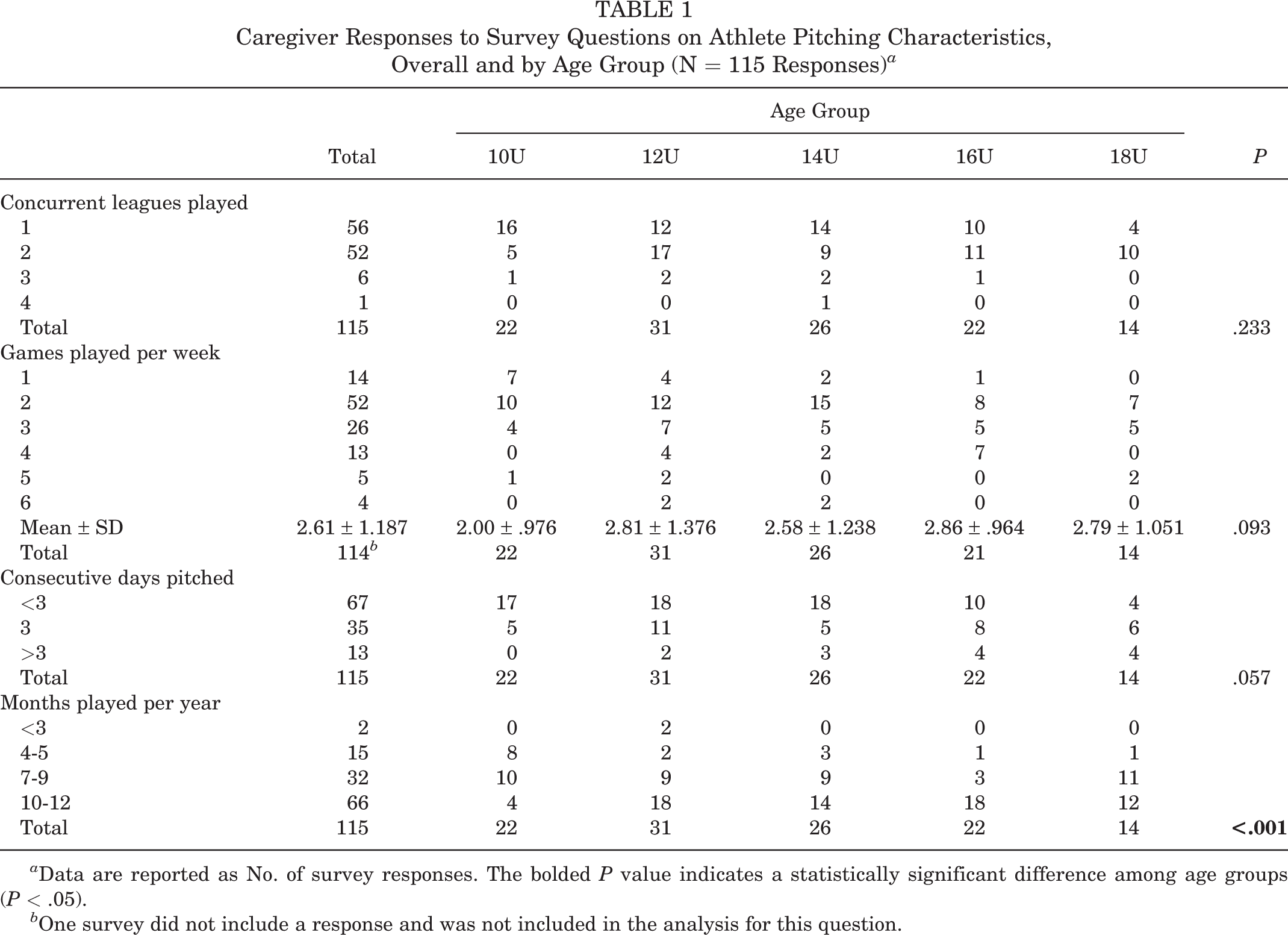
a Data are reported as No. of survey responses. The bolded P value indicates a statistically significant difference among age groups (P < .05).
b One survey did not include a response and was not included in the analysis for this question.
Upper extremity pain after pitching occurred in 57.4% of athletes as reported by their caregivers. The anatomical structures where the pain was reported to have occurred after pitching included the shoulder (n = 38), upper arm (n = 16), and elbow (n = 13) with 33%, 13.9%, and 11.3%, respectively. Of those suffering arm pain, 21.7% sought evaluation by a medical professional.
Discussion
In our study, a survey was distributed to caregivers of youth fastpitch softball pitchers to assess their knowledge of current safe pitching recommendations. A majority of caregivers were between the ages of 31 and 50 years, with half identifying as the athlete’s mother. Used as a proxy measure of socioeconomic status, over 75% of caregivers held a degree above the high school level. While approximately only a quarter of caregivers had participated in a youth sport, about three-quarters of caregivers have coached a youth sport. Also, <15% of caregivers reported awareness of the current youth fastpitch softball recommendations, yet over 90% recorded that they would adhere to evidence-based guidelines if established. When asked about their child’s pitching habits—including the number of pitches per game, consecutive days pitched, games pitched per week, months playing in per year, and simultaneous leagues played in—many caregivers estimated that their athlete pitched above the current STOP Sports Injuries recommendations, which can vary per age group from 50 to 100 pitches per game. 41 More than half of the caregivers reported that their athlete suffered upper extremity pain from pitching, with nearly a quarter of those requiring medical attention. This causes concern that athletes are incurring additional load, leading to an increased risk of overuse injuries.
Over the past decade, youth sports leagues have started to revolutionize their approach to sports participation by emphasizing participant safety. Injury prevention research done in baseball has established safe pitching guidelines, including a reduction in pitch counts with ensuing mandatory rest days, as well as limiting pitch types by age. 16 –19 These concepts are targeted to reduce the stress on skeletally immature pitchers and reduce injury risk in pitchers. Athlete injury prevention is structured around a multidisciplinary approach involving coaches, caregivers, medical staff, and athletes. 1,13 Unfortunately, the current knowledge of the injury or safe sports recommendations among coaches and caregivers is generally not adequate to assist in injury prevention. 7,33,36,45 Equally as concerning is that, in fastpitch softball, there is a paucity of universally established safe pitching guidelines. The combined lack of universal guidelines and caregiver knowledge may contribute to overuse injuries in softball pitchers.
With respect to caregiver knowledge of pitch counts in fastpitch softball, 85.2% of caregivers surveyed in our study were not aware of youth softball pitching recommendations. Additionally, when asked to estimate what they thought was an appropriate pitch count in youth softball, caregiver responses varied between needing no pitch count to allowing >150 pitches per outing. However, if safe pitching guidelines for softball were readily available, 93% of the caregivers in our study would use guidelines to keep their athletes safe. This leads us to believe that with universally accepted regulations and pitch counts, caregivers could play an integral role in protecting youth softball pitchers to reduce the risk of overuse injuries. Currently, there are no restrictions established in US Softball, the National Federation of State High School Associations, or the National Collegiate Athletic Association. 28 The Little League Softball organization has published regulations for pitching availability, and the STOP Sports Injuries campaign has released pitching recommendations for youth softball, yet there is still no restriction on pitch counts, as pitching regulations vary widely among age groups. 25,41
The prevalence of studies involving other sports guided our research team to assess caregivers’ understanding of safe sports recommendations. To our knowledge, this is the first study to survey caregivers of youth fastpitch softball athletes to assess their knowledge of pitching guidelines and how they may relate to athlete safety. The caregiver plays a significant role in the development and health of young athletes. However, studies regarding caregiver understanding of injuries and preventative techniques for softball pitchers are scarce. A study by Reintgen et al 36 determined that 83% of surveyed youth baseball caregivers were unaware of the existence of safe pitching guidelines. Bell et al 7 assessed parental knowledge of sports safety for athletes participating in soccer, basketball, and volleyball tournaments. They discovered that approximately 80% of those surveyed did not know safe sports recommendations related to the duration of training or league participation.
In our study, it was clear that the caregivers were not aware of the safe sports recommendations for fastpitch softball, as 51.3% of them noted that their child participated in >1 softball league at a time and they pitched in 1 (12.2%), 2 (45.2%), or >3 (41.7%) games per week. Additionally, 57.4% of caregivers reported that their athlete played softball 10 to 12 months a year.
The greatest risk factors for shoulder and elbow pain in baseball pitchers have been strongly correlated with the volume of pitching performed, including pitches per game, innings per season, and months pitched per year. 16 Yang et al 43 studied high school softball pitchers and noted that pitchers averaged 12 ± 5.7 games per season and up to 89 ± 25 pitches per game. In addition, weekend tournaments played throughout the year may extend to an additional 1.5 games per day, with a mean of 62 pitches per game. 39 Furthermore, pitchers exhibit a reduction in shoulder strength in addition to shoulder and hip fatigue after a single game pitched and do not fully recover by the following day. 12,39,43 However, the information provided by the caregivers in our study does not account for practices, bullpen sessions, warm-up pitches, pitching camps, or throws made while an athlete is not pitching, as approximately 95% of our athletes play other positions. Zaremski et al 46 studied unaccounted pitch volume in high school baseball players and determined that 42.4% of all pitches thrown were not accounted for in traditional pitch count guidelines and regulations. Like baseball players, it is possible that fastpitch softball players do not have an adequate amount of time to recover from the repetitive stresses placed on their upper extremities, thus increasing their risk of overuse injuries.
Overuse injuries are one of the most common injuries seen throughout fastpitch softball. 4,12,24,36 –38,40 Common pathologies documented are proximal biceps tendonitis, stress fractures, and ulnar neuritis. 5,11,37 Accumulation of high pitch counts from pitching consecutive days increases a pitcher’s susceptibility to fatigue, a natural process that occurs in direct response to repetitive activities and in direct correlation with overuse, which can also cause significant breakdowns of proper pitching mechanics. 6,12,17,19,31,39,47 In the present study, over a quarter of the caregivers reported that their child pitched more consecutive days than recommended by the STOP Sports Injuries guidelines. Additionally, of the athletes who played other sports during the off-season, over 75% played an upper extremity–taxing sport, such as volleyball, basketball, swimming, or tennis. Such data lead us to believe that youth fastpitch softball pitchers are not getting adequate rest and recovery between outings or between softball seasons. Thus, developing universal pitching guidelines and encouraging caregivers and coaches to adhere to guidelines will keep fastpitch softball pitchers safer and healthier.
Limitations
Some limitations in this study are inherent in survey research. Recall responses are associated with reporting errors. First, the population studied was a sample of convenience and illustrates only the small specific geographic region of North Central Florida. As this type of sampling is often used for pilot testing, the research team recognizes the limitations of the presented data. The warm climate in Florida allows athletes to play softball and other sports year-round. Therefore, the experiences of athletes in this region may not be representative of other regions of the country. Surveys were diffusely distributed to caregivers at practices, games, and camps through social media and by word of mouth, with minimal oversight, resulting in no exact method to evaluate the survey response rate. Furthermore, our survey did not include any identification data, and therefore we were unable to evaluate whether duplicate surveys were completed. We noted variable response rates on a few of the questions that could reflect caregivers’ unwillingness to disclose their lack of knowledge. Although respondents were required to identify their relationship to the athlete, we did not inquire as to whether the caregiver responding was the caregiver most involved with the athlete’s sports participation, which could have led to inaccurate reporting of data and decreased awareness of guidelines.
Future Considerations
A primary area of research should include accurate pitch counts for fastpitch softball pitchers during games and practices. Tracking the injuries of these pitchers would allow for the assessment of whether increased pitch count is associated with an increased injury rate in youth fastpitch softball players. Future studies could gather responses from caregivers across the country in different climates, diversifying the geographic data and making conclusions more generalizable. Additionally, future studies could evaluate whether interventions—such as educational materials or seminars—would improve caregivers' awareness of safe pitching recommendations.
Conclusion
Our study demonstrates that a majority of caregivers were generally unaware of youth fastpitch softball pitching recommendations. With no universal regulations, there is increased importance on caregiver awareness of safe pitching recommendations to help reduce the risk of overuse injuries in fastpitch softball pitchers.
Supplemental material for this article is available at https://journals.sagepub.com/doi/full/10.1177/23259671231169947#supplementary-materials.
Supplemental Material
Supplemental Material, sj-pdf-1-ojs-10.1177_23259671231169947 - Caregiver Awareness of Safe Pitching Recommendations in Youth Fastpitch Softball Pitchers
Supplemental Material, sj-pdf-1-ojs-10.1177_23259671231169947 for Caregiver Awareness of Safe Pitching Recommendations in Youth Fastpitch Softball Pitchers by Sravya Kamarajugadda, Jack Italiano, MaryBeth Horodyski, Jason L. Zaremski, Marissa Pazik, Giorgio Zeppieri, Kevin W. Farmer, Stephanie Brombacher-O’Connell, Bryan Prine and Michael Seth Smith in Orthopaedic Journal of Sports Medicine
Footnotes
Final revision submitted December 13, 2022; accepted January 24, 2023.
One or more of the authors has declared the following potential conflict of interest or source of funding: K.W.F. has received education payments from Arthrex and CGG Medical; consulting fees from Arthrex, Exactech, and Flexion Therapeutics; nonconsulting fees from Arthrex, Arthrosurface, Baudax Bio, and CGG Medical; honoraria from Baudax Bio; and hospitality payments from Rotation Medical. AOSSM checks author disclosures against the Open Payments Database (OPD). AOSSM has not conducted an independent investigation on the OPD and disclaims any liability or responsibility relating thereto.
Ethical approval for this study was waived by the University of Florida (reference No. IRB201500306).
References
Supplementary Material
Please find the following supplemental material available below.
For Open Access articles published under a Creative Commons License, all supplemental material carries the same license as the article it is associated with.
For non-Open Access articles published, all supplemental material carries a non-exclusive license, and permission requests for re-use of supplemental material or any part of supplemental material shall be sent directly to the copyright owner as specified in the copyright notice associated with the article.
