




Abstract
Background:
Tibial tubercle osteotomy (TTO) is a commonly utilized surgery in the treatment of patellofemoral instability and chondrosis. A number of case series studies have reported on the mid- and long-term outcomes with varying complication rates.
Purpose:
To report the incidence of major complications after TTO and the rate of progression of knee osteoarthritis at midterm follow-up.
Study Design:
Case series; Level of evidence, 4.
Methods:
All patients who underwent primary TTO between January 1, 2010 and December 31, 2015, and who had ≥5 years of clinical follow-up data were included. Patient demographics and clinical and radiographic outcomes were recorded. Risk factors for complications were identified using multivariate logistic regression analysis.
Results:
A total of 72 patients were included. The mean follow-up period was 104.8 months (range, 67-138 months). The overall complication rate was 38.9% (28/72 patients), and the incidence of major complications was 6.9%. Univariate logistic regression analysis revealed that patients with a history of smoking were more likely to experience a complication (odds ratio = 4.33 [95% CI, 1.29-14.53]; P = .02). Multivariate analysis with TTO as the main predictor indicated that complication rates were not affected by TTO procedure (TTO vs TTO+other), number of screws, or distalization. There was also no difference between anteromedialization and medialization TTO techniques. The rate of patients with Kellgren-Lawrence grade 3 to 4 increased from 12.0% preoperatively to 23.9% at the final follow-up. New osteophyte formation was detected in 5.8% of patients on anteroposterior radiographs and in 9.1% of patients on lateral radiographs.
Conclusion:
In the current study, TTO was found to have a major complication rate of 6.9% at midterm follow-up. Smoking was a risk factor for major complications. Only 11.9% of patients had progression in tibiofemoral osteoarthritis at midterm follow-up.
Tibial tubercle osteotomy (TTO) is a commonly performed surgical technique for the treatment of patellar instability. First described by Hauser 8 in 1938, TTO has been utilized as a standalone or concomitant procedure. It restores the force vectors acting on the patella. 10 The 2 most common techniques include the straight medialization (MZ), 22 the Elmslie-Trillat procedure, which addresses instability and lateral patellar chondral damage; and anteromedialization (AMZ), 5 also known as the Fulkerson osteotomy, which additionally offloads the lateral and distal patellar chondral surfaces. More recently, tibial tubercle distalization has also been added to these procedures.
The mid- and long-term clinical outcomes of TTO have been reported in a few case series, with high rates of return to sports and improved patient-reported outcomes.4,12,15,16 The overall complication rate after TTO has been reported as between 4% and 46%.10,11,14,17,18 However, the majority of these complications are either early postoperative complications, such as perioperative pain, or minor complications, such as superficial wound infection, painful screws, or arthrofibrosis; major complications are rare. In a recent systematic review, Payne et al 17 reported the rate of major complication as 3.0%. Recurrent instability is a major complication of TTO and may occur at any time after the surgery. Pain due to screws is the most commonly cited cause of reoperation after TTO. There is no consensus on whether hardware removal is a complication or should be considered a standard part of the treatment. 6 Unlike clinical outcomes, radiological outcomes12,23 after TTO have not been well-defined.
The purposes of this study were to (1) report the major complication rate after TTO at a minimum 5-year follow-up, (2) identify risk factors for postoperative complications, and (3) report the rate of progression of knee osteoarthritis. We hypothesized that the incidence of major complications after TTO would be <10% and that the rate of progression of knee osteoarthritis would be slow.
Methods
Study Population
We performed a retrospective chart review on patients undergoing TTO at a single institution between January 1, 2010, and December 31, 2015. Included were patients who underwent primary TTO for recurrent patellofemoral instability and had a minimum of 5-year follow-up data. The exclusion criteria were patients with <5-year follow-up data, revision TTO, TTO after total knee arthroplasty, concomitant anterior cruciate ligament reconstruction, history of or concomitant distal femoral osteotomy, history of soft tissue procedures (STP) or trochleoplasty for patellar instability, and those with congenital patellar dislocation or patellar instability secondary to a congenital disorder/syndrome. This study was deemed exempt from institutional review board approval by our institution.
Data Variables
The patient variables that were recorded were age, sex, smoking status, body mass index (BMI), laterality, the presence of trochlear dysplasia, tourniquet use, TTO procedure (AMZ vs MZ), concomitant STP, tibial tubercle distalization, trochleoplasty, chondral procedures, number of screws, and the use of an epidural catheter.
Surgery was recorded as bilateral only if the patient had simultaneous bilateral knee TTO surgery. Patients who had knee surgeries at 2 different time points were recorded as unilateral for the respective knee surgery. Trochlear dysplasia was graded based on Dejour classification using preoperative knee radiographs. All STP, including medial patellofemoral ligament (MPFL) reconstruction (MPFLR), arthroscopic lateral retinacular release, open lateral retinacular lengthening, and MPFL imbrication, were classified as STP. All chondral procedures were recorded. The patient was defined as a smoker if he or she was an active smoker at the time of the surgery or smoked regularly in the past and then quit or a nonsmoker if the patient never smoked. Smoking status was reported separately for each knee for patients undergoing TTO for both knees at 2 different time points. TTO techniques utilized in this cohort were AMZ and MZ with or without concomitant distalization.
Follow-up data were collected through chart review using electronic medical records based on the final clinical visit. Complications during the follow-up period were collected on a RedCap database. 7 Among the complications observed in our cohort, major complications were defined as deep vein thrombosis, pulmonary embolism, septic arthritis, tibial tubercle fracture, and loss of fixation including nonunion or breaking of screws before union.
Radiographic follow-up was performed using preoperative and the last available fixed flexion weightbearing anteroposterior (AP)1,2 and lateral knee radiographs. The modified Kellgren-Lawrence grading scale 24 was used to grade tibiofemoral osteoarthritis. Patients were grouped as follows: patients without an osteophyte or joint space narrowing (grade <2), patients with an osteophyte without joint space narrowing (grade 2), and patients with joint space narrowing (grade 3-4). We also included specific data on new osteophyte formation on AP radiographs. The lateral knee radiograph was graded based on the presence of an osteophyte on the patella. The grading of the osteoarthritis was performed by a fellowship-trained surgeon (S.Y.).
Statistical Analysis
Continuous variables (age and BMI) were presented using medians and interquartile ranges. Categorical variables (sex, smoking, TTO procedure, and TTO technique) were summarized using counts and percentages. A series of univariate logistic regression models were built to investigate the univariate relationship between the predictor and outcome. Multivariate logistic regression was used to model complications. Due to the limited number of patients with complications, only 3 predictors were included: the main predictor (TTO procedure or TTO technique), number of screws, and distalization. Results were summarized using odds ratios (ORs) with 95% CIs. Significance was determined at P < .05. Predictors with missing data (smoking status) were singly imputed using multivariate imputation by chained equations (mice package in R software). Data management and analysis were performed using R software (Version 4.0). All tests were 2-sided, with an alpha level of .05.
Results
After exclusion, 93 patients were eligible, and 72 of these patients (77.4%) were included in the analysis. The median age at surgery was 22.0 years, and there were 50 female and 22 male patients. The mean follow-up period was 104.8 months (range, 67-138 months). The median BMI at surgery was 26.4. A total of 64 patients underwent AMZ TTO (41 AMZ TTO only, 23 AMZ TTO and distalization), and 8 underwent MZ TTO (6 MZ TTO only and 2 MZ TTO and distalization). Additionally, 61 patients had isolated TTO and 11 patients had TTO and concomitant MPFLR. Also, 45 patients had concomitant lateral retinacular lengthening without MPFLR. One screw was used in 5 patients, and 2 screws in 67 patients; 56 patients reported being a nonsmoker, and 15 patients reported being a smoker (Table 1).
Summary Statistics of the Entire Analysis Cohort a

Data are reported as median [IQR] or n (%). AMZ, anteromedialization; BMI, body mass index; MPFLR, medial patellofemoral ligament reconstruction; MZ, medialization; TTO, tibial tubercle osteotomy.
For the total cohort, n = 71, and for the no-complications cohort, n = 43.
The overall complication rate was 38.9% (28/72 patients), and the incidence of major complications was 6.9% (5/72 patients) (Table 2). Two patients (2.8%) had recurrent instability during follow-up (1 patient at 10 months and the second patient at 6 years after surgery); both patients had a history of recurrent instability and underwent isolated AMZ TTO with no concomitant MPFLR. One patient had a pulmonary embolism on postoperative day 12 and was treated with no further complications. Another patient was diagnosed with nonunion that required revision surgery. Moreover, another patient reported traumatic subluxation at the 10-year follow-up after a direct blow to the knee without evidence of frank dislocation and was treated nonoperatively. Among the patients who experienced a major complication, 4 underwent AMZ TTO (4/64; 6.25%) and 1 underwent MZ TTO (1/8; 12.5%).
Postoperative Complications a
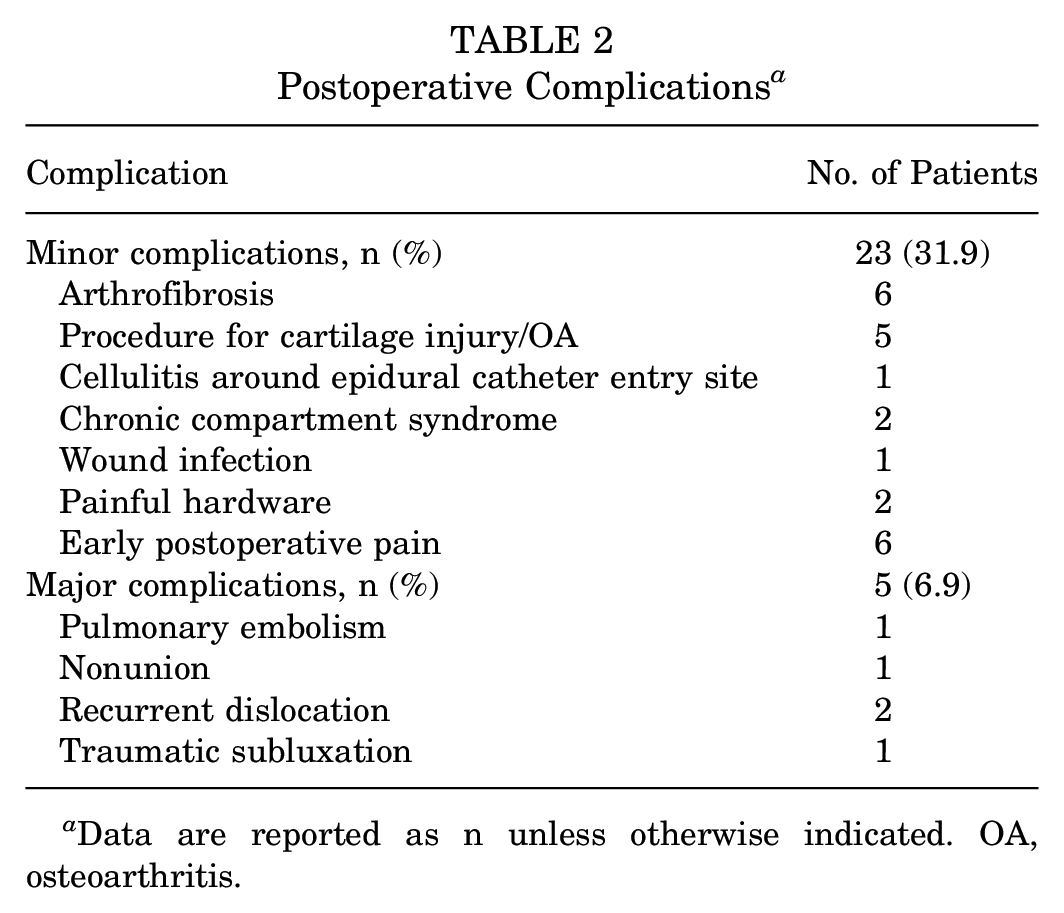
Data are reported as n unless otherwise indicated. OA, osteoarthritis.
Univariate logistic regression analysis on complications revealed that patients with a history of smoking were more likely to experience a postoperative complication (OR, 4.33 [95% CI, 1.29-14.53]; P = .02) (Table 3).
Univariate Logistic Regression Using Complications as an Outcome a
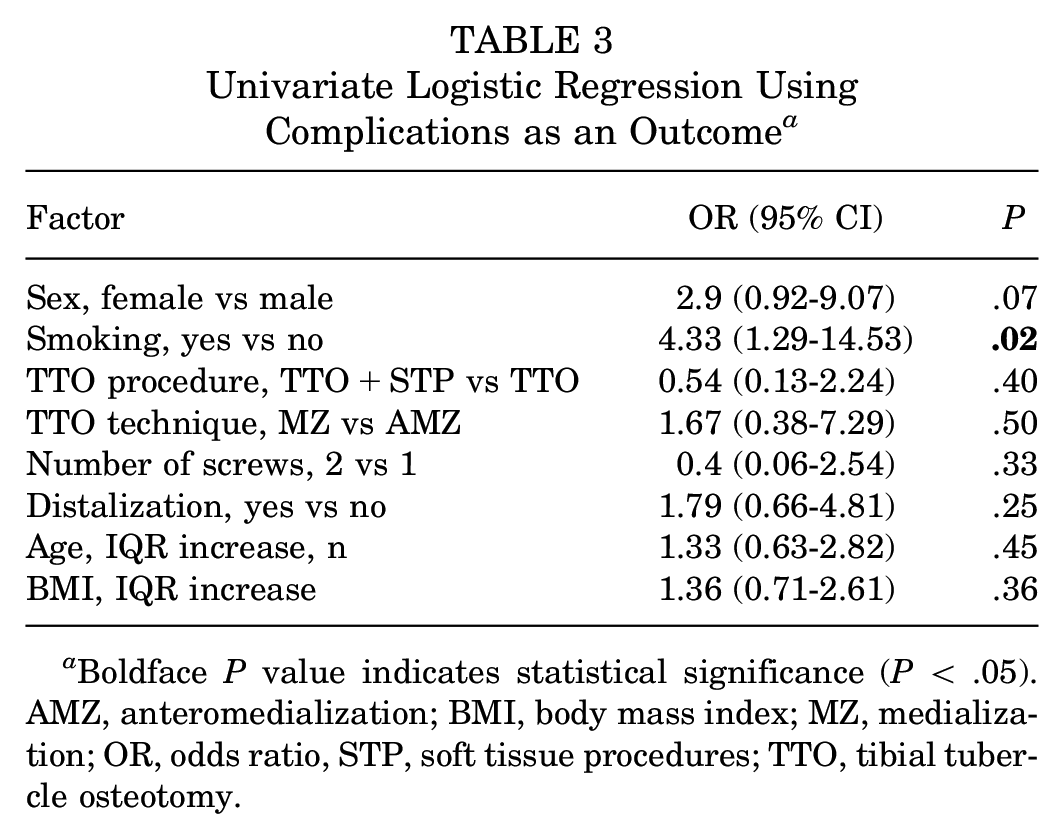
Boldface P value indicates statistical significance (P < .05). AMZ, anteromedialization; BMI, body mass index; MZ, medialization; OR, odds ratio, STP, soft tissue procedures; TTO, tibial tubercle osteotomy.
A multivariate model for complications using TTO procedure as the main predictor revealed that TTO procedure (TTO vs TTO+STP), number of screws, and distalization did not affect complication rates (Table 4). A multivariate model for complications using TTO technique (AMZ vs MZ) as the main predictor revealed no difference in the TTO technique (Table 5).
Multivariable Model for Complications Using TTO Procedure as the Main Predictor a

OR, odds ratio; STP, soft tissue procedure; TTO, tibial tubercle osteotomy.
Multivariable Model for Complications Using TTO Technique (AMZ vs MZ) as the Main Predictor a

AMZ, anteromedialization; MZ, medialization; OR, odds ratio; TTO, tibial tubercle osteotomy.
The mean time to radiographic follow-up was 67 months (range, 62-120 months), with a follow-up rate of 80% (48/60 patients with baseline radiographs). The rate of patients with Kellgren-Lawrence grade 3-4 in the tibiofemoral compartment increased from 12.0% preoperatively to 23.9% at the last follow-up. The rate of patients with an osteophyte on AP knee radiographs was 33.3% preoperatively and increased to 39.1% at the most recent follow-up. The presence of patellar osteophyte on lateral radiographs increased from 31.8% to 40.9% (9.1%) at the most recent follow-up (Table 6).
Radiographic Outcomes a

Data are reported as percentage of patients. AP, anteroposterior.
Of 72 patients, 12 were athletes. Among the 12 athletes, 11 (91.7%) returned to sports after the TTO procedure. The mean time to return to sports was 27.6 ± 10.2 weeks. Sport-specific return-to-sports information is shown in Table 7.
Return-to-Sports Rate by Sport (n = 12 patients) a

NA, not applicable.
Data are reported as number of patients who returned/total for that sport (%).
Discussion
This study demonstrated that the rate of major complications after TTO surgery at midterm follow-up was 6.9% (5/72 patients). Similarly, the rate of recurrent instability was as low as 2.8% (2/72 patients). Smoking was associated with complications after TTO. The progression of knee osteoarthritis was 7.1%, and the rate of new osteophyte formation was 5.8%.
A recent systematic review on the outcomes of tibial tubercle osteotomy reported an 8% complication rate after TTO procedures with a 1.9% recurrent dislocation rate. 18 The same study reported a 2.8% recurrent dislocation rate after isolated TTO. This systematic review did not specify rates based on the type of TTO. Another systematic review by Payne et al 17 reported an overall 3.0% major complication rate after TTO, with MZ TTO having a rate of 2.3% and AMZ TTO 3.1%. The difference was not significant between TTO types. Buuck and Fulkerson 3 reported outcomes of AMZ TTO in 42 knees at a mean follow-up of 4.9 years (range, 0.2-20 years). In their series, 2 patients had patellectomy, 1 patient had deep vein thrombosis, 6.9% of patients had arthrofibrosis requiring manipulation, and 81% had kneeling pain due to prominent screws, of which 40% could not kneel at all. Overall, they removed screws in 69% of patients.
Smoking has been reported to be a risk factor regarding outcomes for a number of musculoskeletal conditions and orthopaedic procedures.9,13,19,21,25 Our findings correlate with the prior findings in the literature. Although only 1 patient had nonunion, the multivariate analysis revealed smoking as the only risk factor for complications after TTO when all complications were included. This information may be utilized in discussion with patients during the preoperative evaluation.
Some authors consider patellofemoral stabilization and realignment procedures to be joint preservation procedures. Recently, Klinge and Fulkerson 12 reported outcomes of AMZ TTO at minimum 15-year follow-up in 15 patients (17 knees). In their series, no patient had undergone knee arthroplasty at the final follow-up. However, the authors did not report any radiographic outcomes. Tscholl et al 23 reported radiographic outcomes of combined MPFLR and MZ TTO at a mean 5.4-year follow-up using the Sperner classification, 20 in which grade 0 represents no degenerative changes, grade 1 represents subchondral sclerosis, grade 2 represents osteophytes on the patella, grade 3 represents narrowing of the joint space, and grade 4 represents tight joint space with osteoarthritic deformation of the patella. The mean preoperative Sperner classification was 0.3 ± 0.7, and it increased to 1.0 ± 0.9 during the follow-up period. In our cohort, a new osteophyte formation was found in 5.8% of patients, and there was progression in Kellgren-Lawrence grading in 7.1% of patients at a mean of 104.8 months. No patient underwent knee arthroplasty.
With regard to the surgical technique, our cohort included MZ and AMZ TTO. Medialization TTO had higher complication rates, but our statistical analysis did not reveal a difference between the groups. Although the number of patients with MZ TTO was lower than AMZ TTO, it was enough to yield an analysis. On the other hand, the numbers indicated the relative preference of techniques by surgeons in addressing patellar instability. Hardware removal is another controversial topic. Some surgeons consider screw removal to be a part of the surgical treatment, while others consider it a complication. In this study, only 2 patients underwent hardware removal due to persistent pain and were included in the analysis as a complication.
One of the patients in our study experienced cellulitis around the epidural catheter entry point. We should note that the use of the epidural catheter was preferred by a single surgeon (S.Y.) during the early study period. The epidural catheter was associated with multiple complications, was replaced by regional blocks, and is no longer used.
Limitations
There were several limitations to our study, including its retrospective design, the lack of patient-reported outcome scores, and the lack of a control group. In addition, for the radiographic follow-up evaluation, we did not have sunrise view to compare preoperative and follow-up images.
Conclusion
In the current study, TTO was found to have a major complication rate of 6.9% at midterm follow-up. Smoking was a risk factor for major complications. Only 11.9% of patients had progression in tibiofemoral osteoarthritis at midterm follow-up.
Footnotes
Final revision submitted March 11, 2024; accepted April 2, 2024.
One or more of the authors has declared the following potential conflict of interest or source of funding: J.P.F. has received grant support from Encore Medical and consulting fees from Linvatec. L.D.F. has received hospitality payments from DJO. AOSSM checks author disclosures against the Open Payments Database (OPD). AOSSM has not conducted an independent investigation on the OPD and disclaims any liability or responsibility relating thereto.
Ethical approval for this study was waived by Cleveland Clinic (reference No. 21-623).
