




Abstract
Background:
The addition of epinephrine to arthroscopic irrigation fluid has been shown to improve surgeon-rated visual clarity during shoulder arthroscopic surgery. Subacromial injections of epinephrine are also used for this purpose.
Purpose/Hypothesis:
To assess the influence of a preoperative subacromial epinephrine injection on surgeon visualization during subacromial shoulder arthroscopic surgery. It was hypothesized that the epinephrine injection would improve surgeon-rated visual clarity.
Study Design:
Randomized controlled trial; Level of evidence, 1.
Methods:
A double-blind randomized controlled trial including adult patients undergoing shoulder arthroscopic surgery in the beach-chair position requiring visualization of the subacromial space was performed. Patients in the epinephrine group (n = 30) received a preoperative subacromial injection of bupivacaine and epinephrine, and those in the control group (n = 30) received a preoperative subacromial injection of bupivacaine. Epinephrine was added to the first 10 L of arthroscopic irrigation fluid in all patients. The primary outcome was surgeon-rated visual clarity throughout the procedure that was recorded at the end of the procedure using a visual analog scale (VAS) scored from 0 (worst) to 10 (best). Secondary outcomes included an increase in pump pressure during the procedure, total operative time, and the intraoperative use of blood pressure–modulating medications.
Results:
Rotator cuff repair was performed in 88.3% of patients (25/30 epinephrine; 28/30 control), with multiple procedures performed in 85.0% of patients (23/30 epinephrine; 27/30 control). The VAS score for visual clarity was slightly better in the epinephrine group compared with the control group, although the difference was neither statistically nor clinically significant (8.3 ± 1.4 vs 7.5 ± 1.8, respectively; P = .09). There was no difference between the epinephrine and control groups in the need for an increase in pump pressure to improve visualization (8/30 [26.7%] vs 7/30 [23.3%], respectively; P > .99), total operative time (62.0 ± 19.4 vs 64.0 ± 30.1 minutes, respectively; P = .90), or the intraoperative use of blood pressure–modulating medications (20/30 [66.7%] vs 17/30 [56.7%], respectively; P = .60). There were no perioperative adverse events in either group.
Conclusion:
The addition of a subacromial epinephrine injection before shoulder arthroscopic surgery resulted in a small improvement in visual clarity that was neither statistically nor clinically significant, with no adverse effects reported in this study.
Registration:
NCT05244525 (ClinicalTrials.gov)
Keywords
Shoulder arthroscopic surgery is a technique used to treat an increasingly wide array of pathological conditions of the shoulder. These include abnormalities within the glenohumeral joint as well as in the subacromial space. Adequate visual clarity is imperative for the safety and efficacy of this procedure.2,14,18,26 During the procedure, arthroscopic irrigation fluid is pumped into the shoulder to improve the visualization of surrounding structures. However, too much irrigation will cause fluid to extravasate into surrounding soft tissue, thus creating difficulties with surgical exposure as well as intraoperative and postoperative swelling. The addition of epinephrine to arthroscopic irrigation fluid has minimal costs and has been shown to improve visual clarity and decrease operative time.14,26 However, it has the potential for rare but serious cardiovascular adverse events.1,8,12,15,24
An injection of diluted epinephrine into the subacromial space before the initiation of shoulder arthroscopic surgery has been used clinically to improve surgical visualization. The vasoconstrictive effect of this pharmacological agent is thought to decrease bleeding from local structures and thus decrease barriers to visualization.10,11,13 The time to the maximal vasoconstrictive effect, and therefore maximal visualization, varies in the literature, with historical reports stating 7 to 10 minutes and newer studies reporting up to 25.9 minutes.17,19 The plasma half-life of epinephrine is approximately 1 minute; however, the local vasoconstrictive effect and visualization benefit are dose dependent, with most concentrations allowing for blood flow to return to baseline between 60 and 120 minutes.6,21 Further potential benefits of this preoperative application include limiting the cost of surgery, decreasing operative time, and limiting the use of blood pressure–modulating agents during the procedure. 24 Furthermore, this technique provides an alternative to the visualization benefits of controlled hypotension, which poses the risk of other serious adverse events including cerebral desaturation. 25 The principle of controlled hypotension is of particular importance with patients undergoing surgery in the beach-chair (upright) position, as this increases the risk for cerebral hypoperfusion. 9
Given the proven benefits of epinephrine within arthroscopic irrigation fluid, we aimed to assess the influence of a preoperative subacromial epinephrine injection on surgeon visualization during shoulder arthroscopic surgery. We also aimed to determine the effect of the epinephrine injection on total operative time and on the use of blood pressure–modulating agents intraoperatively. We hypothesized that the addition of a preoperative subacromial epinephrine injection would improve surgeon-rated visual clarity.
Methods
This prospective, double-blind randomized controlled trial (RCT) took place at 2 hospitals and 2 surgical centers and included 6 sports medicine fellowship–trained orthopaedic surgeons at a single academic institution. The study was conducted using the Consolidated Standards of Reporting Trials (CONSORT) guidelines, 23 and the protocol for the study received institutional review board approval and was registered on ClinicalTrials.gov (NCT05244525).
Patient Enrollment
Patients undergoing shoulder arthroscopic surgery in the beach-chair position requiring visualization of the subacromial space were eligible for study enrollment, which occurred between March 14, 2022, and August 31, 2022. Included procedures were rotator cuff debridement or repair, subacromial decompression, subacromial bursectomy or bursal debridement, lysis of adhesions, synovectomy, and distal clavicle resection. The inclusion criteria were adult patients (age >18 years) who were able to provide informed consent. Patients who were not able to provide informed consent, were non-English speakers, had a documented history of adverse medication reactions to epinephrine, or underwent shoulder arthroscopic surgery in the lateral position or a procedure that did not require visualization within the subacromial space were excluded from the trial. Non-English speakers were excluded from the study because limited resources were available to provide an informed consent form in any language other than English. Patients were permitted to be withdrawn from the trial upon request, and no patient follow-up was necessary for this study. No patients withdrew from the study, and no changes to the study design were made after trial commencement.
Participants were randomized into 1 of 2 groups: those who received a preoperative subacromial epinephrine injection (epinephrine group) and a control group. A power analysis was performed before the initiation of the study to ensure proper power at 80% with an alpha of .5. We calculated that a minimum of 26 patients would be needed in each study group. A total of 30 patients in each study arm were set as the enrollment goal to ensure that statistical power was properly attained.
There were 78 patients screened for the study. Of these patients, 7 failed screening, and 11 patients refused consent, leaving 60 patients to be enrolled in the trial. Overall, 30 patients were enrolled in the epinephrine group, and 30 patients were enrolled in the control group in a parallel fashion. Screening and enrollment were performed by research staff, and the 6 involved surgeons remained blinded to the assignment of each patient for the duration of the trial. Enrollment ceased when the trial met its sample size goal. The CONSORT flow diagram of patient enrollment is shown in Figure 1.

Flow diagram of participant enrollment in the study.
Injection Procedure
Patients randomized to the epinephrine group received an injection of 20 mL of a mixture of 0.3 mg epinephrine in 30 mL of 0.5% bupivacaine at a dilution of 1:100. Patients randomized to the control group received an injection of 20 mL of 0.5% bupivacaine. To ensure proper methodology for the double-blinded study, an operating room circulating nurse prepared the injection according to a randomization card within a sealed envelope, and the injection was not labeled. The injections were performed by a surgeon or orthopaedic sports medicine fellow (S.F., J.M.G., R.K.F., S.E.F., P.G.S., B.P.G.) with an 18-gauge needle using the posterior approach to the subacromial space after the patient was placed in the beach-chair position and before skin preparation and surgical draping. The procedure began no later than 10 minutes after the injection, allowing the epinephrine enough time to exert its effect of vasoconstriction. With reports in the literature suggesting that the time to the maximal effect of local vasoconstriction is between 7 and 25.9 minutes,17,19 the timing of this procedure was deemed optimal.
Arthroscopic irrigation fluid was prepared by adding 1 mL of 5 mg/mL epinephrine for every 1 L of irrigation fluid, up to 10 L of fluid, at a dilution of 1:1000. If the procedure required >10 L of irrigation fluid, the fluid after this threshold did not contain epinephrine. The irrigation pump pressure was set at 35 mm Hg at the beginning of the procedure and was increased only at the request of the surgeon.
Primary Outcome
The primary outcome for this study was surgeon-rated visual clarity of the subacromial space throughout the procedure. Visual clarity was assessed at the completion of the procedure and was intended to be a representation of the surgeon's assessment of clarity throughout the procedure. The surgeon assessed visual clarity using a visual analog scale (VAS) scored from 0 to 10. In this scale, a value of 10 represented the best visual clarity possible, and a value of 0 represented the worst clarity possible. The VAS is a validated and reliable instrument that has been used to quantify inherently subjective factors including pain, visualization, and other patient-reported clinical symptoms.2,7,14,16,26 The mean VAS score was determined for each study group and used for comparison.
Secondary Outcomes
The secondary outcomes measured included operative time, the change in irrigation pump pressure, the use of blood pressure–modulating medications, and the incidence of intraoperative adverse events, with a special interest in cardiovascular events. These data were collected prospectively throughout the case and confirmed with the anesthesiologist at case completion. Additionally, patient characteristics, procedure type, preoperative use of anticoagulants, and intraoperative mean arterial pressure were collected intraoperatively. No changes to trial outcomes were made after the commencement of the trial.
Statistical Analysis
Continuous variables were reported as the mean ± standard deviation, and categorical variables were expressed as frequencies and percentages. The Mann-Whitney U test was used to compare continuous variables between the epinephrine and control groups, and the Fisher exact test was used to compare categorical variables between the groups. In addition, we assessed the clinical significance of the VAS scores. The minimal clinically important difference for the VAS has been previously shown to be 2 points, or 20%. 2 All analyses were performed with an alpha level of .05, indicating statistical significance as P < .05, in STATA (Version 17; StataCorp).
Results
When comparing the characteristics of the epinephrine and control groups, there was no difference in age, sex, and body mass index between groups. These data, as well as the procedures performed within each group, are shown in Table 1. Rotator cuff repair was the most common procedure, performed in 88.3% of patients (83.3% of epinephrine group vs 93.3% of control group), followed by debridement and then subacromial decompression/bursectomy. Acromioplasty was not routinely performed with rotator cuff repair and depended on individual surgeon preference. Multiple procedures were performed in 85.0% of all patients, with 76.7% of patients in the epinephrine group undergoing multiple procedures versus 90.0% of patients in the control group. There was no significant difference in the procedures between the 2 groups (P = .60).
Patient Characteristics and Surgical Procedures a

Data are presented as mean ± SD or n (%) unless otherwise indicated. SLAP, superior labral anterior to posterior.
The study outcomes are shown in Table 2. The mean VAS score for surgeon-rated visual clarity was 8.3 ± 1.4 in the epinephrine group and 7.5 ± 1.8 in the control group; this difference was neither statistically significant (P = .09) nor clinically significant. The mean total operative time was 62.0 ± 19.4 minutes in the epinephrine group versus 64.0 ± 30.1 minutes in the control group (P = .90). The intraoperative use of blood pressure medications to improve visualization in the subacromial space was necessary in 66.7% of the epinephrine group versus 56.7% of the control group (P = .60). The mean irrigation pump pressure was 40.0 ± 7.9 mm Hg in the epinephrine group versus 38.7 ± 5.8 mm Hg in the control group. The intraoperative mean arterial pressure among all participants was 70.9 mm Hg. In the epinephrine group, the mean arterial pressure was 70.5 ± 12.7 versus 71.3 ± 7.3 mm Hg in the control group (P = .81). Although there were small group differences in secondary outcomes, none of these differences were statistically significant. No cardiovascular adverse events were observed, nor were there perioperative adverse events of any kind in the study patients.
Outcomes a
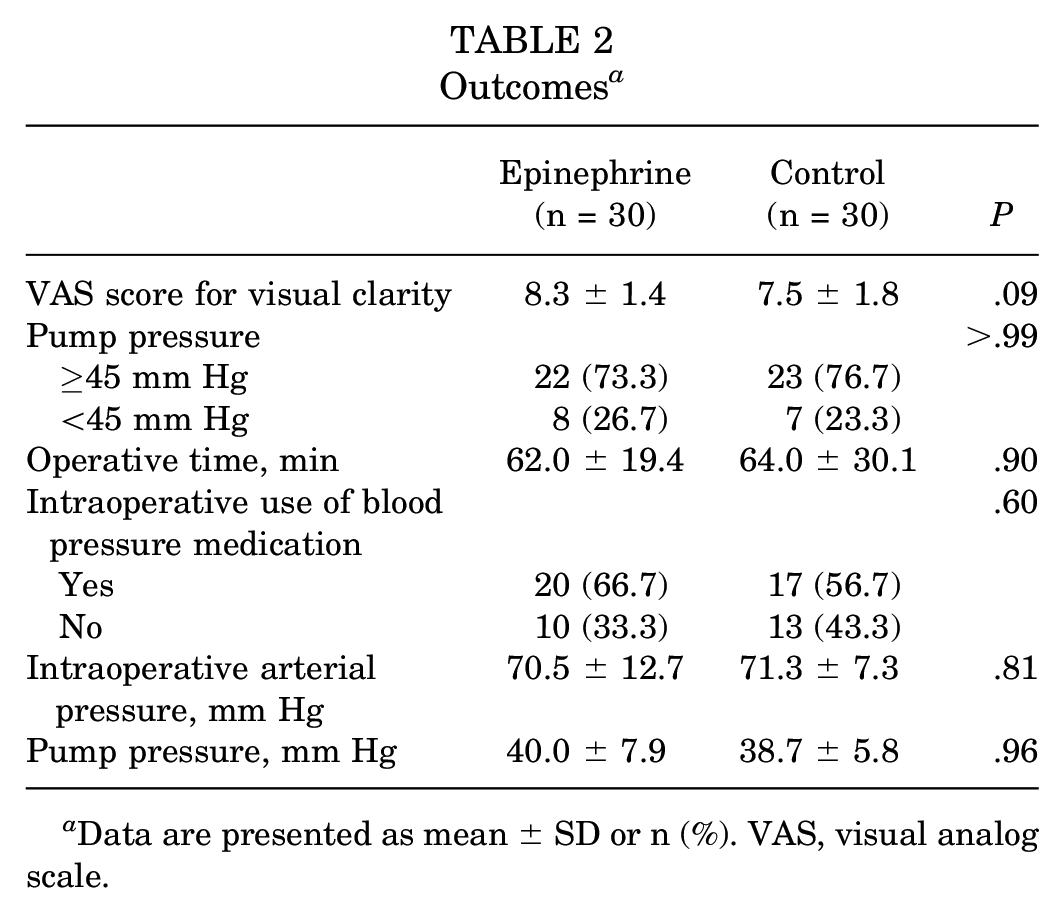
Data are presented as mean ± SD or n (%). VAS, visual analog scale.
Discussion
In the current RCT, although visual clarity was slightly greater when epinephrine was preoperatively injected into the subacromial space, the difference between groups was not statistically significant. Furthermore, our secondary outcomes revealed no significant differences in total operative time, irrigation pump pressure, or the use of blood pressure–modulating agents. There were also no hypertensive, tachycardic, or other adverse events as a result of the subacromial epinephrine injection.
This is the first study to assess the influence that an epinephrine injection has on surgeon visualization during subacromial shoulder arthroscopic surgery. This study builds on other RCTs that have demonstrated improvements in visualization with the addition of epinephrine to arthroscopic irrigation fluid.2,14,26 One such study by van Montfoort et al 26 demonstrated the significant visualization benefits of the addition of epinephrine to arthroscopic irrigation fluid and further showed a reduction in both operative time and amount of irrigation fluid used during the procedure. Their primary outcome was visualization using a numerical rating scale (0-10) that was expressed as a percentage, with results showing that the group with epinephrine in irrigation fluid had 70.1% clarity compared with 51.2% clarity in the placebo group (P = .002). Another trial, by Jensen et al, 14 whose primary outcome was visualization on a VAS (0-10), showed a significant reduction in intraoperative bleeding and an improvement in visualization in the group using epinephrine in irrigation fluid. Intraoperative bleeding was measured from the hemoglobin concentration of irrigation fluid collected postoperatively. An RCT conducted by Avery et al 2 demonstrated a significant increase in surgical visualization. All 3 of these RCTs examining the effects of epinephrine on visualization used a 0- to 10-point rating scale, which led our group to use the same scale to maximize comparability among studies. However, unlike the previous studies, the current trial did not show a significant reduction in operative time or amount of irrigation fluid. None of the RCTs exploring the impact of epinephrine in arthroscopic irrigation fluid on surgeon visualization reported adverse events, providing evidence that epinephrine is safe to use in irrigation fluid.
There are some reports in the literature that have described cardiovascular adverse events linked to epinephrine use in arthroscopic irrigation fluid.1,8,12,15 Abdelrahman et al 1 performed a review of all reported complications associated with the use of epinephrine in arthroscopic surgery and found 9 patients who experienced cardiopulmonary complications. These complications included tachycardia, hypertension, arrhythmia, and pulmonary edema. One such case reported the death of a patient after arthroscopic acromioclavicular resection with labral debridement using epinephrine in irrigation fluid; autopsy results suggested that cardiomyopathy was attributed to catecholamine in arthroscopic fluid. 12 Although rare, these cases represent the small risk that epinephrine in arthroscopic fluid poses to patients and are thought to be the result of the inadvertent systemic administration of epinephrine. This mechanism is clearly demonstrated in the reported case of iatrogenic popliteal venotomy during arthroscopic posterior cruciate ligament reconstruction in which a patient experienced intraoperative cardiopulmonary arrest and flash pulmonary edema, followed by resuscitation. 22 Other sources of errors include dosage and mixture preparation errors.
Our RCT, which administered epinephrine in the subacromial space as well as added epinephrine to irrigation fluid, did not experience any of these adverse events, nor were they expected. The senior surgeon of this study (J.M.G.) has performed these preoperative injections for 10 years and has observed no complications. It is important to note that iatrogenic complications from the administration of epinephrine are unlikely to occur in the subacromial space with proper techniques. 27
Visualization in the subacromial space during shoulder arthroscopic surgery is key to performing a successful procedure. Many factors play a role in contributing to the level of visual clarity during a procedure including, but not limited to, patient positioning, the use of vasoactive medications during the procedure, the modulation of blood pressure by anesthesia, and the pump pressure of irrigation fluid. Hypotensive anesthesia can improve visualization and limits the need for increased irrigation pump pressure and fluid but carries the risk of adverse events including hypotensive and bradycardic events.3,5,20 Controlled hypotension is most often achieved in the beach-chair position, which allows for greater monitoring of both cerebral and systemic blood pressure. Both the use of hypotensive anesthesia and epinephrine in arthroscopic irrigation fluid carry risks, but both agents have been shown to improve visualization in the subacromial space where bleeding is common.4,27 Evaluating additional ways to improve arthroscopic visualization of the subacromial space is therefore clinically relevant, as it could potentially decrease the need for hypotensive anesthesia.
Strengths and Limitations
The strengths of this study include the level 1 evidence of a blinded RCT, the large percentage of procedures that included rotator cuff repair, and the novelty of preoperative epinephrine injections that has not yet been explored in the literature. Including a large number of rotator cuff tears in our study is of particular clinical relevance, as these cases may be longer and involve more extensive bursectomy, which leads to the greater importance of visual clarity in the subacromial space. 27 Although there have been 3 RCTs exploring the relationship between epinephrine in arthroscopic irrigation fluid and visualization,2,14,26 no trial has yet elucidated the effect of preoperative epinephrine injections in the subacromial space on surgical visualization. Lastly, this study addresses a major topic of interest in determining strategies to make one of the most common orthopaedic procedures safer and more effective, and the design of the study, which is aligned with the practice of most arthroscopic surgeons, produced study results that are generalizable to the population of interest .
There are several limitations to this study, such as the subjective nature of the VAS for assessing visual clarity. The inclusion of multiple surgeons in the trial could have led to a bias, as VAS ratings could have represented different levels of clarity among the surgeons. However, because of the subjective nature of rating visualization in the subacromial space, we found that the risk of bias from intersurgeon VAS ratings did not outweigh the benefit of capturing clinically relevant visualization ratings from multiple surgeons to improve the generalizability of this trial. However, collecting VAS scores throughout the procedure or at key points of visualization impairment could have improved the generalizability of our results. Another limitation was that epinephrine was included in irrigation fluid in the first 10 L for all procedures, giving way to a potential bias in overstating the extent to which the preoperative subacromial epinephrine injection contributed to overall visual clarity. Although epinephrine was included in the control group through the use of irrigation fluid, we found that this method was the most relevant for investigation, as the addition of epinephrine in irrigation fluid is the current standard of care and would therefore have the greatest informative value for clinical practice. Lastly, including a third arm in the study in which patients would have received the epinephrine injection preoperatively, but epinephrine would have been removed from irrigation fluid, could have allowed us to better isolate the causative effect of the epinephrine injection from the epinephrine irrigation fluid used in all of our procedures. If a subacromial epinephrine injection is as effective as adding epinephrine to irrigation fluid, this could ease intraoperative efforts for the circulating nurse.
Conclusion
The addition of a subacromial epinephrine injection before shoulder arthroscopic surgery resulted in a small improvement in surgeon-rated visual clarity that was neither statistically nor clinically significant. No adverse effects were reported in any of the patients in this study.
Footnotes
Final revision submitted February 26, 2024; accepted March 18, 2024.
One or more of the authors has declared the following potential conflict of interest or source of funding: S.F. has received grant support from Arthrex and education payments from Arthrex and Smith & Nephew. R.K.F. has received education payments from MedInc of Texas and consulting fees from Applied Medical Resources, LimaCorporate, KCI USA, Lima USA, and Exactech. S.E.F. has received hospitality payments from Arthrex. P.G.S. has received education payments from Arthrex. B.P.G. has received grant support from DJO and education payments from Arthrex, Smith & Nephew, and Stryker. J.M.G. has received education payments from MedInc of Texas; consulting fees from Stryker, Arthrex, and Wright Medical Technology; nonconsulting fees from Arthrex and Wright Medical Technology; and hospitality payments from Zimmer Biomet. AOSSM checks author disclosures against the Open Payments Database (OPD). AOSSM has not conducted an independent investigation on the OPD and disclaims any liability or responsibility relating thereto.
Ethical approval for this study was obtained from the University of Texas Health Science Center at Houston (No. HSC-MS-21-1061).
