



Abstract
Background:
Previous surveys of the practice patterns for anterior cruciate ligament (ACL) reconstruction in collegiate and professional team physicians have shown bone–patellar tendon–bone (BPTB) autograft being the most common graft, with variable return-to-sports timing.
Purpose:
To evaluate the current practice patterns and return-to-sports timing of National Football League (NFL) head team physicians for ACL reconstruction.
Study Design:
Cross-sectional study.
Method:
All 32 NFL head team orthopaedic surgeons were surveyed and asked their primary ACL graft preference, revision ACL graft preference, use of lateral extra-articular tenodesis (LET) or anterolateral ligament reconstruction (ALL), use of suture brace augmentation, return-to-sport timing, and whether functional testing was utilized in determining readiness of return to play. The years of experience of the physician were also evaluated.
Results:
All 32 head team physicians responded, with 31 (97%) using ipsilateral BPTB autograft in the primary setting and 1 using ipsilateral quadriceps autograft. In the revision setting, 24 (75%) physicians preferred a contralateral BPTB autograft, while 5 (16%) used an ipsilateral quadriceps autograft, 1 (3%) used a contralateral quadriceps autograft, and 2 (6%) used a BPTB allograft. One respondent (3%) used suture brace augmentation “most of the time” in the primary setting and always in the revision setting. No respondents utilized an ALL or LET in the primary setting and 2 (6%) respondents always performed an LET in revisions. Five others (16%) have performed at least 1 ALL or LET in an NFL athlete. Mean return to sports was at 9 months postoperatively, with no physicians allowing players to return before 7 months. All but 1 respondent used functional testing in return-to-sports decision-making.
Conclusion:
All but 1 of the 32 NFL head team physicians used BPTB autograft in primary ACL reconstruction. The majority preferred contralateral BPTB autograft in revisions, with a few considering extra-articular procedures or suture bracing in addition. On average, head team physicians allowed players to return at 9 months postoperatively, with none allowing return before 7 months. Nearly all utilized functional testing to aid in return-to-play decision-making. These homogenous findings in this high-risk and public athletic cohort aid in patient education and clinical decision-making for best treatment of ACL injuries, particularly in contact athletes.
Anterior cruciate ligament (ACL) reconstruction is one of the most published topics in the orthopaedic sports medicine literature. 1 With newer high-level multicenter data evaluating ACL graft outcomes as well as new options for ACL augmentation, it is unclear whether practice patterns in those caring for elite athletes has changed.1,21 There have been previous reports outlining graft preferences and return-to-play timing in this group; however, these studies are nearly a decade old.4,5 Players in the National Football League (NFL) are at some of the highest risk for ACL injury and reinjury, with possible long-term knee health and financial implications.13,18 One 2002 study reported that 84% of NFL team physicians use a bone–patellar tendon–bone (BPTB) autograft. 2 In a 2014 study of NFL and National Collegiate Athletic Association (NCAA) football team physicians, 86% preferred a BPTB autograft, and 55% of respondents allowed athletes to return to play at 6 months. 5 One year later, the same group evaluated the practice patterns of 94 professional team physicians in the National Hockey League (NHL), Major League Soccer (MLS), and International Ski and Snowboard Federation (FIS) and found that 70.2% of physicians preferred a BPTB autograft, while 14.9% used the hamstring and 4.3% used the quadriceps. 4
It is unclear whether practice patterns have changed regarding graft selection due to the increased interest in quadriceps autograft and data concerning failure rates of hamstring tendon autograft.14,16,20,21 Further, it is also unknown whether newer considerations with ACL reconstruction augmentation with suture bracing or lateral extra-articular tenodesis (LET)/anterior lateral ligament reconstruction (ALL) has gained traction with NFL team physicians.11,12 In addition, data regarding return-to-play timing and testing have expanded in recent years; therefore, its influence in changes to practice patterns is unknown. 9
The purpose of this study was to survey all 32 NFL head team physicians to determine current ACL practice patterns, which may provide helpful patient education and surgical decision-making information for those caring for athletes. It was hypothesized that these physicians would prefer BPTB autografts, but an increased interest would be seen in quadriceps autografts as well as supplementation with suture bracing and LET.
Method
This study was deemed to be exempt from institutional review board approval. All 32 NFL head team physicians were surveyed by phone by the senior author (J.P.B.) in February 2023. Team physicians were asked the number of years they had fulfilled their role, and they were surveyed as to their primary ACL graft preference, revision ACL graft preference, use and incidence of LET or ALL, use of suture brace augmentation, return to sports timing, and if functional testing was utilized in determining readiness of return to play. These questions were also asked regarding ACL reconstruction in the revision setting. Table 1 provides a summary of the questions asked to each team physician. The responses to each question were recorded and tabulated in a spreadsheet.
Questions Asked to NFL Head Team Physicians Regarding ACL Treatment Preferences
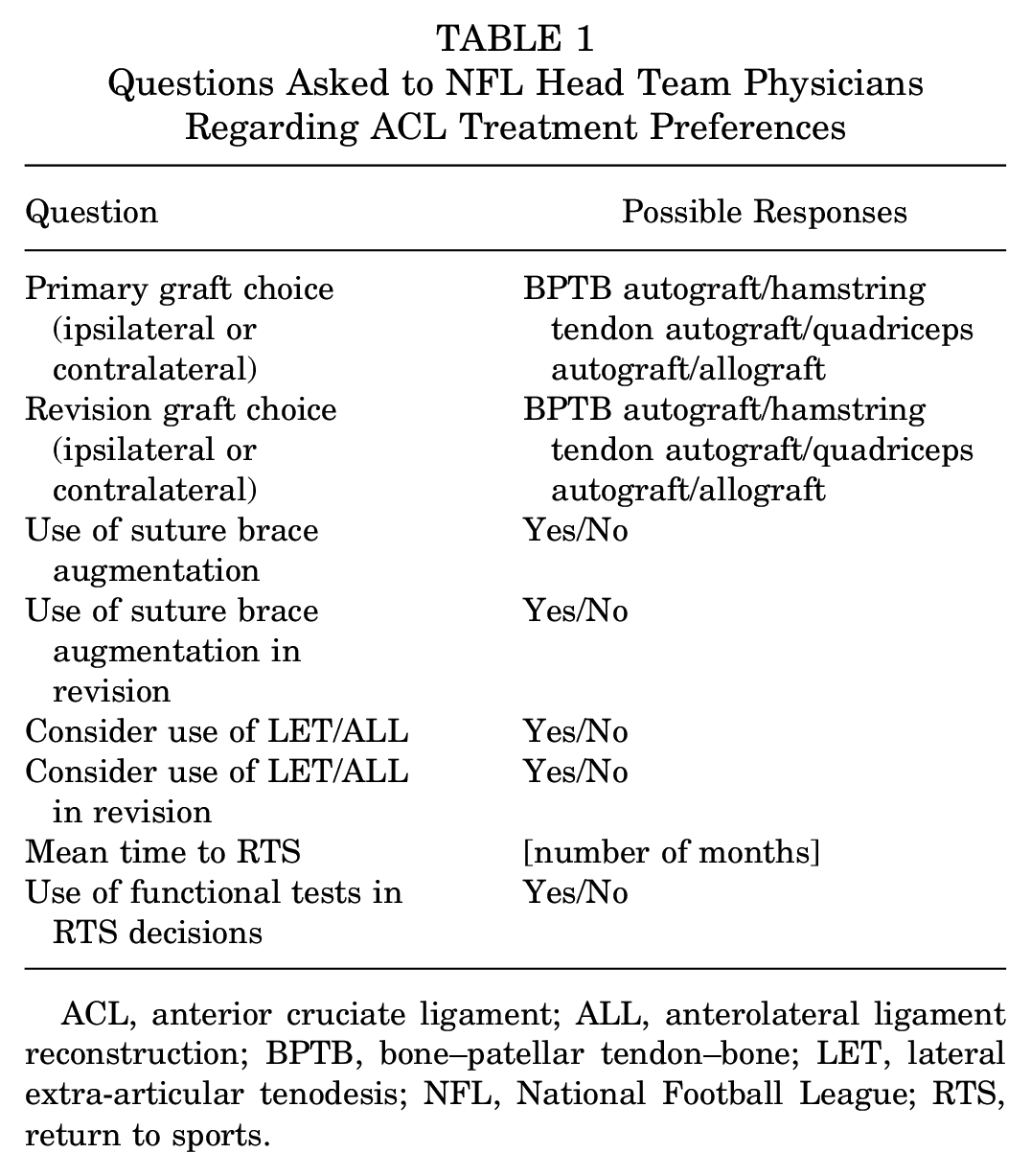
ACL, anterior cruciate ligament; ALL, anterolateral ligament reconstruction; BPTB, bone–patellar tendon–bone; LET, lateral extra-articular tenodesis; NFL, National Football League; RTS, return to sports.
Results
All 32 NFL head team physicians responded; the responses are summarized in Table 2. Overall, 31 (97%) respondents utilized ipsilateral BPTB autografts in the primary setting, with 1 (3%) respondent preferring an ipsilateral quadriceps autograft. In the revision setting, 24 (75%) respondents preferred a contralateral BTB autograft, while 5 (16%) used an ipsilateral quadriceps autograft, 1 (3%) used a contralateral quadriceps autograft, and 2 (6%) used a BPTB allograft. One team physician (3%) used suture brace augmentation “most of the time” in the primary setting and always in the revision setting. None of the respondents regularly utilized an ALL or LET in the primary setting, and 2 (6%) physicians typically performed an LET in revisions. Six physicians (19%) stated they would consider the use of an LET/ALL in the primary setting and 8 (25%) physicians would in revisions. Five other respondents (16%) have performed at least 1 ALL or LET in an NFL athlete.
Responses of NFL Team Physicians Regarding ACL Treatment Preferences
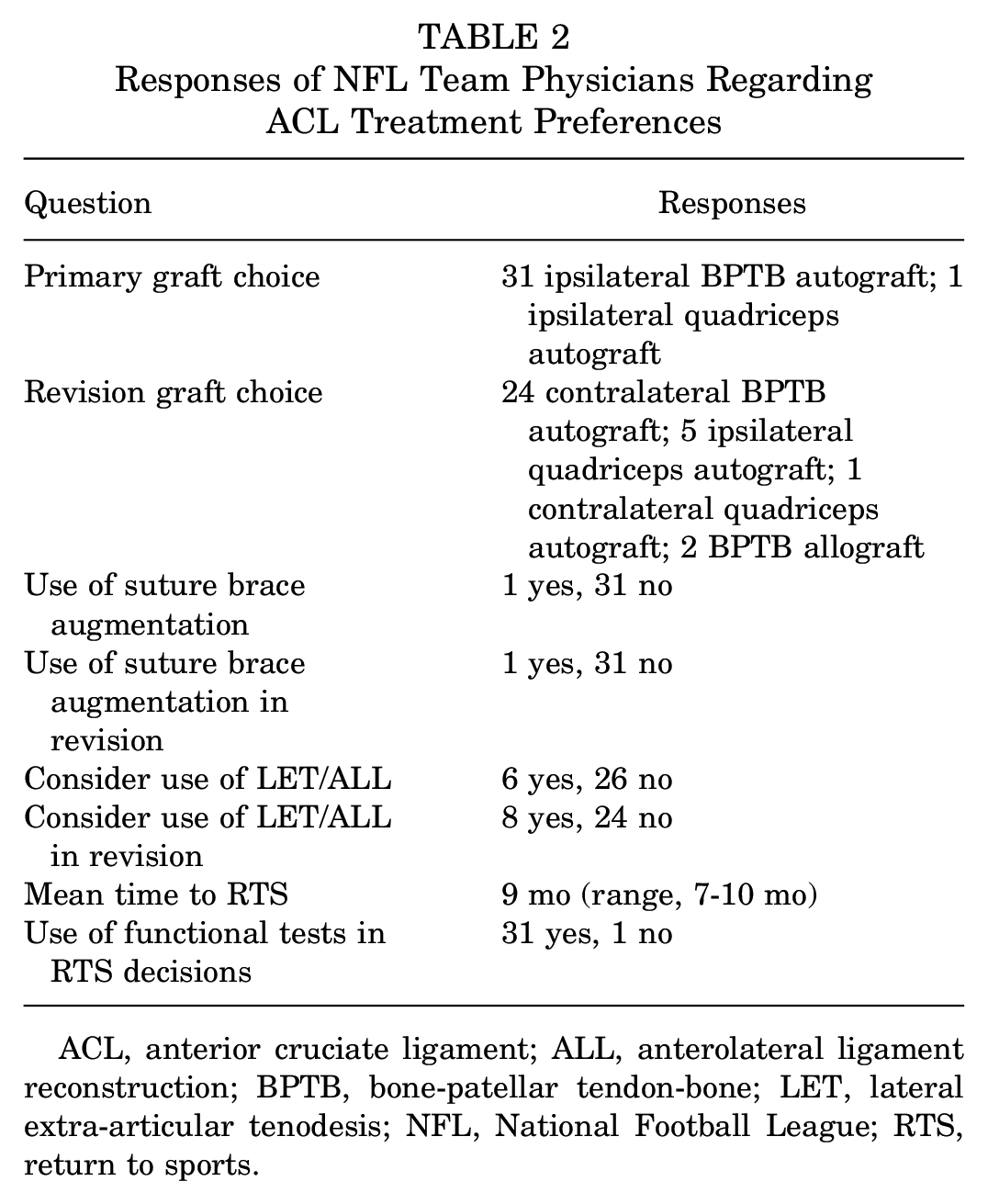
ACL, anterior cruciate ligament; ALL, anterolateral ligament reconstruction; BPTB, bone-patellar tendon-bone; LET, lateral extra-articular tenodesis; NFL, National Football League; RTS, return to sports.
The mean time to return to sports was at 9 months postoperatively, with none of the respondents allowing NFL players to return before 7 months (Table 2). All but 1 (97%) respondent used functional testing in return-to-sports decision-making.
NFL head team physicians had a mean experience of 14 years, with a median experience of 12 years (range, 1-32 years). There were 8 respondents who had served over 20 years in their role as head team physician.
Discussion
The findings of this study were that the primary ACL graft choice for nearly all head NFL team physicians was a BPTB autograft (31/32; 97%), while the most common revision ACL graft choice was a contralateral BPTB autograft (24/32; 75%). One team physician commonly used suture brace augmentation with quadriceps autograft in the primary setting and regularly in revisions. Concomitant ALL or LET in the primary setting was rarely performed, but 2 team physicians did perform it in revisions. Return to sport after ACL reconstruction was typically between 9 and 10 months, with the earliest return being 7 months. All but 1 respondent used special testing to aid in decision-making regarding return to sport.
These results are similar to those in the limited literature evaluating ACL perioperative care in high-level football players with important distinctions. The BPTB autograft appears to remain the gold standard in the NFL because of the high number of studies supporting BPTB in this population. 10 Numerous studies have evaluated failure rates by graft type, with BPTB being reliably low with also high return-to-play rates.7,15,16 In 2008, BPTB was the primary graft choice by 87% of NFL team physicians, while it increased to 97% in 2016. 17 Similarly, in a 2014 study of NFL and NCAA team physicians, 99.3% used autograft and 86% used BTB; however, there was a response rate of only 51%. 5 With the recent increase in the use of a quadriceps autograft, it was unclear if the use of a BPTB autograft would decrease in the current study.14,21 This is not the case with primary ACL reconstruction in the NFL. In the revision setting, the contralateral BPTB autograft was the preferred graft source. With recent data showing higher rates of failure with a hamstring tendon autograft, it is not surprising that the hamstring is not currently a popular choice in the NFL.16,20 Further, the use of an ACL allograft is still minimally utilized in the NFL, likely due to the extensive literature showing its higher rates of failure.3,5,8,22
The addition of augmentations of ACL reconstruction, such as suture bracing or LET versus ALL reconstruction, has not been widely investigated in the football population.11,12,21 The current study shows that in the NFL, these augments are rarely done and typically reserved for the revision setting (6%). Studies do exist that LET/ALL may improve anteroposterior translation as well as rotational stability; however, no consistent difference in patient-reported outcomes have been shown. 11 With further outcome data coming forth, the incidence may change.
Return-to-play timing in the current study is later than in historical reports of high-level American football players, where return to play was commonly allowed closer to the 6-month mark.5,6,19 In a previous survey evaluating NFL team physicians return-to-play preferences, 49% allowed return to play before 6 months in 2008 while that number dropped to 14% in 2016. 17 The current study found that no NFL head team physicians allowed return before 7 months, with the mean being 9 months with a heavy emphasis on return-to-play testing. This change appears to be consistent with trends of sports medicine specialists due to recent data showing lower retear risk when return to play is delayed closer to 9 months. 11 Similarly, the importance of multifactorial return-to-play testing has been shown in recent data and the current study reflects that trend, with 97% of team physicians incorporating that in their postoperative decision-making. 9
With the ACL being one of the most published topics in orthopaedics and the NFL athlete being at a highest risk of injury and public implications of return to play, these data give concrete information from some of the top orthopaedic surgeons in the United States.13,18 The survey respondents have filled the role of head team physician for a mean of 14 years, with 8 team physicians being in their position for more than 20 years. This represents a benchmark for which other football players may be treated. It is hoped that the data from this highly experienced group of surgeons with typically complete and extensive follow-up of their high-profile and high-risk athletes who are in the public forum provides helpful information for orthopaedic best practices as well as patient education.
Limitations
Limitations of this study include a lack of granular data regarding specific positional or situational decision-making. For example, decision-making regarding ACL graft augmentation with suture bracing or ALL/LET was not assessed. In addition, specific criteria used to make return-to-play decisions were not evaluated. It is unclear if most team physicians are using global positioning system data to evaluate accelerations and speed in conjunction with biometric testing, but we suggest this. Despite these surgeons caring for elite athletes with the assumption that the most ideal treatment options are utilized, some of these processes may not be generalizable for amateur athletes playing multiple or different sports who have other personal considerations. As an example, timing of return to sport may not be directly translatable, as high-level athletes have nearly unlimited and constant resources available in postoperative care, such as physical therapy and modalities. Further, world-class athletes likely have protoplasm that allows quicker recovery and healing potential compared with others. This has previously been coined as “athletic reserve,” where elite athletes tend to have quicker recovery, better outcomes, and higher rates of return to play. 2 The current study was also not anonymized, which may lead to inherent bias due to the senior author calling directly. Another factor that should be considered is that not all ACL reconstructions performed on NFL athletes are performed by NFL surgeons. Therefore, the data presented here may not entirely reflect the treatment of all NFL athletes. Future studies evaluating the practice patterns of other sports both in the United States and internationally would be of interest.
Conclusion
All but 1 of the 32 NFL head team physicians reported using a BPTB autograft in primary ACL reconstruction (97%). The majority preferred a contralateral BPTB autograft with revisions and a few considered extra-articular procedures or suture bracing in addition. On average, head team physicians allowed players to return at 9 months postoperatively, with none of them allowing return before 7 months. Nearly, all survey respondents utilized functional testing to aid in return-to-play decision-making. These homogenous findings in this high-risk and public athletic cohort aid in patient education and clinical decision-making for best treatment of ACL injuries, particularly in contact athletes.
Footnotes
Final revision submitted January 31, 2024; accepted February 29, 2024.
One or more of the authors has declared the following potential conflict of interest or source of funding: J.W.A. has received grant support from Arthrex and DJO, education payments from Mid-Atlantic Surgical, and hospitality payments from Smith+Nephew. J.P.B. has received education payments from Fones Marketing Management, consulting fees from Arthrex and DJO, nonconsulting fees from Arthrex, and royalties from Arthrex. AOSSM checks author disclosures against the Open Payments Database (OPD). AOSSM has not conducted an independent investigation on the OPD and disclaims any liability or responsibility relating thereto.
Ethical approval for this study was waived by the University of Pittsburgh.
