




Abstract
Background:
The coronavirus 2019 (COVID-19) pandemic resulted in the cancellation of the 2020 National Football League (NFL) preseason and a decreased preseason roster size. The effect of this disruption on athlete injury rates is unknown.
Purpose/Hypothesis:
The purpose was to quantify the rates of anterior cruciate ligament (ACL), Achilles tendon, and hamstring tendon injuries in NFL players before and after the COVID-19 pandemic. We hypothesized that injury rates in the 2020 season would be higher than those seen prepandemic.
Study Design:
Descriptive epidemiology study. Level of evidence, 4.
Methods:
An online search using publicly available data was carried out to identify all NFL players who sustained an ACL, Achilles tendon, or hamstring tendon injury between April 1, 2017, and March 31, 2021. Data collected included player characteristics as well as career and season of injury workloads.
Results:
The number of Achilles tendon (27 vs 20; P = .024) and hamstring tendon (186 vs 149; P < .001) injuries, respectively, in the 2020 NFL season were significantly higher than the average of the 2017 to 2019 seasons. However, the number of ACL injuries sustained remained constant (43 vs 46; P = .175). More than half (52.9%) of ACL injuries in the 2017 to 2019 seasons occurred in the preseason, while most of the injuries (34.9%) in the 2020 season occurred in weeks 1 to 4. There was no player characteristic or career workload variable collected that was significantly different for players who sustained an ACL, Achilles tendon, or hamstring tendon injury in the 2020 NFL season compared with the 2017 to 2019 seasons.
Conclusion:
In the 2020 NFL season, the number of Achilles tendon and hamstring tendon injuries rose while the number of ACL injuries remained constant compared with the 2017 to 2019 seasons. Injuries that occurred during the first 4 games of the 2020 NFL season were consistent, with higher rates of injuries seen in the preseason in previous years.
Keywords
The coronavirus 2019 (COVID-19) pandemic forced the National Football League (NFL) to temporarily suspend all team activity in order to help contain the spread of the virus and ensure player safety. This involved cancellation of workouts; practices; meetings; and, importantly, the entire preseason in 2020. Roster sizes were also decreased from 90 to 80 players to decrease the number of at-risk personnel. Eventually, the 2020 NFL season did begin and was completed successfully, with all teams playing the standard 16-game regular season.
Injuries are common in professional as well as in youth and collegiate football. Lawrence et al 16 noted that, during a 2-year period in the NFL (2012-2013 and 2013-2014), an injury occurred in 97.7% of games played. Moreover, Binney et al 3 found that, in 2016, there were 804 injuries that led to missed time in a game (excluding head and illness). These injuries are frequently severe and can result in harmful career and financial implications. In particular, anterior cruciate ligament (ACL) injuries have been shown to reduce career length and even decrease an athlete’s chances of making an NFL roster. 5,7,10,24 Achilles tendon ruptures can also result in a devastating career outlook, with 32% of athletes not able to return to the NFL after injury. 21 Although risk factors for ACL, Achilles tendon, and hamstring tendon injury have been identified (eg, previous injury, mechanics, position, timing in season, experience), it is unclear whether they apply to the 2020 season affected by the COVID-19 pandemic. 8,9,14,15,20,28
The effects of COVID-19 are unprecedented; however, similar comparisons may be drawn from the 2011 NFL lockout, where players faced comparable restrictions regarding organized team practices. Binney et al 3 analyzed injury rates in the NFL during this period and found no significant change in conditioning- or nonconditioning-dependent injury rates; however, Myer et al 19 did note a significant increase in Achilles tendon ruptures during this time. Studies in soccer and baseball have demonstrated an increase in injury incidence as a result of the COVID-19 pandemic. 18,22
No study has analyzed injury rates in the NFL before and after the COVID-19 pandemic. Therefore, the aim of this study was to compare rates of ACL, Achilles tendon, and hamstring tendon injuries in the NFL from before and after the COVID-19 pandemic. We hypothesized that injury rates in the 2020 season would be higher than those seen prepandemic.
Methods
An online search using publicly available data, obviating the need for institutional review board approval, was carried out by 4 of the authors (A.M.O., R.W.P., B.F., and A.O.) to identify all NFL players who sustained an ACL, Achilles tendon, or hamstring tendon injury between April 1, 2017, and March 31, 2021. ACL injuries were selected due to ease of data collection; Achilles tendon injuries, to compare with the increased rate noted by Myer et al 19 during the 2011 NFL lockout; and hamstring tendon injuries, to represent muscle injuries that may have been affected by a lack of structured and supervised training. Only NFL players on an active NFL roster at the time of injury were included in analysis. Injuries that did not occur as part of normal football activity (games, practice, etc) were excluded. Data were collected using Microsoft Excel from the following sources: https://www.nfl.com/, https://www.footballdb.com/, https://www.pro-football-reference.com/, injury reports, press releases, and game summaries.
The assessed descriptive variables included team, position, age, height, weight, body mass index, date of injury, injury laterality, and reinjury/revision status. Assessed workload variables included years in the league as well as preseason games played, regular season games played, and postseason games played for both career and season of injury.
Statistical Analysis
Continuous data are presented as means and standard deviations, and categorical data are presented as cell count (%). Analysis of variance (ANOVA) or t tests were used to calculate P values for continuous data, and chi-square tests were used for categorical data. One-way ANOVA was used to compare patient characteristics by individual year. Independent-samples t tests were used to compare descriptive and workload data from 2017 to 2019 and 2020. Mean, standard deviation, and 95% CI were calculated and presented for all included variables. The statistical significance was set at P < .05.
Results
ACL Injuries
Overall, 181 NFL players sustained an ACL injury between 2017 and 2020, with 52 occurring in 2017, 52 in 2018, 34 in 2019, and 43 in 2020. When comparing ACL injuries that occurred in 2017 to 2019 versus 2020, we found no significant difference in overall number, descriptive factors, or career workload (Table 1). However, athletes who sustained an ACL injury in 2020 played significantly more regular season games (4.40 vs 2.78; P = .042) before injury.
Comparison of Characteristics, Career Workload, and Season of Injury Workload Between Athletes Who Sustained an ACL Injury in 2017 to 2019 Versus 2020 a

a Data are reported as mean ± SD unless otherwise indicated. Boldface P values indicate statistically significant difference between seasons compared (P < .05). ACL, anterior cruciate ligament; BMI, body mass index.
b Career statistics exclude season of injury.
A breakdown of ACL injury by quarter of the NFL season is noted in Figure 1. More than half (52.9%) of ACL injuries in the 2017 to 2019 seasons occurred in the preseason, while most (34.9%) of the injuries in the 2020 season occurred in weeks 1 to 4.

Number of athletes in the NFL who sustained an ACL injury during each quarter of the NFL season, 2017 to 2019 average versus 2020. ACL, anterior cruciate ligament; NFL, National Football League; Wk, week.
Achilles Tendon Injuries
Overall, 87 NFL players experienced an Achilles tendon injury between 2017 and 2020, with 23 occurring in 2017, 17 in 2018, 20 in 2019, and 27 in 2020. When comparing Achilles tendon injuries sustained in 2020 compared with the 2017 to 2019 seasons, there was no significant difference in descriptive factors or career workload (Table 2). However, significantly more athletes experienced an Achilles tendon injury in 2020 compared with the average of the 2017 to 2019 NFL seasons (27 vs 20; P = .024).
Comparison of Characteristics, Career Workload, and Season of Injury Workload Between Athletes Who Sustained an Achilles Tendon Injury in 2017 to 2019 Versus 2020 a
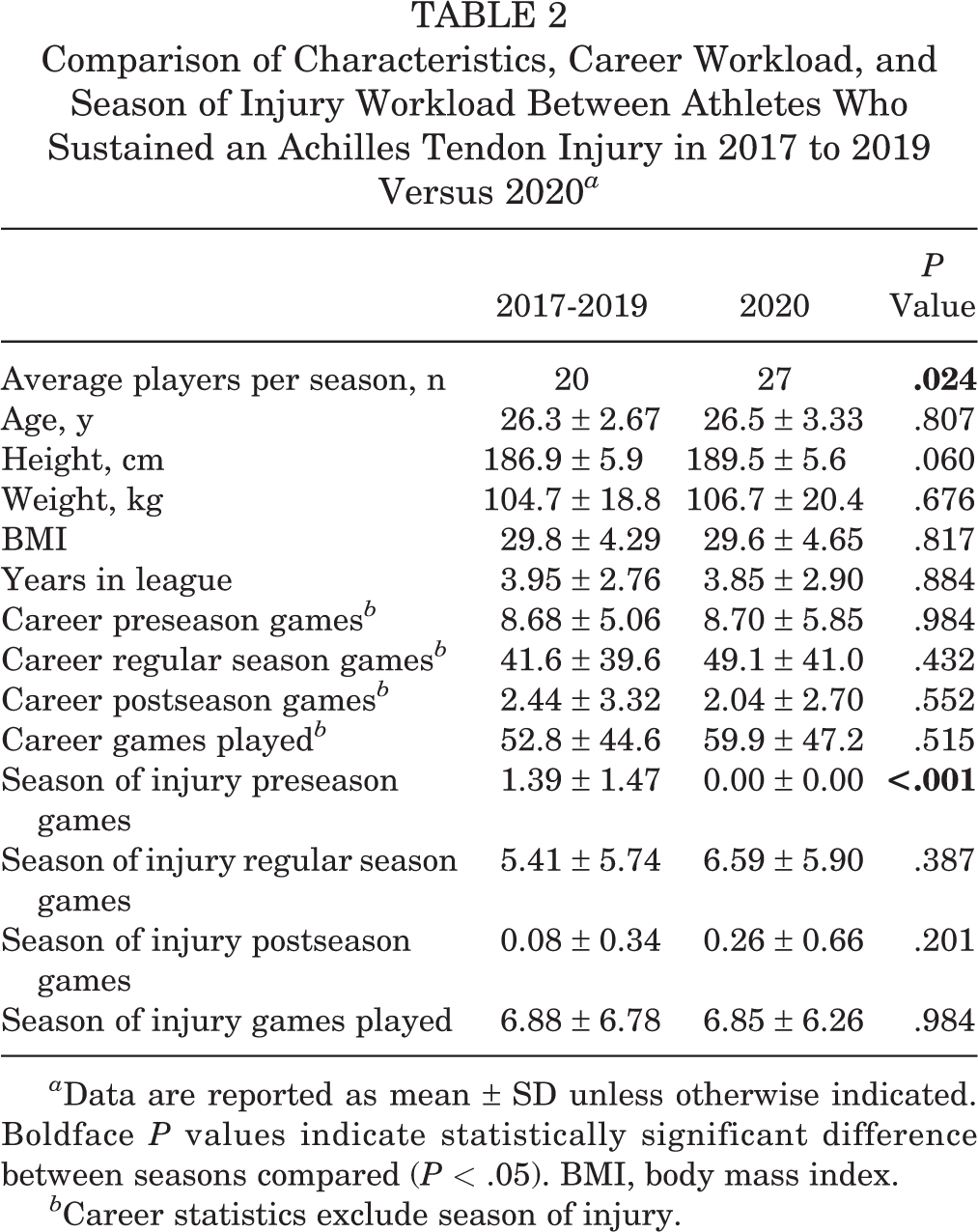
a Data are reported as mean ± SD unless otherwise indicated. Boldface P values indicate statistically significant difference between seasons compared (P < .05). BMI, body mass index.
b Career statistics exclude season of injury.
There was no significant difference in which quarter of the season the Achilles tendon injury occurred between 2020 and 2017 to 2019 (P = .190) (Figure 2).

Number of athletes in the NFL who sustained an Achilles tendon injury during each quarter of the NFL season, 2017 to 2019 average versus 2020. NFL, National Football League; Wk, week.
Hamstring Tendon Injuries
Overall, 633 NFL players sustained a hamstring tendon injury between 2017 and 2020, with 151 occurring in 2017, 136 in 2018, 160 in 2019, and 186 in 2020. When comparing hamstring tendon injuries sustained in 2020 compared with the 2017 to 2019 seasons, there was no significant difference in descriptive factors or career workload (Table 3). However, significantly more athletes sustained a hamstring tendon injury in 2020 compared with the average of the 2017 to 2019 seasons (186 vs 149; P < .001).
Comparison of Characteristics, Career Workload, and Season of Injury Workload Between Athletes Who Sustained a Hamstring Tendon Injury in 2017 to 2019 Versus 2020 a
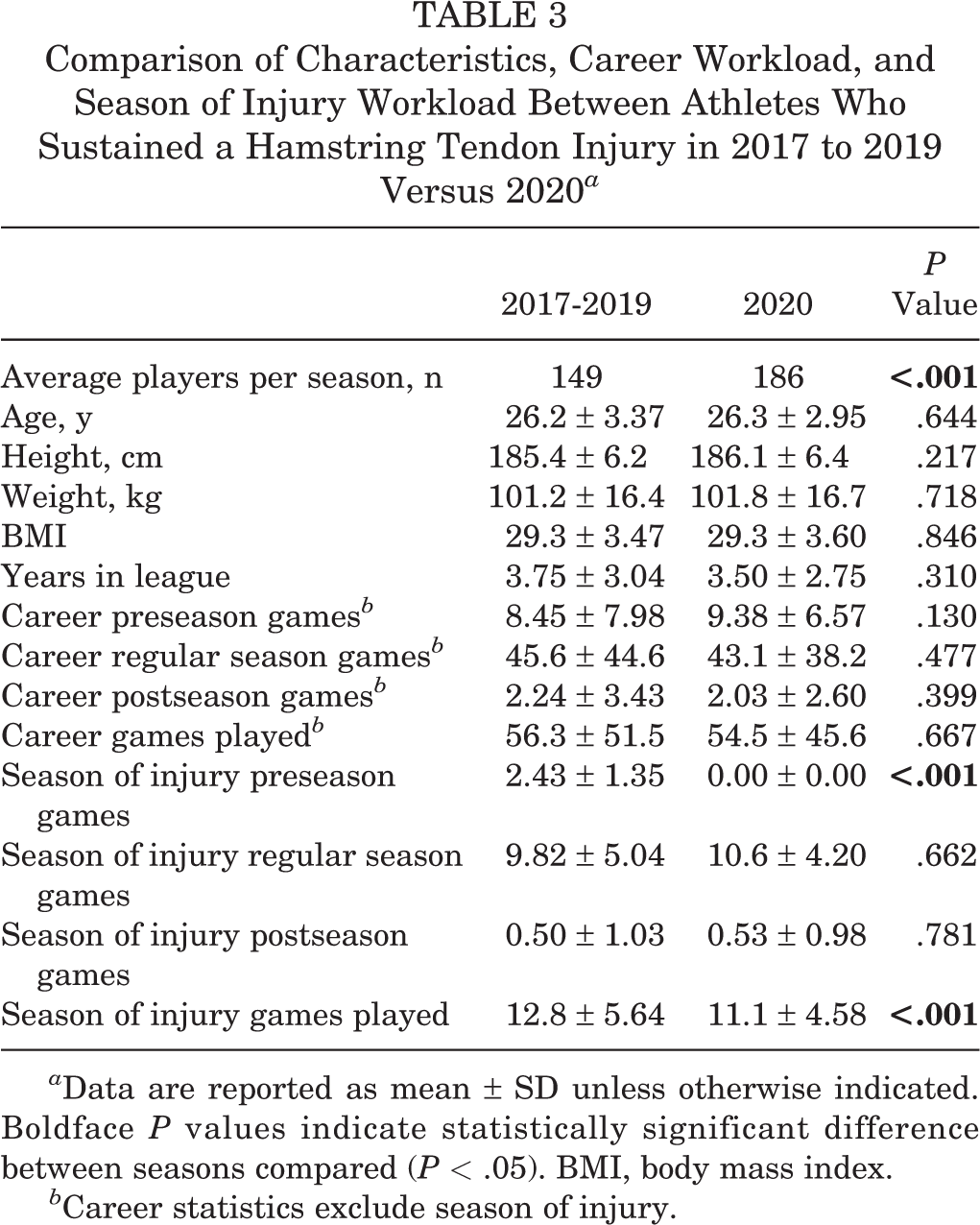
a Data are reported as mean ± SD unless otherwise indicated. Boldface P values indicate statistically significant difference between seasons compared (P < .05). BMI, body mass index.
b Career statistics exclude season of injury.
Breakdown of hamstring tendon injury by quarter of the NFL season is depicted in Figure 3. The most common period for sustaining a hamstring tendon injury was in weeks 1 to 4 for both 2017 to 2019 (30.9%) and 2020 (29.6%).

Number of athletes in the NFL who sustained a hamstring tendon injury during each quarter of the NFL season, average of 2017 to 2019 versus 2020. NFL, National Football League; Wk, week.
A breakdown of injuries sustained by position is presented in Table 4. No statistical analysis was performed for injuries based on position.
Breakdown of ACL, Achilles Tendon, and Hamstring Tendon Injuries by Position, 2017 to 2019 Versus 2020 a
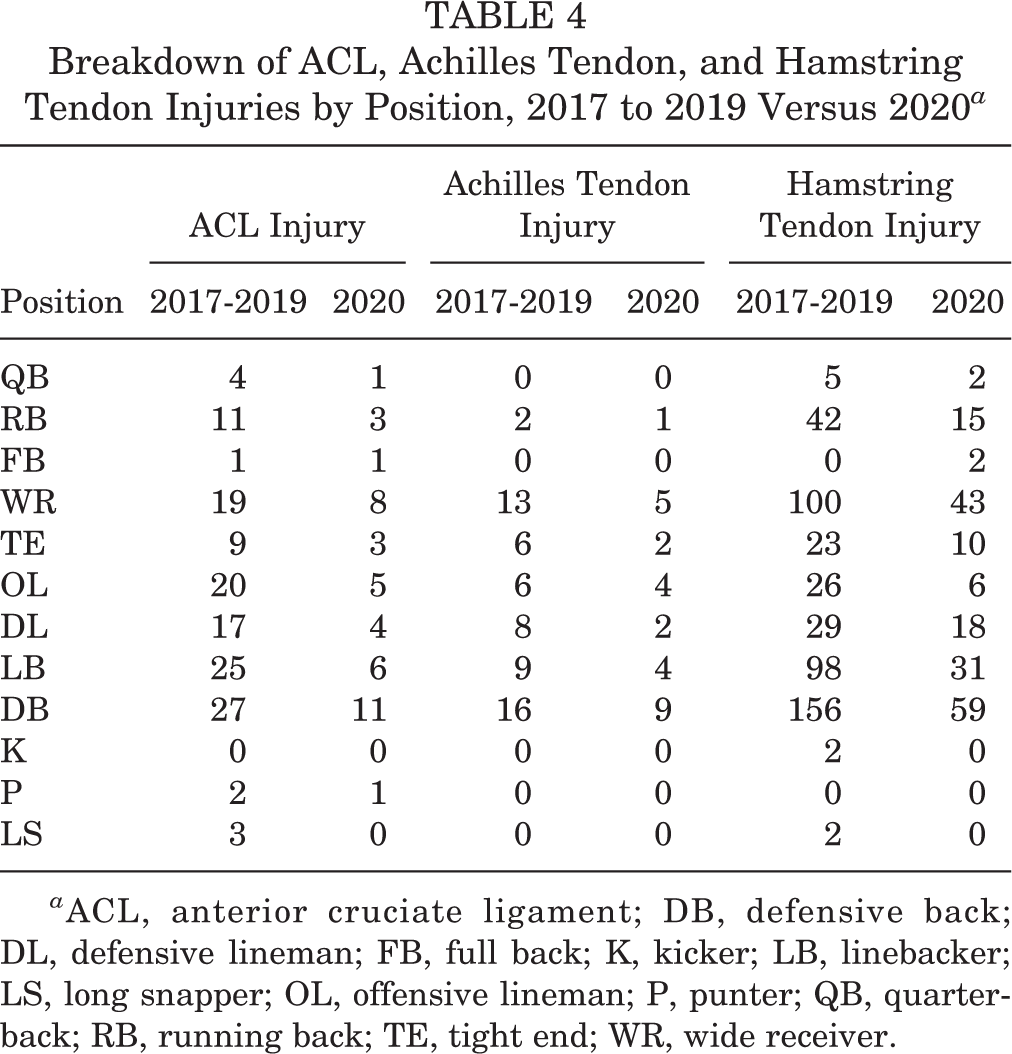
a ACL, anterior cruciate ligament; DB, defensive back; DL, defensive lineman; FB, full back; K, kicker; LB, linebacker; LS, long snapper; OL, offensive lineman; P, punter; QB, quarterback; RB, running back; TE, tight end; WR, wide receiver.
Discussion
The COVID-19 pandemic challenged the NFL in an unprecedented manner. Alongside new health and safety regulations regarding the virus, players had to face unique sporting challenges, including cancellation of the entire preseason. Our hypothesis was partially confirmed, as the number of ACL injuries remained constant while the number of Achilles tendon and hamstring tendon injuries sustained in the 2020 NFL season rose compared with previous seasons.
Cancellation of the entire preseason reduced the number of overall games, excluding playoffs, from 320 to 256 in 2020. Although, anecdotally, preseason games are played at a lesser intensity than are regular season games, the majority of ACL and Achilles tendon injuries occur in a game setting rather than practice. 19,20 In contrast, hamstring injuries are sustained more commonly in practice. 9 Reducing the number of athlete game exposures should, in theory, decrease the number of injuries sustained; however, the results of this study showed that injuries either remained constant or rose. Furthermore, due to new COVID-19 regulations, NFL teams were allowed to carry only 80 players on their roster during the 2020 preseason, as opposed to 90 players for the 2017 to 2019 seasons.
During the COVID-19 lockdown, NFL athletes may not have had the ability, or access to resources, to ensure that they were adequately prepared for the rigors of the NFL season. Limited access to coaches and sports medicine personnel (physical therapists, strength and conditioning coaches, etc) as well as training equipment may have affected an athlete’s training capacity. Recommendations have been published to guide return to sports after the pandemic, highlighting the need to maintain physical and mental health. 2,4,6,23,27 Athletes who do not maintain health may be at increased risk of musculoskeletal injury. Hamstring injuries, in particular, have been noted to recur approximately one-third of the time, with the greatest risk appearing in the first 2 weeks after return to sport. 11,25,26 It is also possible that, regardless of preseason and regimented training regimes, a certain number of injuries will always occur given the intensity of professional football. As there was no preseason in 2020, the first 4 weeks of the regular season in 2020 could be compared with the preseason in previous years (the first 4 games in which players were involved). While these games are not the same intensity, they are still games and not practice. As such, injuries that occurred during weeks 1 to 4 of the 2020 NFL season may have occurred during the preseason of previous seasons, which could be the reason more regular season injuries were seen in 2020. Furthermore, a lack of a preseason in 2020 may also have contributed to the difference in injury rates during the first part of the 2020 season.
Studies have found that 6- or 7-week training programs can produce significant increases in lean body mass and decreases in fat mass and can allow football players to return to peak training performance. 1,13 Furthermore, soft tissue injuries have been noted with increased workloads (typical during the preseason), fatigue, and alterations in training programs. 9,12,17 Allowing players to have an adequate training period that gradually increases in intensity may promote lower injury rates, something that was not possible in 2020 because of COVID-19.
Although the sporting world is returning to normal after the pandemic, results from this study may allow us to gain perspective on the importance of a preseason and training regimens. Although we acknowledge that there are many cofounding factors, including the COVID-19 pandemic, a lack of a preseason did not decrease the number of ACL, Achilles tendon, and hamstring tendon injuries. The past 2021 NFL season had both shortened the preseason and extended the regular season by 1 game. Further research to analyze the effect of this on player injury is warranted, and 2021 will provide interesting data on this subject.
Limitations
Our study had limitations. Information obtained from publicly available databases and websites are only as accurate as the information reported. Some injuries, especially minor injuries, are often underreported in an effort to keep players eligible for future games. If a player’s injury was not publicly reported, that player was not included in this study. Furthermore, information regarding specific training programs for each individual team/player, whether self-directed or team directed, is lacking; therefore, no conclusions can be drawn in regard to injury and type of training program.
Conclusion
In the 2020 NFL season, the number of Achilles tendon and hamstring tendon injuries rose while the number of ACL injuries remained constant compared with the 2017 to 2019 seasons. Injuries that occurred during the first 4 games of the 2020 NFL season were consistent, with higher rates of injuries seen in the preseason in previous years.
Footnotes
Final revision submitted January 2, 2022; accepted February 8, 2022.
One or more of the authors has declared the following potential conflict of interest or source of funding: M.E.B. has received grant support from Arthrex, education payments from Arthrex and Smith & Nephew, and hospitality payments from Stryker. B.J.E. has received education payments from Arthrex, DePuy, Pinnacle, and Smith & Nephew and consulting fees from Arthrex. AOSSM checks author disclosures against the Open Payments Database (OPD). AOSSM has not conducted an independent investigation on the OPD and disclaims any liability or responsibility relating thereto.
Ethical approval was not sought for the present study.