




Abstract
Background:
Citation analysis reflects the influence a work has on a field of research and can be used to identify “classic” works and their qualities in medical specialties. By analyzing the characteristics of these works, we intended to determine what qualities make for a highly cited work in pediatric orthopaedic sports medicine.
Purpose:
To identify the top 25 most cited articles in the field of pediatric orthopaedic sports medicine.
Study Design:
Cross-sectional study.
Methods:
The Science Citation Index Expanded feature within the Web of Science database was searched using a Boolean string, generating 2008 pediatric orthopaedic sports medicine articles arranged by number of citations. The top 25 most cited articles were reviewed for authors, year of publication, source journal, country of origin, region of origin, diagnosis or condition of focus, and level of evidence (LOE).
Results:
Most of the articles were published in the 2000s (range, 1992-2016). The mean number of citations was 166 (range, 119-329), and the mean citation density was 13.25 (range, 4.25-29.57). There were 18 of 25 studies performed in the United States. A plurality of the articles were published in the American Journal of Sports Medicine. The LOE ranged from 2 to 4, with the most common being level 2 (11/25). Anterior cruciate ligament (ACL) injury management (14/25) and epidemiological studies on the incidence of various sports injuries (6/25) were the most represented topics of study. Since the 1990s, the mean citation density for articles related to ACL injuries in young athletes and the epidemiology of sports injuries has been increasing.
Conclusion:
This evaluation demonstrated that ACL injuries and the epidemiology of sports injuries had the highest citation density of the most influential studies in pediatric orthopaedic sports medicine. We identified attributes such as country of publication, journal of publication, and LOE that make for a highly cited pediatric orthopaedic sports medicine article. Overall, citation density in pediatric sports medicine is increasing. Nonetheless, the most represented LOE in the most cited works is level 2, with no level 1 studies being represented in the top 25. In terms of both topics and LOE, this study allows surgeons to identify deficiencies in the existing literature and meaningfully design future studies to improve on these.
The number of citations is an important metric within academia, with the impact factor of a medical journal largely based on the number of times its authors are cited. 24 When mapped topographically, citations establish links between articles, authors, and journals to highlight leading experts whose work is valued and the most influential studies in each field. 25 For individual authors, the H-index, a metric for evaluating the cumulative impact of an author’s scholarly output and performance using the mean number of citations per publication, also demonstrates the impact citations have on identifying substantial contributors to a field. For the average researcher or clinician, the citation number offers a way to screen for relevant publications in their quest to remain up to date on their science or clinical knowledge. 36 Articles that identify and examine the characteristics of “classic works” allow for a greater understanding of what exact qualities make for an outstanding and impactful study. 17 As suggested by Baldwin et al, 5 lists such as these can be used by residency and fellowship directors as required or suggested readings for residents and fellows or by medical school advisors for prospective students interested in pursuing specific subspecialties.
According to the Pediatric Orthopaedic Society of North America, 45 years ago there were only 9 orthopaedic surgeons in the United States and Canada working exclusively with children. 29 Pediatric orthopaedic sports medicine has been an even newer area of subspeciality focus. In 1974, the first pediatric sports medicine clinic was founded at Boston Children’s Hospital. It was not until 2012 that the Pediatric Research in Sports Medicine Society was founded. While the body of literature within pediatric orthopaedic sports medicine continues to expand, existing literature in the field has yet to be thoroughly characterized. Additionally, while certain topics affect both young athletes and adults, there are specific topics of importance to pediatric patients almost exclusively, including but not limited to anterior cruciate ligament (ACL) tears in skeletally immature patients, osteochondritis dissecans, and overuse/apophysitis-type injuries, among others.
The aim of our study was to identify and characterize the most cited articles in the field of pediatric orthopaedic sports medicine, trends in topics covered, journals of impact, regional contributions, and citation density over time. We hypothesized that the rate of citation for articles would increase over time, that articles related to ACL injuries would be highly represented in our list, and that studies performed in the United States would be most common.
Methods
In October 2022, we searched the Science Citation Index Expanded feature within the Web of Science database (Thompson Reuters) using a Boolean string, generating 2008 pediatric orthopaedic sports medicine articles arranged by number of citations. Search details are outlined in Table 1. We included articles with patients ≤18 years of age primarily related to arthroscopy and/or pediatric and adolescent athletes with a focus on pediatric orthopaedic surgery. We excluded non–English-language studies, review articles, case reports, basic science articles, and primary care sports medicine topics such as concussion, expert opinions, and letters to editors. The 2 authors independently screened article abstracts to ensure relevance and compliance to inclusion criteria, followed by a full-text review of candidate studies.
Web of Science Search Parameters

We identified the top 25 most cited articles and recorded the following information: authors, year of publication, source journal, country of origin, region of origin, study design, diagnosis or condition of focus, and level of evidence (LOE). LOE was determined independently by each of the 2 reviewers according to the guidelines outlined by the Journal of Bone and Joint Surgery. 18 As detailed by Baldwin et al, 5 we calculated citation density as the number of citations divided by the number of years since publishing.
Results
The 25 most cited articles had 4169 citations combined. ‡ ACL injury management (14/25) § and epidemiological studies on the incidence of various sports injuries (6/25)9,11,15,31,32,34 were the most represented topics of study (Figure 1). These 2 topics alone encompassed 2208 and 1275 (83.5%) of the total citations, respectively. The remaining topics, osteochondritis dissecans (1/25), 35 meniscectomy (1/25), 20 femoroacetabular impingement (1/25), 30 knee articular cartilage injury (1/25), 22 and medial patellofemoral ligament injury (1/25), 26 comprised only 686 (16.5%) of the citations.

Number of articles by diagnosis and topic of focus. ACL, anterior cruciate ligament.
The mean number of citations was 166 (range, 119-329). The mean citation density was 13.25 (range, 4.25-29.57) (Table 2). The distribution of articles by decade showed a predominance of articles published in the 2000s, with the earliest published in 1992 and the most recent published in 2016 (Figure 2). John W. Powell and Allen F. Anderson were the most prolific authors on this list, comprising 881 (21%) of the total citations. In terms of geography, 18 of 25 articles originated from the United States (Table 3). Within the United States, regional contributions varied, with most studies coming from the Midwest (8/18) (Figure 3).
Top 25 Cited Pediatric Orthopaedic Sports Medicine Articles Published in Web of Science

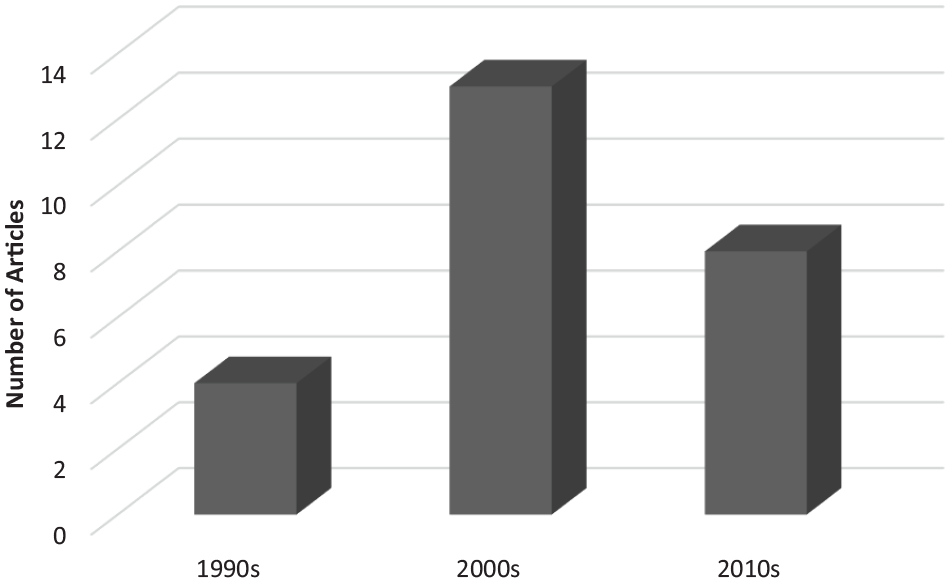
Number of articles by decade.
Article Distribution by Country of Origin


Article contributions by geographic region within the United States.
The 2 authors had 100% agreement on the LOE of included studies. The LOE ranged from 2 to 4, with the most common being level 2 (11/25) (Figure 4). None of the included studies had level 1 evidence. A plurality of the articles were published in the American Journal of Sports Medicine, while the remainder originated from a variety of general and subspeciality journals (Table 4).

Distribution of articles by level of evidence.
Source Journals for the Top 25 Most Cited Orthopaedic Pediatric Sports Medicine Articles

When comparing the article topics by citation density over the past 3 decades, articles related to ACL injuries and epidemiology of sports injuries have increased in citation density over time (Figure 5). The other topics in this list peaked in citation density in the 2000s except for femoroacetabular impingement, with its first publication on the list in the 2010s.

Citation density of article topics by decade. ACL, anterior cruciate ligament.
Since the 1990s, the mean number of citations for all articles on this list has been decreasing (Figure 6). However, when looking at mean citation density, which controls for the age of an article, there has been a trend of increasing citation density in more recent decades (Figure 7).

Mean number of citations by decade.
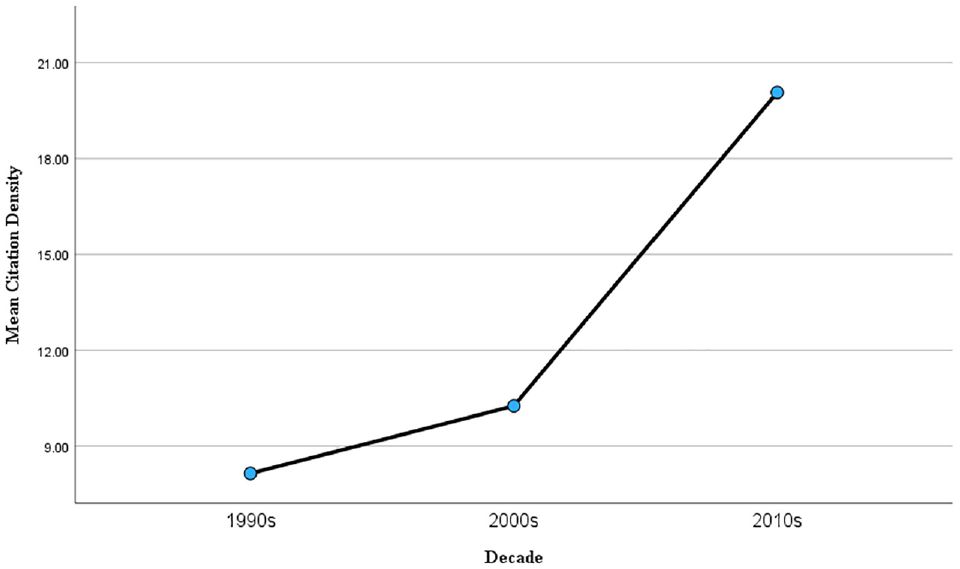
Mean citation density by decade.
Discussion
Our analysis revealed interesting trends among top articles in the field. Articles published more recently received more citations per year than articles from prior decades, with the mean rate increasing from 8.14 citations per year in the 1990s to 20.1 citations per year in the 2010s. This trend may be due to an expanding number of researchers and publications within pediatric orthopaedic sports medicine as well as a rapid advancement in the fund of knowledge in this relatively nascent field. 17 This upward trend in the rate of citation for articles in more recent decades was undetected using only citation number, lending further credibility to the utility of citation density. Our analysis also found an overwhelming influence of articles related to ACL injuries and the epidemiology of sports-related injuries in children. These 2 topics alone accounted for 83.5% of the citations on this list. ACL injuries may represent a focal topic of interest in pediatric orthopaedic sports medicine given the complexity and multiple approaches for addressing ACL tears in skeletally immature athletes. Nonetheless, the dominance of ACL injuries also represents a need to focus on other up-and-coming topics.
Most of the articles came from the United States, which was also the case in many other similar articles across medical fields.1,2,6,10,16 This might indicate that American authors may be at an advantage, especially those publishing out of the Northeast, Southeast, and Midwest. Publishing in the American Journal of Sports Medicine appears to be advantageous for having an influential article in this field, as 10 of the 25 included in this list were published in the American Journal of Sports Medicine. Topic of choice, such as focusing on ACL injury, may give an additional advantage, as papers on this topic were the most cited and had the highest rate of citation per year.
Citation number offers insight to the quality and impact of a study and is widely used in medicine.1,6,10 Additionally, calculating citation density can account for more recently published papers developing a high impact despite not having a longer “runway” since the time of publication. We determined that the pediatric orthopaedic sports medicine articles exerted the most citation influence on the field and what qualities make for such studies. By utilizing this list, program directors and medical school advisors have a resource to help guide their residents or students in familiarizing themselves with some of the most influential papers in pediatric orthopaedic sports medicine. Furthermore, this work allows our colleagues to identify potential areas of deficiency, either in classic papers with lower LOEs or in topics that are underrepresented but becoming more important.
While prior studies of the most cited pediatric orthopaedic works have been performed, pediatric orthopaedic sports medicine has not been well represented. In fact, Baldwin et al 5 performed a study that characterized the 50 most cited articles in pediatric orthopaedic surgery overall, and this list did not include a single pediatric sports medicine paper. This lack of inclusion may be due to a smaller cohort of practicing academic pediatric orthopaedic sports medicine surgeons who were active for less time than that of the entirety of the more established field of pediatric orthopaedics. Nonetheless, these study design limitations do not discount the existing pediatric orthopaedic sports medicine literature or the importance of identifying, studying, and improving on the most impactful papers in the field to date.
This study does have inherent limitations. First, this analysis did not account for authors referencing their own publications, for textbooks or lectures, or for authors choosing to reference studies in their target journals. Second, the categorical organization within the Web of Science database, although encompassing a complete list of the top orthopaedic journals, may have excluded any pediatric orthopaedic sports medicine papers published in nonorthopaedic medical journals, as well as journals not written in English. Last, there may be an inherent bias involved in citation analysis, in that topics that are viewed as popular may be more likely to be cited. Despite this bias, we suggest that citation analysis can be used to shift the focus of the literature onto less popular but still important topics. In the mid-2010s, the Pediatric Research in Sports Medicine Society Tibial Spine Fracture Research Interest Group identified that tibial spine fractures were understudied and set out to fill that gap in knowledge. 8 A search in PubMed over the past 2 decades found a clear increase in the number of studies on tibial spine fractures between 2013 and 2023 compared with the previous decade, which coincides with the efforts of the Tibial Spine Fracture Research Interest Group (Appendix Figure A1). Citation analysis can be used to identify similarly understudied topics and bring institutional resources to bear to further our understanding in these fields.
Conclusion
Our study showed that ACL injuries and the epidemiology of sports injuries had the highest citation density in our list of most cited studies in pediatric orthopaedic sports medicine. We identified attributes such as country of publication, journal of publication, and LOE that make for a highly cited pediatric orthopaedic sports medicine article. Overall, citation density in pediatric sports medicine is increasing. Nonetheless, the most represented LOE in the most cited works was level 2, with no level 1 studies being represented in the top 25. In terms of both topics and LOE, our study allows surgeons to identify deficiencies in the existing literature and meaningfully design future studies to improve on these.
Footnotes
Appendix
Final revision submitted October 5, 2023; accepted February 2, 2024.
One or more of the authors has declared the following potential conflict of interest or source of funding: R.J.M. has received nonconsulting fees from Philips Electronics North America Corporation; hospitality payments from Globus Medical and Medical Device Business Services; and consulting fees from OrthoPediatrics Corp and Philips Electronics North America Corporation. AOSSM checks author disclosures against the Open Payments Database (OPD). AOSSM has not conducted an independent investigation on the OPD and disclaims any liability or responsibility relating thereto.
Ethical approval was not sought for the present study.
