




Abstract
Background:
Oblique strains have become a common injury among professional baseball players. The influence of player workload on oblique strains remains unknown.
Purpose/Hypothesis:
To determine whether workload is a risk factor for oblique strains in professional baseball players. We hypothesized that fewer days of rest, more innings pitched/fielded per game, and more batters faced/plate appearances per game would significantly increase a player's risk of sustaining an oblique strain.
Study Design:
Case-control study; Level of evidence, 3.
Methods:
All professional baseball players who sustained an oblique strain between 2011 and 2017 were identified using the Major League Baseball Health and Injury Tracking System. A separate dataset of player usage—days of rest per game, innings pitched or fielded per game, and batters faced or plate appearances per game—was used to determine the workload. We compared these usage variables between player games ≤2, ≤6, ≤12, and >12 weeks before a documented oblique strain with player games from a control group of players with no oblique strains. In a paired analysis, we compared acute (player games ≤2, ≤6, and ≤12 weeks preinjury) versus chronic (player games >12 weeks preinjury) workloads.
Results:
There were 311 oblique strains in pitchers and 392 oblique strains in position players during the study period. In pitchers, more innings pitched and more batters faced were associated with a subsequent oblique strain (P < .001 for all). In position players, fewer days of rest, more innings fielded, and more plate appearances were associated with a subsequent oblique strain (P < .001 for all). Pitchers who pitched ≥7 innings per game had a 2.4-fold (95% CI, 1.4-4.9) increased risk of subsequent oblique strain compared with those who pitched 1 inning per game. The percentage of position players with a subsequent oblique strain increased by 2.1-fold (95% CI, 1.3-3.5) with >4 plate appearances compared with 1 plate appearance per game.
Conclusion:
Our analysis demonstrated that workload was associated with an increased risk of sustaining an oblique injury in professional baseball players. High workload over time was more predictive of oblique strains compared to acute increases over chronic baseline workload.
Injury rates in professional baseball players, specifically pitchers, have increased in recent years. 3 To decrease injury rates, there has been a recent push to identify modifiable risk factors for injury in this cohort of athletes. Many studies to date have focused on risk factors for common shoulder and elbow injuries, particularly injuries that often require surgical intervention and a prolonged rehabilitation process, such as ulnar collateral ligament tears.7,8,11,12
While shoulder and elbow injuries are common causes of disability in professional baseball players, oblique strains can also lead to significant dysfunction and time missed, with studies reporting a mean time missed of 21 days.1,3 Unfortunately, oblique strains have been increasing in professional baseball players over the past 15 years, and while these injuries are often managed nonoperatively, the recurrence rate has been cited 4 at 12%. Furthermore, oblique strains are among the top 5 most common injuries in professional baseball players. 3 Despite the high prevalence of these injuries, risk factors for oblique strains have not been well defined in professional baseball players.
This study aimed to determine whether the number of days of rest between games, the number of innings pitched/fielded in each game, and the number of batters faced or plate appearances in each game were risk factors for oblique strains in professional baseball players. We hypothesized that fewer days of rest, more innings pitched/fielded per game, and more batters faced/plate appearances per game would significantly increase a player's risk of sustaining an oblique strain.
Methods
This study was performed with the approval of the Major League Baseball (MLB) Research Committee and our institutional review board. The MLB provided 2 deidentified datasets. The first was a list of all injuries reported in the MLB Health and Injury Tracking System (HITS) database for the 2011 through 2017 seasons. The HITS, developed as a league-wide injury surveillance system in 2010 to record player injuries and injury time, is a centralized database that contains deidentified player information. 10 It has been used in several previous studies and has been found to be a reliable source of information.1,2,5,6 The second dataset was a record of player usage between 2011 and 2017. This dataset provided information on the number of batters faced or plate appearances per game for each player, games played, innings pitched, game date, and innings fielded per game. Each player was assigned a unique identification number that allowed the information from both datasets to be linked. The first dataset was reviewed to find all unique injuries described or classified as oblique strains. Duplicates were eliminated. The player-usage dataset included the game date, the number of innings pitched or fielded per game, and the number of batters faced or plate appearances per game for each player. From these, the number of days between each game played and the previous game for that player was calculated to determine the days of rest each player had before each game. Gaps of <175 days were excluded to avoid rest between seasons.
Each game for each player was then considered as an independent injury exposure. Each player game was classified into 1 of the following exposure groups: (1) a player who did not have an oblique strain (control group); (2) a player who had an oblique strain ≤2 weeks after the game; (3) a player who had an oblique strain ≤6 weeks after the game; (4) a player who had an oblique strain ≤12 weeks after the game; (5) a player who had an oblique strain >12 weeks after the game; or (6) a player who had an oblique strain before the game. The last group was excluded to avoid data related to rehabilitation after injury.
Statistical Analysis
All analyses were conducted in Excel Version 16 (Microsoft) and SPSS Version 26 (IBM). All data were evaluated for normality using the Kolmogorov-Smirnov test, and parametric and nonparametric tests were used as indicated. We compared the days of rest per game, the innings pitched or fielded per game, and the batters faced or plate appearances per game between the control group (player games with no oblique strain) and each of the injury groups (player games ≤2, ≤6, ≤12, and >12 weeks before a documented oblique strain) using Student t tests and Mann-Whitney U tests, as appropriate. We also compared whether the player's exposure was as a starting pitcher or as a relief pitcher for each injury period using the chi-square test and calculated relative-risk ratios based on these 2 × 2 tables.
To determine whether there was an acute change in rest and workload over baseline chronic injury risk, we conducted a paired analysis of days of rest, innings pitched/fielded, and batters faced/plate appearances for each player. A workload ≤12 weeks of injury (≤2, ≤6, or ≤12 weeks preinjury) was defined as acute, while a workload >12 weeks from injury was defined as chronic. The comparison of acute versus chronic baseline workloads was made using paired-samples Student t tests and related-samples Wilcoxon signed-rank tests, as indicated by data normality.
Results
During the 7-year study period, 805 cases of oblique strains were recorded in the MLB HITS database, accounting for 2.4% of the 33,592 injuries within the dataset. After eliminating duplicates, 703 unique cases of oblique strains were provided. These 703 players included 311 (44%) pitchers and 392 (56%) position players. Among the pitchers, 109 (35%) had right-sided injuries and 202 (65%) had left-sided injuries; 226 (73%) were right-handed throwers and 85 (27%) were left-handed throwers; and 115 (37%) were major league players at the time of the injury and 196 (63%) were minor league players. The players had a mean age (±SD) of 26 ± 4 years at the time of the injury. These injuries resulted in 28 ± 32 days missed.
Of the 1,046,755 player games, 20% (205,847) were with a player who had an oblique strain at some point during his career; 0.3% (3082) of the games were ≤2 weeks before the injury, 0.8% (8,355) were ≤6 weeks before the injury, 1.3% (14,072) were ≤12 weeks before the injury, and 7.4% (77,318) were >12 weeks before the injury. Of the included games, 28.1% (77,230/275,139) were of a starting pitcher.
Pitchers
No significant differences were found in days of rest when comparing player games ≤2 weeks and ≤6 weeks preinjury with player games in which no oblique strain was sustained (control group). However, there were significantly more days of rest within player games ≤12 weeks and >12 weeks preinjury compared with the control group (P < .001 for both) (Table 1). No significant differences were found in days of rest when comparing player usage data from acute workloads (player games ≤2, ≤6, or ≤12 weeks preinjury) with the baseline chronic workload (player games >12 weeks preinjury) (Table 2). However, a relationship was found between days of rest and the percentage of player games followed by an oblique strain <12 weeks later, such that pitchers with >5 days of rest had a 1.54-fold (95% CI, 1.03-2.4) higher risk of a subsequent oblique strain than pitchers with 1 day of rest (Figure 1A).
Comparison of Pitcher Usage Data Between the Control and Injury Groups a

Data are presented as mean ± SD. Bold P values indicate statistically significant differences between the control and injury groups (P < .05, Mann-Whitney U test). BF, batters faced; DR, days of rest; IP, innings pitched.
Within-Pitcher Paired Analysis of Usage Data Between Baseline Chronic (>12 Weeks) and Acute (≤2, ≤6, and ≤12 Weeks Preinjury) Workloads a
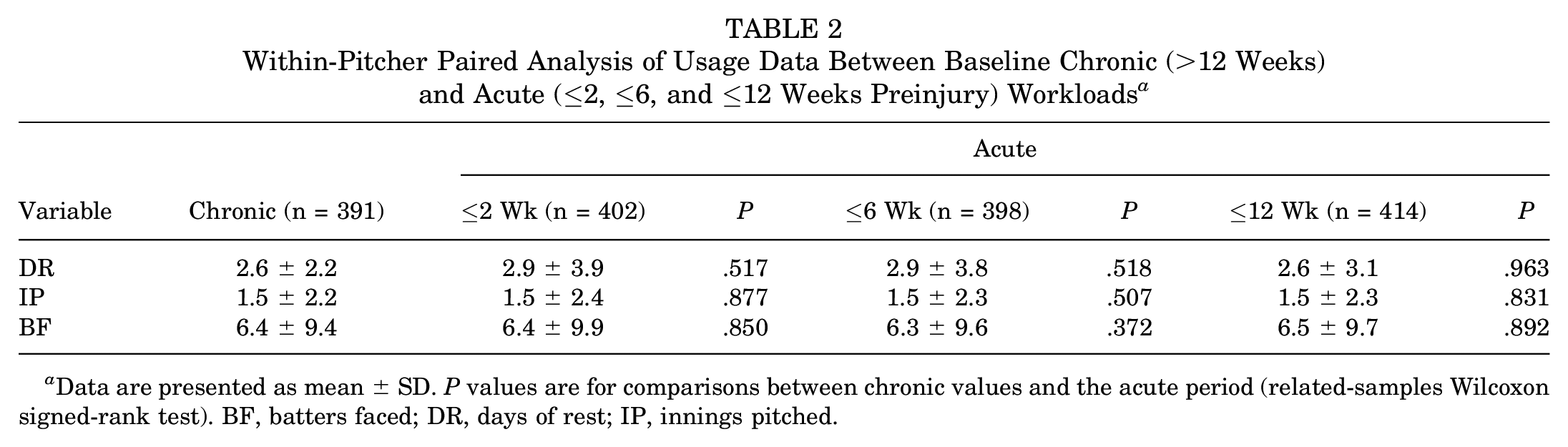
Data are presented as mean ± SD. P values are for comparisons between chronic values and the acute period (related-samples Wilcoxon signed-rank test). BF, batters faced; DR, days of rest; IP, innings pitched.
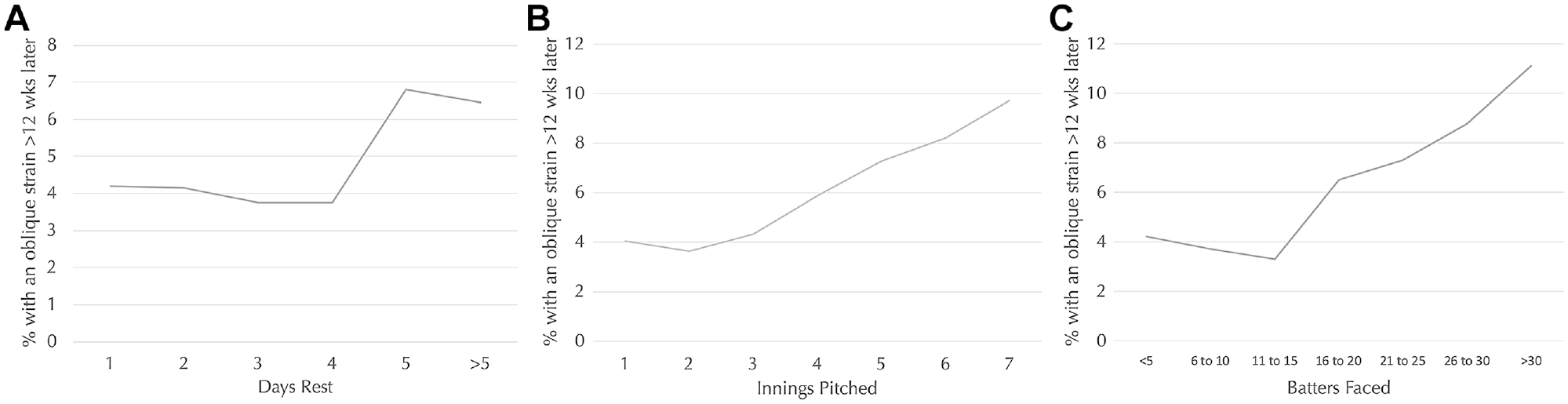
Percentage of pitchers with an oblique strain >12 weeks after a player game according to (A) the number of days of rest between each game, (B) the number of innings pitched per game, and (C) the number of batters faced per game.
There were significantly more innings pitched in the player games ≤2, ≤6, ≤12, and >12 weeks preinjury compared with player games in which there was no oblique strain (P < .001 for all) (Table 1). However, this difference was not significant when comparing acute workloads with baseline chronic workload (Table 2). A clear dose-response relationship was found between innings pitched and the percentage of players with an oblique strain <12 weeks later, such that pitchers who pitched ≥7 innings had a 2.4-fold (95% CI, 1.4-4.9) higher risk of a subsequent oblique strain than those who pitched 1 inning (Figure 1B).
There were significantly more batters faced in the player games ≤2, ≤6, ≤12, and >12 weeks preinjury than there were in player games in which there was no oblique strain (P < .001 for all) (Table 1). This difference was not significant when comparing acute workloads with baseline chronic workload (Table 2). Also, a clear dose-response relationship was found between batters faced and the percentage of players with an oblique strain <12 weeks later, such that pitchers who faced >30 batters had a 2.64-fold higher risk of a subsequent oblique strain than those who faced <5 batters (Figure 1C).
There were significantly more starting pitchers within player exposures ≤2, ≤6, ≤12, and >12 weeks preinjury compared with the control-group player exposures (P < .001 for all) (Table 3).
Comparison of Starting Pitchers in Injury Versus Control Groups a
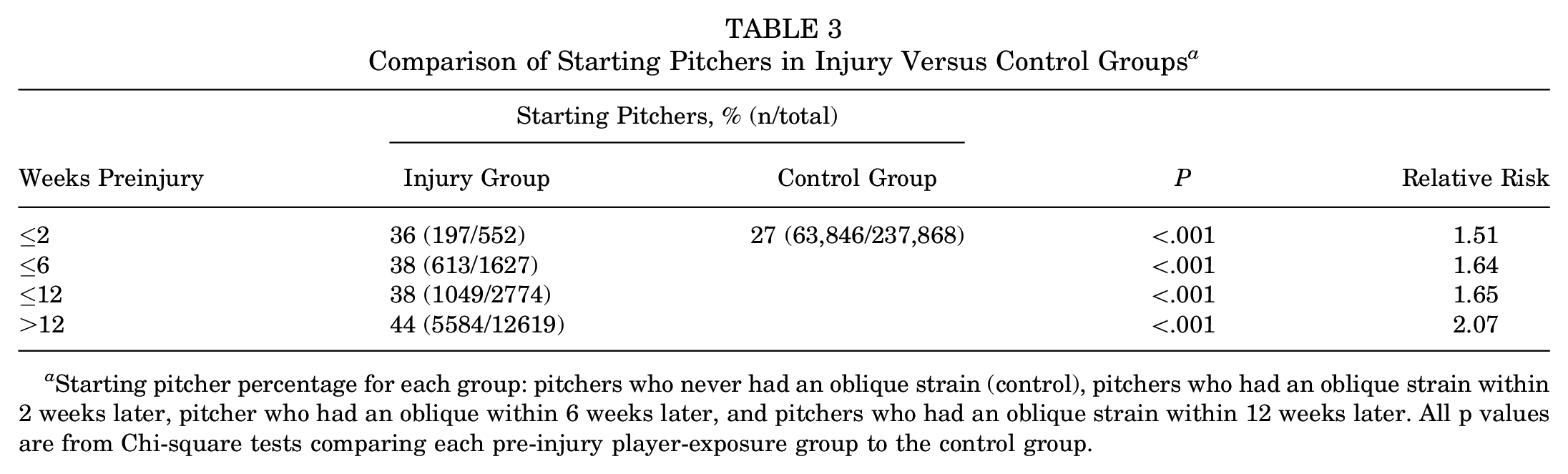
Starting pitcher percentage for each group: pitchers who never had an oblique strain (control), pitchers who had an oblique strain within 2 weeks later, pitcher who had an oblique within 6 weeks later, and pitchers who had an oblique strain within 12 weeks later. All p values are from Chi-square tests comparing each pre-injury player-exposure group to the control group.
Position Players
There were significantly fewer days of rest in the player games ≤2, ≤6, ≤12, and >12 weeks preinjury than there were in the player games in which there was no oblique strain (P < .001 for all) (Table 4). This difference was not significant when comparing data between acute and baseline chronic workloads (Table 5). There was a clear dose-response relationship between days of rest and the percentage of player games followed by an oblique strain <12 weeks later, such that players with a mean of 1 rest day between games had a 1.5-fold (95% CI, 1.1-2.3) higher injury risk versus those with a mean of >5 days of rest (Figure 2A).
Comparison of Position Player Usage Data Between the Control and Injury Groups a

Data are presented as mean ± SD. Bold P values indicate statistically significant differences between the control and injury groups (P < .05, Mann-Whitney U test). DR, days of rest; IF, innings fielded; PA, plate appearances.

Percentage of position players with an oblique strain >12 weeks after a player game according to (A) the number of days of rest between each game, (B) the number of innings fielded per game, and (C) the number of plate appearances per game.
There were significantly more innings fielded within player games ≤2, ≤6, ≤12, and >12 weeks preinjury compared with player games in which there was no oblique strain (P < .001 for all) (Table 4); this difference was not significant when comparing acute with baseline chronic workloads (Table 5). There was a dose-response relationship between innings fielded and the percentage of players with an oblique strain <12 weeks later, such that in those who fielded >9 innings per game on average, the likelihood of a subsequent oblique strain was 1.9-fold (95% CI, 1.1-3.8) higher than in those who fielded 1 to 2 innings per game on average (Figure 2B).
Within–Position Player Paired Analysis of Usage Data Between Chronic (>12 Weeks) and Acute (≤2, ≤6, and ≤12 Weeks Preinjury) Workloads a

P values are for comparisons between chronic values and the acute period (related-samples Wilcoxon signed-rank test). DR, days of rest; IF, innings fielded; PA, plate appearances.
There were significantly more plate appearances in player games at ≤2, ≤6, ≤12, and >12 weeks preinjury compared with player games in which there was no oblique strain (P < .001 for all) (Table 4). However, this difference was not significant when comparing acute workloads with baseline chronic workload (Table 5). A clear dose-response relationship was found between plate appearances and the percentage of players with an oblique strain <12 weeks later, such that players with <4 plate appearances per game on average had a 2.1-fold (95% CI, 1.3-3.5) increase in the percentage of players with a subsequent oblique strain compared with those with 1 plate appearance per game (Figure 2C).
Discussion
Oblique strains are a common cause of pain and dysfunction in professional baseball players and have increased in incidence over the past several years. 1 The primary findings of this study were that players with more innings pitched/fielded per outing and more batters faced/plate appearances per outing were at significantly increased risk of sustaining an oblique strain (P < .001 for all). However, our hypothesis was incorrect, as more, and not fewer, days of rest between outings for pitchers were associated with an increased risk of sustaining a subsequent oblique strain (P < .05). We speculate this result is likely because having more days of rest correlates with being a starting pitcher, which secondarily correlates with pitching more innings and facing more batters in each outing.
Oblique strains in baseball players have been well-documented injuries over the past several years.1,3,4 Camp et al 3 used the MLB HITS database to report all injuries in professional baseball players between 2011 and 2016. These authors found that oblique strains were the fifth most common injury in all of baseball, accounting for 1249 injuries and a total of 24,429 days missed over the study period. The mean number of days missed for all players from an oblique strain was 21.4 days. In the present study, we found that in pitchers, the mean number of days missed for an oblique strain was higher at 28 days. This suggests pitchers take longer to return to play from an oblique strain than position players. Camp et al also broke the oblique strains down by position and mechanism and reported that 41.4% of these injuries were in pitchers and 41.6% of all oblique strains occurred while pitching or throwing.
A pitcher's risk of sustaining an oblique injury rose as the mean number of batters faced per game and the mean number of innings pitched per game increased, with a similar increase in risk with both variables. This rise is likely multifactorial and includes player fatigue, which contributes to changes in mechanics later in games. Interestingly, the risk of sustaining an oblique strain was significant when the injured pitchers’ workload was compared with the control pitchers’ workload throughout the study period. However, when acute workload over the course of 2, 6, and 12 weeks was compared with chronic workload over a >12-week span, increases in batters faced and innings pitched were not associated with an increased risk of sustaining an oblique strain. This was seen in position players as well. This finding indicates oblique strains may be more commonly a product of chronic overuse than a particular acute event. This concept may impact injury mitigation strategies. While monitoring players’ usage in the acute setting with plate appearances, days off, and innings fielded is important, the more important aspect may be limiting the overall baseline workload for these players to decrease the number of oblique strains in particular.
Conversely, one of the more interesting findings from this study was that more days of rest were not associated with a decreased risk of sustaining an oblique strain but rather conferred a higher risk when days of rest were averaged over the course of >12 weeks. This could be due to multiple variables. First, it could be because starting pitchers, who typically have more days of rest between outings compared to relievers, were more likely to sustain an oblique strain. However, it could also be due to decreased conditioning when pitchers are not used on a regular basis.
Oblique strains have not been well studied in the literature. Marshall et al 9 reported core and hip injuries in professional baseball players. They found that core injuries accounted for 14% of all injuries during 2014 and 2015 and that the mean time missed for a core injury was 47 days. In this study, core injuries involved back spasms, oblique strains, intercostal strains, and others. Interestingly, oblique, abdominal, and intercostal strains accounted for 30 of the 63 core injuries. They did not find an association between workload and core injuries. This is in contrast to the findings of this study, in which workload was associated with increased risk for oblique strains. This difference is likely due to the tremendous number of players included in this study and the fact that oblique injuries were separated out in the present study but were grouped into core injuries in the previous study.
These findings indicate that pitching more frequently (fewer days of rest ) but for shorter periods during each outing (fewer innings and fewer batters faced) may decrease a player's risk of sustaining an oblique strain. Furthermore, acute changes in workload do not seem to be as significant of a predictor of sustaining an oblique strain as chronic workload over a player's career. As such, it may be more important to monitor a player's workload throughout entire seasons rather than in a snapshot of several weeks within 1 season. Changes to the present pitching structure may help prevent oblique strains; however, further work is needed to understand whether altering current pitching practices translates to fewer injuries.
Limitations
While the physicians, trainers, and therapists who entered information into the datasets that were used in this study took great care in entering information correctly, it is possible that there were inaccuracies during information entry. However, even if this did occur, it is unlikely that this would have significantly affected the results, given the size of the datasets. It is possible that a player could have suffered from an oblique strain in a previous game to the one listed as their injury game but was able to continue playing with this strain for ≥1 games until reporting the injury. Finally, this study did not evaluate injury-prevention mechanisms, which may include optimization of throwing mechanics, increasing core strength and flexibility, improving hip rotation, and others. Further work is needed in this area.
Conclusion
Our analysis demonstrated that workload was associated with an increased risk of sustaining an oblique injury in professional baseball players. High workload over time is more predictive of oblique strains in baseball players than acute increases over chronic baseline workload.
Footnotes
Acknowledgements
The authors acknowledge the Professional Baseball Athletic Trainers Society for their continued efforts to update the MLB injury database and provide care for these athletes.
Final revision submitted September 1, 2023; accepted November 13, 2023.
One or more of the authors has declared the following potential conflict of interest or source of funding: P.N.C. has received education payments from Active Medical; consulting fees from DePuy Synthes/Medical Device Business Services, Encore Medical, and Responsive Arthroscopy; nonconsulting fees from Arthrex; and hospitality payments from Smith+Nephew. B.J.E. has received grant support from Arthrex; education payments from Pinnacle, Arthrex, and Smith+Nephew; consulting fees from Arthrex and DePuy Synthes; nonconsulting fees from Arthrex; and hospitality payments from Linvatec and Stryker. AOSSM checks author disclosures against the Open Payments Database (OPD). AOSSM has not conducted an independent investigation on the OPD and disclaims any liability or responsibility relating thereto. This study was approved by the MLBPA.
Ethical approval for this study was obtained from the University of Utah (ref No. 00114699).
