




Abstract
Background:
The orthopaedic in-training examination (OITE) is a 275-question test for orthopaedic residents administered annually. As the field of orthopaedics changes, the OITE evolves its content. The incidence of hip preservation–related procedures has increased substantially over the past decade; nonetheless, an analysis of the trends of hip preservation questions on the OITE has not yet been performed.
Purpose/Hypothesis:
The purpose of the study was to evaluate the number and type of questions on the OITE related to hip preservation to determine whether trends over time paralleled the increases in hip-related care in clinical practice. It was hypothesized that the frequency of hip preservation questions on the OITE would increase with time.
Study Design:
Cross-sectional study.
Methods:
Each OITE between 2002 and 2021 was reviewed for questions related to hip preservation. The types of questions included under “hip preservation” were those related to femoroacetabular impingement (FAI), athletic soft tissue injuries of the hip, acetabular labral tears, hip arthroscopy, and surgical management of adult hip dysplasia—excluding arthroplasty. Questions were quantified and categorized by topic, taxonomy level, associated imaging, and cited sources.
Results:
There were 30 hip preservation–related questions between 2002 and 2021. Of these, 77% occurred within the past 10 years. Also, 14 questions (47%) had associated images in the question stem—the most common being radiographs (n = 8 questions). The most commonly tested subcategories were FAI (n = 11 questions [37%]), athletic injuries (n = 7 questions [23%]), and anatomy (n = 7 questions [23%]). Over the last 10 years, 97.9% of citations were from journal articles—the most common being the Journal of the American Academy of Orthopaedic Surgeons, Clinical Orthopedics and Related Research, and the American Journal of Sports Medicine.
Conclusion:
The frequency of hip preservation–related questions on the OITE has increased with time, reflecting trends in clinical practice.
The orthopaedic in-training examination (OITE) is a 275-question test for orthopaedic residents administered annually. Developed by the American Academy of Orthopaedic Surgeons (AAOS), the OITE is designed to assess an orthopaedic surgery trainee’s knowledge each year in 11 primary content areas—including trauma, sports, spine, basic sciences, hip and knee, and pediatrics. Test performance outcomes are used by residency programs to guide orthopaedic resident education at both an individual and program-wide level. Test items are created by skilled orthopaedic surgeons and further reviewed by expert physician committees for relevancy and accuracy. 14 The OITE is considered vitally important in orthopaedic resident training, and research has shown a correlation between OITE performance and success on the American Board of Orthopaedic Surgery parts I and II. 5 Multiple previous studies have examined which topics are tested most frequently, the taxonomy of these questions, and the commonly used references for certain topic subgroups.1,6,15,18,19,22 A primary goal of these studies is to assist residents and residency programs with effective and efficient preparation for the examination. A secondary goal is to gauge whether this important annual examination reflects current and changing clinical practices within orthopaedic surgery.
As the field of orthopaedic surgery continues to change, the OITE has also evolved in the number of questions and content focus to reflect current trends in surgical practice. For example, the percentage of hip- and knee-related questions on the OITE increased significantly between 2005 and 2019, which parallels the increase in demand for primary total hip and knee arthroplasties.7,15 The past several years have seen a steady rise in the utilization of hip arthroscopy and related hip preservation procedures to treat common sources of hip pain—such as labral tears, articular cartilage lesions, and femoroacetabular impingement (FAI).4,23 Hip arthroscopy rates increased from 3.6 per 100,000 to 16.7 per 100,000 between 2005 and 2013, and the overall incidence of hip arthroscopy increased 600% between4,11 2006 and 2010. With the rise of these procedures, OITE questions related to hip arthroscopy and hip preservation will probably increase in the coming years to reflect clinical practice patterns.
In this study, we evaluated the number and type of hip preservation–related questions on the OITE over time to track trends in question volume and determine whether there had been increases on the OITE that paralleled the increases in hip-related care in clinical practice. This information is helpful for residents preparing for the examination and for orthopaedic residency program directors when establishing an educational curriculum that prepares residents for the examination.
Methods
Each OITE between 2002 and 2021 was reviewed for questions related to hip preservation. For the years 2002 to 2012, the OITE was accessed from an online archive of old examinations, answers, and references at a single academic residency institution. For the years 2013 to 2016, published AAOS OITE study guides were used to access test content; for the years 2017 to 2021, the AAOS education platform (ResStudy) was used to access test content from the previous year. The complete examination (N = 275 questions) was accessible and analyzed for the 2002-2016 OITE, while <275 questions were accessible and analyzed for the 2017-2021 examinations—a mean of 245.8 questions each year. This discrepancy is due to the retrospective removal of some OITE questions for various reasons, likely because of poor wording or based on scoring distributions after the test administration. In addition, starting in 2020, the American Board of Orthopaedic Surgery has been contributing a portion of questions to the OITE that are inaccessible to residents or residency programs.
Each available examination question was analyzed by 2 observers (E.L. and L.O.), and we quantified those as “hip preservation” if the question was related to FAI, athletic soft tissue injuries of the hip (anterior superior iliac spine avulsions, snapping hip, or core muscle injuries), labral tears, hip arthroscopy, and surgical management of adult hip dysplasia—excluding arthroplasty. The number of hip preservation questions was quantified for each year of the OITE.
An R2 value was calculated to measure the proportion of variation between the year and the number of hip preservation–related questions. Each question was further classified into 1 of several topic categories: dysplasia, FAI, anatomy, sports-related injuries, and miscellaneous. Anatomy questions specifically asked about the anatomic structures affected by the outlined hip preservation–related problems. We also categorized the questions based on their taxonomy level as described by Buckwalter et al, 1 in which taxonomy level 1 refers to questions involving direct recognition and recall of information, taxonomy level 2 involves questions requiring interpretation and comprehension of information or images, and taxonomy level 3 involves questions required problem solving, such as determining a treatment plan based on history or imaging findings.
We then analyzed the citations for each hip preservation question based on the citation type (journal, book) and source for the last 10 years of the OITE. The most commonly cited sources were reported.
Results
Over the course of 20 years of the OITE (2002-2021), there were 30 hip preservation–related questions. Each year, a mean of 1.5 questions were dedicated to hip preservation. On average, this represented 0.6% of all OITE questions during the study period. There was a positive correlation between time and the total number and percentage of hip preservation questions during the study period (R2 = 0.438 for both) (Figure 1).

(A) The absolute number of hip preservation questions on the OITE each year from 2002 to 2021. (B) The percentage of all hip preservation–related questions on the OITE each year from 2002 to 2021. OITE, orthopaedic in-training examination.
We found that 23 (77%) of the 30 hip preservation–related questions during the 20-year period occurred during the past 10 years (2012-2021) (Table 1). Also, 14 (47%) questions assessed direct recall (taxonomy level 1), 12 (40%) questions required interpretative skills (taxonomy level 2), and 4 (13%) questions required problem-solving skills (taxonomy level 3) (Table 2). Fourteen of the 30 questions (47%) had associated images in the question stem—the most common being radiographs (n = 8 questions), followed by arthroscopic images (n = 4 questions) (Table 3). The most commonly tested subcategories were FAI syndrome (n = 11 questions [37%]), athletic injuries (n = 7 questions [23%]), and anatomy (n = 7 questions [23%]) (Table 4).
Number of Hip-Preservation Questions by Year of OITE a

OITE, orthopaedic in-training examination.
Hip Preservation Questions According to Taxonomy Classification a

Taxonomy level 1: questions involving recall of information; taxonomy level 2: questions involving interpretation of information or imaging; taxonomy level 3: questions requiring problem-solving—such as determining a treatment plan based on a patient’s medical history or imaging findings. Dashes indicate zero questions.
There were no taxonomy classification questions in 2004, 2005, 2008, 2009, 2010, or 2013.
Hip-Preservation Questions Related to Types of Imaging a

Dashes indicate zero questions. CT, computed tomography; MRI, magnetic resonance imaging.
There were no hip preservation questions related to imaging in 2002-2010, 2013, 2016, or 2020.
Hip-Preservation Questions by Subclassification a
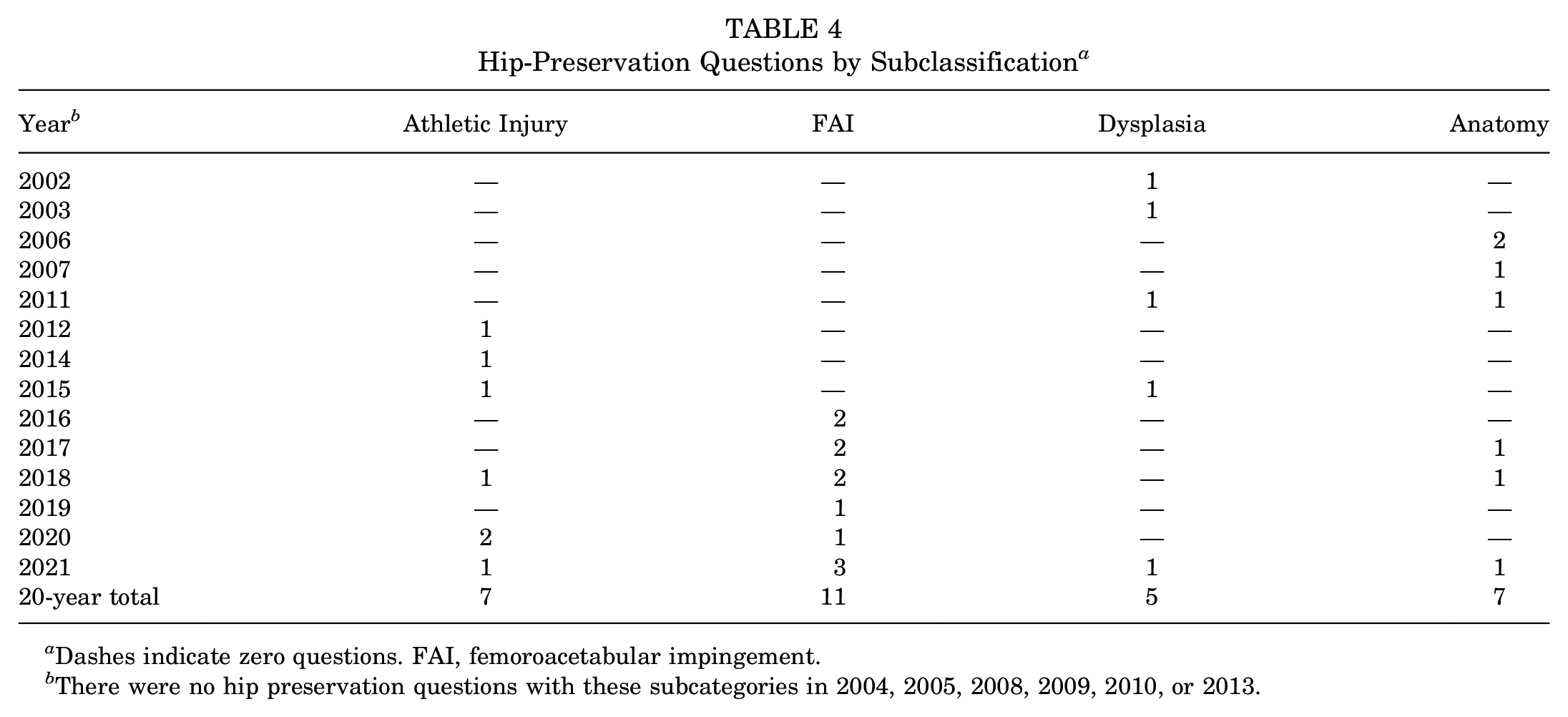
Dashes indicate zero questions. FAI, femoroacetabular impingement.
There were no hip preservation questions with these subcategories in 2004, 2005, 2008, 2009, 2010, or 2013.
Regarding hip preservation–related questions during the past 10 years of the OITE (n = 23 questions), there were 48 total citations: 1 citation (2.1%) was from a textbook, and 47 (97.9%) were from journal articles. The most commonly cited journals were as follows: Journal of the American Academy of Orthopaedic Surgeons (n = 10 citations [21% of all journal citations]); Clinical Orthopedics and Related Research (n = 9 citations [19% of all journal citations]); American Journal of Sports Medicine (n = 7 citations [15% of all journal citations]); and Arthroscopy (4 citations [8% of all journal citations]) (Table 5).
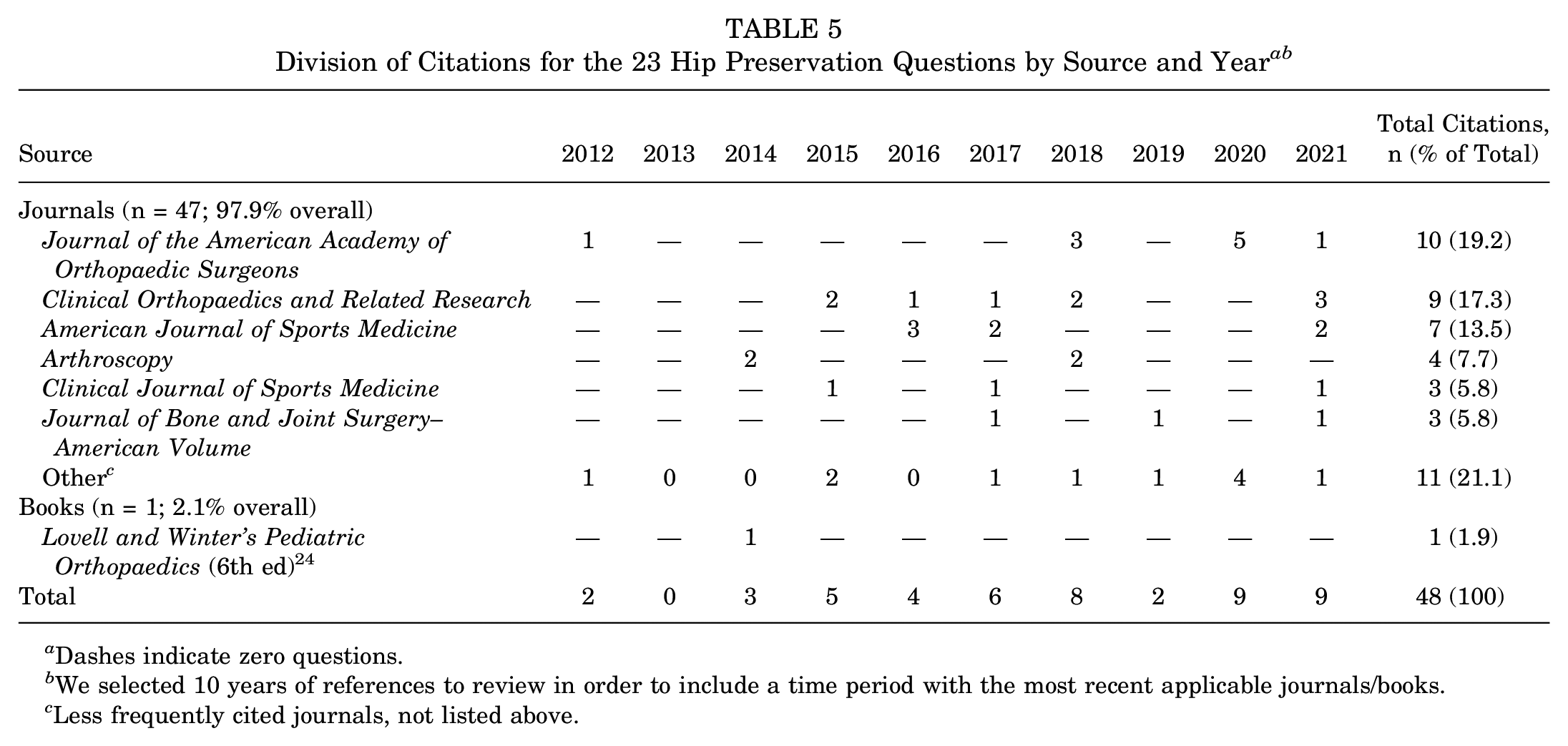
Dashes indicate zero questions.
We selected 10 years of references to review in order to include a time period with the most recent applicable journals/books.
Less frequently cited journals, not listed above.
Discussion
Hip preservation makes up a small portion of the total content tested on the OITE at a mean of 1.5 questions per year or 0.6% of all test questions over the last 20 years. However, the overall amount of hip preservation questions has increased with time. The study findings indicated that 77% of all hip preservation questions during the study period occurred within the past 11 years (Table 1), at a mean of 2.3 questions per year. This reflects a similar trend in the rise of hip preservation surgeries performed in clinical practice over the past 2 decades.4,11,23 There have been between 1 and 6 hip preservation questions in each OITE since 2014 (range, 0.4%-2.8% of all test questions), suggesting that residents and residency programs may expect at least ≥1 questions testing hip preservation knowledge on the OITE in future years. While previous studies have analyzed OITE questions on the content related to pathology, foot and ankle, sports, shoulder and elbow, trauma, oncology, and hand,2,6,8,9,19-21 none have previously studied OITE questions related to hip preservation topics.
Most hip preservation questions on the OITE were taxonomy level 1 (47%), followed by level 2 (40%) and level 3 (13%). The percentage of level 3 questions on hip preservation was low compared with more frequently tested domains such as foot and ankle (41.9%), pathology (32.3%), sports (25.5%), or trauma (19.1%).2,8,20,21 However, there was a higher percentage of level 3 hip preservation questions than level 3 shoulder and elbow questions (13% vs 4.4%)—despite hip preservation questions comprising a smaller amount of all OITE questions compared with shoulder and elbow (0.6% vs 5.5%). 19 The taxonomy classification of the hip preservation questions has also changed with time. The first 9 years of the study period only contained level 1 questions, while all level 3 questions occurred within the past 6 years (Table 4). This trend was also seen when analyzing hip preservation questions related to imaging. All questions containing images occurred within the final 10 years of the 20-year period (Table 3). This suggests that as the frequency of OITE hip preservation questions increases, the number of questions that focus on problem-solving knowledge and image interpretation will also increase.
FAI was the most commonly tested subcategory related to hip preservation (Table 4). While the true prevalence of FAI is difficult to determine based on the literature, the prevalence is estimated to be 10% to 15% in asymptomatic patients. 10 One study determined that 40% of all hip joint pathology was related to FAI, while another study found FAI in 87% of young, active patients with hip pain.13,17 Furthermore, both diagnosis and surgical treatment of FAI consistently increased between 2000 and 2016, with 1 study reporting a 7-fold increase in FAI surgery rate3,11 between 2006 and 2010. Given the clinical relevance of FAI and increasing rates of both diagnosis and surgical treatment, the focus on hip preservation questions related to FAI (33% of all questions) is appropriate. This contrasts the questions on adult hip dysplasia, which constituted only 17% of all hip preservation questions. This discrepancy may be due to the lower incidence of adult hip dysplasia in the general population (ranging from 3% to 5%). However, hip dysplasia is still clinically significant as the leading cause of early-onset hip osteoarthritis. 16 Questions about athletic injuries and anatomy equally comprised the remaining hip preservation questions. Our analysis of commonly tested hip preservation content may assist residents and residency programs with targeted preparation for the OITE.
Over the last 1 years, 48 citations were used for 23 hip preservation questions, for a mean of 2.1 citations per question. The most commonly cited sources were the Journal of the American Academy of Orthopaedic Surgeons, Clinical Orthopedics and Related Research, and the American Journal of Sports Medicine (Table 5). This is consistent with other domains tested on the OITE, such as shoulder and elbow, oncology, hand, trauma, and sports, which also obtain a significant number of citations from the Journal of the American Academy of Orthopaedic Surgeons and Clinical Orthopedics and Related Research.6,8,9,19,21 Most citations came from journals (97.9%) as opposed to textbooks (2.1%), suggesting that residents may focus on reviewing relevant and high-yield journals to streamline their OITE studying for hip preservation questions. Miyamoto et al 12 found that success on the OITE was correlated with frequent review of orthopaedic journals, particularly the Journal of the American Academy of Orthopaedic Surgeons and the Journal of Bone and Joint Surgery–American Volume, although the authors noted that there was likely great benefit in frequently reviewing other orthopaedic journals as well. The use of textbooks as study material, however, was not correlated with improved OITE performance. 12
As the indications and number of procedures for hip preservation–related procedures have grown, the OITE has paralleled an increase in hip preservation–related questions. This increase in the number of questions has not matched the exponential increase in the number of hip arthroscopy cases being performed but does perhaps reflect the growth of evidence-based literature on hip preservation. The OITE may not always reflect the percentage of material tested on the database of the American Board of Orthopaedic Surgery (ABOS) Part 1 examination.
Limitations
Limitations of this study include its retrospective review of previous examination materials. While materials reviewed for test years 2002 to 2012 were from a single institution’s records of the OITE, a complete set of 275 questions were available for review each year. This is in contrast to examinations from years 2017 to 2021, when <275 questions were available for review. In discussion with the AAOS, this discrepancy is due to questions that were poorly worded or did not have acceptable correct answer distributions after analysis. In addition, the past 2 years included 50 or so questions directly from the ABOS, which were not available for further review. It is difficult to predict the number of questions relating to hip preservation within the missing items.
Conclusion
Study findings indicated a positive correlation between time and percentage of hip preservation– related questions on the OITE over the past 20 years. In addition, 77% of hip preservation–related questions over the 20-year study period occurred in the last 10 years, with the highest total number of hip preservation related questions (n = 6) occurring on the 2021 examination. This information may help guide residency program education platforms moving forward and reflect national trends in the number of hip preservation–related surgeries being performed.
Footnotes
Final revision submitted July 31, 2023; accepted August 17, 2023.
One or more of the authors has declared the following potential conflict of interest or source of funding: A.M.S. has received consulting fees from Stryker. AOSSM checks author disclosures against the Open Payments Database (OPD). AOSSM has not conducted an independent investigation on the OPD and disclaims any liability or responsibility relating thereto.
Ethical approval was not sought for the present study.