




Abstract
Background:
Video material is one of the most common types of digital information on social media platforms.
Purpose:
To assess the validity and informational value of TikTok videos with regard to the anterior cruciate ligament (ACL).
Study Design:
Cross-sectional study.
Methods:
Using the terms “anterior cruciate ligament” AND/OR “ACL,” 420 TikTok videos were retrieved, of which 100 videos were included in the analysis. The video duration and the number of likes, shares, and views were recorded. Videos were categorized based on the source (private user, physical therapist, surgeon, and researcher), subject type (patient experience, physical therapy, injury mechanism, anatomy, clinical test, and surgical technique), content (patient experience/testimony, education, and rehabilitation), and any background audio (music or voice). Video quality assessments were conducted using the DISCERN instrument, The Journal of the American Medical Association (JAMA) benchmark criteria, and the Global Quality Score (GQS). Associations between quantitative variables were tested using the Spearman rank correlation. One-way analysis of variance or Mann-Whitney test was performed to assess whether video quality differed by video characteristics.
Results:
A total of 41 videos were published by private users (41%), 34 by physical therapists (34%), 23 by surgeons (23%), and 2 by researchers (2%). Most of the information regarded patient experience (34%), followed by physical therapy (20%), injury mechanism (19%), anatomy (11%), clinical test (9%), and surgical technique (7%). The mean video length was 40.55 ± 41.58 seconds. The mean number of views was 151,084.39 ± 487,150.02, while the mean numbers of comments, likes, and shares were 72.80 ± 249.68, 6781.49 ± 29,163.96, and 98.71 ± 307.76, respectively. The mean DISCERN, JAMA, and GQS scores were 15.73 ± 1.44, 0.19 ± 0.39, and 1.16 ± 0.37, respectively, indicating the poorest quality on all 3 indices. The number of views, likes, shares, comments, and video lengths were all positively correlated with DISCERN (except the number of shares), JAMA, and GQS scores (P < .05). A significant difference was found in DISCERN scores between videos by private users and those by surgeons (15.37 ± 0.98 vs 16.22 ± 1.57; P = .007).
Conclusion:
Our analysis has demonstrated that the educational value of these videos on the ACL on TikTok is poor. Given the rapid growth of TikTok, further research is needed.
Keywords
Anterior cruciate ligament (ACL) injuries are frequent; in the United States, 350,000 ACL reconstructions (ACLRs) are performed each year. 20 ACLR is one of the most common orthopaedic surgery treatments, and postoperative physical therapy is essential for a full and effective recovery. 14 The ultimate goal of patients and physicians is for patients to return to sport (RTS) safely and as soon as feasible. 20 Rehabilitation regimens are continuously improving; however, even a successful operation and suitable rehabilitation cannot shield patients from potential relapses. According to recent research, those who RTS have a 6% to 25% risk of their ACL graft rupturing.7,8 One of the most intricate, complicated, and difficult judgments in sports medicine is whether to allow RTS after ACLR.8,14,20,28
There is no denying that the internet has grown to be a significant resource for medical and health-related information. Also, >50% of people in North America who have access to the internet use it at least once a month for health-related queries.16,21 In contrast, 86% of patients who look online for medical advice are concerned about faulty information, and 44% believe that internet information is only somewhat credible, according to Fox and Rainie. 11 Social media platforms have been incredibly popular over the past 10 years and have significantly altered communication paradigms in practically every sphere of society.3,19,23 Currently, information can be put online in a matter of seconds and exchanged quickly through a variety of channels. Popular multimedia platforms have transformed how information is shared online from a primarily 1-way process of posting information on a private website to one in which information is quickly made available through many websites and user accounts in many forms and iterations and in which responses to original content can be voiced and widely shared through only a few manual clicks or via a predetermined automated process.16,21,23
A considerable impact has been made by the billions of posts, tweets, and video uploads that have come from this transformation in online data interchange on the majority, if not all, areas of human endeavor, including scientific education. Video material is one of the most often used types of digital information provided on these platforms for multimedia. 25 TikTok was designed as an original video-based social media application (app) with distinctive technical architectures and unparalleled user adoption, unlike any other platform, making it a unique online network where imitation and memetic features further accelerate its varied user interactions. 17 TikTok lets users watch and make 15- to 60-second short films with various filters, music, and lip-syncing templates. The content displayed to a user on TikTok is algorithm-driven and customized to their specified preferences and previously liked content. According to data from the United States, 32.5% of users are between the ages of 10 and 19 years, and 29.5% are between the ages of 20 and 29 years, making it especially popular with the typically difficult-to-reach 13-to-29–year age group.13,17 It is widely believed that most TikTok users are preteens.13,17
In this study, we aimed to assess the validity and informational value of the material provided on TikTok with regard to the ACL. The hypothesis was that the video content on this platform would not provide adequate and valid information.
Methods
The present study was exempt from institutional review board approval and focused on ACL videos on the TikTok social media platform. The terms “anterior cruciate ligament” AND/OR “ACL” were used as keywords for an extensive search of video content on the TikTok video platform conducted on April 20, 2023, and the first 100 eligible videos were included. Out-of-topic, non-English, and duplicate videos were excluded from the analysis. A flowchart of the video selection process is presented 6 in Figure 1.

A flowchart of the video selection process performed in this study.
The duration of the videos and the number of likes, shares, and views were recorded for each video. Furthermore, videos were categorized based on the source (private user, physical therapist, surgeon, and researcher), type of subject (patient experience, physical therapy, injury mechanism, anatomy, clinical test, and surgical technique), content (patient experience/testimony, education, and rehabilitation), and the presence of background audio (music or voice commentary).
The quality and reliability assessments of video contents were conducted using the DISCERN instrument, the Journal of the American Medical Association (JAMA) benchmark criteria, and the Global Quality Score (GQS) by 2 experienced knee clinicians (R.D. and T.E.H.); these tools have been used previously in several studies.1,5,9,10,22,26,29,30
Assessment Tools of Video Reliability and Quality
DISCERN Instrument
The DISCERN instrument 9 is an assessment scale developed for patients and providers to assess the reliability and quality of information.5,26 The tool, which consists of 16 items in total, is divided into 3 parts. Items 1 through 8 form the first part and measure the reliability of the information. Items 9 through 15 form the second part, measuring the quality of the information, and the last section consists of a single item with an overall quality rating (item 16). The DISCERN tool uses a 5-point Likert scale. For evaluating the first 15 items, 1 point indicates no, and 5 points indicates yes; the responses are evaluated within this range. For the 16th item, 1 point indicates low quality with serious or extensive deficiencies, 5 points indicates high quality with minimum-wax deficiencies, and the responses are evaluated within this range. The total DISCERN score is calculated as the sum of the first 15 items, with a minimum score of 15 and a maximum score of 75. The reliability and quality of the information are characterized by an increase in scores, where scores of 15 to 27 indicate very poor, 28 to 38 indicate poor, 39 to 50 indicate medium, 51 to 62 indicate good, and 63 to 75 indicate excellent quality .5,9,26 The DISCERN tool is freely accessible at http://www.discern.org.uk.
JAMA Benchmark Criteria
The JAMA benchmark criteria instrument is one of the leading tools used to evaluate medical information obtained from online sources. It includes 4 criteria, authorship, attribution, disclosure, and currency, with a value of 1 point each and a total score of 4 points. In the JAMA evaluation, scores of 0 to 1 represent insufficient information, 2 to 3 represent partially sufficient information, and 4 represent completely sufficient information.29,30
Global Quality Score
The GQS is a scoring system developed by Bernard et al 1 that can be used to assess a video in terms of its instructive aspects for viewers. It allows for the evaluation of quality, streaming, and ease of use of information presented in online videos.1,10 In the evaluation of the GQS, a score of 1 indicates that the video has the poorest quality and is not useful for viewers, while a score of 5 indicates that the video has excellent quality and is very useful for viewers.1,10
Statistical Analysis
Descriptive statistics were presented for video sources, video content, type of video information and video characteristics, and video reliability and quality scores (ie, DISCERN, JAMA, and GQS). Categorical variables are shown as absolute frequencies with percentages. The normality of continuous variables was tested, and variables are presented as the means with standard deviations and medians with interquartile ranges. Correlations between quantitative variables were estimated and tested using the Spearman rank correlation test. To assess whether outcomes—that is, the video quality scores, differed by video sources, video content, background audio, and type of video information—a 1-way analysis of variance or its nonparametric counterpart, the Mann-Whitney test, was performed. Bonferroni adjustment was used for multiple pairwise comparisons. A multiple linear regression model was performed for each single outcome using video sources, video content, type of video information, and video characteristics as independent variables. Categories with higher frequency were used as references. Sensitivity analyses were conducted using the outcomes as count variables and estimating multiple comparisons. A 2-tailed P < .05 was considered to indicate statistical significance. All statistical tests were performed with Stata 14 (StataCorp) and R (R Foundation for Statistical Computing; https://www.R-project.org/).
Results
A total of 100 videos were included in the analysis. A total of 41 videos were published by private users (41%), 34 by physical therapists (34%), 23 by surgeons (23%), and 2 by researchers (2%). Most of the information regarded patient experience (34%), followed by physical therapy (20%), injury mechanism (19%), anatomy (11%), clinical test (9%), and surgical technique (7%). Video content reported patient experience in 43 (43%) videos, education in 37 (37%) videos, and rehabilitation in the remaining 20 (20%). Half (50%) of the videos used music as the background audio, and half (50%) had voice commentary. Detailed results are reported in Table 1.
Video Characteristics: Categorical Variables (N = 100 Videos) a

Data are reported as n (%).
The mean length of the videos was 40.55 ± 41.58 seconds. The mean number of views was 151,084.39 ± 487,150.02, while the mean numbers of comments, likes, and shares were 72.80 ± 249.68, 6781.49 ± 29,163.96, and 98.71 ± 307.76, respectively. The mean DISCERN, JAMA, and GQS scores were 15.73 ± 1.44, 0.19 ± 0.39, and 1.16 ± 0.37, respectively, indicating the poorest quality on all 3 indices. Detailed results are reported in Table 2.
Video Characteristics: Continuous Variables and Quality Scores (N = 100 Videos) a

GQS, Global Quality Score; IQR, interquartile range; JAMA, Journal of the American Medical Association benchmark criteria.
DISCERN scoring: 15-27 = very poor; 28-38 = poor; 39-50 = medium; 51-62 = good; and 63-75 = excellent.
JAMA scoring: 0-1 = insufficient information; 2-3 = partially sufficient information; and 4 = completely sufficient information.
GQS scoring: 1 = poorest quality video, not useful for viewers; 5 = excellent-quality video, very useful for viewers.
Significant Correlations
The number of views, likes, shares, comments, and video lengths were all positively correlated with DISCERN (except number of shares), JAMA, and GQS scores (P < .05). The results are reported in Table 3. In addition, the number of views was positively correlated with the number of likes and comments (P < .05); the number of likes was positively correlated with the number of comments (P < .05), while the number of shares was positively correlated with the number of views, comments, and likes (P < .05). Detailed results are reported in Table 4.
Correlations Between Quality Scores and Video Characteristics a

Bold P values indicate statistically significant differences between groups (P < .05). GQS, Global Quality Score; JAMA, Journal of the American Medical Association benchmark criteria.
Spearman rank correlation.
Correlations Between Video Characteristics a
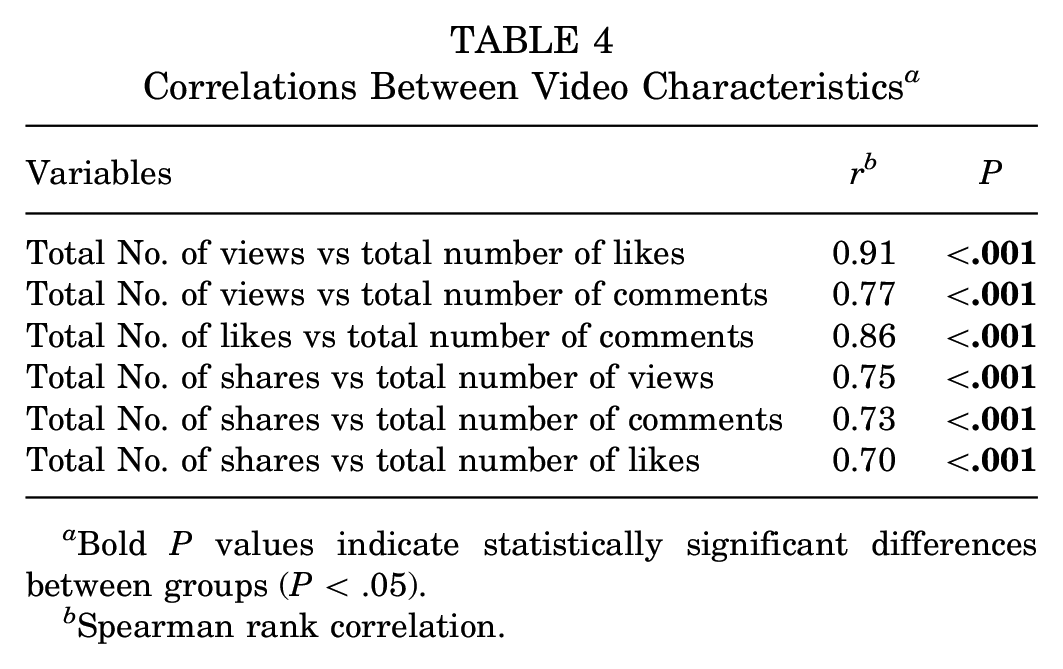
Bold P values indicate statistically significant differences between groups (P < .05).
Spearman rank correlation.
Analysis of video quality by source demonstrated that the only significant difference was regarding the DISCERN score between videos published by private users and those published by surgeons (15.37 ± 0.98 vs 16.22 ± 1.57; P = .007). Detailed results are reported in Table 5. Analysis of video quality by content showed that educational videos had higher DISCERN scores than patient experience videos and rehabilitation videos (P < .05) and had higher JAMA and GQS scores than patient experience videos (P < .05). Detailed results are reported in Table 6. Videos with voice commentary yielded higher scores on all 3 indices than videos with music as the background audio (P < .05). Details are reported in Table 7.
Differences in Video Quality Scores by Source a
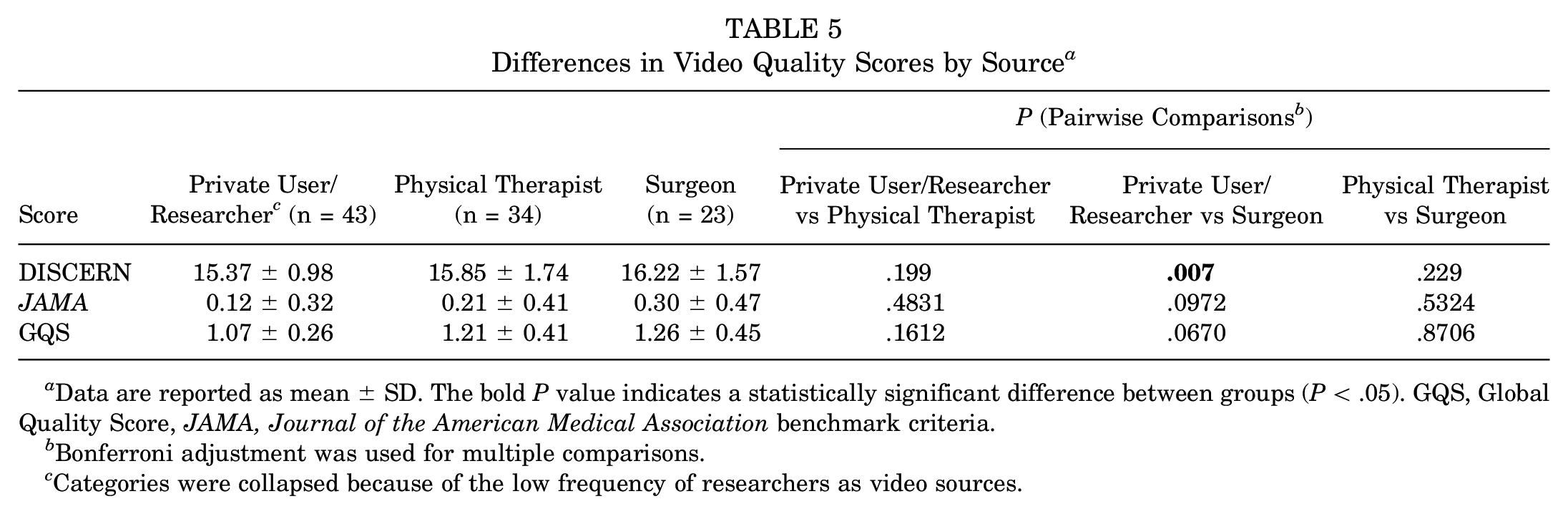
Data are reported as mean ± SD. The bold P value indicates a statistically significant difference between groups (P < .05). GQS, Global Quality Score, JAMA, Journal of the American Medical Association benchmark criteria.
Bonferroni adjustment was used for multiple comparisons.
Categories were collapsed because of the low frequency of researchers as video sources.
Differences in Video Quality Scores by Content a

Data are reported as mean ± SD. Bold P values indicate statistically significant differences between groups (P < .05). GQS, Global Quality Score, JAMA, Journal of the American Medical Association benchmark criteria.
Bonferroni adjustment was used for multiple comparisons.
Differences in Video Quality Scores by Background Audio a

Data are reported as mean ± SD. Bold P values indicate statistically significant differences between groups (P < .05). GQS, Global Quality Score; JAMA, Journal of the American Medical Association benchmark criteria.
The sole significant difference with regard to the type of information was found with anatomy videos, which had superior GQS scores compared with patient experience videos (P = .0147) and physical therapy videos (P = .0258). Detailed results are reported in Table 8.
Pairwise Comparisons in Video Quality Scores Between Types of Information a

Data are reported as mean ± SD. Dashes indicate areas not applicable. Bold P values indicate statistically significant differences between groups (P < .05). GQS, Global Quality Score; JAMA, Journal of the American Medical Association benchmark criteria.
Bonferroni adjustment was used for multiple comparisons.
Discussion
The main findings of this study indicated that TikTok videos about the ACL had poor reliability and quality based on the DISCERN, JAMA, and GQS scores for the 100 videos analyzed. The DISCERN, JAMA, and GQS scores were extremely low, and none of them reached a mean value of sufficient quality (DISCERN 15.73 ± 1.44, JAMA 0.19 ± 0.39, and GQS 1.16 ± 0.37).
No study has analyzed available information on the ACL on TikTok. Only Tabarestani et al 27 recently assessed the quality and educational benefits of Achilles tendinopathy-related TikTok videos and found that although TikTok is a powerful tool for information distribution, the educational value of the videos related to Achilles tendinopathy exercises was poor, with only 1% of videos receiving a grade of “fair” and no videos reaching a score of “good” or “excellent.” Health care professionals should be aware of the high viewership of low-quality content easily accessible on TikTok. 27
In recent years, a few studies,3,24 similar to the present study, have been performed, which analyzed the quality of information on the ACL on the YouTube platform. Cassidy et al 3 examined the quality of YouTube information regarding ACL injury and reconstruction in 2017. After filtering the 964,770 identified videos, 39 videos were retained. The mean modified DISCERN score was 2.25, the mean JAMA score was 2.4, and the mean ACL-specific score was 5.5. Five videos achieved moderate scores (13%), while 15 (38%) and 19 (49%) scored as poor and very poor, respectively. There was no correlation between the number of views and video quality/video source for any scoring system. The authors concluded that most videos viewed on YouTube regarding ACL injury and treatment were of low quality. Similarly, Springer et al 24 investigated the information quality available on YouTube with regard to rehabilitation and RTS after ACLR and found that the vast majority (>75%) of the included videos had poor information quality, reliability, and accuracy. Videos uploaded by medically trained professionals showed significantly higher information quality regarding rehabilitation and RTS than commercial videos or personal testimony videos.
The dissemination of medical research findings across social media channels is growing, and citing academic studies in video descriptions has become commonplace. 2 An analysis of the existing research on the caliber of the health information and instructional videos available on the YouTube platform was published in 2015, 16 and the authors observed that popular measures on YouTube, including the quantity of views and likes, could under no circumstances be used as indicative of the quality of medical and health-related content. The authors indicated that YouTube should enhance its ranking and recommendation system to promote higher-quality material. One strategy might be to undertake expert assessments of videos related to medicine and health and incorporate the results of those evaluations into the ranking algorithm. 16
Although this is the age of social media and digital communication, it is interesting to analyze how patients choose their surgeons for pathologies involving the ACL. In this regard, Chapon et al 4 tried to understand how patients come to know and choose their surgeon by considering a frequent procedure: ACLR. The importance of the “human factor” in the physician-patient interaction was underscored by the fact that two-thirds of patients learned about their surgeon via friends, family, or their primary care physician and that verbal and written communication must be clear. Thus, the relationship of trust was found to be essential to the agreement between the surgeon and the patient. 4
This focus on personal care is partially in contrast with the current literature because an increasing number of patients seek a possible diagnosis online before going to orthopaedic clinics or go to the clinic after searching for information online after the initial consultation.15,18 The overwhelming majority of physicians encounter patients who have researched their condition on the internet before their consultation.15,18 This significantly impacts the patient-physician relationship, and 38% of physicians believe that a patient who arrives with preinformation makes the consultation less effective.15,18 In this scenario, TikTok has found a large response, considering that since its debut in 2016, it has drawn a wide variety of users and stands out from the heavy competition. In terms of both downloads and monthly use in minutes, TikTok has exceeded other well-known social media apps such as Facebook and Instagram. TikTok is a worldwide phenomenon with over 1 billion users, is accessible in over 150 countries, and has been downloaded >200 million times in the United States alone. 17
TikTok is particularly popular among teenagers and the young, being the network par excellence for this target audience. The mean age of Facebook and Twitter users is around 40 years, Instagram users are in their 30s, and TikTok users are around 20 years old, with 32.5% of users being between the ages of 10 and 19 years.13,17 This age gap is significant because younger audiences have distinct media consumption habits and are generally less receptive to traditional advertising in conventional media, which this audience has virtually abandoned. Therefore, there is a significant chance to leverage TikTok as a medium for influencer marketing campaigns given its enormous growth, format, and content qualities, as well as tremendous capacity to contact younger users directly with important potential as consumers.13,17
A 2022 study explored whether users’ background traits and TikTok use can predict their profile memberships. 12 The results offered strong evidence of the differences in TikTok use motives by revealing 4 profiles, namely, overall low, medium, high, and escapist addiction and novelty motives profiles. In addition, these findings of differences across profiles, particularly socially rewarding self-presentation and escapist addiction motives, are novel and notable. 12 Furthermore, the present study generated information regarding the predictive effect of TikTok use frequency and active use (ie, video posting). Reels is one of the fastest-growing short video-sharing apps globally, yet no academic research has examined this app except for a few anecdotal studies. As reported by a recent article, Reels is used as a marketing tool by companies and advertising agencies with little to no educational or scientific content. 17
Limitations
This study has limitations. First, variables such as geographic location or user characteristics may influence the search algorithm results. Non-English videos were excluded from the analysis, further reducing the generalizability of the current results. The present study also used the DISCERN, JAMA, and GQS as quality assessment tools, which have not been fully validated. However, these tools are widely used in studies that evaluate the quality and reliability of online resources. Orthopaedic surgeons are responsible for examining the implications, opportunities and impacts of TikTok on health regarding the ACL and advocating for changes where necessary.
Conclusion
TikTok has changed social media since its expeditious rise, but our analysis has demonstrated that the educational value of these videos on the ACL is poor. Given the rapid growth of TikTok, further research is needed.
Footnotes
Final revision submitted July 26, 2023; accepted August 30, 2023.
Ethical approval for this study was waived by Ospedale Galeazzi SpA.