



Abstract
Background:
The first 2 years of the coronavirus 2019 (COVID-19) pandemic had a profound effect on youth sports participation.
Purpose:
The primary aim of this study was to explore the effect of the COVID-19 pandemic on youth sports injury patterns, with a secondary aim of comparing organized team and individual sport–related injuries in diverse age groups.
Study Design:
Descriptive epidemiology study.
Methods:
The National Electronic Injury Surveillance System (NEISS) was searched to identify injuries sustained by patients aged 11 to 23 years while playing organized team or individual sports from 2017 to 2021. We investigated reports of concussions, dislocations, fractures, and sprains/strains.
Results:
Between 2017 and 2021, there were 58,721 and 3778 team and individual sport–related injuries, respectively. When compared with the prepandemic years, there was a 57.07% decrease in 2020 and 22.31% decrease in 2021 for the number of organized team sport–related injuries. Organized individual sport–related injuries had a 56.24% and 35.18% decrease in number in 2020 and 2021, respectively. Male patients were most likely to be injured in team sports (81.0%), and female patients were most likely to be injured in individual sports (67.1%). High school athletes sustained the majority of injuries in team (57.0%) and individual (51.2%) sports. The years 2020 and 2021 saw a decrease in proportion of sprains/strains and an increase in proportion of fractures.
Conclusion:
The number of organized sport–related injuries reported to emergency departments decreased in 2020, and despite vaccinations and easing of social distancing, the 2021 value did not return to what it was prepandemic. As coronavirus-related restrictions have eased, there should be careful monitoring of sports injuries among youth athletes.
Participation in youth sports has been increasing in the United States over the past decade. 11 In 2019, 55.1% of school-aged children participated in some form of organized sports, while the National Collegiate Athletic Association reported that the 2018-2019 season showed an all-time high in the number of student athletes participating in collegiate sports.19,28 Before the coronavirus 2019 (COVID-19) pandemic, many children were participating in higher levels of athletic training and often engaged in several sports, putting themselves at a higher risk for sustaining both acute and chronic overuse injuries. 2 One study conducted before the pandemic showed an annual estimated mean of 2.6 million emergency room visits related to sports injuries for individuals between 5 and 24 years of age. 6 The same study found that patients with sports-related injuries were more likely to be diagnosed with fractures or sprains compared with individuals sustaining non–sports related injuries.
The onset of the COVID-19 pandemic in March 2020 imposed drastic changes as stay-at-home orders were issued, schools closed, and people began the practice of social distancing. Sports practices, games, and seasons were subsequently canceled, affecting youth participation. A recent report revealed that during the height of the COVID-19 pandemic, mean weekly sport involvement by children aged 6 to 18 years of age decreased to 7.21 hours from 11.51 hours before the pandemic, resulting in a 37.4% decrease in participation hours. 9
Several studies have investigated the change in pediatric emergency room and outpatient visits for trauma, sport, and non–sport related injuries due to the COVID-19 pandemic.22,24,31 Pines et al 22 found that there was a 67% decrease in non–COVID-19 emergency room visits from March to April 2020 for individuals 14 to 17 years of age compared with the same time period in 2019. 22 A study investigating outpatient orthopaedic clinics from a single children’s hospital network revealed that 15.2% of the injuries treated from March to June 2020 were sustained in a formal sports setting, compared with 71.4% in 2018 and 2019. 31 The development of vaccines in 2021 led to hopes that sports participation would normalize. During this year, there was a wide variety in the easing of COVID-19–related restrictions. In 2021, 23 states in the United States continued to maintain a public health state of emergency, and 10 states continued to hold mask mandates. 1 It remained unclear how COVID-19 would affect sports participation and injury rates into 2021 and beyond.
The purpose of this study was to characterize sports injuries obtained by individuals aged 11 to 23 years involved in either individual or team sports in an organized setting, such as in school or an extracurricular sports team, using a nationally representative data set. The primary aim of this study was to investigate the effect of the COVID-19 pandemic on trends in injury patterns by comparing the 3 years before the pandemic with both 2020 and 2021. The secondary aim was to explore differences between team and individual sports and differences in sports injuries between various age groups.
Methods
This study used the National Electronic Injury Surveillance System (NEISS), operated by the US Consumer Product Safety Commission (CPSC; www.cpsc.gov). The NEISS data set sampled 100 emergency departments from hospitals that had ≥6 beds across the country. These hospitals represented a probability sample of US hospitals that met the inclusion criteria. The NEISS sampling frame was classified by hospital size and ordered by location to ensure an appropriate geographic spread. A NEISS hospital coordinator retrospectively coded emergency room records onto a NEISS coding sheet that was then reviewed twice by a CPSC-designed software.This study was determined to be exempt from institutional review board approval.
The NEISS data set was searched to identify patients aged 11 to 23 years in the 5-year period from 2017 to 2021 who sustained the following injuries while playing either a team or individual sport: concussions, dislocations, fractures, and sprains/strains. Among those entries, cases with diagnosis codes for concussion (code 52), dislocation (code 55), fracture (code 57), or sprain/strain (code 64) were selected. Team sports were defined as football, basketball, soccer, and lacrosse. Individual sports were defined as tennis, gymnastics, golf, and track and field. The cases involving injuries sustained while playing football, basketball, soccer, lacrosse, tennis, gymnastics, golf, and track and field were identified using the product codes assigned to each entry (1211, 1205, 1267, 1215, 3284, 1272, 1212, and 5030, respectively). For both team and individual sports, we aimed to select sports that were representative in the NEISS database and common organized sports practiced by our studied age population. This excluded several sports such as baseball, ice hockey, surfing, and cycling because of the minimal number of entries associated with these sports in the data set. Additionally, sports such as swimming were excluded because many injuries reported were non–sport related and instead occurred in a recreational context. “Prepandemic” years were classified as 2017 through 2019, and “pandemic” years were classified as 2020 and 2021. Age groups were defined as middle school (11-13 years), high school (14-18 years), and college (19-23 years). The cutoff for college-age individuals was set at 23 years of age because most students who enter bachelor’s programs at age 18 years or younger graduate within 5 years. 12
The total number of cases collected by the NEISS database was further narrowed by the location/setting in which the injury was sustained. This study focused on common injuries sustained by individuals playing these sports in an organized setting, so cases were excluded that did not occur in either a school or a sports (location codes 8 and 9, respectively) setting. Examples of locations that were excluded include home, farm, public, and unknown settings.
Statistical Analysis
National estimates of these injury cases were calculated using NEISS weighted estimates. Incidence rates were determined using national population estimates from the US Census Bureau (http://data.census.gov/cedsci), with 95% CIs calculated for national estimates and incidence rates. The Pearson chi-square test was used to compare proportions of injuries occurring in school or sports locations and proportions of each diagnosis for all age groups, and the Fisher exact test was used in cases where the number of injuries was <5. All statistical analyses were performed using RStudio version 4.1.2 (http://www.rstudio.com/). P values <.05 were considered statistically significant.
Results
Epidemiology
Team Sports
From 2017 to 2021, the NEISS data set included 58,721 injuries with a diagnosis of a fracture, dislocation, concussion, or sprain/strain related to team sports in individuals aged 11 to 23 years. Using weighted estimates, the number of cases represented 1,731,547 injuries nationally for this 5-year period (95% CI, 1,376,838-2,086,257).
Individual Sports
The NEISS data set included 3,778 injuries with a diagnosis of fracture, dislocation, concussion, or sprain/strain related to individual sports among patients aged 11 to 23 years. This represented 105,440 cases nationally (95% CI, 80,130-130,749). Tables 1 and 2 highlight further case numbers, national estimates, and incidence data.
Number of Injuries and National Estimates of Fracture, Dislocation, Concussion, or Sprain/Strain Each Year in Patients Aged 11 to 23 Years

Incidence Rates by Year of Fracture, Dislocation, Concussion, or Sprain/Strain in Patients Aged 11 to 23 Years

Injury Incidence Rates
Team Sports
Between 2017 and 2019, the number of injuries sustained while playing team sports in a school or sports setting was 30,994 (74.3% of total cases for that period), with a mean of 10,331.33 per year. In 2020, there was a statistically significant decrease to 4435 injuries (66.0% of total cases for that year) sustained in a school or sports setting (P < .001). In 2021, this number increased from the 2020 value to 8026 (78.0% of total cases for that year). Among the team sport injuries sustained in these locations, 81.0% and 19.0%, respectively, of these cases were obtained by male and female patients, for the 5-year duration.
Individual Sports
Between 2017 and 2019, there were 2365 injuries sustained while playing individual sports in a school or sports setting (85.9% of total cases for that period), with a mean of 788.33 per year. There was a statistically significant decrease in 2020 to 345 cases (81.8% of total cases for that year) (P = .026), while 2021 showed an increase to 511 cases (84.9% of total cases for that year). The sex distribution for individual sports for the 5-year period consisted of 32.9% and 67.1% of injuries obtained by male and female patients, respectively.
Age Groups and Diagnosis
Team Sports
For team sports, on average, 33.1%, 57.0%, and 9.9% of the injuries sustained in a school or sports setting were sustained by middle school–, high school–, and college-aged individuals, respectively, for the 5-year period. For all diagnoses included, there was a 57.07% decrease between the prepandemic years and 2020 in the number of injuries sustained while playing team sports. The middle school cohort showed the greatest percentage decrease in injuries (60.11%). For all age groups combined, concussions showed the greatest percentage decrease (63.01%) between these years.
Between the prepandemic years and 2020, there was a statistically significant increase in relative fracture frequency for the middle school cohort (P < .001), the high school cohort (P = .002), and the college-aged cohort (P = .036). There was a statistically significant decrease in relative frequency of sprains/strains for middle schoolers (P < .001) and high schoolers (P = .004) between these years. The college-age cohort presented with a nonsignificant decrease in relative frequency of sprains/strains (P = .089) between these years.
When compared with the prepandemic years, there was a 22.31% decrease in the total number of injuries sustained in 2021 for all age groups. In 2021, the middle school cohort still had the greatest percentage decrease in the number of injuries (26.83%) when compared with the prepandemic years. Concussions show the greatest percentage decrease in number (30.63%) between these years. When compared with that of the prepandemic years, the relative fracture frequency in 2021 remained significantly increased for the middle school (P < .001) and high school cohorts (P < .001), while the relative sprain/strain frequency remained significantly decreased for the middle school (P < .001) and high school cohorts (P < .001). The relative concussion frequency remained significantly decreased for middle schoolers (P < .001). Injury numbers and relative frequencies are presented in Figure 1 and Table 3.

(A) Number and (B) relative frequency of organized team sport–related injuries in patients aged 11 to 23 years, 2017-2021.
Number and Relative Frequency of Organized Team Sport–Related Injuries by Age Group a
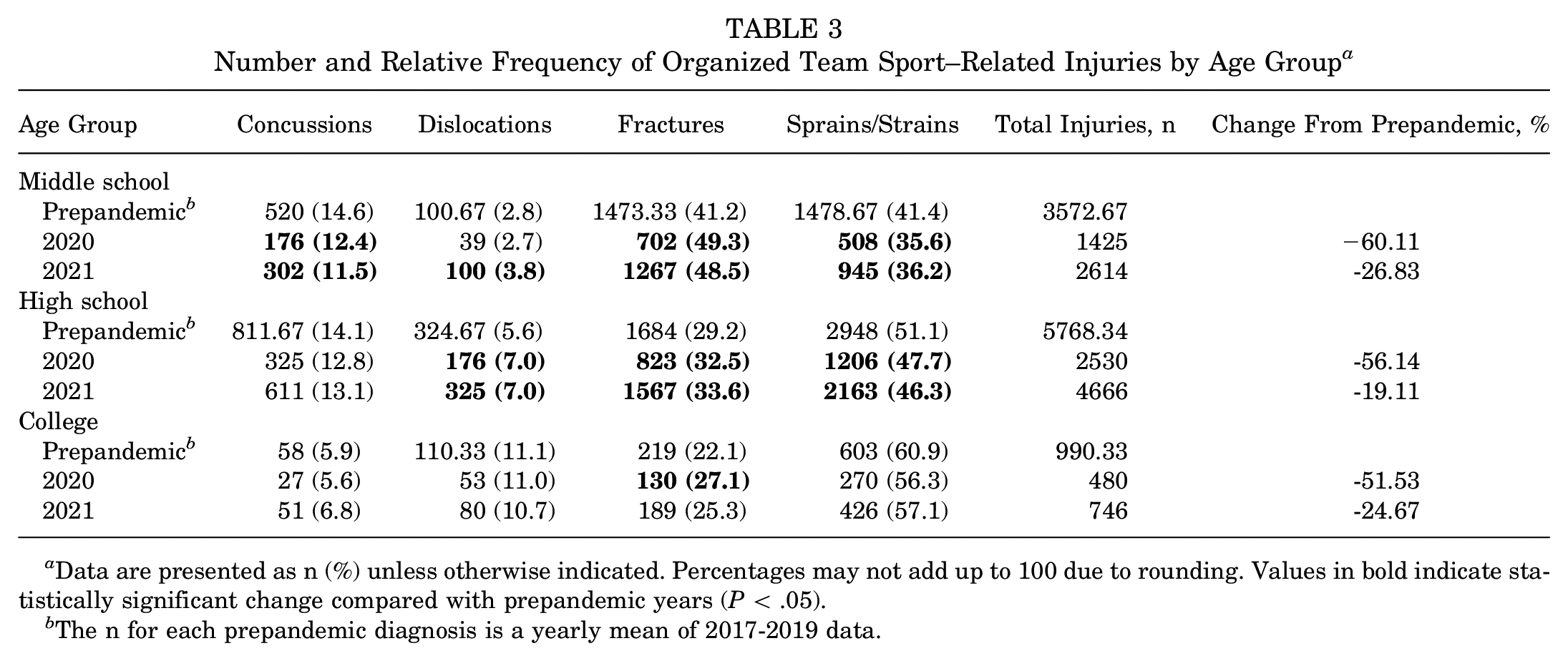
Data are presented as n (%) unless otherwise indicated. Percentages may not add up to 100 due to rounding. Values in bold indicate statistically significant change compared with prepandemic years (P < .05).
The n for each prepandemic diagnosis is a yearly mean of 2017-2019 data.
Individual Sports
Of those injured while playing an individual sport in a school or sports setting, 43.0% were of middle school age, 51.2% were of high school age, and 5.8% were of college age for the 5-year period studied. For all diagnoses included, there was a 56.24% decrease in the number of injuries sustained while playing individual sports between the prepandemic years and 2020. The middle school cohort showed the greatest percentage decrease in injuries (57.63%). For all age groups combined, sprains/strains had the greatest percentage decrease (59.93%) for these years.
When comparing the prepandemic years with 2020, there was an increase in relative fracture frequency among high schoolers playing individual sports (P = .026). The middle school and college-aged cohorts showed a nonsignificant increase in relative fracture frequency (P = .678 and .736, respectively). All 3 age groups (middle school, high school, college) showed a nonsignificant decrease in relative sprain/strain frequency between the prepandemic years and 2020 (P = .368, .715, and .814, respectively).
When compared with the prepandemic years, 2021 showed a 35.18% decrease in total number of injuries sustained while playing an individual sport, for all age groups. The middle school age group had the greatest percentage decrease in 2021 (41.53%) compared with the prepandemic years, while the college-age cohort had an increase in number of injuries (35.48%) between these years. In 2021, the relative fracture frequency for high schoolers remained significantly increased compared with the prepandemic years (P = .003). Injury numbers and relative frequencies are presented in Figure 2 and Table 4.

(A) Number and (B) relative frequency of organized individual sport–related injuries in patients aged 11 to 23 years, 2017-2021.
Number and Relative Frequency of Organized Individual Sport–Related Injuries by Age Group a
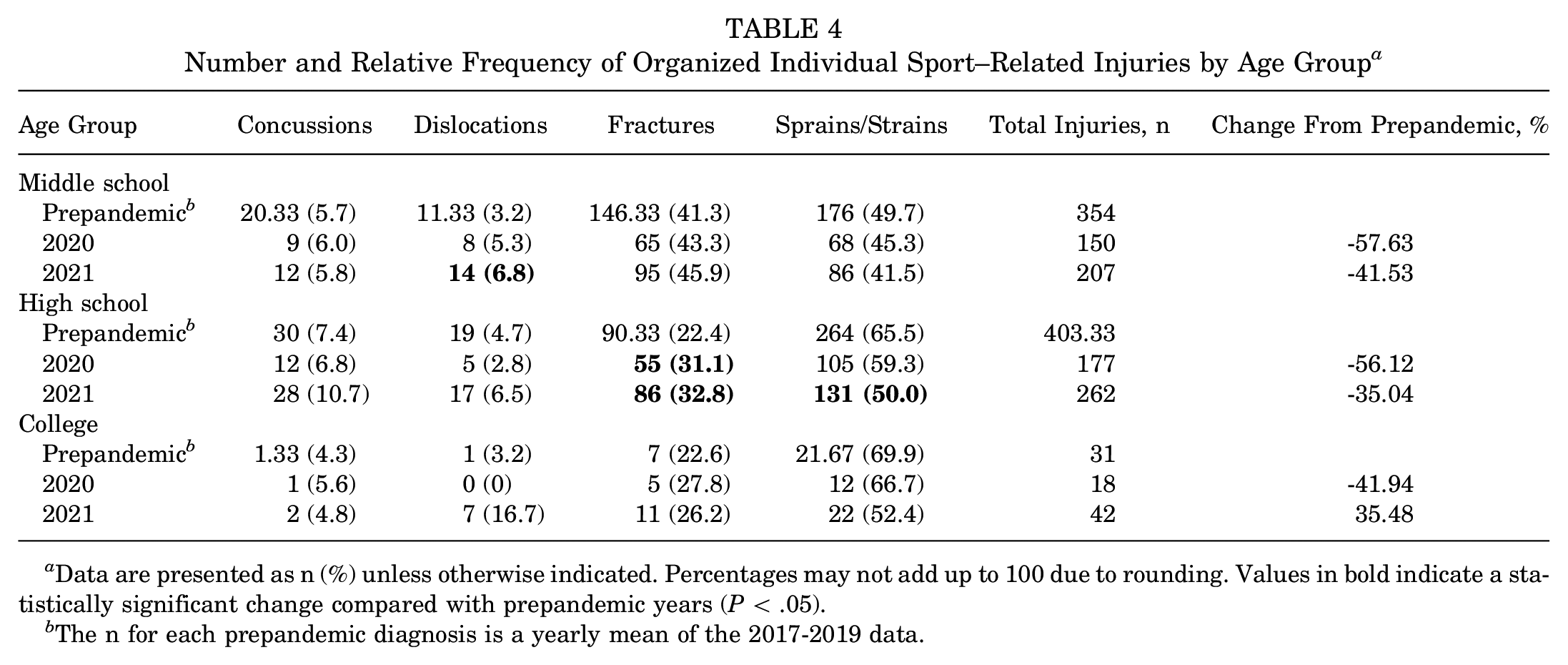
Data are presented as n (%) unless otherwise indicated. Percentages may not add up to 100 due to rounding. Values in bold indicate a statistically significant change compared with prepandemic years (P < .05).
The n for each prepandemic diagnosis is a yearly mean of the 2017-2019 data.
Discussion
By comparing NEISS data from both 2020 and 2021 with a mean of the 2017, 2018, and 2019 data, we intended to ascertain how the first 2 years of the COVID-19 pandemic affected organized sport–related injury rates and presentation to emergency departments. During the first year of the pandemic, there was a decrease in the overall number of injuries as well as the proportion of injuries sustained in a school or sports setting. This pattern is likely due to the impact of COVID-19 stay-at-home orders and the disruption in sports practices and competitions, which is consistent with previous studies.15,17,31 There was a greater number of injuries in 2021 than 2020; however, this value was still lower than that of the prepandemic years. In 2020 and 2021, there was a decreased proportion of sprains/strains and increased proportion of fractures presenting to the emergency department.
For all 5 years studied, there was a larger number of injuries related to team sports than individual sports. This was expected, given the higher incidence of injuries in team sports as compared with individual sports.23,29 The majority of team sport–related injuries were sustained by male athletes, and the majority of individual sport–related injuries were sustained by female athletes. Previous studies have shown that male participants have higher participation levels in team and collision sports as well as a higher incidence of acute sports-related injuries.5,21,23,27 Given this fact, it can be reasoned that gender participation rates may influence the distribution of sports injuries between male and female athletes; however, further research is warranted. A study by Zech et al 32 determined that the injury incidence rate ratios between male and female athletes in team sports is mediated by type of team sport, rather than sex. Previous studies revealed that injury distribution can also be affected by age, genetics, and growth patterns.21,25,27
In 2021, the proportion of sports injuries (concussions, dislocations, fractures, and sprains/strains) that occurred in a school or sports setting nearly matched or surpassed that of the prepandemic years. However, the overall number of injuries did not return to what they were prepandemic, as there remained a 22.31% and 35.18% decrease in number of team and individual sport–related injuries, respectively.
The overall decrease in injuries that remained in 2021 may be explained by the continued reduction in participation in organized sports due to the concern of contracting COVID-19. As of September 2021, 50.3% of parents believed fear of COVID-19 to be a potential barrier for their child to resume sports. 8 The Pfizer-BioNTech COVID-19 vaccine was available for individuals aged ≥16 years starting on December 11, 2020, but it did not receive emergency use authorization for adolescents aged 12 to 15 years until May 10, 2021. 10 Parents were possibly hesitant to send their children back into sports unvaccinated. It is also likely that parents were more reluctant to bring children into the emergency room due to potential COVID-19 exposures. This phenomenon was evident in the early stages of the pandemic as exhibited by the decrease in overall emergency room visits.13,22 As schools opened throughout 2021, more students returned to school sports, club sports, and intramural sports. This led to an increased proportion of injuries that occurred in these settings as opposed to injuries occurring at home or in nonorganized sports settings, when compared with 2020. Additionally, it is possible that among those who participated in nonorganized sports and sustained injuries, fewer reported to an emergency room, leading to the overall higher proportion of injuries sustained in a school or sports setting in 2021. With new variants, such as delta and omicron, COVID-19 still surged throughout the second year of the pandemic, prompting individuals to avoid the emergency room unless they had severe injury or illness.
High school students who hoped to be competitive for college athletics recruiting also returned to organized sport in 2021. In our study, the high school cohort had the greatest number of both team and individual sport–related injuries, as well as the smallest percentage decrease for number of team sport–related injuries in 2021, when compared with the prepandemic years. This means that in 2021, the number of high school athletes injured while playing team sports was the closest to that of the prepandemic years when comparing all 3 age groups. In 2021, the Aspen Institute revealed that individuals aged 15 to 18 were participating in interscholastic and travel or club sports at higher rates than individuals 11 to 14 years of age. 8 Of these younger athletes (ages 11-14), 65.1% 8 had resumed sport participation at the same or higher level than before the pandemic; however, more than half of this involvement had been free play rather than in an organized setting. Middle school athletes likely returned to nonorganized team and individual sports in 2021; however, our inquiry of organized sports would have excluded any injuries that resulted from this.
Significant trends found in our study included the decrease in relative frequency of sprains/strains and the increase in relative fracture frequency in both 2020 and 2021. A study by Wild et al 31 also revealed a higher proportion of orthopaedic sports injuries to be fractures in 2020. Baxter et al 4 found a 108.4% increase in proportion of supracondylar fractures presenting to clinic during lockdown when compared with 2019. Some of the patterns found in our study can be explained by emergency room avoidance. Athletes who experienced sprains/strains and other minor injuries were less likely to present to the emergency department for examination. Additionally, with the extensive implementation of telemedicine during the COVID-19 pandemic by many specialties, including orthopaedics, it is possible that patients opted to be evaluated virtually rather than in the emergency department for minor injuries. 14 This led us to conclude that in 2020 and 2021, there was a major decrease in reporting of sprains/strains to emergency departments, and the true value sustained was higher than what our study revealed. This possible decrease in reporting of sprains/strains offset the proportion of fractures presenting to the emergency room, giving the illusion of a higher percentage of fractures sustained by this age population during the first 2 years of the pandemic. Clinically, it is important to recognize the number of sprains/strains that may have gone untreated, as proper treatment is necessary to prevent further injury and maintain joint mobility. 18 As athletes returned to organized sports, it was vital to monitor injury rates, as deconditioning sustained during lockdown mandates and sports restrictions put athletes at risk for injury.3,30 Over the next several years, it will be imperative to continuously assess injury rates and see how they compare with the prepandemic years. Furthermore, social distancing, quarantining, and other COVID-19–related restrictions severely affected the mental health of this age population.7,16,20,26 Specifically, disruption of daily schedules and sports practices, as well as apprehension surrounding health, led to increased levels of anxiety and depression.
Limitations
While this study aims to assess organized team and individual sport–related injuries, there are several limitations of this study related to the NEISS data set. This data set includes samples from 100 emergency departments across the United States; however, it is possible that these 100 hospitals are not entirely representative of the nation as a whole. Furthermore, given the retrospective nature of data entry, there may be inaccuracies with coding that are not detected in CPSC review. Given the extensive geographic distribution of hospitals sampled by the NEISS data set, we were unable to determine the effect of variable easing of lockdown restrictions across the United States. The data set also excludes those that may have been evaluated at an urgent care or an outpatient setting. College-aged individuals participating in varsity athletics may have visited their school athletic trainer for injury treatment rather than going to the emergency department. Another limitation is the fact that we do not know the true value of individuals’ participation in organized sports for a given year. While we can assess the changes in injury patterns based on changes in emergency department visits, we do not know the exact decrease in the number of individuals actively pursuing organized sports, regardless of their injury status. Thus, we conclude that the national estimates and overall number of injuries sustained in a school or sports setting likely underestimate the true value.
Conclusion
The number of organized sport–related injuries reported to emergency departments decreased in 2020, and despite vaccinations and easing of social distancing, the 2021 value did not return to what it was prepandemic. As coronavirus-related restrictions have eased, there should be careful monitoring of sports injuries among youth athletes.
Footnotes
Acknowledgements
The authors thank Dongliang Wang, PhD, for advice and consultation on statistical analyses.
Final revision submitted April 23, 2023; accepted May 19, 2023.
The authors declared that there are no conflicts of interest in the authorship and publication of this contribution. AOSSM checks author disclosures against the Open Payments Database (OPD). AOSSM has not conducted an independent investigation on the OPD and disclaims any liability or responsibility relating thereto.
Ethical approval for this study was waived by SUNY Upstate Medical University (No. 1923674-1).