




Abstract
Background:
It is unclear how levels of sport participation have changed among adolescents in the United States (US) in recent years, particularly considering evidence of increasing sport professionalization and attrition.
Purpose:
To evaluate the differences and trends in single- and multiple-team sport participation among US high school students between 1999 and 2019.
Study Design:
Descriptive epidemiology study.
Methods:
Using the Youth Risk Behavior Surveillance System of the US Centers for Disease Control and Prevention, a biannual representative survey of US high school students, data on self-reported sport participation (no participation, single team, multiple teams) within the previous year were evaluated. Differences in sport participation prevalence between 1999 and 2019 were assessed in sex strata by grade, race/ethnicity, and US region. Weighted trends using the National Center for Health Statistics Guidelines for Analysis of Trends and logistic regression models were employed for analyses.
Results:
The study sample over the 20-year period (N = 149,404) was 49.8% female; the majority were in ninth grade (27.7% female, 28.7% male), were non-Hispanic White (56.1% female, 56.8% male), and resided in the Southern US (57.6% female, 57.4% male). Among girls, 27.2% (95% CI, 25.8-28.6) reported multiple sports team participation in 1999, while 21.3% (95% CI, 20.1-22.6) reported the same in 2019. Among boys, 39.5% (95% CI, 38.4-40.7) reported multiple sports team participation in 1999 versus 29.1% (95% CI, 27.7-30.6) in 2019. Analyses of trends indicated that girls experienced increasing trends in single-sport team participation (β = 0.04, SE = 0.01, P < .001). Among boys, there were increasing trends in no sport participation (β = 0.06, SE = 0.01, P < .001), while multiple-sport team participation decreased over the 20-year period (β = −0.10, SE = 0.01, P < .001). Disparities in trends were observed among female and male groups by race/ethnicity, grade, and region.
Conclusion:
Sport participation over a 20-year period in the US decreased significantly for boys and increased for single-sports teams among girls. Sport specialization may be contributing some of the observed trends, though limitations in the data require additional research to confirm these hypotheses. Tailored efforts to increase sport participation among both sexes is needed.
Sport participation during childhood and adolescence has been linked with numerous health benefits beyond complementary physical activity, including significant improvements to psychological, cognitive, and emotional outcomes.2,33,37,40 Young athletes have been found to demonstrate improvements in self-exploration, leadership, social intelligence, time management, goal setting, and emotional control.15,19,21 Furthermore, young athletes have better self-esteem and less anxiety and are more likely to engage in healthy behaviors such as abstaining from illicit drug and tobacco use and having higher fruit and vegetable consumption when compared to nonathletes. 33 The physical activity acquired as part of playing many sports cannot be overlooked; high school athletes in the United States (US) are >4 times more likely to engage in vigorous, health-enhancing levels of physical activity than their nonathlete peers.28,40 There are certainly negative aspects of sport participation, including increased risks of musculoskeletal injuries and mild traumatic brain injuries, particularly among collision sports 24 ; however, the general consensus is that the benefits of sport participation outweigh any potential risks. 33 As such, national and international governing bodies aimed at improving public health have recommended sport participation as a key driver for healthy development during childhood and adolescence. 16
Despite these recommendations, 40% of male adolescents and 45% of female adolescents reported in 2019 that they do not participate in any sports. 11 Furthermore, Chen et al 11 found that these low estimates have remained relatively stable or have declined over the past 10 years; the proportion of boys reporting sport participation declined by 3.6% since 2009, while the estimate increased by 2.3% among girls. This study also highlighted existing disparities in rates of sport participation not only by sex but also by race/ethnicity: Hispanic/Latino adolescents reported the lowest prevalence of participation of all race/ethnicity groups. Of particular concern is the body of evidence demonstrating that those who play sports during childhood and adolescence are significantly more likely to continue to be physically active in adulthood than youth nonathletes. 16 Given the dire prevalence estimates of physical activity among adults in the US, 26 and related subsequent negative health outcomes, there is a need to determine how to increase sport participation among children and adolescents and how to reduce sport participation attrition. 4 Understanding current trends in sport participation among adolescents is a prerequisite to the investigation of the underlying reasons for attrition and subsequently developing targeted interventions.
There is currently a lack of understanding on the current prevalence of single- and multiple-team sport participation among representative samples of US adolescents and how prevalence estimates may have changed over time. Furthermore, it is unclear what differences may exist in sport participation trends by grade, sex, race/ethnicity groups, and US regions. This study aimed to fill this gap by examining single- and multiple-team sport participation data from a representative sample of US adolescents between 1999 and 2019. Differences in grade and race/ethnicity were examined by sex-stratified models. These results will offer insight into grade, sex, and race/ethnicity groups at high risk of not participating in sports.
Methods
The protocol for this study received exempt status by our institutional review board. Data for this analysis were obtained from the 1999 through 2019 Youth Behavioral Risk Factor Survey, a serial cross-sectional, school-based assessment of health-risk behaviors among adolescents in the US. Data are collected biannually (in odd years) by the US Centers for Disease Control and Prevention using trained data collectors to administer a self-reported questionnaire to students during regular school hours. Participation is voluntary and requires parental consent. All data are anonymous and freely and publicly available. Participants were in grades 9 through 12 and are a representative sample of US high school–aged students. 9
Demographic factors were evaluated for their association with single- and multiple-team sport participation prevalence and trends. These included participant sex (male, female), grade (9th-12th), race/ethnicity (non-Hispanic White, non-Hispanic Black, Hispanic/Latino, other non-Hispanic race/ethnicity), and US region (Northeast, Midwest, South, West). Sport participation was measured with the question, “During the past 12-months, on how many sports teams did you play? (Count any teams run by your school or community groups).” Discrete answer choices included zero teams, 1 team, 2 teams, and ≥3 teams. For the current analysis, the responses “2 teams” and “≥3 teams” were collapsed into a single classification, so that the primary outcomes defining sport participation were none (zero teams), single team (1 team), and multiple teams (2 teams, ≥3 teams).
All variables under study were evaluated for missingness and found to be <10%. Therefore, a complete case analysis approach was employed, given the size of our dataset and the categorical coding of our variables; these methods have comparable utility to approaches (eg, multiple imputation) that minimize bias.2,22 The prevalence and 95% confidence intervals of sport participation were presented across demographics by year and in sex strata. Using the National Center for Health Statistics Guidelines for Analysis of Trends, 25 we estimated whether there was a significant trend in sport team participation (zero teams, 1 team, or multiple teams) by including survey year as a focal predictor using logistic regression models. Moreover, we used the “margins” command, which is a standard approach for directly adjusting for covariates and their interactions. This approach produces an overall estimate of the trend for the total population of interest. Further, although the Cochran-Armitage test is commonly utilized in trend analyses, it was not used in the primary analysis because this test does not indicate the direction of the trend and is not recommended by the National Center for Health Statistics. STATA Version 15.1 (StataCorp) was used for all analyses. Survey weights were employed to ensure analyses were conducted on a representative sample of all US high school students.
Results
The total weighted and unweighted sample sizes by sex and year are presented in Table 1. Overall, the unweighted sample size consisted of 341,476 (51.8%) girls and 317,759 (48.2%) boys. This represented a final (weighted) sample size of 33,810,807 (49.8%) girls and 34,082,379 boys in high school in the US. Across all years of observation, the largest proportion of the weighted data were from 2009 (33.2%).
Total Weighted and Unweighted Sample Sizes by Sex and Year, Youth Risk Behavior Surveillance System, 1999-2019 a

Data are presented as n (%).
Descriptive statistics on the sample by sex are presented in Table 2. Overall, the majority of the weighted sample was in the 9th grade (27.7% girls, 28.7% boys), of non-Hispanic White race/ethnicity (56.1% girls, 56.8% boys), and residing in the Southern US (57.6% girls, 57.4% boys).
Weighted and Unweighted Sample Descriptive Statistics of US High School Students, Youth Risk Behavior Surveillance System, 1999-2019 a
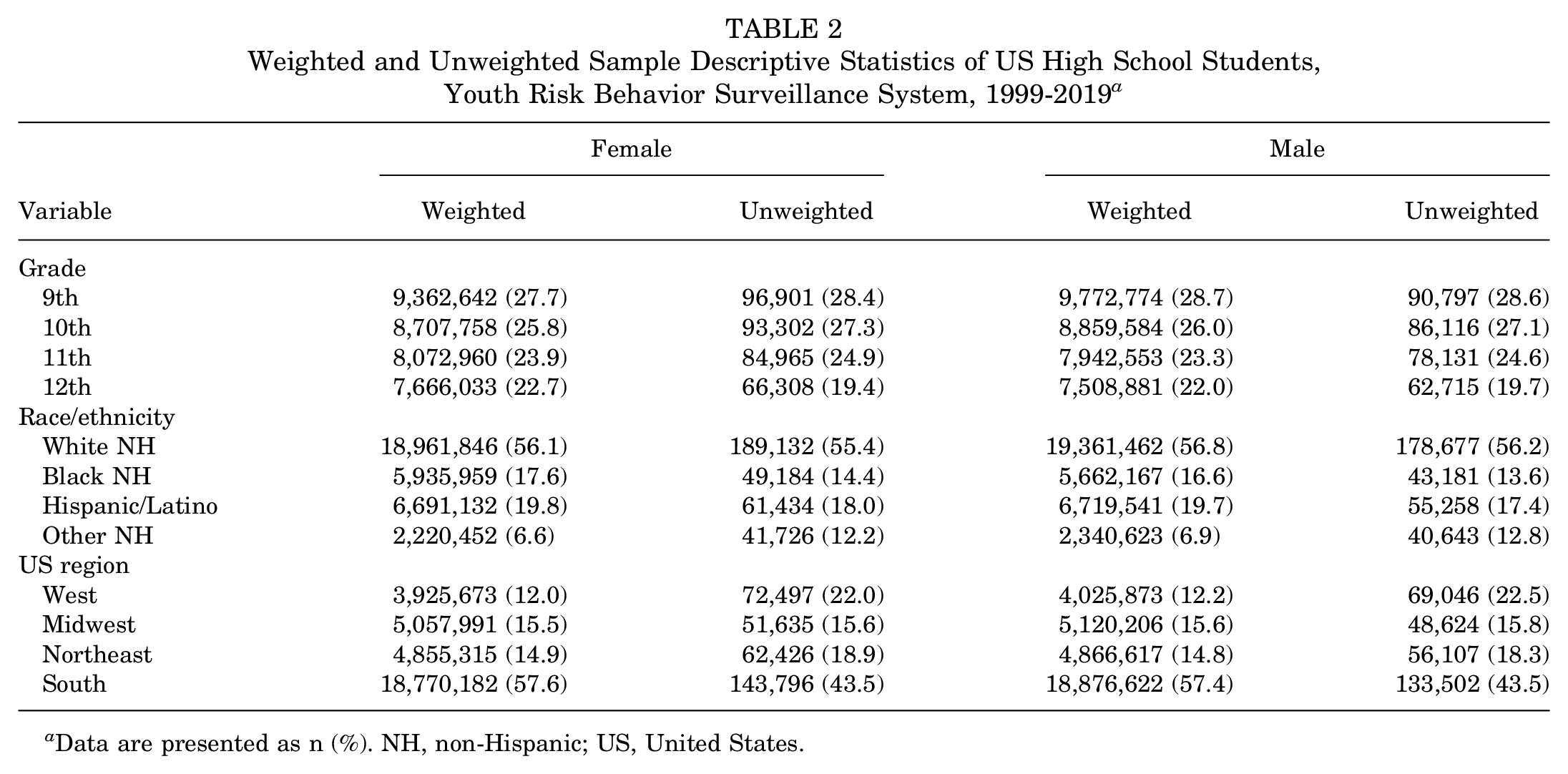
Data are presented as n (%). NH, non-Hispanic; US, United States.
Results on the prevalence of female sport participation (none; single-team sport participation; multiple-team sport participation) in 1999 and in 2019 are shown in Figure 1 and Table 3.

Proportion of female high school students in the United States reporting the number of sports teams on which they participate, Youth Risk Behavior Surveillance System, 1999-2019.
Sport Participation Prevalence Among Female US High School Students, Youth Risk Behavior Surveillance System, 1999-2019 a
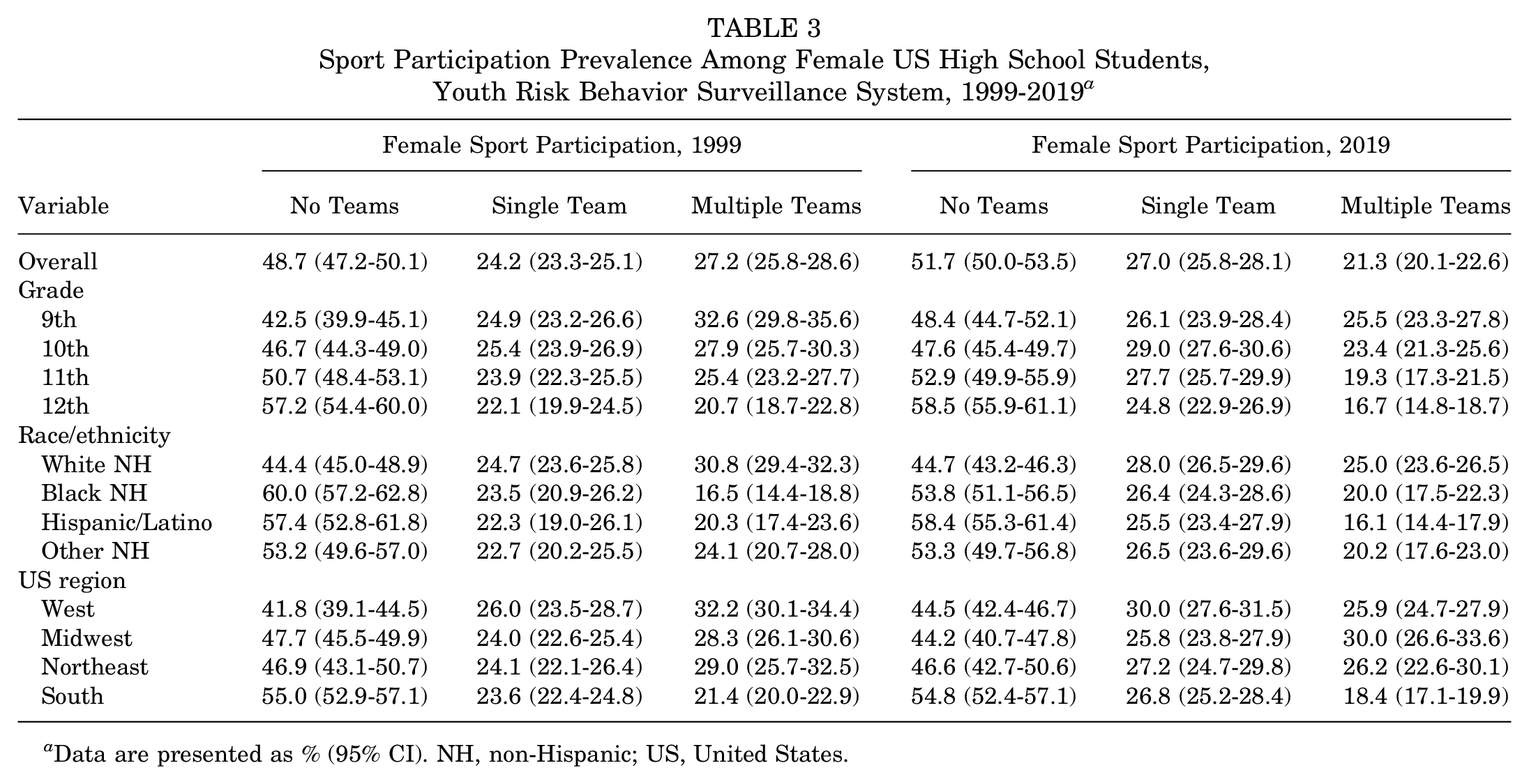
Data are presented as % (95% CI). NH, non-Hispanic; US, United States.
Overall, 48.7% (95% CI, 47.2-50.1) of female high school students reported not playing on a sports team in 1999, while 51.7% (95% CI, 50.0-53.5) reported the same in 2019. Based on grade, the proportion of girls not playing sports was highest in later grades. For instance, in 1999, the proportion of 9th-grade girls reporting no sport participation was 42.5% (95% CI, 39.9-45.1) compared to 57.2% (95% CI, 54.4-60.0) of 12th-grade girls. Similar grade differences persisted in 2019, where there appeared to be a decrease in sport participation as youth aged through high school. Comparing participation percentages across race/ethnicity groups and years indicates that non-Hispanic White girls had the lowest levels of nonparticipation in 1999 (44.4% [95% CI, 45.0-48.9]) and in 2019 (44.7% [95% CI, 43.2-46.3]). Alternatively, non-Hispanic Black girls reported the highest levels of nonparticipation in 1999 (60.0% [95% CI, 57.2-62.8]), while Hispanic/Latino girls reported the highest levels of nonparticipation in 2019 (58.4% [95% CI, 55.3-61.4]). The Southern US had the highest levels of nonparticipation among girls in 1999 (55.0% [95% CI, 52.9-57.1]) and 2019 (54.8% [95% CI, 52.4-57.1]). Regarding single- versus multiple-team sport participation, in 1999 a greater proportion of female sports participants reported playing on multiple sports teams (27.2% [95% CI, 25.8-28.6]) than a single sports team (24.2% [95% CI, 23.3-25.1]). Interestingly, these differences had shifted by 2019, where a greater proportion reported playing on a single sports team in 2019 (27.0% [95% CI, 25.8-28.1]) than on multiple sports teams (21.3% [95% CI, 20.1-22.6]).
Results on the prevalence of male sport participation in 1999 and 2019 are shown in Table 4 and depicted in Figure 2.
Sport Participation Prevalence Among Male US High School Students, Youth Risk Behavior Surveillance System, 1999-2019 a

Data are presented as % (95% CI). NH, non-Hispanic; US, United States.

Proportion of male high school students in the United States reporting the number of sports teams on which they participate, Youth Risk Behavior Surveillance System, 1999-2019.
Overall, 37.2% (95% CI, 35.8-38.5) of male high school students reported no sport participation in 1999 and 45.5% (95% CI, 44.0-47.1) reported no sport participation in 2019. Similar to girls, based on grade, the proportion of boys not participating in sports was greatest among later grades. For boys, in 1999, the proportion reporting no team sport participation was 33.6% (95% CI, 31.7-35.5) among 9th graders compared to 39.0% (95% CI, 36.4-41.6) of 12th graders; in 2019, this estimate rose to 41.2% (95% CI, 37.8-44.6) of 9th graders and 51.1% (95% CI, 48.9-53.3) of 12th graders. When comparing sport participation proportions across race/ethnicity groups and years, Black boys (40.1% [95% CI, 37.2-42.9]) and boys from other race/ethnicities (42.2% [95% CI, 38.2-46.3]) had the highest levels of nonparticipation in 1999. In 2019, the proportions reporting highest levels of nonparticipation shifted to Hispanic/Latino boys (49.9% [95% CI, 47.2-52.5]), while Black boys reported the lowest proportion of no sport participation (41.7% [95% CI, 38.9-44.6]). Boys in the Southern US reported the highest percentages of no sport participation in both 1999 (38.7% [95% CI, 37-40.4]) and persisting into 2019 (47.9% [95% CI, 45.7-50.2]). Differences and changes in single- versus multiple-team sport participation among boys revealed that in 1999, of those who played on sports teams, the majority reported playing on multiple sports teams (39.5% [95% CI, 38.4-40.7]) rather than playing on a single sports team (23.3% [95% CI, 22.5-24.1]). These differences persisted in 2019 to a lesser degree, where 25.4% (95% CI, 24.4-26.4) reported playing on a single sports team and 29.1% (95% CI, 27.7-30.6) reported playing on multiple sports teams.
Analyses of trends in female sport participation between 1999 and 2019 are shown in Table 5. Overall, there was a significant increasing trend in single-team sport participation (β = 0.04, SE = 0.01, P < .001) over the observation period. There was no significant trend for no sport participation (β = −0.02, SE = 0.01, P = .05) or multiple sports team participation (β = −0.01, SE = 0.01, P = .59). Across grades, relative to the lowest grade (9th grade), girls in 12th grade experienced significantly increased prevalence of no sport participation (P < .05) and those in 11th grade had increased prevalence of participating in a single team sport (P < .001) over the 20-year observation period. Similarly, relative to 9th graders, those in the later grades had significantly decreased prevalence of multiple team sport participation over the 20-year observation period (P < .001 for all). Evaluating trends by race/ethnicity among girls indicated that relative to non-Hispanic White girls, those identifying as non-Hispanic Black, Hispanic/Latino, and other race/ethnicity had significantly increased prevalence of no sport participation (P < .001 for all) and significantly decreased prevalence of both single- and multiple-team sport participation over the 20-year observation period (P < .001 for all). The evaluation of US regions indicated that female adolescents residing in the Midwestern (P < .05), Northeastern (P < .01), and Southern (P < .001) US had significant increases in no team sport participation and significant decreases in single-team (P < .01 for all) and multiple-team (P < .001 for all) sport participation relative to those residing in the Western US.
Trends in Sport Participation Among Female US High School Students by Age, Grade, Race/Ethnicity, and US Region, 1999-2019 a

Boldface P values indicate statistical significance (P < .05). aOR, adjusted odds ratio; NH, non-Hispanic; Ref, referent; SE, standard error; US, United States.
Among boys, some similar trends were observed over the 20-year observation period (Table 6). However, overall boys differed from girls in that they experienced significant increases in no sport participation between 1999 and 2019 (β = 0.06, SE = 0.01, P < .001), with no significant change in single-team sport participation (β = −0.003, SE = 0.01, P = .65) and significant decreases in multiple-team sport participation (β = −0.10, SE = 0.01, P < .001). Similar to girls, relative to the lowest grade (9th grade), boys in later grades experienced significantly increased prevalence of no sport participation (P < .05 for all) and significantly decreased prevalence of multiple-team sport participation (P < .001 for all) over the 20-year observation period. Evaluations of the race/ethnicity groups among boys had mixed findings. Relative to non-Hispanic White boys, Black boys experienced significant decreases in no sport participation (adjusted odds ratio [aOR] = 0.82, SE = 0.05, P < .001) over the 20-year period, while Hispanic/Latino boys and those from other race/ethnicity groups experienced significant increases in no sport participation (P < .001 for both). Alternatively, and logically, inverse associations were observed among boys by race/ethnicity groups for single- and multiple-team sport participation. For example, relative to non-Hispanic White boys, Black boys experienced significant increases in single-team sport participation (aOR = 1.23, SE = 0.03, P < .001) and multiple-team sport participation (aOR = 1.21, SE = 0.03, P <0.001), while Hispanic/Latino and those from other race/ethnicity groups experienced decreases in both single- and multiple-team sport participation. The evaluation of US regions among boys were similar to the girls’ results. Residing in the South, Midwest, and Northeast regions of the US was associated with significant decreases in no sport participation (P < .05 for all) and significant increases in single- and multiple-team sport participation for those in the South and Midwest (single-team sport participation, P < .001) and South, Midwest, and Northeast (multiple-team sport participation, P < .001 for all) relative to those residing in the Western US.
Trends in Sport Participation Among Male US High School Students by Age, Grade, Race/Ethnicity, and US Region, 1999-2019 a

Boldface P values indicate statistical significance (P < .05). aOR, adjusted odds ratio; NH, non-Hispanic; Ref, referent; SE, standard error; US, United States.
Discussion
Overall, analyses of trends in US adolescent team sport participation between 1999 and 2019 indicated that the proportion of boys who reported not participating in any sports significantly increased (P < .001) while boys also decreased their participation in multiple sports (P < .001). Female single-team sport participation increased overall in the 20-year span (P < .001), while the proportion of girls reporting they do not participate in any sports remained relatively stable (P = .05). Disparities in sport participation by sex, grade, race/ethnicity, and geographical region were also observed.
Overall, these results are consistent with trends in declining or stable levels of physical activity among US adolescents seen over this same time period.1,5,7,11,13 Furthermore, sports attrition has been noted elsewhere, and dropout rates are known to be the highest among high school students.11,35,36 A body of literature on sport participation attrition during childhood and adolescence have centered on a few key contributing factors, including lack of enjoyment, perceived competence, competing priorities, and injuries. 4 Some have posited that a recent shift in the youth sport model in the US from a recreational, fun-oriented environment to a highly organized and competitive environment has contributed to many of the factors cited above for early sport participation attrition.18,20 Accompanying this shift has been a greater emphasis on early specialization in a single sport. 4 Single-sport youth athletes are more likely to be injured and burn out sooner than multiple-sport youth athletes. 38 Although the finding that girls have increased single-team sport participation between 1999 and 2019 is positive, this may indicate a concerning trend, which has been noted elsewhere, 34 of more female athletes opting to focus on playing a single sport rather than multiple sports. Similarly, the reduction in multiple-team participation found for male athletes may also be related to sports specialization. Temporally structured data and a more refined measure of sport participation are needed to test these hypotheses.
Disparities by Sex, Grade, Race/Ethnicity, and Region
Girls consistently had lower levels of participation in sports than boys over the 20-year observation period; however, the gap between girls and boys narrowed over time. In 1999, 51.3% of girls reported participating in at least 1 team sport, compared to 62.8% of boys, indicating an 11.5–percentage point difference in these estimates. In 2019, these estimates decreased to 48.3% of girls and 54.5% of boys, a 2.8–percentage point difference. The reduction in this gap was primarily driven by an 8.3–percentage point decrease in male sport participation, whereas female participation levels remained relatively stable (from 51.3% to 51.7%). Title IX of the Educational Amendments of 1972 prohibited discrimination on the basis of sex in education programs and activities that receive federal financial assistance. At the high school level, this resulted in greater athletic opportunities for girls. Debate remains on the effectiveness of Title IX and whether trends seen in the current study can be attributed to the law 39 ; however, the 50-year-old policy cannot be ignored as a potential driver.
Disparities by grade, where younger students had greater levels of sport participation than older students, were seen consistently across years and sexes. It is unclear why there is a consistent drop in sport participation through high school. Some have hypothesized that it may be related to the timing of puberty 6 and possibly the incidence of obesity. 41 Rates of obesity rise through high school, and adolescents with overweight and obesity are less likely to play sports and be physically active.3,17,23,32,41 Of course, one must consider the temporal relation between physical activity and body weight; however, there is a growing body of literature questioning the independent role physical activity plays in body weight control among adolescents.14,27,31 Therefore, one could hypothesize that despite playing sports during early years of high school, body weight gains occurring during that time make it less likely for those children to continue to play sports.
Similarly, our findings demonstrate significant disparities by race/ethnicity. Among girls, those identifying as non-Hispanic White race/ethnicity consistently reported higher levels of sport participation over the 20 years than girls identifying as non-White race/ethnicities. Among boys, an interesting shift occurred over the 20-year period. In 1999, 64.3% of non-Hispanic White boys reported playing on at least 1 sports team, compared to 59.9% of non-Hispanic Black boys. In 2019, the prevalence of participation for non-Hispanic White boys dropped 8.7 percentage points to 55.6%, while non-Hispanic Black males dropped only 1.6 percentage points, thereby surpassing non-Hispanic White boys. Therefore, as was similarly seen among boys and girls, the narrowing of the disparity gap is attributed to a larger decrease in participation levels among non-Hispanic White adolescents rather than the non-Hispanic Black boys, significantly increasing their participation levels.
Racial and ethnicity disparities have been seen in studies of adolescent physical activity, but they are less understood within the area of sport participation specifically. Using National Health and Nutrition Examination Survey data, another population-based surveillance mechanism of US residents, Turner et al 41 found no significant differences in the percentage of adolescents reporting sport participation by race/ethnicity. Our results suggest that race/ethnicity disparities do exist and are more prevalent among girls than boys, and efforts to reduce disparities over the past 2 decades may have been more effective among boys than girls.
Between 1999 and 2019, those residing in the Western and Midwestern US reported the highest levels of sport participation compared to those in the South and Northeast. These results are similar to what has been found previously among adults and adolescents. Several analyses of population-based samples of adults during this same time period found that those residing in the Western US reported the highest levels of physical activity, while those in the South reported the lowest.10,12,29 Physical activity data by US region among adolescents are less clear; however, a review from 2016 found that among 16 studies on differences in physical activity in rural versus urban areas of the US, 12 found children and adolescents residing in rural areas were more physically active (n = 9) and had higher levels of sport participation (n = 3) than those residing in urban areas. 30 Given that the Northeast region contains highly urbanized states including New York, New Jersey, and Massachusetts, while the West includes Montana, Idaho, Wyoming, New Mexico, Arizona, and Utah, the urban/rural differences may be contributing to these differences, although this should be explored in further analyses. It is unclear why disparities exist by region and urbanicity in the US; however, hypotheses include climate and seasonal variation (regional differences), 8 and structural economic factors (urbanicity differences). 29
Although the results of the current study demonstrate a narrowing in the disparity gap by sex and race/ethnicity, this was due to a reduction in participation by the less marginalized group (race/ethnicity: non-Hispanic White; sex: male) rather than an increase in participation by their counterpart. So, while boys experienced a decrease in participation over the 20-year period, girls’ participation levels remained unchanged. Hispanic/Latino girls and non-Hispanic Black boys maintained their participation levels while White girls and boys decreased participation levels. Given the overall trend among adolescents is a decrease in physical activity and sport participation, these findings among girls and non-Hispanic Black boys are encouraging and should be explored further.
Strengths and Limitations
This study has several limitations. First, this was a serial cross-sectional analysis, thereby limiting our ability to draw conclusions about changes in any of the demographics of interest over time and their effect on sport participation over time. Therefore, care should be taken when interpreting the results as having any cause-effect relation between the variables under study. Second, the data were limited in its measures on gender (rather than just biological sex). Given the recent interest in the role of gender in sports and how transgender and other gender minority athletes are discriminated against within sports, future surveillance mechanisms should aim to include incorporate measures of these groups as well as other factors of interest (and potential confounders) such as accessibility, socioeconomic status, and types of sports. Finally, all data are self-reported and subject to social desirability bias and recall error. However, the discrete nature of playing/not playing on single or multiple sports teams helps to minimize the impact of recall error. Despite these limitations, the population under study is representative of US high school students and therefore these findings provide a reasonable representation of how sport participation has changed in the US over the past 20 years. Consistency in the measures allows for comparisons over time and this study provides long-term changes in sport participation over time by the factors of interest.
Future Directions
The youth sports model in the US has recently been criticized for becoming professionalized. 42 Access to sports is becoming more restricted; the focus has shifted from the development of general athleticism to focused training on skills and peak performance, and many children have cited a lack of fun in youth sports today, 43 with too much emphasis on winning and competition. Future studies should aim to elucidate specific motivations for attrition and quantify sport specialization trends using more robust measures. Analyses that identify specific groups in which sports attrition is highly prevalent set the groundwork for effective intervention and reduction of injury, burnout, and subsequently higher levels of physical activity in these populations.
Conclusion
Sport participation attrition was found to be prevalent in high school, with disparities existing by sex, grade, race/ethnicity, and region of the US. Despite girls experiencing more stable participation rates over the past 20 years and a narrowing gap in participation between boys, fewer girls participated in sports than boys overall. Similarly, those from non-White race/ethnicity groups had lower participation rates. Additional research is needed, which includes improved measures in sport participation that may be able to identify specialization and including more factors that may be contributing to changes in sport participation. Tailored efforts to reduce attrition and improve participation, particularly among girls and minority racial/ethnic groups, are needed.
Footnotes
Final revision submitted February 20, 2024; accepted March 18, 2024.
One or more of the authors has declared the following potential conflict of interest or source of funding: H.B.E. has received speaking fees from OrthoPediatrics. AOSSM checks author disclosures against the Open Payments Database (OPD). AOSSM has not conducted an independent investigation on the OPD and disclaims any liability or responsibility relating thereto.
Ethical approval for this study was waived by The University of North Texas Health Science Center.