



Abstract
Background:
The coronavirus 2019 (COVID-19) pandemic led to frequent schedule changes, abbreviated seasons, and disrupted training at all levels of organized sports.
Purpose/Hypothesis:
The purpose of this study was to investigate the epidemiology of sports-related injuries at a single National Collegiate Athletic Association (NCAA) Division I institution during the 2020 COVID lockdown season when compared with pre-COVID seasons. It was hypothesized that there would be an increase in the overall injury rate and an increase in the number of days missed because of injury during the 2020 season when compared with the previous seasons.
Study Design:
Descriptive epidemiology study.
Methods:
The injury surveillance database at a single NCAA Division I institution was queried for injuries that resulted in time loss (missed game or practice) for a student-athlete or for injuries that persisted >3 days. Injuries were categorized by anatomic area. Days unavailable because of injury were recorded as total days that a student-athlete was listed as “out of activity.” Injury incidence and days unavailable, per 1000 athlete-exposures (AEs), were calculated for 3 pre-COVID seasons (2017-2019) and the 2020 season. The authors calculated the injury rate ratio (IRR) and its associated 95% CI of the 2020 season in comparison with those for the pre-COVID seasons.
Results:
Compared with the pre-COVID seasons, the total injury incidence increased by 10.5% in the 2020 season (68.45 vs 75.65 injuries/1000 AEs; IRR, 1.11 [95% CI, 1.08-1.13]). Total days unavailable decreased by 20.7% in the 2020 season (1374 vs 1089 days/1000 AEs; IRR, 0.79 [95% CI, 0.77-2.26]). Compared with women’s teams, men’s teams had a larger increase in total injury incidence (16.4% vs 6.5%) and larger decrease in days unavailable (23.7% vs 10.75%). There were no clear trends to changes in anatomic distribution of injuries, either by sport or between the sexes.
Conclusion:
Compared with the pre-COVID seasons, the injury incidence was higher and the number of days missed because of injury lower among collegiate student-athletes at a single NCAA Division I school in the season immediately after the COVID-19 lockdown.
On March 12, 2020, the National Collegiate Athletic Association (NCAA) announced that all spring sports would be cancelled because of the coronavirus 2019 (COVID-19) pandemic. 22 NCAA sports did not resume until the fall of 2020, with different NCAA conferences adopting conference-specific policies on when to resume play. 4,6,13,27,28 Even after play resumed, NCAA student-athletes were subjected to frequent scheduling delays and changes, leading to intermittent disruptions of the 2020 fall season. 7,9,24 Furthermore, throughout this early phase of the pandemic, many student-athletes lacked access to facilities, training partners, and coaches. 23,25
The unprecedented nature of the COVID-19 pandemic meant that there was no evidence-based strategy to guide a safe return to sport after a prolonged suspension of play. 5 Prior studies have suggested that extended periods of detraining in athletes are associated with deconditioning of cardiorespiratory fitness, metabolic fitness of skeletal muscle, and tendon and ligament tissues. 18,30,34 This deconditioning and decreased training volume are concerning not only for the loss of athletic qualities essential for elite performance but also for increased risk of injury. 18,30,34 The extent to which these disruptions affected NCAA player health and safety remains unknown.
Injury rates among professional athletes in the season after the spring 2020 suspension of play have been well documented. For example, both the National Football League (NFL) and Major League Baseball saw increased injury rates after the spring 2020 shutdown. 2,3,29 In European soccer leagues, Germany’s professional soccer league saw a 3-fold increase in injury rate, 31 while the English Premier League experienced an increase in overall injuries as well as a decrease in time to first injury during the 2020 season. 16 It is possible that these findings would be magnified among collegiate student-athletes because NCAA student-athletes are less likely to have access to the level of training, quality of equipment, and intensity of coaching necessary to maintain physical fitness and game readiness during a pandemic-induced lockdown compared with professional athletes.
The purpose of the present study was to evaluate this gap in the literature by quantifying the injury rates across collegiate sports at a single NCAA Division I varsity institution after the onset of the COVID-19 pandemic. Based on the results of prior studies among professional athletes, 2,3,29 we hypothesized that there would be an increased injury rate and increased number of days missed because of injury across all sports teams in the 2020 season compared with the pre-COVID seasons.
Methods
Injury Surveillance
Injury data for 4 sports seasons (pre-COVID: 2017-2018, 2018-2019, and 2019-2020; post-COVID: 2020-2021) were extracted from a single NCAA Division I institution’s athletic department injury surveillance database. The study was considered exempt from institutional review board approval because of the database’s deidentified presentation. Events were recorded in the database by sports-specific athletic trainers when student-athletes were evaluated. Internal auditing measures were in place to ensure uniform recording standards across sports. Injury surveillance methods were consistent across all years of the study. Data were extracted for all sports that had at least 1 competition during the 2020 season (2020-2021). These sports were men’s baseball, men’s basketball, women’s basketball, women’s cross-country, women’s fencing, women’s field hockey, men’s football, men's golf, women’s golf, women’s lacrosse, men’s soccer, women’s soccer, women’s softball, swimming and diving (combined), men’s tennis, women’s tennis, women’s volleyball, and men’s wrestling. Men’s and women’s swimming and diving injuries could not be separated in the database and thus were excluded from comparisons based on sex.
An event was labeled in the database as an “injury” if it resulted in time loss for the student-athlete, if it resulted in a missed practice or game, or if the problem persisted >3 days. Because of the database’s deidentified presentation, multiple injuries experienced within the same season could not be linked to an individual student-athlete; thus, multiple injuries were recorded as unique events. “Total days unavailable” were recorded as days for which the student-athlete was listed as “out of activity” in relation to missed practices or games because of injury. Injuries were further categorized by anatomic area into upper body, lower body, central axis (defined as injuries to the spine, neck, pelvis, chest, and abdomen), and head, as well as sports-related medical issues. Non–sports-related medical issues and illnesses were not recorded as injuries in the database and thus were not included in the total injury incidences or days unavailable. COVID-19 infections and time lost due to COVID-19 infection were excluded from the analysis.
The injury rate ratio (IRR) and associated 95% CI were calculated by dividing the team-specific 2020 season injury rate by the team-specific pre-COVID injury rate. Injury rates were expressed per 1000 athlete-exposures (AEs), with 1 AE equal to 1 game per athlete. Similar to prior studies on injury rates among professional athletes, injury incidence and total days unavailable were calculated per 1000 AEs. 2,3,29 AEs were calculated for each season of every sport independently because of changing numbers of games and athletes per season. Injury incidence and total days unavailable for the pre-COVID seasons were calculated from cumulative injuries that took place during an academic year between August 1, 2017, and July 31, 2020. For the 2020 post-COVID season, the injury incidence and total days unavailable were calculated from injuries that took place between August 1, 2020, and July 31, 2021.
Importantly, no formal statistical tests were performed as part of these analyses. With only 3 years of pre-COVID data and only a single post-COVID season available for analysis, we believe that this study lacked power to detect statistically significant differences without a high margin of error. Furthermore, the purpose of this study was not to provide estimates of the differences between the pre- and post-COVID seasons. Instead, we wanted to highlight epidemiological data that sports leagues across the competitive spectrum can use to better understand sports-specific injury risks.
Results
Across all student-athletes, there was a 10.5% increase in total injury incidence in the 2020 season compared with the pre-COVID seasons (68.45 vs 75.65 injuries/1000 AEs; IRR, 1.11 [95% CI, 1.08-1.13]) (Table 1). Among individual sports, football experienced the highest overall injury incidence during the pre-COVID seasons and the 2020 season (181.96 vs 251.03 injuries/1000 AEs; IRR, 1.38 [95% CI, 1.28-4.27]) (Table 1). Football accounted for the largest percentage of AEs at 13.6%. Volleyball experienced the greatest increase in injury incidence (123% increase; IRR, 2.22 [95% CI, 1.9-10.77]), followed by wrestling (93.2% increase; IRR, 1.93 [95% CI, 1.68-7.93]) (Table 1).
Comparison of Injury Incidence Between the Pre-COVID and 2020 Seasons a
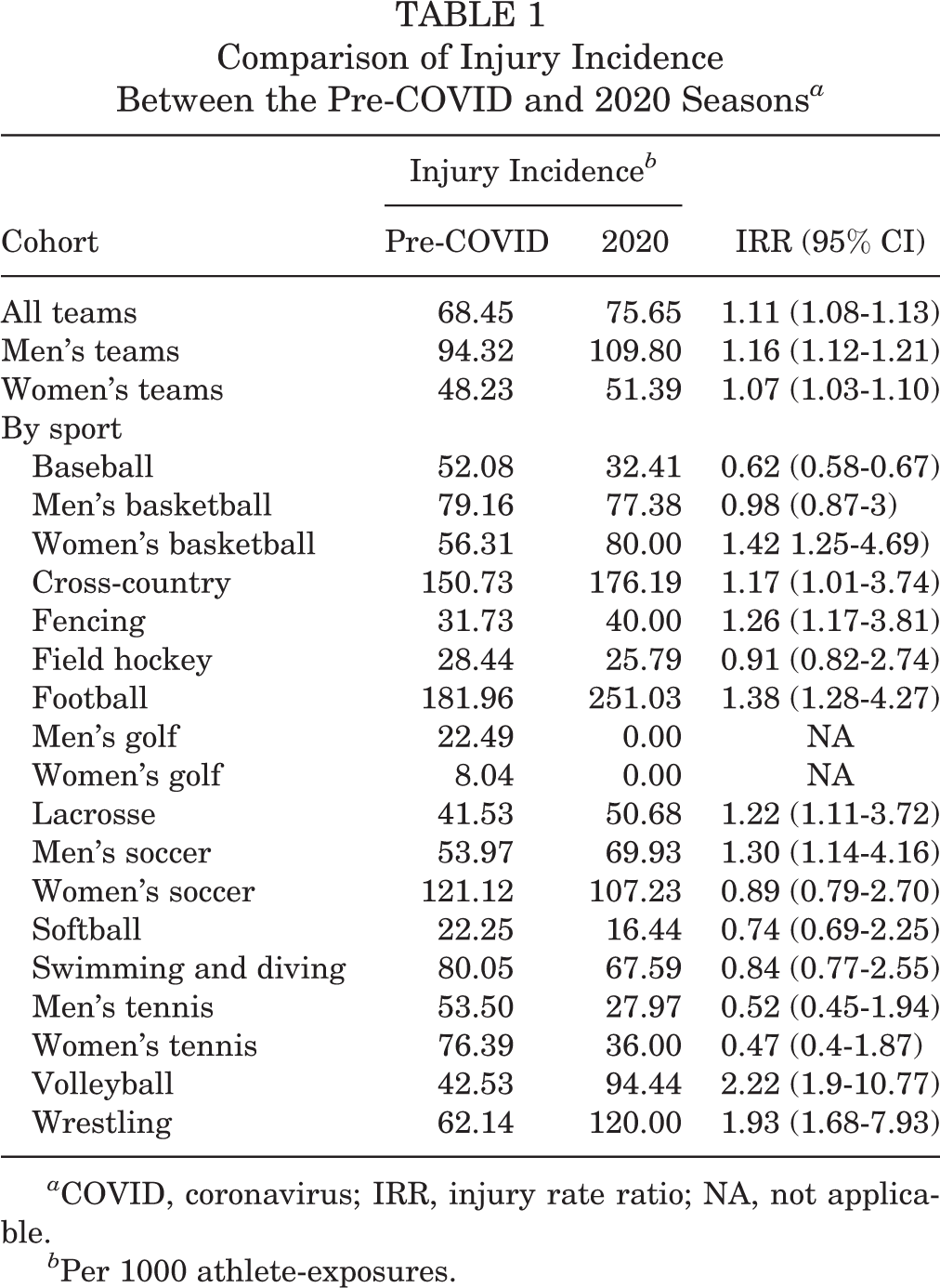
a COVID, coronavirus; IRR, injury rate ratio; NA, not applicable.
b Per 1000 athlete-exposures.
There was a 20.7% decrease in the total days unavailable from the pre-COVID seasons to the 2020 season (1374 vs 1089 days/1000 AEs; IRR, 0.79 [95% CI, 0.77-2.26]) (Table 2). Football experienced the most number of days unavailable in the pre-COVID seasons (4053.04 days/1000 AEs), while cross-country running had the most number of days unavailable during the 2020 season (4723.8 days/1000 AEs) (Table 2).
Comparison of Total Days Unavailable Between the Pre-COVID and 2020 Seasons a

a COVID, coronavirus; IRR, injury rate ratio; NA, not applicable.
b Per 1000 athlete-exposures.
The distribution of injuries according to anatomic area varied for each team, without any collective trend across sports during the 2020 season (Appendix Table A1). Wrestling yielded the largest increase in both lower body injuries (IRR, 1.9 [95% CI, 1.65-7.68]) and central axis injuries (IRR, 4.1 [95% CI, 3.57-69.34]), while women’s lacrosse experienced the largest increase in upper body injuries (IRR, 3.2 [95% CI, 2.91-26.96]).
In the subgroup analysis of injury rates by sex, men’s teams had a higher injury incidence and greater mean number of days unavailable during the pre-COVID seasons and the 2020 season. Men’s teams had a higher increase in injury incidence from the pre-COVID season to the 2020 season, at 16.4% (IRR, 1.16 [95% CI, 1.12-1.21]), compared with a 6.5% increase in the women’s teams (IRR, 1.07 [95% CI, 1.03-1.10]) (Table 1). However, men’s teams also had a larger decrease in the number of days unavailable at 23.7% (IRR, 0.76 [95% CI, 0.73-2.23]), compared with a 10.70% decrease in the women’s teams (IRR, 0.89 [95% CI, 0.86-2.53]) (Table 2). The anatomic distribution of injuries for men’s and women’s teams across seasons is presented in Table 3. Men’s and women’s teams had an increase in incidence for lower body, upper body, and central axis injuries, while there was a decrease in the incidence of head injuries.
Comparison of Injury Incidence According to Sex and Anatomic Area Between the Pre-COVID and 2020 Seasons a

a COVID, coronavirus; IRR, injury rate ratio; medical issue, sports-related medical issue.
b Per 1000 athlete-exposures.
Discussion
When compared with the pre-COVID seasons, a 10.5% increase in total injury incidence was observed in the 2020 season (68.45 vs 75.65 injuries/1000 AEs; IRR, 1.11 [95% CI, 1.08-1.13]). However, across the same seasons, there was a decrease in the total days unavailable per 1000 AEs (1374 vs 1089 injuries/1000 AEs; IRR, 0.79 [95% CI, 0.77-2.26]) (Table 2). This decrease in days unavailable suggests that injury severity of the mean reported injury event may have decreased in the COVID-19 lockdown season. Furthermore, men’s sports experienced both a greater increase in injury rate and a greater decrease in days unavailable compared with women’s sports, suggesting that not all student-athletes experienced the same change in injury rates after the COVID-19 lockdown. Injury rates disproportionality increased in male student-athletes and student-athletes in higher-contact sports after the COVID-19 lockdown.
The current study is the first to analyze changes in injury rates for NCAA Division I student-athletes in the season immediately after the COVID-19 lockdown. Among professional athletes, multiple prior studies have highlighted the conflicting epidemiology of injuries in the postlockdown season. Although an increased injury incidence during the 2020 season was reported in Germany’s and England’s professional soccer leagues, as well as in the NFL and Major League Baseball, 2,3,16,29,31 Orhant et al 26 observed a negative effect on injury rates during the 2020 season in the French Ligue 1 and 2 soccer leagues, while Marotta et al 17 found that injury rates were unchanged in the Italian Serie A soccer league. Similarly, the injury incidence and profile for United Kingdom domestic men’s cricket were comparable to those of previous seasons. 11 These findings suggest that the COVID-19 lockdown did not have a universal impact on injury rates for all high-level athletes. Thus, to assess the risk athletes faced returning to play during the abnormal 2020 season, it is important to analyze unique competition settings and levels across sexes and sports type. The present study is the first to address this gap in the literature by describing injury rates in the postlockdown season for collegiate student-athletes at a single NCAA Division I institution.
Given the nearly 500,000 participating students and the more than US$1 billion annual revenue of the NCAA, 20,21 an increase in injury incidence could have significant financial implications for both collegiate programs and student-athletes, who typically bear the cost of their own health insurance. 33 As such, there are a number of financial and organizational factors at play contributing to when and how to return to play after elongated lapses in training, as was the case in 2020. Previous studies have highlighted the lifelong effects of collegiate injuries, with a previous survey reporting that 50% of former student-athletes experienced chronic injuries and 67% reported major injuries throughout their careers. 32 Former collegiate student-athletes experience more physical limitations, chronic injuries, and decreased health-related quality of life than the general population. 8,32 Thus, a change in injury rates, as seen in the current study, could therefore have a significant effect on a collegiate student-athlete’s future and overall well-being. Although these results are limited to certain sports at a single NCAA Division I institution, coaches and athletic trainers may use these results to consider appropriate return-to-play timelines and precautions, as well as to better assess which groups of student-athletes may require more targeted injury prevention programs. Furthermore, these findings may bring awareness to student-athletes about the risk associated with returning to play after lockdowns and reduced sports preparation.
Overall Injuries
Across all student-athletes, during the 2020 season, 635 injuries during 8394 AEs were measured for an injury incidence of 75.65 per 1000 AEs (Table 1). In support of the hypothesis, this rate is higher than the pre-COVID injury incidence of 68.45 per 1000 AEs. Importantly, COVID-19 infections cannot directly explain the increase in injury incidence across the overall cohort because non–sports-related medical issues and COVID-19 infections were excluded from the analysis. Instead, it is possible that the restrictions implemented during COVID-19 altered typical training regimens and thus potentially reduced athlete work capacity and physical preparedness. 34 This effect may have been exacerbated in collegiate student-athletes, who more heavily rely on team facilities and coaches for training and often do not have the same financial support that professional athletes can rely on for accessing private and at-home training. However, given the retrospective nature of this study and limitations of the injury database, specific reasons for increased injury rates were not able to be assessed but may be useful in future evaluations.
Between 2009 and 2014, the NCAA Injury Surveillance Program (ISP) reported an estimated 1,053,700 injuries that occurred during an estimated 176.7 million AEs, leading to an injury incidence of 5.96 per 1000 AEs across the 24 NCAA championship sports. 14,15 The large difference in reported pre-COVID overall injury rates in the NCAA-ISP versus the current study’s cohort (5.96 vs 68.45 per 1000 AEs) (Table 1) 15 is likely because of differences in injury surveillance procedures. The current study’s definition of injury was broader than that of the NCAA-ISP, as it also included injuries that persisted for >3 days, which created the potential for the study to capture events that did not necessarily remove student-athletes from play. 14 Also, the current study did not include the lower-injury-rate sports of track and field, bowling, rifle, and rowing. Inclusion of these sports in the NCAA-ISP cohort likely lowered the overall injury rate while still contributing to the total AEs.
Although a number of factors may have contributed to the increased injury rate observed in this study, it is possible that decreased preparedness from COVID-19 restrictions contributed to increased injury risk for student-athletes. The Centers for Disease Control and Prevention emphasizes adequate preseason training for injury prevention in collegiate student-athletes. 10 However, appropriate retraining after a lockdown has not been well studied. Before the COVID-19 pandemic, work stoppages and lockouts among professional athletes were the only instances in which seasons were either cut short or postponed. For example, Myer et al 19 found a significant increase in rates of Achilles tendon injuries during the preseason after the 4-month NFL lockout in 2011. It is therefore unsurprising that overall injury rates increased among the included cohort of NCAA Division I student-athletes after the COVID-19 lockdown.
Despite an overall increase in injury incidence, the mean number of days that student-athletes were unavailable because of injury decreased in the season after the COVID-19 lockdown. In 2020, there were 8394 student-athletes who were not available for practice or competition (1089 days unavailable/1000 AEs) (Table 2). The number of days unavailable decreased from the pre-COVID rate of 1374 days unavailable per 1000 AEs, which contradicts the initial hypothesis. One possible explanation of this finding is that students felt increased psychological pressure to return to play during shortened seasons. A 2013 systematic review found that when competitive athletes are recovering from an injury, greater external pressure combined with more self-determination contributes to premature return to sport. 1 A second possible explanation of these findings is that players experienced numerically more but overall less severe injuries after the COVID-shortened season.
Epidemiology by Sex
It is also important to understand how different student-athlete characteristics may influence injury rates in the season after a lockdown. In the current study, it was observed that male student-athletes experienced a higher injury incidence and more number of days unavailable before the COVID-19 lockdown than female student-athletes. Both sexes experienced an increase in injury incidence after COVID-19 lockdowns; however, male student-athletes had a greater change (Table 1). This is consistent with the study by Kerr et al, 15 who reported that between 2009 and 2014, men’s NCAA sports had higher injury rates than women’s sports (6.5 vs 5.2 per 1000 AEs). These disparities between male and female sports injuries have been attributed to a multifactor combination of anatomic, hormonal, and neuromuscular differences between the sexes. 12 One explanation of the findings in the current study is that male student-athletes were more sensitive to alterations associated with lockdowns. There are a number of explanations for this observation. At our institution, the sports that experienced both the highest overall injury rate (football) and the greatest increase in injury rate (wrestling) are men’s sports, which may present a bias in the data. Although this is the case, it is important to note that there may be other factors related to sex, such as disparities in return-to-play precautions and training, that may contribute to a discrepancy in injury rates experienced by sex. Further investigation is necessary to determine factors that may be at play in this regard; however, the observed trend may alert team health officials to be proactive in identifying student-athletes who are in higher risk groups after lockdowns.
Limitations
There are several limitations that should be considered when interpreting the results of this study. All included data are from a single NCAA Division I institution, so it is possible that injury rates and trends cannot be generalized to other collegiate institutions. However, use of an institution-specific database was necessary because of the discontinuation of the NCAA Injury Surveillance System in 2015. 14 Further, as is common among other retrospective studies of injury epidemiology, severity of injuries could not be directly assessed using the current database. Total days unavailable was used as a proxy for injury severity. This study was also limited because changes in injury rates could only be compared for the 2020 season. Additional years of surveillance would aid in determining if the changes were transient and rebounded to prepandemic levels in following seasons or if the effects of the pandemic had long-lasting implications for collegiate injury rates.
Another limitation was that the institution analyzed did not participate in all NCAA championship sports. The study did not include data on beach volleyball, bowling, gymnastics (men’s and women’s), ice hockey (men’s and women’s), men’s lacrosse, rifle, rowing, skiing, indoor track, outdoor track, men’s volleyball, or water polo (men’s and women’s). In this study, the indirect effects that COVID-19 had on injury characteristics were analyzed, such as lockdown measures and schedule changes; however, the direct effects of returning to play after a COVID-19 infection were not assessed. Further investigation needs to be done to elucidate the long-term consequences of COVID-19 infection on student-athlete risk of injury. Despite these limitations, we believe that the data presented in this study are representative of changes in injury characteristics that occurred during the COVID-19 season in varsity NCAA student-athletes.
Conclusion
Compared with the pre-COVID seasons, the injury incidence was higher and the number of days missed because of injury was lower among collegiate student-athletes at a single NCAA Division I school in the season immediately after the COVID-19 lockdown. Taken together, these findings suggest that lack of regular access to training facilities, athletic trainers, coaches, and teammates may lead to increased injury risk. Understanding the specific risk factors and reasons for the changes in injury characteristics allows for guided resource allocation and improved focus of prevention measures. We recommend that for the safety of student-athletes, increased caution be taken when returning to play after prolonged restrictions on athletics.
Footnotes
Final revision submitted March 27, 2023; accepted April 13, 2023.
One or more of the authors has declared the following potential conflict of interest or source of funding: M.A.T. has received nonconsulting fees from Arthrex and Smith & Nephew and hospitality payments from Medwest. V.K.T. has received education payments from Arthrex, consulting fees from Smith & Nephew, and nonconsulting fees from Smith & Nephew. AOSSM checks author disclosures against the Open Payments Database (OPD). AOSSM has not conducted an independent investigation on the OPD and disclaims any liability or responsibility relating thereto.
Ethical approval for this study was waived by Northwestern University (No. STU00215945).