




Abstract
Background:
Spine injuries are common in collegiate wrestlers and can lead to reinjury, persistent pain, and time lost from participation.
Purpose:
To describe the epidemiology of spine injuries in National Collegiate Athletic Association (NCAA) wrestlers between academic years 2009 to 2010 and 2013 to 2014.
Study Design:
Descriptive epidemiology study.
Methods:
The incidence and characteristics of spine injuries were identified utilizing the NCAA–Injury Surveillance Program database. Spine injuries were assessed for injury type, injury mechanism, time of season, event type, recurrence, participation restriction, and time lost from participation. Rates of injury were calculated as the number of injuries divided by the total number of athlete-exposures (AEs). Injury rate ratios (IRRs) were calculated for event type and time of season, and results with 95% confidence intervals that did not include 1.0 were considered statistically significant.
Results:
There were an estimated 2040 spine injuries reported in the database over the 4-year period, resulting in an injury rate of 0.71 per 1000 AEs. Spine injuries were over twice as likely to occur in competitions as in practices (IRR, 2.02; 95% confidence interval, 1.10-3.69). More injuries occurred in both the preseason (0.94 per 1000 AEs) and the postseason (1.12 per 1000 AEs) compared with the regular season (0.55 per 1000 AEs). Contact injuries (42%) were the most common mechanism of injury, and brachial plexus injury (20%) was the most common diagnosis. Only 1.3% of injuries required surgery, and athletes most commonly returned to sport within 24 hours (33%) or within 6 days (25%).
Conclusion:
This investigation found an overall injury rate of 0.71 per 1000 AEs in wrestling athletes between academic years 2009 to 2010 and 2013 to 2014. The majority of these injuries were new, and athletes most commonly returned to sport within 24 hours. The injury rate was highest in competition, and both the preseason and the postseason showed a higher injury rate than that in season. Efforts to improve injury prevention and management should be informed by these findings.
Keywords
National Collegiate Athletic Association (NCAA) wrestling comprises approximately 7200 student athletes. 24 The sport has demonstrated a high rate and wide variety of injuries resulting from the athlete’s exposure to direct contact, twisting forces, and takedowns. 9,22,26 Consequently, in comparison with other NCAA sports, wrestling is second only to spring football in overall injury rate. 14
Spine injuries are particularly prominent, as they comprise approximately 15% of all sports injuries. 28 Additionally, it has been reported that sporting activities are the fourth most common cause of injuries to the spinal cord itself, comprising 8.7% of overall spinal cord injuries. 2,3 Although many of these injuries are benign, spine injuries can be extremely debilitating or even life threatening. This is specifically relevant in wrestling because of the severity of injuries associated with the sport. In a 5-year study across athletes in 25 NCAA sports, wrestling had the highest severe injury rate at 1.73 per 1000 athlete-exposures (AEs). 15 It has also been reported that injuries to the head and neck comprise 11.2% of all severe sport injuries and wrestling predisposes athletes most to injuries in these regions. 11,15 Consequences of these injuries range from temporary disability to career-ending symptoms and can result in permanent disruption of daily living.
Despite the frequency and implications of spine injuries in wrestling athletes, there is a paucity of information dedicated to evaluating and characterizing these injuries in NCAA wrestlers. Specifically, there is limited published information regarding the setting of wrestling injuries, their acuity, specific diagnoses, season timing, and associated return to play timelines. The purpose of this study was assess these factors in NCAA wrestling athletes. In order to sufficiently capture these variables on a large scale, a database tracking the details of NCAA injuries was utilized. We hypothesized that there would be recorded data that captured details in the epidemiology of spine injuries in NCAA wrestlers.
Methods
Data Collection
The NCAA–Injury Surveillance Program (ISP) is a prospectively gathered database managed by the nonprofit research organization Datalys Center for Sports Injury Research and Prevention. The database was used to assess data from a 4-year period spanning the athletic seasons between 2009 to 2010 and 2013 to 2014. The research review board of the NCAA approved this study, and it was found to be exempt from institutional review board approval.
The NCAA-ISP and its use has been previously described. 16 The database utilizes a voluntary convenience sample from any of the 3 NCAA divisions, resulting in year-to-year variability in the number of programs contributing to its data. 8 This generates a deterministic rather than random data sample that is an appropriate means to monitor injury trends and patterns in NCAA sports. 7
Athletic trainers (ATs) and physicians are responsible for inputting data at each participating program. ATs record injury and exposure data via each program’s electronic health record throughout the preseason, regular season, and postseason. A detailed report that includes information surrounding the injury, anatomic site involved, event type, diagnosis, and return to participation time is completed by ATs and/or physicians. For each practice and competition, ATs record the overall number of athletes participating.
The NCAA-ISP data were queried for wrestlers in any of the 3 NCAA divisions who sustained a “spine,” “back,” “neck,” “lumbar spine,” “thoracic spine,” “cervical spine,” or “sacroiliac” injury as well as “lower back pain.” Accordingly, this investigation depended on the ATs, physicians, and any other medical staff involved in the accurate diagnosis and reporting of the included spine injuries.
Computing National Estimates
Calculating estimates from the NCAA-ISP database has been previously described. 5 National estimates of back injuries were computed using poststratification sample weights based on division and academic year applied to each reported injury and AE. The following formula was used to calculate poststratification sample weights:

where weightabc indicates weight for the ath sport of the bth division in the cth year. We corrected for an estimated 88% capture rate of injuries in the NCAA-ISP by further adjusting weights for all data. 17 Unless otherwise noted, the presented numbers represent estimates from these calculations.
Data Analysis
The data set was analyzed for the rate and characterization of all spine injuries in NCAA wrestlers using previously standardized weighted estimates. 7,13 Spine injuries were assessed for injury type, injury mechanism, time of season, event type, recurrence, participation restriction, and time lost from participation. The injury rate was computed as the number of injuries per the total number of AEs and reported as a ratio of injuries per 1000 AEs. The injury rate and injury rate ratio (IRR) were also calculated for event type and time of season. The following formula demonstrates a sample IRR calculation using rates between competition and practice as an example 10 :

Results with 95% confidence intervals (CIs) that did not include 1.0 were considered statistically significant. Descriptive data were reported as percentages, and participation restriction time was reported using intervals of <24 hours, 1 to 6 days, 7 to 21 days, and >21 days. All data were analyzed using IBM SPSS (IBM Corp) and Excel (Microsoft Corp).
Results
A total of 57 spine injuries in men’s wrestling were identified in the NCAA-ISP database between the academic years 2009 to 2010 and 2013 to 2014. This represents an estimated 2040 total spine injuries over this period. These injuries occurred at a rate of 0.71 injuries per 1000 AEs over 2,871,519 total estimated exposures. The most common injuries reported were stingers (0.14 per 1000 AEs), paralumbar muscle strains (0.11 per 1000 AEs), and cervical spine disc injuries (0.10 per 1000 AEs) (Figure 1).

Men’s wrestling spine injuries by type per 1000 athlete-exposures (2009-2010 to 2013-2014).
Injuries by Event Type, Season Timing, and Weight Class
Spine injuries were approximately twice as likely to occur during competition when compared with practice (IRR, 2.02; 95% CI, 1.10-3.69) (Table 1). The postseason had the highest injury rate at 1.12 per 1000 AEs, followed by preseason (0.94 per 1000 AEs) and regular season (0.55 per 1000 AEs). However, when compared with the regular season, there was no significant relative risk found for the preseason (IRR, 1.70; 95% CI, 0.98-2.95) or postseason (IRR, 2.04; 95% CI, 0.62-6.62) (Table 2). The 165-lb (75-kg) and 197-lb (89-kg) weight classes had the highest weighted injury totals at 455 and 318, respectively, while the 184-lb (83-kg) weight class had the lowest at 67 (Figure 2).
Men’s Wrestling Practice and Competition Injuries, 2009-2010 to 2013-2014 a

a AE, athlete-exposure; IRR, injury rate ratio.
b Competition vs practice, IRR 2.02 (95% CI, 1.10-3.69).
Men’s Wrestling Injuries by Time of Season, 2009-2010 to 2013-2014 a
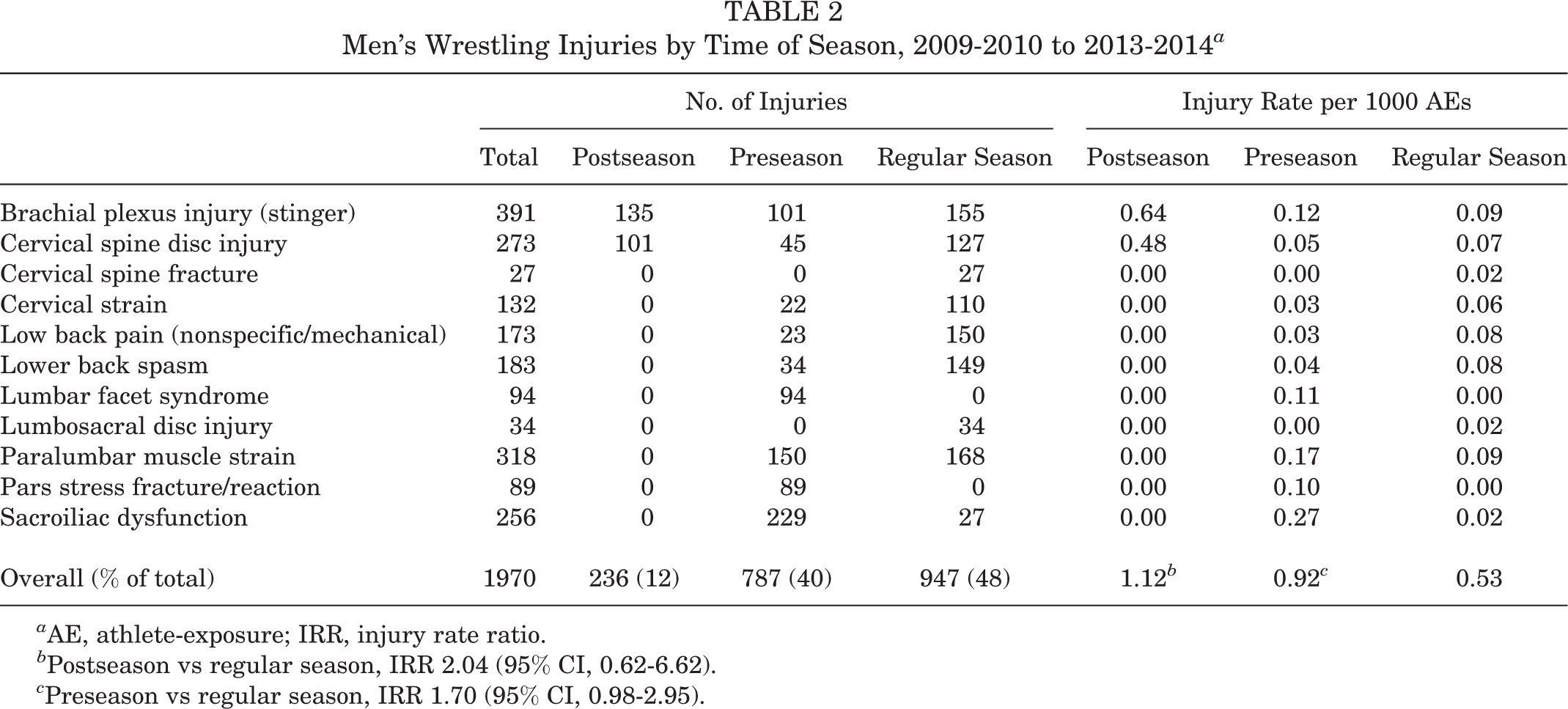
a AE, athlete-exposure; IRR, injury rate ratio.
b Postseason vs regular season, IRR 2.04 (95% CI, 0.62-6.62).
c Preseason vs regular season, IRR 1.70 (95% CI, 0.98-2.95).
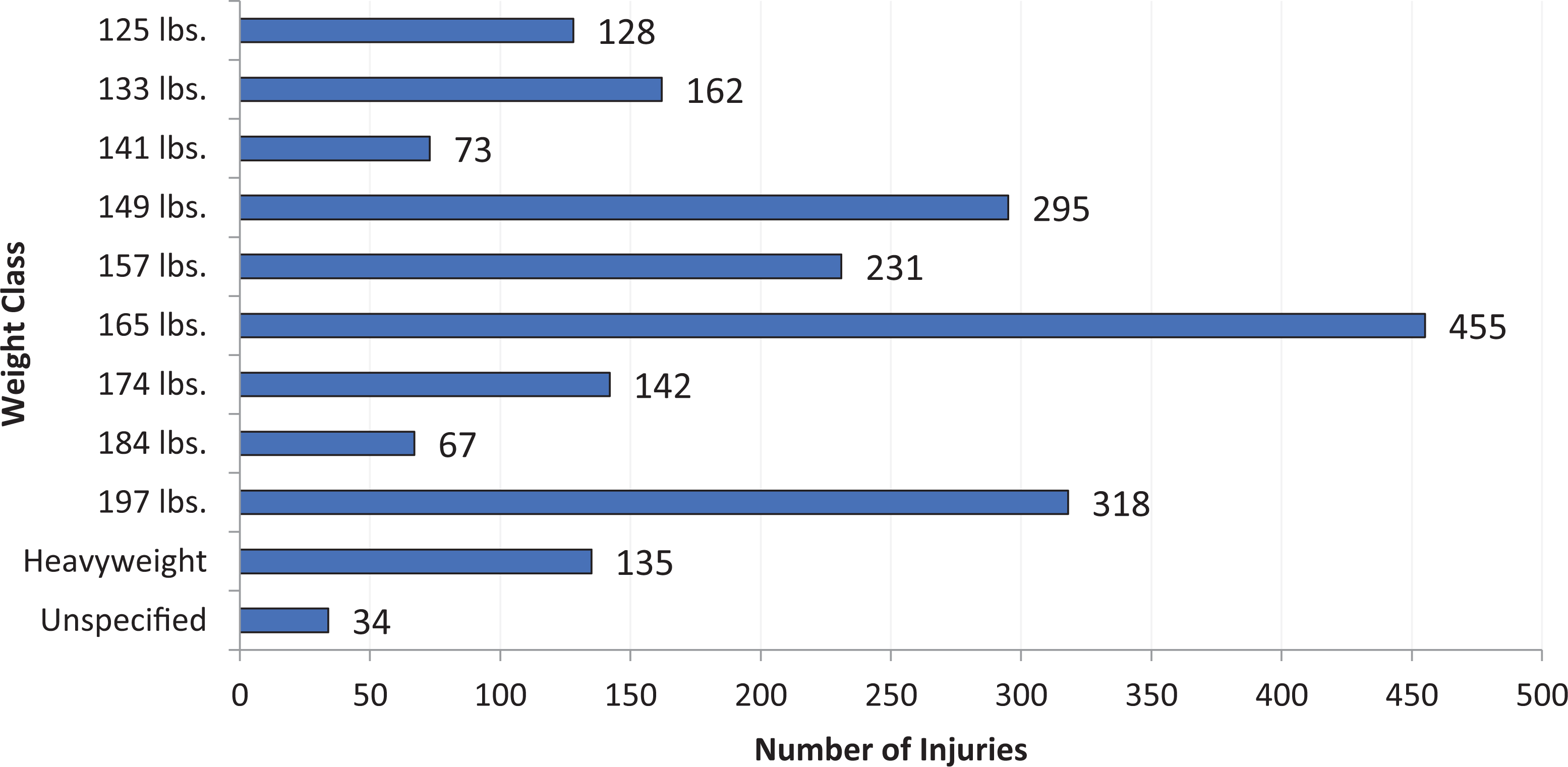
Incidence of spine injuries by weight class (2009-2010 to 2013-2014).
Mechanism of Injury, Injury Recurrence, Time Lost From Play, and Need for Surgery
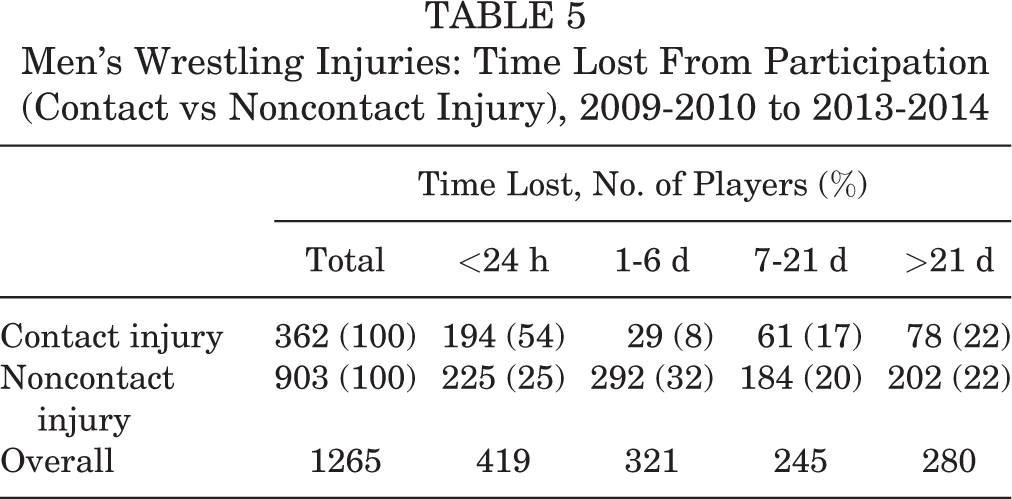
Contact injuries were the most common, comprising 42% of all sustained injuries (Table 3). Of all recorded injuries, 86% were documented as new injuries, while 13% were recurrent injuries from a previous academic year (Table 4). Athletes most commonly returned to play within 24 hours (33%) or within 1 to 6 days (25%) after injury onset, and 22% remained out of play for >21 days (Table 5). When compared with noncontact injuries, contact injuries were more commonly associated with return to play within 24 hours (Table 5). Only 1.3% of injuries required surgery.
Men’s Wrestling Injuries by Mechanism, 2009-2010 to 2013-2014

Men’s Wrestling Injuries: New Versus Recurrent, 2009-2010 to 2013-2014

Men’s Wrestling Injuries: Time Lost From Participation (Contact vs Noncontact Injury), 2009-2010 to 2013-2014
Discussion
This analysis of the NCAA-ISP database for spine injuries in collegiate wrestlers between the academic years 2009 to 2010 and 2013 to 2014 resulted in several important findings: (1) athletes were more likely to sustain a spine injury in competition than in practice, (2) injuries were more commonly sustained in preseason and postseason than in season, (3) injuries occurred most frequently as a result of contact, (4) the majority of athletes returned to play within 24 hours of their injury, and (5) 13% of injuries were recurrent. The overall rate of spine injuries was 0.71 per 1000 AEs in collegiate wrestlers.
Previous investigations into wrestling injuries have been performed. A 2007 review of all wrestling injuries found that the majority are related to contact, occur in matches, and are relatively evenly spread across weight classes. 1 The frequency of catastrophic spine injuries in wrestling has been estimated at 0.52 per 1000 AEs in high school athletes and 2.11 per year in collegiate wrestlers. 4,6,29 Injury estimations for noncatastrophic injuries have been reported to occur at a rate of 6 per 1000 AEs in high school wrestling athletes. 21 For Olympic wrestlers, these noncatastrophic injuries occur in as many as 26.5% of athletes. 9,23 Other investigations have been limited by analysis of a single team, school-aged athletes, or outdated data. 11,20,22,27 Of all available studies, few have been dedicated to NCAA athletes, and none of these investigations has focused specifically on injuries to the spine. Characterizing spine injuries in NCAA wrestlers will inform the expectations and management of these potentially catastrophic injuries and aid in the development of improved injury prevention and rehabilitation programs.
In our study, we found an overall injury rate of 0.71 per 1000 AEs for spine injuries in NCAA wrestlers. This is slightly higher than the 0.52 per 1000 AEs estimate for catastrophic injuries in wrestlers and significantly lower than the 8.3 per 1000 AEs estimate of overall injuries in NCAA wrestlers. 1 Our results also demonstrated that NCAA wrestlers sustained a higher rate of spine injuries during competitions when compared with practices (1.25 vs 0.61 per 1000 AEs, respectively). However, the overall number of spine injuries in practice was greater than that in competitions because of significantly more time spent in practice. These findings align with those of previous studies on the epidemiology of overall injuries in wrestlers. 1,11 Moreover, the increased risk of injury in competitions has been reported in other collegiate sports and is potentially explained by an increased intensity of play during competitive matches. 8,19 Along with associated fatigue, these high-effort competitions may create a more unpredictable environment than practice creates and subsequently predispose the athlete to increased risk of injury. Although NCAA ATs should be aware of the heightened risk for injury in competitions, they should also be mindful that the majority of injuries actually occur in the practice setting.
Spine injuries occurred at a higher rate in the preseason (0.94 per 1000 AEs) when compared with in season (0.55 per 1000 AEs). This increased risk of injury in the preseason in men’s collegiate athletics has been previously reported and can potentially be explained by poor conditioning, high-intensity preseason training, and increased duration of preseason practices. 12,18,19 Specific to wrestling, the early part of the season involves more athletes competing for starting positions and wrestle-offs between teammates. 11 Additionally, the preseason may involve more extreme attempts to reach a goal body weight for the upcoming season. 1 These findings have not been previously reported for collegiate wrestling, and taken together they emphasize the importance of appropriate injury prevention programs. The optimal injury prevention strategies will vary between programs, and in-competition injuries are likely unavoidable; however, our results suggest that the most feasible and effective prevention interventions would include targeting avoidable contact injuries during practice, ensuring proper preseason endurance and weight management, and allowing resolution of previous injuries.
Spine injuries were evenly distributed among all weight classes, which corresponds well with previous reports of wrestling injuries. 1,14,27 In terms of injury mechanism, contact injuries were most common. This aligns with previous reports that have noted direct contact and takedowns are the main mechanisms by which a wrestling athlete incurs injury. 21,23,25 It is notable that >85% of these injuries were documented as new. This is also consistent with previous reports regarding the acuity of wrestling injuries. 9 Together, our results confirm previous reports that wrestling injuries do not vary significantly among weight classes and the majority of injuries are new rather than preexisting.
Our study also provided information regarding return to play. One third (33%) of all injured participants returned to sport within 24 hours. Although 22% of athletes remained out of play for >21 days, <2% of injuries required surgical intervention. Table 5 outlines the return to play as compared between contact and noncontact injuries. Returning to play within 24 hours was more common for contact (54%) than noncontact (25%) injuries. Both groups showed a 22% rate of removal from sport >21 days. These results suggest that although injuries occur relatively frequently in NCAA wrestling, athletes can commonly return the next day, especially if the injury involved contact. However, medical staff should be aware that a prolonged avoidance of activity is not rare. Future studies focusing on the return to play and long-term outcome of these athletic injuries would assist in further understanding.
Limitations
This study has several limitations. Utilizing a national database makes our study subject to weakness associated with this method of data collection. Most importantly, it relies upon honest and accurate reporting by staff and is limited in what it can report. It does not allow for long-term tracking of clinical or functional outcomes for different injuries. Further, the data set spans a 4-year period that was not stratified by individual years. As a result, the relevance of the presented data could be undermined by unidentified year-to-year changes and may not be representative of all wrestling injuries throughout time.
Conclusion
This investigation found an overall injury rate of 0.71 per 1000 AEs in wrestling athletes between the academic years 2009 to 2010 and 2013 to 2014. The majority of these injuries were new, and athletes most commonly returned to sport within 24 hours. The injury rate was highest in competition, and both the preseason and the postseason showed a higher injury rate than that in season. Efforts to improve injury prevention and management should be informed by these findings.
Footnotes
Acknowledgment
This publication contains materials created, compiled, or produced by the Datalys Center for Sports Injury Research and Prevention Inc on behalf of the NCAA, ©2021. All rights reserved. The National Collegiate Athletic Association–Injury Surveillance Program (NCAA ISP) data were provided by the Datalys Center for Sports Injury Research and Prevention. The ISP was funded by the NCAA. The content of this manuscript is solely the responsibility of the authors and does not necessarily represent the official views of the Datalys Center or the NCAA. The authors thank the many athletic trainers who have volunteered their time and efforts to submit data to the NCAA ISP. Their efforts are greatly appreciated and have had a tremendously positive effect on the safety of collegiate athletes.
Final revision submitted March 15, 2021; accepted March 30, 2021.
One or more of the authors has declared the following potential conflict of interest or source of funding: K.S.M. has received grant support from Stryker and education payments from Goode Surgical. J.D.H. has received education payments from Arthrex. J.L.M. has received education payments from Arthrex. A.C. has received speaking fees from Arthrex and consulting fees from Arthrex, Zimmer-Biomet, and Trice Medical. AOSSM checks author disclosures against the Open Payments Database (OPD). AOSSM has not conducted an independent investigation on the OPD and disclaims any liability or responsibility relating thereto.
Ethical approval for this study was waived by the Mayo Clinic (application No. 17-008147)