



Abstract
Background:
Head-down tackling has been associated with injuries to the brachial plexus, cervical spine, and head in high school and collegiate American football. Head-down tackling has also been associated with decreased effectiveness in successful tackles compared with head-up tackling.
Purpose:
To assess tackling techniques used during National Collegiate Athletic Association (NCAA) Division I football games and to evaluate the successful tackling rates according to technique.
Study Design:
Cross-sectional study.
Methods:
Three reviewers analyzed 1000 consecutive solo defensive tackling attempts made in the 2021 season (October to December) by 8 universities within the NCAA Southeastern Conference. Slow-motion replays were used to analyze the success of the tackling attempt, the tackling method, and the initial point of contact with respect to the offensive player’s waist. The chi-square or Fisher exact test was used to analyze categorical data, and the 2-tailed Student t-test or the Mann-Whitney U test was used to analyze continuous data.
Results:
Head-up and head-down tackling occurred in 902 (90.2%) and 98 (9.8%) tackle attempts, respectively. Head-up tackles were successful in 76.2% of the attempts compared with 55.1% for head-down tackles (P < .001). Tackles were made at or above the offensive player’s waist in 777 (77.7%) attempts and below the waist in 223 (22.3%) attempts. Tackles at or above the waist were successful in 77.6% of the attempts compared with 61.9% of tackles below the waist (P < .001). The inside-shoulder method was used in 592 (59.2%) tackles, the arm method in 317 (31.7%), the head-across-the-bow method in 72 (7.2%), and the helmet-to-helmet method in 19 (1.9%). Inside-shoulder tackles had the highest success rate of 93.2%, compared with 41.6% for arm (P < .001), 59.7% for head-across-the-bow (P < .001), and 73.7% for helmet-to-helmet (P = .001) tackles. Inside-shoulder tackles resulted in head-up tackling in 92.9% compared with 41.7% for head-across-the-bow (P < .001) and 57.9% for helmet-to-helmet (P < .001) tackles. There were no recorded injuries to the tackler.
Conclusion:
Head-up tackles, tackles made at or above the offensive player’s waist, and inside-shoulder tackles had the highest success rates. Head-down tackling and tackling below the waist were associated with poor tackling methods, including head-across-the-bow and helmet-to-helmet tackles, which had lower success rates.
Keywords
Head-down tackling and head-across-the-bow tackling have been shown to be associated with injuries to the brachial plexus, cervical spine, and head in high school and collegiate American football. 1 –5,9,13 The head-across-the-bow technique is a commonly taught tackling technique that involves the tackler placing the head across the front of the body of the ball carrier. However, this technique has been associated with head-down tackling, which places the brachial plexus, cervical spine, and head into a position at risk for injury. 13
“Spearing” is a head-down tackling technique that involves the tackler placing the head and neck in a neutral or flexed position during a tackle, in which axial compression forces are transferred from the crown of the helmet directly into the cervical spinal column, sometimes leading to catastrophic vertebral body failure and quadriplegia. 11,13 Since the prohibition of spear tackling in 1976, the rate of catastrophic spine injuries has decreased significantly. The incidence of cervical spine fractures and dislocations in high school football players decreased from 7.72 per 100,000 in 1976 to 2.31 per 100,000 in 1987. 14 –16 Similarly, the incidence of quadriplegia in high school and collegiate football players dropped from 24 players in 1976 to 5 in 1984. 14 The current recommendation of the National Athletic Trainers’ Association is to avoid these high-risk techniques by initiating contact with the chest or shoulder while maintaining a head-up posture. 6 –8 However, even with the implementation of these recommendations and prohibitions, 29% of the deaths among high school and collegiate football players from 2005 to 2014 have been associated with either head-down or head-across-the-bow tackling. 9,14 In addition to the risk of sustaining catastrophic injuries, head-down and head-across-the-bow tackling have also been shown to decrease the effectiveness of producing successful tackles compared with head-up tackling. 13
The objective of this study was to assess tackling techniques used during National Collegiate Athletic Association (NCAA) Division I football games and to analyze the successful tackling rates using these techniques. We hypothesized that head-down tackling and tackling below the waist are the least efficient at producing successful tackles.
Methods
Study Population
The study protocol was exempt from the local institutional review board, as all data used for analysis were publicly available. A retrospective cohort analysis was performed by 3 orthopaedic surgery residents (T.H., K.B., D.D.) with prior experience in analyzing tackling methods. The analysis was performed in August and September 2022 by evaluating 1000 consecutive defensive solo tackling attempts made in the 2021 season by 8 Southeastern Conference universities. Inclusion criteria were any defensive tackle attempts as defined by Stockwell et al. 13 Exclusion criteria were tackles with insufficient replays or camera angles to complete proper tackle analysis.
Data Collection
Three orthopaedic surgery residents with prior experience in analyzing tackling methods independently reviewed each tackle attempt. Slow-motion replays of full games were used to analyze the success of the tackling attempt, the tackling method, and the relationship of the tackler’s head to the offensive player’s waist at the point of contact during the tackling attempt. The criteria used to assess these parameters were adapted from Stockwell et al 13 and are summarized in Appendix Table A1. The only difference was that the heads-up tackling position was lowered from >45° in their study to >30° in the current study. Each reviewer analyzed the same 1000 tackles in a blinded fashion, and the interrater reliability of the assessments was calculated. Data regarding any injuries associated with the tackle were also obtained.
Statistical Analysis
Data analysis was performed using the Statistical Package for the Social Sciences statistical software (Version 25.0; IBM). The chi-square test or Fisher exact test was used to analyze categorical data, and the 2-tailed Student t test or Mann-Whitney U test was used to analyze continuous data. A P value <.05 was considered statistically significant.
Interrater reliability was calculated using the Landis and Koch breakdown, with the following interpretation of kappa values: ≤0.2, poor agreement; 0.21 to 0.4, fair agreement; 0.41 to 0.6, moderate agreement; 0.61 to 0.8, good agreement; and 0.81 to 1.0, very good agreement. 10
Results
The interrater reliability across all parameters was good (mean, κ = 0.718; range, 0.632-0.802) (Table 1). Head-up and head-down tackling occurred in 902 (90.2%) and 98 (9.8%) tackle attempts, respectively (Table 2). Head-up tackles were successful in 76.2% of the tackle attempts compared with 55.1% of the head-down tackle attempts (P < .001). Tackles were made at or above the level of the offensive player’s waist in 777 (77.7%) tackle attempts and below the waist in 223 (22.3%) tackle attempts (Table 3). Tackles at or above the waist were successful in 77.6% of the tackle attempts compared with 61.9% of tackles below the waist (P < .001). Successful tackles occurred in 741 (74.1%) tackle attempts (Table 4).
Interrater Reliability for Raters A, B, and C a

a Interpretation of kappa: ≤0.2, poor; 0.21-0.4, fair; 0.41-0.6, moderate; 0.61-0.8, good; 0.81-1, very good.
Summary of Tackles by Head Position a

a Data are presented as n (%).
Summary of Tackles by Relationship to Offensive Player’s Waist a

a Data are presented as n (%).
Summary of Tackles by Tackle Success a

a Data are presented as n (%).
We identified 592 (59.2%) tackles using the inside-shoulder technique; 317 (31.7%), arm technique; 72 (7.2%), head-across-the-bow technique; and 19 (1.9%), helmet-to-helmet technique. The inside-shoulder technique had the highest successful tackle rate at 93.2%, compared with 41.6% for the arm technique (P < .001), 59.7% for the head-across-the-bow technique, (P < .001) and 73.7% for the helmet-to-helmet technique (P = .001) (Figure 1). The inside-shoulder technique resulted in head-up tackling in 92.9% compared with 41.7% for the head-across-the-bow technique (P < .001) and 57.9% for the helmet-to-helmet technique (P < .001) (Figure 2).
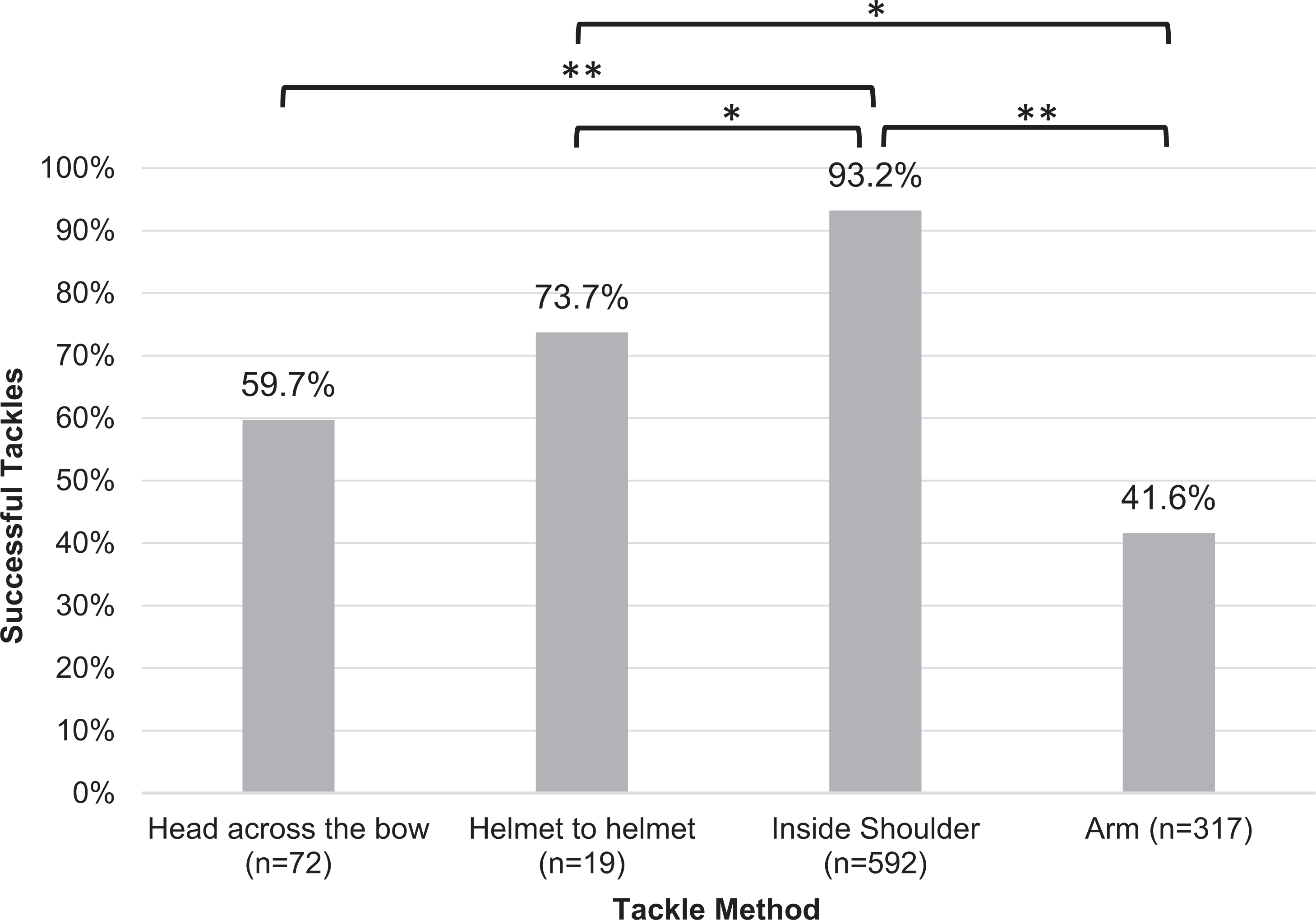
Percentage of successful tackles by tackle method. Significant difference between groups: *P < .05; **P < .001.

Percentage of head-up tackles by tackle method. Significant difference between groups: **P < .001.
There were no recorded injuries to the tackler in this cohort. There were 2 (0.2%) recorded minor injuries to the ball carrier that resulted in a delay of game: 1 head injury from a head-down helmet-to-helmet tackle above the waist, and 1 shoulder injury after a head-up inside-shoulder tackle above the waist. Both players returned to the game at a later time.
Discussion
Our major findings showed that head-up tackles were successful in 76.2% of the tackle attempts in contrast to head-down tackles, which were successful in 55.1% of the tackle attempts (P < .001). The results were similar to a 2020 study by Stockwell et al, 13 who found an 81% success rate with head-up tackling compared with 63% in head-down tackling in youth, middle school, and high school football. We also found that head-up tackling occurred in 98.8% of tackles at or above the waist compared with 81.1% of tackles below the waist (P < .001). Moreover, we found that below-the-waist tackling resulted in a high rate of head-down tackling (42.9%). This was also consistent with Stockwell et al, who reported that head-up tackling occurred in 91.9% of the tackles at or above the waist as opposed to 70.6% below the waist. 13 Our data analysis found that executing a head-up technique will naturally raise the point of contact with the ball carrier to deliver a tackle at or above the level of the waist.
We also found that head-across-the-bow and helmet-to-helmet tackling have significantly higher rates of head-down positioning at the time of contact, which in turn places the brachial plexus, cervical spine, and head in a position of increased risk of injury. 13 These techniques were also associated with significantly lower tackle success rates compared with the inside-shoulder technique. These findings further show the importance of maintaining a head-up technique, which naturally avoids high-risk techniques. There have been multiple videos and articles made that demonstrate proper tackling techniques including maintaining a head-up position at the time of impact. 5,12 The National Athletic Trainers’ Association has also provided a position statement on avoiding head-down contact and spearing. 6 –8 Our data accentuate the importance of continuing to provide these resources to players even at the collegiate level to further decrease the incidence of high-risk tackling techniques.
While our study was not designed to measure the safety of tackling techniques, we found no recorded injuries to the tackler in this cohort. However, there were 2 (0.2%) recorded minor injuries to the ball carrier that resulted in a delay of game: 1 head injury from a head-down helmet-to-helmet tackle above the waist and 1 shoulder injury after a head-up inside-shoulder tackle above the waist. Both players returned to the game at a later time. Because of the low incidence of injuries in this cohort, we are unable to provide a direct correlation between the tackling techniques with the injury incidence; however, multiple previous studies have demonstrated the direct correlation between head-down, helmet-to-helmet, and head-across-the-bow techniques and high rates of brachial plexus, cervical spine, and head injuries.1-5,9,13 Thus, although helmet-to-helmet tackling was found to be somewhat effective in producing successful tackles within our study, this technique of tackling has been strictly prohibited in American football because of these associated injuries. Furthermore, no previous studies have investigated the injury rate based on per-tackle basis, and thus, our study is unable to compare these injury rates to normal injury statistics.
Finally, we found that the mean interrater reliability across all groups was good (κ = 0.718). In the Stockwell et al 13 study, the mean interrater reliability across all groups was also good, with a slightly lower kappa value (κ = 0.66). Those authors noted that the lower kappa in their study was largely due to defining the head-up technique with a high cutoff angle of >45°, and they suggested that future studies should lower the angle to >30° to improve the interrater reliability. We modified our rating as suggested (see Appendix Table A1), which likely led to the improvement of this value.
Limitations
There are several limitations to this study. First, because of the retrospective nature of our study, data analysis may be prone to selection bias. This study also utilized publicly available game footage used for general game review and not for quantitatively grading tackling techniques. Finally, unlike some previous studies, this study was not designed to identify direct correlations between tackling techniques and injury incidence.
Despite these limitations, to our knowledge, this is the largest study that analyzes the tackling techniques used during NCAA Division I football games and their relation to successful tackles. The strength of this study was its ability to identify the clear association of the head-down technique with poorer tackling methods and lower tackling success. The results of this study allow both sports physicians and athletic trainers who are in direct contact with these players to convey not only the risk of these poorer tackling methods but also their inefficiency in producing successful tackles. Future studies that focus on investigating the injury rate based on a per-tackle basis as well as correlating the tackling technique statistics with techniques taught by coaches among college football teams would be helpful to better assess the safety ramifications of these techniques.
Conclusion
The head-up tackling technique, tackles made at or above the level of the offensive player’s waist, and the inside-shoulder technique were more efficient at producing successful tackles. Head-down tackling and tackling below the waist were associated with poor tackling methods, including head-across-the-bow and helmet-to-helmet tackling, which have lower success rates and place the player at risk for injury to the brachial plexus, cervical spine, and head.
Footnotes
Final revision submitted February 20, 2023; accepted April 5, 2023.
One or more of the authors has declared the following potential conflict of interest or source of funding: C.S. has received consulting fees from NuVasive; hospitality payments from Medtronic; and has stock/stock options in Alphatec Spine and NuVasive, and Restor3d. R.A.W.M. has received consulting fees from DePuy/Medical Device Business Services and Stryker; royalties from Globus Medical; and hospitality payments from NuVasive. AOSSM checks author disclosures against the Open Payments Database (OPD). AOSSM has not conducted an independent investigation on the OPD and disclaims any liability or responsibility relating thereto.
Ethical approval was not sought for the present study.
APPENDIX
Criteria for Assessment of Tackles a

| Tackle Methods |
| • Head across the bow: During initial impact, the head of the defender is across the path of the runner’s momentum. |
| • Helmet to helmet: Anytime the initial contact made is helmet to helmet; usurps other tackle categories. |
| • Inside shoulder: Initial contact made by the defender with the shoulder; the aim is at the offensive player’s near shoulder, and the defender’s head remains to the inside of that shoulder, not crossing in front of the runner’s body and momentum. |
| • Arm: Initial and substantial defensive player contact with the runner is with outstretched arm(s), not with shoulder or head. Tackle attempts where the defensive player lunged for but missed the offensive player were categorized as arm tackles by default. |
| Rating of Head Position b |
| • Head up: Helmet approximately >30° to the ground during the initial contact. |
| • Head down: Helmet approximately <30° to the ground during initial contact. |
| Relationship of Tackle to the Offensive Player’s Waist |
| • Above: The tackler’s initial point of contact is above the offensive player’s waist/belt line. |
| • At: The tackler’s initial point of contact is at the offensive player’s waist/belt line. |
| • Below: The tackler’s initial point of contact is below the offensive player’s waist/belt line. Missed tackle attempts where the defensive player did not touch the offensive player were counted as below by default. |
| Tackle Success |
| • Successful: The defender successfully takes the player with the ball to the ground, and the play officially ends. More than one player can be credited with a successful tackle attempt at the same time. In such a situation, the initial defender must maintain contact while another defender(s) completes the tackle. If the defensive player causes the offensive player to fumble the ball, this counts as a successful tackle. If the defensive player forces the offensive player out of bounds, this is a successful tackle. |
| • Unsuccessful: The defensive player makes a defensive move toward the runner and misses the player or does not successfully take the player to the ground to officially end the play. If the defender has contact with the runner but the runner breaks free and remains in bounds to continue the play, this is an unsuccessful tackle. |
a Adapted from Stockwell et al. 13
b Modified from Stockwell et al 13 at their suggestion.