



Abstract
Background:
Precise postural control helps prevent anterior cruciate ligament injury. However, it is unknown whether the anticipated postural stability can be improved during a physically uncertain and cognitively demanding task.
Hypothesis:
Anticipated postural stability will improve through unanticipated single-leg landing with a rapid foot placement target tracking.
Study Design:
Controlled laboratory study.
Methods:
A total of 22 healthy female university-level athletes performed a novel dual-task paradigm: an unanticipated single-leg landing with foot placement target tracking. In the normal condition (60 trials), the participants jumped from a 20 cm–high box onto the landing target with their dominant leg as softly as possible. In the subsequent perturbation condition (PC) (60 trials), the initially assigned landing target was abruptly switched randomly, requiring participants to modify their preplanned foot placement position to the newly assigned position. The center-of-pressure trajectory length within the first 100 ms after foot impact (CoP100) was calculated as a measure of anticipated postural stability for each trial. In addition, the peak vertical ground-reaction force (FzPeak) was quantified to assess landing load, and the degree of postural adaptation during PC was quantified by fitting an exponential function to trial-by-trial changes in CoP100. Participants were divided into 2 groups according to increase or decrease in CoP100, and results were compared between the groups.
Results:
The direction and magnitude of postural sway alterations of the 22 participants showed a spectrum-like variation during the repeated trials. Twelve participants (sway-decreased group) exhibited a gradual reduction in postural sway (CoP100) during the PC, while the remaining 10 participants (sway-increased group) showed a gradual increase in CoP100. The FzPeak during the PC was significantly less in the sway-decreased group compared with the sway-increased group (P < .05).
Conclusion:
Variation in the direction and magnitude of postural sway alteration among participants suggested that there was individual variation in an athlete’s adaptive ability of the anticipated postural stability.
Clinical Relevance:
The novel dual-task paradigm described in this study may be useful for rating individual injury risk based on an athlete’s postural adaptation ability and may aid in targeted prevention strategies.
Keywords
During acute orthopaedic trauma in sports, the latency between the onset of the risky external force application and the initiation of injury is extremely short. A typical example is noncontact anterior cruciate ligament (ACL) injuries, which often occur due to a large ground-reaction force (GRF) acting at the landing limb during a rapid deceleration motion such as a single-leg landing. 4,11 Observational studies employing video-capture methods have approximated time from initial foot contact (IC) to ACL disruption at 40 to 105 ms. 13,15 Tsuda et al, 25 in their study of the ACL-hamstrings reflex arc, reported the latency between ACL stimulus and the onset of hamstring activation to be 50 to 180 ms. Additional latency due to the electromechanical delay 12 may further increase the difficulty in transiently resisting the adverse ACL stress caused by the rapidly increasing GRF. Collectively, the physiological evidence implies that an injury prevention strategy that largely depends on one’s sensory feedback loop may not be effective. Therefore, to mitigate the risk of ACL injury in sports, it is important to train athletes to anticipate a rapid change in GRF with adjustments that produce appropriate lower limb orientation relative to the expected GRF direction and lead to a stable whole-body postural stability. 2
In sporting situations, however, multiple other demands on the athlete’s attention can affect his or her focus on postural stability. 10 Sports-specific demands include concurrent interpersonal interactions (teammates/opponents) and equipment (ball and/or stick) manipulation, 4,15,28 all the while executing strategic decision making. Such tasks may affect background postural regulation 9 and result in postural instabilities. 16,19 Other potential interfering factors include physically uncertain sporting environments. In team sports such as soccer, basketball, and handball, players sharing limited space with others on the court may induce indirect postural perturbation because of close proximity. 4 Notably, approximately 70% to 85% of ACL injuries occur in a noncontact or indirect contact manner. 3,28 Considering the high ACL injury rates in the space-sharing team sports, 21 the cause may be a self-triggered (contact-free) postural perturbation elicited by an unanticipated modification of a preplanned movement to escape colliding with others.
We therefore asked ourselves, is it possible to improve anticipated postural stability in sports even in such a highly perturbed and cognitively demanding environment? If so, are there any differences between individuals? To this end, we designed a novel experimental paradigm using a single-leg landing task that could evoke and quantify self-triggered postural perturbation while allocating the athlete’s attentional focus outside of the task at hand. The purpose of this study was to investigate whether anticipated postural stability could be improved through repeated exposure to physically perturbed and cognitively demanding single-leg landing trials. We used a dual-task paradigm that combined single-leg landing (primary motor task) with landing target tracking by visual stimuli as an ACL injury situation-specific secondary motor task to achieve this goal. The hypothesis was that the postural sway measure just after IC would gradually decrease (ie, postural stability would improve) through the repetition of a physically perturbed and cognitively demanding single-leg landing trial.
Methods
Participants
A total of 22 healthy female athletes with normal or corrected-to-normal (with contact lenses) vision participated in this study (mean height, 162.6 ± 5.8 cm; mean weight, 59.4 ± 8.4 kg; mean age, 20.9 ± 1.5 years), which was conducted from March 2012 to November 2013. All participants belonged to the university’s handball team and regularly trained for competitive handball games as part of the Division 1 West Japan University League. Excluded were athletes with major injuries (eg, ACL injury) or any neurological symptoms that could affect their postural stability, those with light to moderate orthopaedic trauma (eg, ankle sprain) up to 6 months before experiment day, and those who would not be able to visually recognize the illumination of the red-colored laser pointer on the force plate used for the experiment. Experimenters confirmed that there was no pain or anxiety in performing the landing test before data measurement. This study received approval from the ethics review board of our institution, and all the participants provided written informed consent.
Experimental Procedure
The single-leg landing task consisted of participants jumping off a 20 cm–high platform with the dominant leg and with arms crossed in front of the chest, landing with that leg onto the center of a force plate (sampling, 1 kHz) (type 9281B; Kistler) as softly as possible and remaining on that leg as still as possible for ≥5 seconds after landing. No further landing instructions were provided since this study aimed to quantify the inherent postural strategy of individuals. The gaze point was not specified during landing for safety reasons.
All participants wore black compression shirts, shorts, and standardized shoes (model THH536; Asics). The dominant leg for each participant was determined as the leg with the smaller center-of-pressure (CoP) trajectory length from 20 ms to 5 seconds after landing, as averaged over 3 single-leg landings. After a standardized warm-up consisting of lower limb muscles stretching as instructed by the experimenter (I.O.), the participants were asked to perform a single-leg landing task using their dominant leg for 150 trials.
The participant’s standing position on the platform was set so that both feet were offset from the edge of the platform and the dominant foot was on the extension line of the center of the force plate. Three landing targets were provided on the force plate: R (right), C (center), and L (left) (Figure 1). Two photocells (E3G-R17, mirror reflection type; Omron Corp) were placed on either side of the platform: photocell 1 was aimed next to the dominant foot to detect the toe-off movement, and photocell 2 was aimed at the midpoint of the lateral pelvis to detect forward trunk movement (Figure 2A, top image). When the participant stood on the platform and the 2 photocells were blocked by the participant’s dominant foot and trunk, a red-colored laser pointer illuminated 1 of 3 landing targets on the force plate. A custom LabVIEW script (Version 2016 Fall; National Instruments) was used to control the laser pointers based on the photocell signals. The laser pointer was obliquely projected onto the force plate as a 10 × 5–mm ellipse that was easily identified by the participants from the platform. The participants were asked to shift their center of mass forward as much as possible on the platform while maintaining an upright posture and, when they felt they could no longer offset their body forward, to step off and land with their dominant foot on the landing target assigned by the laser pointer as precisely as possible. To satisfy this task requirement, photocell 2 (detecting forward trunk movement) needed to respond before photocell 1 (detecting toe-off) (Figure 2B, top image). This task requirement was repeatedly announced to the participant during data measurement.

Top view of the initial foot position on the jump-off platform, the force plate, and the position of the 3 landing targets: L (left), C (center), and R (right). To facilitate forward movement of the participant’s center of mass, the portions of the feet distal to the metatarsophalangeal joint were offset from the edge of the platform.

Unanticipated single-leg landing with the novel landing target-switching trial (perturbation condition). The upper figures illustrate the sequence of motions. (A) When the 2 photocells were blocked by the participant’s trunk and landing foot, the landing target (target L) was illuminated by a red-colored laser pointer on the force plate. (B) During a target-switching trial, the initially assigned landing target switched to another position (target R) after photocell 1 detected the toe-off movement, and the participants were asked to attempt to land on the newly assigned position while simultaneously keeping their single-leg standing posture as much as possible. (C) The center-of-pressure (CoP) trajectory length from 20 to 100 ms (CoP100) after landing and the distance between the CoP and the newly assigned target (DistanceCoP_Target) were quantified.
There were 3 experiment conditions, each consisting of a number of cycles with 10 trials in each cycle. The first 6 cycles (trials 1-60) were conducted under the normal condition (NC), in which the laser pointer illuminated only target C. The purpose of performing the NC first was to assess the baseline postural stability and effect of fatigue by comparing postural sway measure between NC and subsequent conditions. In the next 6 cycles (trials 61-120), participants performed the perturbation condition (PC), which consisted of 40% of fixed-target trials and 60% of target-switching trials. In the target-switching trials, the initially assigned landing target abruptly switched to another position after photocell 1 detected the toe-off movement (Figure 2B), and the participants attempted to land on the newly assigned position while simultaneously keeping their single-leg standing posture with as much effort as possible (Figure 2C). The order of target-switching patterns was randomized for each participant, but the number of target-switching patterns among the participants was the same. Finally, the washout condition (WC) was performed for 3 cycles (trials 121-150) with the fixed landing at target C.
Any trial in which the participant was unable to maintain single-leg stationary standing after landing was recorded as a failure, but the measurement was not redone. To reduce fatigue, participants had a 20-second break between the trials as well as ≥3 minutes of rest per cycle. If participants requested, further breaks were allowed. No feedback information regarding the amount of the postural sway and landing impact was provided to the participants during data measurement.
Data Measurement
The force plate was fixed on the solid floor with a level-adjustable metal base, and its horizontal level was confirmed with a level ruler (Inc-R-60; Akatsuki Manufacturing). Signals from the force plate and photocells were sampled with an analog-digital converter (sampling frequency, 1 kHz) (NI USB-6218BNC; National Instruments) and stored on a personal computer for offline analysis.
Data Analysis
Data processing was performed with custom scripts written with Scilab Version 6.0.0. (Scilab Enterprises). The timing of IC was defined as the time when the vertical GRF component exceeded 10 N and the GRF data from 20 ms to 5 seconds after IC were extracted. To eliminate high-frequency noise, the extracted GRF data were smoothed with a second-order Butterworth digital filter (zero-time-shift, low-pass, cutoff frequency, 70 Hz). Then, the CoP trajectory length from 20 to 100 ms (CoP100) was calculated as a performance measure of anticipated postural stability for each trial. This time window was selected because the contribution of sensory feedback information from the stance leg became small. Observing the trial-by-trial change in the postlanding postural sway (CoP100) served as an indication of whether anticipated postural stability is learnable. The peak vertical GRF (FzPeak) normalized to body weight was calculated as a measure of the landing load. As a measure of effort for target tracking, the distance between the second target and the CoP at 1 second after IC (DistanceCoP_Target) was calculated. Note that the CoP data of the first 0 to 19 ms after IC were not used because in this phase the small magnitude of vertical GRF potentially added to the numerical noise on the CoP data.
Statistical Analysis
Postural Perturbation Assessment
The participant-wise mean of CoP100 (m), FzPeak (% body weight), and DistanceCoP_Target (m) were calculated for each condition (NC, PC, and WC). The normal distribution of 3 outcome measures was confirmed by the Shapiro-Wilk test (P < .05). Repeated-measures 1-way analysis of variance (ANOVA) (factor: condition [NC, PC, WC]) and the post hoc Tukey honestly significant difference (HSD) test were performed (P < .05). Based on the results of this ANOVA, we examined whether the PC was demanding enough in terms of postural sway and landing load compared with the NC. In addition, we examined whether participant fatigue significantly affected the postural sway by comparing the CoP100 values from the NC and WC.
Adaptation Assessment During the PC
The values of CoP100, FzPeak, and DistanceCoP_Target during the PC (60 trials) were normalized by the mean value of the first 10 trials of the PC to represent the trial-by-trial change rate (%). The degree of the postural adaptation shown by CoP100 during the PC was quantified by fitting an exponential function, CoP100(n) = Aeb (n), where n is the trial number, A is the magnitude of CoP100, and e is the Napier constant. The sign of the exponent b denotes the direction of postural adaptation: when b < 0, the normalized CoP100 value decreased as a function of the trial; otherwise (b > 0), it increased. The norm of exponent b denoted the magnitude of adaptation.
The participants were classified into 2 groups: the sway-decreased group (b < 0) and sway-increased group (b > 0). In addition, the PC was divided into 3 phases: early (trials 61-80), mid (trials 81-100), and late (trials 101-120). Two-way ANOVA with the post hoc Tukey HSD test was performed to investigate the mixed effect of group (sway-decreased vs sway-increased) and phase (early vs mid vs late) on the postural sway (CoP100), landing load (FzPeak), and effort for target tracking (DistanceCoP_Target). The significance level was set at P < .05. All statistical analyses were performed with R (Version 4.1.0; The R Foundation for Statistical Computing).
Results
A wide range of direction and magnitude of postural sway alteration throughout the PC was observed among the 22 participants. Twelve of the participants showed a trial-by-trial decrease in CoP100 (b < 0), and they were classified as the sway-decreased group, while the remaining 10 showed an increase in CoP100 (b > 0) and were classified as the sway-increased group (Figure 3). Of 3300 total trials, 105 were recorded as failures, for an overall percentage of 3.2% (4.8 failed trials per participant).
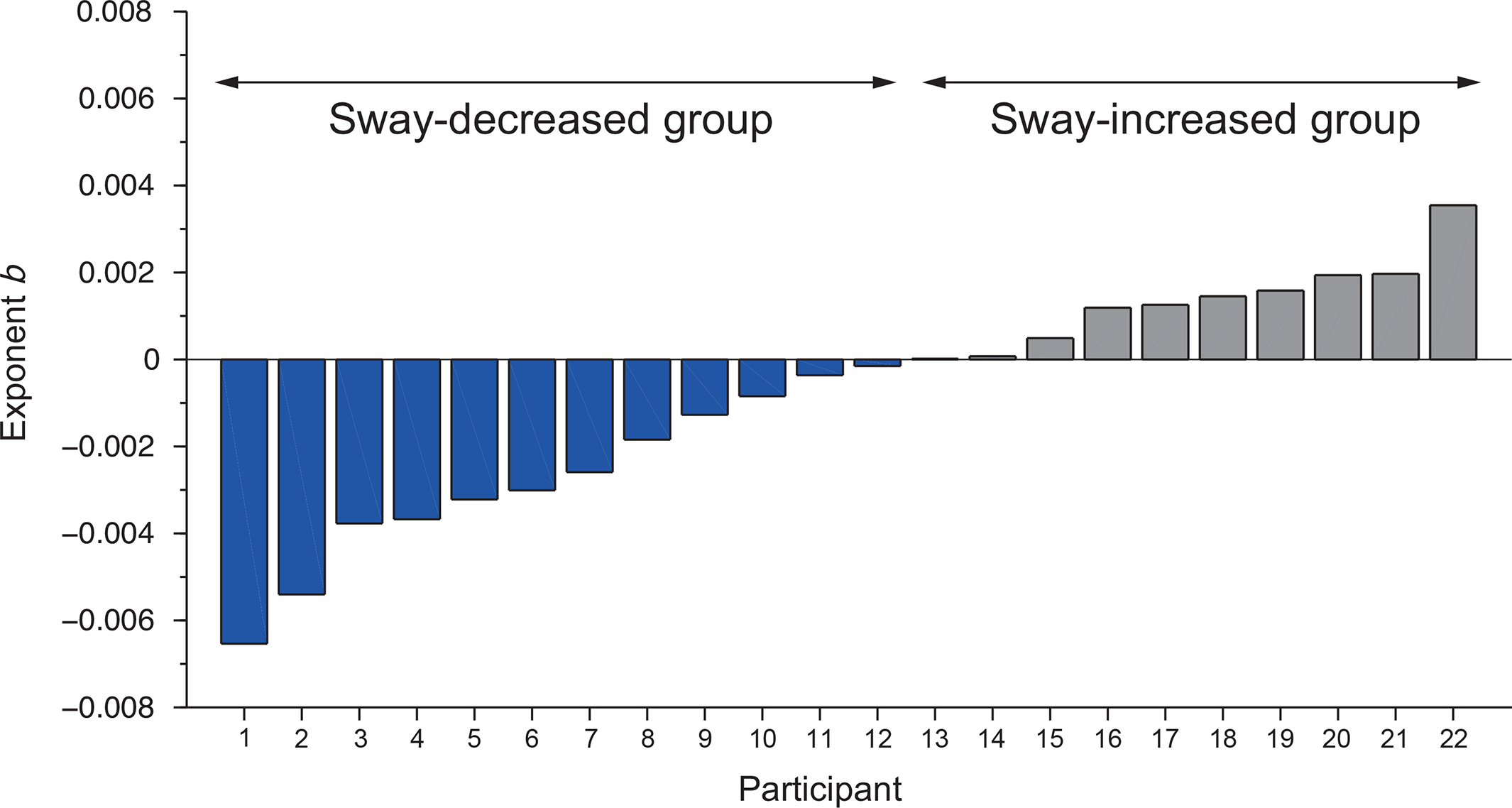
Spectrum-like individual variation of the adaptation direction and magnitude characterized by exponent b of the exponential function.
Representative Data
The trial-by-trial changes in CoP100 and DistanceCoP_Target from the representative participants for both groups (sway-decreased and sway-increased) are shown in Figure 4. Participant 1 showed a drastic increase in CoP100 at the beginning of the PC; however, CoP100 gradually decreased as the trials progressed, exhibiting the largest negative b (–0.006534) among all participants. At the end of the PC, CoP100 was reduced to nearly the same value as WC (Figure 4A). In contrast, the CoP100 of participant 22 during the PC gradually increased and resulted in the largest positive b (0.003545). For both participants, the values of DistanceCoP_Target during the PC were consistently high throughout the 3 phases (range, 0.11-0.24 m).
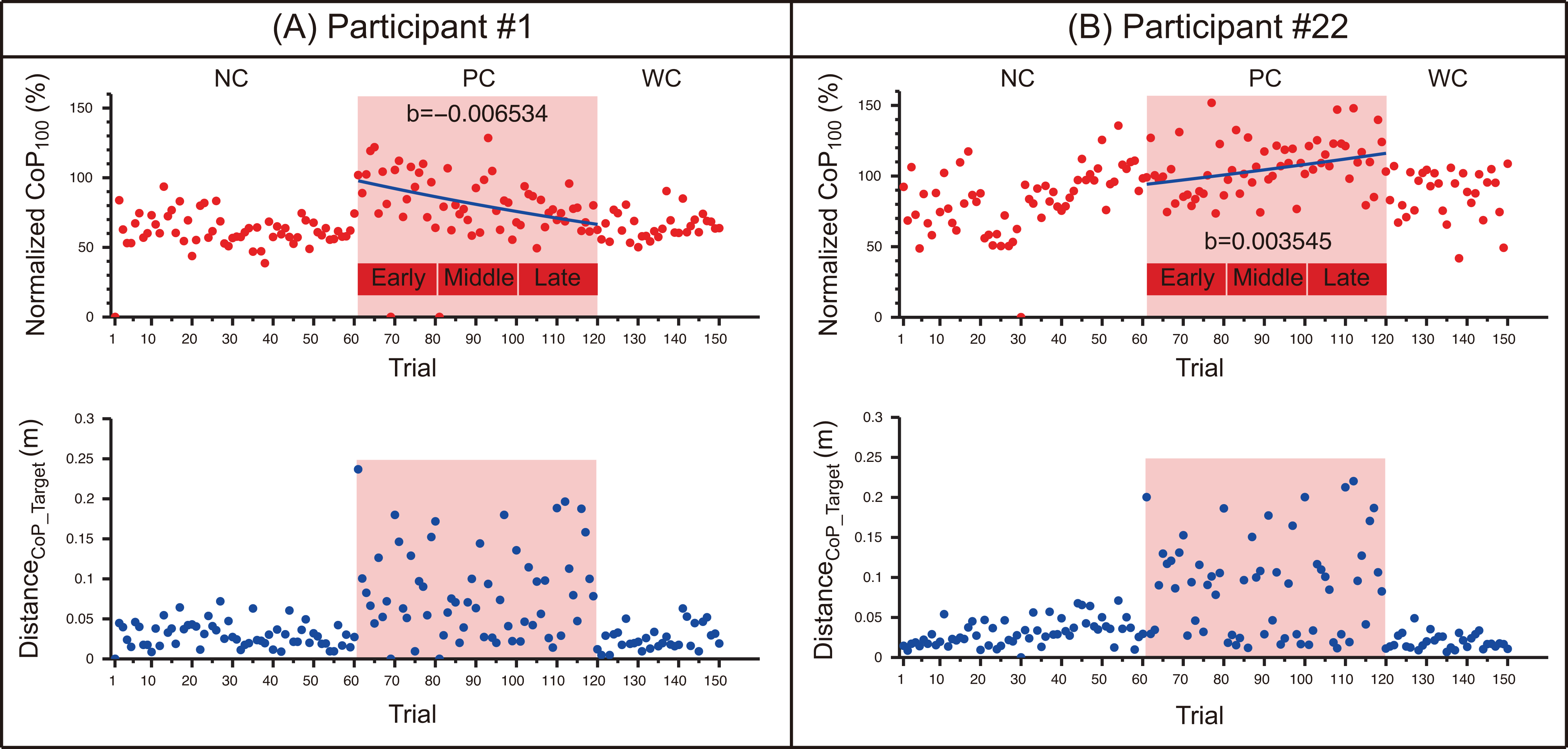
Trial-by-trial change of CoP100 and DistanceCoP_Target of 2 representative participants who showed the (A) largest negative and (B) largest positive exponent b values. NC, normal condition; PC, perturbation condition; WC, washout condition; CoP100, center of pressure trajectory length from 20 to 100 ms after initial contact; DistanceCoP_Target, distance between the second target and the center of pressure at 1 second after initial contact.
Perturbation Task Quality Assessment
During the PC, CoP100 increased significantly compared with the NC and WC (P < .01; F 2 = 5.13) (Figure 5A). Similarly, FzPeak and DistanceCoP_Target during the PC significantly increased compared with those in NC and WC, respectively (P < .05; F 2 = 3.69; F 2 = 313.1) (Figure 5, B and C).
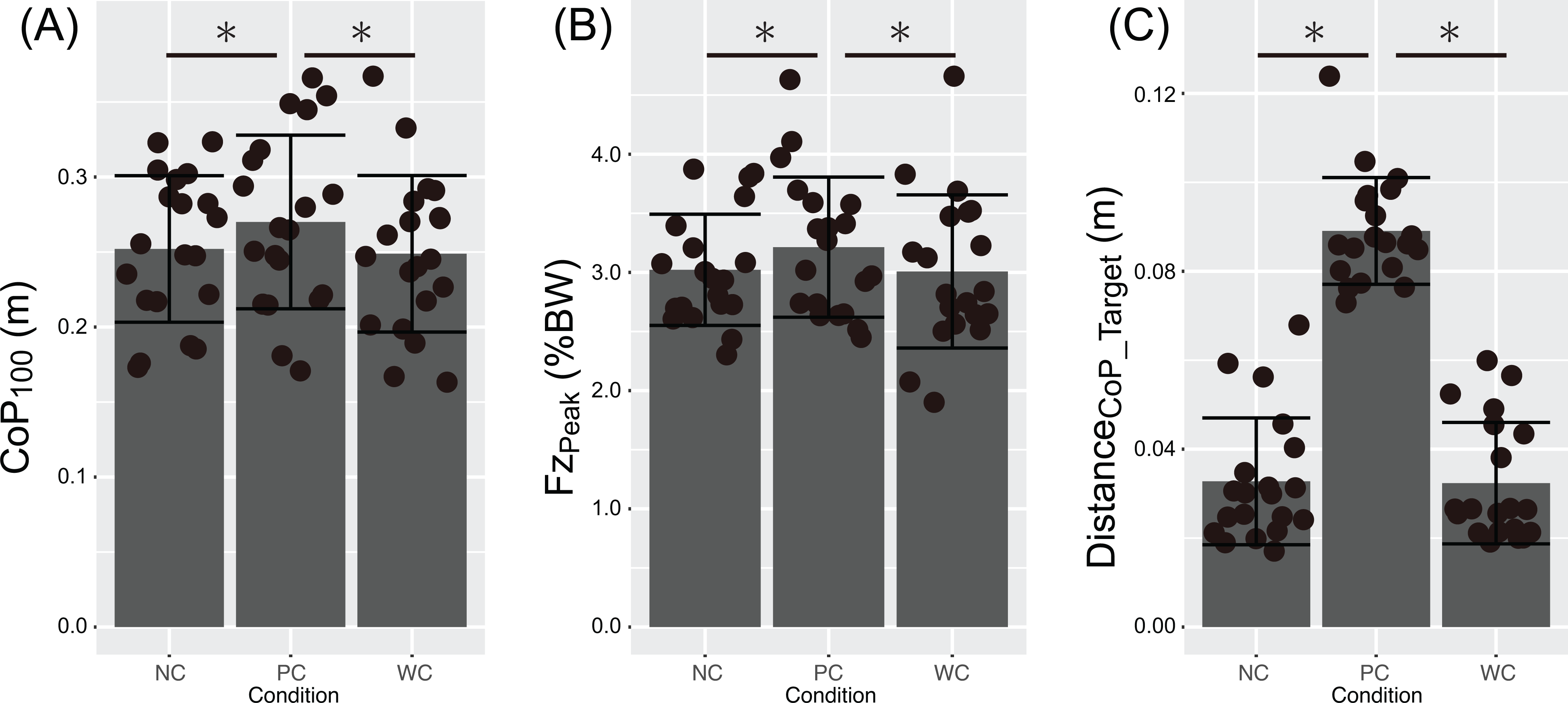
Mean (A) CoP100, (B) FzPeak, and (C) DistanceCoP_Target values during the perturbation task. Error bars indicate SDs. *Significantly larger values in the perturbation condition (PC) compared with the normal condition (NC) and washout condition (WC) for all metrics. BW, body weight; CoP100, center of pressure trajectory length from 20 to 100 ms after initial contact; FzPeak, peak vertical ground reaction force; DistanceCoP_Target, distance between the second target and the center of pressure at 1 second after initial contact.
Adaptation Assessment During the PC
Two-way ANOVA revealed significant main effects for group (P < .01; F 1 = 164.5) and phase (P < .05; F 2 = 2.36), with significant interactions (P < .01; F 2 = 22.7) on the time-course change of CoP100. The sway-decreased group showed a significant decrease in CoP100 from the early to midphase during the PC, while the sway-increased group oppositely showed a significant increase in CoP100 at the same phases (Figure 6A). Similarly, for FzPeak, there were significant main effects for group (P < .01; F 1 = 68.6) and phase (P < .01; F 2 = 6.14), as well as the interaction (P < .05; F 2 = 4.04). The sway-decreased group showed a significant decrease in FzPeak from the early to late phase, whereas the sway-increased group showed consistent values through the phases (Figure 6B). No significant effect of group (P = .11; F 1 = 2.6), phase (P = .26; F 2 = 1.3), or interaction (P = .31; F 2 = 1.1) was found for DistanceCoP_Target (Figure 6C).

Assessment of adaptation in perturbation condition for (A) CoP100, (B) FzPeak, and (C) DistanceCoP_Target between study groups and perturbation condition phases. Shown are mean values, with error bars indicating SDs. *Statistically significant difference (P < .05) between the early, mid, and late phases. †Statistically significant difference (P < .05) between the sway-decreased and sway-increased groups. CoP100, center of pressure trajectory length from 20 to 100 ms after initial contact; FzPeak, peak vertical ground reaction force; DistanceCoP_Target, distance between the second target and the center of pressure at 1 second after initial contact.
Discussion
The direction and magnitude of postural adaptation in these 22 female athletes showed a diverse range in response to physically perturbed and cognitively demanding single-leg landing repetitions. In this spectrum, 12 of 22 participants (sway-decreased group) exhibited a gradual decrease of postural sway quantified by the CoP trajectory length within 100 ms from IC (CoP100) throughout the 60 trials during the PC. This result partially supports our hypothesis that the anticipated postural stability can be improved even in a physically perturbed and cognitively demanding environment. In addition, the 12 participants who showed a reduction in CoP100 during the PC also exhibited a gradual decrease in FzPeak (Figure 6B), suggesting that not only postural stability but also impact absorption was optimized.
In contrast, the 10 other participants displayed increased postural sway. Although the results of these 10 athletes did not support our hypothesis, the contrasting results from these 22 participants suggested that there was individual variation in the adaptive ability of anticipated postural stability, which may provide useful information for risk rating and targeted preventive interventions based on individual characteristics.
Task Difficulty
First, we believe that our task design served the intended function of testing. Previous studies that investigated the effect of divided attention on the motor performance adopted a non–sport specific secondary-attention task that incorporates mental arithmetic. 8,22 However, it is debatable whether such tasks are really appropriate in the context of replicating the occurrence of ACL injury. 10 To overcome this previous limitation, we presented the online landing target tracking via visual stimuli as a secondary motor task. The first aim of this test was to induce a self-triggered postural perturbation during landing to replicate the noncontact ACL injury situation, and the achievement of this aim was clearly proved by the significant increase of CoP100 in the transition from NC to PC (Figure 5A). The placement of the CoP position outside of the preplanned base of support increased the gravity-driven toppling torque. The online landing target tracking via visual stimuli produced the expected mechanical disturbance of landing posture. The second aim of the current task was to interfere with the participants’ attention on their safe landing by getting them to focus on the target tracking rather than on the stable landing. The measured variables of this study did not directly quantify the direction of participants’ attentional focus; however, the intercondition difference in FzPeak may indirectly explain the attentional interference that occurred during the PC (Figure 5B). In this study, the FzPeak became significantly higher during the PC compared with the NC and WC (Figure 5B). Greater GRF magnitudes at foot impact have been consistently observed under cognitively demanding landing or cutting maneuvers. 1,2,23,24 In contrast, the attentional focus on landing kinematics or foot-impact sound reduces the magnitude of impact GRF. 7,18,20 Collectively, previous research has suggested that allocation of attention elsewhere other than landing interferes with the impact absorption skill, and it was reasonable to assume that the attention of our participants was also allocated to target tracking rather than the safe landing itself. For both groups, DistanceCoP_Target, the metric of effort, did not change through the adaptation phases (ie, PC) (Figure 6C), suggesting that the task difficulty was consistently effective throughout the PC. Therefore, the current dual-task design (unanticipated single-leg landing combined with the landing target tracking) successfully satisfied our intended requirement of replicating the physical and cognitive context associated with a noncontact ACL injury.
Individual Variation in Postural Adaptative Response
The observed spectrum-like variation in the adaptation rate (exponent b) from negative to positive (see Figure 3) indicated that there was individual-level variation in the direction and magnitude of adaptation for anticipated postural control during the single-leg landing task. The gradual decrease of CoP100, observed in 12 of 22 participants, indicated the presence of adaptative plasticity in anticipated postural control, while the time for sensory feedback loop was insufficient. In addition, the sway-decreased group showed a significant decrease of CoP100 from the early to midphase of the PC (Figure 6A), suggesting that the anticipated postural stability in this group rapidly adapted to the novel perturbation environment. Such rapid adaptation may be favorable for preventative training under time constraints on the sports field.
There are 2 interpretations for the remaining 10 participants who showed an increase of CoP100 value after landing. One is that they were simply unable to adapt to our dual-task test, and thus no adaptations occurred during the PC. It is likely that the participants simply could not stabilize their posture after landing despite understanding the task requirement, since they were repeatedly requested to reduce the postural fluctuation after landing. We suspect that the difficulty level of the dual task was too high for their cognitive–motor integration skill, indicating that the dual-task design successfully allowed us to classify populations depending on their adaptational ability of the anticipated postural control. Our second interpretation is that they adopted the landing strategy that involved the increase of their postural sway after landing. For this to be true, the increase in postural sway of 10 participants may have originated from their stiff landing strategy. During the PC, it might have been more difficult to precisely estimate the direction and magnitude of GRF input at foot impact than during the NC. In response to such an uncertain force field, it can be inferred that the 10 participants adopted a strategy of increasing joint impedance (co-contraction of lower limb antagonist muscle pair) so as to resist GRF inputs of several magnitudes and directions. This interpretation is supported by the fact that FzPeak in the sway-increased group was consistently higher than that in the sway-decreased group throughout the PC (Figure 6B). It has been reported that the strategy to maintain arm orientation during an arm-reaching task is to increase joint impedance during the naive phase in response to an uncertain force field. 5 A similar strategy may be observed in the weightbearing lower limb in the present study. Still, the high joint impedance was expected to have resulted in an increase in postural sway (CoP100) because the multibody link flexibility of lower limb segments was impaired. 14,17 Thus, the capacity to buffer postural disturbance against landing impact was diminished. This is expected to have led to an increase in CoP100.
Clinical Implications
The variety in the postural sway adaptation through PC among participants implied that our dual-task paradigm could rate the populations based on their ability to adapt to postural disturbance. If the postural adaptation ability in a demanding environment was related to the ACL injury risk, we speculate that our dual-task paradigm could assess individuals’ risk for ACL injury. We rated our participants via stable landing posture and landing load, which has previously been shown to affect the dynamic knee valgus torque 26,27 and ACL strain 6 after landings. Although we did not evaluate the posttesting incidence of ACL injury among the participants, based on the findings of previous studies, 6,26,27 it can be assumed that the postural adaptation ability has the potential to screen high- and low-risk populations.
In addition to the biomechanical implications, we would like to address the potential risk from a behavioral standpoint. Cognitively, it was a forced choice prioritizing 2 conflicting queries (ie, a successful target tracking vs a safe landing within a limited amount of available time). Clearly, the participants’ strategy was posture first, since the overall rate of trial failures was just 3.2%. Regardless of our ability to classify athletes into high- and low-risk populations, we do not intend to conclude that the sway-increased group of 10 participants is at high risk for ACL injury. However, based on our findings, we believe the risk of potential trauma to be higher for athletes who devote themselves to sports context–specific valuing, which occasionally results in risky decision behavior, at the expense of posture stabilization. A future prospective survey may be able to determine how biased personality traits (eg, valuing sports context–specific benefit over safe postural control) affect whole-body biomechanics and result in an individual’s risk for noncontact ACL injury.
Limitations
As 1 limitation, since the total number of trials was 150, the effect of fatigue on the change in the outcome variable is a concern. However, the fact that adequate rests were provided, that the participants did not request additional ones, and that there were no significant differences in CoP100 and FzPeak between the NC and WC suggests that fatigue was adequately controlled. Second, although the instructions given to the participants were rigorously maintained during the experiment, the hyperacute nature of the task would have made it impractical to expect the same level of compliance to the secondary task (target tracking) among the participants. However, the metric of effort for target tracking (DistanceCoP_Target) did not significantly increase through the PC for both the sway-decreased and sway-increased groups, suggesting that participants conformed to the target tracking requirement. This study was also limited in answering whether the participants were able to retain or consolidate anticipated postural control skills adapted by the unanticipated single-leg landing task. The rapid postural stabilization observed in half of the participants in this study would be pragmatic as a short exercise routine in daily sports training, but the long-term effect, whether postural stabilization occurs, is yet to be determined. Further long-term study is therefore warranted.
Conclusion
We observed a spectrum-like variation in the direction and magnitude of postural sway alterations in female athletes during multiple trials of a novel unanticipated single-leg landing task. Twelve of 22 participants exhibited a gradual decrease in their postural sway, while the others showed gradual increase in postural sway. Participants who showed decreased postural sway also reduced the landing impact force. The results suggested that there is individual variation in an athlete’s adaptive ability of the anticipated postural stability, which may provide useful information for risk assessment and targeted interventions based on individual characteristics.
Footnotes
Acknowledgment
The authors acknowledge support from the athletes who participated in this study. They also thank Dr Mai Kitaura and Dr Yui Kawano for their efforts in organizing the experiment and Dr Koji Kadota for his constructive comments when establishing our novel dual-task paradigm.
Final revision submitted February 9, 2023; accepted March 9, 2023.
One or more of the authors has declared the following potential conflict of interest or source of funding: Support was received from the Japan Society for the Promotion of Science Grant-in-Aid (KAKENHI) for Young Scientists (B) (No. 24700716). AOSSM checks author disclosures against the Open Payments Database (OPD). AOSSM has not conducted an independent investigation on the OPD and disclaims any liability or responsibility relating thereto.
Ethical approval for this study was obtained from Mukogawa Women’s University (No. 11-14).