




Abstract
Background:
Achilles tendon injuries represent one of the most common reasons for referral to orthopaedic surgeons.
Purpose:
To outline the characteristics, examine trends in publication, and evaluate the correlation between citations and study quality of the 50 most cited articles on Achilles tendon injury.
Study Design:
Cross-sectional study.
Methods:
After searching the Web of Science for articles published in orthopaedic journals, we identified the 50 most cited articles on Achilles tendon injury and abstracted their characteristics. Risk of bias was assessed using the modified Coleman Methodology Score (mCMS). Multiple bivariate analyses (Pearson or Spearman correlation coefficient) were used to evaluate the association among number of citations, citation rate (citations/year), 2020 journal impact factor (JIF), year of publication, level of evidence (LoE), study type (tendon rupture or chronic tendinopathy), sample size, and mCMS.
Results:
The top 50 articles were cited 12,194 times. Each article had a mean ± SD 244 ± 88.8 citations (range, 157-657) and a citation rate of 12.6 ± 5.4 per year (range, 3-28). A total of 35 studies (70%) were published between 2000 and 2010. The citation rate of the 16 most recent studies was almost double that of the 16 oldest studies (17.5 vs 9.9; P < .001). Nineteen studies (49%) were classified as having poor quality (mCMS <50 points). The mean JIF of the 9 journals that published the studies was 5.1. The citation rate correlated with the number of citations (r = 0.56; P < .001), publication year (r = 0.60; P < .001), and LoE (r = –0.44; P = .005). The publication year correlated with the LoE (r = –0.40; P = .01). Study quality in terms of mCMS correlated with the JIF (r = 0.35; P = .03) and LoE (r = –0.48; P = .003) but not the citation rate (P = .15).
Conclusion:
The mean LoE and the citation rate of the most cited articles on Achilles tendon injury both significantly increased over time. Although the JIF was positively correlated with study quality, almost half of the studies had poor-quality methodology.
The Achilles tendon is the thickest and strongest tendon in the human body. 57 Nevertheless, its rupture is a relatively common event, accounting for almost 20% of large tendon injuries and with an incidence of 2.1 per 100.000 person-years, 37 especially between 20 and 59 years of age and occurring during recreational or professional sport activity. 37 Achilles tendinopathy has an incidence of around 2 per 1000 person-years, 2,22 with a close relationship to sporting activities in one-third of cases. 22
With regard to the clinical management of these conditions, approaches based on solid scientific evidence are strongly recommended as an attempt to standardize treatments and reproduce the best possible outcome for the patient. This translates into the need for physicians to use research databases, find the appropriate studies to answer a question, critically appraise the data collected, and integrate the new findings with their previous knowledge and patient needs. 20 From a practical standpoint, the identification of the most relevant articles on a specific topic may be useful to spare time, efficiently summarize what has been demonstrated, and realize ambiguities or emerging strategies in that field. On this basis, over the past 5 years, a number of bibliometric analyses have been published to identify the most cited articles in general orthopaedic surgery 70,73 and in more defined areas of interest, such as cartilage surgery, 25 platelet-rich plasma, 64 anterior 81 and posterior 35 cruciate ligament reconstruction, rotator cuff tear, 24 shoulder instability, 7 fracture nonunion, 27 hip arthroscopy, 13 and unicompartmental knee arthroplasty. 28
Regarding the Achilles tendon, multiple randomized controlled trials and meta-analyses of studies with level 1 evidence have been published to guide clinicians in their daily decision making when facing patients with Achilles tendon rupture or tendinopathy. 1,12,38,48,52,71 Nevertheless, to the best of our knowledge, no study has ever identified and analyzed the main features of the most influential studies in this field. This would allow one to evaluate the trends in research and clinical recommendations.
We thus set out to perform a bibliometric analysis of the literature to identify and characterize the 50 most cited articles on the Achilles tendon injury that were published in orthopaedic journals. We hypothesized that the number of citations and the citation rate would correlate with the methodological quality and the level of evidence (LoE) provided by each study.
Methods
Search Strategy
We queried the Thomson ISI Web of Science using the single keyword “Achill*” in March 2022. The search was arbitrarily restricted to the Web of Science category “orthopedics” to include all orthopaedic journals. Articles were sorted in descending order of citation count. Each article was evaluated independently by 2 authors (A.S. and A.B.) to determine whether it was appropriately related to the Achilles tendon, first by checking the title and/or abstract and then, if necessary, reading the full text. Any discrepancy between authors was resolved by consensus.
Data Extraction
The 50 most cited articles were analyzed independently by 2 authors (A.S. and A.B.) and the following information was recorded: authors, journal of publication, year of publication, number of citations, geographic origin of corresponding author, type of article (basic science, outcome study, diagnostic study, other), study design (randomized controlled trial, nonrandomized prospective comparative study, cohort study, case-control study, case series, case report, review article, expert opinion), and study subject (tendon rupture or chronic tendinopathy). Any discrepancy between authors was resolved by consensus. For each clinical article, the LoE was determined independently by the same 2 authors using guidelines published by Obremskey et al. 56
For the journals that published these 50 articles, the journal impact factor (JIF) for the year 2020 was extracted from Web of Science. The JIF is calculated by dividing the number of citations to the journal in a given year by the number of articles published in that journal in the previous 2 years.
Risk-of-Bias Assessment
The modified Coleman Methodology Score (mCMS) was used to assess the quality of clinical studies (excluding reviews and meta-analyses). 14 Two investigators performed the mCMS assessment twice (A.S. and A.I.), with an interval of 10 days, and discussed the scores when a >2-point difference was present, until consensus was reached. The mCMS ranges from 0 to 100, with ≥85 considered excellent; 70 to 84, good; 50 to 69, moderate; and <50, poor. 14
Synthesis of Results and Statistical Analysis
Data were pooled and presented as mean and standard deviation, range, and absolute value with percentage. The Shapiro-Wilk test was used to test for normality. Parametric and nonparametric continuous variables were compared using the Student t test or Wilcoxon rank-sum test, respectively. Correlations were explored through multiple bivariate analyses using the Pearson (parametric data) or Spearman (nonparametric data) correlation coefficient as reported by Lintz et al, 39 with the r value (positive or negative) deemed negligible between 0 and 0.3; low, 0.3 and 0.5; moderate, 0.5 and 0.7; high, 0.7 and 0.9; and very high, 0.9 and 1. The significance level for the estimates of effect was set at P < .05. All analyses were performed using STATA statistical software package (Version 14.0; StataCorp).
Results
Overall
We found 21 studies § on Achilles tendinopathy and 25 studies ∥ focusing on tendon ruptures. The 4 remaining studies 31,68,75,79 evaluated Achilles tendon disorders in general (Appendix Table A1). The trend over the years for both types of studies is reported in Figure 1.
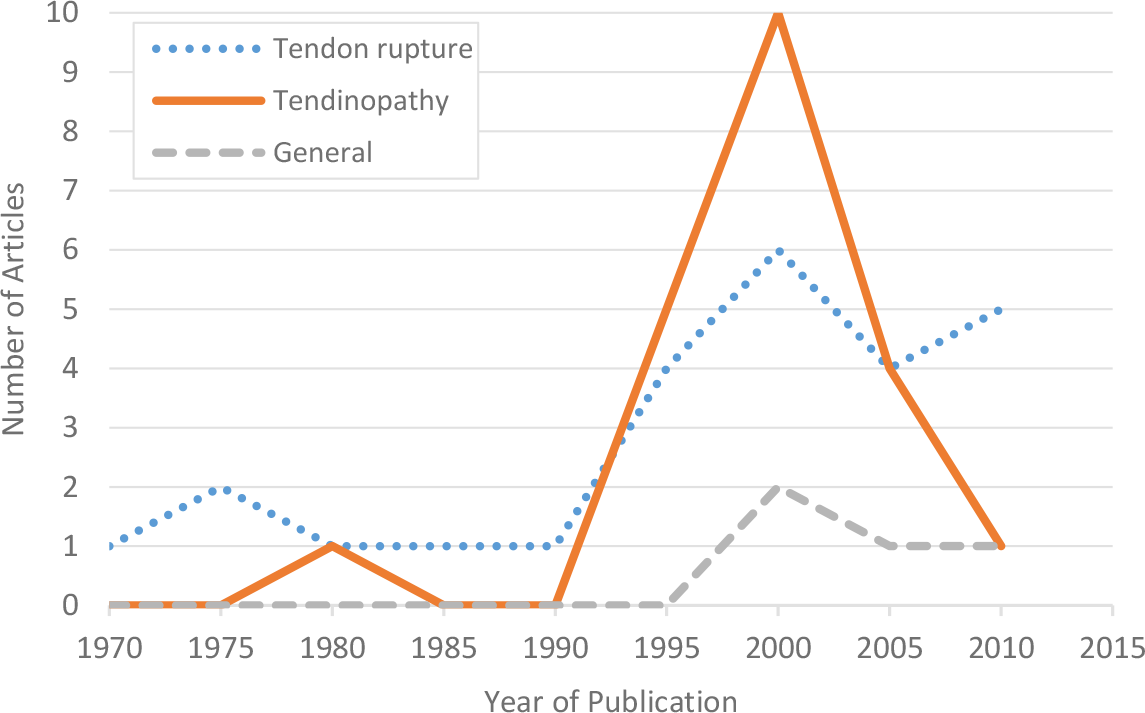
The number of publications over time (approximately 1970-2015) related to Achilles tendon rupture, Achilles tendinopathy, or Achilles conditions in general.
The number of citations for these 50 articles was 12,194. Per article, the mean number of citations was 244 ± 88.8 (range, 157-657) and the mean citation rate was 12.6 ± 5.4 per year (range, 3-28). The mean number of citations was similar between studies on Achilles tendon rupture and Achilles tendinopathy (244.8 ± 75.5 and 243 ± 109.5, respectively; P = .65), which suggests a similar degree of interest in both fields. Most articles (n = 32; 64%) were published in The American Journal of Sports Medicine (n = 20) and the Journal of Bone and Joint Surgery (n = 12). Of the total, 35 (70%) were published between 2000 and 2010. The mean JIF for the 9 journals in which the 50 articles were published was 5.1 ± 1.2 (Table 1).
Journals in Which the 50 Most Cited Articles on Achilles Tendon Were Published a

a JIF, journal impact factor.
Correlation Analysis
The citation rate correlated moderately and positively with the number of citations (r = 0.56; P < .001) and the year of publication (r = 0.60; P < .001), while a low negative correlation was found with the LoE (r = –0.40; P = .01) (Figure 2A, Table 2). Year of publication was also negatively correlated with the LoE (r = –0.44; P = .005) (Figure 2B). Study quality as evaluated with the mCMS had a low positive correlation with JIF (r = 0.35; P = .03) (Figure 2C) and a low negative correlation with LoE (r = –0.48; P = .003) (Figure 2D), but study quality was not correlated with the citation rate (P = .15). Out of 39 primary studies (51%; ie, excluding reviews and meta-analyses), 20 had a prospective and comparative design, while 19 (49%) were classed as poor quality (mCMS <50). The citation rate of the 16 most recent studies was almost double that of the 16 oldest studies (17.5 vs 9.9; P < .001).

Correlations between (A) the number of citations per year (CIT_YEAR) and the LoE of each article (r = –0.40; P = .01), (B) the LoE and the year of publication (r = –0.44; P = .005), (C) the mCMS and the 2020 impact factor of the journal in which each article was published (r = 0.35; P = .03), and (D) the mCMS and the LoE (r = –0.48; P = .003). LoE, level of evidence; mCMS, modified Coleman Methodological Score.
Correlations Between Main Variables Extracted From the 50 Most Cited Articles on the Achilles Tendon a

a Data are presented as r value (P value). Bold P values indicate statistical significance (P < .05). JIF, journal impact factor; LoE, level of evidence; mCMS, modified Coleman Methodology Score.
Discussion
In analysis of the 50 most cited articles on Achilles tendon injury, we found a low but significant correlation between LoE and year of publication, which demonstrates a progressive improvement of the quality of studies over time in this field. The number of citations and the citation rate did not correlate with study quality as assessed through the mCMS. Also, a number of highly cited studies were review articles and meta-analyses, which could be expected since they summarize a larger body of work.
As depicted in Figure 1, in this bibliometric study, we documented a growing interest toward Achilles tendon disorders in the years between 1990 and 2000. Among the top cited studies focusing on chronic Achilles tendinopathy, only 1 was published before 1990, while 5 were published between 1995 and 2000. Out of 7 comparative studies, 3 focused on the value of eccentric calf muscle to treat tendinosis, 23,46,58 which is nowadays commonly used in clinical practice as a keystone of nonoperative management. 51 In a recent systematic review on midportion Achilles tendinopathy, heavy eccentric calf training (also known as the Alfredson protocol) was proven more effective than traditional physiotherapy and reduced the duration of symptoms as compared with the natural history of the condition. 51 On the other side, the number of top cited studies produced on Achilles tendon rupture was constant until 2010 (approximately 4-6 studies/year). The trend toward an increased quality of studies suggests that more recent ones might represent a landmark for future authors, although not enough time has probably passed to let them collect a sufficient number of citations and be included in our bibliometric analysis.
Of note, the mean JIF for the journals of publication was 5.1, which was relatively high considering that, in the orthopaedic field, the journal with the highest 2021 JIF (6.2) was The American Journal of Sports Medicine, as reported by the Journal Citation Reports–Web of Science Group. 76 Similar bibliometric analyses on orthopaedic conditions have reported a generally lower mean JIF for the articles selected in their studies (eg, fracture nonunion, 27 2.7; platelet-rich plasma, 64 3.3; unicompartmental knee replacement, 28 4.5), except from the study on the anterior cruciate ligament by Zhu et al, 81 where the mean JIF was similar (5.6). This likely reflects the large interest toward Achilles-related conditions from researchers (who tend to produce and submit high-quality studies) and from highly ranked journals (that publish those articles in their issues).
Interestingly, the 2 articles with the highest number of citations also had the highest citation rates. 5,67 The most cited article (657 citations, 27.4 citation rate) was a 1998 study by Alfredson et al, 5 who prospectively assessed heavy-load eccentric calf muscle training in the treatment of chronic Achilles tendinosis in recreational athletes. This study documented its effectiveness and substantially contributed to this treatment’s becoming part of modern nonoperative protocols for chronic tendinopathy. The second-most cited article was the 2007 study by Sánchez et al 67 (419 citations, 27.9 citation rate). This level 3 case-control study highlighted advantages after using platelet-rich fibrin matrices in the open repair of an Achilles tendon. In this case, the large number of citations demonstrates the substantial interest of the scientific community toward the biological enhancement of surgical procedures to increase the success rate and reduce the number of complications in the treatment of Achilles tendon rupture.
The 15 articles with the highest citation rate (mean, 19.3 citations per year) were all published between 1998 and 2011. Noteworthy, among them we found the article by Nilsson-Helander et al, 54 in which the Achilles Tendon Total Rupture Score was first described and validated. Before that study, Achilles tendon disorders were generally assessed using generic scores (ie, the Foot and Ankle Outcome Score) or scales developed to evaluate chronic tendinopathies (eg, Victorian Institute of Sports Assessment–Achilles), although they were not specific for Achilles tendon ruptures. Conversely, most high-level studies now adopt the Achilles Tendon Total Rupture Score as a shared tool to assess the clinical outcome after Achilles tendon rupture. 16,26,63,80 Also, in 2011 van Dijk et al 75 clarified the nomenclature around Achilles tendon–related disorders by defining midportion Achilles tendinopathy, paratendinopathy (acute or chronic), insertional Achilles tendinopathy, retrocalcaneal bursitis, and superficial calcaneal bursitis—which are all suspected in case of pain behind the ankle but differ in terms of symptoms, clinical signs, findings at imaging, and histopathology. The high citation rate for these studies demonstrates how helpful they have been for researchers and authors to standardize the assessment of the outcome after Achilles tendon rupture and the definitions of various conditions around this area, respectively.
Limitations
We acknowledge some limitations of this study. First, we selected articles based primarily on the number of citations, regardless of the study design and LoE. This was a deliberate decision based on the will to be inclusive and provide an exhaustive overview of the most cited articles about Achilles tendon disorders. Second, the choice to select the first 50 articles was arbitrary, but it was supported by previous studies with a similar design. 13,24,25,35 Third, while it must be considered that authors are usually keen to cite articles published in journals in which they want to publish and articles that they have authored (self-citation), no subgroup analysis was performed to control these variables. Fourth, only journals categorized in the orthopaedic field in the Web of Science database were considered, therefore excluding journals from other fields (eg, sport sciences, biology, rehabilitation, surgery) in which highly cited articles could have been published. Finally, there is potential for bias relating to the gray literature, which has been discussed in previous studies 24 and which cannot be controlled but must be borne in mind when interpreting the results of these studies.
Conclusion
The findings of this analysis of the 50 most cited articles on Achilles tendon pathology indicated that although the JIF of the publication journal was positively correlated with study quality, the methodology was poor in almost half of the studies. The number of citations and the citation rate did not correlate with study quality. Nevertheless, the mean LoE provided by studies significantly increased over time, which corresponds to a growing interest in prospective and comparative analyses and which translates into a potential greater reliability of their results and conclusions.
Footnotes

Final revision submitted February 1, 2023; accepted February 22, 2023.
The authors declared that there are no conflicts of interest in the authorship and publication of this contribution. AOSSM checks author disclosures against the Open Payments Database (OPD). AOSSM has not conducted an independent investigation on the OPD and disclaims any liability or responsibility relating thereto.
Ethical approval was not sought for the present study.
APPENDIX
Characteristics of the 50 Most Cited Articles on the Achilles Tendon a

| No. of Citations | ||||||
|---|---|---|---|---|---|---|
| First Author | Title | Year | Overall | Per Year | LoE | mCMS |
| Alfredson 5 | Heavy-load eccentric calf muscle training for the treatment of chronic Achilles tendinosis | 1998 | 657 | 27.4 | 2 | 43 |
| Sanchez 67 | Comparison of surgically repaired Achilles tendon tears using platelet-rich fibrin matrices | 2007 | 419 | 27.9 | 3 | 51 |
| Cetti 17 | Operative versus nonoperative treatment of Achilles tendon rupture: a prospective randomized study and review of the literature | 1993 | 373 | 12.9 | 5 | 61 |
| Åstrom 11 | Chronic Achilles tendinopathy: a survey of surgical and histopathologic findings | 1995 | 363 | 13.4 | 4 | 49 |
| Maffulli 41 | Rupture of the Achilles tendon (current concepts review) | 1999 | 362 | 15.7 | 5 | — |
| Nistor 55 | Surgical and non-surgical treatment of Achilles tendon rupture: a prospective randomized study | 1981 | 336 | 8.2 | 1 | 72 |
| Khan 33 | Treatment of acute Achilles tendon ruptures: a meta-analysis of randomized, controlled trials | 2005 | 328 | 19.3 | 1 | — |
| Öhberg 59 | Neovascularisation in Achilles tendons with painful tendinosis but not in normal tendons: an ultrasonographic investigation | 2001 | 316 | 15.0 | 3 | 33 |
| Clement 19 | Achilles tendinitis and peritendinitis: etiology and treatment | 1984 | 310 | 8.1 | 3 | 42 |
| Järvinen 31 | Achilles tendon disorders: etiology and epidemiology | 2005 | 289 | 17.0 | 5 | — |
| Wren 79 | Mechanical properties of the human Achilles tendon | 2001 | 287 | 13.6 | 5 | — |
| Ma 40 | Percutaneous repair of acute closed ruptured Achilles tendon: a new technique | 1977 | 285 | 6.3 | 5 | 52 |
| Kujala 34 | Cumulative incidence of Achilles tendon rupture and tendinopathy in male former elite athletes | 2005 | 285 | 16.8 | 3 | 38 |
| Willits 77 | Operative versus nonoperative treatment of acute Achilles tendon ruptures: a multicenter randomized trial using accelerated functional rehabilitation | 2010 | 283 | 23.6 | 1 | 75 |
| Mafi 46 | Superior short-term results with eccentric calf muscle training compared to concentric training in a randomized prospective multicenter study on patients with chronic Achilles tendinosis | 2001 | 276 | 13.1 | 1 | 48 |
| Nilsson-Helander 54 | The Achilles Tendon Total Rupture Score (ATRS): development and validation | 2007 | 273 | 18.2 | 1 | 39 |
| Jozsa 32 | The role of recreational sport activity in Achilles tendon rupture: a clinical, pathoanatomical, and sociological study of 292 cases | 1989 | 250 | 7.6 | 3 | 22 |
| Inglis 30 | Ruptures of the tendo Achillis: an objective assessment of surgical and non-surgical treatment | 1976 | 247 | 5.4 | 2 | 28 |
| Paavola 62 | Current concepts review Achilles tendinopathy | 2002 | 247 | 12.3 | 5 | — |
| Alfredson 4 | Is vasculo-neural ingrowth the cause of pain in chronic Achilles tendinosis? An investigation using ultrasonography and colour Doppler, immunohistochemistry, and diagnostic injections | 2003 | 246 | 12.9 | 4 | 33 |
| Maffulli 45 | Changing incidence of Achilles tendon rupture in Scotland: a 15-year study | 1999 | 244 | 10.6 | 4 | 31 |
| Nilsson-Helander 53 | Acute Achilles tendon rupture: a randomized, controlled study comparing surgical and nonsurgical treatments using validated outcome measures | 2010 | 242 | 20.2 | 1 | 65 |
| Mortensen 49 | Early motion of the ankle after operative treatment of a rupture of the Achilles tendon: a prospective randomized clinical and radiographic study | 1999 | 238 | 10.3 | 1 | 63 |
| Mueller 50 | Effect of Achilles tendon lengthening on neuropathic plantar ulcers—a randomized clinical trial | 2003 | 229 | 12.0 | 1 | 61 |
| Soroceanu 72 | Surgical versus nonsurgical treatment of acute Achilles tendon rupture: a meta-analysis of randomized trials | 2012 | 228 | 22.8 | 1 | — |
| Fahlström 23 | Chronic Achilles tendon pain treated with eccentric calf-muscle training | 2003 | 226 | 11.9 | 2 | 37 |
| Maffulli 43 | Tenocytes from ruptured and tendinopathic Achilles tendons produce greater quantities of type III collagen than tenocytes from normal Achilles tendons: an in vitro model of human tendon heating | 2000 | 224 | 10.2 | 4 | 30 |
| Schepsis 68 | Achilles tendon disorders in athletes | 2002 | 224 | 11.2 | 5 | — |
| Rompe 66 | Eccentric loading, shock-wave treatment, or a wait-and-see policy for tendinopathy of the main body of tendo Achillis: a randomized controlled trial | 2007 | 219 | 14.6 | 1 | 55 |
| Åstrom 10 | Imaging in chronic Achilles tendinopathy: a comparison of ultrasonography, magnetic resonance imaging and surgical findings in 27 histologically verified cases | 1996 | 209 | 8.0 | 3 | 44 |
| de Jonge 21 | One-year follow-up of platelet-rich plasma treatment in chronic Achilles tendinopathy: a double-blind randomized placebo-controlled trial | 2011 | 204 | 18.5 | 1 | 59 |
| Öhberg 58 | Effects on neovascularisation behind the good results with eccentric training in chronic mid-portion Achilles tendinosis? | 2004 | 199 | 11.0 | 2 | 45 |
| Alfredson 6 | In situ microdialysis in tendon tissue: high levels of glutamate, but not prostaglandin E2 in chronic Achilles tendon pain | 1999 | 190 | 8.3 | 3 | 27 |
| Paavola 61 | Long-term prognosis of patients with Achilles tendinopathy: an observational 8-year follow-up study | 2000 | 188 | 8.5 | 2 | 64 |
| Maffulli 44 | Early weightbearing and ankle mobilization after open repair of acute midsubstance tears of the Achilles tendon | 2003 | 182 | 9.6 | 2 | 63 |
| Alfredson 3 | Sclerosing injections to areas of neo-vascularisation reduce pain in chronic Achilles tendinopathy: a double-blind randomised controlled trial | 2005 | 182 | 10.7 | 1 | 50 |
| Wong 78 | Quantitative review of operative and nonoperative management of Achilles tendon ruptures | 2002 | 182 | 9.1 | 3 | — |
| Tallon 74 | Outcome of surgery for chronic Achilles tendinopathy: a critical review | 2001 | 180 | 8.6 | 2 | — |
| Chen 18 | Extracorporeal shock waves promote healing of collagenase-induced Achilles tendinitis and increase TGF-β1 and 1GF-1 expression | 2004 | 176 | 9.8 | 3 | 41 |
| Lea 36 | Non-surgical treatment of tendo Achillis rupture | 1972 | 171 | 3.4 | 3 | 48 |
| Bhandari 15 | Treatment of acute Achilles tendon ruptures: a systematic overview and metaanalysis | 2002 | 171 | 10.0 | 3 | — |
| Rompe 65 | Eccentric loading versus eccentric loading plus shock-wave treatment for midportion Achilles tendinopathy: a randomized controlled trial | 2009 | 167 | 12.8 | 1 | 59 |
| van Dijk 75 | Terminology for Achilles tendon related disorders | 2011 | 167 | 15.2 | 5 | — |
| Olsson 60 | Stable surgical repair with accelerated rehabilitation versus nonsurgical treatment for acute Achilles tendon ruptures: a randomized controlled study | 2013 | 164 | 18.2 | 1 | 59 |
| Armstrong 8 | Lengthening of the Achilles tendon in diabetic patients who are at high risk for ulceration of the foot | 1999 | 162 | 7.0 | 5 | 38 |
| Schepull 69 | Autologous platelets have no effect on the healing of human Achilles tendon ruptures: a randomized single-blind study | 2011 | 162 | 14.7 | 1 | 63 |
| Holmes 29 | Etiologic factors associated with symptomatic Achilles tendinopathy | 2006 | 159 | 9.9 | 3 | 37 |
| Assal 9 | Limited open repair of Achilles tendon ruptures: a technique with a new instrument and findings of a prospective multicenter study | 2002 | 158 | 7.9 | 2 | 62 |
| Maffulli 42 | Light microscopic histology of Achilles tendon ruptures: a comparison with unruptured tendons | 2000 | 158 | 7.1 | 3 | 51 |
| Mandelbaum 47 | Achilles tendon ruptures: a new method of repair, early range of motion, and functional rehabilitation | 1995 | 157 | 5.8 | 5 | 43 |
a LoE, level of evidence; mCMS, modified Coleman Methodology Score.