



Abstract
Background:
The development of Achilles tendon treatment modalities has been rapid, and it is increasingly difficult for clinicians to stay up to date with the most influential studies in this field. In order to fully understand the current state of the literature regarding Achilles tendon injury, it is invaluable to be familiar with the foundational articles and studies upon which the field is built.
Purpose:
To objectively determine the 50 most frequently cited studies in Achilles tendon pathology and to conduct a bibliometric analysis.
Study Design:
Cross-sectional study.
Methods:
The Clarivate Analytics Web of Knowledge database was used to gather data and metrics of Achilles tendon research. The 50 most cited articles were selected for analysis from an initial 17,244 identified articles. The information extracted for each article included author name, publication year, country of origin, journal name, study type, and level of evidence.
Results:
For these 50 studies, the total number of citations was calculated to be 13,159, with a mean of 263.2 citations per paper. The most cited article collected 657 citations. The publication dates of the 50 studies included in this analysis spanned 41 years (1972-2013). The largest number of articles were published by Swedish authors (n = 14); however, many other countries were represented, including Canada and Finland (n = 6 articles each). The most prevalent study designs were cohort studies (n = 13) with level 4 evidence studies being the most common (n = 14).
Conclusion:
Among the 50 most influential articles in Achilles tendon pathology, the study designs most commonly used were cohort studies and review articles. Sweden was the country of origin for the most studies included on this list, which reflects this country’s interest and commitment to researching Achilles tendon injuries and treatments.
The Achilles tendon is the primary plantarflexor of the foot and is formed by the confluence of 2 muscles in the lower leg, the gastrocnemius and the soleus. Achilles tendon ruptures and other pathologies are common musculoskeletal injuries, particularly in active and athletic individuals. 18,29 The treatment of Achilles tendon injuries has seen many changes and innovations over the past several centuries. The initial description of Achilles tendon ruptures dates all the way back to 1575 with Ambrose-Pare describing his treatment, which consisted of bandages and a rigid strapping technique. 37 However, it was not until the early 20th century when surgical management of Achilles tendon ruptures became the recommended treatment option. Surgeons such as Abrahamsen, Quenu, and Stoianovitch were among the earliest pioneers of surgical Achilles tendon rupture repair and reported the first positive outcomes associated with surgical management. 28
Currently, there is no universally accepted treatment for Achilles tendon injuries; many options, both operative and nonoperative, exist. Additionally, the state of the Achilles tendon injury literature has rapidly advanced over the past several decades with new studies regarding rehabilitation protocols, surgical technique, stem cell treatment, platelet-rich plasma potential, mechanisms of injury, and updated epidemiology being released daily. 9,11,16,33,36,45 With this rapid expansion of the Achilles tendon pathology literature, it has become increasingly difficult for medical professionals and learners to stay up to date with the most impactful articles in this field.
Citation analyses are an effective method that can objectively determine the degree of impact a grouping of articles has had on a particular field or subject of interest. 1,10,15,27 The number of citations an article has collected over its publication life is a valuable metric that reflects the influence it has had in its subject area. ∥ Moreover, it is of value to readers less familiar with a body of work to understand common characteristics of the mot cited pieces of research on a certain topic. Items such as author name, country of origin, level of evidence, and study type provide unfamiliar readers with a better understanding about the state of the literature, its major contributors, and potential future directions.
Within the field of orthopaedic surgery, there have been numerous bibliometric analyses with the goal of collecting and characterizing the most impactful studies in the field. Analyses in the fields of arthroscopy, 7,30,32 arthroplasty, 17 pediatric orthopaedics, 4 knee surgery, 2 concussion, 25 and hand surgery 43 have all been performed. Additionally, Lefaivre et al 21 performed a bibliometric analysis for the top 100 most cited studies in all of orthopaedics; however, no studies pertaining to Achilles tendon injuries were included. Therefore, the purpose of this study was to objectively determine the 50 most frequently cited studies in Achilles tendon pathology and to analyze them with a bibliometric analysis. We hypothesized that publication year would have a substantial impact on the total number of citations that a given article was able to accumulate. In addition, given the extensive history of Achilles tendon treatments, we hypothesized that the top 50 most cited articles would be primarily level 1 and 2 evidence studies.
Methods
Approval from the institutional review board was deemed unnecessary due to the public nature of this data set. The Clarivate Analytics Web of Knowledge database was utilized to obtain the data and metrics reported in this analysis. 12 Similar methods were followed to those reported in other orthopaedic bibliometric analyses. ¶ The literature search occurred on December 18, 2021. Varying Boolean queries were utilized in order to capture all iterations of Achilles tendon pathology relevant to orthopaedic surgery and sports medicine. The most inclusive Boolean search query resulting in the most total searches was used for analysis. The final Boolean search phrases were (Achille’s OR Achilles OR Achille’s tendon OR Achilles Tendon OR Calcaneal tendon) AND (rupture OR repair OR injury OR surgery OR surgical repair OR disorder OR disease OR treatment OR rehabilitation OR reconstruction). This search resulted in 17,244 total articles. A search of bibliographies was not performed.
The search results were then reordered in descending order of total citations so that articles with the most total citations were at the top of the list. The title and abstract of each search result were then reviewed to determine the relevance to Achilles tendon pathology. An article was excluded from further analysis if it did not present information on surgical techniques, management, surgical outcomes, complications of treatment (operative or nonoperative), rehabilitation, biomechanical mechanisms of injury, or epidemiologic trends in relation to Achilles tendon pathology, rupture, or injury. Articles with peripheral mention of Achilles tendon pathology were excluded. If the inclusion or exclusion of an article was in question, the full manuscript was obtained and reviewed by 2 authors (M.L.M. and R.J.H.) to ultimately decide.
A total of 279 search results were reviewed before reaching 50 articles that met the above inclusion criteria. The full manuscripts for these final 50 articles were obtained and reviewed to obtain the following information: first and last author name; year of publication; country of origin; publishing journal name; article category (rupture, tendinosis, tendinopathy, injuries, epidemiology); focus of the article; study type (expert opinion, review article, descriptive study, case report, case series, case-control study, cohort study, randomized controlled trial); and the respective level of evidence. The level of evidence is a measure of the article’s relative risk of bias and the Journal of Bone and Joint Surgery guidelines were utilized to classify the selected studies. 44 The level of evidence and study type were determined by a consensus opinion between the first and second authors (M.L.M. and R.J.H.) If there was a disagreement between the first and second authors, the senior author (K.A.P.) was consulted. If an article was a review or commentary on a subject with no clearly characterized systematic review of the literature, it was classified in the “expert opinion” category. The citation density for each article was also calculated, which represents the total number of citations divided by the number of years since publication (as of 2021).
Results
The 50 Achilles tendon articles included in this study are listed in Appendix Table A1. They have been cited 13,159 times, with a mean of 263.2 citations per article. The earliest article publication occurred in 1972, while the latest publication was from 2013; this represents a range of 41 years. Of the 50 total articles, 33 were published since 2000, and over half of the included studies were published after 2002. In addition, 2002 was the year with the most articles published (n = 6) followed closely by 2005 (n = 4) (Figure 1).

The top 50 most cited Achilles tendon pathology articles by publication year.
The most cited article in this collection, by Alfredson and Lorentzon, 3 was cited a total of 657 times. The next most commonly cited articles were by de Vos et al 13 and Robinson et al, 39 which accumulated 512 and 422 total citations, respectively. The difference between the most cited article (657 citations; Alfredson and Lorentzon 3 ) and the least cited (164 citations; Olsson et al 35 ) was also substantial. Across the 41-year period that this collection of influential articles spanned, the most citations in a single year occurred in 2017 (880 citations), followed closely by 2018 and 2016 (840 and 835 citations, respectively). Moreover, across the 41-year span, the total number of citations accumulated each year has risen exponentially. This rise has been most prevalent since 1996 (Figure 2).
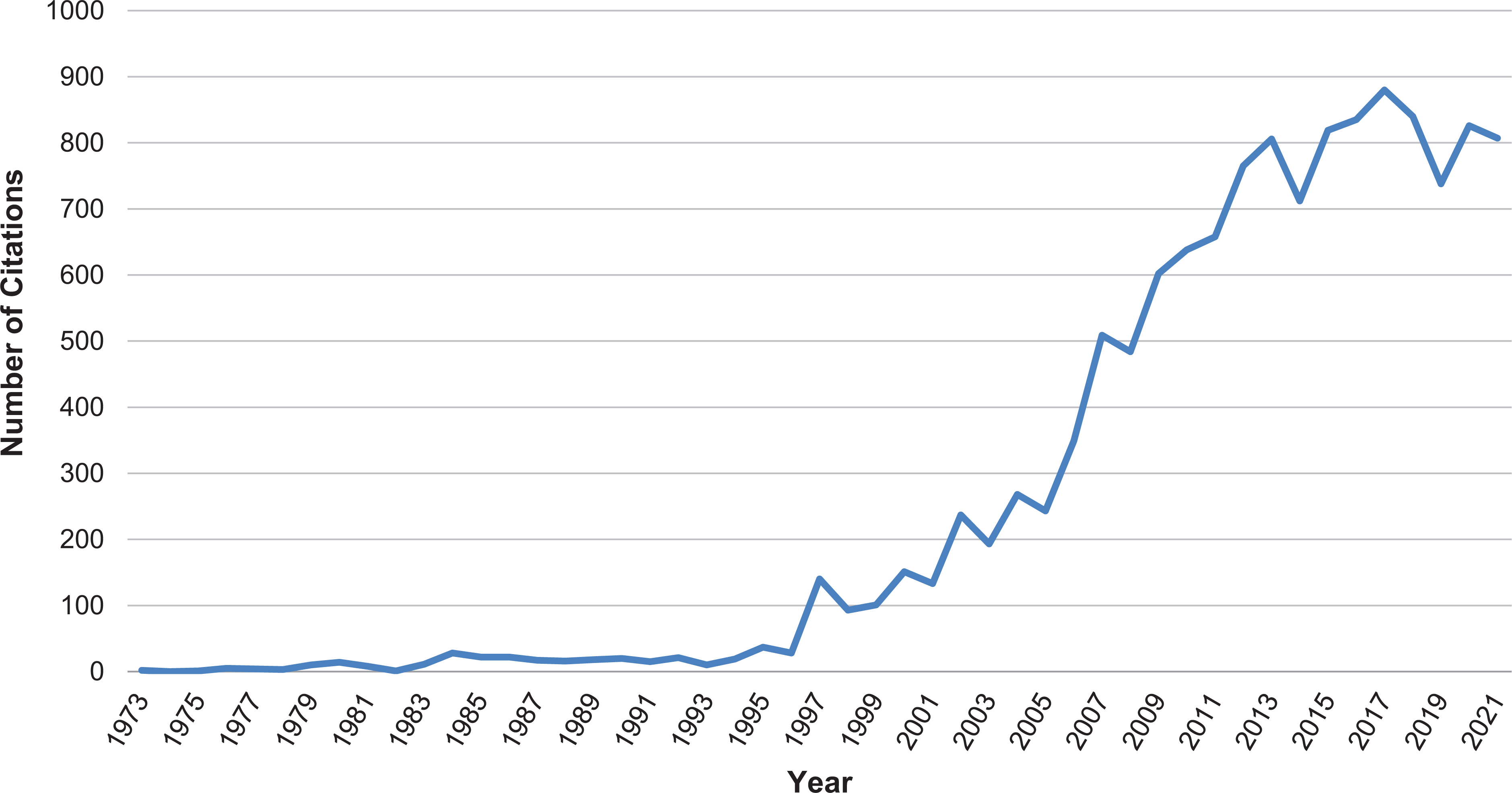
The number of citations accumulated by the top 50 most cited articles about Achilles tendon pathology per year.
Citation density, the total number of citations divided by the number of years since publication, was also calculated for each of the 50 articles included in this analysis. The top 3 articles stratified by citation density can be attributed to de Vos et al 13 (46.5 citations/year), Sánchez et al 41 (29.9 citations/year), and Alfredson and Lorentzon 3 (28.6 citations/year) (Appendix Table A1). The oldest article in this analysis, published in 1972 by Lea and Smith, 20 ranked last in terms of citation density (3.5 citations/year). The newest article included in this analysis, published in 2013 by Olsson et al, 35 ranked eighth in citation density (20.5 citations/year).
With regard to the most represented authors of these 50 influential articles, Maffulli, Alfredson, and Karlsson possessed the most first or last/senior author papers in this analysis. Maffulli had a total of 9 articles that had accumulated 1993 total citations or 15.1% of the total citations generated by the entire collection of 50 articles. A total of 13 authors had ≥2 articles included in this analysis (Table 1).
The Most Represented Authors Among the Top 50 Most Cited Achilles Tendon Articles and Their Respective Total Citations

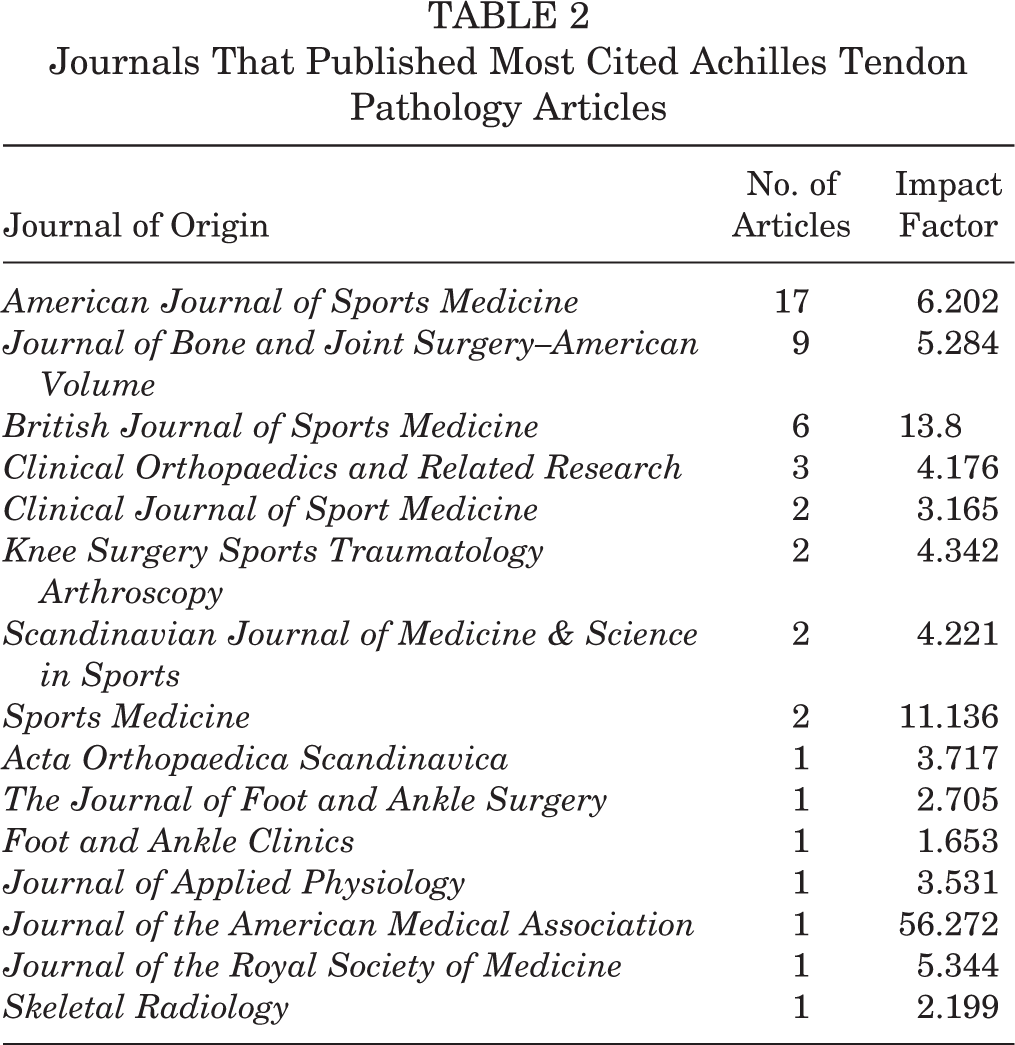
All 50 articles included in this analysis were published in English and originated in 15 scientific journals. The mean impact factor of the origin journals was 8.5 ± 13.6. The American Journal of Sports Medicine had the most articles represented (n = 17), followed by the Journal of Bone and Joint Surgery–American Volume (n = 9) and the British Journal of Sports Medicine (n = 6) (Table 2). These influential articles originated from 13 countries with Sweden (n = 14), Canada (n = 6), and Finland (n = 6) accounting for the most (Figure 3).
Journals That Published Most Cited Achilles Tendon Pathology Articles

The top 50 most cited Achilles tendon pathology articles according to country of origin.
With regard to article category, Achilles tendon rupture was the most common study classification (n = 23) followed by tendinopathy (n = 16) and tendinosis (n = 6). Achilles injury treatment was the most common article focus (n = 25) followed by epidemiology (n = 8), literature review (n = 7), surgical technique (n = 3), imaging (n = 2), questionnaire validation (n = 2), rehabilitation (n = 2), and biomechanics (n = 1). The most common study design was a cohort study (n = 13) followed by review article (n = 11), randomized controlled study (n = 8), case series (n = 8), descriptive article (n = 6), case-control (n = 2), and expert opinion (n = 2). Finally, most of the 50 articles had an evidence level of 4 (n = 14), followed by levels 1 and 2 (n = 11 each), level 3 (n = 8), and level 5 (n = 6) (Figure 4).

The top 50 most cited Achilles tendon pathology articles by level of evidence.
Discussion
The major finding of our research was that the majority of the top 50 most cited articles about Achilles tendon pathology have been published since 2002, are cohort studies or review articles, and have an evidence level of 1, 2, or 4. A large number of these articles originated in non-US countries such as Sweden, Canada, and Finland. In addition, most of these highly influential articles can be categorized as representing tendon rupture, tendinopathy, or tendinosis with special focus on treatment options/algorithms, epidemiological trends, literature review and summation, and surgical technique description and comparison.
As noted previously, the treatment and management of Achilles tendon injuries and disease has a long history dating back hundreds of years. As a result, the current literature surrounding Achilles tendon pathologies is relatively well developed. This observation is supported by the large number of evidence level 1 and 2 studies and randomized controlled trials, cohort studies, and review articles (systematic reviews and meta-analyses). These findings are representative of high-quality evidence that reflects a mature state of the literature and can objectively guide management.
This is in contrast to other fields such as orthopaedic arthroscopy and sports concussion, which had very few randomized controlled trials and level 1 and 2 studies. For example, in a study by McQuivey et al, 25 of the top 100 most cited articles in sport concussion research, 63% of articles were level 4 or 5 evidence and there were zero randomized controlled trials and level 1 evidence pieces of literature. Similarly, studies by Murphy et al, 32 Moore et al, 30 and Barbera et al, 7 in orthopaedic knee, shoulder, and hip arthroscopy, respectively, found similar trends of predominantly level 4 and 5 evidence and fewer pieces of high-impact, level 1 research. This finding is encouraging for orthopaedic sports medicine and foot and ankle surgeons, as the state of the Achilles tendon pathology literature is very robust and consists of high-quality pieces of literature from which to learn and influence practice.
Interestingly, despite the earliest publication arising in 1972 and the wide range of publication years in the study, the majority of the most influential articles have been published in the past 20 years. Therefore, despite the state of the Achilles tendon injury literature being relatively robust and mature, there still exists great opportunity for new, innovative research to be conducted on this subject. For example, several of the most cited articles in this analysis published in the past 20 years have focused on the application of emerging technologies such as platelet-rich plasma/stem cells, minimally invasive surgical techniques, and innovative methods of rehabilitation and nonoperative treatment options.
In addition to many of the most cited articles being published in the past 20 years, the newest studies also have significantly greater citation densities when compared with older studies (P < .01). In fact, when dividing the 50 studies by those published before and after 2002, those published after 2002 had a mean citation density of 17.4 citations/year while those published before had an mean density of 10.9 citations/year. This finding demonstrates the known tendency of foundational articles experiencing slowing of citation frequency as they age and newer pieces of literature replacing them. This phenomenon is known as “obliteration by incorporation.” 15 Obliteration by incorporation occurs when ideas and theories within a scientific field become so well known and accepted that the original contributors of this knowledge are no longer cited or recognized. This finding is common in many dynamic scientific fields where the state of the literature is constantly evolving and changing. Moreover, it is also likely that the observed incidence of highly cited articles occurring over the past 2 decades may be due to a growing volume of article submissions. In orthopaedics specifically, scientific manuscript submission volumes have increased at a cumulative annual growth rate of 10.2%. 22 Therefore, the observed incidence of highly cited, high citation-density articles occurring over the past 2 decades is likely due to obliteration by incorporation and a rising rate of article submission and acceptance.
Unlike other similar analyses, the most influential articles in this field have not originated from American authors. In fact, European authors accounted for 78% of the top 50 most cited articles while American authors only represented 10% of the collection. Sweden was responsible for the most articles in this analysis (28%), and Nordic countries as a whole accounted for nearly half of the most influential articles. This finding is in stark contrast to a study performed by Lefaivre et al, 21 which found that 72% of the most influential articles in all of orthopaedic surgery originated from US authors. In the field of Achilles tendon injury treatment and rehabilitation, Sweden and other Nordic countries have led the field.
Limitations
This study has several limitations. First, the selection criteria used to obtain the top 50 most cited studies, while well defined, were partially subjective in nature. Articles being considered for inclusion were often questionable due to unique study designs, vague methodology, or unclear purpose statements that did not fall exactly within the bounds of our exclusion and inclusion criteria. However, the authors introduced as much objectivity as possible in the selection of articles by having multiple authors review selections, particularly if ambiguity was noted. Additionally, the reviewing authors were second- and third-year allopathic medical students with extensive experience conducting bibliometric analyses. Second, while citations are an important metric used to assess an article’s influence and impact on its field, it is not the only factor that measures an article’s overall effect. Articles with fewer total citations, but large impacts on the field, may have been overlooked. However, total citations are an objective metric used to stratify the literature and avoid ambiguity and subjective decisions. Finally, the Web of Knowledge database was utilized for this study. While this database is comprehensive, it is possible that some high-impact articles may have been excluded by either the search criteria or tabulation of the citations.
Conclusion
Among the 50 most influential articles on Achilles tendon pathology, the study designs most commonly used were cohort studies and review articles. Sweden was responsible for the most studies included on this list, which reflects this country’s interest and commitment to researching Achilles tendon injuries and treatments. This article serves as a reference to direct orthopaedic practitioners to the 50 most influential studies in Achilles tendon rupture repair.
Footnotes
Notes
Final revision submitted May 14, 2022; accepted August 10, 2022.
One or more of the authors has declared the following potential conflict of interest or source of funding: K.A.P. has received education payments from Arthrex and ImpactOrtho. AOSSM checks author disclosures against the Open Payments Database (OPD). AOSSM has not conducted an independent investigation on the OPD and disclaims any liability or responsibility relating thereto.
Ethical approval was not sought for the present study.
Appendix
The Top 50 Most Cited Achilles Tendon Pathology Articles

| Rank | Article | No. of Citations (citation density a ) |
|---|---|---|
| 1 | Alfredson H, Lorentzon R. Chronic Achilles tendinosis: recommendations for treatment and prevention. Sports Med. 2000;29:135-146. | 657 (28.6) |
| 2 | de Vos RJ, Weir A, van Schie HTM, et al. Platelet-rich plasma injection for chronic Achilles tendinopathy: a randomized controlled trial. JAMA. 2010;303(2):144-149. | 512 (46.5) |
| 3 | Robinson J, Cook J, Purdam C, et al. The VISA-A questionnaire: a valid and reliable index of the clinical severity of Achilles tendinopathy. Br J Sports Med. 2001;35:335-341. | 422 (21.1) |
| 4 | Sánchez M, Anitua E, Azofra J, Andía I, Padilla S, Mujika I. Comparison of surgically repaired Achilles tendon tears using platelet-rich fibrin matrices. Am J Sports Med. 2007;35:245-251. | 419 (29.9) |
| 5 | Cetti R, Christensen S-E, Ejsted R, et al. Operative versus nonoperative treatment of Achilles tendon rupture: a prospective randomized study and review of the literature. Am J Sports Med. 1993;21:791-799. | 373 (13.3) |
| 6 | Maffulli N. Rupture of the Achilles tendon. J Bone Joint Surg Am. 1999;81:1019-1036. | 362 (16.5) |
| 7 | Aström M, Gentz CF, Nilsson P, et al. Imaging in chronic Achilles tendinopathy: a comparison of ultrasonography, magnetic resonance imaging and surgical findings in 27 histologically verified cases. Skeletal Radiol. 1996;25:615-620. | 361 (13.9) |
| 8 | Kvist M. Achilles tendon injuries in athletes. Sports Med. 1994;18:173-201. | 346 (12.8) |
| 9 | Nistor L. Surgical and non-surgical treatment of Achilles tendon rupture. A prospective randomized study. J Bone Joint Surg Am. 1981;63:394-399. | 336 (8.4) |
| 10 | Khan RJK, Fick D, Keogh A, et al. Treatment of acute Achilles tendon ruptures. A meta-analysis of randomized, controlled trials. J Bone Joint Surg Am. 2005;87:2202-2210. | 328 (20.5) |
| 11 | Clement DB, Taunton JE, Smart GW. Achilles tendinitis and peritendinitis: etiology and treatment. Am J Sports Med. 1984;12:179-184. | 310 (8.4) |
| 12 | Järvinen TAH, Kannus P, Maffulli N, et al. Achilles tendon disorders: etiology and epidemiology. Foot Ankle Clin. 2005;10:255-266. | 289 (18.1) |
| 13 | Kujala UM, Sarna S, Kaprio J. Cumulative incidence of Achilles tendon rupture and tendinopathy in male former elite athletes. Clin J Sport Med. 2005;15:133-135. | 285 (17.8) |
| 14 | Ma GWC, Griffith TG. Percutaneous repair of acute closed ruptured Achilles tendon: a new technique. Clin Orthop Relat Res. 1977;128:247-255. | 285 (6.5) |
| 15 | Willits K, Amendola A, Bryant D, et al. Operative versus nonoperative treatment of acute Achilles tendon ruptures: a multicenter randomized trial using accelerated functional rehabilitation. J Bone Joint Surg Am. 2010;92:2767-2775. | 283 (25.7) |
| 16 | Mafi N, Lorentzon R, Alfredson H. Superior short-term results with eccentric calf muscle training compared to concentric training in a randomized prospective multicenter study on patients with chronic Achilles tendinosis. Knee Surg Sports Traumatol Arthrosc. 2001;9:42-47. | 276 (13.8) |
| 17 | Öhberg L, Alfredson H. Ultrasound guided sclerosis of neovessels in painful chronic Achilles tendinosis: pilot study of a new treatment. Br J Sports Med. 2002;36:173-175. | 274 (16.1) |
| 18 | Nilsson-Helander K, Silbernagel KG, Thomeé R, et al. Acute Achilles tendon rupture: a randomized, controlled study comparing surgical and nonsurgical treatments using validated outcome measures. Am J Sports Med. 2010;38:2186-2193. | 273 (19.5) |
| 19 | Puddu G, Ippolito E, Postacchini F. A classification of Achilles tendon disease. Am J Sports Med. 1976;4:145-150. | 272 (6.0) |
| 20 | Öhberg L, Lorentzon R, Alfredson H. Eccentric training in patients with chronic Achilles tendinosis: normalised tendon structure and decreased thickness at follow up. Br J Sports Med. 2004;38:8-11. | 253 (13.3) |
| 21 | Józsa L, Kvist M, Bálint BJ, et al. The role of recreational sport activity in Achilles tendon rupture: a clinical, pathoanatomical, and sociological study of 292 cases. Am J Sports Med. 1989;17:338-343. | 250 (10.0) |
| 22 | Leppilahti J, Puranen J, Orava S. Incidence of Achilles tendon rupture. Acta Orthop Scand. 1996;67:277-279. | 250 (7.8) |
| 23 | Inglis AE, Scott WN, Sculco TP, et al. Ruptures of the tendo Achillis. An objective assessment of surgical and non-surgical treatment. J Bone Joint Surg Am. 1976;58:990-993. | 247 (13.0) |
| 24 | Paavola M, Kannus P, Järvinen TAH, et al. Achilles tendinopathy. J Bone Joint Surg Am. 2002;84:2062-2076. | 247 (5.5) |
| 25 | Kader D, Saxena A, Movin T, et al. Achilles tendinopathy: some aspects of basic science and clinical management. Br J Sports Med. 2002;36:239-249. | 243 (12.8) |
| 26 | Maffulli N, Waterston SW, Squair J, et al. Changing incidence of Achilles tendon rupture in Scotland: a 15-year study. Clin J Sport Med. 1999;9:157-160. | 243 (11.0) |
| 27 | Nilsson-Helander K, Thomeé R, Silbernagel KG, et al. The Achilles tendon Total Rupture Score (ATRS): development and validation. Am J Sports Med. 2007;35:421-426. | 242 (22.0) |
| 28 | Mortensen HM, Skov O, Jensen PE. Early motion of the ankle after operative treatment of a rupture of the Achilles tendon. A prospective, randomized clinical and radiographic study. J Bone Joint Surg Am. 1999;81:983-990. | 238 (10.8) |
| 29 | Soroceanu A, Sidhwa F, Aarabi S, et al. Surgical versus nonsurgical treatment of acute Achilles tendon rupture: a meta-analysis of randomized trials. J Bone Joint Surg Am. 2012;94:2136-2143. | 228 (25.3) |
| 30 | Fahlström M, Jonsson P, Lorentzon R, et al. Chronic Achilles tendon pain treated with eccentric calf-muscle training. Knee Surg Sports Traumatol Arthrosc. 2003;11:327-333. | 226 (12.6) |
| 31 | Schepsis AA, Jones H, Haas AL. Achilles tendon disorders in athletes. Am J Sports Med. 2002;30:287-305. | 224 (11.8) |
| 32 | Rompe JD, Furia J, Maffulli N. Eccentric loading versus eccentric loading plus shock-wave treatment for midportion Achilles tendinopathy: a randomized controlled trial. Am J Sports Med. 2009;37:463-470. | 219 (15.6) |
| 33 | Maffulli N, Sharma P, Luscombe KL. Achilles tendinopathy: aetiology and management. J R Soc Med. 2004;97:472-476. | 215 (12.6) |
| 34 | Aström M, Rausing A. Chronic Achilles tendinopathy. A survey of surgical and histopathologic findings. Clin Orthop Relat Res. 1995;316:151-164. | 209 (8.4) |
| 35 | Silbernagel KG, Thomeé R, Thomeé P, et al. Eccentric overload training for patients with chronic Achilles tendon pain—a randomised controlled study with reliability testing of the evaluation methods. Scand J Med Sci Sports. 2001;11:197-206. | 206 (10.3) |
| 36 | de Jonge S, van den Berg C, de Vos RJ, et al. Incidence of midportion Achilles tendinopathy in the general population. Br J Sports Med. 2011;45:1026-1028. | 205 (20.5) |
| 37 | de Jonge S, de Vos RJ, Weir A, et al. One-year follow-up of platelet-rich plasma treatment in chronic Achilles tendinopathy: a double-blind randomized placebo-controlled trial. Am J Sports Med. 2011;39:1623-1630. | 204 (20.4) |
| 38 | Alfredson H, Pietilä T, Jonsson P, Lorentzon R. Heavy-load eccentric calf muscle training for the treatment of chronic Achilles tendinosis. Am J Sports Med. 1998;26(3):360-366. | 202 (9.6) |
| 39 | Khan KM, Forster BB, Robinson J, et al. Are ultrasound and magnetic resonance imaging of value in assessment of Achilles tendon disorders? A two year prospective study. Br J Sports Med. 2003;37:149-153. | 196 (10.9) |
| 40 | Wapner KL, Pavlock GS, Hecht PJ, et al. Repair of chronic Achilles tendon rupture with flexor hallucis longus tendon transfer. Foot Ankle. 1993;14:443-449. | 196 (7.0) |
| 41 | Paavola M, Kannus P, Paakkala T, et al. Long-term prognosis of patients with Achilles tendinopathy. Am J Sports Med. 2000;28:634-642. | 188 (9.0) |
| 42 | Maffulli N, Tallon C, Wong J, et al. Early weightbearing and ankle mobilization after open repair of acute midsubstance tears of the Achilles tendon. Am J Sports Med. 2003;31:692-700. | 182 (10.1) |
| 43 | Wong J, Barrass V, Maffulli N. Quantitative review of operative and nonoperative management of Achilles tendon ruptures. Am J Sports Med. 2002;30:565-575. | 182 (9.6) |
| 44 | Roos EM, Engström M, Lagerquist A, et al. Clinical improvement after 6 weeks of eccentric exercise in patients with mid-portion Achilles tendinopathy—a randomized trial with 1-year follow-up. Scand J Med Sci Sports. 2004;14:286-295. | 181 (10.6) |
| 45 | Tallon C, Coleman BD, Khan KM, et al. Outcome of surgery for chronic Achilles tendinopathy: a critical review. Am J Sports Med. 2001;29:315-320. | 180 (9.0) |
| 46 | Lea RB, Smith L. Non-surgical treatment of tendo Achillis rupture. J Bone Joint Surg Am. 1972;54(7):1398-1407. | 171 (3.5) |
| 47 | Bhandari M, Guyatt GH, Siddiqui F, et al. Treatment of acute Achilles tendon ruptures: a systematic overview and metaanalysis. Clin Orthop Relat Res. 2002;190-200. | 169 (8.9) |
| 48 | Kongsgaard M, Aagaard P, Kjaer M, et al. Structural Achilles tendon properties in athletes subjected to different exercise modes and in Achilles tendon rupture patients. J Appl Physiol (1985). 2005;99:1965-1971. | 169 (10.6) |
| 49 | Rompe JD, Nafe B, Furia JP, et al. Eccentric loading, shock-wave treatment, or a wait-and-see policy for tendinopathy of the main body of tendo Achillis: a randomized controlled trial. Am J Sports Med. 2007;35:374-383. | 167 (13.9) |
| 50 | Olsson N, Silbernagel KG, Eriksson BI, et al. Stable surgical repair with accelerated rehabilitation versus nonsurgical treatment for acute Achilles tendon ruptures: a randomized controlled study. Am J Sports Med. 2013;41(12):2867-2876. | 164 (20.5) |
a Citation density = total number of citations divided by the number of years since publication.