




Abstract
Background:
The wide range of clinical applications and controversial scientific evidence associated with platelet-rich plasma (PRP) therapy in musculoskeletal medicine requires an examination of the most commonly cited studies within this field.
Purpose:
To identify the 50 most cited articles on PRP, assess their study design, and determine any correlations between the number of citations and level of evidence (LoE) or methodological quality.
Study Design:
Cross-sectional study.
Methods:
The Web of Science database was queried to identify the top 50 most cited articles on PRP in orthopaedic surgery. Bibliometric characteristics, number of citations, and LoE were recorded. Methodological quality was evaluated using the Modified Coleman Methodology Score (MCMS), Methodological Index for Non-randomized Studies (MINORS), and Minimum Information for Studies Evaluating Biologics in Orthopaedics (MIBO). The Pearson correlation coefficient and Spearman correlation coefficient (r S) were used to determine the degree of correlation between the number of citations or citation density and LoE, MCMS, MINORS score, and MIBO score. Student t tests were performed for 2-group comparisons.
Results:
The top 50 articles were published between 2005 and 2016 in 21 journals. The mean number of citations and citation density were 241 ± 94 (range, 151-625) and 23 ± 8, respectively, and the mean LoE was 2.44 ± 1.67, with 15 studies classified as LoE 1. The mean MCMS, MINORS score, and MIBO score were 66.9 ± 12.6, 16 ± 4.7, and 12.4 ± 3.7, respectively. No correlation was observed between the number of citations or citation density and LoE, MCMS, MINORS score, and MIBO score. A significant difference (P = .02) was noted in LoE in articles from the United States (3.56 ± 1.7) versus outside the United States (2 ± 1.5). Seven of the 8 in vivo studies were published between 2005 and 2010, whereas 19 of the 25 clinical outcome investigations were published between 2011 and 2016. Studies that were published more recently were found to significantly correlate with number of citations (r S = –0.38; P = .01), citation density (r S = 0.36; P = .01), and higher LoE (r S = 0.47; P = .01).
Conclusion:
The top 50 most cited articles on PRP consisted of high LoE and fair methodological quality. There was a temporal shift in research from in vivo animal studies toward investigations focused on clinical outcomes.
Keywords
Platelet-rich plasma (PRP) therapy is one of the most highly discussed and controversial topics in the field of orthopaedic surgery. Originally used in the 1970s by hematologists for transfusions in patients with thrombocytopenia and then used in maxillofacial surgery for its cell proliferation–inducing effects, PRP quickly became widely used for the treatment of various musculoskeletal disorders. 5 Much of the controversy surrounding PRP has to do with poorly standardized preparation and administration protocols, as well as a history of PRP’s being applied to many pathologies before rigorous investigation regarding its efficacy. It is thought that a major contributor to PRP’s rapid integration into clinical practice has been its coverage in the media as a popular treatment of elite athletes and celebrities, leading to acceleration of its use through the notorious “hype pipeline.” 80
With osteoarthritis and joint disorders being the second most common nonacute condition for which patients seek health care in the United States, 93 there is clearly a high demand for nonsurgical therapies, such as PRP, for the treatment of these conditions. Currently, PRP is most commonly used in the treatment of cartilage-related conditions, followed by meniscal, tendinous, and glenoid labral pathology. 104 However, this pattern of usage is not entirely aligned with current evidence for PRP. PRP has the highest-quality evidence for the treatment of lateral epicondylitis and knee osteoarthritis. 53,54 Although not as well supported, there is evidence surrounding the use of PRP in the treatment of patellar tendinopathy and plantar fasciitis. 28,58,69,98 However, there is either insufficient evidence or a lack of efficacy for the use of PRP in rotator cuff tendinopathy, osteoarthritis of the hip, high ankle sprain, Achilles tendinopathy, muscle injuries, acute fracture or nonunion, surgical augmentation in rotator cuff repair, Achilles tendon repair, and anterior cruciate ligament (ACL) reconstruction. 53 With expanding usage of PRP, the global PRP market is expected to grow between $380 million and $4.5 billion within the next 10 years, 44 with the vast majority of spending coming out-of-pocket from patients at a cost of $707 on average per injection (range, $175-$4973) 68 since PRP therapy is not typically covered by most medical insurance companies. 44
As PRP has gained popularity in the field of musculoskeletal medicine, there has been a concurrent sharp increase in the number of publications relating to PRP. An independent PubMed search by our study team for the terms “platelet-rich plasma” yielded 12,913 publications, with the year 2020 having the largest number of publications to date (1243 articles), which was up from only 132 articles during the year 2000. From these publications, questions remain regarding study design and methodological quality of the most popularly referenced investigations of PRP therapy in the setting of musculoskeletal pathology. It is well known that studies with positive findings are more likely to be published and cited than are those reporting negative results, 45 and this bias may also be present in the PRP literature. Furthermore, previous bibliometric analyses in the field of orthopaedic surgery relating to the elbow, 43 the rotator cuff, 91 the spine, 101 the ACL, 99 the ankle, 59 pediatrics, 8 and patellar instability 2 have identified numerous scenarios whereby some of the most commonly cited studies are of low scientific quality. Thus, further characterization of the most highly cited publications on PRP is warranted to better understand the current practices and controversy surrounding PRP.
The purpose of this study was to objectively identify the 50 most cited articles evaluating the use of PRP in musculoskeletal medicine, assess the study design of these investigations, and determine if there is any correlation between the number of citations for these studies and their level of evidence (LoE) or methodological quality. We hypothesized that most commonly cited articles would report a benefit associated with PRP therapy yet have low-quality study methods.
Methods
The Web of Science online database (Version 5.35) was queried in March 2021 for articles published in English without date restrictions. 8,51,55,91,101 The terms “platelet-rich plasma,” “PRP,” “orthobiologics,” “platelet-concentrated therapy,” “autologous conditioned plasma,” “autologous plasma injection,” “regenerative therapy,” and “platelet-rich growth factors” were individually searched within this database. All articles and their associated journals were included in the search results. The resultant articles were sorted by the number of times cited, from most to least. Each article was reviewed to determine whether it was related to PRP in musculoskeletal medicine, and the top 50 most cited articles that met inclusion criteria were selected.
Each article in the 50 most cited list was assessed for the following characteristics: number of citations, author(s), year of publication, journal source, country of origin, and study type (controlled laboratory study, animal study, literature review, systematic review, retrospective cohort study, prospective cohort study, case-control study, case series, or randomized controlled trial [RCT]). The citation density for each article was computed by dividing the total number of citations by the number of years since publication. For each clinical article, the LoE was determined based on guidelines published by the Journal of Bone and Joint Surgery—American Volume (JBJS). 60 Study methodological quality for each article was analyzed using the Modified Coleman Methodology Score (MCMS), 85 Methodological Index for Non-randomized Studies (MINORS), 90 and Minimum Information for Studies Evaluating Biologics in Orthopaedics (MIBO). 71 MCMS ranges from 0 to 100, and scores <55 are considered poor, between 55 and 69 are fair, between 70 and 84 are good, and between 85 and 100 are excellent. 16 An overall MINORS score of 24 is considered a perfect score and suggests low risk of bias. 16 An overall MIBO score of 23 is considered a perfect score and suggests high transparency, reproducibility, and comparability. 72 Controlled laboratory studies, literature reviews, and animal studies were not evaluated for methodological quality.
The data were analyzed for a normal distribution using the Kolmogorov-Smirnov test. The Pearson correlation coefficient (r) was used to determine the degree of correlation between the top-cited articles and their corresponding LoE, study quality, and year of publication when the data were normally distributed; and the Spearman correlation coefficient (r S) was used to determine the degree of correlation if the data did not follow a normal distribution. The strength of correlations for both tests was defined according to previous assessments of top-cited articles in orthopaedic surgery. 2,43,91 Student t tests were performed for 2-group comparisons. P < .05 was defined as significant. IBM SPSS Statistics, Version 26 was used.
Results
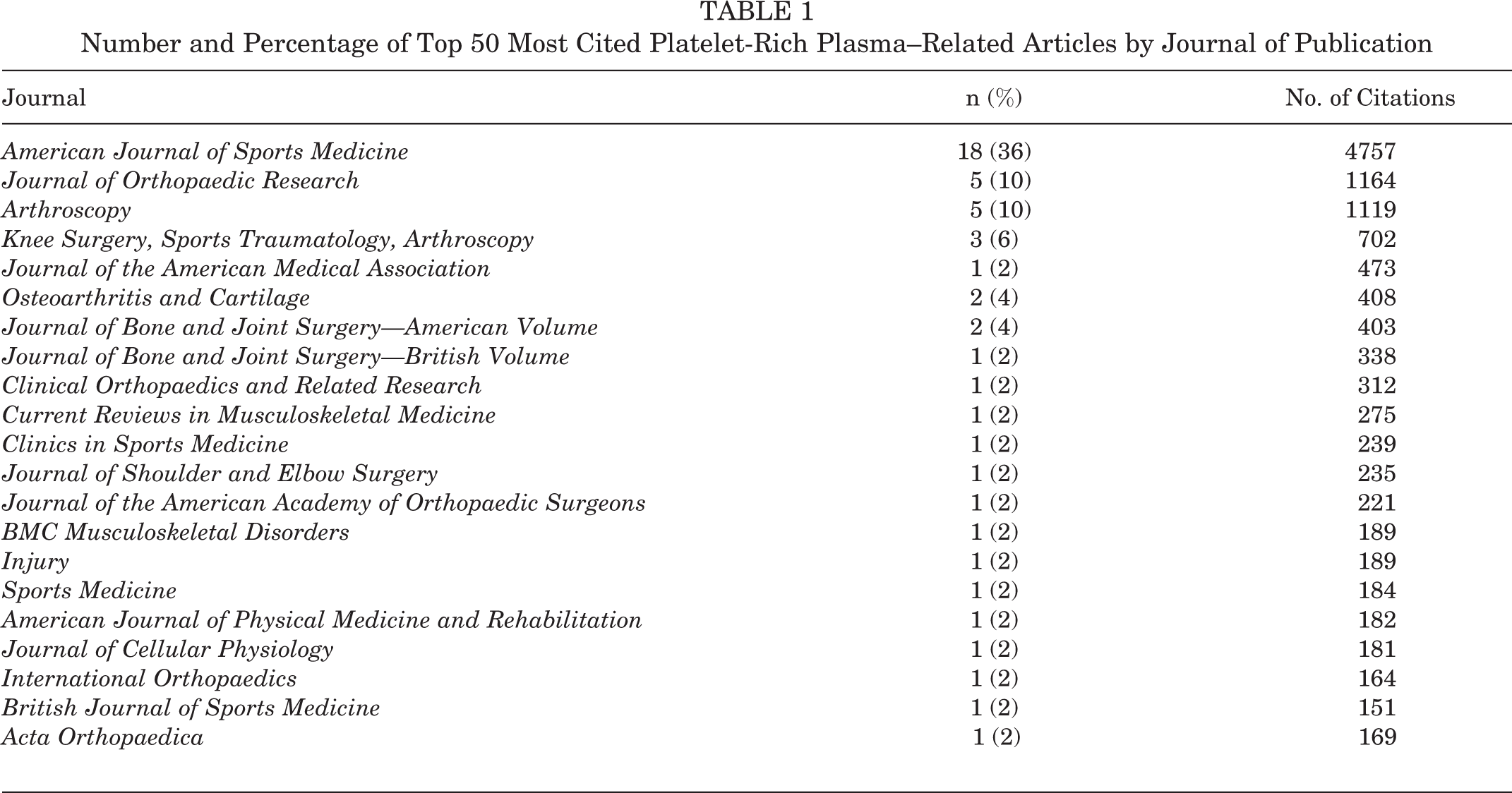
The top 50 most cited articles on PRP were published between 2005 and 2016 and are shown in Appendix Table A1. The overall mean number of citations was 241 ± 94 (range, 151-625), and the mean citation density was 23 ± 8. The decade between 2010 and 2019 accounted for the largest number of articles (n = 34; 68%) (Figure 1), with most of the articles published in 2011 (n = 12; 24%). The top 50 articles were published in 21 different journals, with the top 3 most cited journals being the American Journal of Sports Medicine (n = 18; 36%), Arthroscopy (n = 5; 10%), and the Journal of Orthopaedic Research (n = 5; 10%) (Table 1). A total of 13 countries were represented in the list, with the United States (n = 19; 38%), Italy (n = 10; 20%), and the Netherlands (n = 7; 14%) contributing the most articles (Figure 2). There was no significant difference between articles published in the United States versus outside the United States regarding the mean number of citations (n = 19, 263 ± 114 vs n = 31, 227 ± 78, respectively; P = .19) and mean citation density (24.7 ± 8.7 vs 22.2 ± 7.7, respectively; P = .29).

Distribution of top 50 most cited platelet-rich plasma–related articles by decade of publication.
Number and Percentage of Top 50 Most Cited Platelet-Rich Plasma–Related Articles by Journal of Publication

Distribution of top 50 most cited platelet-rich plasma–related articles by country of origin.
The most common study type among the most cited articles was the RCT (n = 15; 30%) (Figure 3). Of the clinical articles, predominating topics included use of PRP therapy in the setting of knee osteoarthritis (n = 10; 20%) and elbow tendinopathy (n = 7; 14%). A breakdown of topic by PRP therapy outcome and LoE is shown in Table 2.

Distribution of top 50 most cited platelet-rich plasma–related articles by study type.
Distribution of Clinical Research Topics by Platelet-Rich Plasma Therapy Outcome and Level of Evidence a

a Values are expressed as n (%). The percentage represents the percentage of articles within the top 50 most cited platelet-rich plasma articles.
The overall mean LoE for qualifying articles (n = 34) was 2.44 ± 1.67, with studies classified as level 1 being the most prevalent (n = 14) (Figure 4). Level 3 studies were not represented. Unclassified articles are largely basic science studies that do not qualify for assessment using the LoE guidelines published by JBJS. There were no significant correlations between number of citations or citation density and LoE (rs = 0.12, P = .51, and rs = –0.22, P = .22, respectively). However, a significant difference (P = .02) was noted in LoE in articles from the United States (3.56 ± 1.7) versus outside the United States (2 ± 1.5).

Distribution of top 50 most cited articles by level of evidence (LoE).
Twenty-five studies were analyzed for methodological quality, given the exclusion of 11 reviews, 8 animal studies, and 6 controlled laboratory studies. The overall mean MCMS, MINORS score, and MIBO score were 66.9 ± 12.6, 16 ± 4.7, and 12.4 ± 3.7, respectively. There was no significant correlation between number of citations or citation density and MCMS (r S = 0.075, P = .72, and r S = 0.3, P = .15, respectively), MINORS score (r S = 0.19, P = .36, and r S = 0.37, P = .07, respectively), or MIBO score (r = 0.21, P = .3, and r = 0.17, P = .41, respectively). Also, no significant difference existed in articles from the United States versus outside the United States concerning MCMS (62.75 ± 16.32 vs 67.67 ± 12.06, respectively; P = .48), MINORS score (13.5 ± 4.51 vs 16.43 ± 4.75, respectively; P = .27), and MIBO score (11 ± 1.15 vs 12.71 ± 4.03, respectively; P = .41).
Articles were analyzed for change over time. This change over time demonstrated a shift from in vivo animal model investigations toward clinical studies focused on health outcomes. There was a weak negative correlation between number of citations and year of publication (r S = –0.38; P = .01), whereas a weak positive correlation was noted for citation density and publishing year (r S = 0.36; P = .01). There was also a weak positive correlation observed between year published and improved LoE (r S = 0.47; P = .01). However, no statistically significant correlations were noted between more recent year of publication and improved MCMS (r S = 0.19; P = .35) MINORS score (r S = 0.03; P = .87), or MIBO score (r = –0.19; P = .37).
Discussion
This investigation identified the 50 most cited articles related to PRP in musculoskeletal medicine. Nearly half (48%) of the studies had a high LoE (level 1 or 2). However, when assessed via MCMS, MINORS, and MIBO scoring criteria, most studies were of fair methodological quality. Additionally, there were no significant correlations between number of citations and LoE (r S = 0.12; P = .51) or MCMS (r S = 0.075; P = .72), MINORS score (r S = 0.19; P = .36), or MIBO score (r = 0.21; P = .3). However, significant correlations were noted for recent publication date and improved LoE (r S = 0.47; P = .01), number of citations (r S = –0.38; P = .01), and citation density (r S = 0.36; P = .01).
In medical literature, the number of times an article is cited by other authors is often used as a marker of influence within a discipline for research topics, journals, and authors alike. 1,7,9,10,17,30,55 This list of the top 50 most cited articles on PRP provides seminal papers in musculoskeletal medicine for historical indexing and identifies authors and topics of study that have profoundly influenced its growth in the past 20 years. The articles within this list also demonstrate the evolution of standard practices and controversies regarding PRP, which may serve to guide clinical practice and future research studies. This investigation demonstrated that there was no significant relationship between the number of citations of the top 50 most cited articles and their methodological quality based on 2 separate scoring systems for assessing study method. The articles in the top 50 most cited were of a high LoE and had fair methodological assessment scores.
By analyzing the characteristics of the prominent articles in the top 50 list, we sought to ascertain the features that make these articles important to colleagues within orthopaedic surgery. Here, we found that the most cited article within the list was by Foster et al, 37 with 625 citations accrued since its year of publication (2009). This large citation number likely reflects the importance of this comprehensive review in the history of knowledge about PRP clinical applications in the setting of sports-related injuries. The most common studies were RCTs (LoE 1), which were mostly published in the American Journal of Sports Medicine between 2010 and 2015 and were largely conducted in various European countries.
Although no prior bibliometric analyses exist regarding PRP, the results of this study are fairly similar to those of previous bibliometric reviews in subspecialties of orthopaedic surgery. Comparable with findings in ulnar collateral ligament surgery, 43 patellar instability, 2 rotator cuff surgery, 91 and multiligamentous knee injury literature, 40 the most predominant country among the most cited articles on PRP was the United States (38%). This trend corroborates the fact that the United States perseverates as a global leader in research output. 55 As suggested previously, this finding may be subject to bias, given that many journals are published in the English language and based in the United States. Journals based in the United States of high impact factor may also impose a geographical bias for publishing research work from American authors, and articles from high-impact journals are often cited more because of their perceived quality.
RCT studies were the most represented type of study in this investigation, differing from prior bibliometric analyses in orthopaedics, which tend to have more case series and basic science studies. 2,7,40,43,91 This finding highlights the possible increased demand for interventional studies capable of providing reliable scientific evidence, such as RCTs, to adjudicate the controversies surrounding the lack of both clear guidelines for PRP and high-quality evidence supporting its range of potential applications and benefits for musculoskeletal injuries. However, the stringent regulations and costs associated with RCTs and higher PRP costs in the United States compared with foreign countries may explain why RCTs are more likely to originate out of the country. 13,70,78,84,103 This is in line with our investigation, in which most of the RCTs (13 of 15 studies, LoE 1) and prospective cohort studies (6 of 7 studies, LoE 2) found within the top 50 list were conducted abroad. This trend may explain the statistically significant difference found between improved LoE and articles published abroad versus in the United States (P = .02). This emphasizes the influence of international researchers whose contributions have been essential in the evolution of PRP therapy, in terms of its fundamental understanding and clinical practice application. In addition, the considerable number of RCTs and prospective cohort studies in this investigation reflect the recent increasing importance of evidence-based medicine across all fields. 29 Correspondingly, this study determined that there was a statistically significant increase in quality of evidence as publication year approached the modern era (P = .01). Even with this improvement, we observed no statistically significant correlation between improved methodological quality (MCMS, MINORS, or MIBO) and year of publication. Despite growing interest surrounding PRP over the years, the quality of studies has not improved accordingly. Perhaps this finding is attributable to the fact that a great proportion of the clinical studies found within our top 50 most cited list were consistently underpowered and had insufficient follow-up time.
Previous bibliometric analyses in shoulder surgery, 74 rotator cuff surgery, 51,91 spine surgery, 101 ulnar collateral ligament injuries, 43 and multiligament knee injuries 40 have found similar results regarding timing of publication, with a vast majority of the most cited papers being published as they approached the present. Ordinarily this trend is nonintuitive, as increasing time since publication would allow for more opportunity to accumulate citations. Our finding may reflect the relatively recent emergence of PRP therapy because of its novel tissue healing and regeneration potential in conditions such as chronic tendinopathies, cartilage repair, and repair of soft tissue injuries, 41,67 which were the focus of numerous papers in our list. Perhaps this increase in recognition of PRP led to an overall increase in the number of publications in recent years. Furthermore, only 3 of the previous most cited orthopaedic literature studies evaluated the methodological quality of the identified articles. 40,43,91 In support of what has been previously described, our investigation shows a continued need for high-quality reports on PRP clinical applications and outcomes in orthopaedic disease processes.
After 2010, there was a shift in topics from in vivo PRP studies to outcomes-based, comparative clinical studies surrounding PRP use versus other nonoperative therapies for treatment of orthopaedic diseases. The most frequently investigated study topics included PRP use for treatment of knee osteoarthritis and elbow epicondylitis. Considering that the number of publications on PRP continues to grow, it is imperative to evaluate the quality of studies that guide its clinical use. Furthermore, Table 2 shows therapy outcome, either positive or negative, for PRP in relation to either placebo or alternative therapies, for all clinical research studies within the 50 most cited publications on PRP. The distribution of outcomes for articles in our investigation generally followed the current clinical recommendations for PRP use based on recent meta-analyses. For example, in this study, the vast majority of outcomes for PRP use in knee osteoarthritis and elbow epicondylitis were positive, which is in line with current general consensus that PRP is superior to hyaluronic acid for osteoarthritis 11,12 and PRP is superior to corticosteroids for elbow epicondylitis. 42 Not surprisingly, many of the articles related to knee osteoarthritis and elbow tendinopathy were classified with greater LoE, comprising most of the level 1 and 2 studies found in our investigation. Both clinical studies within our list on PRP for patellar tendinopathy had positive outcomes, which follows current moderate evidence that PRP is superior to other nonsurgical treatments for patellar tendinopathy. 21 The finding in our sample that the majority of outcomes were negative for PRP in the treatment of rotator cuff lesions, Achilles tendinopathy, and fractures is also in line with lack of current evidence for these PRP uses. 75,83,102 Finally, although there were no clinical studies on PRP for plantar fasciitis within our top 50 most cited articles, it should be noted that there is emerging evidence of greater efficacy for PRP compared with corticosteroids. 42 However, the overall consensus continues to state that PRP is currently an experimental therapy and thus requires proper patient education regarding risks and benefits. Although current indications and expected outcomes remain controversial, for those with recalcitrant musculoskeletal disease processes who are not ideal surgical candidates, PRP may be an effective alternative therapy, particularly in patients who are affected by knee osteoarthritis or elbow epicondylitis.
When appreciating works published in high-impact journals or with lofty citation numbers, it is important to be mindful that they do not necessarily correlate with high-quality studies. As this study has identified a lack in methodological quality when reviewing current highly cited PRP publications, we hope future clinicians and researchers will adopt aspects of the MCMS, MINORS, or MIBO scoring criteria when designing their studies to achieve higher-quality literature.
Limitations
This review had several limitations. Selecting the top 50 articles for our citations list was arbitrary, as was the inclusion of any alternative number of studies among other citation analysis investigations. 1,7,9,10,47,55 In addition, we recognize that our list of publications may not adequately represent all the literature related to PRP. We only included 50 of the numerous available publications, and our search protocol only accounted for peer-reviewed publications available online. Furthermore, our study utilized only 1 database, Web of Science, to identify the most cited articles. We recognize this may have omitted certain relevant articles from our study. Therefore, in an attempt to optimize sampling of the relevant literature, we did not limit our search criteria to only orthopaedic journals.
There was a large number of animal, in vitro, and review articles that were included in our top 50 most cited list; however, only 25 of these studies were clinical investigations that could be assessed for methodological quality, as LoE does not apply to nonclinical studies or review articles. Our study design may have benefited from evaluating the top 50 clinical investigations to better understand the quality and change in PRP clinical research over time, but in an effort to provide a more comprehensive review, we aimed to identify all research articles that may appeal to the variety of investigators within this field. Additionally, as in any citation study, the number of citations represents influence within a medical discipline; however, this correlation often introduces biases such as timing of publication and self-citation, 2,7,8,17,91,101 resulting in the identification of articles that do not necessarily represent the most influential or best articles. Citation density partially accounts for the inherent biases present in the number of citations metric. As in previous studies, this investigation may have generated articles that underwent the “snowball effect,” whereby authors are more likely to cite an article because of relevant previous citations rather than for its content and quality. 17,79
It should also be noted that, recently, the combination of PRP with additional adjunctive therapies has increased in use, thereby confounding interpretation of isolated PRP treatment efficacy. Four studies within our most cited studies list utilized PRP therapy in combination with an additional therapeutic product. In addition, our study did not distinguish between the different types of PRP therapy, such as leukocyte-rich versus leukocyte-poor, because of the fact that our overall goal was to determine the current quality of studies related to PRP therapy regardless of preparation formulation. Finally, we recognize that regardless of preparation technique, the variability of platelet concentrations as well as variability in the amount of and types of growth factors contained within harvested autologous platelet preparations continues to present challenges related to interpreting clinical efficacy. Platelet concentrations and their growth factors vary greatly temporally and from patient to patient; thus, it is impossible to standardize PRP treatment administration. 57,76,94,96
Conclusion
The top 50 most cited articles on PRP in orthopaedic surgery showcased a myriad of geographic regions and journals. These studies were primarily of high LoE (level 1) but fair methodological quality when assessed using MCMS, MINORS, and MIBO scoring criteria. There was a temporal shift from animal studies toward clinical investigations. Articles published abroad were statistically different from US publications in terms of LoE. A statistically significant correlation between improved LoE and more recent year of publication was also noted in our review. Overall, higher methodological quality studies are necessary to establish informed appropriate guidelines and management standards regarding PRP-based therapeutic interventions.
Footnotes
Final revision submitted December 11, 2021; accepted January 21, 2022.
One or more of the authors has declared the following potential conflict of interest or source of funding: K.J.J. has received education payments from Arthrex and Micromed; consulting fees from Linvatec; speaking fees from Arthrex and Linvatec; honoraria from Joint Restoration Foundation, Musculoskeletal Transplant Foundation, and Vericel; and hospitality payments from Aesculap and DePuy. T.J.K. received research support from the US Department of Veterans Affairs (project No. 2020-000059) and has received education payments from Micromed, consulting fees from Heron Therapeutics, honoraria from Fidia Pharma and Musculoskeletal Transplant Foundation, and hospitality payments from RTI and Smith & Nephew. AOSSM checks author disclosures against the Open Payments Database (OPD). AOSSM has not conducted an independent investigation on the OPD and disclaims any liability or responsibility relating thereto.
Ethical approval was not sought for the present study.
APPENDIX
The Top 50 Most Cited Articles on Platelet-Rich Plasma in Orthopaedic Surgery, 2005-2016 a

| Rank | Title | First Author | Year | Study Type | Citations (CD) | LoE | MCMS | MINORS | MIBO |
|---|---|---|---|---|---|---|---|---|---|
| 1 | Platelet-rich plasma: from basic science to clinical applications | Foster 37 | 2009 | Review | 625 (52.1) | 5 | NA | NA | NA |
| 2 | Treatment of chronic elbow tendinosis with buffered platelet-rich plasma | Mishra 64 | 2006 | Prosp cohort | 499 (33.3) | 2 | 58 | 13 | 12 |
| 3 | Platelet-rich plasma injection for chronic Achilles tendinopathy: a randomized controlled trial | de Vos 25 | 2010 | RCT | 473 (43.0) | 1 | 82 | 22 | 12 |
| 4 | Positive effect of an autologous platelet concentrate in lateral epicondylitis in a double-blind randomized controlled trial: platelet-rich plasma versus corticosteroid injection with a 1-year follow-up | Peerbooms 78 | 2010 | RCT | 382 (34.7) | 1 | 79 | 23 | 14 |
| 5 | Treatment with platelet-rich plasma is more effective than placebo for knee osteoarthritis: a prospective, double-blind, randomized trial | Patel 77 | 2013 | RCT | 345 (43.1) | 1 | 74 | 21 | 16 |
| 6 | The biology of platelet-rich plasma and its application in trauma and orthopaedic surgery: a review of the literature | Alsousou 4 | 2009 | Review | 338 (28.2) | 5 | NA | NA | NA |
| 7 | Autologous preparations rich in growth factors promote proliferation and induce VEGF and HGF production by human tendon cells in culture | Anitua 6 | 2005 | Lab | 319 (19.9) | NA | NA | NA | NA |
| 8 | The role of growth factors in cartilage repair | Fortier 36 | 2011 | Review | 312 (31.2) | NA | NA | NA | NA |
| 9 | Platelet-rich plasma intra-articular injection versus hyaluronic acid viscosupplementation as treatments for cartilage pathology: from early degeneration to osteoarthritis | Kon 50 | 2011 | Prosp cohort | 295 (29.5) | 2 | 58 | 15 | 18 |
| 10 | Platelet-rich plasma: intra-articular knee injections produced favorable results on degenerative cartilage lesions | Kon 48 | 2010 | Prosp cohort | 295 (26.8) | 2 | 53 | 11 | 18 |
| 11 | Ongoing positive effect of platelet-rich plasma versus corticosteroid injection in lateral epicondylitis: a double-blind randomized controlled trial with 2-year follow-up | Gosens 38 | 2011 | RCT | 276 (27.6) | 1 | 79 | 23 | 5 |
| 12 | Platelet-rich plasma augmentation for arthroscopic rotator cuff repair: a randomized controlled trial | Castricini 19 | 2011 | RCT | 276 (27.6) | 1 | 77 | 19 | 16 |
| 13 | Comparison of growth factor and platelet concentration from commercial platelet-rich plasma separation systems | Castillo 18 | 2011 | Lab | 275 (27.5) | NA | NA | NA | NA |
| 14 | Platelet rich plasma injection grafts for musculoskeletal injuries: a review | Sampson 86 | 2008 | Review | 275 (21.2) | 5 | NA | NA | NA |
| 15 | Platelet rich plasma (PRP) enhances anabolic gene expression patterns in flexor digitorum superficialis tendons | Schnabel 88 | 2007 | Animal | 268 (19.1) | NA | NA | NA | NA |
| 16 | Can platelet-rich plasma enhance tendon repair? A cell culture study | de Mos 24 | 2008 | Lab | 254 (19.5) | NA | NA | NA | NA |
| 17 | Platelet-rich plasma: a milieu of bioactive factors | Boswell 15 | 2012 | Review | 252 (28.0) | NA | NA | NA | NA |
| 18 | Growth factor and catabolic cytokine concentrations are influenced by the cellular composition of platelet-rich plasma | Sundman 94 | 2011 | Lab | 245 (24.5) | NA | NA | NA | NA |
| 19 | Treatment of tendon and muscle using platelet-rich plasma | Mishra 65 | 2009 | Review | 239 (19.9) | 5 | NA | NA | NA |
| 20 | Platelet-rich plasma stimulates porcine articular chondrocyte proliferation and matrix biosynthesis | Akeda 3 | 2006 | Animal | 236 (15.7) | NA | NA | NA | NA |
| 21 | Platelet-rich plasma: the PAW classification system | DeLong 26 | 2012 | Review | 235 (26.1) | 5 | NA | NA | NA |
| 22 | Platelet rich plasma in arthroscopic rotator cuff repair: a prospective RCT study, 2-year follow-up | Randelli 81 | 2011 | RCT | 235 (23.5) | 1 | 70 | 20 | 9 |
| 23 | Platelet-rich plasma differs according to preparation method and human variability | Mazzocca 61 | 2012 | Lab | 234 (26.0) | NA | NA | NA | NA |
| 24 | Platelet-rich plasma: current concepts and application in sports medicine | Hall 39 | 2009 | Review | 221 (18.4) | 5 | NA | NA | NA |
| 25 | Platelet-rich plasma intra-articular knee injections for the treatment of degenerative cartilage lesions and osteoarthritis | Filardo 32 | 2011 | Prosp cohort | 220 (22.0) | 2 | 53 | 11 | 16 |
| 26 | Temporal growth factor release from platelet-rich plasma, trehalose lyophilized platelets, and bone marrow aspirate and their effect on tendon and ligament gene expression | McCarrel 62 | 2009 | Animal | 215 (18.0) | NA | NA | NA | NA |
| 27 | Collagen-platelet rich plasma hydrogel enhances primary repair of the porcine anterior cruciate ligament | Murray 73 | 2007 | Animal | 205 (14.6) | NA | NA | NA | NA |
| 28 | Comparison between hyaluronic acid and platelet-rich plasma, intra-articular infiltration in the treatment of gonarthrosis | Cerza 20 | 2012 | RCT | 193 (21.4) | 1 | 79 | 12 | 10 |
| 29 | The effect of platelet-rich fibrin matrix on rotator cuff tendon healing: a prospective, randomized clinical study | Rodeo 82 | 2012 | RCT | 192 (21.3) | 2 | 62 | 14 | 12 |
| 30 | Platelet-rich plasma vs hyaluronic acid to treat knee degenerative pathology: study design and preliminary results of a randomized controlled trial | Filardo 34 | 2012 | RCT | 189 (21.0) | 1 | 67 | 14 | 11 |
| 31 | Platelet-rich plasma releasate inhibits inflammatory processes in osteoarthritic chondrocytes | van Buul 97 | 2011 | Lab | 189 (18.9) | NA | NA | NA | NA |
| 32 | Platelet-rich plasma: new clinical application: A pilot study for treatment of jumper’s knee | Kon 49 | 2009 | Case series | 189 (15.8) | 4 | 48 | 7 | 18 |
| 33 | Platelet-rich plasma intra-articular injections for cartilage degeneration and osteoarthritis: single- versus double-spinning approach | Filardo 35 | 2012 | Prosp cohort | 187 (20.8) | 2 | 65 | 13 | 18 |
| 34 | Platelet-rich therapies in the treatment of orthopaedic sport injuries | Sanchez 87 | 2009 | Review | 184 (15.3) | 5 | NA | NA | NA |
| 35 | One-year follow-up of platelet-rich plasma treatment in chronic Achilles tendinopathy: A double-blind randomized placebo-controlled trial | de Jonge 23 | 2011 | RCT | 183 (18.3) | 1 | 70 | 19 | 10 |
| 36 | Treatment of knee joint osteoarthritis with autologous platelet-rich plasma in comparison with hyaluronic acid | Spakova 92 | 2012 | Prosp cohort | 182 (20.2) | 2 | 60 | 10 | 16 |
| 37 | Platelet-rich plasma enhances the initial mobilization of circulation-derived cells for tendon healing | Kajikawa 46 | 2008 | Animal | 181 (13.9) | NA | NA | NA | NA |
| 38 | Platelet-rich plasma versus autologous whole blood for the treatment of chronic lateral elbow epicondylitis: a randomized controlled clinical trial | Thanasas 95 | 2011 | RCT | 178 (17.8) | 1 | 68 | 18 | 13 |
| 39 | The use of platelet-rich plasma in arthroscopy and sports medicine: optimizing the healing environment | Lopez-Vidriero 56 | 2010 | Review | 178 (16.2) | 5 | NA | NA | NA |
| 40 | Treatment of lateral epicondylitis with platelet-rich plasma, glucocorticoid, or saline: a randomized, double-blind, placebo-controlled trial | Krogh 52 | 2013 | RCT | 173 (21.6) | 1 | 71 | 20 | 12 |
| 41 | Basic science and clinical application of platelet-rich plasma for cartilage defects and osteoarthritis: a review | Zhu 105 | 2013 | Review | 172 (21.5) | 5 | NA | NA | NA |
| 42 | Efficacy of autologous platelet-rich plasma use for orthopaedic indications: a meta-analysis | Sheth 89 | 2012 | Systematic review | 169 (18.8) | 2 | 45 | 14 | 6 |
| 43 | How can one platelet injection after tendon injury lead to a stronger tendon after 4 weeks? Interplay between early regeneration and mechanical stimulation | Virchenko 100 | 2006 | Animal | 169 (11.3) | NA | NA | NA | NA |
| 44 | Efficacy of platelet-rich plasma for chronic tennis elbow: a double-blind, prospective, multicenter, randomized controlled trial of 230 patients | Mishra 66 | 2014 | RCT | 168 (24.0) | 2 | 85 | 19 | 10 |
| 45 | Use of platelet-rich plasma for the treatment of refractory jumper’s knee | Filardo 33 | 2010 | Prosp cohort | 164 (14.9) | 2 | 58 | 13 | 9 |
| 46 | Efficacy of intra-articular platelet-rich plasma injections in knee osteoarthritis: a systematic review | Meheux 63 | 2016 | Systematic review | 159 (31.8) | 1 | 46 | 8 | 10 |
| 47 | Effects of platelet-rich plasma on the quality of repair of mechanically induced core lesions in equine superficial digital flexor tendons: a placebo-controlled experimental study | Bosch 14 | 2010 | Animal | 157 (14.3) | NA | NA | NA | NA |
| 48 | Platelet-rich plasma intra-articular knee injections show no superiority versus viscosupplementation: a randomized controlled trial | Filardo 31 | 2015 | RCT | 153 (25.5) | 1 | 91 | 20 | 11 |
| 49 | Comparison of the acute inflammatory response of two commercial platelet-rich plasma systems in healthy rabbit tendons | Dragoo 27 | 2012 | Animal | 151 (16.8) | NA | NA | NA | NA |
| 50 | Growth factor-based therapies provide additional benefit beyond physical therapy in resistant elbow tendinopathy: a prospective, single-blind, randomised trial of autologous blood injections versus platelet-rich plasma injections | Creaney 22 | 2011 | RCT | 151 (15.1) | 1 | 74 | 20 | 9 |
a CD, citation density; Lab, controlled laboratory study; LoE, level of evidence; MCMS, Modified Coleman Methodology Score; MIBO, Minimum Information for Studies Evaluating Biologics in Orthopaedics; MINORS, Methodological Index for Non-randomized Studies; NA, not applicable; Prosp, prospective; RCT, randomized controlled trial.