




Abstract
Background:
Analyzing the current trends in meniscal allograft transplant (MAT) is important. However, no recent descriptive epidemiological study based on a national registry database has been reported.
Purpose:
To assess serial trends in the incidence of MAT in the Republic of Korea between 2010 and 2018, stratified by age and sex.
Study Design:
Descriptive epidemiology study.
Methods:
The number of MAT procedures between 2010 and 2018 was assessed using the Korean National Health Insurance claims database. We used code N0825 for isolated MAT and code N0820 for MAT combined with other procedures, such as ligament reconstruction, realignment surgery, and cartilage procedures. The incidence of MAT was calculated using the general population data of the Republic of Korea, and Poisson log-linear regression analysis was used to assess statistical serial trends.
Results:
A total of 369 patients underwent MAT in 2010 and 774 in 2018, with an increase of 47.6%. The incidence of MAT per 100,000 person-years in the Republic of Korea increased significantly during the period studied, from 0.75 in 2010 to 1.50 in 2018 (annual relative risk = 1.09; 95% CI, 1.08-1.10; P < .001), whereas the rate of MAT combined with other procedures increased from 5.1% in 2014 to 16.0% in 2018. MAT was mostly performed in men in their early 20s. Most MAT procedures were performed in the summer and winter, with distinct seasonal variances.
Conclusion:
In the Republic of Korea, the incidence of MAT in 2018 was 1.50 per 100,000 person-years, with an average annual increase of 10% since 2010. MAT was mostly performed in men in their early 20s, and the rate of MAT combined with other procedures has increased since 2014.
Since the first meniscal allograft transplant (MAT) was performed by Milachowski et al 16 in 1984, advances in surgical techniques and understanding of appropriate indications over the past 30 years have improved clinical outcomes and survivorship. Consequently, satisfactory long-term clinical results of MAT have been reported. 5,10,17 –19 Therefore, MAT is no longer considered an experimental procedure and is instead recognized as an effective treatment for active, young patients with symptomatic, meniscus-deficient knees.
However, whether these satisfactory results translate to the real-world popularity of MAT remains unknown. In this respect, a descriptive epidemiological study provides information about the trends and popularity of MAT and sheds light on the differences between general indications of MAT and available epidemiologic data, thus providing a better understanding of MAT.
The most recent epidemiological study of MAT was a report on the incidence of MAT in the United States by Cvetanovich et al 4 in 2015. To the best of our knowledge, this is the only epidemiological study of MAT. Cvetanovich et al reported the trends in MAT in the United States using a large database of privately insured non-Medicare patients. In that study, MAT was an uncommon procedure, with an incidence of 0.24 MAT procedures per 100,000 patients per year, with no changes in its incidence between 2007 and 2011. However, recent descriptive data have not been reported since 2015 nor are there any reports on the nationwide cohort data.
Thus, the current study aimed to assess serial trends in the incidence of MAT between 2010 and 2018, stratified by age and sex, based on the Korean National Health Insurance claims database. We hypothesized that the incidence of MAT and the rate of MAT combined with other procedures would increase between 2010 and 2018 and that MAT would be performed mostly in young male patients.
Methods
This nationwide retrospective epidemiological study was conducted using the Korean National Health Insurance claims database. The study was reviewed and approved by the institutional review board of our institution.
National Health Insurance (NHI) is compulsory for all Korean citizens, and medical claims are reviewed and evaluated by a public institution, the Health Insurance Review and Assessment (HIRA) Service. All surgical procedures are assigned a specific code and categorized for medical claims, and the information is collected and provided in an open access form, stratified by age and sex. This study used the codes N0825 and N0820, which were available beginning in 2010, corresponding to the procedural complexity of the MAT procedure. The code N0825 is used for isolated MAT, and N0820 is a code that was newly developed in 2014 to claim an additional fee when complex procedures are performed. The NHI coverage guidelines for MAT in the Republic of Korea are presented in Table 1. The complex procedure code is used when the following additional procedures are performed simultaneously with MAT: (1) realignment surgery, such as high tibial and distal femoral osteotomies; (2) ligament reconstruction surgery, such as anterior cruciate ligament reconstruction; and (3) cartilage procedures for cartilage lesions, such as microfracture or osteochondral autograft transplantation. Before 2014, both codes were identified under the N0825 code.
Proposed Insurance Coverage Guidelines for Meniscal Allograft Transplant by National Health Insurance in the Republic of Korea a
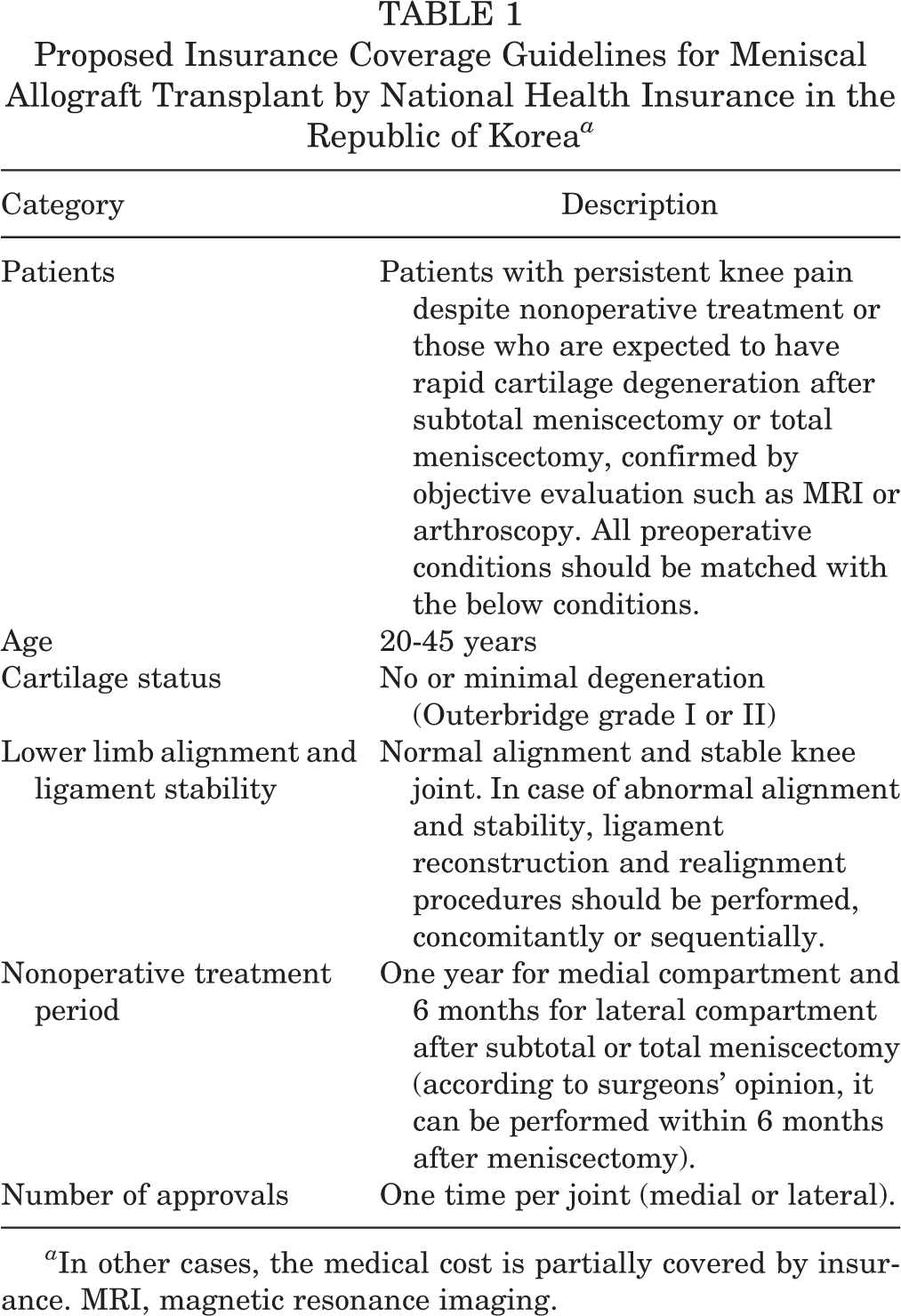
a In other cases, the medical cost is partially covered by insurance. MRI, magnetic resonance imaging.
The total population, and populations stratified by age and sex, were collected using the population projection survey of Statistics Korea, which was released on the Korean Statistical Information Service website. 12 Because the HIRA Service provides age-specific raw data classified into 5-year intervals, the age of the patients was classified into 5-year intervals from 20 to 50 years, and the remaining patients were classified into <20 and >50 age groups. The annual incidence of MAT was calculated as the number of procedures per year divided by the total population for the indicated year. The incidence of MAT by age and sex was calculated as the total number of MAT procedures during the study period divided by the total number of the population stratified by age and sex during the study period. The monthly number of procedures was collected to investigate seasonal trends.
Statistical Analysis
All statistical analyses were performed using SPSS Version 21.0 (IBM Corp). P values <.05 were considered statistically significant. The annual trend and the trend stratified by sex were analyzed with estimation of relative risk using a log-linear Poisson regression analysis. Relative risks are presented with 95% CIs. The seasonal trend and variation in the incidence of MAT over time were analyzed and visualized using the ggseas package of R 3.6.1 (R Foundation).
Results
A total of 4791 MAT procedures were performed between 2010 and 2018 in the Republic of Korea, with an increase of 47.6% from 369 in 2010 to 774 in 2018. The annual numbers of MAT procedures by age and sex are presented in Table 2. The incidence of MAT per 100,000 person-years in 2010 and 2018 was 0.75 and 1.50, respectively, indicating a significant increase during the study period (annual relative risk = 1.09; 95% CI, 1.08-1.10; P < .001) (Figure 1). The number of MATs combined with other procedures increased from 23 (5.1%) in 2014 to 124 (16.0%) in 2018 (Figure 1). When analyzing the monthly incidence, we noted a distinct seasonal variance. MAT procedures were mostly performed in July in summer and January in winter (Figure 2). MAT was performed more frequently in male patients than in female patients (relative risk = 1.92; 95% CI, 1.81-2.04; P < .001) (Figure 3). On analyzing the incidence of MAT by age, we identified a bimodal peak in the early 20s and early 40s. However, MAT was performed more frequently in male patients in their early 20s and in female patients in their early 40s (Figure 4).
MAT Procedures by Procedural Complexity, Sex, and Age Group, 2010-2018 a

a Values are shown as No. (incidence per 100,000 person-years). Dashes indicate no available data. MAT, meniscal allograft transplantation.
b “Simple” indicates isolated MAT, and “complex” indicates MAT combined with other procedures, where additional surgery is performed concurrently with MAT.

Number of meniscal allograft transplant (MAT) procedures between 2010 and 2018 in the Republic of Korea. “Simple” indicates isolated MAT, and “complex” indicates MAT combined with other procedures, where additional surgery is performed concurrently with MAT.

Serial monthly incidence of meniscal allograft transplant (MAT) procedures in the Republic of Korea between 2010 and 2018 and seasonal variance of MAT using time-series decomposition analysis. The y-axis indicates the number of procedures per 1,000,000 person-months. All x-axes show the same time period. (A) Monthly incidence of MAT over time. (B) Trend in the incidence of MAT over the analyzed period. (C) Seasonal component of the time series of the monthly incidence of MAT. The distinct seasonal variance, which was concentrated in January and July, is identified.

Incidence of meniscal allograft transplant in the Republic of Korea between 2010 and 2018, stratified by sex.
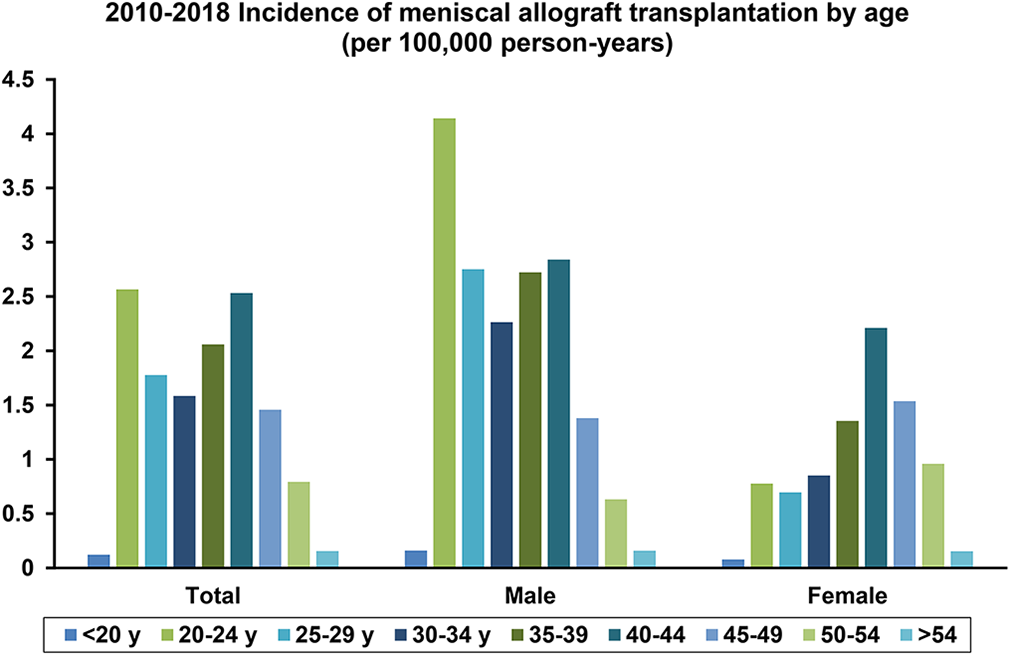
Overall incidence of meniscal allograft transplant in the Republic of Korea between 2010 and 2018, stratified by age and sex.
Discussion
The primary finding of this study was that although MAT is a rare procedure (mean incidence, 1.1 per 100,000 person-years), the trend in the incidence of MAT and the rate of MAT combined with other procedures are increasing. MAT was more frequently performed in male than in female patients, and bimodal peaks in the early 20s and early 40s were identified. In addition, a distinct seasonal variance was identified.
Owing to different time frames and methods, it is difficult to directly compare the results of the present study with those of the study done in the United States in 2015. However, the incidence of MAT in the Republic of Korea appears to be higher than that in the United States. Cvetanovich et al 4 analyzed the incidence of MAT in the United States between 2007 and 2011 using the PearlDiver patient records database. In that study, the mean incidence of MAT was 0.24 procedures per 100,000 population per year, with no significant increase during the study period. Furthermore, MAT procedures were performed more commonly in young male patients. The results of the present study showed a higher incidence of MAT than the previous study, indicating an overall incidence of 1.1 MATs per 100,000 person-years. The differences in the incidence may be due to a selection bias arising from the differences in estimation methods using different databases. Because Cvetanovich et al estimated the incidence based on a private health insurance database, there may be selection bias owing to expensive medical costs and different insurance approval policies. Conversely, in the current study, a complete enumeration study was available because the claims data were collected and controlled by a national agency in the Republic of Korea. In addition, the provision of national health insurance leads to a relatively lower medical cost. These factors may have contributed to a higher incidence of MAT than was reported by Cvetanovich et al.
Similar to the results reported by Cvetanovich et al, the present study showed that MAT was performed more frequently in male patients. The current study identified that this difference was according to their age, in that the incidence of MAT was highest in male patients in their early 20s and in female patients in their early 40s. These differences may be attributable to the different activity levels between male and female patients and the lower meniscal repair ratio in female patients in the Republic of Korea. 3
The present study demonstrated that the number of complex procedures steadily increased from 2014, when the complex code was introduced. In line with this, an increase in the rate of concurrent surgery in MAT patients was also observed. Patients with indications for MAT often have additional issues, such as anterior cruciate insufficiency and cartilage lesions. As reported in a recent systematic review, the clinical outcomes of MAT combined with other procedures are not inferior to those of isolated MAT. 8,14,20 Therefore, this result seems to reflect the efforts to correct the correctable factors as much as possible in the concept of a biological knee reconstruction.
Another interesting finding of the present study was the identification of a seasonal variance in MAT procedures. It seems likely that this result is attributable to the specific purpose and indication of MAT. Unlike traumatic injury of the knee, which requires surgical intervention such as meniscal repair and anterior cruciate ligament reconstruction at a relatively early period, 6,13,15 MAT is indicated for patients who experience activity-related pain and swelling after subtotal or total meniscectomy, despite nonoperative treatment. 17,20 Therefore, the surgery is not urgent in most cases. In addition, considering the time that is required for rehabilitation and postoperative care, such as crutch walking, 7,17 it seems that MAT is commonly performed during summer or winter vacations when young patients have spare time.
As mentioned in recent epidemiological studies of meniscal surgery, the rate of meniscal repair is increasing due to an emphasis on the importance of maintaining meniscal function in young patients. 1,3,9 According to Chung et al, 3 the rate of meniscal repairs increased in the Republic of Korea between 2010 and 2017, and the rate was highest, 30% to 40%, in those in their teens and 20s. This increase in meniscal repair may reduce the burden of potential MAT candidates; however, an increased incidence of MAT was also identified during this study period. Considering that the effect of an increase in the rate of meniscal repair may be delayed and given the slight reduction in the total number of MAT procedures in 2019 compared with 2018, a long-term cohort study is needed to demonstrate clearer effect.
Several limitations of this study should be noted. First, there is the possibility of error from inaccurate claims codes, which is an inherent limitation of claims-based studies. However, the accuracy of this coding system has been validated by previous studies. 2,11 Hence, the error seems to be minimal. Second, the claims-based database of the HIRA Service lacks detailed clinical information, such as previous operations and the signs and symptoms that are associated with MAT. This may have resulted in a reporting bias. However, as presented in Table 1, the insurance coverage guidelines for MAT are similar to the current general indications for MAT that have been reported in previous studies. 7,17,19 Therefore, the results of this study can be considered to indicate reliable trends in MAT. Third, there are no codes for the side of surgery or for revision MAT; thus, in cases where 2 codes are identified in 1 patient, it is uncertain whether the latter code indicates a primary MAT for the contralateral knee or a revision MAT for the ipsilateral knee. Fourth, the complex code is indicated only in cases in which the combined surgery was performed concurrently with MAT. The cases in which the combined surgery, such as realignment surgery, ligament reconstruction, and cartilage procedure, was performed before or after MAT were not identified. Thus, the rate of combined surgery may be higher than that reported in the present study.
Conclusion
In the Republic of Korea, the incidence of MAT in 2018 was 1.50 per 100,000 person-years, with an average annual increase of 10% since 2010. MAT was mostly performed in men in their early 20s, and the rate of MAT combined with other procedures has increased since 2014.
Footnotes
Final revision submitted October 23, 2020; accepted November 30, 2020
The authors declared that there are no conflicts of interest in the authorship and publication of this contribution. AOSSM checks author disclosures against the Open Payments Database (OPD). AOSSM has not conducted an independent investigation on the OPD and disclaims any liability or responsibility relating thereto.
Ethical approval for this study was obtained from Asan Medical Center (ref No. 2020-0753).