




Abstract
Background:
High shoulder distraction force has been observed in softball pitchers during the acceleration phase (top of the pitch to ball release) of a pitch. Increasing elbow flexion may reduce shoulder forces and the susceptibility to pain by shortening the lever arm of the throwing arm.
Purpose:
To determine the association of peak elbow flexion during the acceleration phase of the pitch with peak shoulder distraction force and ball velocity.
Study Design:
Descriptive laboratory study.
Methods:
A total of 61 female collegiate softball pitchers (mean age, 19.9 ± 1.9 years; mean height, 175.7 ± 5.7 cm; mean weight, 83.6 ± 12.7 kg; 49 right-handed) volunteered for this study. Biomechanical data were collected with a 3-dimensional electromagnetic tracking system while the pitchers threw 3 maximal-effort fastballs at a regulation distance. Peak elbow flexion and peak shoulder distraction force were calculated for the acceleration phase and averaged across the 3 trials. Ball velocity was assessed with a radar gun.
Results:
Simple linear regression analyses indicated that peak elbow flexion did not influence peak shoulder distraction force during the acceleration phase of the pitch (F(1,59) = 2.412; P = .126), with R 2 = 0.023. Additionally, peak elbow flexion during the acceleration phase of the pitch did not influence ball velocity (F(1,59) = 2.435; P = .124), with R 2 = 0.023. A bivariate correlation analysis showed a significant association between ball velocity and shoulder distraction force (R 2 = 0.343; P = .007) in which ball velocity constituted approximately 34% of the variance in shoulder distraction force.
Conclusion:
Peak elbow flexion did not influence ball velocity or peak shoulder distraction force during the acceleration phase of a windmill softball pitch. However, there was a significant and positive relationship between ball velocity and peak shoulder distraction force. These results may indicate that ball velocity and other kinematic variables may be more related to shoulder distraction force than elbow flexion.
Clinical Relevance:
Increasing elbow flexion can shorten the lever arm, but it did not reduce shoulder distraction force or increase ball velocity. Therefore, elbow flexion may be more useful as a description of the pitching style rather than a single measure related to increased performance or the risk of injuries. Future research should continue to examine the relationship between other kinematic parameters with shoulder distraction force.
The windmill softball pitch relies on rapid sequentially generated movements that transmit forces from the lower extremity through the hips, trunk, and shoulder and on to the elbow and wrist to ultimately maximize ball velocity. 12,17,21,27,28 Thus, altered biomechanics may adversely affect the kinetic chain and increase stress at the shoulder, reaching up to 80% body weight during the acceleration phase (top of the pitch to ball release) of a pitch 28 (Figure 1). It is understood that the magnitude of forces about the upper extremity during the windmill pitch are similar to those generated during the baseball pitch, with a small difference occurring in the timing of peak distraction forces. 4,14,18,28 In the baseball pitch, shoulder distraction forces are highest during the deceleration/follow-through phase, 4 whereas in softball pitching, the distraction forces are highest during the acceleration phase of movement. 4,28
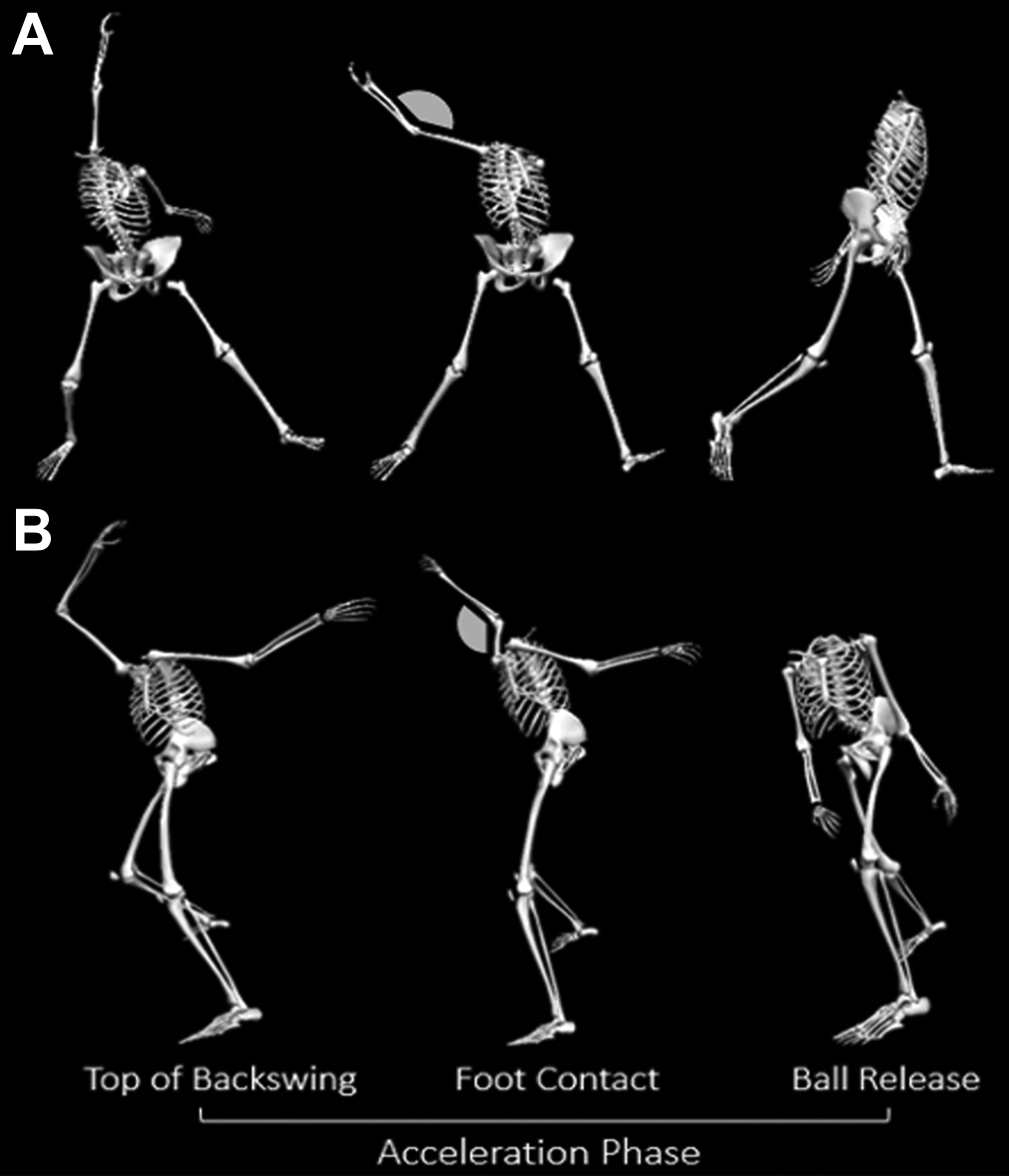
Acceleration phase of a windmill softball pitch: (A) sagittal view and (B) frontal view.
The full-body dynamic motion of the windmill softball pitch also requires the arm to make an approximately 485° arc of motion. 4 The elbow of the throwing arm is mostly extended throughout the circumducted movement 5 and likely contributes to centrifugal distraction force on the shoulder. An extended elbow may also lead to greater ball velocities by mechanically creating a longer lever arm during circumduction, whereas a pitching arm with greater elbow flexion would result in a shorter lever arm. 4 However, greater angular velocities of the upper extremity may subsequently increase distraction forces at the throwing shoulder.
The underhand delivery unique to windmill softball pitching relies heavily on the kinetic chain to achieve fast pitch velocities. Movements preceding ball release are meant to allow the pitcher to maximally produce and transmit force through her body in a proximal-to-distal fashion, and optimal sequencing dictates ball velocity. Softball pitchers’ mechanics may vary because of coaching technique, skill, age level, and body composition. 10,12 The baseball literature has examined the influence of biomechanical metrics on performance such as elbow flexion and ball velocity 22,23,29 ; however, the topic is limited within the softball literature. Werner 26 reported that greater internal rotation of the throwing shoulder was significantly correlated with greater pitch velocity. Additionally, Friesen et al 11 noted that pitchers with more throwing arm elbow flexion at foot contact reported lower earned run averages, indicating better performance. These 2 studies signify the important contribution of the throwing arm position for pitch success.
The elbow joint is frequently injured in baseball pitching, whereas softball pitchers sustain injuries more regularly at the shoulder joint. 20 Elbow mechanics influence the adjacent shoulder joint, 4 and baseball research has reported that the presence of a longer lever arm/throwing arm among older and taller pitchers is likely related to increased force exerted through the upper extremity. 1 Given the total circumduction and windmill nature of the throwing arm during softball pitching, it is theorized that the lever arm/throwing arm can be manipulated via elbow joint kinematics such as flexion. Therefore, the primary aims of the study were to examine the association between (1) peak elbow flexion and peak shoulder distraction force during the acceleration phase of a pitch as well as (2) peak elbow flexion during the acceleration phase of a pitch and ball velocity. It was hypothesized that greater peak elbow flexion would be associated with smaller peak shoulder distraction forces during the acceleration phase of the pitch. It was additionally hypothesized that greater peak elbow flexion during the acceleration phase of the pitch would be associated with slower ball velocities.
Methods
A total of 61 female softball pitchers (mean age, 19.9 ± 1.9 years; mean height, 175.7 ± 5.7 cm; mean weight, 83.6 ± 12.7 kg; 49 right-handed) were recruited to participate in this study from a National Collegiate Athletic Association (NCAA) Division I program. Inclusion criteria required that all participants (1) were actively competing on their team’s roster as a pitcher, (2) were injury and surgery free for the past 6 months, and (3) had no history of surgery on the pitching arm. An injury was defined as being diagnosed by an athletic trainer or physician and resulting in time loss from practice or competition. There were at least 10 participants for each of the 2 dependent variables analyzed deeming a sample size of 20 appropriate. The institutional review board of Auburn University approved all testing protocols, and written informed consent was obtained from each participant before data collection.
On the day of testing, participants reported to the laboratory before engaging in any throwing or vigorous physical activity. Kinematic data were collected using an electromagnetic tracking system (Flock of Birds; Ascension Technology). There were 14 electromagnetic sensors attached to each participant using previously established methodologies. 14,19 Digitized joint centers for the shoulder, T12 to L1, and C7 to T1 were used to develop a linked segment model. 15,16,31,32 The global axis system was established in reference to a right-handed participant. The vertical direction was represented by the y-axis, anterior to the y-axis and in the direction of movement was the positive x-axis, and orthogonal and to the right of the x- and y-axes was the positive z-axis. Raw sensor position and orientation data were transferred from the global system to a locally based coordinate system. Euler angle sequences consistent with the International Society of Biomechanics standards and joint conventions were used to define the position and orientation of the body segments. 31,32 Shoulder motion was defined relative to the trunk utilizing the Euler sequence of YX′Y″, and elbow motion was defined relative to the humerus using the Euler sequence of ZX′Y″. 32 Raw data were independently filtered along each global axis using a fourth-order Butterworth filter with a cut-off frequency of 13.4 Hz. 14,16,30
Shoulder distraction force was calculated with The MotionMonitor xGen software (Innovative Sports Training) as previously described. 3,6 -9,11,13,14,24,25 Peak shoulder distraction force was extracted during the acceleration phase. Previously, it has been reported that the acceleration phase exhibits the largest throwing arm forces and torques throughout the pitch 2,14,28 ; therefore, we sought to examine the most extreme values of elbow flexion and shoulder distraction force to ideally inform mechanics during the acceleration phase rather than isolating a specific event. The acceleration phase is defined as the duration of time from the top of the pitch to ball release (Figure 1).
Each participant was given an unlimited time to perform her individual prethrowing warm-up (average time was 7 minutes). Testing began when participants felt prepared to throw the required maximal-effort pitches. Pitches were thrown off a flat surface with no pitching rubber. Testing required each participant to throw 3 fastballs to a catcher located at a regulation distance (13.11 m [43 ft]). A successful pitch trial was saved for analysis if the ball was in the strike zone as determined by the catcher. The mean of each dependent variable for the 3 pitches was used for analysis. A calibrated radar gun (Stalker Pro II; Stalker Radar) recorded ball velocity to the nearest mile per hour.
Statistical Analysis
Statistical analyses were performed using SPSS software (version 22; IBM Corp), with an alpha level set a priori at P ≤ .05. Simple linear regression was performed to examine the association between peak elbow flexion and peak shoulder distraction force during the acceleration phase of the pitch. A second simple linear regression was performed to examine the association between peak elbow flexion during the acceleration phase of the pitch and ball velocity. Finally, a bivariate correlation analysis was conducted to examine the relationship between ball velocity and peak shoulder distraction force during the acceleration phase of the pitch.
Results
The mean ball velocity was 24.6 ± 1.3 m/s (55 ± 3 mph). Descriptive statistics and correlations of variables can be found in Tables 1 and 2, respectively. Peak elbow flexion did not influence peak shoulder distraction force during the acceleration phase of the pitch (F(1,59) = 2.412; P = .126), with R 2 = 0.023. Furthermore, peak elbow flexion during the acceleration phase of the pitch did not influence ball velocity (F(1,59) = 2.435; P = .12), with R 2 = 0.023. There was a significant correlation between ball velocity and shoulder distraction force (R 2 = 0.343; P = .007).
Peak Elbow Flexion and Peak Distraction Force During the Acceleration Phase of the Pitch as Well as Ball Velocity

Pearson Correlation Values Between Peak Elbow Flexion and Peak Distraction Force as Well as Ball Velocity During the Acceleration Phase of the Pitch

Discussion
High shoulder distraction force exhibited during the windmill pitch is recognized as a risk factor for upper extremity pain. 13,14 In response to high rates of pain and injuries among pitchers, researchers are seeking ways to lessen potentially deleterious upper extremity forces without jeopardizing ball velocity. Although total circumduction of the throwing arm is necessary during windmill pitching, increased elbow flexion may be one adjustment that pitchers can make to shorten the lever arm and subsequently decrease shoulder distraction forces. 1 However, the findings of the current study do not support the hypothesis in which peak elbow flexion did not influence peak shoulder distraction force during the acceleration phase or ball velocity. Peak elbow flexion only constituted 2.3% of both shoulder distraction force and ball velocity, indicating that other kinematic variables may contribute more to these examined variables.
A prior study examining elbow flexion among NCAA softball pitchers throwing rise balls showed high variability in elbow flexion values during foot contact (standard deviation [SD], 43°) as well as during ball release (SD, 32°). 13 The high variability in elbow flexion over these 2 events of the pitch reveals the prevalence of individualistic pitching styles, even among a fairly homogeneous sample of pitchers. The findings of the current study encompassed elbow flexion during the acceleration phase (including the events of top of the pitch, foot contact, and ball release) (Figure 1). It was demonstrated that there was moderate variability in degree of peak elbow flexion (SD, 17°) during the acceleration phase. The lower variability in elbow flexion in this study compared to previous studies may explain why peak elbow flexion did not influence shoulder distraction force. Additionally, it should be noted that the previous study examining rise balls (a specialty pitch) might result in a greater variance in technique, whereas a fastball pitch generally involves a more straightforward technique.
Skilled pitchers in the current study may have more developed musculoskeletal systems that increased their ability to resist shoulder distraction forces. Similarly, as research notes, elite pitchers may have optimized kinematic variables related to shoulder distraction forces, which might also help to combat shoulder distraction force. 28 Regardless, understanding elbow flexion angles among elite pitchers may be useful for pitching coaches and sports medicine professionals when informing individualized aims for consistent pitching mechanics.
Ball velocity is one commonly used metric of pitching performance. Ball velocity was also fairly homogeneous in this sample of pitchers, which may explain why elbow flexion did not influence ball velocity. The mean pitch velocity for the fastball in the current study was 24.6 ± 1.3 m/s, which is comparable to velocities in Werner et al 28 and Barrentine et al, 4 with mean values of 27 m/s (rise ball) and 25 m/s (fastball), respectively. Werner et al 28 reported slightly higher pitch speeds using a sample of Olympic pitchers and determined elbow angle at ball release to be one of 7 kinematic variables that explained shoulder distraction force. A moderate but significantly positive correlation (R 2 = 0.343; P = .007) between shoulder distraction force and ball velocity was found in the present study. Therefore, shoulder distraction force was related to ball velocity, while peak elbow flexion was not. This may be explained by the current study measuring peak elbow flexion throughout the acceleration phase, whereas Werner et al 28 alternatively measured elbow flexion at the instant of ball release. Analyzing additional upper extremity kinematic variables at equivalent ball velocities may be viable in determining factors that influence shoulder distraction force. Further, perhaps measuring peak elbow extension or elbow flexion normalized to the arm length might offer a better surrogate for lever arm length. Of importance, however, is the application of understanding elbow flexion through this phase of the motion. Softball pitchers can understand and apply findings while knowing precisely what elbow flexion is and how it can change during the windmill pitch.
Greater elbow flexion during the windmill softball pitch would theoretically shorten the lever arm and potentially lead to greater arm acceleration. 1 The elbow acts as a third-class lever that favors speed and range of motion about a fulcrum (shoulder) at the top of the pitch when the arm begins making its way into an underhand position. A flexed elbow early in the acceleration phase enables elbow extension during stride foot contact. Then in preparation for ball release, the pitching arm elbow flexes and continues to flex during the pitch follow-through. It is theorized that this rapid elbow flexion near release aids in generating ball velocity. 28 For this reason, the timing of kinematic variables, such as elbow flexion, may be useful in predicting shoulder distraction forces. However, the findings from the current study show that elbow flexion did not influence shoulder distraction force. Because the previous literature 12 showed that more elite pitchers are more able to follow a sequential pattern of movement, perhaps the entire time series of elbow flexion can offer a clearer picture of how it may affect throwing arm kinetics versus peak values. Similarly, the timing of peak elbow flexion may be another important variable to examine in understanding shoulder distraction force. Prior examinations of the windmill softball pitch have noted that the sequential nature of the throwing arm is crucial for obtaining maximal ball velocity. 2 Elbow flexion only constituted 4% of the variance and did not significantly influence ball velocity; therefore, future examinations of energy flow or segmental sequencing may better determine the factors associated with ball velocity to better direct athlete development efforts.
A few limitations of the study should be mentioned. First, only the fastball pitch was analyzed; however, prior research showed that elbow flexion does not vary between the fastball, curveball, changeup, and drop-ball pitch types. 5 Second, only the acceleration phase of the pitch was analyzed. Previous research noted that elbow flexion is greatest during the initial upswing of the pitching arm in preparation for the acceleration phase and during follow-through, 10 while the largest shoulder distraction forces occur during the acceleration phase of the pitch. 4,28 Elbow flexion occurring early in the pitching cycle may have more influence on acceleration phase kinetics and may help to predict later kinematics such as that during ball release and the acceleration phase. We sought to examine the acceleration phase of movement due to the uniqueness of pitching techniques. Analyzing other phases of the pitching motion may provide a more comprehensive understanding of the relationship between elbow flexion, pitching kinetics, and performance. Third, pitching in a laboratory setting should be considered because not fully replicating a competitive environment may affect pitching intensity.
Conclusion
Peak elbow flexion did not influence ball velocity or peak shoulder distraction force during the acceleration phase of a windmill softball pitch. However, there was a significant and positive relationship between ball velocity and peak shoulder distraction force. These results may indicate that ball velocity and other kinematic variables likely have a greater effect on shoulder distraction force than elbow flexion. Further, elbow flexion may be more useful as a description of the pitching style rather than a single measure related to increased performance or the risk of injuries.
Footnotes
Final revision submitted September 14, 2021; accepted October 3, 2021.
One or more of the authors has declared the following potential conflict of interest or source of funding: This study was supported in part by an appointment to the postgraduate research program at the United States Army Aeromedical Research Laboratory, administered by the Oak Ridge Institute for Science and Education through an interagency agreement between the United States Department of Energy and the United States Army Medical Research and Development Command. AOSSM checks author disclosures against the Open Payments Database (OPD). AOSSM has not conducted an independent investigation on the OPD and disclaims any liability or responsibility relating thereto.
Ethical approval
Ethical approval for this study was obtained from Auburn University (protocol No. 15-474 EP 1512).