




Abstract
Background:
The relationship among sleep duration, subjective well-being, and injury risk in athletes is poorly defined.
Purpose:
To evaluate the independent effects of sleep duration, sleep quality, and subjective well-being on in-season injuries in collegiate female volleyball athletes.
Study Design:
Cohort study; Level of evidence, 2.
Methods:
During a 9-month competitive season, 17 female National Collegiate Athletic Association (NCAA) Division I volleyball players reported mood, fatigue, stress, soreness, sleep duration (hours), and sleep quality every morning. Well-being measures were recorded from 0 (worst) to 5 (best), and all time-loss injuries were recorded by the team athletic trainer. Separate mixed-effects logistic regression models were used to evaluate the effects of sleep and subjective well-being on in-season injury. Each well-being variable was also included in a separate mixed-effects logistic regression model with sleep duration as a covariate.
Results:
A total of 54 injuries were recorded during the study period. Compared with days without an injury, mood, fatigue, stress, soreness, sleep quality, and sleep duration were significantly worse the day before an injury occurred. In the separate prediction models, in-season injury was significantly predicted by fatigue (odds ratio [OR], 0.56 [95% CI, 0.36-0.86]; P = .008), mood (OR, 0.52 [95% CI, 0.35-0.78]; P = .002), stress (OR, 0.63 [95% CI, 0.42-0.94]; P = .023), soreness (OR, 0.54 [95% CI, 0.38-0.79]; P = .001), sleep quality (OR, 0.49 [95% CI, 0.34-0.7]; P < .001), and sleep duration (OR, 0.69 [95% CI, 0.55-0.87]; P = .001). In the multivariable models, sleep duration remained a significant independent predictor in each of the subsequent multivariable models (OR, 0.72-0.74; P < .05 for all), as did mood (OR, 0.55 [95% CI, 0.36-0.83); P = .005) and soreness (OR, 0.57 [95% CI, 0.39-0.83]; P = .003), while fatigue (OR, 0.65 [95% CI, 0.42-1]; P = .054) and stress (OR, 0.68 [95% CI, 0.45-1]; P = .061) no longer reached statistical significance.
Conclusion:
Increased sleep duration, mood, and decreased soreness were independently associated with a reduced risk of in-season injury in this cohort of female NCAA volleyball players.
The benefits of sport participation on physical and mental health are well-established, 27 but injuries continue to be an inherent risk of participation in athletics. When athletes sustain injuries resulting in time lost from participating in their sport, it can lead to significant negative outcomes, such as lower quality of life, incidence of depression, lower level of play after return to sport, and a threat to athletic success. 1,9,21,22 Injured college athletes exhibit significantly higher emotional distress for at least 2 months after injury, 14 and a significant portion of injured young athletes report symptoms of posttraumatic stress disorder after an anterior cruciate ligament rupture. 20 Although there is a growing understanding of the potentially long-term negative impacts of injury on athletes’ well-being, factors unrelated to training that affect the likelihood of injury are not well-understood.
Volleyball is a popular sport, particularly among female collegiate athletes. In the 2018-2019 competitive season, there were 1112 National Collegiate Athletic Association (NCAA) women’s volleyball teams, with a total of 17,780 athletes participating. 19 While volleyball is considered a noncontact sport, injuries are relatively common, largely ankle and wrist sprains and concussions, and female collegiate volleyball players sustain more injuries per athlete exposure (AE; individual training sessions and competitions) than male volleyball players. 2 In data originating from the NCAA Injury Surveillance Program, a nonprofit research organization analyzing data from women’s volleyball injuries from the 2013-2014 and 2014-2015 academic years, it was found that female athletes sustained 7.07 injuries per 1000 AEs . 2 Competitive college and high school athletes have reported depression symptoms 1 week up to 1 month after injury, and women are particularly at risk. 1
Collegiate student-athletes balance their time between athletic, academic, and social commitments, and sleep often suffers as a result. There is accumulating evidence that sleep duration and quality are associated with improved performance and competitive success in athletes and that a lack of sleep can be inhibitory of endurance performance and reaction time. 35 Sleep is also acknowledged among elite athletes as an important recovery tool. 5 Longer sleep duration counters the negative effects of high training loads on well-being in female adolescent soccer players, and sleep and training load had independent effects on fatigue, mood, and stress in athletes. 31 While sleep can have a positive effect on athletes’ performance and recovery, aspects of sports participation can have a negative impact on sleep. In collegiate soccer players, greater levels of fatigue, tension, depression, and anger are associated with global sleep dysfunction. 3 Subjective measures of well-being (mood, fatigue, stress, and soreness) and sleep quality have been shown to be predictors of injury in various populations. 24,28,29,33 In athletes, impairments in subjective well-being and sleep quality contribute to increased risk of injury, 9,13,32 and increased sleep duration is independently associated with a reduced risk of in-season injury in male collegiate division I basketball players. 34
Taken together, these findings suggest that lower sleep duration and well-being both increase the risk of injury in athletes. However, few studies have attempted to study the interaction of sleep and well-being on injury risk, and these limited data should be replicated in female athletes. Therefore, the purpose of this study was to evaluate the independent effects of sleep and well-being on in-season injuries in collegiate female volleyball athletes. We hypothesized that both decreased sleep duration and subjective well-being would be independent predictors of in-season injuries in female collegiate volleyball players.
Methods
Study Design
This study used a prospective cohort design, and the participants in this study were 17 female NCAA Division I volleyball athletes who provided information regarding self-reported training load, sleep, and subjective well-being every day during a 9-month study period, including the fall championship and spring competitive seasons. All procedures were approved by an institutional review board. Because the data were collected as part of the standard athlete-monitoring practices of the team involved and analyzed retrospectively, informed consent was not deemed necessary for inclusion in this retrospective analysis.
Height and mass were measured at the start of each testing session with a stadiometer and a standard electronic scale, respectively. No data were included from the 4-week winter break period between the fall and spring seasons. Each morning during the study period, before any volleyball events, athletes were asked to provide ratings of fatigue, mood, soreness, stress, and sleep quality on a 0 (worst) to 5 (best) Likert scale, with descriptive text prompts 31 as well as prior night sleep duration in hours, using online software (Metrifit). The evaluation of sleep quality through self-report has been suggested as an appropriate measure in team sport athletes, even when compared with objective measures, such as wrist actigraphy. 8 Finally, self-reported sleep duration is a commonly used, low-cost metric, which has been found to be highly correlated with objective measures of sleep duration in athletes. 7 Daytime naps were not included as part of sleep duration.
Throughout the study period, injuries that resulted in time loss were recorded by the team athletic trainer and reported as both injuries per day and injuries per week. The date of injury onset was determined by the athletic trainer as the first date the injury was recorded. Both first-time and repeat injuries were included if they were felt to represent new injuries based on resolution of symptoms and return to full participation between time-loss injuries. Because the athletic trainers worked directly with the student-athletes during treatment of injuries, blinding was not possible. Compliance with the completion of daily training load and well-being ratings was encouraged periodically throughout the study period by coaching staff.
Statistical Analysis
Data were initially evaluated for normality using descriptive statistics and histogram analysis. Prior night sleep and subjective well-being measures were compared between days with and without an injury using least squares means from mixed-effects linear regression models, including individual repeated measures as a random effect. A mixed-effects logistic regression model was developed to predict injury, including increments of sleep duration (<6 hours, 6-6.9 hours, 7-7.9 hours, and 8 hours) 35 as a fixed effect and individual repeated measures as a random effect. To evaluate the association between injury and prior night sleep duration and subjective well-being measure from the morning of the same day (mood, fatigue, soreness, and stress), separate mixed-effects logistic regression models were used to evaluate their association with in-season injury by including the variable as a fixed effect and individual repeated measures as a random effect. This tested the relative ability of each variable reported in the morning to predict the likelihood of injury later that same day, while adjusting for the repeated measures from each individual. To determine the independence of sleep and well-being as predictors of injury, separate mixed-effects logistic regression models were developed to predict injury with each well-being variable (mood, fatigue, soreness, and stress) and sleep duration included as fixed effects and individual repeated measures as a random effect. Statistical significance was determined a priori at the .05 level, and all tests were 2-tailed. All statistical analyses were performed in R (The R Project for Statistical Computing). 23
Results
Anthropometric data for the participants are presented in Table 1. A total of 54 injuries were identified on 45 days in 14 of the 17 athletes. The distributions of injuries throughout the study period by day and week are shown in Figure 1. Three players left the team in the middle of the year because of graduation and end of eligibility, resulting in some missing data from the second half of the year. Combined with other randomly missed data entries by players, the overall missing information was 13% for the year. If the data of the 3 players’ who left the team midyear were not considered missing after they were no longer on the team after the middle of the year, the missing values would be 6.8%.
Baseline Anthropometric Data Among Female Collegiate Volleyball Athletes a
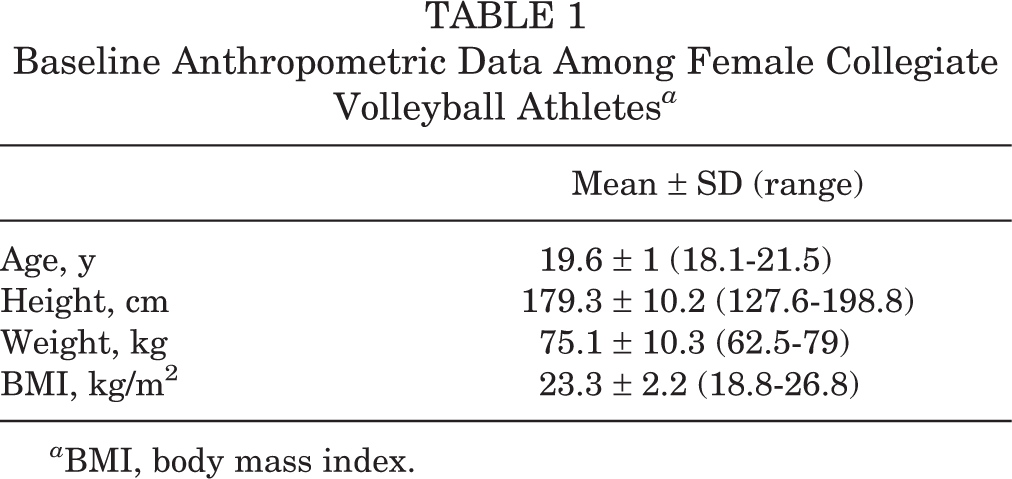
a BMI, body mass index.

Number of daily and weekly injuries among female collegiate volleyball athletes.
The mean sleep duration during the study period was 7.9 ± 1.2 hours, and 70.6% of the athletes had a mean of <8 hours of sleep per night. The mean nightly sleep duration and quality are shown in Figure 2.

The mean nightly, self-reported sleep duration (black) and sleep quality (gray) among female collegiate volleyball athletes. Sleep duration is shown in hours, while sleep quality is reported from 0 (worst) to 5 (best).
Compared with days without a reported injury, days in which an injury occurred were found to have significantly lower (worse) mood, fatigue, stress, soreness, sleep quality, and sleep duration the night before the injury (Figure 3).
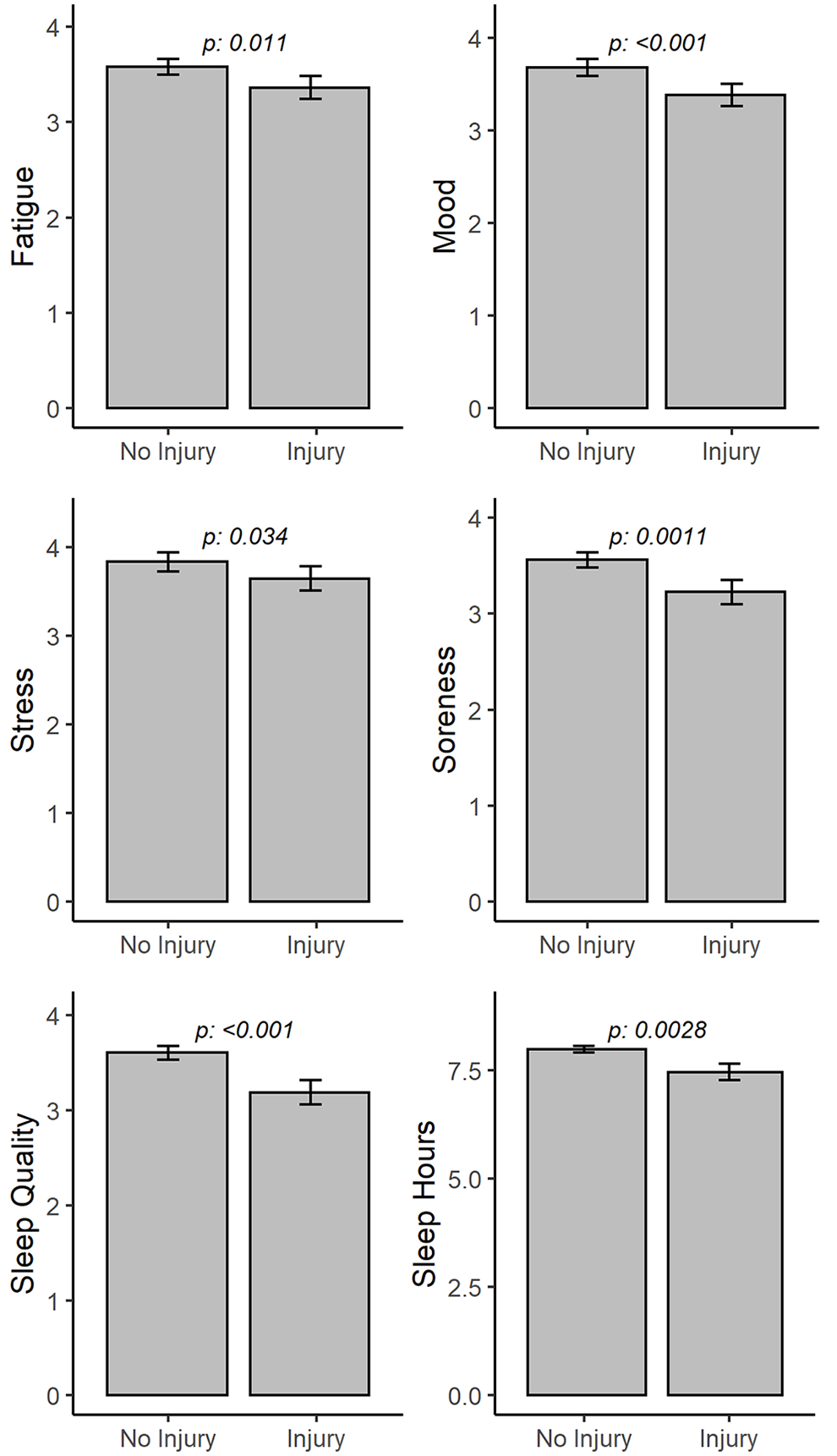
The mean daily subjective well-being, sleep duration, and sleep quality on the morning of days with and without a subsequent injury among all participants.
Sleep duration and quality were found to be significantly related to each of the subjective well-being measures the following morning (Table 2).
Spearman Correlation Coefficients Between Sleep Duration and Subjective Well-Being Measures the Following Day a

aP < .001.
The relative risk of injury following nights with varying amounts of sleep the prior night are shown in Figure 4.

Relative risk of injury on days following different amounts of sleep among collegiate female volleyball athletes. The y-axis represents the odds ratio from the mixed-effects logistic regression model to predict daily injury.
Daily fatigue, mood, stress, soreness, sleep quality, and sleep hours were all found to be significant predictors of injury in the separate mixed-effects logistic regression analysis; however, after inclusion with sleep duration in the multivariable models, sleep duration, mood, and soreness remained significant, independent predictors of injury (Table 3).
Separate Mixed-Effects Logistic Regression Models to Identify Predictors of in-Season Injury in Female Collegiate Volleyball Players a

a Bolded P values indicate statistical significance (P < .05). OR, odds ratio.
b Separate mixed-effects logistic regression models to predict injury with morning well-being or prior night sleep measure as a fixed effect and individual as a random effect.
c Separate mixed-effects logistic regression models to predict injury with morning well-being measure and prior night sleep duration as fixed effects and individual as a random effect.
Discussion
The primary finding of this study was that both sleep and subjective measures of well-being are independent predictors of injury in female NCAA Division I volleyball athletes. Specifically, mood and soreness remained independent predictors of in-season injury, even after adjusting for sleep duration the night before. Worse morning stress and fatigue also seemed to be associated with an increased risk of injury later that day, but these relationships did not meet our statistical significance level, perhaps because of the relatively small sample size. Our findings are consistent with previous studies in elite athletes that found that decreases in sleep volume contribute to a higher risk of injury. 18,29,34 Specifically, we sought to reproduce previously published findings related to well-being and injury risk regarding collegiate men’s basketball athletes. With respect to sleep duration, our results are very similar, suggesting that these findings may be generalizable to other populations of collegiate athletes. In contrast to our findings, however, a recent report in male Division I football players found that sleep duration was not correlated with injury incidence during a football season. 6 That study used time loss as a surrogate for injury incidence and reported low compliance with sleep duration data collection, which may have undermined their ability to identify a relationship between sleep and injury risk. In the current study, athletes reported sleep metrics and subjective well-being metrics every day for an entire school year, allowing us to develop a more complete data collection and analysis with insight into the relationship among sleep, subjective well-being, and injury risk.
While the relationship between sleep and subjective well-being has been previously documented, 4,10,31 the relationship between subjective well-being and injury risk in athletes is incompletely understood. In the present study, we found that all of our measures of well-being were predictive of in-season injury. Because sleep duration and well-being may be related, we included both sleep duration and well-being in our multivariable models to identify the independent effects of each well-being measure. Our findings that well-being and injury risk are related also are in line with findings from our previous study in collegiate male basketball players, where it was found that subjective well-being variables were significant predictors of injury. 34 Our findings differ slightly, however, in that while that study found that soreness in male athletes was the only independent subjective well-being metric predictive of injury after adjusting for sleep duration, we found that both soreness and mood were independent predictors of injury in female athletes in the multivariable models. Nonetheless, the finding that worse subjective well-being is correlated with higher incidence of injury is consistent with prior research exploring this relationship. 11,26 In a retrospective study, Galambos et al 11 asked athletes to report injuries and well-being in the preceding 12 months, where it was found that higher rates of anger, confusion, depression, fatigue, tension, and life stress were all significantly higher in athletes who sustained injuries than those who reported no injuries. Smith et al 26 found that while physical factors did not significantly predict injuries in male hockey players, psychosocial factors, including low vigor and high fatigue, significantly predicted athlete injuries.
Predictors of injury may be sex- and sport-specific. Although prior research has continually identified the value of subjective well-being as a predictor of injuries in athletes, little research has attempted to specifically evaluate this in female athletes. Female athletes have different rates of injury from male athletes as well as higher rates of depressive symptoms following athletic injury than male athletes. 17 In a group of adolescent female soccer players, lower mood and higher acute training were associated with increased injury risk. 32 Although it is widely reported that athletes do not get the quantity and quality of sleep that is recommended, 15 we found that athletes who slept less than 7 hours the prior night had a significantly higher risk of injury than those who slept more than 7 hours. This suggests a minimum sleep duration of 7 hours to minimize injury risk in collegiate athletes, which is in line with other recommendations in the literature. 25 However, prior research in youth athletes has suggested an 8-hour minimum cutoff to minimize injury risk 18,30 ; moreover, the most recent consensus statement from the American Academy of Sleep Medicine and Sleep Research Society recommends a minimum of 7 hours of sleep and that sleeping over 9 hours may be most appropriate for young adults. 36
Our finding that sleep duration, mood, and soreness are independent predictors of injury in female collegiate athletes suggests that a more holistic approach to injury prediction may be warranted in this population. Mental health depends on affective, subjective states, including emotions, stress responses, impulses, and mood, all of which affect how a person thinks, feels, and behaves. 12 Unlike objective measures of physical health and fitness, subjective measures may be equally, if not more, relevant to injury risk in athletes. The traditional focus of sports team training has been focused on daily training, conditioning, nutrition, and coaching, but there is recent evidence that a shift in sports team culture to include sleep as a critical component of peak performance has resulted in both improved sleep and athletic performance among college athletes. 16 Consistent with prior evidence in high-level athletes, our data suggest that daily reporting of sleep, soreness, stress, mood, and fatigue may help identify collegiate female volleyball athletes at risk of injury and facilitate interventions to reduce the risk of injury. In addition, it may allow coaches and health care providers to intervene on behalf of their athletes to mitigate negative psychosocial symptoms and improve mental health. Given the significant impact that injury can have on future health outcomes in athletes, developing robust methods to identify athletes at greater risk of injury is imperative.
Limitations
This study has several limitations. As with virtually all longitudinal studies, we did have missing data. This was felt to be missing at random within the data set, however, and imputation of missing sleep and well-being data did not result in a substantive change in the results of our analyses. Naps and travel for competitive events were not included in the sleep-duration data collection, and thus, their impact on the results is unknown. We did not include additional risk factors for injury, such as anatomic differences, body composition, fitness level, or prior injury, which could potentially confound our results. Furthermore, our findings do not confirm the cause-and-effect relationship between sleep and injury risk in athletes, and further study that explores the relationship among overtraining, sleep, and injury is warranted. While we sought to identify relationships within a specific sport and sex, a larger sample size in future studies would allow for the inclusion of additional risk factors and their interactions as well as separate prediction models for different injury mechanisms. The mechanisms by which sleep, mood, and soreness play a factor in injury risk is beyond the scope of this study; however, they could all have a negative effect on reaction time, cognitive function, and confusion, which could lead to greater injury risk. Additional research is necessary in other populations of athletes to determine whether these relationships are similar and more generalized or if sport-specific recommendations can be made.
Conclusion
This study demonstrated that increased sleep duration and improved subjective well-being are associated with a decreased risk of injury among collegiate female volleyball athletes. Although we also found that several subjective well-being measures were predictors of injury risk, mood and soreness remained independent predictors of injury after adjusting for the effects of sleep duration. This seems to suggest that among female collegiate volleyball athletes, both sleep duration and subjective well-being exert separate effects on injury risk. Given the known benefits of sleep, however, efforts to promote proper sleep may improve well-being and decrease the risk of in-season injury. Alongside the existing literature, these results suggest that proactive monitoring of sleep and well-being on a daily basis may help identify individuals at risk for injury and facilitate interventions to reduce risk.
Footnotes
Final revision submitted February 18, 2021; accepted March 2, 2021.
The authors declared that there are no conflicts of interest in the authorship and publication of this contribution. AOSSM checks author disclosures against the Open Payments Database (OPD). AOSSM has not conducted an independent investigation on the OPD and disclaims any liability or responsibility relating thereto.
Ethical approval for this study was obtained from the University of Wisconsin–Madison (ID No.: 2018-0049).