




Abstract
Background:
Hand and wrist injuries are a common but underestimated issue in taekwondo. Detailed data on injury risk, patterns, and mechanism are missing.
Purpose:
To evaluate (1) the fight time exposure-adjusted injury incidence rate (IIR) and clinical incidence and (2) injury site, type, sport-specific mechanism, and time loss in taekwondo.
Study Design:
Descriptive epidemiology study.
Methods:
Athletes from a single national Olympic taekwondo training center were investigated prospectively for hand and wrist injuries during training and competition over 5 years. The Orchard Sports Injury Classification System Version 10 was used to classify injury type, and analysis of the anatomic injury site was performed. The mechanism of injury was classified as due to either striking or blocking techniques.
Results:
From a total of 107 athletes, 79 athletes (73.8%) with a total exposure time of 8495 hours were included in the final data set. During the study period, 75 injuries of the hand and wrist region were recorded despite the athletes using protective hand gear. The IIR was 13.9 (95% CI, 10.5-17.5) and was significantly higher during competition. The clinical incidence as an indicator for risk of injury was 60.7% (95% CI, 50.9-70.5). Finger rays were the most affected location (68%), and fractures (43%) and joint ligament injuries (35%) were the most common type of injury. Significantly more injuries were found on the dominant hand side (P < .001). Comparison of injury mechanisms demonstrated significantly more injuries at the finger rays deriving from blocking techniques (P = .0104). The mean time loss for all hand and wrist injuries was 15.7 ± 13.5 days (range, 3-45 days) and was highest for distal radial fractures, with a mean of 39.7 ± 4.8 days (range, 32-45 days).
Conclusion:
There was a significantly higher IIR for acute hand and wrist injuries in elite taekwondo athletes during competition, which resulted in considerable time loss, especially when fractures or dislocations occurred. Significantly more injuries to the finger rays were found during blocking despite the use of protective hand gear. Improvement of tactical skills and blocking techniques during training and improved protective gear appear to be essential for injury prevention.
Hand and wrist injuries commonly occur in contact sports. 8,13,20,22 In particular, combat sports including high-frequency striking techniques, such as boxing, karate, and taekwondo, have shown a meaningful injury risk despite the use of sport-specific protective hand gear. 5,9,13 Nevertheless, hand injuries in combat sports are still underestimated and may cause severe long-term functional deficits. 5 Taekwondo is a popular combat sport worldwide, combining spiritual values and Olympic sportsmanship. 7,19 The Olympic taekwondo style is a full-contact sport primarily based on powerful kicking and striking techniques, with the lower limb directed to the opponent’s head and trunk. 1,2 The upper limbs, especially the forearms and the hands, are used for blocking kicks as well as delivering strikes. Protective gear is therefore mandatory in sparring and competition fights. 11,17 Research interest for this sport grew after it was demonstrated to have the highest injury risk in the 2012 Olympic Games. 6 While in former studies the lower extremity was reported to be the main site of injuries, the number of injuries reported to the upper extremity, especially the hand and wrist region, has grown in recent studies. 3,9,14 –16,18,19 However, detailed data about those injuries are scarce and were only reported for a limited number of athletes observed during short-term periods or single events. 3,4,9,21 The purpose of this study was to further evaluate the clinical incidence and exposure-adjusted injury incidence rate (IIR) in a larger study population over a long period to provide detailed information on the type, location, sport-specific mechanism, and time loss associated with hand and wrist injuries. We hypothesized that elite taekwondo athletes would have lower IIRs and time loss during copetition than training because of their experience, technical skills, and mandatory protection gear.
Methods
Study Population and Outcomes of Interest
All 107 athletes from a single national Olympic taekwondo training center were investigated prospectively for training and competition injuries over a study period of 5 years (January 1, 2014, to December 31, 2018). A substudy within this cohort was conducted between January 1, 2015, and January 1, 2020, and included additional specific data regarding all hand and wrist injuries in the population. Part of this study sample has been included in another publication with a different inclusion period and study aims. 10 While the aim and results of this study have not been previously published, the descriptive information of the study population has. 9 All athletes were performing at the black-belt level, took part in a regular institutional training schedule with a training frequency of 5 to 6 times a week, and participated regularly in competition fights. As requested by the official rules, the use of protective gear including hand gloves and forearm protectors was mandatory for all athletes during training and competition fights and supervised by the attending medical staff. The primary outcomes of interest were the clinical incidence and exposure-adjusted IIR for hand and wrist injuries during training and competition over the study period. The secondary outcomes of interest were injury location, type, and associated time loss as well as the mechanism of injury. The study protocol was approved by a university research ethics board, and all participants gave their informed consent to the study.
Data Collection
Data regarding fight exposure and injuries were recorded prospectively. All athletes were evaluated for hand and wrist injuries by competent medical staff (team physician or physical therapist) during training sessions or competition. In case of an acute injury, athletes were examined by experienced sports orthopaedic specialists from an Olympic training center within the first week. The exact diagnosis of injury type and location was based on clinical examination as well as radiologic results from ultrasound, radiographic, and magnetic resonance imaging data. Injuries were defined by criteria recommended by Junge et al 11 as “all injuries receiving medical attention regardless of the consequences with respect to absence from competition or training.” For classification of injury type, the Orchard Sports Injury Classification System Version 10 was used. 20 Analysis of injury location was done according to anatomical regions of the hand and wrist. Time loss due to injury was defined as time elapsed until return to full-contact taekwondo training and was analyzed retrospectively.
In case of hand or wrist injury, the mechanism of injury was assessed by the observing relevant medical staff attending the fights from personal interviews on the same day as the injury and was classified as due to either striking or blocking techniques. The dominant hand side was assessed for all athletes during the personal interview. The data of athletes who finished their career during the study period or presented with incomplete medical documentation were excluded from final evaluation.
Statistical Analysis
As the number of elite athletes was limited by nature, no sample size was calculated. As previously published, 10 IIR was calculated using the athletes’ exposure per 1000 hours of training fight time and per 1000 hours of competition fight time, with 95% CIs: IIR = number of injuries/hours of exposure × 1000. For a description of the risk of first injury in the study population, the epidemiologic clinical incidence for the 5-year study period was calculated, with 95% CIs, as recommended by Knowles et al, 13 as number of injured athletes/number of athletes studied. The risk of subsequent injury was also calculated: number of athletes with multiple injuries/number of injured athletes.
Injury data were obtained prospectively but analyzed retrospectively. Radiographs were analyzed retrospectively. Statistical analysis was performed using IBM SPSS Statistics for Windows (Version 24; IBM Corp). The chi-square test was used to determine statistical differences between sex and injured hand side. For comparison of IIRs, the exact Poisson test was used. For statistical comparison of injury mechanism, the Fisher exact test was used. All reported P values are 2-tailed, with an alpha level <.05 considered significant. Descriptive results are demonstrated as mean ± SD and range unless otherwise stated.
Results
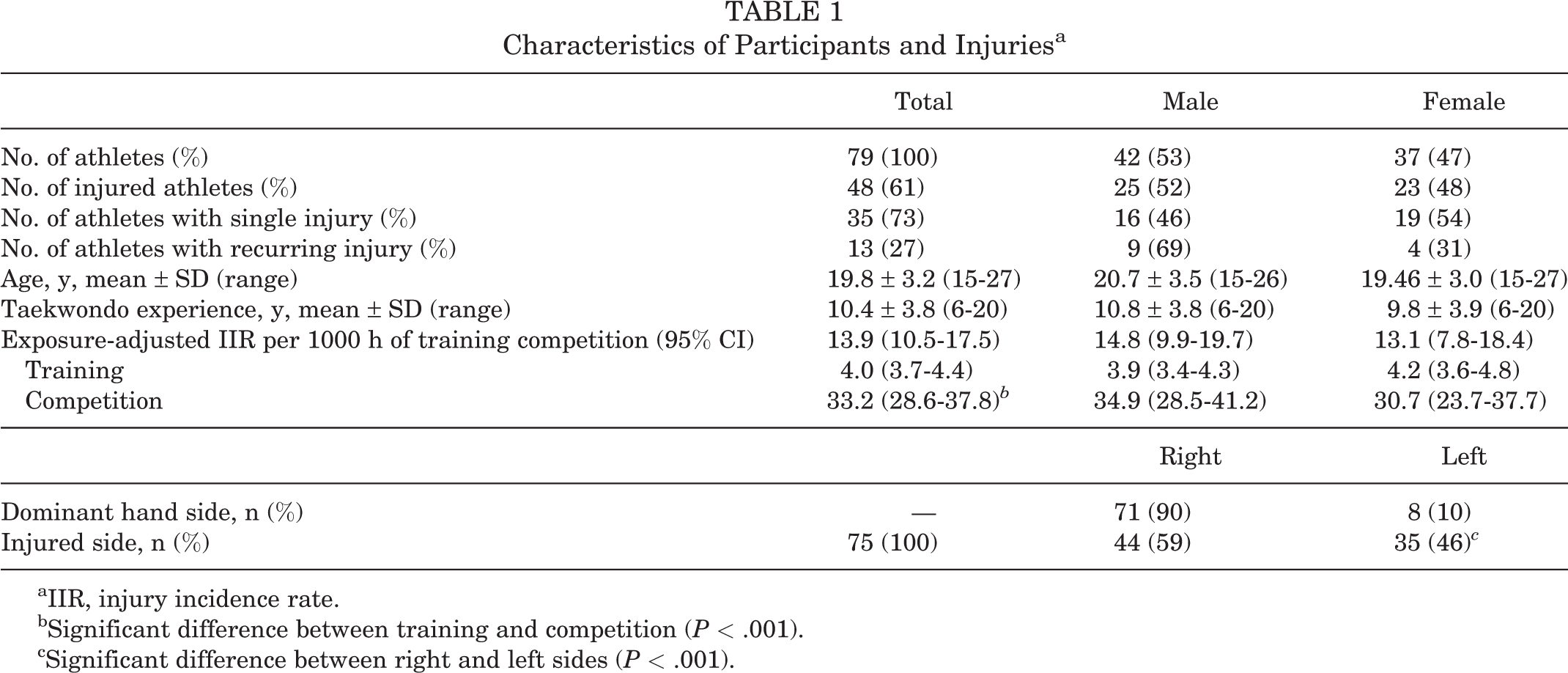
From the original 107 athletes at the Olympic training center, 79 athletes (73.8%) with a total exposure time of 8495 hours were included in the final data set. The average age was 19.8 ± 3.2 years (range, 15-27 years), with an average experience of taekwondo practice of 10.4 ± 3.8 years (range, 6-20 years). There was no significant difference between male and female athletes according to injuries or taekwondo experience. Most of the participants (90%) described their right hand as their dominant one. During the study period, 75 injuries of the hand and wrist region were recorded in 48 participants (61%), while 31 participants (39%) remained uninjured. Of those 48 injured participants, 35 (73%) had a single injury, while 13 (27%) had recurring injuries or injuries of the contralateral side (Table 1).
Characteristics of Participants and Injuriesa
aIIR, injury incidence rate.
bSignificant difference between training and competition (P < .001).
cSignificant difference between right and left sides (P < .001).
The right-hand side was affected in 59% of all injuries. Significantly more injuries were found on the right-hand side (P < .001). The total IIR was 13.9 (95% CI, 10.5-17.5). During training sessions, 24 injuries (32%) were found, while 51 injuries (68%) occurred during competition fights. The IIR for competition was significantly higher compared with that for training (P < .001).
The epidemiologic clinical incidence as an indicator for the risk of injury during the 5-year study period was 60.7% (95% CI, 50.9-70.5). The risk for subsequent injury was 27% (95% CI, 17.2-36.8). Regarding injury sites, the finger rays were the most affected location (68%), followed by the wrist joint (16%). Fractures (43%) and joint ligament injuries (35%) were the most common types of injury, followed by dislocation (15%) and bruising (8%). Most fractures (72%), joint ligament injuries (62%), and all dislocations occurred to the finger rays. Regarding the radius, all 6 injuries were found to be fractures (Table 2).
Injury Type According to Location a

a Data are reported as n (%).
b Finger ray = finger including metacarpal bone.
The majority of the injuries (71%) occurred during the performance of blocking techniques, and finger rays were most affected from blocking (85%). When comparing the 2 mechanisms of injuries with injury locations, significantly more injuries at the finger rays occurred from blocking (P = .0104) than from striking (Table 3). Injuries to the wrist joint occurred mainly during striking (41%).
Hand Injury Locations According to Injury Mechanism a

a Data are reported as n (%). Dashes indicate no P value calculated.
b Finger ray = finger including metacarpal bone.
c Statistically significantly different between striking and blocking groups.
The mean time loss for all hand and wrist injuries was 15.7 ± 13.5 days (range, 3-45 days) and was highest for fractures (mean, 24.0 ± 13.4 days; range, 4-45 days) and dislocations (mean, 18.6 ± 15.9 days; range, 4-42 days). Time loss according to injury type is shown in Table 4.
Time Loss in Days According to Injury Type a

a Data are reported as mean ± SD (range).
b Single injury; mean, SD, and range were not calculated.
Discussion
The most important finding of this study was that there was a significantly higher IIR for acute hand and wrist injuries in elite taekwondo athletes during competition compared to training despite the use of protection gear. Finger ray injuries were most frequently found and affected primarily the thumb ray and the little finger ray. Furthermore, significantly more injuries to the finger rays occurred during blocking than striking techniques. Fractures and dislocations resulted in the greatest time loss.
IIRs of hand and wrist injuries vary greatly among different sports. A study by Fraser et al 8 examined the details of 1123 ball-contact injuries and found a clinical incidence of 32.7% for hand and wrist injuries, which was highest in men’s football (77.9%) and women’s volleyball (60.3%). For combat sports, the injury risk seems to be even higher, especially during competition. A recent prospective study over 8 years by Loosemore et al 14 found an injury risk of 347 per 1000 hours during competition for male athletes in elite boxing. However, the mean athletes’ observation time was only 28.5 months in this study. Besides boxing, participants of karate and taekwondo were also found to have a high injury risk, but injury rates differed widely among the different combat sports studied. Apparently, fighting techniques and protective gear are not comparable. 4 Although recent studies have shown considerable injury rates for the upper extremities in taekwondo, most of them were graded as minor. 9,14 –16,18,19,21 Furthermore, a detailed evaluation of exposure-adjusted hand and wrist injuries during training and competition over a longer period is still missing. 3,9,18,21 A prospective study by Park et al 19 reported that 14% of the injuries during training were to the upper extremities in elite taekwondo athletes; however, competition injuries were not evaluated, and no detailed analysis was presented. This study is the first to present an exposure-adjusted IIR with sport-specific injury analysis for elite taekwondo athletes using standardized glovelike protective hand gear. The characteristic injury patterns found in this study suggest that the edge of the hand as well as the thumb ray are prone to injury from blocking. While bruising and joint ligament injuries resulted in minor time loss, between 5 and 7 days, radial located fractures and dislocations of the thumb ray in particular forced the athletes to withdraw from training for 4 to 6 weeks.
Forearm protection with solid pads is mandatory by rules; however, hand protection gear only provides some soft padding of the metacarpal, while the fingers remain widely unprotected, making them prone to injury, especially during defensive blocking techniques (Figure 1). A former study hypothesized that protective hand gear in taekwondo mainly protects the attacker rather than the defender. 12 The presented data support the assumption that the actual protective gear might not be sufficient to prevent injuries to the hand resulting from explosive kicks. 12 The high occurrence of fractures and dislocations at the thumb and little finger rays might confirm this observation, as the outer finger rays are most likely to be hit. Firmly closing the hand to a fist while performing blocking movements might contribute to prevention of those injuries. On the contrary, more injuries to the wrist joint were associated with striking movements. Inappropriate striking techniques to the plain trunk protector as well as unintentional hits with the fist to the opponent’s olecranon or knee cap might be reasons for those injuries. A radiological study by Mayer et al 17 found severe degenerative changes of the hand and wrist region in martial arts athletes. Besides exact diagnosis and proper treatment, improvement of protective gear according to the described injury patterns should be considered. Therefore, improved bracing of the thumb and little finger ray seems to be advantageous, but there is also concern that protective hand gear conveys a false sense of security to the athlete. Regardless of protection, awareness that the hand and wrist region is not suitable for absorbing the enormous energy deriving from foot strikes in modern full-contact taekwondo should be raised. The high IIR during competition fights suggests that tactical considerations might be more beneficial for prevention. It seems more advantageous to focus on keeping an optimal distance from the opponent for defense of kicks instead of routinely using the hands for blocking. In this context, the competition rules on the deduction of points for moving backward or turning one’s back to the opponent should be reconsidered. Further athletic training of the forearm muscles seems to be a promising option to improve muscle strength, as the hands seem to be less prone to injury during blocking when body tension is improved and the hand is firmly closed to a fist. Detailed video analysis of blocking and striking skills combined with continuous training might be feasible to monitor improvement of the recommended technical and tactical skills.
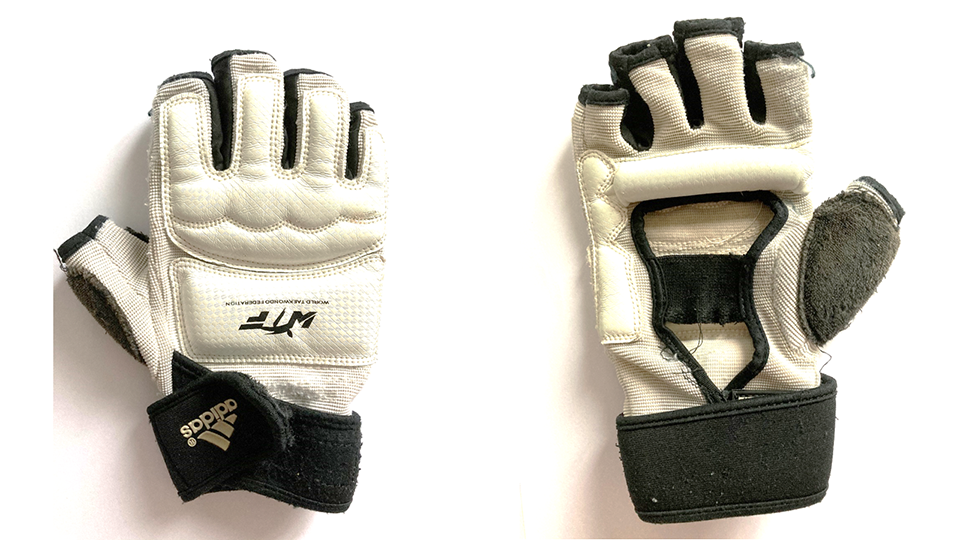
Standard hand protection gear (right glove, dorsal and palmar view) used during competition from an athlete who sustained a fifth metacarpal bone fracture from blocking a kick.
Limitations of the Study
Despite the prospective evaluation of injuries, a certain selection bias can be assumed because of the small number of athletes from 1 national training center, but the number of elite athletes is limited by nature. Furthermore, a selection bias might have occurred because of athletes lost to follow-up. Different persons were participating in data collection, and some injuries might not have been assessed because of underestimation. Because of the nature of athletes participating in combat sports, this might have especially affected the inclusion of milder forms of injury types, such as bruising or joint ligament injuries. It remains unclear in this study if injury risk skewed toward the remaining 79 athletes over time. Time lost from participation due to injury might also have acted as a confounding factor. Furthermore, evaluation of the injury mechanism by interview certainly favored a recall bias, although it was done in a timely manner.
Conclusion
There was a significantly higher IIR for acute hand and wrist injuries in elite taekwondo athletes during competition, resulting in considerable time loss, especially when fractures or dislocations occurred. Significantly more injuries to the finger rays were found during blocking despite the use of protective hand gear. Constant improvement of tactical skills and blocking techniques during training as well as improvement of current protective gear appear to be essential for injury prevention.
Footnotes
Final revision submitted June 18, 2020; accepted July 28, 2020.
The authors declared that they have no conflicts of interest in the authorship and publication of this contribution. AOSSM checks author disclosures against the Open Payments Database (OPD). AOSSM has not conducted an independent investigation on the OPD and disclaims any liability or responsibility relating thereto.
Ethical approval for this study was obtained from Paracelsus Medical University (ref No. 2018-007).