




Abstract
Background:
The anterolateral ligament (ALL) of the knee remains a topic of interest. All aspects of the ligament, including its anatomy, biomechanics, imaging, and clinical importance, are areas for research among knee surgeons.
Purpose:
To evaluate the trends in research on the ALL of the knee, as indicated by studies indexed in PubMed from 2010 to 2019.
Study Design:
Cross-sectional study.
Methods:
We searched PubMed for article titles from January 1, 2010, to December 31, 2019, that included the term “anterolateral ligament.” The initial search was performed with the terms “anterolateral ligament AND knee” and “anterolateral ligament NOT knee.” Next, we performed a search using “anterolateral complex OR anterolateral reconstruction OR lateral extra-articular tenodesis” to avoid missing any studies. A bibliometric evaluation was performed for the search results, and we noted the characteristics of the most cited articles in PubMed.
Results:
Published studies on the ALL peaked in 2017, with 56 studies, and then declined from 2017 to 2019. The 3 leading journals with articles on the ALL were Arthroscopy; Knee Surgery, Sports Traumatology, Arthroscopy; and The American Journal of Sports Medicine. Cadaveric anatomic, cadaveric biomechanical, and clinical imaging studies of the ALL were the most common types of studies published from 2010 to 2019. Clinical studies on the ALL consisted of 18 articles, with the majority displaying a low level of evidence.
Conclusion:
Cadaveric anatomic/histological, cadaveric biomechanical, and clinical imaging studies of the ALL were the most commonly published studies from 2010 to 2019. More clinical outcome studies with a high level of evidence are needed to increase the supporting data for the future practice of ALL reconstruction.
The anterolateral ligament (ALL) is known as the newly rediscovered knee ligament. 2 This ligament was first described by Segond 22 in 1879 and was further described by Claes et al. 4 The term “anterolateral ligament” of the knee was first used by Vieira et al 30 in 2007, who described it as an anatomic fibro-osseous part of the iliotibial band. Interest in its investigation significantly increased after earlier articles by Vincent et al 31 and Claes et al. 5 Cadaveric anatomic and histological analysis performed by Vincent et al 31 revealed that the ALL is a discrete structure with a fibrous core surrounded by the synovium. The ALL originates near the popliteus tendon insertion and inserts into the lateral meniscus and tibial plateau 5 mm distal to the articular surface and posterior to the Gerdy tubercle. 31 In addition, Claes et al 5 clarified that the ALL is a distinct ligament at the anterolateral aspect of the knee. It is hypothesized that the ALL acts as a restraint in controlling internal tibial rotation and may affect the pivot-shift phenomenon, which are known challenges in patients with anterior cruciate ligament (ACL) ruptures. 11 Therefore, identifying published research on ALL anatomy, biomechanics, and imaging will help us to understand its clinical importance. It is also important to understand what investigators have performed so far in studies on the ALL; these data could be used as a basis for determining further research on the ALL.
In this study, we investigated the trends in research on the ALL that was indexed in PubMed between 2010 and 2019. We attempted to understand the recent progress of ALL research from the view of publication bibliometrics. We hypothesized that there would be an increasing trend in the number and type of articles on the ALL during the past 10-year period.
Methods
We performed an advanced search on “anterolateral ligament” of the knee in PubMed from January 1, 2010, to December 31, 2019. First, the article search was performed using 2 terms: “anterolateral ligament AND knee” and “anterolateral ligament NOT knee.” We initially used the term “anterolateral ligament” to find published articles that focused on and defined the anterolateral structure of the knee as a “ligament,” which remains controversial. Next, a search using “anterolateral complex OR anterolateral reconstruction OR lateral extra-articular tenodesis” was performed to find any studies missed by the initial method. Screening was then conducted on all the records.
First, we investigated whether all records were associated with the knee joint and confirmed that the articles described the ALL as a knee stabilizer and as the main topic of investigation. Further, we analyzed the trend in publications by year, author and orthopaedic center, type of article and study design, journal name, and article with the most number of citations. Errata, editorials, letters to the editor, editorial comments, and responses to comments were excluded from the analysis.
A total of 259 records using the first 2 search terms was obtained: 136 records from “anterolateral ligament AND knee” and 123 records from “anterolateral ligament NOT knee.” All records were associated with the knee joint. We found 5 records of errata and 39 records of editorials, letters to the editor, editorial comments, and responses to comments, and 1 article mentioned the ALL in the title as part of an injured structure during knee surgery; this article was also excluded from the analysis. We found that all records using “anterolateral ligament NOT knee” were related to the issue of the ALL being a knee stabilizer. Thus, 214 articles using the first 2 search terms were included for further evaluation.
The final search, using “anterolateral complex OR anterolateral reconstruction OR lateral extra-articular tenodesis,” resulted in 50 records, among which 6 were duplicates of the previous search, 6 were editorial comments or responses to comments, 1 was an erratum, and 28 did not discuss the ALL as the main concern of the research. The remaining 9 articles were included for further analysis. Overall, 223 articles from all search results were included in the bibliometric analysis (Figure 1).

Flow diagram of the article selection process. ALL, anterolateral ligament.
Results
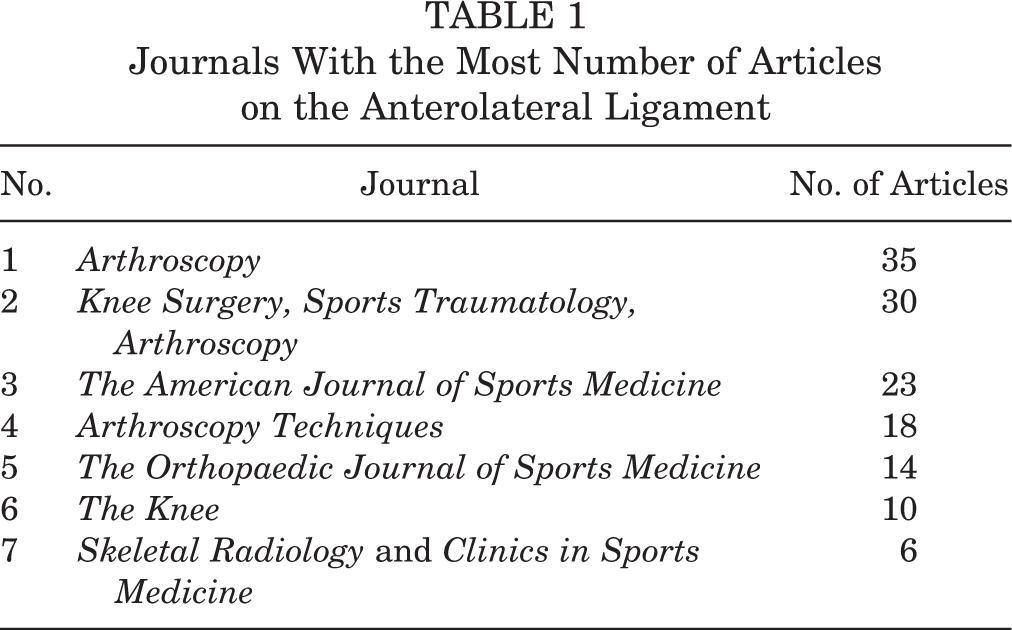
The earliest result was a 2012 article published by Vincent et al 31 on ALL anatomy and histology. No records were found in the years 2010 and 2011. From 2015 to 2016, publications doubled from 20 to 41 articles, and it reached a peak in 2017 with 56 articles published. Publications decreased thereafter, and in 2019 there were 46 articles published on the topic (Figure 2). The journals Arthroscopy; Knee Surgery, Sports Traumatology, Arthroscopy; and The American Journal of Sports Medicine were the 3 leading sources of published research on the ALL during the period studied, with 35, 30, and 23 articles, respectively (Table 1).

Number of published articles on the anterolateral ligament (ALL) of the knee, 2010-2019.
Journals With the Most Number of Articles on the Anterolateral Ligament
Camilo Partezani Helito was the author with the highest number of published studies on the ALL of the knee, with more than 30 articles, followed by Bertrand Sonnery-Cottet (Table 2). The studies by Claes et al, 5 Vincent et al, 31 and Dodds et al 7 were the 3 most cited articles in PubMed during the study period, with more than 100 citations each (Table 3).
Authors With the Most Number of Articles on the Anterolateral Ligament

Top 10 Cited Articles on the Anterolateral Ligament

The most commonly published study types regarding the ALL were cadaveric anatomic/histological studies, cadaveric biomechanical studies, and clinical imaging studies, each with more than 40 articles (Figure 3A). Data on the yearly trend of research also showed that these 3 study types were the most common among published articles during the period studied. Additionally, we noted an increasing trend in clinical outcome studies from 2015 to 2019 (Figure 3B), with 18 such studies published in that period. Retrospective case series, case-control studies, and cohort studies were the most commonly performed clinical outcome studies; we found only 1 randomized controlled trial and 1 systematic review (Figure 4). The 18 clinical outcome studies are summarized in Appendix Table A1.

Anterolateral ligament (ALL) research by study design, 2010-2019. (A) Overall distribution. (B) Distribution by year.

Distribution of clinical studies on the anterolateral ligament (ALL) by study design, 2010-2019. RCT, randomized controlled trial.
Discussion
PubMed is one of the most commonly used search engines in the biomedical literature, and it is updated daily. In PubMed, searching is easy, with study abstracts made available to all for free. PubMed helps in literature searches by the availability of “advanced search” options on the website and the provision of updated citation data for each article that is indexed. One could well investigate the trends in published research on a particular issue in PubMed, including investigations on articles published during a certain period in the past. Several studies have investigated trends in publications on the ACL, 8,15 however, to the best of our knowledge, there have been no previous studies showing research trends in studies on the ALL. Through this work, we showed the trends in recent research and present recommendations for future research on the ALL of the knee.
There has been an increasing number of studies on the ALL until recently. The year 2017 was identified to be the peak in number of published articles. Cadaveric anatomic/histological and cadaveric biomechanical studies were the most published articles each year until 2019. This indicated that there are still controversial issues associated with the anatomy and biomechanics of the ALL. The existence, true origin, insertion point, and biomechanical behavior of the native ligament and the biomechanics of its reconstruction technique remain the main issues for research. 2,7,33
Diagnostic imaging of the ALL is challenging, 3 thus making clinical imaging one of the most common issues discussed in ALL studies. Several methods, including magnetic resonance imaging, ultrasound, and fluoroscopy, have been used to investigate the anatomy of or injuries to the ALL. There was an increasing number of clinical imaging studies during each year of the study period, with a total number of 43 articles. The literature indicated that clinical examinations, plain radiography (Segond fracture), ultrasound, and magnetic resonance imaging are useful in diagnosing ALL injuries. 9,10,27
The clinical importance of the ALL was also one of the main interests in the published studies. Although we found that studies on clinical outcomes regarding the ligament were scarce (n = 18 articles), this number increased each year, with 7 published articles in 2019. Most of the clinical investigations were performed retrospectively, which has its weaknesses; case-control studies, cohort studies, and case series were the most performed clinical studies. The issues raised in these clinical studies ranged from untreated ALL injuries to nonoperative treatment of ALL injuries, ALL reconstruction in combination with routine ACL reconstruction, ALL reconstruction with chronic ACL injuries, and ALL reconstruction with revision ACL reconstruction. Although most of the results in the clinical studies supported the practice of ALL reconstruction, the research findings showed some variation. Furthermore, most of the clinical studies had a low level of evidence, and only 1 article was a randomized controlled trial on ALL reconstruction. 14 The results of the current study do not support the routine practice of ALL reconstruction, and further study on the clinical outcomes after ALL reconstruction is needed.
The limitations of this study include the use of PubMed as the only search engine. Although most of the commonly referenced medical journals are indexed in PubMed, some articles not indexed on PubMed might have been missed during our search. Studies that discussed lateral extra-articular tenodesis or the anterolateral complex (not specific to the ALL) were excluded. Some information may have been missed by the search methodology used. However, we believe that our method was able to shed some light on the research trends concerning the ALL.
Conclusion
Cadaveric anatomic/histological, cadaveric biomechanical, and clinical imaging studies on the ALL of the knee were the most commonly published studies from 2010 to 2019. More clinical outcome studies with a high level of evidence are needed to increase the supporting data on the future practice of ALL reconstruction.
Footnotes
Final revision submitted August 7, 2020; accepted September 14, 2020.
The authors declared that there are no conflicts of interest in the authorship and publication of this contribution. AOSSM checks author disclosures against the Open Payments Database (OPD). AOSSM has not conducted an independent investigation on the OPD and disclaims any liability or responsibility relating thereto.
Ethical approval was not sought for the present study.
APPENDIX
Studies on Clinical Outcomes of the ALL a

| No. | Lead Author (Year) | Study Design | Treatment | Outcomes/Suggestions | LOE |
|---|---|---|---|---|---|
| 1 | Ibrahim 14 (2017) | Randomized controlled trial | Combined ACL + ALL reconstruction | ALL reconstruction should not be performed routinely for patients undergoing ACL reconstruction. | 2 |
| 2 | Temponi 28 (2019) | Retrospective case series | Nonoperative treatment for ALL injury | The prognosis of an ALL injury after nonoperative treatment appeared to be excellent. | 4 |
| 3 | Sonnery-Cottet 25 (2017) | Comparative multicenter cohort study | Combined ACL + ALL reconstruction | ACL reconstruction with a hamstring tendon graft + ALL graft was associated with greater odds of returning to preinjury levels of sport compared with ACL reconstruction with a 4-strand hamstring tendon graft. | 2 |
| 4 | Castelli 1 (2019) | Retrospective case-control study | ACL reconstruction for ACL injury with/without ALL injury (no treatment for ALL injury itself) | There was a significant difference in residual rotatory instability in the 2 subpopulations, and 9% of patients in the ACL + ALL lesion group showed residual jerk or subluxation. | 3 |
| 5 | Helito 13 (2019) | Retrospective case-control study | Combined ACL + ALL reconstruction | Combined ACL + ALL reconstruction in patients with ligamentous hyperlaxity resulted in a lower failure rate and improved knee stability parameters compared with isolated ACL reconstruction. | 3 |
| 6 | Gunaydin 9 (2019) | Retrospective case-control study | ACL reconstruction for ACL injury with/without ALL injury (no treatment for ALL injury itself) | An ALL rupture had negative effects on functional outcomes. ALL reconstruction performed concomitantly with ACL reconstruction or later will have a positive effect on functional outcomes. | 3 |
| 7 | Rosenstiel 21 (2019) | Retrospective case series | Combined ACL + ALL reconstruction | Combined ACL + ALL reconstruction was associated with excellent outcomes in professional athletes with respect to graft rupture rates, return to sport, knee stability, and reoperation rates after the injury. | 4 |
| 8 | Lee 17 (2019) | Cohort study | ALL reconstruction + revision ACL reconstruction | Revision ACL reconstruction in combination with ALL reconstruction significantly reduced rotational laxity and showed a higher rate of return to the same level of sports activity than revision ACL reconstruction alone. | 3 |
| 9 | Delaloye 6 (2018) | Systematic review | Combined ACL + ALL reconstruction | Combined ACL + ALL reconstruction provided promising results that may improve graft rupture rates and meniscal repair failure rates while maintaining excellent functional outcomes. | 3 |
| 10 | Yoo 32 (2019) | Retrospective case-control study | ACL reconstruction for ACL injury with/without ALL injury (no treatment for ALL injury itself) | Combined ACL + ALL injuries showed poor graft tension during second-look arthroscopic surgery after transtibial ACL reconstruction with an allograft, although significant differences in clinical outcomes and stability were not observed. | 3 |
| 11 | Gürpınar 10 (2018) | Retrospective case-control study | ACL reconstruction for ACL injury with/without ALL injury (no treatment for ALL injury itself) | The difference found in rotational measurements was possibly less than the value of the minimal clinically important difference and did not have a clinical effect. ALL reconstruction may not be recommended as a standard treatment in all patients. | 3 |
| 12 | Sonnery-Cottet 24 (2018) | Cohort study | Combined ACL + ALL reconstruction | Combined ACL + ALL reconstruction was associated with a significantly lower rate of failure of medial meniscal repair compared with that performed at the time of isolated ACL reconstruction. | 3 |
| 13 | Helito 11 (2018) | Retrospective case-control study | Combined ACL + ALL reconstruction | There is a possible indication for combined ACL + ALL reconstruction when patients present with symptoms more than 12 months after the injury. | 3 |
| 14 | Mogos 18 (2017) | Cohort study | Combined ACL + ALL reconstruction | Combined ACL + ALL reconstruction was an effective surgical procedure with improved postoperative clinical results and no significant short-term complications. | 3 |
| 15 | Thaunat 29 (2017) | Retrospective case series | Combined ACL + ALL reconstruction | The reoperation rate after combined ACL + ALL reconstruction was broadly comparable with that after isolated ACL reconstruction, as reported in other studies. | 4 |
| 16 | Shah 23 (2017) | Retrospective case series | Combined ACL + ALL reconstruction | Patients with significant rotational instability after an ACL injury and assessed to have a grade 3 pivot shift may benefit from combined ACL + ALL reconstruction. | 4 |
| 17 | Sonnery-Cottet 26 (2015) | Retrospective case series | Combined ACL + ALL reconstruction | Combined ACL + ALL reconstruction can be an effective procedure without specific complications at a minimum 2-year follow-up. | 4 |
| 18 | Zhang 34 (2016) | Cohort study | Combined ACL + ALL reconstruction | Anatomic double-bundle ACL reconstruction and anatomic single-bundle ACL + ALL reconstruction were better than anatomic single-bundle ACL reconstruction in terms of postoperative knee stability and joint function. | 3 |
a ACL, anterior cruciate ligament; ALL, anterolateral ligament; LOE, level of evidence.