




Abstract
Background:
There are 2 movement patterns associated with an anterior cruciate ligament (ACL) injury: dynamic valgus and stiff landing. Although sex-dependent differences have been identified for adults, less is known for preadolescent athletes regarding movement patterns known to load the ACL.
Hypothesis:
We hypothesized that girls would demonstrate greater vertical ground reaction forces and knee valgus angles. We further hypothesized that the exercise intervention would affect girls more than boys and that this would primarily be demonstrated in less sagittal plane excursions, increased vertical ground reaction forces and knee valgus moments for girls than for boys.
Study Design:
Controlled laboratory study.
Methods:
Male and female soccer and handball players (n = 288; age range, 9-12 years) were recruited. A motion capture system synchronized to a force platform was used to record 5 trials of a cutting maneuver before and after a 5-minute fatigue intervention. Linear mixed models were constructed, and analysis of variance was used to analyze differences in outcomes associated with the sex of the athletes.
Results:
Boys showed greater peak knee valgus moment (0.26 vs 0.22 N·m/kg, respectively; P = .048), peak knee internal rotation moment (–0.13 vs –0.10 N·m/kg, respectively; P = .021), knee rotation excursion (–7.9° vs –6.9°, respectively; P = .014), and knee extension excursion (2.7° vs 1.4°, respectively; P < .001) compared with that in girls. A significant sex × fatigue intervention interaction (F = 7.6; P = .006) was found, which was caused by a greater increase in first peak vertical ground-reaction force (vGRF) from before to after the fatigue intervention for girls (15.3 to 16.0 N/kg) compared with boys (16.4 to 16.5 N/kg).
Conclusion:
Differences detected for biomechanical factors during the cutting maneuver do not point to a greater ACL injury risk for prepubescent or early pubescent girls than for boys. Nonetheless, girls go on to develop more detrimental movement patterns in adolescence than those in boys in terms of biomechanical risk factors.
Clinical Relevance:
Early adolescence is a good target age to learn and develop muscular control; balance, strength; flexibility; and jumping, running, and landing control. This time of physical and athletic growth may therefore be an appropriate period to influence biomechanical factors and thereby task execution and the injury risk.
Anterior cruciate ligament (ACL) injury is one of the most serious injuries of the lower limb and can result in a relatively low rate of return to sports, 2 decreased quality of life in later years, 3 and a high rate of knee osteoarthritis. 1 It is an expensive injury, with the surgical cost for ACL reconstruction alone reportedly being between US$5000 and US$17,000. 31
The ACL is the primary restraint against anterior tibial translation, 20 which is difficult to quantify with 3-dimensional movement analysis using reflective markers because of soft tissue artifacts. 34 However, the ACL has been demonstrated in cadaveric studies to be loaded through tibiofemoral compression 15 as well as tibial internal rotation moment (IRM) and knee valgus moment (VM). 14 Furthermore, prospective studies have proposed VM 11 and tibiofemoral compression (per the vertical ground-reaction force [vGRF]) 19 as risk factors for an ACL injury, and these variables can be estimated with 3-dimensional motion analysis. 18,33
Compared with male athletes, adult female athletes show a 2- to 3-fold increased incidence in ACL injuries per hour of exposure. 35 Myer et al 23 reported in their review article that most ACL injuries in female athletes occur during a noncontact episode, typically during deceleration, lateral pivoting, or landing tasks that are often associated with high external knee joint loads. The incidence of ACL injuries in youngsters has been rising over the past few years. A recent Australian study reported an almost 150% increase in hospital-treated ACL injuries from 2005 to 2015 in youngsters aged 5 to 14 years (from 2.74 to 6.79 per 100,000 person-years). 26
Although Briem et al 8 found that girls and boys adopted different landing strategies during the drop jump (DJ) and were differently affected by fatigue, others have not observed sex-related differences in ACL risk factors before puberty during the cutting maneuver. 27 Several systematic reviews have examined the effects of fatigue and how fatigue interventions affect the kinetics and kinematics of the lower extremity in older athletes. 4,5,7 However, fatigue protocols appear to have inconsistent effects on the lower limb kinematic or kinetic variables known to increase ACL injury risk. 7
Few studies have compared the biomechanical risk factors of an ACL injury of boys and girls during the execution of a cutting maneuver. Importantly, none has focused specifically on the time frame of injury occurrence or attempted to induce fatigue to assess how this may influence performance. Therefore, the aim of this study was to compare the kinematics and kinetics relevant to an ACL injury of male and female athletes aged 9 to 12 years within the first 100 milliseconds of the cutting maneuver, which is the time frame when ACL injuries occur. 17 To the best of our knowledge, this is the first study to investigate the effects of both sex and fatigue intervention on ACL injury–related biomechanics during the cutting maneuver in preadolescent athletes. Based on previous findings of the DJ maneuver, 8 we hypothesized that girls would demonstrate greater vGRF and knee valgus angles. We further hypothesized that the fatigue intervention would affect girls more than boys and that this would primarily be demonstrated in less sagittal plane excursion, and increased vGRF and knee VM for girls than for boys.
Methods
Participants
After receiving ethical approval for the study from the National Bioethics Committee, a total of 293 participants were recruited from local handball and soccer clubs, but data from 288 athletes were used for further analysis. Data for 5 participants were excluded because of technical errors or erroneous performance. Athletes were aged between 9 and 12 years and were recruited from the teams’ age-based training groups. Exclusion criteria were a history of torn knee ligaments or muscles of the lower extremities, intra-articular corticosteroid injections within the previous 3 months, neurological impairments, impaired balance, and any orthopaedic problems of the lower limb. Before participation, all procedures were explained to each athlete, and informed consent forms were signed by the participant and a parent or guardian. No knee radiographs or bone age radiographs were obtained in this study.
Data Collection
Kinematic data were collected at 200 Hz using a marker set with 46 markers and an 8-camera motion capture system (Qualisys) positioned around a calibrated test area. Kinetic data were simultaneously collected at 2000 Hz from a force platform (AMTI) embedded in the floor. Where possible, markers were placed directly onto the skin to minimize movement artifacts resulting from loose clothing. A static measurement was used to define segments and joint centers based on anatomic markers, while clusters of 3 to 4 markers tracked each segment during dynamic trials. Marker-based kinematics and kinetics have been shown to be highly reliable 25 but display systematic errors in knee abduction angles, especially at higher flexion angles. 33
After warming up on a stationary bicycle for 5 minutes and performing preparatory cutting maneuvers, participants performed 5 cutting maneuvers against a dummy opponent. The movement was performed from a ready position without a run-up using a self-selected change of direction angle. Athletes took a quick step sideways onto the tested leg before accelerating to a maximal take-off away from the tested leg. Athletes were encouraged to use as much speed and explosiveness as they could. The order of testing was randomized with a coin flip, and 5 valid trials were performed for each leg. A fatigue protocol described by Briem et al 8 in which a slide board was used to fatigue lower limb muscle groups was then implemented. Bumpers were located on each end of the board, with the distance between them set at 1.5 times the participant’s leg length. The participants stood on the board, pushed laterally off one bumper, and glided to the other side of the slide board, where the same movement was performed to glide back, maintaining a slightly flexed position throughout the protocol. The task ensured multiplanar exertion through both lower limbs. This was repeated for 5 minutes, gradually increasing the effort at the end of each of the first 4 minutes to maximal effort during the last minute, after which the motion analysis protocol was repeated for another set of cutting tasks.
Data Synthesis and Statistical Analysis
Kinematic and kinetic outcome variables within the first 100 milliseconds of stance were chosen as markers for ACL loading according to 2 proposed injury mechanisms supported by prospective risk factor studies. 6 The first cluster of outcome variables reflected dynamic valgus collapse based on the peak magnitude of knee VM and IRM, knee frontal and transverse plane excursions, and knee valgus angle and knee rotation angle at initial contact (IC). The second cluster of outcome variables reflected stiff landings 19 as determined by values of first peak vGRF, knee flexion angle at IC, knee flexion excursion, and knee extension excursion.
Force variables were normalized by body weight and presented in N·m/kg (VM and IRM) or N/kg (vGRF). The frontal and transverse plane knee moments are reported as peak external moments identified within the first 100 milliseconds as local maxima in which the largest from each trial recorded was used for analysis. Joint angles (deg) were extracted at IC and at the highest value identified within the first 100 milliseconds, and excursions were calculated as the difference between the 2. Knee angles in the frontal plane were defined as valgus (negative) or varus (positive) angles and in the transverse plane as internal (positive) and external (negative) rotation angles. Positive values of frontal plane knee moment are referred to as knee VM, while negative values represent knee varus moment. Negative values of transverse plane knee rotation excursion indicate that the knee rotated into greater internal rotation.
Inverse kinematics and inverse kinetics were performed using Visual3D (C-Motion). Data were imported to R (R Foundation for Statistical Computing) for analysis and processing. Jamovi, an R-based program, was used for the construction of linear mixed statistical models and creation of figures. Power analysis was performed using G*Power.
An initial model was created to identify fixed main effects for sex, fatigue intervention, and leg dominance as well as interactions of (1) sex × fatigue intervention and (2) sex × leg dominance. To obtain more accurate statistical models of sex-dependent differences, leg dominance and fatigue intervention were included in the models to adjust for the effect of these variables. The participant was included as a random effect in all models to adjust for the repeated-measures design of the study. For each of the fixed variables used, a random factor (random slope) was added in succession (fatigue intervention and leg dominance) to the linear mixed model and the best-fit model selected according to –2 × log likelihood (using chi-square distribution to test for a significant improvement for each successive addition of a random effect). Alpha was set at 0.05. Results are reported as least squares means and difference between least squares means with 95% CIs. A power analysis revealed that an effect size of 0.25 had a power of 0.83 in the study.
Results
There were no differences in age, height, or weight between the sexes (Table 1). Statistical results of the differences (analysis of variance) are reported in Tables 2 to 4. The best-fit model was always one that included random slopes for both fatigue intervention and leg dominance.
Participant Characteristics a

a Data are reported as mean ± SD. There were no statistically significant differences in any variable between boys and girls.
Results of Analysis of Variance for Sex (Main Effect) a

a IC, initial contact; IRM, internal rotation moment; vGRF, vertical ground-reaction force; VM, valgus moment.
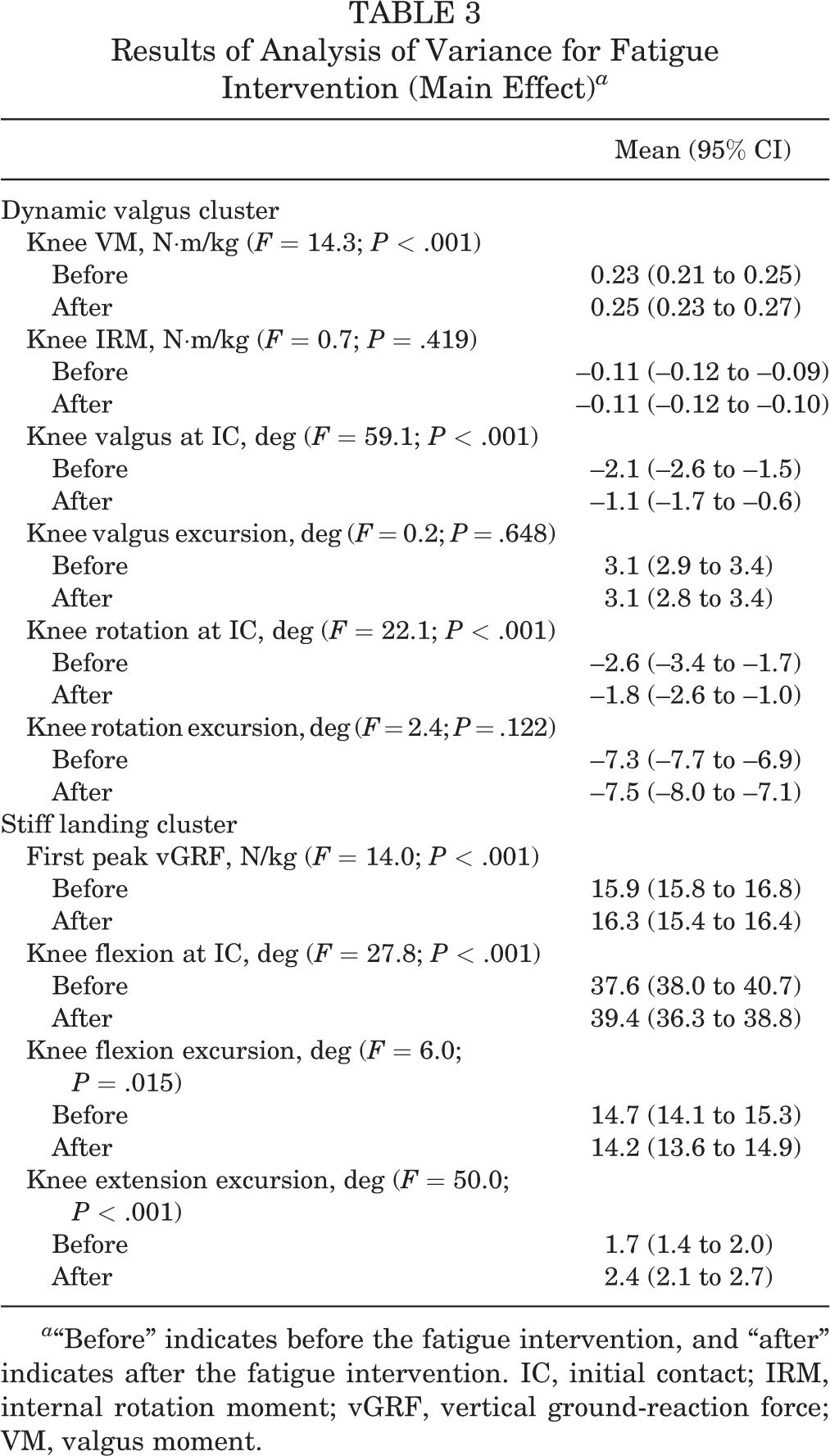
Results of Analysis of Variance for Fatigue Intervention (Main Effect) a
a “Before” indicates before the fatigue intervention, and “after” indicates after the fatigue intervention. IC, initial contact; IRM, internal rotation moment; vGRF, vertical ground-reaction force; VM, valgus moment.
Results of Analysis of Variance for Sex × Fatigue Intervention (Interaction) a

a “Before” indicates before the fatigue intervention, and “after” indicates after the fatigue intervention. IC, initial contact; IRM, internal rotation moment; vGRF, vertical ground-reaction force; VM, valgus moment.
Dynamic Valgus Cluster
For the dynamic valgus cluster, statistically significant main effect of sex was found for 3 variables, as boys demonstrated greater peak knee VM and IRM as well as greater excursion from an externally rotated position toward internal rotation (Table 2). Main effects of fatigue intervention were observed in a significant increase in peak knee VM, greater knee valgus angle at IC, and less knee external rotation angle at IC from before to after the intervention (Table 3). No statistically significant interaction between these 2 factors (sex × fatigue intervention) was found (Table 4).
Stiff Landing Cluster
For the stiff landing cluster, there was a sex × fatigue intervention interaction (Table 4). Although boys demonstrated higher peaks overall, a significant increase in first peak vGRF from before to after the intervention was seen for girls (15.3 to 16.0 N/kg), while the fatigue intervention affected boys minimally (16.4 to 16.5 N/kg) (Figure 1). Overall, a main effect of sex was found for knee extension excursion, as boys showed significantly greater knee extension excursion during the first 100 milliseconds compared with that in girls (Table 2). Main effects of the fatigue intervention were found for all other variables, reflecting a greater knee flexion angle at IC (before intervention, 37.6°; after intervention, 39.4°; P < .001) with a slight decrease in knee flexion excursion (before intervention, 14.7°; after intervention, 14.2°; P = .015) and greater knee extension excursion (before intervention, 1.7°; after intervention, 2.4°; P < .001) (Table 3).
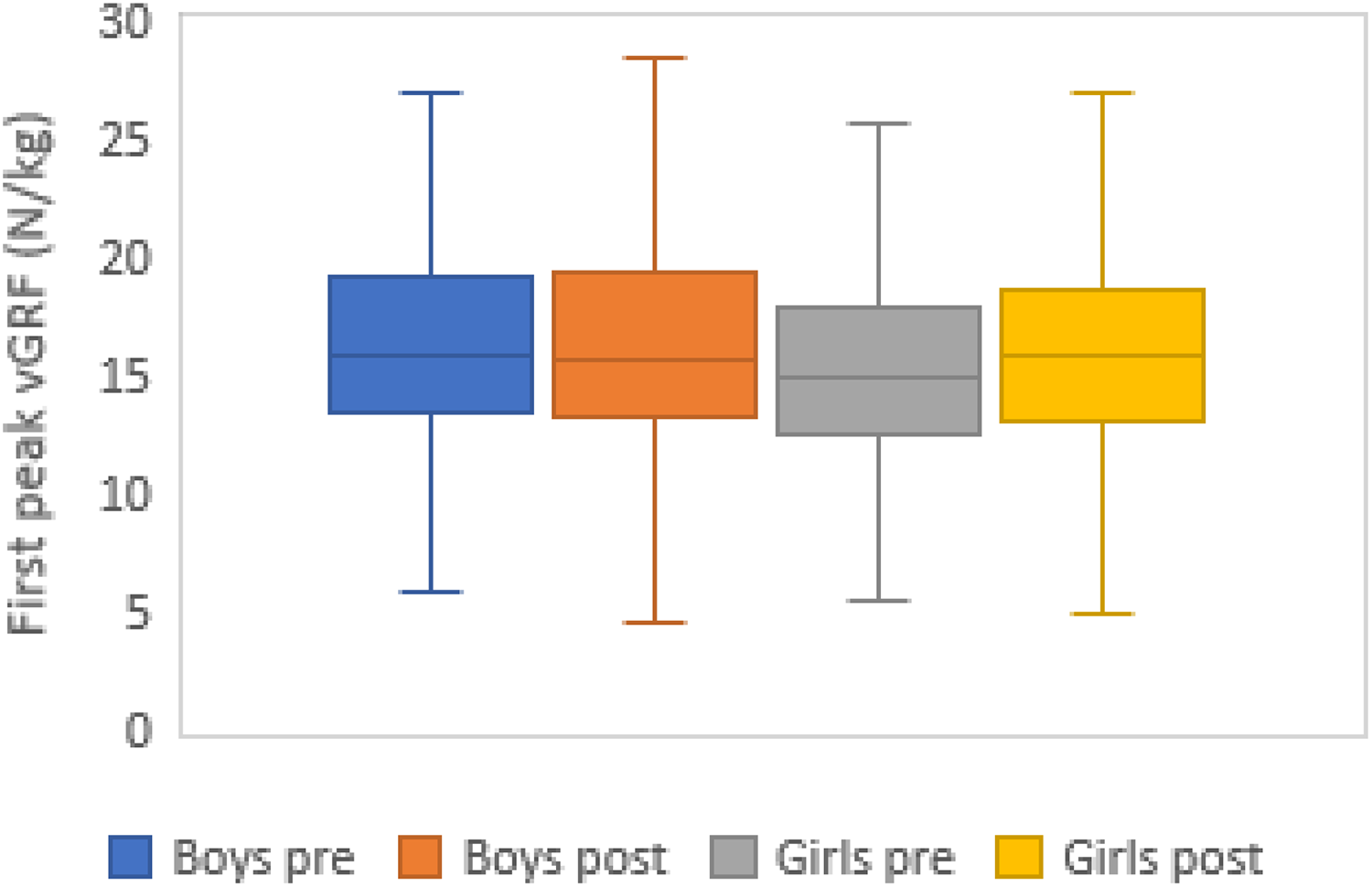
Mean (95% CI) of vertical ground-reaction force (vGRF) (N/kg) of boys and girls for the first 100 milliseconds of the cutting maneuver before (pre) and after (post) a 5-minute fatigue intervention.
Discussion
In the present study, our main purpose was to investigate whether differences between preadolescent boys and girls would be identified for key biomechanical variables during the performance of a cutting maneuver. The main findings of this study demonstrate that in prepubertal or early pubertal athletes, sex-related differences were observed in which, compared with girls, boys showed higher VM, IRM, first peak vGRF, rotation excursion, and extension excursion.
Dynamic Valgus Cluster
Women are at a greater risk for ACL injuries than are men, 35 and knee VM has been linked to a risk of ACL injuries. 12 Few studies have investigated the cutting maneuver during the narrow time frame relevant for an ACL injury, but a study by Sigward and Powers 30 involving 30 collegiate soccer players found that female participants showed greater VM than male participants in the early deceleration phase of a cutting maneuver, which is a time period very similar to that in our study. This is in contrast with the findings of the present study, which may be explained by the age difference. The athletes recruited for the present study were at an age in which girls and boys have an equal risk of ACL injury, 13,22 and consequently, one would expect them to demonstrate similar patterns of biomechanical risk factors. In a larger cross-sectional study, Sigward et al 28 compared 3 age groups and did not find a statistically significant sex × maturity interaction. However, the number of participants in each group was low (n = 18-20), and a significant main effect of greater VM for female participants was driven by differences found in prepubertal girls. The higher knee joint moments demonstrated by boys in our study may reflect greater agility and speed of execution, which is consistent with the trend for boys demonstrating higher vGRF values. Greater forces have also been suggested to reflect greater experience in sports, 29 although this was not accounted for in our study. Tanikawa et al 32 found no sex-dependent differences in kinematics and kinetics in a small study of recreational adults performing a variety of tasks, including a change of direction movement. Although not statistically significant, the VM was 40% higher for male compared with female participants during cutting, while the difference between boys and girls in our study was 16.7%. This is not a large difference, and the sex-dependent differences seen for this age group may not be clinically important in terms of ACL injury risk, as the magnitude of the forces seen is likely most often smaller than that needed to result in an ACL injury.
Stiff Landing Cluster
Boys, not girls, tended to demonstrate greater vGRF and had greater knee extension excursion during the first 100 milliseconds of the change of direction task, indicative of a stiffer landing strategy. The ACL is known to be loaded through tibiofemoral compression, 21 and stiff landings, as assessed via vGRF and knee flexion angles during the DJ task, have previously been associated with ACL injury risk in young female athletes, with the injured cohort displaying a 30% higher peak vGRF compared with that in the uninjured group. 19 In comparison, our 95% CIs support at most a 14% difference, which in and of itself is unlikely to affect the injury risk, but the timing of other contributing factors must be considered in this multifactorial injury. 27 In contrast to the findings of the present study, analysis of data obtained during the DJ performed by the same cohort has shown that girls had higher peak vGRF during the early landing phase compared with boys, 8 indicating that results from DJ and cutting maneuvers are not interchangeable. The trend for higher vGRF, as noted earlier, coupled with greater extension excursion seen for boys may reflect greater speed and explosiveness during the execution of the task. Similar to what was seen for DJ performance, girls responded to the fatigue intervention with greater vGRF, while the boys maintained similar levels; this was the only statistically significant interaction seen. Changes from before to after the intervention seemed to demonstrate a response to fatigue in which less dissipation of forces through knee flexion and higher vGRF went hand in hand, consistent with the DJ study. 8
Although cutting and the DJ are used for screening of ACL injury risk, movement patterns are different, and this may explain the differences in kinematics and kinetics. 16 Studies using the DJ task have demonstrated that compared with boys, girls show higher peak VM, 8 but studies have used different methodologies for analyses. We have recently shown that peak values during the complete deceleration phase occur much later in the movement compared with the time frame during which an ACL injury would occur. 27 A difference between sexes in mean knee abduction angles at IC has been reported 8 for the DJ, while in the current study, no difference was found. Prospective risk factor studies have exclusively used the DJ 8 and variations of it, while change of direction movements are far more often associated with the injury mechanism. 27 The current study demonstrated that even at this young age, biomechanical differences between the sexes are present. The direction of the difference is not toward a higher risk for girls using currently reported risk factors, as would be expected, but toward a higher risk for boys instead. Studies have shown that female adults are 4 to 6 times more likely to sustain a noncontact ACL injury than are male adults participating in the same sport. 3 Because, within this age group, there are no large epidemiological studies reporting ACL injuries and the incidence rate is very low, 10 it is unlikely that these differences play a crucial role in ACL injuries in preadolescents. This does, however, seem an opportune time to start focusing on injury prevention, as there is a sharp rise in ACL injury incidence during the teenage years. 24 This greater incidence may be linked to physiological changes during adolescence, and to be effective, the implementation of preventive training may therefore be indicated during the early teens to influence movement patterns.
A 5-minute progressive fatigue intervention was employed in this study as a convenient way to induce fatigue. Statistical analysis revealed that a number of variables were affected by the fatigue intervention, with only 1 interaction by sex, an increase in early peak vGRF for girls, not boys, which is consistent with results reported for DJ performance. 8 The direction of fatigue effects appears to always be toward a greater risk: increased vGRF, a more extended position at IC, less flexion excursion, and greater extension excursion during the first 100 milliseconds of foot contact. The effects of fatigue on ACL injury incidence, however, are not clear. Recent publication assessing time of season and time in game has not indicated that this influences the injury incidence. 9 Different fatigue protocols did not produce alterations in lower limb biomechanical factors that are believed to increase the risk of noncontact ACL injuries. 4
There are several strengths and limitations in the present study that should be acknowledged. First, we had a large sample size (n = 288) and therefore good statistical power. The data presented were baseline measurements of a prospective cohort study, and the athletes in our sample were younger than the age group in which ACL injuries become more common. These findings may therefore not reflect sex-specific differences that translate into a later increase in the risk of injuries for girls. However, it is important to know when sex differences start to manifest so that training parameters can be altered before the onset of an increased risk. At this age, children’s motor development is not complete, and differences in the skill of execution among athletes may be greater in this age group compared with mature athletes, leading to a greater spread in the data. We accounted for this in our design by using a cutting maneuver without a running start. We propose that this decreased the potential confounding effect of maturity and motor development but acknowledge that it may have led to a systematic bias in which the force of execution was lower compared with that with a running start. Similarly, it remains unclear if execution speed was another possible confounding factor, which was not discussed in this work. It is debatable whether the changes seen after the fatigue intervention were equally likely to be the result of increased movement speed due to a warm-up effect or whether the 5-minute progressive fatigue intervention was enough to induce fatigue in this group of athletes. Another novelty was the performance of the cutting maneuver, which was more likely to mimic an injury situation than a bilateral DJ, and an exercise/fatigue intervention that, to the best of our knowledge, has not previously been introduced for this age group. Athletes who participate in different sports can perform cutting and landing tasks differently. However, there were other factors for which we could not control that may have influenced these results, including other sports, how often they attended practices and physical education in school, and their general lifestyle. The last limitation is that the maturity of each athlete remained unknown.
Conclusion
The current study demonstrated that even at this young age, biomechanical differences between the sexes were present. However, the direction of the difference is not toward a higher risk for girls using currently reported risk factors, as would be expected, but a higher risk for boys instead. We conclude that at this early age, girls do not demonstrate movement patterns associated with a greater risk of ACL injuries during cutting maneuvers. These findings should help practitioners decide on when to implement intervention programs aimed to reduce movement patterns associated with ACL injuries.
Footnotes
Final revision submitted February 24, 2020; accepted March 10, 2020.
One or more of the authors has declared the following potential conflict of interest or source of funding: This study was funded by the Icelandic Centre for Research (Rannís). AOSSM checks author disclosures against the Open Payments Database (OPD). AOSSM has not conducted an independent investigation on the OPD and disclaims any liability or responsibility relating thereto.
Ethical approval for this study was obtained from the National Bioethics Committee (approval code VSNb2012020011/03.07).