




Abstract
Background:
Improving our understanding of the situations and biomechanics that result in anterior cruciate ligament (ACL) injury will support the design of effective injury risk mitigation programs. A few video analyses have been published in recent years, but not specifically involving English soccer.
Purpose:
To describe the mechanisms, situational patterns, and biomechanics (kinematics) of ACL injuries of players involved in matches involving teams in the top 2 tiers of professional English soccer (the Premier League and the Championship).
Study Design:
Case series; Level of evidence, 4.
Methods:
We identified 148 consecutive ACL injuries across 11 seasons of professional English soccer. Overall, 124 (84%) injury videos were analyzed for mechanism and situational patterns, while biomechanical analysis was possible in 91 injuries. Three independent reviewers evaluated each video. ACL injury epidemiology (month, timing within the match, and location on the playing field at the time of injury) was also reported.
Results:
More injuries occurred in defensive (n = 79; 64%) than offensive (n = 45; 36%) playing situations; 24 (19%) injuries were direct contact, 52 (42%) indirect contact, and 47 (38%) noncontact. Of the indirect and non-contact ACL injuries (n = 100), most (91%) occurred during 4 main situational patterns: (1) pressing/tackling (n = 50; 50%); (2) being tackled (n = 18; 18%), (3) landing from a jump (n = 13; 13%), and (4) regaining balance after kicking (n = 10; 10%). These injuries generally involved a knee flexion strategy (with minimal hip/trunk flexion and reduced plantarflexion) in the sagittal plane and appearance of knee valgus in most cases (70%; 96% of identifiable cases). More (n = 71; 57%) injuries occurred in the first half of matches than in the second half (P < .01).
Conclusion:
Indirect contact rather than noncontact was the main ACL injury mechanism in male elite English soccer players. Four main situational patterns were described, with pressing/tackling and being tackled accounting for two-thirds of all indirect and noncontact injuries. Biomechanical analysis confirmed a multiplanar mechanism, with knee loading patterning in the sagittal plane accompanied with dynamic valgus. More injuries occurred in the first half of matches.
Reducing injury burden is of upmost importance in professional soccer players due to the financial and team performance implications of time lost from play.27,28,36 Anterior cruciate ligament (ACL) injuries in particular are a major issue for soccer teams and players. Despite a team of 25 players experiencing only 1 ACL injury every 2 seasons (injury incidence per team per season, 0.43), 51 the high rate of time loss (mean time lost in elite soccer, 210 days)24,51 results in a significant overall injury burden (0.43 × 210 = 90.3 days), almost equivalent to that of hamstring injuries.22,23 Furthermore, ACL injuries are career threatening even at the elite end of soccer, 57 they carry a high risk of reinjury, 17 and they can negatively affect performance and career length.2,43,51
An understanding of injury epidemiology and etiology is crucial in designing injury risk mitigation programs.41,50 A key aspect of injury etiology is establishing the contact mechanisms and context (situational patterns) in which injuries occur. 4 Video analysis is a frequently used and valid tool for investigating injury mechanisms, playing situations and gross biomechanics preceding and during actual injuries. 6 Several systematic video analyses of ACL injuries have been published across different sports,5,12,19,29,31,48 with a number of them focusing on injuries in soccer.9,15,26,37,52 One of our previous studies 15 was a video analysis of a large number of consecutive ACL injuries (N = 134) in professional Italian soccer matches, describing the injury mechanisms, situational patterns, and biomechanics of these injuries. While of important value, it is unknown if the study findings can be generalized to other nations with different playing styles, levels of physicality, 14 and cultural norms.
The English Premier League (20 teams) and the Championship (24 teams) are considered among the best soccer leagues in the world, and it is of interest to those working in and with elite-level English soccer players (as well as a wider consideration around generalizability of previous research) if previous research performed in other leagues reflects the context of English soccer. In the current study, we aimed to describe, using video analysis, the injury mechanisms, situational patterns, and biomechanics related to ACL injury on those professional soccer players playing in the topflight English leagues. A further purpose was to document the distribution of ACL injuries across the match, the season, and the playing field.
Methods
Injury Identification and Extraction of Videos
We performed a systematic search of online database resources across 11 seasons (from 2010-2011 to 2020-2021 until February 2021) to identify ACL injuries occurring in players on the English Premier and Championship teams. This included domestic league matches, as well as friendly, domestic, and international cup and national team (England) matches.
The study methodology has been previously described.15,37 In summary, to identify ACL injuries, each season and team rosters were extracted from online databases (legaseriea.it; legab.it) and single team websites. Then, each player was searched on Transfermarkt.de (Transfermarkt), for injury history details. This methodology has been recently validated for injury identification in professional soccer 34 and adopted by studies on return to play after ACL injury 43 and hip surgery 35 in professional soccer. We supplemented this search by examining further data sources that may have been missed, including national and local media. Injuries were included only when we were able to corroborate the injury with official team media reports. Only injuries involving complete ACL rupture were included. Through similar methods (publicly available sources), any ACL reconstruction procedures undergone by players were tracked.
Match videos were obtained from an online digital platform (wyscout.com; Wyscout). If the video was not available, a second digital platform was searched (paninidigital.com; Panini Digital; DigitalSoccer Project). Videos were then processed using a cloud-based service (paninidigitalcloud.com; DigitalSoccer Project) and downloaded to a personal computer. Match video processing was performed with a cloud-based tool (Digital Log; DigitalSoccer Project). Each ACL injury video was cut to approximately 12 to 15 seconds before and 3 to 5 seconds after the estimated injury frame (IF) to accurately evaluate the playing situation that preceded the injury and injury mechanisms.
All of the videos we accessed as well as the data on the ACL injury were publicly available (subject to paying a license fee). All data were treated confidentially, and no personal player information was accessed. Therefore, ethics approval for this study was not required.15,40
Video Evaluation
The videos were independently evaluated by 3 reviewers (F.D.V., M.S., M.B.) according to 2 predetermined checklists (Supplemental Tables S1 and S2, available separately). All reviewers were involved in sport medicine and orthopaedic rehabilitation practice and/or had extensive experience in video analysis research. Each video was downloaded onto a personal computer and opened with the online software program Kinovea (KinoveaInk) and analyzed through an evaluation flow.
Each reviewer evaluated the original video to define the injurious situation, characterized as defensive or offensive, based on ball possession and specific playing situation. The injured side was determined based on injury history information gathered as well as video data. The dominant leg was defined as the preferred kicking leg, categorized as right or left and determined if the injury occurred to dominant kicking leg. Leg loading was established as on the injured, uninjured, or both limbs. Subsequently, the intensity of action was determined based on estimated horizontal and vertical velocities (zero, low, moderate, or high).
A series of views were then used to determine the injury mechanism and situational pattern. Injury mechanism was divided into 3 categories according to previous research15,38: (1) noncontact, defined as an injury occurring without any contact (at the knee or any other level) before or at IF; (2) indirect contact, defined as an injury resulting from an external force applied to the soccer player, but not directly to the injured knee; and (3) direct contact, defined as external force directly applied to the injured knee. Based on previous findings, we considered the estimation of IF as initial contact (IC) plus 40 ms,15,30,31 but individually determined the estimated IF in all cases, as previous research has shown variance in the time between IC and IF and difference in time between IC and IF across situational patterns. 49 We used the term “situational pattern” to determine the playing action and context of the injury. This was performed for noncontact and indirect contact injuries only and was categorized into 4 main patterns: (1) pressing/tackling, (2) being tackled, (3) landing from jump, and (4) regaining balance after kicking. Any injuries that did not fit these patterns were categorized as other.
After independent analysis, the reviewers met for 1 day to achieve consensus on all items regarding injury mechanisms and situational patterns and to perform a biomechanical (kinematic) analysis. Disagreements were resolved via consensus.15,40,52 Before the meeting, the intraclass correlation coefficient between the reviewers for the IC and IF was 0.99.
Biomechanical (Kinematic) Analysis
Kinematic analysis was performed on noncontact and indirect contact injuries as per previous research 15 when a sufficient quality frontal and/or sagittal view of the injured player was available, collectively as a group during the consensus meeting. The analysis was performed to estimate intersegmental relationship and joint angles according to frontal and sagittal plane alignment at IC and IF. When >1 view was available, composite videos were created by manual synchronization using visual cues.15,40
Sagittal plane angles and trunk tilt were estimated using custom-made software (Screen Editor; GPEM) to the nearest 5°. The remaining frontal and coronal plane estimated joint positions were categorized according to appearance. Foot strike was evaluated according to previous methodology15,52 and after foot contact to the ground, at IC and IF (also see the checklist in Supplemental Table S2, available separately).
Seasonal, Match, and Field Distribution
For each available injury video, data regarding the seasonal, match, and field distributions were gathered through the systematic web revision and the analysis of the videos in relation to the injured player position. We considered (1) month of ACL injury, (2) phase of the game when the ACL injury occurred (the minute and which half of the match), (3) number of minutes played by the ACL-injured athlete, and (4) field location. The player's position on the soccer pitch at the time of ACL injury was recorded according to the lines of the playing field, according to our previous study 15 and based on the study by Andersen et al. 1 The length of the field was divided into a defensive third, midfield, and offensive third, and the width of the field was divided into a left corridor, middle, and right corridor. In addition, the playing field was divided into 11 different zones. The field zone dimensions in square meters were calculated considering the official FIFA soccer field size (105 × 70 m).
Statistical Analysis
Continuous variables have been presented as the median (range). Discrete variables are presented as absolute numbers and percentage of the number of total observations. The proportion test was used to explore possible differences in the distribution of ACL injuries between match halves. An a priori significance level of P < .05 was used. All statistical analyses were conducted using Excel 2016 (Microsoft) and Stata 12 (Statacorp).
Results
A total of 148 ACL injuries were tracked and included. Of these, 55 injuries occurred during Premier League matches; 59 during Championship matches; 2 during Premier League 2 (U23) matches; 11, 5, and 6 during domestic, European, and international team cup matches, respectively; and 10 during domestic and international friendly matches. Injuries occurred in 7 goalkeepers, 50 defenders, 60 midfielders (including wingers) and 31 center forwards. There were 77 (55% of 140) injuries to the right ACL and 63 (45% of 140) injuries to the left ACL (8 injuries were unidentifiable; these were not included in the video analysis), with 81 (58% of 139) injuries to the dominant kicking leg and 58 (42% of 139) to the nonkicking leg. There were 125 primary, 12 contralateral native, and 11 previously reconstructed (ACL graft reinjuries) ACL injuries. A flowchart of the included injuries is shown in Figure 1.

Detailed flow chart of the study. ACL, anterior cruciate ligament.
Injury Mechanism
Video footage was available and identifiable for situational pattern and injury mechanism analysis in 124 of the 148 injuries (84%). Two videos had 5 camera views, 8 videos had 4 views, 50 videos had 3 views, 46 videos had 2 views, and 18 videos had a single camera view. More injuries occurred in defensive (n = 79; 64%) than offensive (n = 45; 36%) situations. Most injuries (110 cases; 92% of 120) involved loading of the injured leg, with single-limb loading on the ground frequently observed (88 cases; 73%). We categorized 47 (38%) noncontact, 52 (42%) indirect contact, and 24 (19%) direct contact injuries (1 case was inconclusive). A large proportion of injuries were estimated to involve high or moderate horizontal speeds (95 cases; 79%), while few (n = 12; 10% of cases) involved high or moderate vertical speeds at IC. Injury mechanism details are summarized in Table 1.
Characteristics of All ACL Injuries and for Noncontact and Indirect Contact Injuries Across Identified Situational Patterns a

Values in parentheses represent number of observations.
Direct Contact Injuries
Direct contact injuries (n = 24; 19%) occurred in both defensive (n = 14; 58%) and offensive (n = 10; 42%) playing situations, with 14 (58%) injuries occurring while tackling, and 10 (42%) while being tackled.
Indirect and Noncontact Injuries According to Situational Pattern
The noncontact or indirect contact ACL injuries (n = 100) were categorized according to the 4 main situational patterns as follows: (1) pressing/tackling (n = 50; 50%), (2) being tackled (n = 18; 18%), (3) landing from a jump (n = 13; 13%), and (4) regaining balance after kicking (n = 10; 10%). Nine cases were categorized as “other” and included dribbling (n = 4), controlling the ball from the air, diving to make a save (goalkeeper), passing, shielding the ball from opposing player, reaching to kick the ball (standing leg injured), and collision with own player. Additional details are reported in Table 1.
Pressing/tackling injuries (n = 50) were all classified as defensive, where the player approached the opponent to close space and/or make a tackle. In pressing injuries (n = 27), the player was predominantly injured during noncontact (81%) deceleration or cutting. In tackling injuries (n = 23), there was typically opponent contact (91% indirect contact) before or at estimated IF (Figure 2).

Examples of pressing and tackling injuries. (A-D) Pressing injury to player in black with injury to left ACL. (A) Approaching the opponent, (B) initial contact, (C) injury frame, (D) loss of balance. (E-H) Tackling injury to player in light blue with injury to right ACL. (E) Approaching the opponent, (F) initial contact and tackling, (G) injury frame, (H) loss of balance. ACL, anterior cruciate ligament.
Being tackled, the second most common situation (18%) typically involved indirect contact (89%) involving a duel-type interaction between the opponent and the injured player (Figure 3) either in (n = 15) or out of ball possession (n = 3). There was typically a mechanical perturbation generally involving the upper body (72%) before or at IF (Figure 3).

Examples of injuries occurring while being tackled. (A-D) Player in blue and white with injury to right ACL being tackled with contact on uninjured lower body part of right limb. (A) Mechanical perturbation, (B) initial contact of injured leg with ground, (C) estimated injury frame of right ACL, (D) loss of balance. (E-H) Player in black and yellow with injury to right ACL being tackled on the upper part of the body. (E) Mechanical perturbation, (F) initial contact of injured leg with ground, (G) estimated injury frame of right ACL, (H) loss of balance. ACL, anterior cruciate ligament.
Landing from a jump (13%) was the third most common pattern, often involving mechanical perturbation to the upper body preceding (n = 9 out of 13), but not at, IF (n = 2 out of 13) (Figure 4). Regaining balance after kicking (10%) was largely noncontact (80%), in which the player loaded his injured leg after kicking the ball, with his attention/gaze away from the injured leg at IF.

Examples of injuries incurred after landing from a high jump and while regaining balance after kicking. (A-D) Player in red and white with injury to right ACL landing from high jump. (A) Jumping, (B) initial contact after landing, (C) estimated injury frame of right ACL, (D) loss of balance. (E-H) Player in blue with injury to right ACL regaining balance after kicking. (E) Kicking the ball, (F) initial contact with ground, (G) estimated injury frame of right ACL, (H) loss of balance. ACL, anterior cruciate ligament.
Biomechanical Analysis
Biomechanical analysis was possible for 91 injuries. All angle data are reported as median values. On the sagittal plane at IC, players displayed an upright trunk (5°), a flexed hip (40°), shallow knee flexion (20°), and plantarflexed ankle (–15° dorsiflexion) with predominantly flat foot appearance (60%).
On the frontal plane at IC, the trunk was slightly tilted ipsilaterally (5°), typically in a neutral position (60%), with an abducted hip (73%), valgus (42%) or neutral (27%) knee appearance, and an externally rotated foot (65%).
From a sagittal plane perspective at estimated IF, the trunk remained upright (10°; +5° from IC), with similar hip flexion (42°; +2° from IC), greater knee flexion (35°; +15° from IC), and plantarflexed ankle (–10°; +5° dorsiflexion from IC), with planted flat foot (83%; but 96% of all identifiable cases). On the frontal plane, the trunk was tilted ipsilaterally (10°; +5° from IC) with greater prevalence of trunk rotation toward the uninjured side versus IC (57%). The hip remained abducted in most cases (60%), with greater prevalence of knee valgus (70%; but 96% of all identifiable cases) and externally rotated foot (65%).
A significant increase in hip internal rotation and/or adduction from IC to IF was seen in most (60%), with valgus collapse occurring in 1 in 4 cases (25%). Additional details are reported in Tables 2 and 3.
Sagittal Plane Metrics of Noncontact and Indirect Contact ACL Injuries a
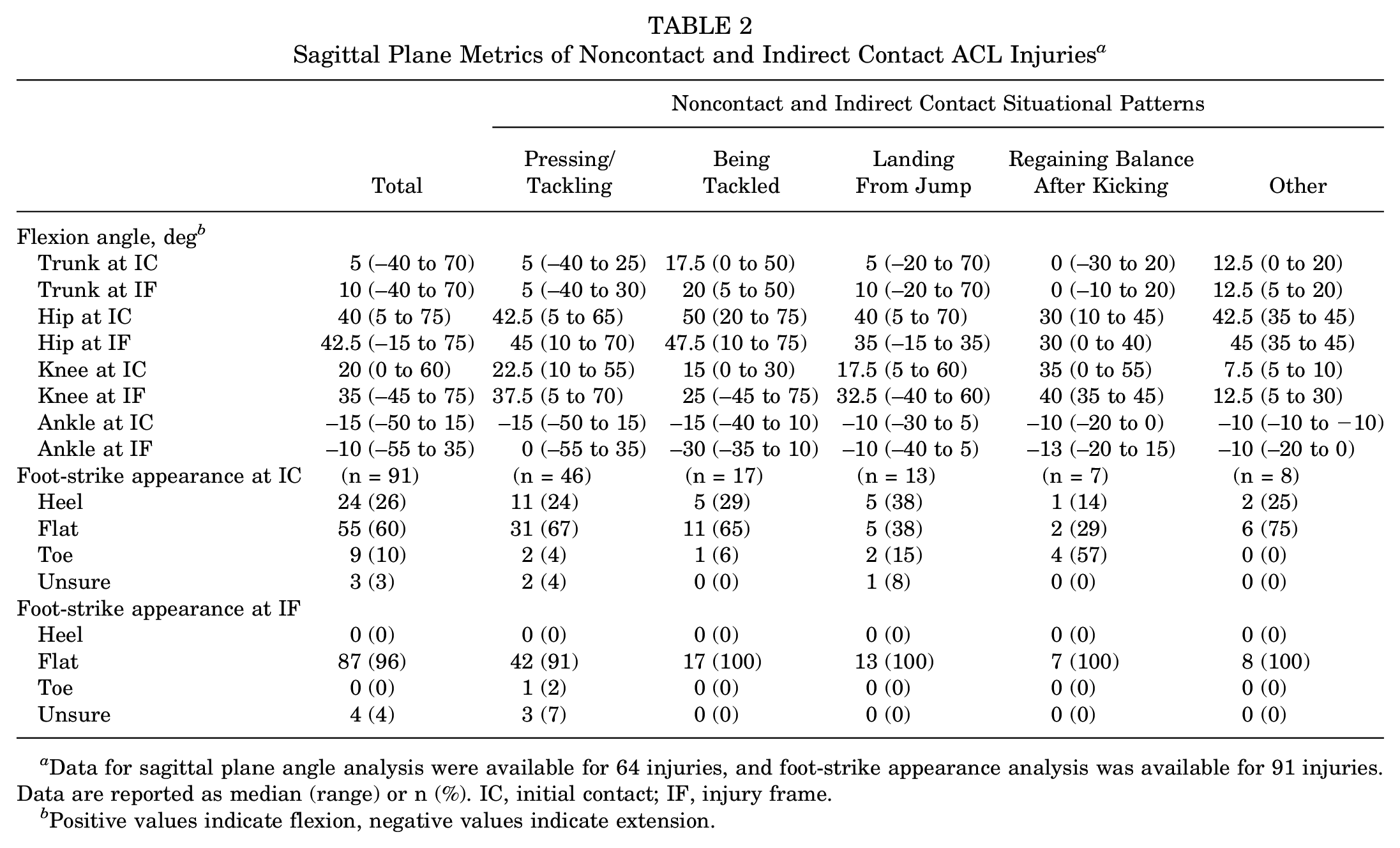
Data for sagittal plane angle analysis were available for 64 injuries, and foot-strike appearance analysis was available for 91 injuries. Data are reported as median (range) or n (%). IC, initial contact; IF, injury frame.
Positive values indicate flexion, negative values indicate extension.
Frontal- and Transverse-Plane Metrics of Noncontact and Indirect Contact ACL Injuries a
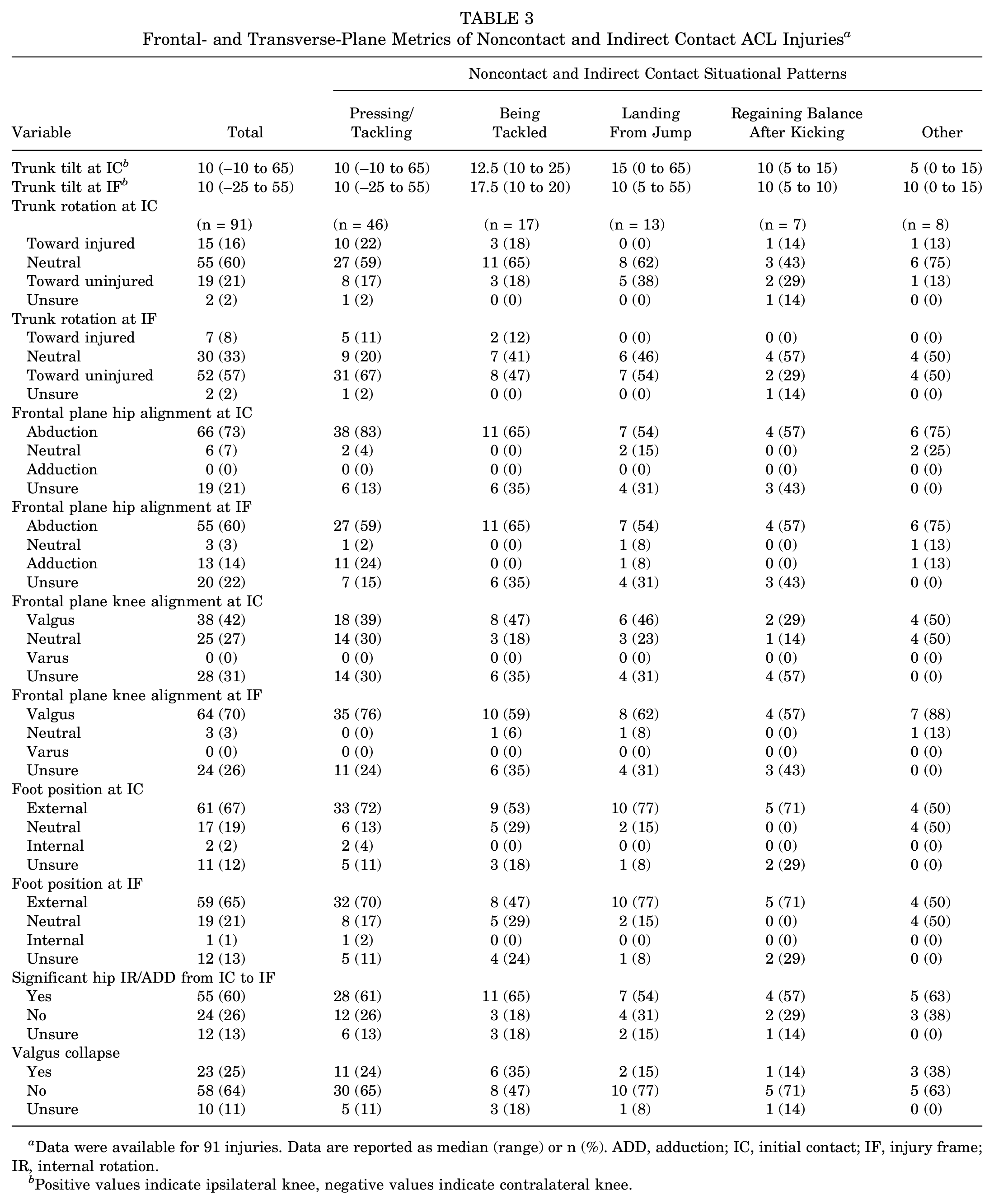
Data were available for 91 injuries. Data are reported as median (range) or n (%). ADD, adduction; IC, initial contact; IF, injury frame; IR, internal rotation.
Positive values indicate ipsilateral knee, negative values indicate contralateral knee.
Seasonal, Match, and Field Distribution
Data for seasonal (n = 148), match timing (n = 124), and field distribution (n = 124) were available. Seasonal distribution demonstrated a lower number of injuries in June and May, similar numbers of injuries across August through January, and a slight drop-off toward the end of the season from February onward (Figure 5).

Distribution of ACL injuries (n = 148) throughout the soccer season according to month of the year. The dashed line represents the trend line for the 2-month rolling mean.
More injuries occurred during the first half of a match (n = 71; 57%) than the second half (n = 53; 43%) (P < .01), with an increase in injuries occurring over the course of each half (Figure 6A). When considering the minutes played, correcting for substitutions, 45% of ACL injuries occurred in the first 30 minutes (Figure 6B).

Distribution of anterior cruciate ligament (ACL) injuries (N = 124) throughout the match according to (A) match minutes and specific time zone/period and (B) minutes of effective playing time. Dashed lines represent linear trendlines.
ACL injuries according to field location are detailed in Figure 7; see also Supplemental Tables S3 and S4, available separately.

Distribution of the 123 ACL injuries on the soccer pitch according to a modification of a previously published division of the field 1 ; The field location could not be identified for 1 injury. The gray arrows indicate the divisions along the length and width of the field, and the dashed black lines mark the boundaries of the 11 zones. The blue dots represent defensive injuries and the red dots represent offensive injuries.
Discussion
The most important findings of the present study were that (1) most ACL injuries in male professional English soccer matches occurred without direct contact mechanism, with indirect contact injuries being the most common injury mechanism; (2) 4 main situational patterns were identified, with pressing/tackling and being tackled accounting for more than two-thirds of injuries; (3) ACL injuries involved a predominant knee flexion strategy in the sagittal plane and appearance of altered frontal and transverse plane motions; and (4) more injuries occurred in the first half of the matches. Some differences were noted for ACL injuries in the English top leagues versus previous work in Italian soccer matches.
Injury Mechanisms
More ACL injuries occurred while defending (64%), as with previous research in soccer players.15,52 Our data again indicated that ACL injuries occur more commonly during high-velocity horizontal deceleration tasks (eg, pressing/tackling), rather than vertical deceleration tasks (eg, landing from jump), similar to previous research in soccer 15 and other sports including rugby 17 and basketball. 49 Injury risk mitigation programs should emphasize the importance of training horizontal deceleration.
The proportion of noncontact injuries (38%) was much lower than 1 previous study (66% noncontact) 52 and slightly lower than our previous study on elite Italian soccer players (44%). 15 A key finding of this study was that indirect injuries were the predominant mechanism of ACL injuries in English elite-level soccer (42%), although still similar to our previous research on Italian elite soccer (44%) 15 and not necessarily significantly different from noncontact prevalence in this study (38%). The importance of indirect contact in ACL injury causation has recently been reported in soccer 15 and other sports such as rugby 17 and American football, 29 as well as in other injuries in soccer players including severe muscle, 19 medial collateral ligament, 10 and Achilles tendon rupture. 16 This study supports previous research that highlights the importance of indirect contact injuries in ACL causation. Most of these indirect contact injuries involved contact to the injured player's upper body before or at IF, which is thought to lead to mechanical perturbation resulting in loss of neuromuscular control and suboptimal kinematics. 47 As 81% of ACL injuries occurred without direct knee contact, our work reiterates the potential for injury risk mitigation.
We found a higher proportion of direct contact injuries (19%) than previous research in European soccer (12%).15,52 This is much lower than research in rugby (32%) 17 and much higher than in basketball (3%). 49 The higher proportion in English versus other European soccer matches likely relates to a higher level of physicality of English soccer and potentially a lower incidence of noncontact injuries. Further work to delineate risk for the various contact mechanisms of injury across leagues, accounting for exposure, is needed.
Situational Pattern of Noncontact and Indirect Injuries
We identified 4 key situational patterns explaining 91% of noncontact and indirect contact ACL injuries, similar to findings in our previous research 15 : (1) pressing/tackling, (2) being tackled, (3) landing from a jump, and (4) regaining balance after kicking. The portion of pressing/tackling injuries (50% vs 47%) and being tackled (18% vs 20%) injuries was very similar to our previous research on Italian soccer players, 15 and further emphasizes these 2 patterns as the main situational patterns, collectively explaining more than two-thirds of indirect and noncontact ACL injuries. In the current cohort, landing from a jump was the third main situational pattern (13%) and, while still lower, represented than research from Waldén et al 52 (25%), it was higher than our previous research in Italian soccer (7%). 15 This likely relates to differences in playing styles, with more in the air duels/headers in English versus Italian soccer and change in elite soccer playing styles from the original study from Waldén et al 52 (based on matches from 2001 through to 2011). Regaining balance after kicking was like previous research in soccer (13% vs 16%). 15 Given that the current study (N = 124) and our previous study (N = 134) 15 have presented similar findings concerning situational pattern analysis, across 2 different leagues on >250 ACL injuries, these likely reflect the generalized situational pattern of ACL injuries in elite-level soccer.
Biomechanics
Our data again support the existing literature showing that ACL injuries occur generally in early knee flexion, with altered frontal plane loading.15,31,33,39,52 We reported a predominant knee-dominant flexion strategy in the sagittal plane, with limited loading/motion at joints other than the knee, like previous research.15,30,52
From IC to IF, there was no/minimal change in hip, trunk, or ankle dorsiflexion, but with a 15° increase in knee flexion. The 20° knee angle at IC is thought to correspond to high ACL loading and a vulnerable position.11,55 The increase in knee flexion from IC to IF corresponds to the body of published research (15°-25°),15,30,52 and the knee flexion angle at IF (35°) sits between 2 previously published studies in soccer, in which Waldén et al 52 reported an IF knee flexion angle of 30° and Della Villa et al 15 one of 40°. Furthermore, numerous other studies across other sports have reported similar knee flexion angles (30°-53°) at IF using video analysis17,49 as well as with model-based image-matching approaches (46°-47°).31,58 While we reported predominant loading at the knee, the change knee flexion from IC to IF was still only half of that found in similar movements not resulting in injury (+15° vs +34°), 6 suggesting reduced knee acceptance in the sagittal plane. Injuries largely occurred in plantarflexion (–10° dorsiflexion), with minimal changes in dorsiflexion from IC to IF (+5°). The reported dorsiflexion angle was lower than that observed in our previous research in soccer players with 2-dimensional video analysis (0°-10°), 15 but similar to that using model-based image matching approaches (4°-5°).31,58 This ankle flexion increase (dorsiflexion range of motion) from IC to IF was dramatically reduced compared with that reported in controls performing similar movements and not sustaining ACL injuries (44°). 7 A flat-footed strike pattern (96% of cases at IF) and reduced ankle angular motion (5° vs 44° dorsiflexion) likely contributed to ankle stiffness and knee joint loading by hindering the calf muscle's ability to absorb external ground-reaction forces while decelerating, landing, or cutting.13,54 This, in combination with minimal trunk and hip motion, suggests preferential sagittal plane loading at the knee level. ACL injuries typically occur with around 3 to 4 times body mass (2000-3000 N) vertically directed ground-reaction force on the single limb. 31 In this sagittal plane scenario, these forces would likely be preferentially focused on the knee, predisposing it to injury.
The altered sagittal plane motions were accompanied by altered frontal- and transverse-plane motions, thought to be crucial for ACL injury. 39 Valgus appearance was apparent in nearly all observable (96%) cases. Similarly, hip abduction motion was common,15,30,52 with a significant increase in hip internal rotation and/or adduction (medial thigh motion) from IC to IF in many (60%) cases. This common increase in frontal-plane motion is likely due to the high external knee abduction moment, determined by hip abduction20,44 on a laterally orientated and planted foot position outside the base of support.20,46
We found a lateral trunk tilt toward the injured limb at IC and IF (10°), as found in other sports, 48 but larger than previous studies on male professional soccer players and rugby players (5°).15,19 The lateral trunk tilt was high for landing injuries (15°) at IC, as reported in a recent study on ACL injuries in basketball. 49 The identified trunk lean at IC for pressing/tackling injuries was the same as our previous study on Italian soccer players (10°), 15 although that study reported a 7.5° increase from IC to IF (17.5° at IF), not found in this study (0° change, 10° at IF). A more pronounced lateral trunk tilt is thought to increase ACL loading due to a lateral shift of the center of mass, achieving a resultant vector line lateral to the knee joint and thereby increasing the knee abduction moment. 44
Seasonal, Match, and Field Distribution
We found a relatively consistent pattern of ACL injuries throughout the year, in contrast to previous research in Italian soccer. 15 The lower proportion of injuries in the months of June and May likely related to reduced match play during these months. Previously, in Italian soccer, 15 we noted a higher proportion of ACL injuries occurring during the first part of the season (September-October) and the secondary peak (March-May) compared with the winter months (January-February), similar to other research. 26 It was speculated this could have been due to sunny/hot weather and on hard/dry fields, which are thought to increase injury risk,3,56 and higher rainfall in the winter months. The differential findings in the current cohort may relate to climate differences and soccer pitch conditions, as well as match play incidence in these months.
Although we found a gradual increase in injuries over the course of the first half of the match, as there was a lower number of injuries in the second half, our work suggests that cumulative fatigue over the course of match play is not a major risk factor for ACL injury, supporting previous research.8,15 Other factors associated with the earlier periods of the match, such as lack of physical preparedness 15 and intense engagements,42,45 may be more important. Interestingly, there appear to be fewer ACL injuries in the first 15 minutes of the match versus the subsequent 30 minutes of the first half, and a slight increase in injuries during the first 30 minutes of effective match time. This is different from previous results in Italian soccer, 15 which found that 25% of injuries occurred in the first 15 minutes of effective match time (vs 18% in this study) and a gradual decrease in injuries throughout match play; however, the findings are similar to recent research we have reported on severe muscle injuries in elite soccer. 19 It is unsure why this was found, but it could relate to match intensity as well as physical preparation.
The field distribution showed a slightly higher prevalence of injury in the offensive third of the field, in contrast to previous research on Italian soccer, which showed a higher proportion in the defensive third. 15 As with previous research,15,26 fewer injuries were seen in the middle of the soccer pitch.
Implications for Practice and Future Research
Understanding injury mechanisms is considered important for prevention.4,41,50 Our work—the findings from this study and our previous study on Italian soccer 15 —collectively suggests that many ACL injuries in elite professional soccer may be preventable, with <1 in 5 occurring because of direct contact. Indirect contact prevalence is similar or slightly greater than the prevalence of noncontact injuries in male players, which suggests mechanical perturbation as an important factor in ACL causation. While nearly 2 in 5 injuries were noncontact, our previous research has shown these injuries typically involved the ball or an opposing player close by or in which the player's attention was directed away from the ground at the time of foot impact to the ground, potentially indicating a role of neurocognitive error and/or distraction in injury causation. 25 Our work suggests that improving neuromuscular control/kinematics during single-leg landing and horizontal deceleration and cutting actions in response to either mechanical or neurocognitive perturbation may be important to reduce ACL injury risk, as well as eccentrically strengthening the lower limb and quadriceps to develop the capacity to absorb high deceleration forces in the sagittal plane. 53 Previous research has shown that change of direction technique may be effectively trained to reduce external knee abduction moment, 20 and altered kinematics at the time of screening for change of direction kinematics has been shown to be prospectively associated with ACL injury risk in a small group of female soccer players. 21 The similarity of findings in this study to that of our work in Italian soccer players 15 suggests that these findings may reflect the typical mechanism, situational patterns, and biomechanics (kinematics) of ACL injury. Further work is now needed to better understand why players get injured under these contexts (the why vs the how).
Strengths and Limitations
The main strengths of our study are (1) the sample size (N = 124), which when including our previous work in Italian soccer players (N = 134) 15 is the largest to date in systematic video analyses of ACL injuries; (2) the consistent biomechanical analysis with the use of measurement tools by 3 independent viewers; and (3) the presentation of field, match, and seasonal distribution data, only presented once previously on a grouping of Italian-only soccer matches. The limitations of this study lie in the methodology used to identify ACL injuries, different from the gold standard of prospective studies having frequent contact with the teams or access to medical records and use of video analysis with assessment of kinematics using video and tools, as opposed to the gold standard model-based image-matching technique. 32 However, the video analysis method is valid 32 and has been consistently adopted in many previously studies. ¶ Furthermore, we did not differentiate between ACL injuries with concomitant injuries (eg, meniscus, medial collateral ligament, articular cartilage), which could affect return-to-play strategies. An additional limitation of our study was the exclusion of training injuries, which could potentially interfere with the overall presentation of ACL injuries in professional soccer, as well as the lack of match play exposure data, which has clear implications for injury epidemiology.
Conclusion
Our work provides further evidence that most ACL injuries occur without direct knee contact in professional soccer. In the current study on elite English soccer players, more than 2 in 5 injuries occurred via indirect contact mechanisms, and indirect contact as opposed to noncontact was the dominant ACL injury mechanism found. Pressing/tackling and being tackled represented more than two-thirds of all direct contact and noncontact ACL injuries. Injuries occurred often during defensive and horizontal intense actions and more so in the first half of the match than the second half. This information may be useful for a better comprehension of potential situations that may be considered in primary reduction and secondary reduction (rehabilitation) settings.
Supplemental Material
sj-pdf-1-ojs-10.1177_23259671251314642 – Supplemental material for Systematic Video Analysis of ACL Injuries in Male Professional English Soccer Players: A Study of 124 Cases
Supplemental material, sj-pdf-1-ojs-10.1177_23259671251314642 for Systematic Video Analysis of ACL Injuries in Male Professional English Soccer Players: A Study of 124 Cases by Francesco Della Villa, Matthew Stride, Antonio Bortolami, Andy Williams, Michael Davison and Matthew Buckthorpe in Orthopaedic Journal of Sports Medicine
Footnotes
Final revision submitted August 12, 2024; accepted September 5, 2024.
The authors declared that there are no conflicts of interest in the authorship and publication of this contribution. AOSSM checks author disclosures against the Open Payments Database (OPD). AOSSM has not conducted an independent investigation on the OPD and disclaims any liability or responsibility relating thereto.
Ethical approval was not sought for the present study.

References
Supplementary Material
Please find the following supplemental material available below.
For Open Access articles published under a Creative Commons License, all supplemental material carries the same license as the article it is associated with.
For non-Open Access articles published, all supplemental material carries a non-exclusive license, and permission requests for re-use of supplemental material or any part of supplemental material shall be sent directly to the copyright owner as specified in the copyright notice associated with the article.
