




Abstract
Background:
As the incidence of overuse injuries to the medial elbow in overhead athletes continues to rise, recent evidence suggests a link between these injuries and alterations in biomechanics produced by athlete fatigue. Previous studies have evaluated the effect of fatigue on elbow injuries using a wide array of fatigue protocols/athletic tasks, and, as a consequence, the results have been heterogeneous.
Purpose:
To determine whether there is a uniform alteration in neuromuscular function or biomechanics as the overhead athlete fatigues. Furthermore, this study sought to determine whether player fatigue should be accounted for in ulnar collateral ligament (UCL) injury prevention programs.
Study Design:
Systematic review.
Methods:
A systematic review of the literature using PubMed and MEDLINE databases was performed. Keywords included fatigue, upper extremity, baseball, pitcher, throwing, and muscle activity. Inclusion criteria consisted of original research articles in the English language involving healthy athletes, use of fatigue protocols, and the evaluation of at least 1 upper limb biomechanical variable.
Results:
A total of 35 studies involving 644 athletes (90 females, 554 males; mean age, 20.2 years) met the inclusion criteria. General fatigue protocols were used in 2 investigations, peripheral protocols were used in all 35 studies, and 5 different athletic tasks were studied (simulated baseball game, overhead throwing, high-effort swimming, simulated tennis game, and overhead serving). There was a uniform decrease in muscle force production and proprioception in athletes after completing a fatigue protocol. However, there was no consistency among studies when evaluating other important upper limb biomechanical factors. The fatigue protocols did not consistently produce statistically significant changes in elbow torque, pitching biomechanics, or ball velocity.
Conclusion:
A uniform decrease in muscle force production and proprioception was found after fatigue protocols; however, a majority of fatigue protocols published in the current literature are inconsistently measured and produce heterogeneous results. Therefore, currently, no recommendations can be made for changes in UCL injury prevention training programs to account for potential effects of fatigue. The effect of muscle force production and proprioception on upper extremity injuries should be evaluated in future studies.
Injuries sustained by the overhead throwing athlete have been evaluated extensively. ¶ In particular, the rise of ulnar collateral ligament (UCL) injuries in baseball pitchers continues to gain interest. 11 Chronic overuse and repetitive stresses on the medial elbow are thought to contribute to UCL injury in pitchers. 2,22,23,62 Although guidelines on rest and pitch counts have been implemented in an attempt to decrease overuse injuries, the risk factors for these injuries are often multifactorial. 7,15,18,50
The contribution of fatigue to musculoskeletal injuries has been studied previously. 3,19,45,47 Muscle fatigue is defined as any exercise-induced reduction in the ability of a muscle to produce maximal force or power. 17 Muscle fatigue can be caused by central factors (brain or spinal cord) or peripheral factors (muscle or peripheral nervous system). It is hypothesized that fatigued muscles absorb less energy before meeting the amount of stretch required to cause ruptures in ligaments and other structures. General fatigue protocols have been developed in an attempt to mimic real game or match situations to cause a global reduction in voluntary muscle activity throughout the body. On the other hand, peripheral fatigue protocols cause reductions in force generation in the muscle distal to the neuromuscular junction and do not include changes to overall muscular control. 3
Recent studies 19,24,47,50 have found that pitchers may experience alterations in biomechanics and increased risk of injury when pitching in the fatigued state. These studies have demonstrated a decline in performance and an increase in overuse symptoms, including decreased pitch velocity, altered pitching biomechanics, increased pain, and altered muscle activation patterns. 19,47 Conversely, earlier investigators 48,49 have suggested no difference in pitching mechanics or muscle activation during a simulated game. These prior studies have included a wide variety of fatigue protocols and tested athletic tasks, making a comparison of the findings inherently difficult. Because previous studies have produced heterogeneous results, it is important to determine the precise effect of fatigue on overuse injury risk in overhead athletes to potentially decrease the incidence of injury in this at-risk athletic population.
The purpose of this systematic review was to determine whether there is a uniform alteration in neuromuscular function or biomechanics as the overhead athlete fatigues. Furthermore, this review attempted to determine whether player fatigue should be accounted for in pitching guidelines to decrease elbow injuries. We hypothesized that previous studies would not show a uniform change in neuromuscular function or biomechanics as an athlete fatigues.
Methods
Research Framework
PRISMA (Preferred Reporting Items for Systematic Reviews and Meta-Analyses) guidelines were followed during the search and review phases of this study. 36
Information Sources and Study Selection
A systematic review of the PubMed database and the Medline database via Ovid was performed in March 2018. Results were limited to articles in English published between January 1, 2000, and December 31, 2017. The following search string was constructed for the PubMed search: (throw OR pitch OR baseball OR softball) AND (upper extremity OR arm OR elbow OR shoulder) AND (fatigue OR muscle activity OR neuromuscular). For the Medline search, Medical Subject Headings were used when available. Reference lists from all primary articles were checked by 3 authors (T.R.J., J.S.T., S.A.) to further retrieve articles that may not have been captured by the database.
Eligibility Criteria
All eligible articles were published in a peer-reviewed journal in the English language. The primary search resulted in 259 articles. All articles were reviewed and included if they met the following criteria: (1) English language; (2) normal, healthy participants; (3) a fatigue protocol; (4) evaluation of at least 1 upper limb biomechanical variable; and (5) the effect of fatigue studied immediately after completion of the outlined protocol (Figure 1).
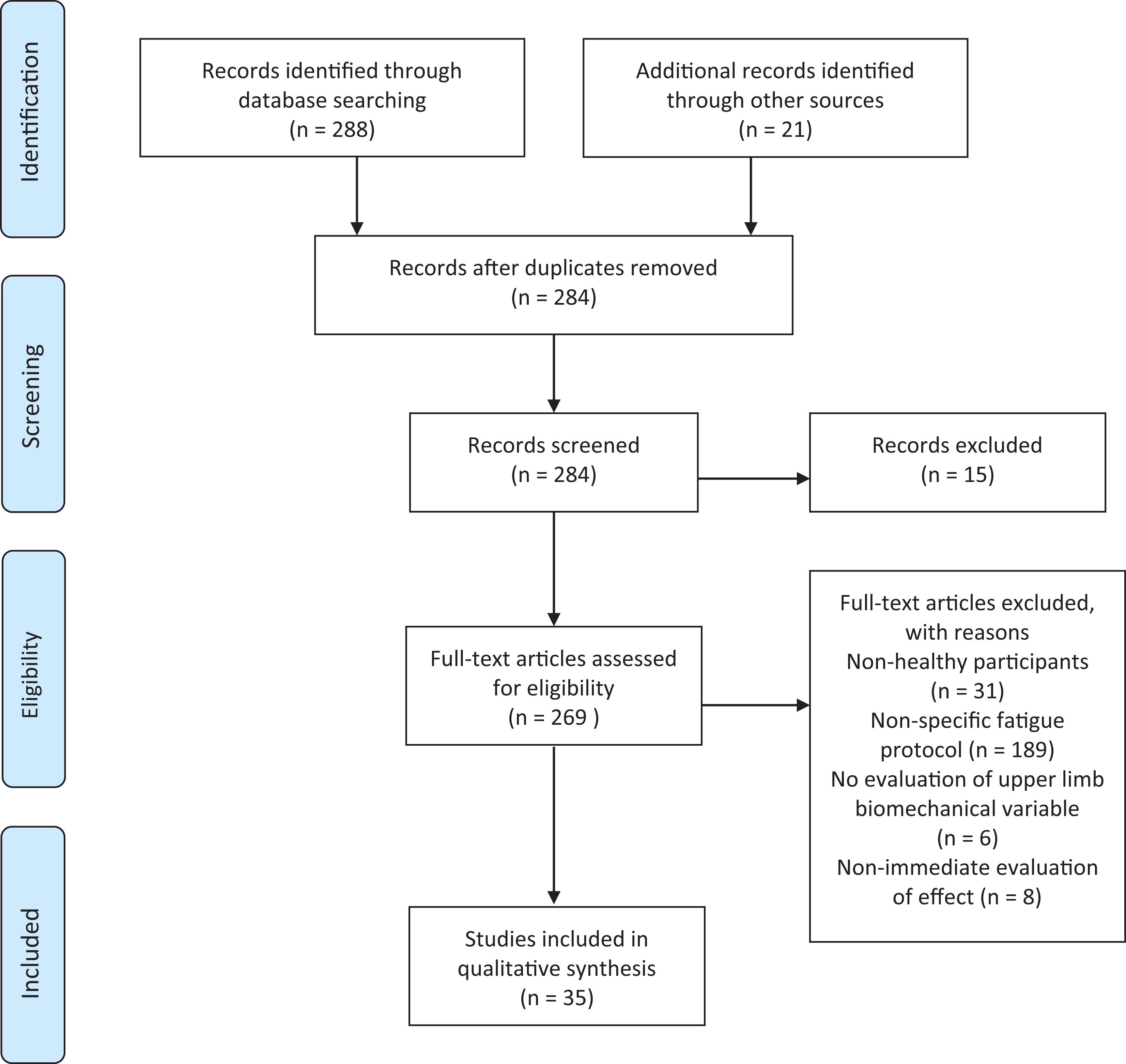
PRISMA (Preferred Reporting Items for Systematic Reviews and Meta-Analyses) flowchart illustration of study inclusion and exclusion criteria.
Data Extraction and Synthesis
The extracted data included age, sex, weight, height, fatigue protocol, measures of fatigue, athletic task, muscles tested, and kinematics tested. Effects on ball velocity, upper limb biomechanics, muscle activation, and recovery after fatigue were also assessed. Articles were reviewed by all authors, and agreement was reached regarding the data extracted. Because of the heterogeneous methodology used in all of the articles, a meta-analysis was not performed. Thus, statistics were primarily descriptive, and each study was analyzed qualitatively. Weighted analysis was performed after participants were pooled across included studies.
Risk of Bias
Owing to the heterogeneity of the studies, the Methodological Index for Non-Randomized Studies (MINORS) instrument was used to rate the quality of the investigations. 56 The MINORS criteria include a 24-point scale for comparative studies and a 16-point scale for noncomparative studies. The MINORS score is reported as a percentage of the total available points. 63
Results
Study Selection and Study Bias
The systematic review yielded 269 potential articles, of which 35 met the inclusion criteria for this study. Of the 35 studies, 30 were noncomparative and 5 were comparative studies. The mean MINORS score for noncomparative studies was 64.3% (range, 50%-81.3%), while the mean MINORS score for comparative investigations was 68.3% (range, 67%-71%).
Study Characteristics
A total of 644 participants were included in the studies, of which 554 were male and 90 were female participants. The mean age of the study population was 20.1 years. Ten studies (28.6%) involved youth (<18 years) athletes. # Thirteen studies were performed on baseball players, ** 4 on tennis players, 33,43,52,54 2 on swimmers, 14,44 and 2 on softball players. 12,55 The remainder of the investigations evaluated some form of exercise that was not sport-specific (Table 1).
Study Characteristics

Fatigue Protocols
All studies included a peripheral fatigue protocol involving an upper limb task. Two studies also utilized a general fatigue protocol as one of the experimental arms, both utilizing a running or a core fatigue protocol. 24,53 Peripheral fatigue protocols involved either a sport-specific athletic task such as throwing, swimming, or tennis shots or involved structured exercises with weights. Three primary measures were used to measure adequate athlete fatigue in exercise tasks: the Borg Rating of Perceived Exertion scale, inability to complete further repetitions of task, or target percentage drops in maximum voluntary isometric contraction (MVIC) via electromyography (EMG) or torque via dynamometer. Seven studies measured athlete fatigue using the Borg Rating of Perceived Exertion scale. 5,14,26,37,43,51,59 The mean fatigue rating was 6.53 before and 15.44 after fatigue protocols.
Upper Limb Athletic Tasks
Eight studies on baseball players and 2 on softball players attempted to mimic in-game fatigue patterns through the use of heterogeneous simulated or real games as a fatigue protocol. †† No study sought to determine a specific point when fatigue was commenced. The remaining 3 studies on baseball players utilized repetitive throwing that did not emulate in-game scenarios. 24,58,61 The 2 studies on swimming fatigued participants through high-effort swimming of varying distances. 14,44 Of the tennis studies, 1 emulated a simulated game environment, 43 while the other 2 involved repetitive overhead serves. 52,54 A total of 16 protocols utilized weighted exercise: 5 examined shoulder fatigue, 8,29,32,37,53 6 primarily elbow fatigue, 4 -6,30,47,61 and 4 involved both joints. 13,26,28,31
Study Outcome Measures
Eighteen studies used EMG to examine changes in muscle activation patterns. ‡‡ Fourteen studies used a 3-dimensional motion capture to examine joint kinematics, §§ and 15 used MVIC measurements before and after fatigue protocol. ∥∥ Measures of muscle force production (torque) before and after fatigue protocol were also conducted in 13 of the investigations with the use of a dynamometer. ¶¶ In these studies, comparisons of outcomes before and after fatigue protocols were calculated via t test or analysis of variance.
Ball Velocity
Ball velocity was a primary outcome in 13 studies; 2 of the studies were performed on tennis players, 43,54 1 on fast-pitch softball pitchers, 12 and the remainder on baseball pitchers. ## The 2 investigations on tennis players found a significant drop in serve speed as the athlete progressed through a simulated game. 43,54 Among pitchers, there were varying results regarding changes in ball speed after fatigue protocols. Three studies showed insignificant decreases in ball speed (<2 mph), 19,20,25 2 studies did not find a significant drop in velocity after a simulated game, 48,49 and the remainder of the studies on baseball players did show significant decreases in ball velocity as athletes progressed through the simulated games (Figure 2). There was a mean decrease in ball velocity of 2.9% after fatigue protocols.

Effects of fatigue on ball velocity and muscle torque. Each dot indicates results for athletic tasks either for the entire cohort or for each subgroup when comparisons were performed (such as different task or fatigue protocol) within a study. (A) Ball velocity, 12 task analyses in 12 studies. (B) Muscle torque, 13 task analyses in 13 studies.
Upper Limb Biomechanics
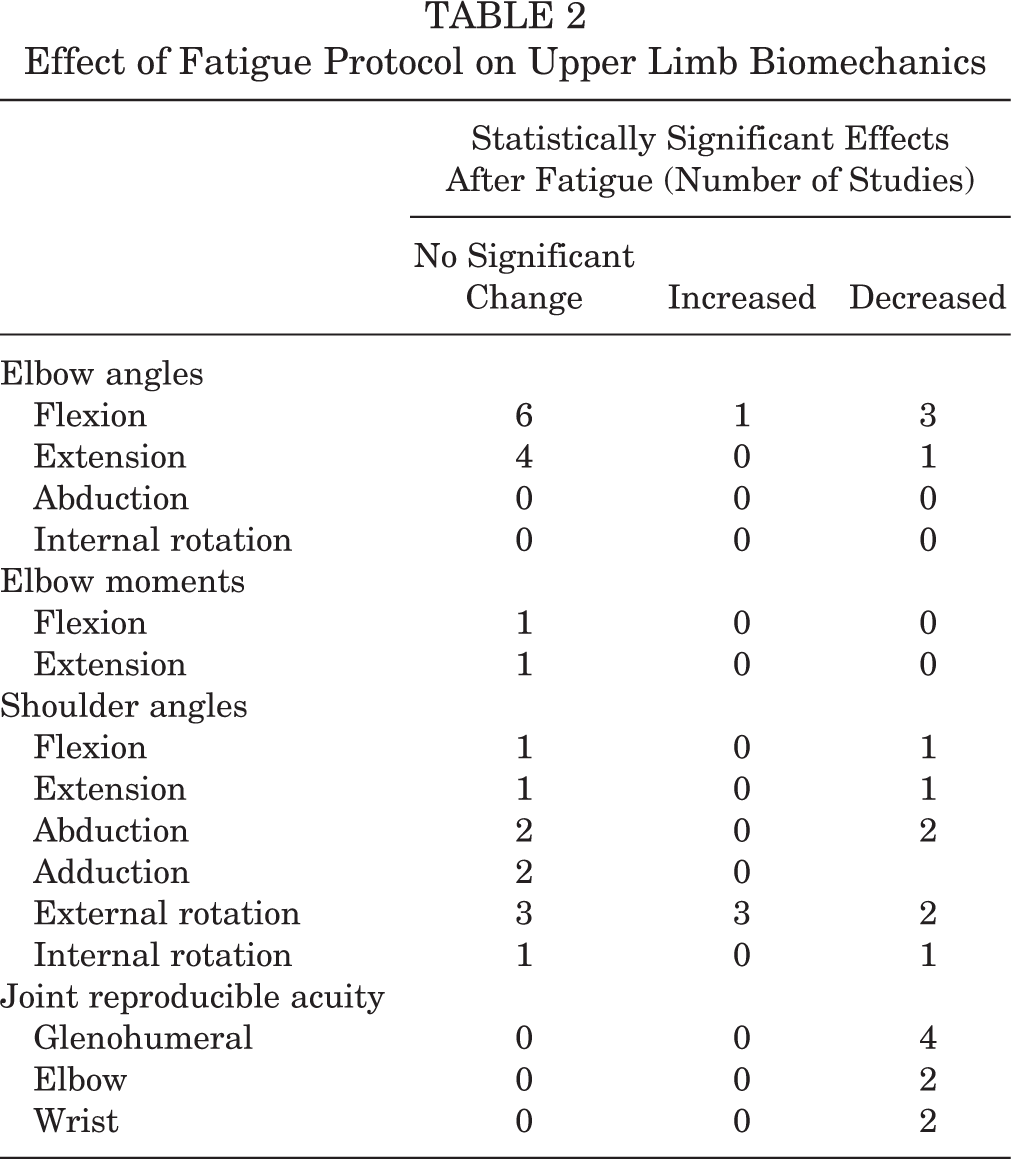
Fourteen studies analyzed biomechanics via a 3-dimensional video motion capture. §§ There was inconsistency regarding reported differences in pitching biomechanics before and after fatigue protocols. Two studies reported no differences in joint angles (shoulder, elbow, and hip) before and after simulated games. 48,61 Among the remainder of the investigations, there were no consistent reports of differences in elbow or hip kinematics before and after fatigue protocols (Table 2). Three studies demonstrated increased scapular upward rotation with fatigue. 8,32,37 One study found a significant decrease in the angle between the forearm and ground at ball release, also known as arm slot. 47 In this study, however, there were no differences found in shoulder rotation or arm speed as pitchers fatigued.
Effect of Fatigue Protocol on Upper Limb Biomechanics
Six studies assessed proprioception and position sense following fatigue protocols. 6,24,29,44,58,59 While specific protocols differed, each investigation essentially required participants to re-create a joint position after upper extremity fatigue. In each of the 6 studies, there were significant changes in acuity of joint angle reproduction, with overall diminished proprioceptive accuracy. One investigation noted this change to be of higher magnitude in the dominant versus nondominant arm. 44
Muscle force production, as measured by dynamometer before and after fatigue protocols, was assessed in 14 studies. a While the tested musculature varied between studies, all included protocols demonstrated statistically significant drops in muscle torque with fatigue. One of these studies was conducted on adolescent pitchers and found that pitching a simulated game resulted in significantly decreased torque generation at both the shoulder and elbow joint musculature. 51 Another study examining the effects of the bench press on elbow joint forces reported that bench pressing leads to lower torque and higher joint forces acting at the elbow after fatigue. 28 Five studies measured the torque of elbow flexors before and after fatigue protocol and found a mean 23.69% drop in force production in the fatigued state. 5,12,28,30,51 Three studies additionally examined a change in torque at the elbow extensors, pronator, and supinators and found decreases in force production of 23.8%, 25.8%, and 24.0% after fatigue protocols, respectively. 12,28,51 Only 1 study examined medial elbow torque after a pitching fatigue protocol and found a significant increase in elbow torque (0.84 N·m) per inning as athletes fatigued. 47
Muscle Activation
EMG was utilized to measure muscle activation in 18 of the included studies. b The effect of fatigue protocols on activation varied significantly between investigations. Four investigations looked specifically at EMG changes in throwers. Statistically significant decreases in activity were observed in the biceps brachii, triceps brachii, brachioradialis, flexor carpi radialis, flexor carpi ulnaris, flexor digitorum superficialis, extensor digitorum, extensor carpi radialis longus, extensor carpi radialis brevis, supinator, and pronator (Figure 3). 61

Effects of fatigue on electromyography activity. There were no uniform effects of fatigue on electromyography muscle activation patterns. Each dot indicates the result for athletic tasks either for the entire cohort or for each subgroup when comparisons were performed (such as fatigue protocol or different tasks) within a study. Biceps brachii (BB), 6 task analyses in 18 studies; triceps brachii (TB), 7 task analyses in 18 studies; brachioradialis (BRD), 2 task analyses in 18 studies; flexor carpi radialis (FCR), 5 task analyses in 18 studies; flexor carpi ulnaris (FCU), 1 task analysis in 18 studies; flexor digitorum superficialis (FDS), 1 task analysis in 18 studies; extensor digitorum (ED), 1 task analysis in 18 studies; extensor carpi radialism logus (ECRL), 4 task analyses in 18 studies; extensor carpi radialis brevis (ECRB), 2 task analyses in 18 studies; supinator (SUP), 1 task analysis in 18 studies; and pronator (PROT), 1 task analysis in 18 studies.
Recovery
Six studies examined recovery after fatigue protocol. 5,14,51,52,55,59 A study performed on swimmers swimming above their average speed found that torque production was able to return to prefatigue values after 2.5 minutes. 14 After eccentric elbow flexor exercise, individuals still exhibited significantly decreased maximum force production after 2 hours, and objective joint stiffness, as measured by range of motion with a goniometer, had worsened in the same period. 5 Softball players pitching at a multiday tournament were unable to recover to their prefatigue strength between each of their games, and their strength generation significantly decreased as they pitched in more games. 55 In youth baseball players, deficits in shoulder force production remained after 2 days of rest. 51
Discussion
This study found that fatigue protocols currently published in the literature produce a decrease in muscle force production and proprioception after the completion of a fatigue protocol. However, there is wide variation in the study protocols and athletic tasks evaluated in the literature, which produced inconsistent results when evaluating other upper limb biomechanical factors. There were no consistent data that demonstrated the type of fatigue protocol (general vs peripheral) or athletic task (simulated game vs repetitive throwing) and uniformly produced statistically significant changes in pitching biomechanics. Therefore, currently no recommendations can be made for changes in UCL injury prevention training programs to account for potential effects of fatigue.
The 35 included studies demonstrated heterogeneous methods with regard to fatigue protocols and primary outcomes. Owing to this fact, a meta-analysis could not be performed. All studies used muscular fatigue to indicate an endpoint for the protocol. The measures of fatigue included the Borg Rating of Perceived Exertion scale, inability to complete further repetitions of task, or target percentage drops in MVIC via EMG or torque via dynamometer. These protocols relied on either a set number of repetitions (eg, throws) or dynamic testing of muscle fatigue using an instrument indicating muscle fatigue (eg, velocity or MVIC via EMG). For example, Gandhi et al 25 measured fatigue after a simulated game of approximately 90 pitches in 25 baseball players using EMG testing and found that fastball velocity significantly dropped from 65 to 63 mph and MVIC significantly dropped by 7%. In adolescents, prolonged pitching also led to a drop in performance, as measured by ball velocity and subjective muscle fatigue. However, although participants had increased subjective pain and tiredness throughout the course of the simulated games, there was insufficient evidence to suggest pain as an indicator for impending injury. 19,51 The effect of fatigue was also noted in tennis players, as a simulated game led to drops in serve velocity and decreases in MVIC in dominant forearm musculature. 54 Fatigue protocols utilizing a simulated game fail to account for variations in player-to-player endurance. Additionally, these protocols do not account for sex-based variations, as it has been determined that females fatigue with variation compared with men. Alterations experienced by a pitcher succumbing to fatigue can have protective and detrimental effects. While a decreased fastball velocity would have a protective effect on elbow stress, decreased muscle activity about the elbow would decrease the secondary support provided by the musculature. Overall, it appears that fatigue protocols had a varying effect on in-game performance; however, further investigation is necessary to define the precise contribution of fatigue to injury in the throwing arm.
Altered proprioception or joint position sense appears to cause players to be less aware or protective of their extremities. In the present systematic review, all 6 studies that examined proprioception found that there were significant changes in acuity of joint angle reproduction, with diminished proprioceptive accuracy overall after fatigue protocol. In a cross-sectional study of 17 collegiate pitchers, Manske et al 39 found that dominant elbows demonstrated significant losses of active joint reproduction after throwing, particularly at the 35% and 80% angles; this was not demonstrated in the nondominant elbows. Only 1 of the 35 included studies directly measured torque experienced by the medial elbow. In this study of 11 pitchers using a specialized mobile sensor, Okoroha et al 47 found that medial elbow torque increased (0.84 N·m per each inning pitched; P < .01; effect size, 0.08) while pitch velocity decreased (0.28 mph per inning; P < .01; effect size, 0.27) as the pitcher fatigued. It is thought that fatigue leads to increased joint reactive forces and sensorimotor system deficits, resulting in the inability of the pitcher to maintain ideal throwing mechanics and causing greater UCL stress and higher propensity for injury. 16,39 However, more studies must be done to determine the direct effect of fatigue on valgus moments about the elbow.
Overhead throwing athletes generate up to 120 N·m of valgus torque about the elbow. 22 While the UCL has been regarded as the primary stabilizer of valgus stress in the elbow, cadaveric studies have shown that it can only resist approximately 34 N·m of torque. 1 In a cadaveric study of attenuated UCLs evaluating muscle torque specifically, Udall et al 60 showed that the flexor digitorum superficialis (FDS), pronator teres, and flexor carpi ulnaris are all active stabilizers of the elbow to valgus stress, with the FDS muscle being the largest contributor. In the present study, all included protocols that evaluated muscle fatigue demonstrated statistically significant drops in produced muscle torque with fatigue. In the UCL-intact elbow, the flexor-pronator muscles play a role in stabilizing the UCL and protecting the ligament from stress. 60 As athletes fatigue their flexor-pronator mass muscles with repeated throwing, they will have decreased ability to protect the intact UCL through dynamic stabilization, which may place them at risk for injury.
Results in a majority of the studies were reported as mean ± SD without mention of participants who were at heightened risk stratification for injury. Few studies reported the clinically relevant changes for their tested biomechanical factors, which can be useful in risk stratification. Objective measures such as EMG, strength testing, and dynamometers are useful in identification; however, the injury threshold for each muscle has not been fully elucidated. There was no uniformity between investigations in reporting which muscles were affected most by fatigue, limiting the ability to recommend targeted strengthening of any particular muscle group. In a similar study investigating lower extremity fatigue and anterior cruciate ligament injury, Barber-Westin and Noyes 3 suggested the use of equivalence testing, where a significant difference between the 2 test conditions (pre- and postfatigue) can be more clearly elucidated.
Previous studies have hypothesized that the effect of fatigue on lower extremity muscles is dependent on whether an athlete undergoes a peripheral versus a central fatigue protocol. 45 Barber-Westin and Noyes 3 further recommended known fatigue measures such as heart rate as a standard in subsequent fatigue measures. While these measures would certainly be helpful when measuring lower extremity fatigue, they have limited applicability in upper extremity fatigue, as athletes may not have significant elevations of traditional general fatigue markers such as heart rate during upper extremity fatigue. Instead, it may be better to focus on specific measures of peripheral fatigue (eg, EMG and strength decrement) in future studies.
A limitation of this systematic review is that only 5 (14.3%) of the included studies performed a prospective power analysis. Several studies included minimally clinical important differences for the variable in which they were investigating. For instance, Skillington et al 55 examined fatigue using a visual analog scale (VAS) among 16 softball pitchers using a minimally clinical important difference of 2. However, several scales were used in subjective determination of fatigue (eg, VAS and Borg Rating of Perceived Exertion scale), which makes it difficult to compare the magnitude of change and difference between studies. Although muscle weakness/fatigue in the lower extremity has been found to produce differential landing mechanics and increased risk of ACL injury, the exact role of muscle stabilization in UCL injury as well as further clarification between fatigue rating scales are needed in future studies.
Conclusion
A uniform decrease in muscle force production and proprioception was found after fatigue protocols; however, a majority of fatigue protocols published in the current literature are inconsistently measured and produce heterogeneous results. Therefore, currently no recommendations can be made for changes in UCL injury prevention training programs to account for potential effects of fatigue. A more uniform analysis is required to properly evaluate the relationship between fatigue and UCL injury, including refinement of methods of analysis and fatigue protocols. Additionally, the effect of muscle force production and proprioception on upper extremity injuries should be evaluated in future studies.
Footnotes
One or more of the authors has declared the following potential conflict of interest or source of funding: T.R.J. has received educational support from DePuy/Medical Device Business Services and hospitality payments from Zimmer Biomet. K.R.O. has received educational support from Smith & Nephew and Medwest and hospitality payments from Stryker and Wright Medical. J.C. has received educational support from Smith & Nephew and Arthrex. V.M. has received educational support from Arthrex and Pinnacle and hospitality payments from Stryker and Smith & Nephew. N.V. has received consulting fees from Smith & Nephew, Medacta, and Arthrex; nonconsulting fees from Pacira and Arthrex; educational support from Medwest; and royalties from Smith & Nephew. AOSSM checks author disclosures against the Open Payments Database (OPD). AOSSM has not conducted an independent investigation on the OPD and disclaims any liability or responsibility relating thereto.