




Abstract
Background:
Low back injuries are common in collegiate football players and can frequently lead to persistent pain, reinjuries, and time lost from participation.
Purpose:
To describe the epidemiology of back injuries in National Collegiate Athletic Association (NCAA) football players during the 2009/2010 through 2013/2014 academic years utilizing the NCAA Injury Surveillance Program (ISP) database.
Study Design:
Descriptive epidemiology study.
Methods:
A convenience sample of NCAA varsity football teams was utilized to determine the rates and patterns of back injuries as well as to generate national injury estimates. The rates and distribution of back injuries were identified within the context of mechanism of injury, injury chronicity, and time lost from sport. Injury rates were calculated as the number of injuries divided by the total number of athlete-exposures (AEs). Incidence rate ratios were calculated to compare the rates of injury between season, event type, mechanism of injury, injury chronicity, and time lost from sport.
Results:
Nationally, there were 267 low back injuries reported in the database. These were used to estimate 7076 back injuries over the 5-year period, approximately 82% of which were new injuries. The injuries occurred at a rate of 2.70 per 10,000 AEs. Overall, injuries were 3.12 times more likely to occur in competitions than in practices. Athletes were 4.67 times more likely to sustain a back injury during the preseason compared with the postseason but were 1.41 times more likely to sustain a low back injury during the preseason compared with the regular season. Both contact and noncontact were reported equally as the mechanism of injury (37.8% and 38.3%, respectively), and unspecified low back pain was the most common injury (64.2%). Only 1.6% of patients required surgery for their injury, and the majority of athletes (59.6%) returned to play within 24 hours.
Conclusion:
There was a relatively high rate of lumbar back injuries at the collegiate level (2.70/10,000 AEs), the majority of which were new injuries. About 18% of reported injuries were reinjuries. Although very few required surgery, a careful examination and work-up should be conducted to evaluate each injury. Regimented physical therapy and reconditioning programs are recommended to avert reinjuries.
American football has been a staple of collegiate sports in the United States for over a century. During the 2016–2017 season, there were 671 National Collegiate Athletic Association (NCAA) college and university varsity football teams, with over 70,000 student-athletes participating across 3 divisions. 13 Given the high-intensity and high-impact nature of the sport, injuries are commonplace. Most of these injuries occur during regular practices (56%), but the actual rate of injuries is highest during competitions (36.94/1000 athlete-exposures [AEs]). 16 In addition, compared with high school, athletes in college are older and stronger, leading to higher energy mechanisms of injury. This is evidenced by the lower injury rate in high school athletes when compared with that in collegiate athletes (4.36 and 8.61 per 10,000 AEs, respectively). 21
Although not the most common injury sustained by football players, low back injuries have the potential to cause significant morbidity. Untreated, these injuries can linger and become chronic problems in the future. In the National Football League (NFL), between 2000 and 2011, lumbar spine injuries comprised 30.9% of all spinal/axial skeleton injuries. 17 In addition, Schroeder et al 20 reported that over 13% of athletes from a single NFL franchise were identified as having a previous lumbar spine injury. Interestingly, they found that players drafted with a known history of lumbar injuries had a significant decrease in the number of years and games played compared with those without such a history. Another series reported that 63 of 65 retired NFL players presenting for disability evaluations reported suffering from a symptomatic lumbar spine. 4
Although low back injuries have been well described in professional football, there remains a paucity of literature on these injuries in NCAA athletes. 9,17 The NCAA Injury Surveillance Program (ISP) provides reliable data on injuries in collegiate athletes and has been used previously to describe these injuries. 1,6,16,25 The purpose of this study was to analyze the NCAA ISP database from the 2009/2010 to 2013/2014 academic years in order to characterize the epidemiology of low back injuries in NCAA football athletes.
Methods
Data Collection
The study was found to be institutional review board exempt and was approved by the research review board of the NCAA. The data analyzed and presented in this study were collected by the NCAA ISP. The NCAA ISP is a prospectively gathered injury surveillance program managed by the Datalys Center for Sports Injury Research and Prevention, an independent nonprofit research organization. The methodology for gathering data in the NCAA ISP has previously been described in the literature and is briefly reviewed below. 14,23 We utilized data from the 2009/2010 to 2013/2014 academic years.
The NCAA ISP provided a voluntary convenience sample of NCAA football programs over the 5-year period. Consequently, there is variability in the number of programs participating in the data set each year. 7,14 As previously reported, this creates a deterministic sample of data, as opposed to a random sample, and has been used to monitor injury trends and patterns. 5
Athletic trainers (ATs) at each participating program recorded injury and exposure data electronically through each institution’s electronic health record (EHR). Data were collected during organized practices and competitions during the preseason, regular season, and postseason. For each injury, ATs and/or physicians completed a detailed report on the injury itself as well as the circumstances surrounding the injury. Injury data collected included the anatomic site, diagnosis, and circumstances of the injury and event type. The date on which players returned to practices was then also recorded. The ATs also recorded the number of student-athletes participating in each practice and competition to determine exposures.
To be certified as a contributing member, each school’s EHR system had to undergo a data validation process. The data recorded via the EHR were then deidentified and extracted from each program. Next, these data were passed through a verification process to ensure validity and consistency. These quality assurance measures allowed the ATs to be notified if any data were missing. The ATs then worked in tandem with the quality assurance team to remedy any problems. Finally, the exported data passed through an automated verification process that conducted a series of range and consistency checks, limiting outliers. Data that passed the verification process were then placed into the aggregate research database.
The database was queried for football players in any division who sustained a “lower back” or “lumbar” injury and “sacrum/pelvis” injury. Data included in the data set not pertinent to the lower back (such as a gluteus medius injury, hemorrhoids, hernia, etc) were not included in the analysis. This study relied on the training and expertise of the ATs collecting data, as well as the other members of the medical staff assisting in documentation, to accurately diagnose and report all lower back injuries. The most recently updated diagnoses were used.
Computing National Estimates
To calculate national estimates of the number of lower back injuries, poststratification sample weights based on sport, division, and academic year were applied to each reported injury and AE. Poststratification sample weights were calculated with the following formula:

where weightabc is the weight for the ath sport of the bth division in the cth year. Weights for all data were further adjusted to correct for underreporting, accounting for the estimated 88.3% capture rate of all time-loss medical care injury events with the NCAA ISP previously reported in the literature. 3,7,16,23
Definitions
An AE was defined as 1 student-athlete participating in 1 NCAA-sanctioned practice or competition in which he or she was exposed to the possibility of an athletic injury, regardless of the time associated with that participation. Degenerative injuries reported were defined as a combination of lumbosacral degenerative disease and lumbar facet syndrome.
Statistical Analysis
Data were analyzed to assess the rates and patterns of low back injuries sustained in collegiate athletes. Low back injuries were analyzed for injury type, time loss, time of season, event type, chronicity of injury, and injury mechanism. The injury rate was defined as the number of injuries divided by the number of AEs. The rates were reported as the ratio of injuries per 10,000 AEs and were reported as an overall rate as well as individual rates for event type (practice, competition) and time of season (preseason, regular season, postseason). Incidence rate ratios (IRRs) were calculated to compare rates between event type and time of season, as they are useful for determining whether one participation type has an increased rate of injuries compared with another. The following is an example of an IRR comparing injury rates between competitions and practices:

All reported 95% CIs not containing 1.0 were considered statistically significant. Participation restriction time was reported as intervals (<24 hours, 1-6 days, 7-21 days, and >21 days), and descriptive data were presented as percentages of injuries. Data were analyzed using SPSS software (IBM) and Excel (Microsoft).
Results
Overall, 267 low back injuries were reported to the NCAA ISP database during the 2009/2010 to 2013/2014 academic years for varsity football teams. The injuries reported in this sample represented a national estimate of 7076 low back injuries occurring in NCAA football players during this time period (Table 1). The overall injury rate for low back injuries was 2.70 per 10,000 AEs. Over 64% of the injuries were reported as unspecified low back pain. After pain, the most common diagnoses were contusion (11.8%), sacroiliitis (8.2%), and disc herniation (7.6%). Injury rates were comparable between NCAA Divisions I and III (3.30 and 3.10 per 10,000 AEs, respectively) (Table 2).
National Estimates of Low Back Injuries by Injury Type a

a AE, athlete-exposure.
National Estimates of Low Back Injuries by NCAA Division a

a AE, athlete-exposure; NCAA, National Collegiate Athletic Association.
Event Type
The low back injury rate for practices and competitions was 2.30 and 7.10 per 10,000 AEs, respectively (Table 3). Players were 3.12 times more likely to be injured during competitions compared with practices (IRR, 3.12 [95% CI, 2.38-4.08]).
Injuries in Relation to Practices and Competitions a

a AE, athlete-exposure; IRR, incidence rate ratio.
Season of Play
The injury rate was the highest during the preseason, at 3.50 per 10,000 AEs (Table 4). Players were 1.41 times more likely to be injured during the preseason than in the regular season (IRR, 1.41 [95% CI, 1.10-1.80]) and 4.67 times more likely to be injured during the preseason compared with the postseason (IRR, 4.67 [95% CI, 1.48-14.73]).
Injuries in Relation to Season of Play a

a AE, athlete-exposure; IRR, incidence rate ratio.
Mechanism of Injury
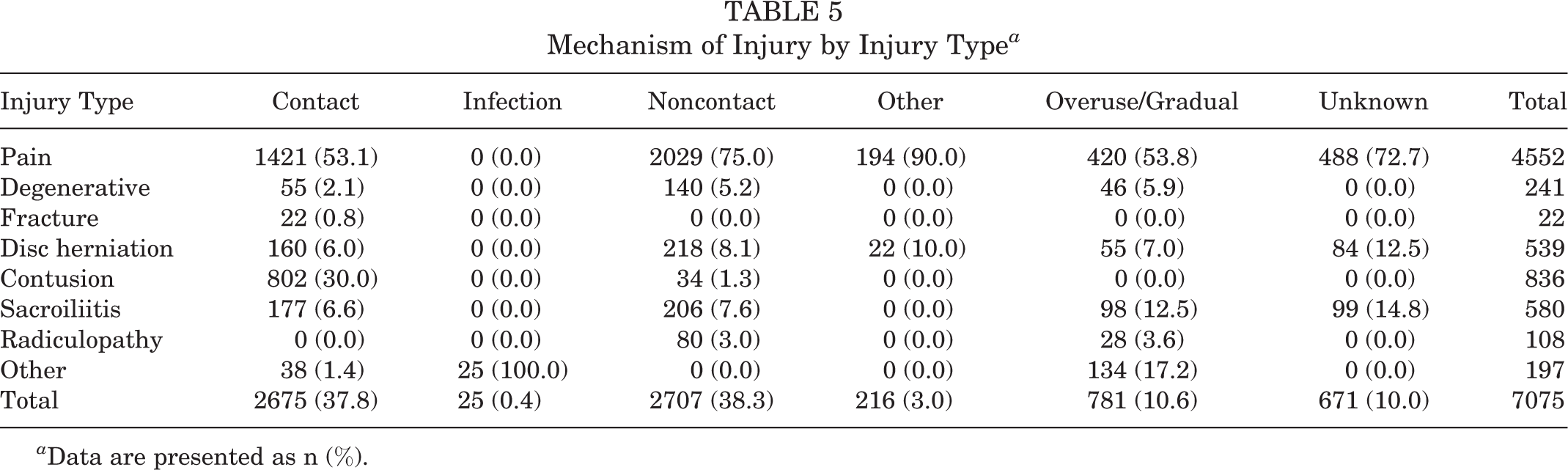
Noncontact injuries (n = 2707; 38.3%) were the most common injury type, followed closely by contact injuries (n = 2675; 37.8%) (Table 5). Most noncontact and contact injuries resulted in unspecified low back pain (n = 2029 [75.0%] and n = 1421 [53.1%], respectively), while 30.0% (n = 802) of contact injuries led to contusions.
Mechanism of Injury by Injury Type a
a Data are presented as n (%).
Injury Chronicity
Overall, 82.2% (n = 5787) of injuries were new. Unspecified low back pain was the most common diagnosis (n = 3862; 66.7%) (Table 6). The second most common new injury was contusion (n = 802; 13.9%). Among reinjuries, unspecified low back pain was the most common injury (n = 658; 52.4%), while the second most common injury diagnosis was disc herniation (n = 299; 23.8%).
Chronicity of Injury by Injury Type a

a Data are presented as n (%).
b Does not include 34 injuries in which chronicity was missing or unknown.
Injuries by Position
Defensive linemen suffered more low back injuries (n = 1412; 20.7%) than any other position (Figure 1). Defensive backs, wide receivers, and offensive linemen suffered comparable amounts of low back injuries (n = 1073 [15.8%], n = 970 [14.2%], and n = 947 [13.9%], respectively), while tight ends and kickers/punters suffered the least amount (n = 158 [2.3%] and n = 161 [2.4%], respectively).
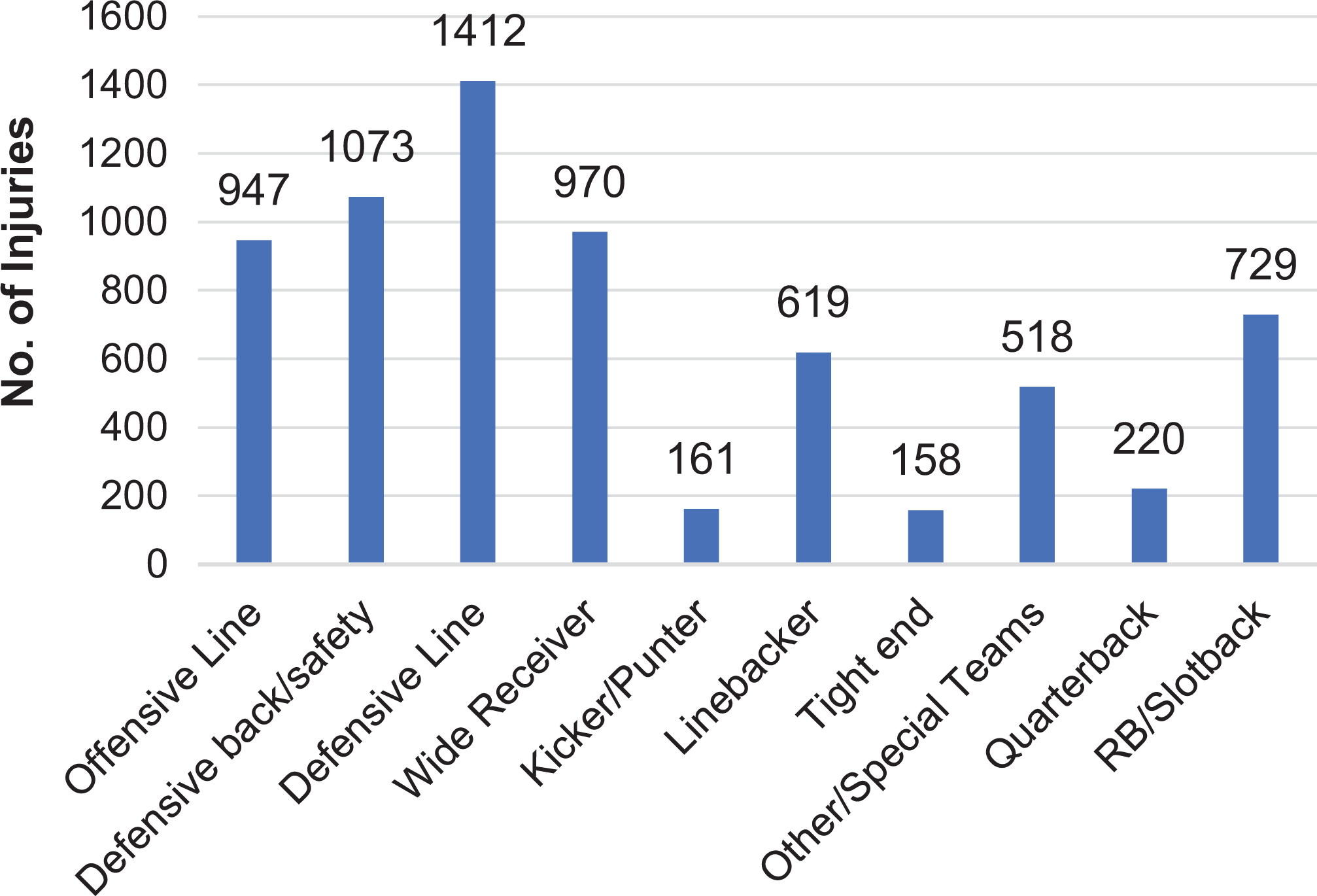
National Collegiate Athletic Association (NCAA) football injuries by position. Does not include 264 injuries in which position was not included.
Surgical Management
Overall, only 1.6% of injuries (n = 112) required definitive surgical treatment. Disc herniation and radiculopathy were the only abnormalities to receive surgical treatment; 15.6% of patients with disc herniation (n = 84) and 25.9% of patients with radiculopathy (n = 28) underwent definitive surgical treatment.
Time Lost From Sport
Most players suffering low back injuries returned to play less than 24 hours after their injury (n = 3371; 59.6%) (Table 7). Of the remaining injuries which lasted more than or equal to 24 hours, 72% returned to play in less than a week. Among players with unspecified low back pain, nearly two-thirds returned to play within 24 hours. However, outside of unspecified low back pain and contusions, the majority of other injuries resulted in return to play more than 24 hours after the injury. More than half (53.7%) of the players with radiculopathy did not return to play for over 21 days.
Time Lost From Sport by Injury Type a
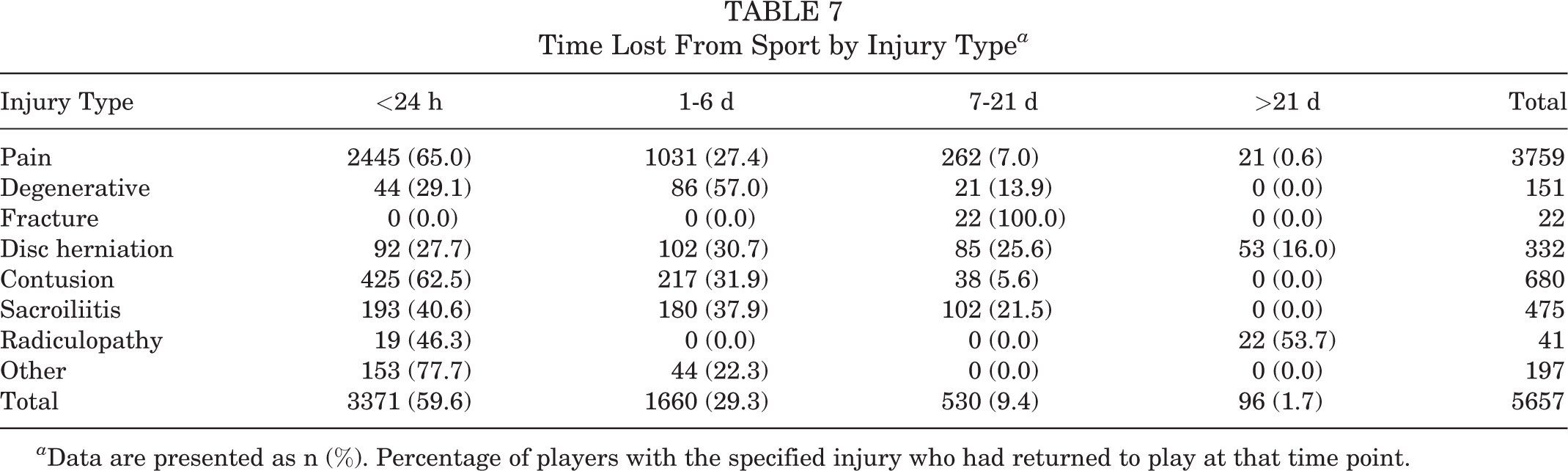
a Data are presented as n (%). Percentage of players with the specified injury who had returned to play at that time point.
Discussion
To date, most studies describing low back injuries in football players have been limited to professional athletes or small sample sizes. 9,11,12,17 –20,22,24 Characterizing lumbar injuries in NCAA football players will allow for more informed expectations and management of these injuries. This injury and sport-specific knowledge can help in the implementation and augmentation of injury prevention and rehabilitation programs.
Analysis of the NCAA ISP database for low back injuries in collegiate football players during the 2009/2010 to 2013/2014 academic years revealed a number of important findings: (1) players were more likely to sustain a low back injury in competitions than in practices, (2) players were 1.41 times more likely to sustain a low back injury during the preseason compared with the regular season, (3) low back injuries occurred equally as frequently from contact and noncontact injuries, (4) the majority of players with low back injuries returned to play within 24 hours of their injury, and (5) nearly 18% of low back injuries were classified as recurrent injuries or reinjuries. In this study, low back injuries occurred at a rate of 2.70 per 10,000 AEs. This rate of back injuries in collegiate football is consistent with previously published studies. 15,16
NCAA football athletes suffered the highest rate of low back injuries during competitions when compared with practices (7.10 vs 2.30 per 10,000 AEs, respectively). Previous studies have also demonstrated this increased risk of injuries in collegiate athletes during competitions. 7,26 This could be caused by a higher intensity and more aggressive style of play. Additionally, once the regular season has begun, there is less contact and tackling during practices than there is during competitions.
Coaching staff and trainers should be aware that low back injuries are more likely to occur during the preseason. The low back injury rate during the preseason was found to be 3.50 per 10,000 AEs. This relatively high injury rate can likely be attributed to the poor conditioning found during this time period, especially given the fact that many of these injuries are noncontact-type injuries. Previous studies have postulated that preseason core strength and flexibility imbalances are implicated in the high rates of preseason injuries. 10 Wilkerson and Colston 26 found that a mild degree of low back dysfunction and poor core muscle endurance appeared to be important modifiable risk factors for low back injuries, and they recommended that these be identified and addressed before participation. These findings underscore the necessity for injury prevention programs that begin in the preseason and continue throughout the regular season and postseason.
Low back injuries commonly lead to missed participation at all levels of play. The current study demonstrated that nearly 60% of players with low back injuries returned to play within 24 hours. This is in stark contrast to the average time to return to play of 22.8 days reported in NFL players after a low back injury. 17 It is possible that higher energy injuries occur at the professional level, leading to more severe injuries. Additionally, less rigorous injury prevention measures at the NCAA level could contribute to more injuries with a lower severity.
In professional football, the literature has reported that nearly 80% of disc herniations occur at the lumbar spine. 9,24 Lumbar disc herniation was also common at the collegiate level. Additionally, disc herniation was the largest risk factor for surgical management in this study, and 15.6% of players with disc herniation underwent surgical treatment. This number is much lower than a 2011 case series of 66 NFL linemen, of whom nearly 80% underwent surgical management of lumbar disc herniation. 24 Although return to play after surgery was not recorded in the NCAA ISP, Weistroffer and Hsu 24 reported that over 80% of players who underwent lumbar discectomy returned to play, while only 28.6% of those managed nonoperatively did so. Other studies have reported similar results. 11 Finally, professional athletes who underwent lumbar discectomy enjoyed significantly longer careers than those who were treated nonoperatively. 12 Further studies are warranted to evaluate the outcomes of lumbar discectomy in collegiate athletes.
Notably absent in our diagnoses are both spondylosis and spondylolisthesis. While these diagnoses have been used to predict short careers in the NFL, 20 their incidences overall in the NFL are extremely low. 17 Our study only looked at patients who were symptomatic, and the diagnoses from the NCAA ISP are not granular. Therefore, it is possible that players with symptomatic spondylolisthesis or spondylolysis who were part of this sample were either part of (1) the degenerative category or (2) the pain category. It may then follow that patients in the pain category with underlying spondylolisthesis or spondylolysis may not have had symptoms long enough to warrant radiographic imaging, which may have allowed them to be categorized into a different diagnostic group (degenerative vs fracture). Fredrickson et al 8 found the incidence of pars defects to be approximately 4%; of these, very few were symptomatic. 2 Although the literature has suggested that perhaps linemen are at a higher risk of lumbar spine fractures, 17 in this specific sample, symptomatic back pain was not very commonly associated with pars defects or spondylolysis (ie, fracture). It is very possible that patients who did have symptomatic pars defects did not report pain.
The NCAA ISP is a long-standing, reputable injury reporting system, but it has its limitations. Principally, data entry is dependent on the AT entering the data correctly. Errors in entering the data can be made or portions of an entry accidentally omitted. Additionally, there is the possibility for overreporting or underreporting of low back injuries. Participation in the database is voluntary, and therefore, there may be a selection bias among participating programs. This could limit the generalizability across NCAA programs. Despite these limitations, we believe that the data presented in this study are representative of low back injuries in NCAA football athletes.
Conclusion
To date, this is the largest study of low back injuries in NCAA football athletes, and it provides needed insight on the management and treatment of these injuries. This study found a high injury rate for low back injuries among collegiate football athletes from 2009/2010 to 2013/2014 (2.70/10,000 AEs). The majority of injuries were new injuries, and most players returned to sport in less than 24 hours. Although the majority of injuries occurred in competitions, the injury rate per 10,000 AEs was highest in the preseason, identifying a potential opportunity for interventions to minimize these injuries. Conditioning and core strengthening programs in the off-season could potentially decrease the incidence of these injuries.
Footnotes
Acknowledgment
This publication contains materials created, compiled, or produced by the Datalys Center for Sports Injury Research and Prevention on behalf of the NCAA. © 2019 National Collegiate Athletic Association. All rights reserved. The NCAA ISP data were provided by the Datalys Center. The ISP was funded by the NCAA. The content of this article is solely the responsibility of the authors and does not necessarily represent the official views of the Datalys Center or the NCAA. The authors thank the many ATs who have volunteered their time and efforts to submit data to the NCAA ISP. Their efforts are greatly appreciated and have had a tremendously positive effect on the safety of collegiate athletes.
One or more of the authors has declared the following potential conflict of interest or source of funding: D.E.H. is a consultant for Arthrex, has received educational support from Smith & Nephew, and has received hospitality payments from Stryker. A.C. is a consultant for Cayenne Medical and has received educational support from Arthrex. AOSSM checks author disclosures against the Open Payments Database (OPD). AOSSM has not conducted an independent investigation on the OPD and disclaims any liability or responsibility relating thereto.
Ethical approval for this study was waived by the Mayo Clinic Institutional Review Board.