




Abstract
Background:
Academic conferences are sources of novel research that can influence clinical decision making. Orthopaedic surgery maintains a relatively high rate of publication compared with other surgical subspecialties, and sports medicine conferences hold an even higher rate within the subspecialty. The American Orthopaedic Society for Sports Medicine (AOSSM) annual meetings have been shown to have among the highest rates of publication for accepted abstracts.
Purpose:
To determine differences between 2-year publication rates of poster and podium abstracts accepted into the AOSSM annual meetings and identify factors associated with publication.
Study Design:
Cross-sectional study.
Methods:
The AOSSM archives were queried for all accepted poster and podium presentations for annual meetings from 2011 through 2015. Google Scholar and MEDLINE databases were used to determine which abstracts transitioned into journal articles. Publication rates were compared based on publication 2 years following presentation. Logistic regression was performed to demonstrate which variables were most correlated with successful publication. Data on publication impact factor and number of citations were collected by use of the InCites database.
Results:
Of 628 abstracts accepted during this period, 265 were poster presentations and 363 were podium presentations. Overall, 44.7% of abstracts presented were accepted into peer-reviewed journals within 2 years of presentation. No statistical difference was found between poster and podium presentations for journal publication (P = .328). Poster presentations were published in journals with statistically lower impact factor (P = .005) and had a statistically lower number of citations (P < .001) compared with podium presentations. Multivariate logistic regression analysis demonstrated that only number of authors was correlated with publication (P = .003).
Conclusion:
Podium and poster presentations accepted into AOSSM conferences had equal rates of publication within 2 years and should influence decision making equally. The relative impact of podium presentations appeared to be greater, which suggests that the AOSSM selects podium presentations that will have greater clinical impact. Increasing number of coauthors was the only factor found to be correlated with publication.
Academic conferences offer the opportunity to disseminate up-to-date information on current research topics in a variety of fields. The information disseminated through these conferences and peer-reviewed journals can directly affect clinical decisions and patient care. As such, quality metrics of abstracts presented at conferences are an important investigative topic. In surgical subspecialty conferences, publication rates of abstracts presented range from 37.8% to 47%. 17,18 Knowledge of the factors associated with literature publication rates after presentation at such meetings can directly benefit researchers on the cutting edge of new medical developments across a variety of clinical and academic settings.
The American Orthopaedic Society for Sports Medicine (AOSSM) annual meetings are large-scale international conferences that present a variety of clinical and basic science abstracts within the field of orthopaedic sports medicine. Previously, the abstracts from the AOSSM annual meetings have had the highest publication rate (67.1%) of all orthopaedic conferences. 13 Prior studies have demonstrated the rate of publication for abstracts presented at other orthopaedic conferences to range from 40.1% to 61%. 4,5,9,10,22 Additionally, podium presentations have been found to be more impactful than posters, based on a higher publication rate. Sprague et al 19 reported that the most common self-reported barriers to publication 5 years after presentation at the American Academy of Orthopaedic Surgeons (AAOS) Annual Meeting in 1996 were lack of time to prepare a manuscript, ongoing recruitment for studies, and disputes with coauthors.
Factors such as study design, sample size, multiple authors, and nonnegative studies with positive results have been previously reported to influence publication in peer-reviewed journals or increase time to publication. 6,20 No investigation has explored the influence of these variables on publication of abstracts from any contemporary conference of sports medicine. The objective of this study was to determine the current rate of publication for poster and podium abstracts presented at the AOSSM annual meetings and to determine factors associated with publication. We hypothesized there would be a comparable rate of publication between poster and podium presentations.
Methods
Archives of the AOSSM annual meetings (open and Specialty Day meetings) from 2011 to 2015 were used as a database for collection of abstract titles, authors, and institution geography. Abstracts selected for awards during conferences were also noted. The Google Scholar and MEDLINE databases were queried separately for each title and author combination. To account for title changes of abstracts, keywords and author names were used in the search query to ensure inclusion of all abstracts.
Whether an abstract was eventually published, the journal name, journal impact factor, number of coauthors of publication, times cited, and time from conference to publication were collected. Two-year publication rates were established by analyzing rates of publication of articles published electronically within 730 days. Data on journal impact factor were collected from the InCites database (2015 Journal Citation Reports; Clarivate Analytics, 2017). Each article was categorized by study design. The following 10 categories were used: prospective cohort, retrospective cohort, randomized controlled trial, animal/cadaveric study, case-control study, systematic review, radiographic study, case series, medical education study, or database study, as an adaptation from the author guidelines of The American Journal of Sports Medicine (AJSM). 1 Studies were also categorized into either prognostic, therapeutic, diagnostic, or economic and decisional analysis to assign levels of evidence based on the classification standards of The Journal of Bone and Joint Surgery. 21 Basic science studies that involved animals or cadavers were not assigned a level of evidence.
Statistical analysis was performed by use of R Studio software version 1.0.143 (R Foundation for Statistical Computing). Chi-square and t tests were conducted to measure independence of variables. A logistic regression was created by use of publication as a binomial outcome, with the following variables: abstract study design, population size, number of authors, level of evidence, and whether the data were presented as poster or podium. Statistical significance was indicated at P < .05.
Results
From all open and Specialty Day meetings of the AOSSM between 2011 and 2015, a total of 645 abstracts were analyzed. During these meetings, 265 poster presentations and 380 podium presentations took place. A mean ± SD of 53.0 ± 20.7 posters were presented per year, while 76.0 ± 11.5 podium presentations were given per year. Of the 628 abstracts, 327 (50.7%) were published as of August 2017 in peer-reviewed journals that are indexed by either Google Scholar or PubMed. A mean of 110 and 19 abstracts were presented at each open and Specialty Day annual meeting, respectively. The mean time to publication was 341.4 ± 395.2 days. The mean number of authors on each publication was 5.5 ± 2.0. Podium presentations that were selected for awards had a higher rate of publication than those that were not (P = .044). No difference was found between poster and podium abstracts in the number of authors per manuscript from 2011 to 2015 (r = 0.594, P = .668) (Table 1). Abstracts were published in journals with a mean journal impact factor of 4.3 ± 1.9. No statistical difference was found in the 2-year publication rate between poster and podium presentations (P = .328). From publication trends over time, a difference in the publication rate between posters and podiums was noted only in 2015 (Figure 1).
Analysis of Publication Rates of AOSSM Abstracts, 2011 to 2015
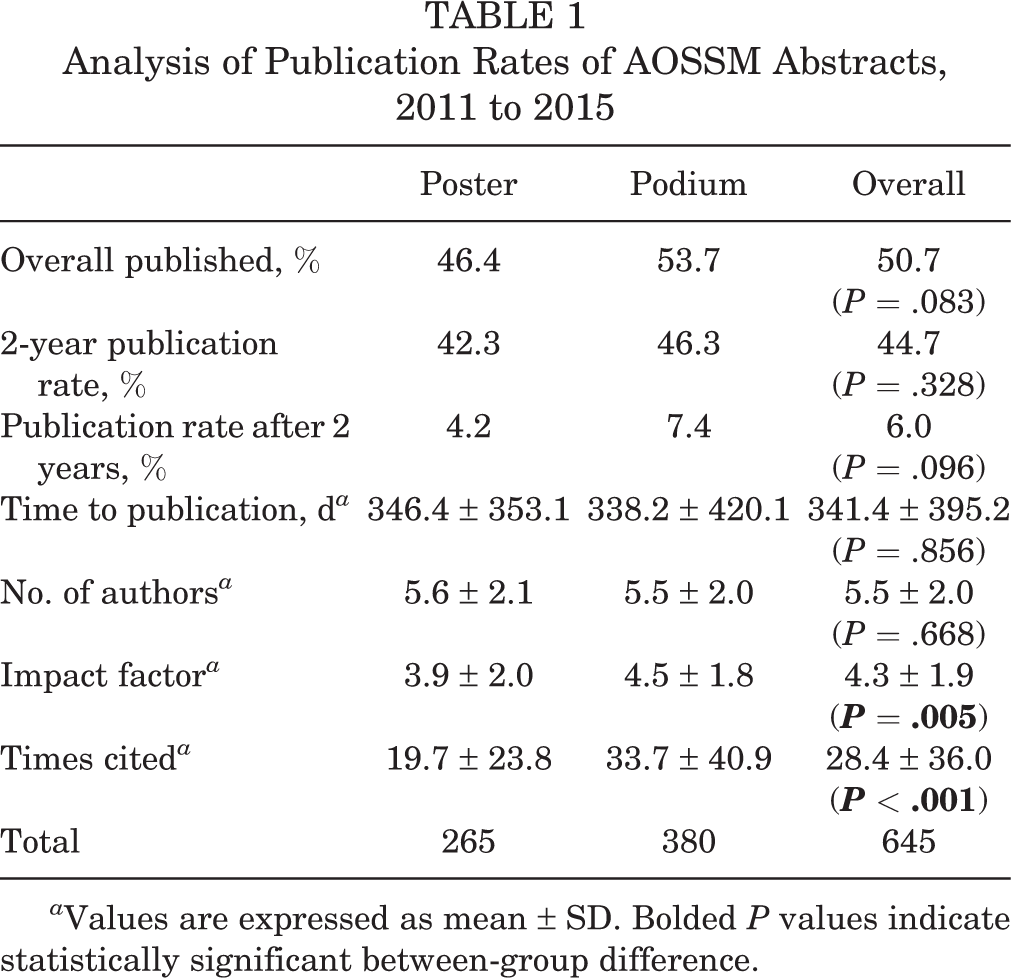
a Values are expressed as mean ± SD. Bolded P values indicate statistically significant between-group difference.
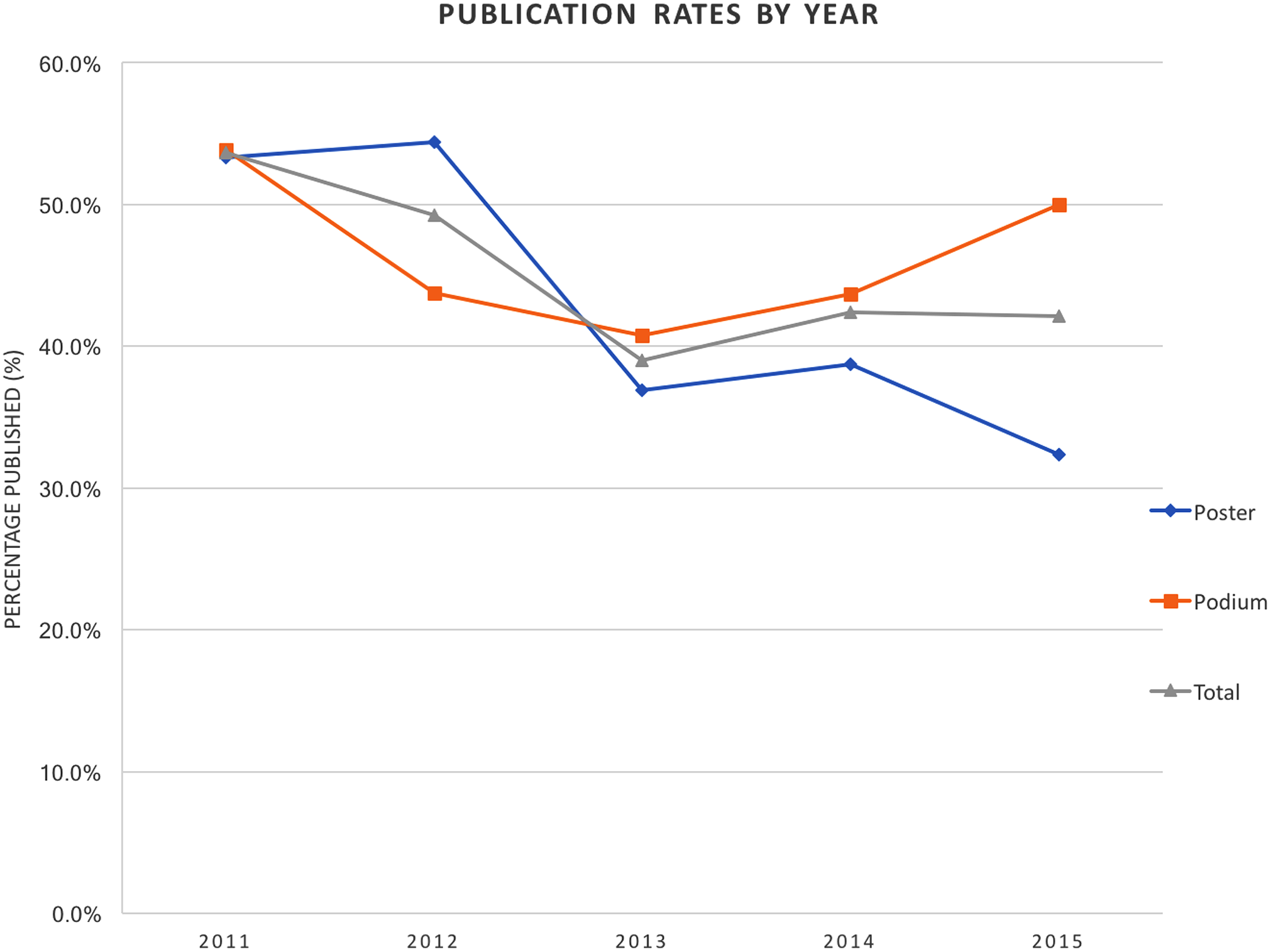
Two-year publication rate of abstracts presented during AOSSM annual meetings, 2011 to 2015. Podium versus poster comparison was significant only in 2015 (P = .039). A statistically significant decrease was noted in the number of poster presentations accepted as manuscripts (P = .035).
No statistical difference was found between the mean number of poster abstracts versus podium abstracts selected for presentation per year (Table 2). A statistically greater number of podium abstracts were accepted for publication per year compared with poster abstracts (P < .001). A difference in 2-year publication rates between poster and podium presentations was noted only in 2015 (P = .035) (Figure 1). Poster presentations were published in journals with statistically lower impact factor (P = .005). When published, poster presentations also had a statistically lower number of citations (P < .001) than podium presentations.
Publication Trends for AOSSM Abstracts, 2011 to 2015

a Publication was measured 2 years from the date of presentation.
The majority of accepted presentations (42.1%) were retrospective in nature, followed by prospective cohort studies (42.0%) (Table 3).
Analysis of Publication Rates for AOSSM Abstracts Stratified by Study Design

a Values are expressed as mean ± SD. Bolded P value indicates statistical significance.
Abstracts from the AOSSM annual meetings were published in a total of 49 unique journals. Most studies were not published in any journal (49.3%). Of those published, the majority of abstracts were accepted in AJSM (29.1%). A statistical difference was found between the acceptance of posters (49.2%) versus podium presentations (68.8%) in AJSM (P < .001).
Within the levels of evidence, studies were further categorized as therapeutic (n = 444), diagnostic (n = 125), prognostic (n = 58), or economic and decision analyses (n = 18).
Logistic regression using publication rate as a binomial outcome with respect to study design, level of evidence, number of authors, and study population size was calculated. Only the number of coauthors was statistically correlated with the likelihood of publication: A greater number of coauthors resulted in a higher rate of publication (P = .003) (Table 4).
Multivariate Logistic Regression Analysis of Variables Associated With Publication of AOSSM Abstracts a

a Bolded P value indicates statistical significance.
Discussion
The overall publication rates of abstracts presented at the AOSSM conferences from 2011 to 2015 was 50.7%, and the 2-year publication rate was 44.7%. The lack of difference in the 2-year publication rate between podium and poster abstracts (P = .328) may reflect an improvement in quality of posters that are being presented at the AOSSM conference over time. 5,7,9,13 However, our analysis still indicates that podium presentations were published in journals with a higher impact factor and were cited more often compared with poster presentations (P = .005 and P < .001, respectively), which suggests that the AOSSM is still selecting more impactful abstracts as podium presentations. Significantly more podium presentations were accepted per year because the Specialty Day conference is exclusive to podium presentations, although our analysis on rates of publication should be unaffected by this. According to our analysis, the AOSSM selects poster and podium presentations of high quality that have an equal likelihood of dissemination into peer-reviewed journals. This suggests that clinicians attending the AOSSM conferences should value information from both podium and poster presentations with regard to clinical decision making.
This study updates previous results by Kinsella et al, 13 who analyzed data from 2006 to 2010. Our measured publication rate was lower than that reported by Kinsella et al 13 (67.1%), although an equal percentage of abstracts were published in AJSM compared with that analyzed by Kinsella et al 13 from 2006 to 2010 (57.5% vs 56.9%, respectively). The publication rate for the AOSSM conferences remain higher than previously reported publication rates for meetings of the AAOS, Musculoskeletal Tumor Society, Arthroscopy Association of North America, and International Society of Arthroscopy, Knee Surgery, and Sports Medicine. 2 ,3, 5,7,11,12,15 The publication rate following presentations at the Arthroscopy Association of North America meeting increased from 49% in 2008-2012 to 67.1% in 2011-2014.
The seemingly lower publication rate described in the present study may be attributable to increased competition among sports medicine journals or increased selectivity of AJSM due to its right-of-refusal policy. The AOSSM requires submission to AJSM for first right of refusal for all abstracts presented at the annual conference. This rule means that the scientific society has first preference to publish abstracts presented at its annual meeting, which is also reflected by the higher rate of publication in this journal. However, refusal for publication in this journal may subsequently delay publication substantially and account for the reduced publication rates reported within this study. An additional consideration is the 2013 launch of the Orthopaedic Journal of Sports Medicine (OJSM), which is also published by the AOSSM, as this journal published an additional 4.8% of abstracts at these meetings. The included dates of the present study captured this journal in its infancy. As this journal has grown substantially since, at present there are likely a greater number of publications and citations from OJSM.
The equalization of publication rates between poster and podium presentations may also reflect an increase in both quality and volume of research being performed. The overall time to publication was 341.4 ± 395.2 days, which is less than previously reported values by Bhandari et al 3 (528 ± 365 days) and Frank et al 9 (474.5 ± 438 days). Shorter times to publication and higher rates of publication in comparison with other conferences suggest that presentations at the AOSSM are based on studies that are more complete. Both posters and podiums saw a decline in 2-year publication rates from 2011 to 2015, but this trend was statistically significant only for poster presentations (P = .035). This trend may highlight an increase in competitiveness in the sports medicine literature that coincides with a greater amount of research being performed.
From the logistic regression analysis, the number of coauthors was the only variable found to be statistically significant in the likelihood of eventual publication. Assuming that authorship is granted only for valuable contributions to the study, this reinforces the idea that collaboration influences success in orthopaedic literature. AJSM and most sports medicine journals do not have strict authorship limits; however, they request signed forms to validate contribution of all authors to the preparation of a manuscript. As competition for publication increases over time, collaboration may become an effective strategy for researchers to consider when planning future investigations. Synchronizing efforts and pooling resources, either within the same institution or across multiple institutions, may allow investigators to plan more complex studies with greater clinical impact. 16 The number of authors of a publication has been shown to have a linear relationship with number of times an article is cited in high-impact journals. 8 Additionally, investigators who had greater numbers of coauthors were reported to have more publications, although this is likely due to continued collaborative efforts after completion of an initial collaborative study. 14 A greater number of authors may also reflect institutions with larger resources from staffing of in-training residents, fellows, research assistants, or PhDs. Regarding future work, this finding may re-emphasize the value of not restricting the number of authors in sports medicine research, as this was found to be significantly associated with success of a publication. However, this practice is valid only if all authors contribute to the research; adding authors to increase the chance of publication would not be supported.
Study design was not found to be a significant factor related to publication, according to our logistic regression analysis. However, univariate chi-square analysis showed that cadaveric and animal studies were statistically correlated with publication success. A factor that may contribute to this finding is that cadaveric and animal studies involve data collection over a short period of time, which may allow for faster time to publication. Additionally, these studies do not pose any risk to human participants and thus gain approval by institutional review boards more quickly. Further, no follow-up is required, which suggests that cadaveric studies may be closer to completion at the time of abstract presentation compared with clinical studies that report on incomplete and midterm patient cohorts. Cadaveric and animal studies involve greater start-up costs with respect to specimen collection, staffing, biomechanical apparatus, and laboratory setup, which will drive more thorough planning prior to data collection.
Similar to this study, Baweja et al 2 found no correlation of level of evidence with publication rate. Higher level evidence studies often require the greatest amount of follow-up and additional research. For this reason, results may not be publishable in the near future. This is an important consideration during scientific meetings, as these higher impact studies may be incomplete and require additional follow-up. The present study analyzed trends in publication over time to suggest that the quantity and competitiveness of orthopaedic research have increased. These trends also suggest that poster and podium presentations have comparable quality and that clinical decision making should not be limited to podium presentations at high-quality conferences such as the AOSSM annual meetings. Future research aimed at identifying reasons for failure in publishing these abstracts would be valuable in corroborating these findings.
Limitations of this study include using a 2-year postpresentation time point for publication rate rather than 3 years. Data retrieved from this study suggest that the mean time to publication is approximately 1 year. Further, we found that the publication rate at 2 years following presentation was 4.2% and 7.4% for posters and podiums, respectively (P = .114). The likelihood of publishing after the 2-year mark is relatively low, and it is likely that projects remaining unpublished after this duration may be either abandoned or considerably modified from their original presentation. Number of times cited is a time-dependent variable, as articles published earlier are more likely to have additional citations. This creates some bias in this measurement; however, given that the independent variable was posters and podiums that were presented through all years, this does not confer bias in comparison. Analyzing the publication trends at 2 years following presentation allowed for uniform measure of trends across all 5 years.
This study is also limited to trends drawn over a 5-year span, although it was compared with a previous study that analyzed the previous 5 years for historical comparison. 13 Further limitations include the inability to obtain data with regard to number of abstracts submitted each year, although we can extrapolate from other literature that demonstrates a decreasing abstract acceptance rate over time in the general orthopaedic literature. 3,4,7,9,13
Conclusion
Podium and poster presentations accepted into AOSSM conferences have equal rates of publication in 2 years. The relative impact of podium presentations appears to be greater, which suggests that the AOSSM selects abstracts for podiums that will have greater clinical impact. Studies with a greater number of authors was the only factor found to be correlated with publication.
Footnotes
One or more of the authors has declared the following potential conflict of interest or source of funding: N.N.V. receives royalties from Smith & Nephew and Vindico Medical Orthopaedics-Hyperguide; is a consultant for Smith & Nephew, Arthrex, Minivasive, and Orthospace; receives research support from Smith & Nephew, Arthrex, DJ Orthopaedics, and Ossur; has stock/stock options in Cymedica Orthopedics, Minivasive, and Omeros; and has received hospitality payments from Cymedica Orthopedics, Stryker, Medacto, and Wright Medical. AOSSM checks author disclosures against the Open Payments Database (OPD). AOSSM has not conducted an independent investigation on the OPD and disclaims any liability or responsibility relating thereto.
Ethical approval was not sought for the present study.