




Abstract
Background:
Posterior labral injuries have been recognized as a particularly significant clinical problem in collision and contact athletes.
Purpose:
To evaluate the effect that posterior labral tears have on early National Football League (NFL) performance based on position, associated injuries, and operative versus nonoperative management.
Study Design:
Cohort study; Level of evidence, 3.
Methods:
A retrospective review of all participants in the NFL Combine from 2009 to 2015 was performed using medical and imaging reports documented at the combine. Magnetic resonance imaging scans were analyzed for tear location, associated injuries, and evidence of previous surgical interventions. Each player’s NFL draft position, as well as number of games played, number of games started, and snap percentage in his first 2 NFL seasons were collected for performance analysis and were compared with a control group of uninjured counterparts.
Results:
Players with posterior labral tears were selected significantly later in the draft than those in the control group (draft position, 171.6 vs 156.1, respectively; P = .017). Although no single individual position was significantly affected by posterior labral tears, linemen (both offensive and defensive) with posterior labral tears were drafted significantly later than those without tears (draft position, 164.0 vs 137.7, respectively; P = .018) and had a significantly lower percentage of snaps in their first NFL season (23.8% vs 27.7%, respectively; P = .014). Players who underwent surgical management before the combine had a significantly higher percentage of snaps in their second NFL season than those who were managed conservatively (31.4% vs 22.3%, respectively; P = .022). None of the concomitant injuries recorded (superior labral anterior-posterior tears, glenoid bone loss, reverse Hill-Sachs lesions, rotator cuff tears, reverse humeral avulsions of the glenohumeral ligament, and posterior labral tears combined with anterior tears) significantly affected the draft position, number of games played, number of games started, or snap percentage for the cohort as a whole or any specific position.
Conclusion:
Posterior labral tears did negatively and significantly affect early NFL outcomes for collegiate football players across several different metrics, especially among linemen. While operative management did not produce significantly superior performance in most outcome measures, it may allow for better longevity of the shoulder and warrants further investigation. Concomitant shoulder injuries did not significantly affect early NFL outcomes in this cohort.
Posterior glenohumeral instability, which accounts for only 2% to 5% of shoulder instability cases overall, is an often subtle finding that encompasses a broad spectrum of pathoanatomy affecting the capsulolabral soft tissue and bony architecture of the shoulder. Unlike anterior instability, there is rarely a significant traumatic event that initiates symptom onset, and examination findings are more related to pain and weakness than true mechanical instability. 3,5,27 Traumatic posterior shoulder instability has been recognized as a significant clinical problem in collision and contact athletes in particular. 7 This is thought to be caused by the repeated exposure to posteriorly directed shear forces that their shoulders sustain, causing posterior labral detachment. 19 This microtrauma, typically with the shoulder in a forward flexed and internally rotated position, results in stretching and injuries to the posterior band of the inferior glenohumeral ligament and adjacent capsular structure and labrum. 4,9,24,25
Magnetic resonance imaging (MRI) has become an increasingly useful tool in terms of diagnosing posterior instability, depicting abnormalities related to the labral tissue, surrounding posterior capsule, infraspinatus, and teres minor. 14 This diagnostic information can help guide the decision between conservative or surgical management.
Surgical management has evolved over time from open to arthroscopic techniques and usually involves plication of the capsular tissue with or without a shift and restoration of the labral bumper with fixation using a suture anchor device. Regardless of the technique, success rates for operative management range from 27% to 100%. 
The National Football League (NFL) Combine evaluates the most elite collegiate-level football players in preparation for entrance into the professional level. As such, it presents a unique opportunity to evaluate the medical records and history of these athletes to better understand the effects of certain injuries on performance and longevity. Of the 581 players who underwent shoulder MRI in the 2009 to 2015 NFL Combine, 58.5% showed evidence of labral tearing, which represented 14.9% of the overall NFL Combine population. 21 Given the prevalence of labral injuries within this population of athletes, the purpose of this study was to evaluate the effect that posterior labral tears have on draft position and early NFL performance based on position, concomitant injuries, and operative versus nonoperative management. We hypothesized that these injuries would negatively affect NFL performance, concomitant injuries would be further detrimental to NFL performance, and operative management would improve performance compared with nonoperative management.
Methods
Study Design
A retrospective review of all NFL Combine participants from 2009 to 2015 was performed after approval from the authors’ institutional review board. Medical records and MRI reports were reviewed to identify all players with posterior tears of the glenoid labrum. MRI was performed in players with prior labrum surgery, history of shoulder instability in the National Collegiate Athletic Association (NCAA) database, or physical examination findings suggesting anterior or posterior instability. Therefore, it was presumed that these players were symptomatic or had been symptomatic in their collegiate playing career. Moreover, 3-T MRI scans in the coronal, sagittal, and axial planes performed at the NFL Combine were independently reviewed by 2 sports medicine fellowship–trained orthopaedic surgeons (M.T.P., J.P.B.).
The medical records and imaging reports are compiled at each NFL Combine, where the medical staff of each of the 32 NFL teams perform a musculoskeletal evaluation and record comprehensive orthopaedic notes for each player attending the combine. All injury data for this study were collected through a review of these notes and were analyzed for involved structures, associated injuries, and evidence of previous surgical interventions. All injury data were collected through a review of the injury registry available to the medical and training staff of all NFL teams after completion of the NFL Combine.
Labrum Evaluation
For each affected shoulder, the size and location of the tear were documented. Labral tears were classified in terms of location as anterior, posterior, or combined anterior and posterior. Any associated injuries were also documented, including superior labral anterior-posterior (SLAP) tears, glenoid bone loss, reverse Hill-Sachs lesions, rotator cuff tears, reverse humeral avulsions of the glenohumeral ligament (HAGLs), and tears that were combined with anterior labral tears. Additionally, any evidence of previous surgical interventions seen on shoulder MRI was noted.
Performance Evaluation
Player position and number of missed collegiate football games were obtained from the medical database organized during the NFL Combine. Each player’s respective NFL draft position, as well as number of games played, number of games started, and snap percentage in the first 2 NFL seasons were collected through the use of NFL.com and Pro Football Focus, which are web-based, publicly accessible comprehensive sports statistics databases. Snap percentage for each player was defined as the total number of participated plays divided by the total number of eligible plays over the course of a season. Undrafted players were assigned a draft position of 254 for statistical analysis. Players who were released were included in the analysis with any statistics that they had accumulated before their release.
A control group was created to evaluate whether players without posterior labral injuries were drafted in earlier rounds and had superior early performance during the first 2 seasons compared with players with labral injuries. The control group was formed from players who participated in the NFL Combine from 2009 to 2015 based on the following set of criteria: (1) no significant missed time before the NFL (≤2 total missed games in college) and (2) no history of any surgery on any joint before the NFL Combine.
Statistical Analysis
The performance metrics detailed above were compared between groups. Data were tested for normal distribution. For comparisons of normally distributed continuous variables between groups, an independent t test was utilized. For comparisons of nonnormally distributed continuous variables between groups, the Mann-Whitney U test was utilized. Comparisons of 2 categorical variables were performed by use of the chi-square test and Fisher exact test. All P values were 2-tailed, and P values of <.05 were considered statistically significant. All statistical analyses were performed with R (The R Project for Statistical Computing).
Results
Demographics
A total of 2285 players participated in the NFL Combine between 2009 and 2015, of whom 581 underwent MRI of their shoulder. Among those players with shoulder MRI scans, 221 (38.0%) showed evidence of a posterior labral tear. Twenty-three (10.4%) of these players sustained bilateral shoulder injuries, for a total of 244 affected shoulders. One hundred sixty shoulders (65.6%) were managed operatively, while 84 (34.4%) underwent nonoperative management. One hundred seventy-six (79.6%) players showed evidence of a concomitant injury (SLAP tears, glenoid bone loss, reverse Hill-Sachs lesions, rotator cuff tears, reverse HAGLs, combined anterior labral tears) compared with 45 (20.4%) players with an isolated posterior labral tear. The prevalence of each concomitant injury is detailed in Table 1.
Prevalence of Associated Injuries With Posterior Labral Tears a
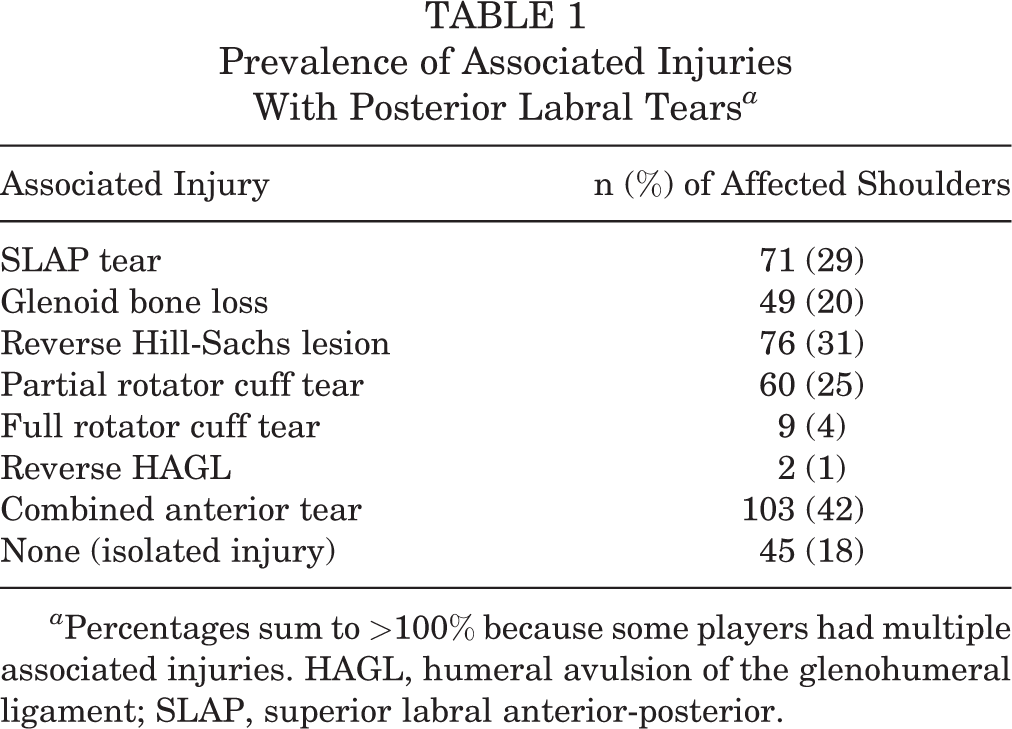
a Percentages sum to >100% because some players had multiple associated injuries. HAGL, humeral avulsion of the glenohumeral ligament; SLAP, superior labral anterior-posterior.
Performance Analysis
All 2285 players who participated in the NFL Combine between 2009 and 2015 were included in outcomes analysis. A total 913 of these players met the criteria for the control group, and all 913 were included in our comparisons.
In terms of draft position, players with posterior labral tears were selected significantly later than those in the control group (draft position, 171.6 vs 156.1, respectively; P = .017). Linemen (both offensive and defensive) with posterior labral tears were drafted significantly later than their healthy counterparts (draft position, 164.0 vs 137.7, respectively; P = .018); however, there was no significant difference among non-linemen. Players with posterior labral tears also played significantly fewer games during their first 2 seasons in the NFL than those in the control group (12.8 vs 15.3, respectively; P = .024); however, no specific position group was significantly affected. There was no significant association between posterior labral tears and number of games started in the player’s first 2 NFL seasons (P = .054). Players with posterior labral tears had a significantly lower percentage of snaps in their first NFL season (23.8% vs 27.7%, respectively; P = .014); however, this significant association was not present during their second season of play. Performance comparisons between injured players and controls are detailed in Tables 2 to 4.
Mean Draft Position at the NFL Combine for Injured Players Versus Controls a
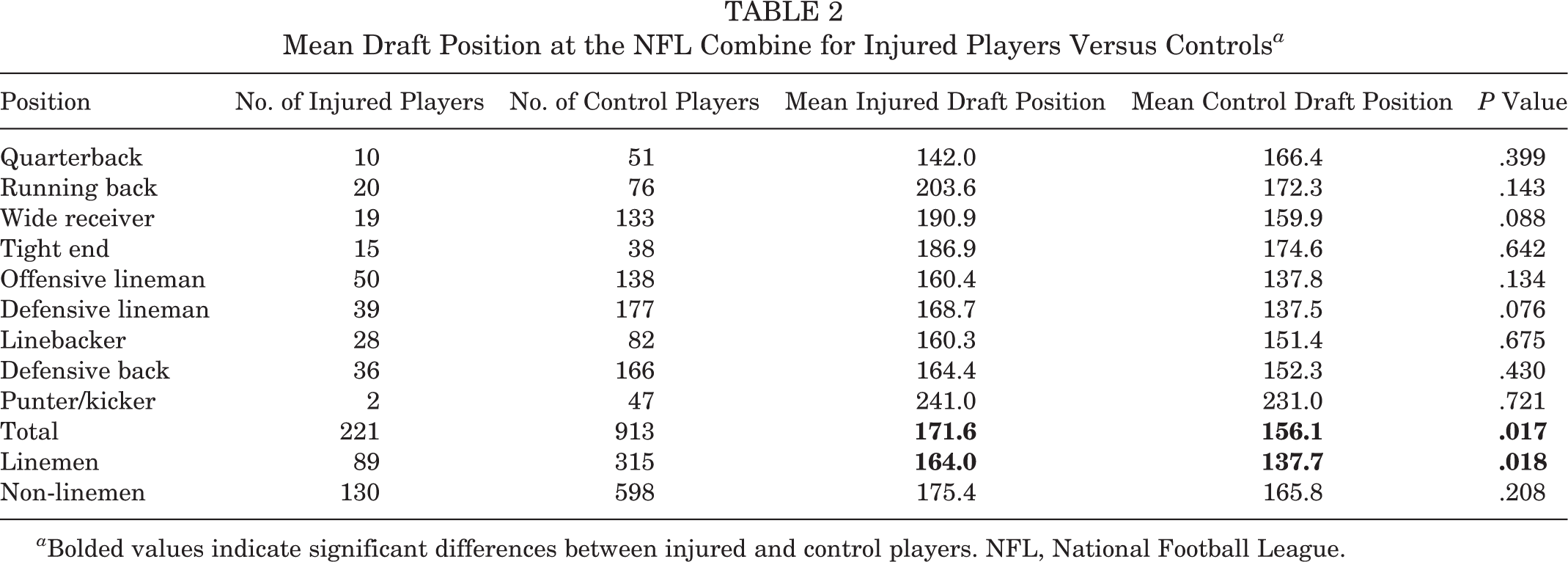
a Bolded values indicate significant differences between injured and control players. NFL, National Football League.
Mean Number of NFL Games Played and Games Started in the First 2 Seasons for Injured Players Versus Controls a

a Bolded values indicate significant differences between injured and control players. N/A, not applicable; NFL, National Football League.
Mean Snap Percentage in Each of the First 2 NFL Seasons for Injured Players Versus Controls a

a Bolded values indicate significant differences between injured and control players. N/A, not applicable; NFL, National Football League.
There was no significant difference between operative or nonoperative management for players with posterior labral tears identified at the combine in terms of draft position, number of games played, number of games started, or snap percentage in their first NFL season. However, players who underwent surgical management before the combine had a significantly higher percentage of snaps in their second NFL season than those who were managed conservatively (31.4% vs 22.3%, respectively; P = .022). Snap percentages for operatively versus nonoperatively managed players are outlined in Table 5.
Mean Snap Percentage in Each of the First 2 NFL Seasons for Surgically Versus Nonsurgically Managed Injured Players a
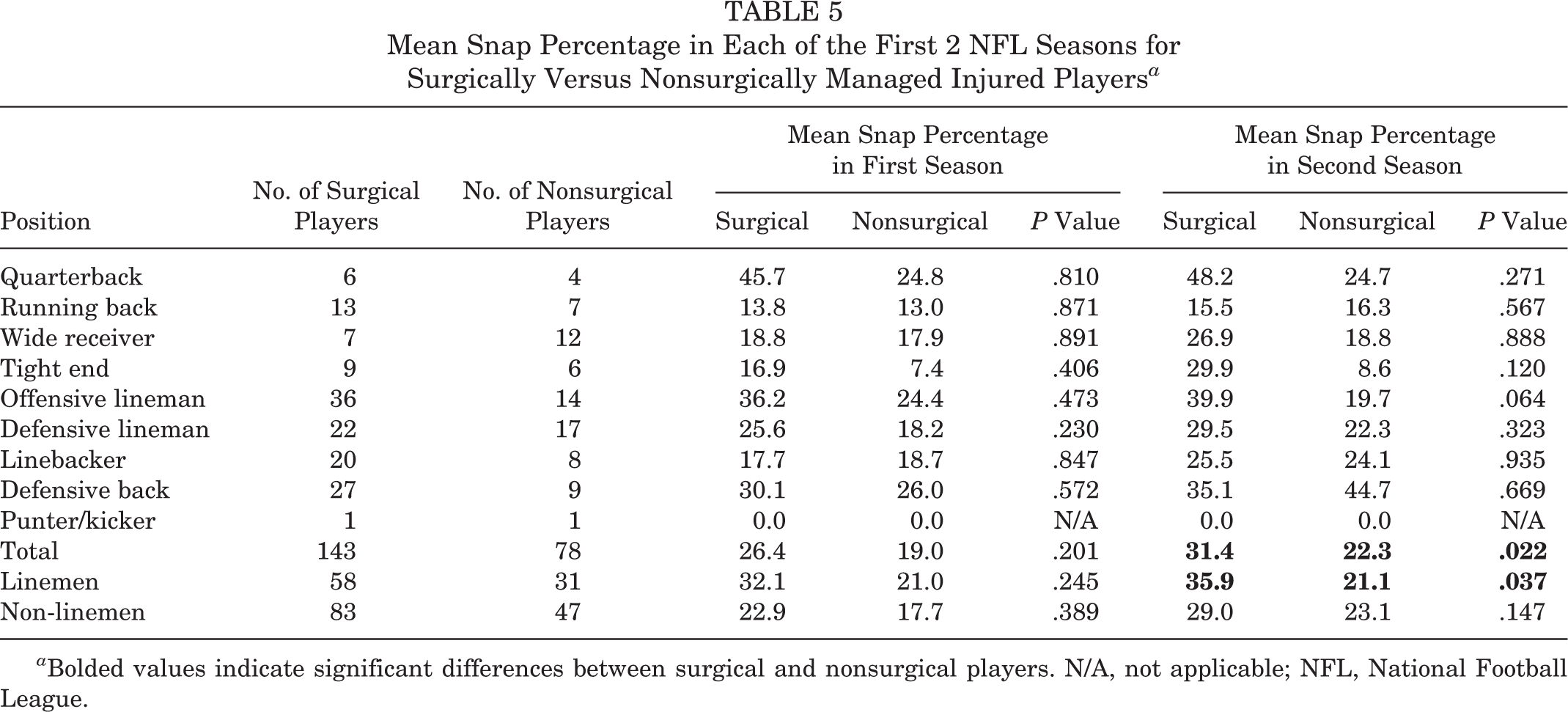
a Bolded values indicate significant differences between surgical and nonsurgical players. N/A, not applicable; NFL, National Football League.
None of the recorded concomitant injuries significantly affected draft position, number of games played, number of games started, or snap percentage for the cohort as a whole or any specific position.
Discussion
The most important finding of our study was the negative effect of posterior labral injuries on the draft position, games played, and snap percentage of NFL Combine participants. Linemen were particularly affected; they demonstrated a significantly lower draft position, reduction in total games played, and lower snap percentage compared with those without a labral injury. Other notable findings include the significantly higher second-season snap percentage in players who showed MRI evidence of surgical intervention for their posterior labral tear, as well as the lack of any significant effects from concomitant injuries.
The negative impact that posterior labral injuries have on a combine participant’s early NFL performance is important to consider especially because of how often these injuries occur among elite football players. 6,11,16,17 In the current study, 244 of the shoulders that underwent shoulder MRI demonstrated a posterior glenoid labral tear with and without concomitant injuries, making up 10.7% of all 2285 combine participants during the study period.
Linemen (offensive and defensive) were the only position group in our cohort to demonstrate a significant association between performance metrics and posterior labral tears, as players with labral injuries were drafted later than their counterparts in the control group. This is important, considering that linemen have a significantly higher risk for labral tears in at least 1 shoulder. 21 Mair et al 19 hypothesized that contact athletes who engage their opponents with their arms in front of the body, as linemen typically do, were more susceptible to this injury because of the compressive force and shearing force that result from repeated posteriorly directed impact. With modern blocking and block-shedding techniques, the posterior capsule is subject to repetitive microtrauma, which can lead to attenuation of the labrum and laxity of the posterior capsule, resulting in posterior instability. The pain and/or weakness associated with this injury is exacerbated by blocking and other maneuvers, which load the posterior shoulder and can ultimately lead to a decreased ability to perform these tasks as effectively. Therefore, linemen are likely to perform worse with posterior labral tears, as demonstrated in this study, because they are more dependent on performance involving contact with extended arms than skill positions such as wide receivers, running backs, and defensive backs. A later draft position can have significant financial implications on these players, as demonstrated by the rookie contracts after the 2016 NFL draft. The average rookie salary for players drafted in the first round was US$3.7 million compared with US$1.4 million for players drafted in the second round and US$847,000 for players drafted in the third round. 12
While operative management did not significantly improve draft position, number of games played, or number of games started when compared with nonoperative management, players who underwent surgery did have a significantly higher percentage of snaps in their second NFL season. This may suggest that surgical management to plicate the attenuated capsular tissue along with repair and restoration of the labral bumper may provide a defense against the progression of instability, which may increase the longevity and sustainability of the shoulder in NFL athletes. This difference could also be attributed to several other factors, including more focused rehabilitation, shoulder-directed strength and conditioning, and use of a brace. Further investigation is required to make any definitive statement on this topic.
Unlike the negative effect of concomitant injures with anterior labral injuries, 20 concomitant injuries did not significantly affect any metric when combined with posterior labral tears, perhaps suggesting that the labral tear is the most limiting factor in posterior instability. This may be because of the nature of the injury, with anterior instability generally occurring in a more acute, traumatic mechanical fashion and posterior instability occurring with repetitive, chronic microtrauma in which significant concomitant injuries are less likely to be present.
Because of the retrospective nature of this study, there are limitations that we acknowledge. Our analyses by specific position groups were limited by the sample size, which made it more difficult for these comparisons to demonstrate statistically significant associations. There is an inherent selection bias in studying injuries at the NFL Combine because players with labral injuries that significantly affected performance likely would not be invited to the combine. Not all players at the combine underwent MRI of their shoulder, so some posterior labral injuries may not have been diagnosed. Only a 2-year follow-up was available for all players in our cohort. This study did not correlate physical examination findings with imaging findings, limiting the clinical applications. The metrics utilized do not necessarily account for the quality of play, as comparing NFL statistics such as yardage or touchdowns proved difficult across different positions. Further, they do not account for players who may be performing well but are not playing because a more skilled or experienced player in the same position is receiving more playing time. This study does not analyze other outcome factors such as games missed from shoulder injuries or the need for further shoulder surgery. However, we believe that higher quality of play is demonstrated when a player is given more playing time, measured through number of games played, number of games started, and snap percentage.
Conclusion
Posterior labral tears did negatively and significantly affect early NFL outcomes for collegiate football players across several different metrics, especially among linemen. While operative management did not produce significantly superior performance in most outcome measures, it may allow for better longevity of the shoulder and warrants further investigation. Concomitant shoulder injuries did not significantly affect early NFL outcomes in this cohort.
Footnotes
One or more of the authors has declared the following potential conflict of interest or source of funding: S.J.F. receives research support from DJO. S.M. receives research support from DJO and Smith & Nephew. M.D.P. is a consultant for Arthrex, DePuy, and Arthrosurface. J.P.B. is a consultant for and receives royalties from Arthrex. R.F.L. receives royalties from Arthrex, Ossur, and Smith & Nephew; is a paid consultant for Arthrex, Ossur, and Smith & Nephew; and receives research support from Arthrex, Linvatec, Ossur, and Smith & Nephew. M.T.P. receives royalties from Arthrex and SLACK and is a paid consultant for Arthrex and the Joint Restoration Foundation (AlloSource).
Ethical approval for this study was obtained from Partners HealthCare.