




Abstract
Background:
While the kinematics of the pitching arm, trunk, and pelvis have been described and studied, glove arm kinematics remain an understudied portion of the pitching motion. Baseball pitchers seek to achieve maximum ball velocity in a fashion that does not place the arm at risk of injury.
Purpose:
To assess the relationship between glove arm shoulder horizontal abduction and elbow flexion and pitching arm kinematics and kinetics among youth pitchers to determine whether recommendations can be made toward a safer pitching motion.
Study Design:
Descriptive laboratory study.
Methods:
Thirty-three right-handed youth male baseball pitchers (mean ± SD: age, 13.6 ± 2.0 years; height, 169.4 ± 14.3 cm; weight, 63.5 ± 13.0 kg; experience, 7.3 ± 3.0 years) threw 3 fastballs to a catcher while kinematic data were collected with an electromagnetic tracking system. The Spearman rank-order test was used to identify relationships between glove arm horizontal abduction and glove arm elbow flexion and various kinematics and kinetics found at maximum shoulder external rotation (MER) and ball release for the fastest fastball delivered by each participant.
Results:
At MER, there were significant relationships found between a more flexed glove arm elbow and increased pitching arm elbow valgus force (rs [31] = –0.52, P = .002), increased pitching arm shoulder anterior force (rs = –0.39, P = .024), and decreased hip velocity (rs [31] = –0.45, P = .009). Additionally, there were significant relationships between greater glove arm horizontal abduction at MER and increased pitching arm humeral velocity (rs [31] = 0.52, P = .002) and increased trunk rotational velocity (rs [31] = 0.40, P = .022) at MER.
Conclusion:
A more extended glove arm elbow and more horizontally abducted glove arm shoulder at MER could prove to be more advantageous for performance and possibly be a safer motion for the baseball thrower.
Clinical Relevance:
The orthopaedic community can dictate safer biomechanics when communicating with pitchers, trainers, and pitching coaches.
Glove arm kinematics is an understudied portion of the pitching motion, and knowledge of the entire motion is important for performance improvement and injury prevention. Anecdotally, pitching instructors often recommend as a teaching point that pitchers pull the glove arm into the body. After examining the glove arm, Ishida and Hirano 7 concluded that an unused glove arm restricts a pitcher’s trunk control, which limits its ability to twist. These authors did not find a difference in torso rotational velocity between a fixed glove arm and a free glove arm but did find that a fixed glove arm advances the torso rotation in the pitching sequence, suggesting that glove arm kinematics affect the mechanical work involved in upper torso rotation. Pulling the glove arm into the body allows for the trunk to rotate, which may increase force generation through trunk rotation and decrease force generation through rotational torque generated by the shoulder, which has been associated with elbow injury in professional pitchers. 1 It was reported that a glove arm positioned closer to the trunk is associated with lateral trunk lean at ball release (BR), and it was postulated that lateral trunk lean to the glove side may assist with increased ball velocity. 20 However, lateral trunk lean to the glove side has also been shown to place greater proximal force and varus moment on the pitching elbow. 16,20 Ball velocity is important to the success of a pitcher; therefore, strategies that increase ball velocity while reducing joint stresses are beneficial.
Temporal, kinetic, and kinematic differences in the pitching motion have been related to increased ball velocity and force production. 2,19 Trunk rotation has been found to be an important component for pitch velocity. 6 Murata 12 suggested that the glove arm shoulder acts as a fulcrum for which the trunk rotates, finding less movement of the glove arm shoulder to be related to increased ball velocity. For maximum ball velocity to be achieved and to sustain trunk control, a pitcher needs to maintain an active glove arm by sustaining glove arm muscle activation and attempt to close the gap between the glove arm and the pitching arm during the arm acceleration phase of throwing. An active glove arm may also assist in shortening the moment arm of the trunk during trunk rotation, thus resulting in greater throwing arm force production. 7,12 Thus, inefficiency in proximal segmental kinematics, such as trunk velocity and positioning, will ultimately result in compensations in the more distal segmental kinematics, such as pitching shoulder and elbow, by causing alterations to segmental sequencing, which authors postulate place a thrower at risk of elbow injury. 3,9,18
Factors affecting the timing and magnitude of trunk rotation should be of interest to baseball pitchers, coaches, and the orthopaedic community attempting to prevent injury. To increase ball velocity by controlling the moment of inertia of the trunk and upper extremity, the glove arm should be a point of focus. 7,13 Because dynamic coupling takes place, a pitcher’s limbs should be oriented to maximize torso rotational velocity for momentum to be conserved and travel up the kinetic chain to the shoulder. 5,7
Because of the established importance of glove arm kinematics with regard to trunk rotation, we focused on the arm acceleration phase of the pitching motion by examining kinematics and kinetics at maximum external rotation (MER) and BR. The purpose of this study was to assess the relationship between glove arm kinematics and trunk, pelvic, and pitching arm kinematics and kinetics among youth throwers. We hypothesized that with a more extended glove arm elbow and abducted shoulder at MER and flexed elbow and adducted shoulder at BR, there would be a positive relationship, with advantageous kinetics and kinematics of the pitching motion.
Methods
Participants
Thirty-three right-handed youth male baseball pitchers were recruited to participate (mean ± SD: age, 13.6 ± 2.0 years; height, 169.4 ± 14.3 cm; weight, 63.5 ± 13.0 kg; experience, 7.3 ± 3.0 years). All participants were actively participating on a competitive baseball team, were in good physical condition, and had no injuries within the past 6 months. The institutional review board at Auburn University approved all testing protocols. Informed written consent was obtained from each participant and his parents before testing.
Protocol
Kinematic data were collected at 100 Hz with an electromagnetic tracking system (trakSTAR; Ascension Technologies Inc) synced with The MotionMonitor (Innovative Sports Training). Electromagnetic sensors were attached to the following locations: (1) posterior aspect of the torso at the first thoracic vertebrae (T1) spinous process; (2) posterior aspect of the pelvis at the first sacral vertebrae (S1); (3 and 4) flat, broad portion of the acromion on bilateral scapula; (5 and 6) lateral aspect of the bilateral upper arm at the deltoid tuberosity; (7 and 8) posterior aspect of the bilateral distal forearm, centered between the radial and ulnar styloid processes; (9) dorsal aspect of the second metatarsal of the left foot; (10 and 11) lateral aspect of bilateral upper leg, centered between the greater trochanter and the lateral condyle of the knee; (12 and 13) lateral aspect of bilateral lower leg, centered between the head of the fibula and lateral malleolus 8 ; and (14) dorsal aspect of the third metacarpal of the pitching hand. A 15th movable sensor was attached to a plastic stylus used for the digitization of bony landmarks. 14,15,24,25
The error in determining position and orientation of the electromagnetic sensors with the current calibrated world axis system was less than 0.01 m and less than 3°, respectively. Intrarater reliability of digitization was determined during a pilot study of 9 collegiate softball athletes. Using the technique described here, the investigator reported intraclass correlation coefficients (3, k) of 0.75 to 0.93 for all measurements. To ensure accurate identification and palpitation of bony landmarks, the participant stood in anatomic neutral throughout the duration of the digitization process so that his body segments could be defined.
Raw data regarding sensor position and orientation were transformed to locally based coordinate systems for each body segment. For the world axis, the Y-axis represented the vertical direction; in the direction of movement was the positive X-axis; and orthogonal to X and Y to the right was the positive Z-axis. Position and orientation of the body segments were obtained with Euler angle sequences that were consistent with the International Society of Biomechanics standards and joint conventions. 24 More specifically, a ZX′Y′′ sequence was used to describe pelvis and trunk motion and a YX′Y′′ sequence to describe shoulder motion. All pelvis and trunk motions were captured in reference to the world axis. All arm kinematic and kinetic data were calculated in reference to the proximal segment axis. All raw data were independently filtered along each global axis with a fourth-order Butterworth filter with a cutoff frequency of 13.4 Hz. 14,15,23 All data were time-stamped through The MotionMonitor and passively synchronized with a data acquisition board. Joint kinetics were determined through inverse dynamics calculated by The MotionMonitor.
Following sensor attachment and digitization, each participant was allotted an unlimited amount of time to warm up (mean time, 10 minutes) and become familiar with all testing procedures. For testing, each participant threw 3 trials of a fastball off a standard pitching mound to a catcher at the appropriate distance away, as determined by the participant’s age and league. A pitch trial was saved if the ball was in the strike zone. Strike zone was determined by the investigator based on the pitch location and catcher’s movement for the pitch.
Statistical Analysis
Data were processed by MatLab and analyzed with SPSS 21 for Windows (IBM). Descriptive statistics were calculated for all kinematic and kinetic parameters for the fastest fastball delivered by each participant. The pitching motion was analyzed at shoulder MER, BR, and shoulder maximum internal rotation (MIR). For each pitch, BR was marked as the midpoint between MER and MIR. Variables were examined at the events of MER and BR.
A Shapiro-Wilk test of normality was used with the data. Because the data did not meet the assumption of normality, a Spearman rank-order test was used to identify relationships between these 2 variables (glove arm elbow flexion and glove arm horizontal abduction) and the following: pitching arm elbow kinetics normalized to body mass (varus/valgus force, compression/distraction force, anterior/posterior force), pitching arm shoulder kinetics normalized to body mass (varus/valgus force, compression/distraction force, anterior/posterior force), lateral trunk flexion angle, trunk axial rotation angle, pelvic rotational velocity, pelvic axial rotation angle, and pitching arm humerus velocity at MER and BR. For the kinetic variables assessed, varus/valgus force was the linear internal force in the Z direction; compression/distraction force was the linear internal force in the Y direction; and anterior/posterior force was the linear internal force in the X direction. Significance was set a priori at P ≤ .05 to limit type 1 error. Correlational strengths, positive or negative, were defined as follows: weak, 0.20-0.39; moderate, 0.40-0.59; and strong, ≥0.60.
Results
Table 1 presents descriptive statistics for variables at MER, BR, and MIR. Tables 2 to 4 present results from the Spearman rank-order test. At MER, there were significant negative relationships found between glove arm elbow flexion and trunk axial rotation angle (rs [31] = –0.41, P = .019), pitching arm elbow valgus/varus force (rs [31] = –0.52, P = .002), pitching arm shoulder anterior/posterior force (rs = –0.39, P = .024), and hip velocity (rs [31] = –0.45, P = .009) (Table 2). These relationships indicate that as glove arm elbow flexion increases, trunk axial rotation is more in the position toward the pitching arm. An increase in pitching arm elbow valgus force at MER was moderately correlated with an increase in glove arm elbow flexion at MER. Additionally, an increase in glove arm elbow flexion was weakly associated with less pitching arm anterior shoulder force at MER. Also, an increase in glove arm elbow flexion was moderately associated with a decrease in hip velocity.
Variables at Shoulder Maximum External Rotation, Ball Release, and Shoulder Maximum Internal Rotation a
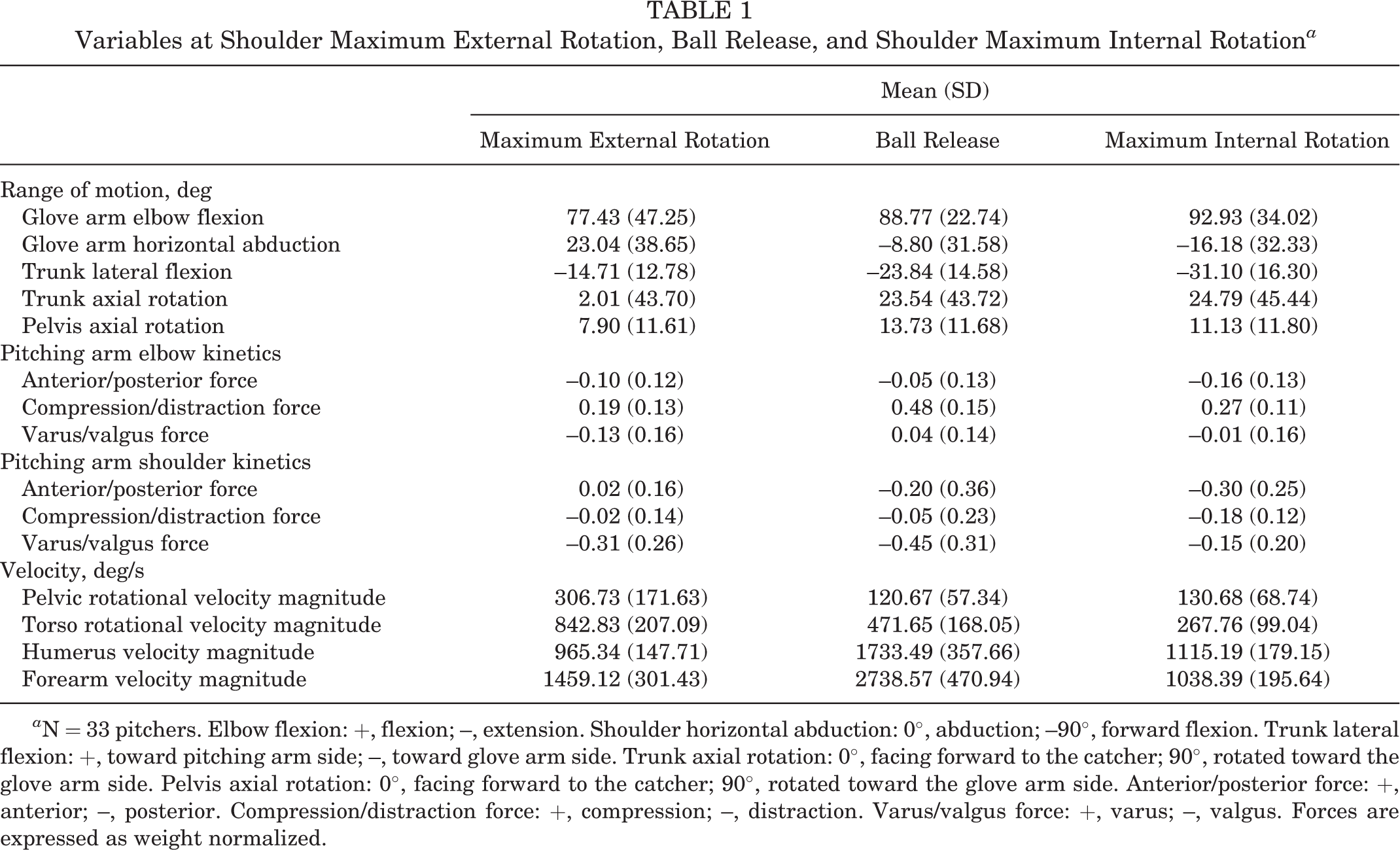
a N = 33 pitchers. Elbow flexion: +, flexion; –, extension. Shoulder horizontal abduction: 0°, abduction; –90°, forward flexion. Trunk lateral flexion: +, toward pitching arm side; –, toward glove arm side. Trunk axial rotation: 0°, facing forward to the catcher; 90°, rotated toward the glove arm side. Pelvis axial rotation: 0°, facing forward to the catcher; 90°, rotated toward the glove arm side. Anterior/posterior force: +, anterior; –, posterior. Compression/distraction force: +, compression; –, distraction. Varus/valgus force: +, varus; –, valgus. Forces are expressed as weight normalized.
Spearman Rank-Order Correlation of Glove Arm Elbow Flexion and Horizontal Abduction at MER With Variables at MER a

a MER, maximum external rotation.
bP ≤ .05.
Spearman Rank-Order Correlation of Glove Arm Elbow Flexion and Horizontal Abduction at MER With Variables at BR a

a BR, ball release; MER, maximum external rotation.
bP ≤ .05.
Spearman Rank-Order Correlation of Glove Arm Elbow Flexion and Horizontal Abduction at BR With Variables at BR a

a BR, ball release.
bP ≤ .05.
At BR, there were significant negative relationships between glove arm elbow flexion at MER and trunk axial rotation angle (rs [31] = –0.39, P = .023) and pitching arm anterior/posterior shoulder force (rs [31] = –0.42, P = .014) (Table 3). This reveals a weak negative relationship between glove arm elbow flexion at MER and trunk axial rotation angle at BR. An increase in glove arm elbow flexion was associated with a decrease in trunk axial rotation angle at BR. Also, an increase in glove arm elbow flexion at MER was moderately associated with decreased pitching arm shoulder anterior force at BR.
There was a significant negative relationship between glove arm elbow flexion at BR and pitching arm shoulder anterior/posterior force at BR (rs [31] = –0.37, P = .036) (Table 4). This provides evidence for a weak association between increased glove arm elbow flexion at BR and decreased pitching arm shoulder anterior force at BR.
There were significant positive relationships between glove arm horizontal abduction at MER and pitching arm humeral velocity at MER (rs [31] = 0.52, P = .002), trunk rotational velocity (rs [31] = 0.40, P = .022), and pelvis axial rotation angle at BR (rs [31] = 0.52, P = .002) (Tables 2 and 3). This indicates a moderate relationship between increased glove arm horizontal abduction at MER and increased pitching arm humeral velocity at BR. There was a moderate relationship identified between increased glove arm horizontal abduction at MER and increased trunk rotational velocity at BR, in addition to a moderate relationship between increased glove arm horizontal abduction at MER and increased pelvic axial rotation angle at BR. Last, there was a significant positive relationship between glove arm horizontal abduction at BR and pelvis axial rotation angle at BR (rs [31] = 0.42, P = .015) (Table 4), thus suggesting a moderate relationship between increased glove arm horizontal abduction at BR and increased pelvic axial rotation angle at BR.
Discussion
The purpose of this study was to assess the relationship between glove arm horizontal abduction and elbow flexion with the pitching arm kinematics and kinetics of a fastball from a youth baseball pitcher. Our hypothesis was supported—that is, if the glove arm elbow was extended and shoulder abducted at MER and the elbow flexed and shoulder adducted at BR, there would be a positive relationship with advantageous kinetics and kinematics. The most important finding of this study was that when the glove arm elbow is more flexed at MER, there is an association of less trunk rotation, increased pitching arm elbow valgus force, and decreased hip velocity at MER. The relationship between increased glove arm elbow flexion and decreased trunk rotation indicates that the glove arm could be associated with the conservation of momentum. As found by Ishida and Hirano, 7 an unused glove arm could cause trunk rotation to occur earlier in the pitch delivery, thus affecting the conservation of momentum in the kinetic chain (Figure 1A). These findings suggest that an emphasis of a more extended glove arm elbow and more horizontally abducted glove arm shoulder at MER could be more advantageous to performance and may be a safer motion for the baseball thrower. 4
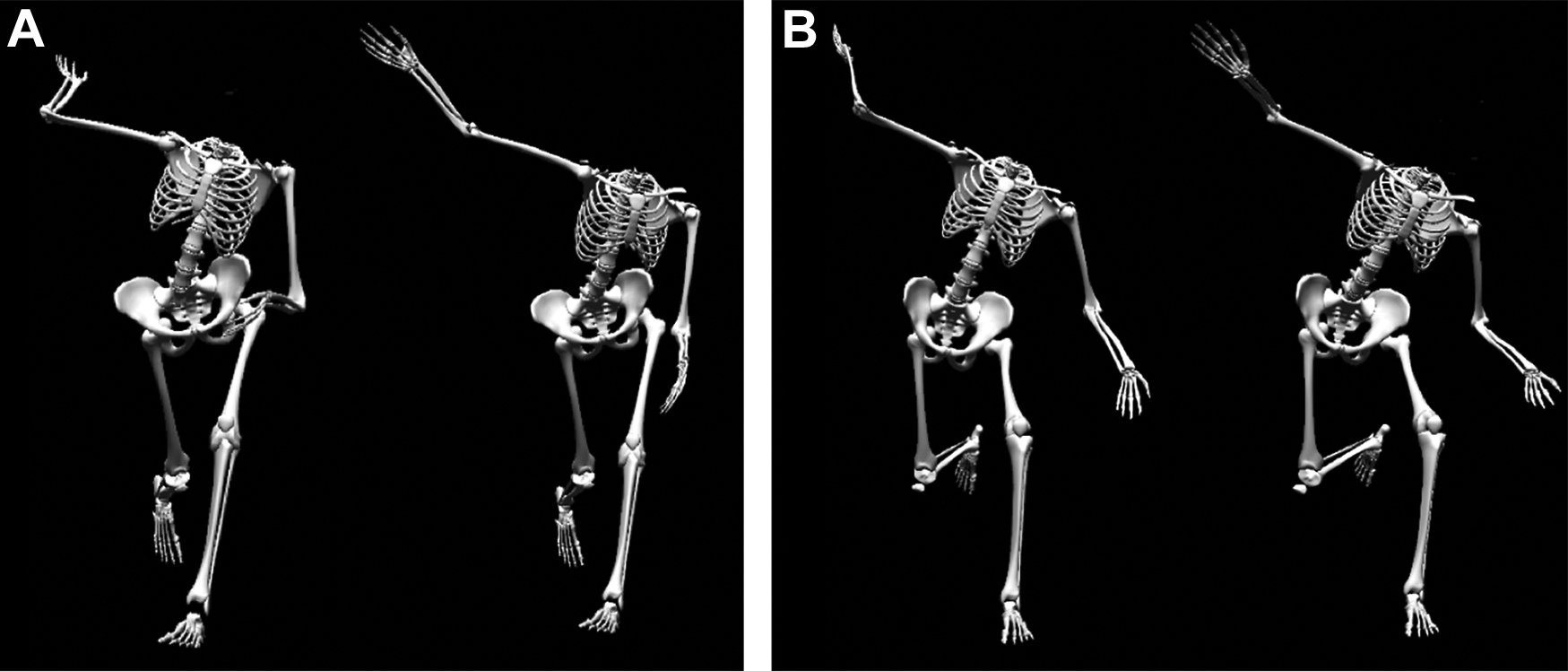
Glove arm: (A) less active and (B) active.
We classified an active glove arm as one where the elbow is extended and the shoulder is abducted at shoulder MER (Figure 1B). To keep the glove arm side active from MER through BR, the pitcher would need to flex the glove arm elbow and horizontally adduct the glove arm shoulder. Our idea of a more active glove arm would mean that the pitcher uses the entire body to work as a kinetic chain. A more open trunk position toward the glove arm side at MER is related to increased ball velocity. 22 Based on the current study and the study by Ishida and Hirano, 7 an active glove arm has a relationship with trunk positioning, which suggests that an emphasis of a more extended glove arm elbow and more horizontally abducted glove arm shoulder at MER would be more advantageous to performance and may be a safer motion for the baseball thrower.
We also observed a relationship between glove arm elbow flexion and decreased pitching arm anterior shoulder forces at MER and BR. A certain amount of anterior/posterior shoulder force is needed during the pitch to prevent humeral head translation and balance joint laxity with stability. 4,11 The current study revealed that glove arm elbow flexion has a relationship with anterior shoulder force and therefore may prevent anterior glenohumeral laxity. 10 As it was reported that professional and Little League pitchers generate substantial anterior shoulder force during the cocking phase of the pitching motion, 17 allowing the glove arm to assist with dissipating some of that force could be beneficial. Instead of instructing pitchers to pull with the glove arm, coaches should become advocates of an active glove arm and teach pitchers to close the distance between the glove arm and the pitching arm once they enter the arm acceleration phase of pitching to dissipate pitching shoulder and elbow joint loads.
The relationship between glove and pitching arm in the current study suggests that the trunk serves as a link between arms and that glove arm positioning has an effect on segmental velocities. With glove arm horizontal abduction, we found a relationship between a more abducted glove arm shoulder and pitching arm humerus velocity. As argued by Stodden et al, 21 increased pitching arm horizontal shoulder abduction would give more time for upper extremity musculature to generate greater force to increase the velocity of the ball. Paying attention to glove arm positioning during the pitch could help set the trunk in an optimal position to encourage lower body contribution to the throw. Because the glove arm may be more easily manipulated than the trunk by the pitcher during the delivery, this should be encouraged by coaches and clinicians alike to decrease injuries and improve performance.
Our findings agree with those of Ishida and Hirano 7 suggesting a link between glove arm position and trunk kinematics. Having the glove arm more horizontally abducted at MER allows the pitcher to get it in position to best assist with trunk rotational velocity. Murata 12 found less glove arm shoulder joint movement as a requirement for increased ball velocity. We believe that it takes an active effort from the pitcher to minimize shoulder joint movement. Increasing shoulder horizontal abduction at MER places the glove arm in the position that it needs to stay in for the rest of the pitch. If the glove arm shoulder acts as a fulcrum, minimal shoulder joint movement would be expected to efficiently enhance torso rotational velocity and sequencing. To maintain a constant shoulder joint position, an active effort would be required for the pitcher. Thus, an active glove arm at MER, as indicated by glove arm shoulder horizontal abduction, lends itself to increased torso rotational velocity.
Limitations to this study include a sample size of only 33, use of only right-handed participants, having athletes who participated in different leagues with different mound distances, examining only the fastest fastball per pitcher, and equipment error. Our study determined only that a relationship exists between glove arm kinematics and accepted pitching kinematics. Future studies should attempt to determine if glove arm kinematics cause alterations to trunk and pitching arm kinematics and kinetics. Also, future studies should consider pitches other than just the fastball in addition to glove arm kinematic variations on ball velocity to determine the glove arm’s influence on performance. Another limitation of this study is that it investigated only 2 kinematic parameters of the glove arm and pitching kinetics/kinematics. Additional theories considering glove arm position could be made.
Conclusion
This study investigated and found associations between glove arm kinematics and kinetics/kinematics of the baseball fastball. An extended glove arm elbow and more horizontally abducted glove arm shoulder at MER is more advantageous to performance and may be a safer motion for the baseball pitcher.
Footnotes
One or more of the authors has declared the following potential conflict of interest or source of funding: A.W.A. receives research support from Arthrex and Ceterix; is a paid speaker/presenter for Arthrex and Smith & Nephew; is a consultant for Arthrex, Mako Surgical, Procedural Orthopedics, BlueBelt Technologies, and Microaire Surgical Instruments; and receives royalties from Arthrex. J.R.A. is a consultant for Halyard Health and a paid speaker/presenter for Arthrex.
Ethical approval for this study was obtained from the Auburn University Institutional Review Board.