




Abstract
Background:
Several studies have analyzed the most cited articles in shoulder, elbow, pediatrics, and foot and ankle surgery. However, no study has analyzed the quality of the most cited articles in elbow medial ulnar collateral ligament (UCL) surgery.
Purpose:
To (1) identify the top 50 most cited articles related to UCL surgery, (2) determine whether there was a correlation between the top cited articles and level of evidence, and (3) determine whether there was a correlation between study methodological quality and the top cited articles.
Study Design:
Systematic review.
Methods:
Web of Science and Scopus online databases were searched to identify the top 50 cited articles in UCL surgery. Level of evidence, number of times cited, year of publication, name of journal, country of origin, and study type were recorded for each study. Study methodological quality was analyzed for each article with the Modified Coleman Methodology Score (MCMS) and the Methodological Index for Non-randomized Studies (MINORS). Correlation coefficients were calculated.
Results:
The 50 most cited articles were published between 1981 and 2015. The number of citations per article ranged from 20 to 301 (mean ± SD, 71 ± 62 citations). Most articles (92%) were from the United States and were level 3 (16%), level 4 (58%), or unclassified (16%) evidence. There were no articles of level 1 evidence quality. The mean MCMS and MINORS scores were 28.1 ± 13.4 (range, 3-52) and 9.2 ± 3.6 (range, 2-19), respectively. There was no significant correlation between the mean number of citations and level of evidence or quality (rs = –0.01, P = .917), MCMS (rs = 0.09, P = .571), or MINORS (rs = –0.26, P = .089).
Conclusion:
The top 50 cited articles in UCL surgery constitute a low level of evidence and low methodological quality, including no level 1 articles. There was no significant correlation between the mean number of citations and level of evidence or study methodological quality. However, weak correlations were observed for later publication date and improved level of evidence and methodological quality.
The number of times that an article is cited by other authors has been used as a measure for the academic impact of an article in the medical literature. 1,8,10,32 Research productivity for authors and the impact factor for journals are calculated with the number of citations associated with each publication. 26 Impact factor is defined as follows: the number of journal citations within a given year from the preceding 2 years (eg, 2017 citation of items published in 2015 or 2016) divided by the total number of potentially citable items (ie, all items published by a journal over those preceding 2 years). 12
It was recently reported that the impact factor has gone from a measure of a journal’s citation influence to a surrogate that assesses the scholarly value of work published in that journal. 21 As such, several new metrics have been created to objectively assign a methodological quality value to journals based on the number of citations of a journal over a given period, including the Immediacy Index, Scopus SCImago Journal Rank, Scopus CiteScore, and Scopus Source Normalized Impact per Paper. This has led to several studies analyzing the top cited articles in their respective fields. 4,19,24,25
Improved understanding of musculoskeletal basic science and the development of new surgical implants and techniques have led to rapid increases in publications in the orthopaedic literature. 11,22 As such, several authors have attempted to analyze the most cited articles in shoulder, elbow, pediatrics, and foot and ankle surgery. 3,5,15,17,23 However, no study has analyzed the quality of the most cited articles in elbow medial ulnar collateral ligament (UCL) surgery.
Such an assessment is important, as injuries to the elbow UCL are on the rise despite prevention strategies. 13 These patients often present with medial elbow pain affecting their throwing velocity and accuracy limiting their availability and effectiveness in games. 6 In 1946, Waris 31 became the first to describe elbow UCL ruptures (in javelin throwers), but UCL reconstruction was not popularized until Jobe performed the first UCL reconstruction in 1974 on pitcher Tommy John. 7 Since that time, the frequency of surgical reconstruction has increased dramatically. 6
Also, as researchers are increasingly evaluated and compared by their studies’ academic impact, “top 50” or “top 25” lists of articles on a specific topic are of high value to readerships if, upon critical analysis, their methodological quality supports their “top x” ranking.
The purpose of this study was to (1) identify the top 50 most cited articles related to UCL surgery, (2) determine if there was a correlation between the top cited articles and their level of evidence, and (3) determine if there was a correlation between study methodological quality and the top cited articles. We hypothesized that there would be no significant correlation between the top cited articles in UCL repair surgery and level of evidence or study methodological quality.
Methods
The Web of Science (v 5.23.2; Thomson Reuters) and Scopus online databases were searched in March 2017 according to previously described methods without date restrictions. 3,17,18,30 The terms “ulnar collateral ligament of the elbow reconstruction,” “UCL reconstruction,” “ulnar collateral ligament of the elbow repair,” and “UCL repair” were individually searched in each database. All articles and all journals were included. Articles were sorted by the number of times cited, from highest to lowest. Each article was evaluated to determine whether it was appropriately related to UCL surgery. The number of citations for each article was then averaged between the 2 search engines to create a list of the top 50 cited articles in UCL surgery.
Characteristics from each article were recorded: number of times cited, year of publication, name of journal, country of origin, and study type (narrative review, technique guide, animal studies, cadaveric studies, retrospective or prospective case series, cohort investigations, case-control, and randomized controlled trial). Level of evidence for each study was evaluated per the guidelines of the Journal of Bone and Joint Surgery (American). 20 Study methodological quality was analyzed for each article with the Modified Coleman Methodology Score (MCMS) and Methodological Index for Non-randomized Studies (MINORS). 9,16,27,28
Data were tested for normal distribution with the Kolmogorov-Smirnov test. When the data were normally distributed, the Pearson correlation coefficient (r) was used to determine the correlation between the top cited articles (by mean number of citations) and level of evidence and the correlation between study methodological quality and the top cited articles. When the data were not normally distributed, the Spearman correlation coefficient (rs ) was used to determine the degree of correlation between the top cited articles (by mean number of citations) and level of evidence and the degree of correlation between study quality and the top cited articles. Correlation (r and rs ) was defined as follows: as a perfect (–1), strong (–0.70), moderate (–0.50), or weak negative linear relationship (–0.30); as no linear relationship (0); or as a weak (0.30), moderate (0.50), strong (0.70), or perfect positive linear relationship (1). Student t tests were carried out for 2 group comparisons. P value <.05 was defined as significant.
Results
The 50 most cited articles in elbow UCL treatment were published between 1981 and 2015 (Table 1). The decade from 2000 to 2009 accounted for the greatest number of articles (n = 23) (Figure 1). The selected articles were published in 12 journals (Figure 2). Most of the articles (n = 29, 58%) were published in the American Journal of Sports Medicine. The mean number of citations ranged from 20 to 301 (mean ± SD, 71 ± 62 citations) (Table 1). Four countries were represented, with 46 (92%) of the top 50 cited articles being from the United States (Figure 3).
Top 50 Most Cited Articles in Ulnar Collateral Ligament Surgery a
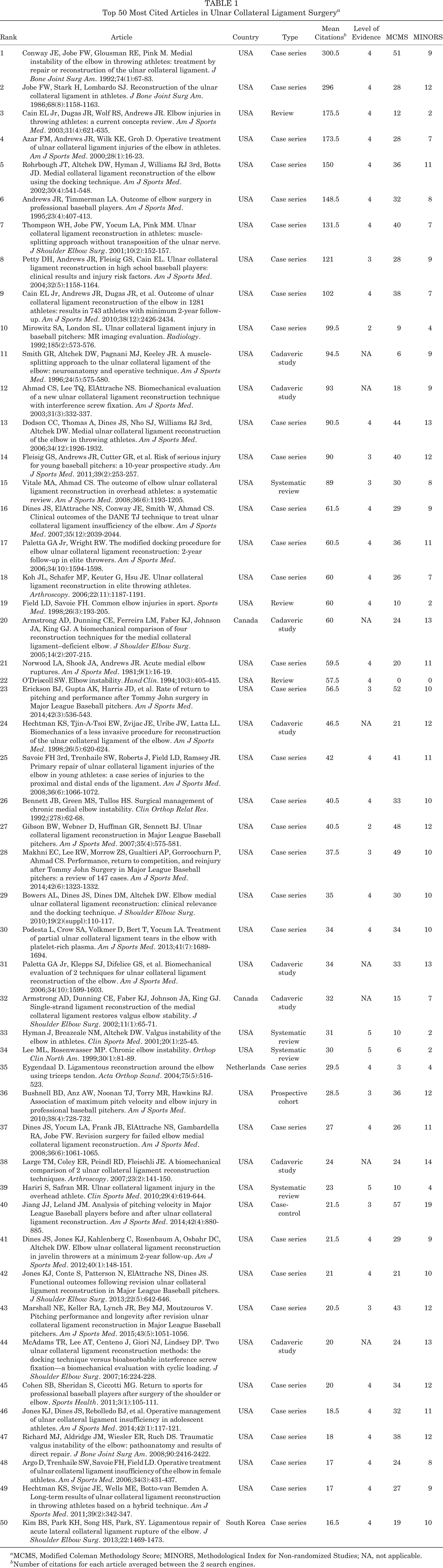
a MCMS, Modified Coleman Methodology Score; MINORS, Methodological Index for Non-randomized Studies; NA, not applicable.
b Number of citations for each article averaged between the 2 search engines.

Number of most cited articles and decade of publication.

Number of top 50 cited articles in each journal. AJSM, American Journal of Sports Medicine; CORR, Clinical Orthopaedics and Related Research; JBJS-Am, Journal of Bone and Joint Surgery (American); JSES, Journal of Shoulder and Elbow Surgery.

Countries represented in top 50 most cited articles.
The most common type of article was retrospective case series, with 33 (66%) (Figure 4). The studies had evidence levels ranging from 2 to 5 and unclassified (eg, cadaveric studies), with the most common being level 4 (Figure 5). There was no significant correlation between the mean number of citations and level of evidence (rs = –0.01, P = .917) among the studies included in the review.

Top 50 cited articles by article type. Review, narrative review.

Top 50 cited articles by level of evidence.
The mean MCMS was 28.1 ± 13.4 (poor; range, 3-52). There was no significant correlation between the mean number of citations and MCMS (rs = 0.09, P = .571). The mean MINORS was 9.2 ± 3.6 (range, 2-19). There was no significant correlation between the mean number of citations and MINORS (rs = –0.26, P = .089).
Studies were analyzed for change over time. There was a weak negative correlation between year published and level of evidence (rs = –0.35, P = .037). Weak positive correlations occurred between year published and MCMS (r = 0.48, P = .001) and between year published and MINORS (rs = 0.35, P = .020).
Discussion
This study identified the top 50 most cited articles related to UCL treatment. There was no significant correlation between the number of citations for the top 50 cited articles and level of evidence or study methodological quality. This study confirmed all our hypotheses. Most studies (80%) had low levels of evidence (levels 4 or 5 or unclassified) and low methodological quality (poor MCMS, low MINORS). However, with time, weak correlations were observed for later publication date and improved level of evidence and methodological quality.
One previous study evaluated the top cited articles in elbow surgery. Huo et al 15 demonstrated that among the top 50 articles cited in elbow surgery, the majority were published in the 1990s (n = 18) and 1980s (n = 19). These results intuitively make sense, given that time since publication would increase the likelihood of citation. Our results differ in that the majority of cited articles were published after the year 2000, although our 2 most cited papers were among the oldest included in the study. However, these findings may be related to an increase in the overall number of publications over the past decade inflating and saturating the databases. 11,22 Conversely, it may reflect an increase in UCL surgery, as such injuries continue to rise. 13
In the current study, the majority of articles were published in the American Journal of Sports Medicine (58%) and the Journal of Shoulder and Elbow Surgery (14%). This differs from a prior study assessing elbow surgery, with only 12% and 0% of the top cited articles coming from the American Journal of Sports Medicine and Journal of Shoulder and Elbow Surgery, respectively. 15 Similar to the current study, the Journal of Bone and Joint Surgery (American) was a major source of top cited articles. This is to be expected, as these 3 journals consistently have the highest impact factors in the orthopaedic surgery literature. 29
Most authors (92%) from the top 50 cited articles were from the United States. This trend was seen in previous citation studies of shoulder surgery, plastic surgery, general surgery, and orthopaedic surgery (top 100 articles). 17 –19,23,25 This finding indicates a possible bias toward American authors, as several of the top journals in orthopaedic surgery are based in the United States and published in the English language. However, it is also possible that the majority of the UCL articles are from the United States because baseball is predominately a US sport.
Previous studies showed that the majority of the top cited articles in orthopaedic and elbow surgery are level 4 case series. 17,18,23 This was similar to the present study on UCL surgery, in which 25 (50%) articles were level 4 case series. With the recent focus on evidence-based medicine, this study found weak correlations for later publication date and improved level of evidence and methodological quality. However, low-level studies still dominate the literature and should serve as an impetus to improve the methodological quality of studies investigating this topic.
It is possible that this new emphasis is not yet reflected in the number of citations and that if this study were repeated at a later date, the number of investigations with low levels of evidence would decrease. This trend is apparent in a comparison of a study by Namdari et al 23 (published in 2012; level 1 studies, n = 0) with a more recent study by Kraeutler et al 17 (published in 2016; level 1 studies, n = 3). 18 In addition, analogous to the calculation of impact factor, more recent citation data—2 or 5 years rather than the past 30 years (as used in the current study)—would be highly likely to change the composition of the current investigation’s top 50 cited list.
In contrast to previous papers, the current study analyzed the methodological quality of the top cited articles. According to the MCMS, all articles were poor (scores <55), with the overall mean MCMS classified as poor (28.1). Harris et al 14 found similar results in a topic not investigated in other top citation articles—specifically, poor overall methodological quality in articular cartilage studies. The methodological quality deficiencies identified in this study should guide the future study design, conduct, and reporting of UCL surgery.
Additionally, the current study aimed to determine if there was any correlation between level of evidence and study methodological quality with number of citations. As expected, there was no significant correlation between level of evidence and number of citations. This is in contrast to a study by Arshi et al, 2 which evaluated the top cited articles in cartilage surgery for which the number of citations was correlated with a stronger level of evidence. However, there was a higher number of level 1 and 2 studies in that study compared with the present study.
There was also no significant correlation between the mean number of citations and MCMS and MINORS. The poor correlation between study quality and number of citations is due to the small number of level 1 and 2 studies as compared with the lower-level studies. Additionally, the poor correlation between number of citations and methodological quality is likely secondary to the MCMS favoring randomized controlled trials, while the MINORS favors nonrandomized controlled trials. However, study methodological quality appears to be improving with time, as there was a weak correlation between year published and MCMS and MINORS in the present study. The “classic” articles are typically going to be case studies and therefore have lower levels of evidence, since they initially present the injury and surgical repair technique. Additionally, UCL injuries are still relatively uncommon as compared with other sport-related injuries, making it more challenging to perform level 1 or 2 studies.
This study has a number of strengths and limitations. It was the first to analyze the most cited articles in elbow UCL surgery. The number of articles (N = 50) was arbitrarily chosen and may have eliminated other influential articles. However, this number is based on several previously published studies. 3,15,17,23 This study also utilized only 2 databases: Web of Science and Scopus. However, Scopus is the world’s largest scientific database, and by combining it with Web of Science, we believe that few to no citations were missed. Additionally, the search in this study was not limited to “known” orthopaedic journals; rather, it extended to previously published papers to limit the potential for missed relevant articles.
The number of citations can be influenced by a number of factors. One such potential is high-volume authors citing their own work (“self-citation”), which was not accounted for in this study. Also there appears to be a “snowball effect” to citations, as other authors are more likely to cite an article because of previous citations rather than for its content or quality. 18 There is also a disadvantage to newer published articles having less time to accrue citations, although this did not seem to be a factor here. Using a 2- or 5-year selection eligibility period (or any arbitrarily chosen time) could change the composition of the top 50 studies in the current investigation’s list.
To objectively analyze the most cited papers, this study included review articles, which served an important purpose: to corroborate the heavily cited low level of evidence. Although review articles often “double dip” certain articles (ie, ones already cited), the fact that they are more heavily cited than other primary articles further demonstrates the overall weakness of the UCL literature. A final limitation is that the number of times an article is cited is always changing and depends not on the quality or content of the article but rather on shifts in the field that change over time.
Conclusion
The top 50 cited articles in UCL surgery constitute a low level of evidence and low methodological quality, including no level 1 articles. There was no significant correlation between the mean number of citations and level of evidence or study methodological quality. However, weak correlations were observed for later publication date and improved level of evidence and methodological quality.
Footnotes
One or more of the authors has declared the following potential conflict of interest or source of funding: P.C.M. has received research support from Arthrex and DePuy; is a paid speaker for Aastrom Biosciences and Vericel; and has received financial/material support for a sports medicine fellowship from 2Aastrom Biosciences, Arthrex, and MedInc. D.M.L. has received educational support and financial/material support for a sports medicine fellowship from Arthrex and MedInc. J.D.H. has received research support from DePuy and Smith & Nephew; has received educational support from Arthrex and MedInc; is a paid consultant for NIA Magellan and Smith & Nephew; is a paid speaker for Ossur and Smith & Nephew; receives publishing royalties from SLACK Inc; and receives financial/material support for a sports medicine fellowship from Arthrex and MedInc.