




Abstract
Objectives:
knee arthroscopy done usually through two punctures (anteromedial and anterolateral). We aimed to record the impact of delayed tract closure on the post-operative sub-acute and chronic anterior knee pain.
Design:
Ultrasonography was used to evaluate the healing pattern of portal-site tracts.
Setting and Participants:
104 operated patients, followed up for one year. Puncture wounds were divided into two groups, (1) anteromedial group and (2) anterolateral group. Each group contains 104 portal-site tract.
Main Outcome Measures:
VAS was used to measure pain related to delayed tract healing and its association with the post-operative sub-acute and chronic knee pain.
Results:
Anteromedial and anterolateral tracts average total healing time was (47 days, 28 days) respectively. The median VAS of anteromedial tract after 2 weeks, one month, three months, six months and one year was (8.2, 6.3, 4, 1.9, 0.6) respectively, and for the anterolateral tract was (7.4, 5.5, 2.8, 1.2, 0.2) respectively. A statistical significance was detected between the two groups at the first and third months with P values 0.042 and 0.0035 respectively.
Conclusions:
Anteromedial tracts closed later than anterolateral tracts. Both portal-site tracts delayed closure is a potential for post-operative sub-acute and chronic anterior knee pain after arthroscopic surgery.

Ultrasound imaging of a female patient’s medial portal-site tract, 6 month after arthroscopic procedure still complaining of an anteromedial knee pain revealed an incompletely closed tract, stage (1). ST: Subcutaneous tissue, PST: Portal-site tract, FC: Medial femoral condyle, TP: Tibial platue
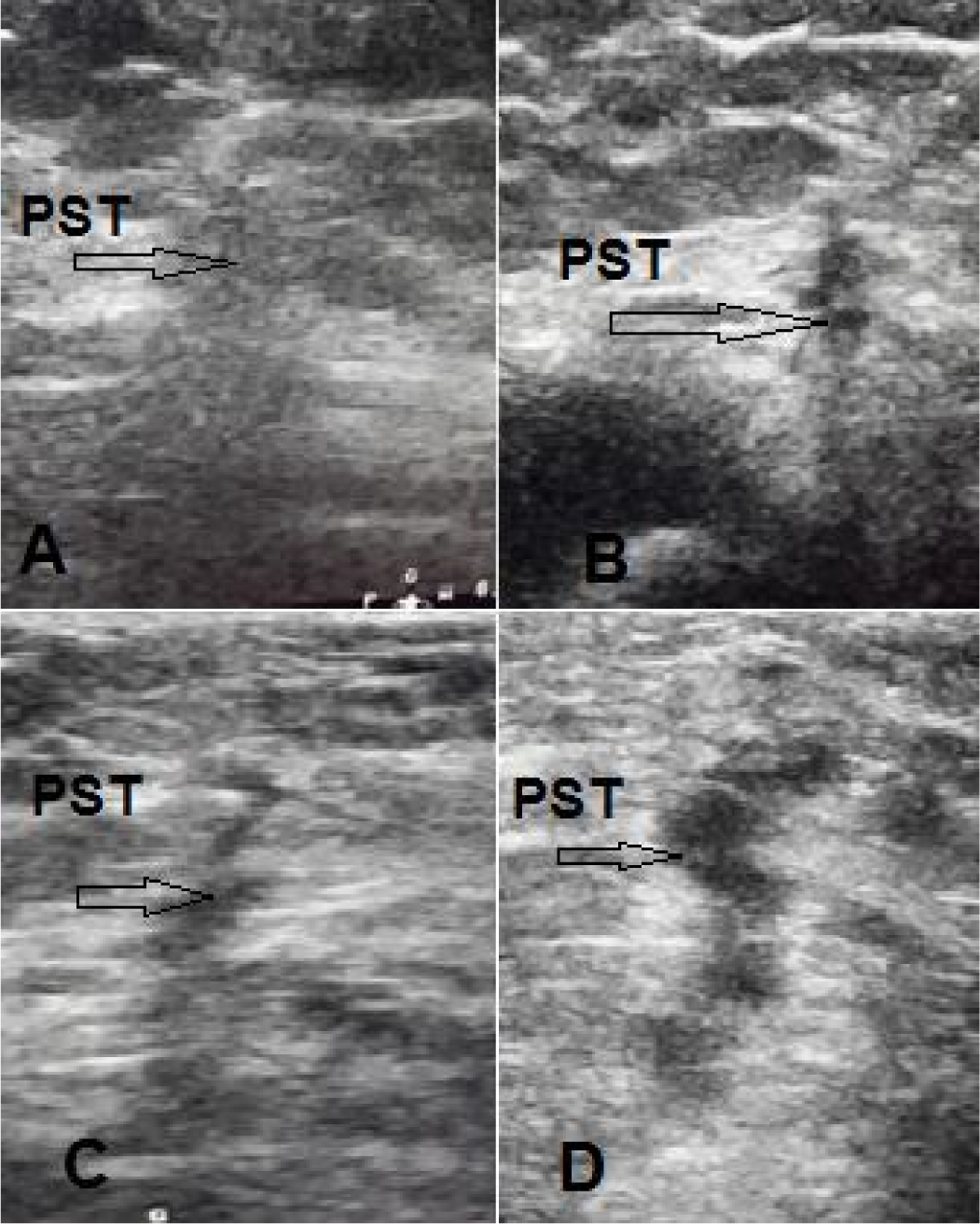
Ultrasonography staging of portal-site tract closure pattern observed during the follow-up period. PST: Portal-site tract. A: stage (0) the PST is totally closed. B: stage (1) the PST is sub-totally closed. C: stage (2) the PST is partially closed. D: stage (3) the PST is totally open.