




Abstract
Background:
Concussion prevention in the National Football League (NFL) is an important priority for player safety. The NFL now has modified game schedules, and one concern is that unconventional game schedules, such as a shortened rest period due to playing on a Thursday rather than during the weekend, may lead to an increased risk of injuries.
Hypothesis:
Unconventional game schedules in the NFL are associated with an increased rate of concussion.
Study Design:
Descriptive epidemiological study.
Methods:
This study analyzed concussions and game schedules over the NFL regular seasons from 2012 to 2015 (4 years). Documented numbers of concussions, identified by use of the online database PBS Frontline Concussion Watch, were summarized by regular-season weeks. Association of days of rest and game location (home, away, or overseas) with the rate of concussion was examined by use of the χ2 test. Logistic regression analysis was performed to examine the relationships of days of rest and home/away games to the risk of repeated concussions, with adjustment for player position.
Results:
A total of 582 concussions were analyzed in this study. A significantly greater number of concussions occurred in the second half of the season (P < .01). No significant association was found between the rate of concussion and the days of rest, game location, or timing of the bye week by the team or the opponent (P > .05). Game schedules were not significantly associated with the occurrence of repeat concussions (P > .05).
Conclusion:
Unconventional game schedules in the NFL, including playing on Thursday and playing overseas, do not seem to put players at increased risk of concussions.
Concussion in the National Football League (NFL) has received substantial attention in recent years. Concussion, a type of mild traumatic brain injury (mTBI), 22 has been associated with various health consequences, including short-term problems (eg, headache, dizziness, and memory problems) 4 and long-term disabling conditions (eg, anxiety, stress, and depression) 29 among American football players, 37 although the evidence is not unanimous and further research is needed. 20 The general public is aware that sports concussion is a growing public health concern. 23,38
While it had been alleged that the NFL did not take appropriate actions for concussion management in the past, 17,28 the league has recently made efforts to address the issue of concussion. For example, starting in 2012, in each NFL game there is now an independent, certified athletic trainer, known as an “ATC spotter,” who monitors injuries from above the field and is granted the ability to request the team medical professionals to evaluate a player or to request the officials to stop the game if the player is suspected to have sustained a concussion. 21 As part of brain injury research effort, the NFL announced in 2013 its plan to invest $60 million to improve mTBI diagnosis. 36 To make the game of football safer, it is important that the NFL continue to strive for concussion management, including prevention and treatment strategies.
The NFL has introduced modified game schedules, and one concern is that certain game schedules may lead to an increased risk of injuries. 30 A majority of NFL games are played on Sunday, while the NFL also schedules a small number of games on other days (eg, Monday and Thursday) 27 as well as overseas (eg, London, UK, and Mexico City, Mexico). 24 For example, if a team plays on Sunday and then plays on the following Thursday, players will have only 3 days of rest between the games. These unconventional game schedules create unique challenges for the teams and players (eg, shorter recovery time and condensed travel schedule), which may adversely affect the players’ health and performance and thus may increase the risk of injuries. The aim of this study was to examine whether game schedules are associated with the rate of concussions in the NFL.
Methods
The present study analyzed the rate of concussions and game schedules for 32 NFL teams during the 2012-2015 NFL regular seasons (4 years, excluding preseasons and playoffs). The NFL regular season consists of 17 weeks, and each team plays 16 games and has 1 bye week. A team does not play during the bye week, which is traditionally scheduled between week 4 and week 12 of the regular season, with teams having different bye week schedules set by the league. The bye week provides players with an opportunity to rest and recover from injuries. Data on concussions and game schedules were retrieved from PBS Frontline Concussion Watch (http://apps.frontline.org/concussion-watch) and Pro-Football-Reference.com (http://www.pro-football-reference.com/), respectively. PBS Frontline Concussion Watch includes NFL players “who have officially been listed on the NFL injury report with either a concussion or a head injury beginning with the 2012-2013 NFL season.” 3 This study was reviewed by the university institutional review board (IRB) and received an IRB exemption determination (IRB_00099212), as we conducted a secondary analysis of data available through web-based public access domains, which disclose no individual health information.
First, we identified players who were reported to have sustained a concussion during the 2012-2015 NFL regular seasons. In addition, players who had multiple concussions in the same season were separately identified. Not all concussion cases had specific information on whether the injury occurred during a game or practice. However, according to a report from the NFL, 25 more than 95% of concussions in the past several regular seasons occurred during games. Therefore, the data analysis in this study was performed assuming that all concussions occurred during games; concussion cases with unknown injury dates or those occurring during the bye week were excluded from the analysis.
We then retrieved the game schedule for each concussion case. One of the variables of interest for game schedules was days of rest between the games (categorical variable: 3 days, 5-7 days, or 9-14 days, excluding games in week 1). For example, if the team played on Sunday and then played on the following Thursday, this was considered 3 days of rest. Other variables of interest for game schedules included regular-season week (ordinal categorical variable: weeks 1-17) and game location (categorical variable: home, away, or overseas).
Documented numbers of concussions were summarized by regular-season week. We used a χ2 goodness-of-fit test to compare the observed frequencies of concussions by days of rest and by game location with the expected distributions of concussions that were calculated from the game schedules in the 2012-2015 regular seasons. For example, a total of 2048 regular-season games were played by 32 NFL teams over the 4 years. We excluded 128 games in week 1, and of the remaining 1920 games, 128 games were played after 3 days of rest (6.67%), 1528 games were played after 5 to 7 days of rest (79.58%), and 264 games were played after 9 to 14 days of rest (13.75%). These proportions served as the expected proportions of concussions; that is, if there was in fact no relationship between days of rest and rate of concussion, then the number of concussions should be proportional to the percentage of games played within each rest category. 6 In case of small expected frequencies, empirical P values were computed by use of exhaustive enumeration or 10,000 Monte Carlo resamples. 13 A 2-way contingency table analysis with Fisher exact P value computation was performed to examine the association between the rate of concussions by days of rest (excluding games in week 1) and that by game location (excluding overseas games because of the small sample size).
To examine the potential association of bye week to the rate of concussions, a χ2 goodness-of-fit test was performed to compare the distribution of concussions by timing of the bye week for each team (first half vs middle or at week 9 vs second half of the season) with the expected distribution of bye weeks calculated from the regular-season schedules. Over the 2012-2015 NFL regular seasons, the bye weeks were scheduled as follows: 1088 (53.1%) bye weeks in the first half of the season (ie, weeks 4-8), 352 (17.2%) in the middle of the season (ie, week 9), and 608 (29.7%) in the second half of the season (ie, weeks 10-12). These proportions served as the expected proportions for the aforementioned χ2 goodness-of-fit test. Furthermore, we analyzed the rate of concussions based on whether the opposing team had just come off the bye week. Of the 2048 regular-season games in 4 years, there were 128 games (6.25%) in which the team just came off the bye week, which was used as the expected proportion for a χ2 goodness-of-fit test. Last, a logistic regression analysis was conducted to examine the relationships of days of rest and game location (home or away) to the risk of repeated concussions (outcome variable with 2 categories: yes/no) using player position (categorical variable: offense or defense, excluding special team) as a covariate.
Results
A total of 645 concussions were documented over the 2012-2015 NFL seasons. Of these, 40 concussions were reported during the preseason, 11 were reported in the playoffs, 2 were reported during the bye week, and 10 were reported with unknown injury dates. As a result, this study analyzed 582 cases of concussions, including 30 concussions in week 1 and 32 repeated concussions. No player sustained more than 2 concussions in a single season. The number of concussions by regular-season week are summarized in Figure 1. It appears that more concussions occurred in the second half of the season than in the first half. An exact binomial test, as a follow-up analysis, showed that when concussion cases were divided before and after the teams played the first 8 regular-season games, significantly more concussions were reported (P < .01) during the second half of the season (n = 327, 56.2%) than during the first half of the season (n = 255, 43.8%).
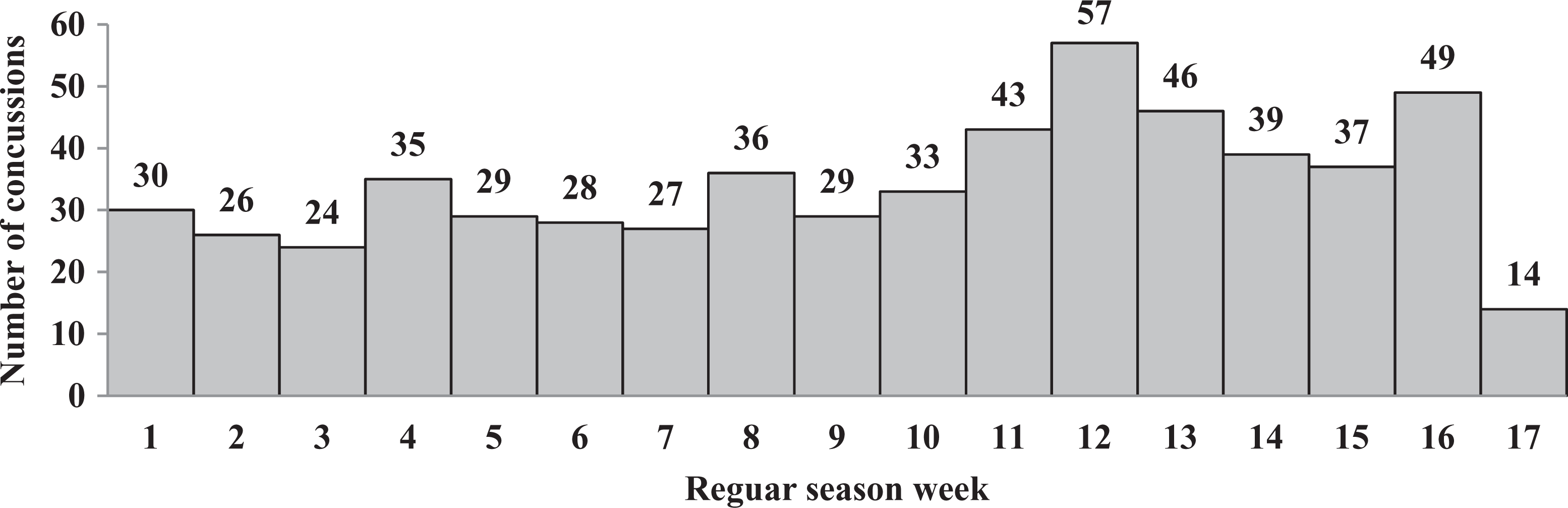
Concussions by regular-season week during the 2012-2015 National Football League seasons (N = 582).
According to the χ2 goodness-of-fit test, the observed distribution of concussions by days of rest was not significantly different from the expected distribution calculated from the regular-season schedules (χ2 2 = 3.50, empirical P = .17), suggesting that days of rest did not have a significant effect on the rate of concussions. Table 1 shows the observed and expected frequencies of concussions and their ratios. Although not statistically significant, about 15 more concussions than expected were reported in the games played after 9 to 14 days of rest. As was the case with days of rest, game location was not significantly associated with the rate of concussions (χ2 2 = 2.88, empirical P = .23) (Table 2). This nonsignificant result held true even after concussions reported in overseas games (n = 5) were excluded from the analysis (χ2 1 = 2.36, empirical P = .11). It may be worth noting, however, that 39 more concussions occurred in away games than in home games. The 2-way contingency table analysis indicated no significant association between concussions stratified by days of rest and those stratified by home/away games (χ2 2 = 1.85, Fisher exact P = .39) (Figure 2).
Numbers of Concussions by Days of Rest During the 2012-2015 National Football League Regular Seasons a
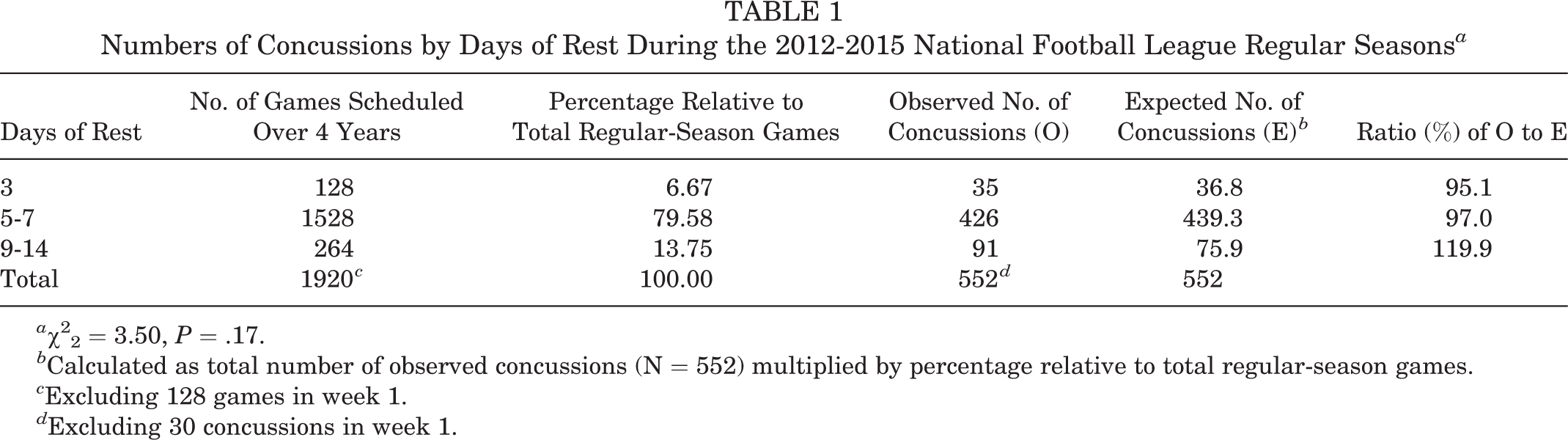
a χ2 2 = 3.50, P = .17.
b Calculated as total number of observed concussions (N = 552) multiplied by percentage relative to total regular-season games.
c Excluding 128 games in week 1.
d Excluding 30 concussions in week 1.
Numbers of Concussions by Game Location During the 2012-2015 National Football League Regular Seasons a

a χ2 2 = 2.88, P = .23.
b Calculated as total number of observed concussions (N = 582) multiplied by percentage relative to total regular-season games.

Associations for the rate of concussions between days of rest and home/away games during the 2012-2015 National Football League regular seasons (n = 547; 30 concussions in week 1 and 5 concussions during overseas games were excluded). χ2 2 = 1.85, Fisher exact P = .39.
Of the 582 concussions, 297 cases, 98, cases, and 187 cases occurred in players whose teams had their bye week in the first half, the middle, and the second half of the season, respectively. In addition, 35 of 582 concussions occurred when the opponent just came off the bye week. The χ2 goodness-of-fit test showed that whether teams had their bye week in the first half, the middle, or the second half of the season was not significantly associated with the rate of concussions (χ2 2 = 1.69, P = .43). Likewise, no significant association was found between the rate of concussions and whether the opponent just came off the bye week (χ2 1 = 0.06, P = .81). Last, the logistic regression analysis showed that neither days of rest nor home versus away game was a significant predictor of the occurrence of repeated concussions (model: log-likelihood-ratio χ2 = 1.62, P = .65, R 2 = 0.007; P > .05 for both predictors) (Table 3) after adjustment for player position.
Logistic Regression Analysis on the Relationships of Days of Rest and Home/Away Games to the Risk of Repeated Concussions During the 2012-2015 National Football League Regular Seasons a
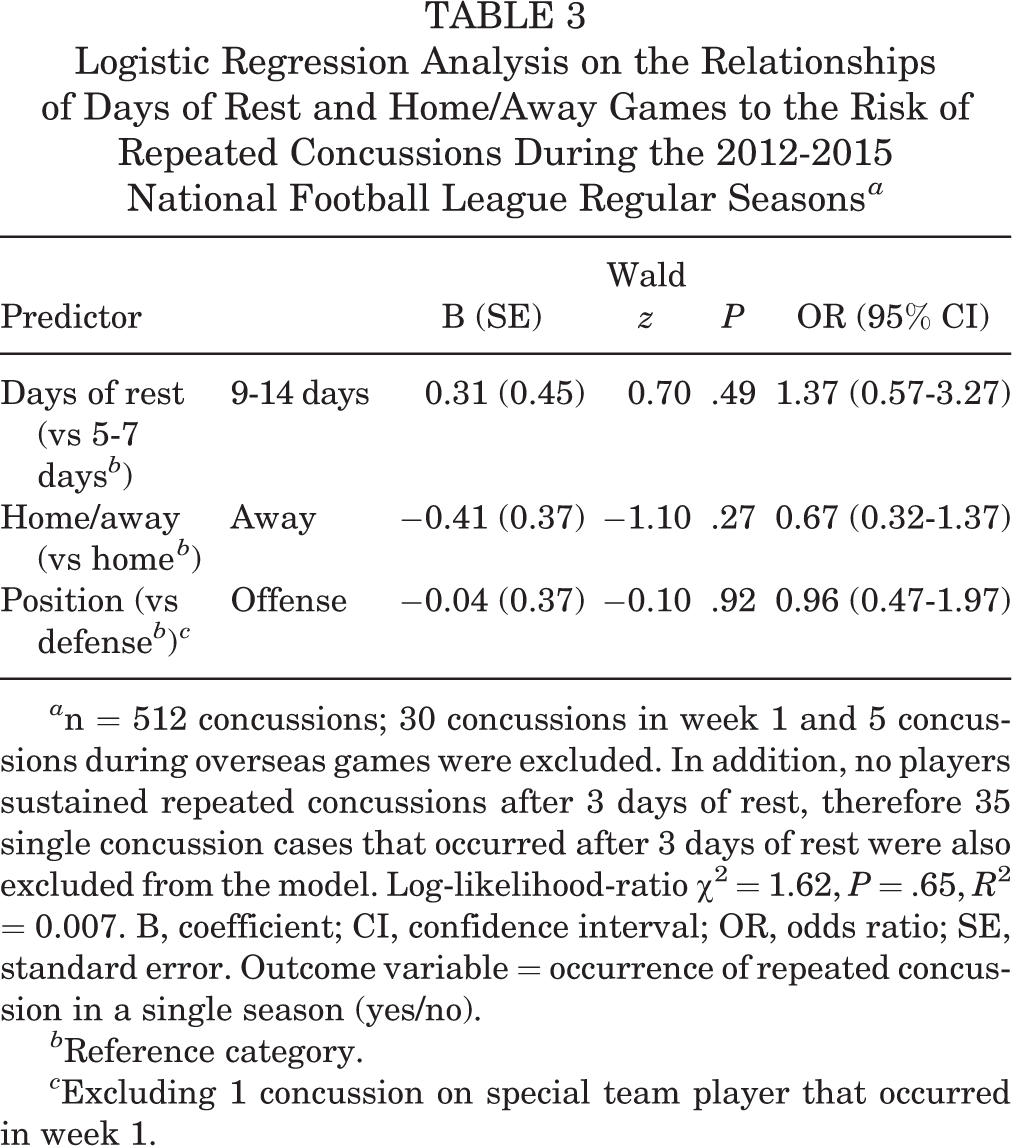
a n = 512 concussions; 30 concussions in week 1 and 5 concussions during overseas games were excluded. In addition, no players sustained repeated concussions after 3 days of rest, therefore 35 single concussion cases that occurred after 3 days of rest were also excluded from the model. Log-likelihood-ratio χ2 = 1.62, P = .65, R 2 = 0.007. B, coefficient; CI, confidence interval; OR, odds ratio; SE, standard error. Outcome variable = occurrence of repeated concussion in a single season (yes/no).
b Reference category.
c Excluding 1 concussion on special team player that occurred in week 1.
Discussion
Concussion in the NFL is an important issue. Because of the potential adverse health consequences resulting from concussion and mTBI, it is essential that the NFL address the prevention and treatment of concussion. In addition to holding the conventional Sunday games, the NFL schedules games on other days of the week as well as overseas. These unconventional game schedules may affect injury risks among NFL players, and this study aimed to determine whether game schedules in the NFL today have any association with the rate of concussions.
The analysis of concussions by regular-season week indicated that concussions seem to occur more frequently later in the season. When the season was divided into 2 halves, before and after the teams played the first 8 games, more concussions occurred in the second half of the season over the course of 4 years. This may be because players have become physically and/or mentally fatigued during the course of the season, which could increase the risk of concussion. 32 In contrast, Lawrence and colleagues 16 did not find a significant association between the rate of concussions and regular-season week. The discrepancy in the findings between the studies could stem from the methodological differences in the data collection. As well, Lawrence et al reported that colder game-day temperature was a potential risk factor for concussions. The NFL season begins in the fall and continues through the winter. Therefore, game-day temperature, on average, is lower later in the NFL season, which might also explain the increased numbers of concussions in the second half of the season. Further research is warranted to elucidate why more concussions occur later in the season.
We found no significant association between the rate of concussions and the days of rest, game location, or timing of the bye week by the team or the opponent. Moreover, the rate of repeated concussions (multiple concussions in a single season) did not seem to be affected by these game schedules. Hence, as far as concussion is concerned, unconventional game schedules in the NFL today are not likely to increase the risk. In particular, there was no evidence that fewer days of rest (eg, 3 days of rest due to playing on Thursday) or playing overseas is linked with an increased risk of concussion. The NFL also released statistics showing that the rate of game injuries during Thursday games was similar to or even lower than the rate during Sunday or Monday games. 25 However, players argue that a short rest period is a concern for player safety. 33 Since the number of games played on Thursday and overseas is still small, more data on concussions by these game schedules are needed before a more definitive conclusion can be made.
Trends in concussions by game schedules were observed in our study. First, concussions tended to occur in the games after longer rest (9-14 days of rest: 15 more concussions than expected in our analysis). One potential reason for this observation is that extra days of rest (and an extra weekend if it involves the bye week) may disrupt the rhythm of practice and game play to which players are accustomed during the season. For example, the NFL Collective Bargaining Agreement mandates that players receive at least 4 consecutive days off during the bye week. 26 In addition, practice time during the bye week does not increase dramatically, as the number of padded practices that each team can have during the regular-season is limited by the NFL Collective Bargaining Agreement. 26 Consequently, the workload during a longer rest period is likely to initially decrease compared with other weeks and then to substantially increase prior to and during the upcoming game. This workload difference may be one factor that contributes to an increased risk of concussion after 9 to 14 days of rest. 9
Another trend found in this study is that more concussions were likely to be reported in away games. Playing away from home involves challenging travel schedules that often include long-distance travel and changes in time zone. Traveling could lead to sleep loss and potential cognitive changes caused by sleep deprivation among players. 34 Sleep deprivation has been shown to increase fatigue-related injuries in sports, 18 and experts suggest that sleep disorders may put athletes at greater risk for concussion. 19 Furthermore, time-zone change can negatively affect football performance. 31 These factors collectively could contribute to the risk of concussion. Hence, team medical professionals in the NFL may need to monitor players’ risk of concussion after additional days of rest (eg, after the bye week or in the next game after playing on Thursday) or while playing on the road.
Limitations associated with the current study should be mentioned. First, we relied on a publicly available website to collect data on concussions. The NFL manages a system called the NFL Injury Surveillance System, in which athletic trainers and team physicians record data on injured players. 5,7 Unfortunately, we did not have access to this system and thus were unable to compare our concussion data with those in the NFL Injury Surveillance System. Hence, there may be relevant information for concussion diagnoses that is not available to the public (eg, suspected concussions) and thus was not analyzed in this study. As well, suspected concussions may or may not be diagnosed as concussions. We believe, therefore, that focusing on reported (ie, diagnosed) concussions yielded consistent results regarding the association of game schedules and concussions in this study. Additionally, PBS Frontline Concussion Watch, from which the data on concussions were retrieved in this study, included NFL players officially listed as having a concussion or a head injury on the NFL injury report, which should make our concussion data relatively close to those in the NFL Injury Surveillance System. Second, the sample size in this study was not large because of the availability of data on concussions, especially after we excluded 10 cases of concussions with unknown injury dates, which reduced the statistical power. Third, it is likely that factors unique to each individual player not examined in this study are associated with the risk of concussions, such as the player’s condition at the time of the game, skill level, and history of prior concussions. Fourth, it has been suggested that concussions in football are underreported 2 ; therefore, concussions analyzed in this study may not represent all the concussion cases in the NFL. The issue of potentially underreporting of concussions is not specific to this study or to the NFL but applies to other contact sports as well. 1,14,15 Hence, caution should be taken when interpreting study findings on concussions in sports. Fifth, this is an observational study; therefore, we were unable to draw causal inferences of concussions and game schedules from our data analysis.
Despite the aforementioned limitations, the current study attempted to answer novel research questions on game schedules and concussions in the NFL, which to our knowledge had not been investigated in the past. In addition to this study, we previously examined the association between style of play and the rate of concussions in the NFL and found that West Coast offense might be a risk factor for concussion in the NFL. 35 We believe that our studies contribute to research on risk factors of concussion in the NFL.
With respect to concussion in other contact sports, Gardner et al 10 reported that the rate of concussions in rugby differed by match play versus training session, by seasons, and by playing position, with ball carriers having a greater risk of concussion than tacklers. In the National Hockey League (NHL), significantly more concussions than expected were observed among forwards, during the first period, and in the defensive zone. 11 Furthermore, a majority of concussions in the NHL occurred as a result of player contact. 12 These authors proposed that rule changes may reduce the incidence of concussions in the NHL. 12 These epidemiological findings are useful for developing effective prevention strategies for concussions in sports. For instance, research has shown that protective equipment (eg, helmets in skiing and snowboarding) and policy and rule changes (eg, prohibiting body checking in youth ice hockey) are effective in reducing concussions. 8 It is therefore important to continue research to identify risk factors for concussion in sports in order to protect the health of athletes.
In summary, our study indicated no evidence that a shorter rest period (3 days of rest due to playing on Thursday) and playing overseas are associated with the rate of concussions in the NFL regular-season. Contrary to the beliefs of the media and players, the current NFL game schedules do not seem to put players at increased risk of concussion. We found increased numbers of concussions in games after longer rest periods (9-14 days of rest) and in away games, although this finding was not statistically significant. Furthermore, significantly more concussions occurred in the second half of the season than in the first half. These findings could be useful for team medical professionals in the NFL, in terms of monitoring concussions for their players. Future research should be conducted to include more years of data on concussions for more robust analyses and results.
Footnotes
The authors declared that they have no conflicts of interest in the authorship and publication of this contribution.
Ethical approval for this study was waived by the University of Utah Institutional Review Board.