




Abstract
Background:
A substantial number of orthopaedic surgeons apply for sports medicine fellowships after residency completion. The Internet is one of the most important resources applicants use to obtain information about fellowship programs, with the program website serving as one of the most influential sources. The American Orthopaedic Society for Sports Medicine (AOSSM), San Francisco Match (SFM), and Arthroscopy Association of North America (AANA) maintain databases of orthopaedic sports medicine fellowship programs. A 2013 study evaluated the content and accessibility of the websites for accredited orthopaedic sports medicine fellowships.
Purpose:
To reassess these websites based on the same parameters and compare the results with those of the study published in 2013 to determine whether any improvement has been made in fellowship website content or accessibility.
Study Design:
Cross-sectional study.
Methods:
We reviewed all existing websites for the 95 accredited orthopaedic sports medicine fellowships included in the AOSSM, SFM, and AANA databases. Accessibility of the websites was determined by performing a Google search for each program. A total of 89 sports fellowship websites were evaluated for overall content. Websites for the remaining 6 programs could not be identified, so they were not included in content assessment.
Results:
Of the 95 accredited sports medicine fellowships, 49 (52%) provided links in the AOSSM database, 89 (94%) in the SFM database, and 24 (25%) in the AANA database. Of the 89 websites, 89 (100%) provided a description of the program, 62 (70%) provided selection process information, and 40 (45%) provided a link to the SFM website. Two searches through Google were able to identify links to 88% and 92% of all accredited programs.
Conclusion:
The majority of accredited orthopaedic sports medicine fellowship programs fail to utilize the Internet to its full potential as a resource to provide applicants with detailed information about the program, which could help residents in the selection and ranking process. Orthopaedic sports medicine fellowship websites that are easily accessible through the AOSSM, SFM, AANA, or Google and that provide all relevant information for applicants would simplify the process of deciding where to apply, interview, and ultimately how to rank orthopaedic sports medicine fellowship programs for the Orthopaedic Sports Medicine Fellowship Match.
Since the initiation of Accreditation Council for Graduate Medical Education (ACGME)–accredited fellowships in 1985, there has been a significant increase in the number of orthopaedic surgeons pursuing fellowship training as well as a steady decrease in the proportion of practicing general orthopaedic surgeons (44.2% in 1990 to 28.7% in 2006). By 1997, the number of orthopaedic residents pursuing fellowship training was as high as two-thirds. 12 A 2013 study published by Horst et al 8 demonstrated that 90% of orthopaedic surgeons applying for board certification were fellowship trained, whereas only 76% were fellowship trained in 2003. Over this same time period, job opportunities for general orthopedists have declined, whereas positions for fellowship-trained orthopaedic surgeons have been increasing. 12
Completion of a fellowship program after residency is rapidly becoming a necessity for the orthopaedic surgeon. The growing demand for subspecialization as well as the expanding array of surgical techniques has increased the level of experience required to become a competent independent surgeon. Duty hour restrictions and greater supervision requirements, however, have limited the ability to gain the necessary experience during residency alone. In a 2012 Fellowship and Residency Electronic Interactive Database (FREIDA) survey, 87.4% of orthopaedic surgery residents planned to pursue a fellowship, and many are now choosing to complete 2 fellowships, often combining related subspecialties. 2 This trend will likely persist as the field of orthopaedics continues to expand.
Currently, there are 523 ACGME-accredited fellowship positions across the 9 orthopaedic subspecialties, the largest of which is sports medicine. Seven of these, including sports medicine, utilize the San Francisco Match (SFM) program to manage the application and matching process. 3 The Orthopaedic Sports Medicine Fellowship Match was established in 2008 with the purpose of preventing forced early selections as well as coordinating fellowship appointments. Only programs accredited by the ACGME, Canadian Orthopaedic Association (COA), or Arthroscopy Association of North America (AANA) are eligible to participate in the match. 13 As of May 2015, there were 95 accredited orthopaedic sports medicine fellowship programs offering a total of 221 positions.
One of the most important resources available to applicants to assess and rank programs for the matching process is the Internet. While some information, such as a basic program description, contact information, and name of the program director, is available on the SFM website, the majority of published information that is likely to influence the applicant’s decision to apply to and visit a program will be found on the program website. In a survey of orthopaedic residency applicants, the program website was ranked as the fifth most important resource, behind away rotation experience, current residents, interview day, and mentor/faculty advisor. 9 A survey of 222 emergency medicine residency applicants evaluating what components on program websites they found most useful showed that the greatest amount of value was placed on program information (eg, curriculum), faculty information, patient demographics, as well as salary, benefits, and alumni information. 6 This is likely to be true for fellowship applicants as well.
Numerous studies have examined the content and accessibility of program websites for a number of different residencies and fellowships. Mulcahey et al 11 evaluated the content and accessibility of orthopaedic sports medicine fellowships and found that most accredited fellowship programs lacked a website that provided detailed information and was easily accessible. The data for their study were gathered in 2012 but were not published until 2013. The purpose of the current study was to (1) evaluate the links listed for ACGME-accredited orthopaedic sports medicine fellowships in the American Orthopaedic Society for Sports Medicine (AOSSM), AANA, and SFM databases; (2) determine the accessibility of these websites through a search on Google; (3) review the content provided on the program websites; and (4) compare the results of this study to Mulcahey et al. 11
Methods
Website Accessibility
A complete list of current accredited orthopaedic sports medicine fellowship programs is maintained by AOSSM at http://www.sportsmed.org and AANA at http://www.aana.org. The fellowship match, which is managed by the SFM (http://www.sfmatch.org), is supported by both AANA and AOSSM. As of May 2015, there were 95 ACGME-accredited sports medicine fellowships, all of which were included in this study. The AOSSM, SFM, and AANA databases were accessed in May 2015. Each of the 3 databases was assessed in terms of the following criteria: (1) the percentage of programs that provided a link, (2) the percentage of provided links that were functional, and (3) the percentage of provided links that connected directly to the fellowship program’s website.
The search engine Google was utilized to evaluate the accessibility of the websites for each of the orthopaedic sports medicine fellowship programs. A search was first performed using the following phrase, “program name + sports medicine fellowship” and then with the phrase, “program name + orthopedic sports medicine fellowship.” Only the first 10 search results were assessed for the presence of the program’s website. Google searches were completed on December 11, 2015.
Website Evaluation
Fellow Education
The AOSSM-mandated sports medicine fellowship curriculum places emphasis on the development of the 3 types of knowledge: declarative, procedural, and conditional. 7 To assess each website’s completeness in addressing these components of the sports medicine fellowship curriculum, 11 criteria were evaluated for each site. These included a description of didactic instruction, journal club, research requirements, rotation schedule, call responsibilities, team coverage, cases performed, conferences attended, current or previous research, outpatient office responsibilities, and the presence of a link to the AOSSM website. In addition, it was noted whether the website provided a list of faculty members and whether the fellowship was associated with an orthopaedic residency program.
Recruitment
To evaluate each website as a tool for recruitment, inclusion of the following were noted: program description, selection process information, list of current fellows, annual salary, list of recent graduates, inclusion of date of most recent website update, and a direct link to either the AOSSM or SFM websites.
Results
As of September 2015, there were 95 accredited orthopaedic sports medicine fellowships listed on the ACGME website. Ninety of these programs are listed on the AOSSM website, 49 (54%) of which include a link for the sports medicine fellowship website; however, only 42 (47%) of the links were functional and only 7 (8%) connected directly to the fellowship web page (Figure 1). Twenty-nine programs are listed on the AANA website, 24 (83%) of which provide a website link. Twenty (69%) of these links connected to functioning websites, but only 4 (14%) of the links connected directly to the fellowship web page (Figure 2).

Accessibility of orthopaedic sports medicine fellowship websites provided on the American Orthopaedic Association for Sports Medicine (AOSSM) database.
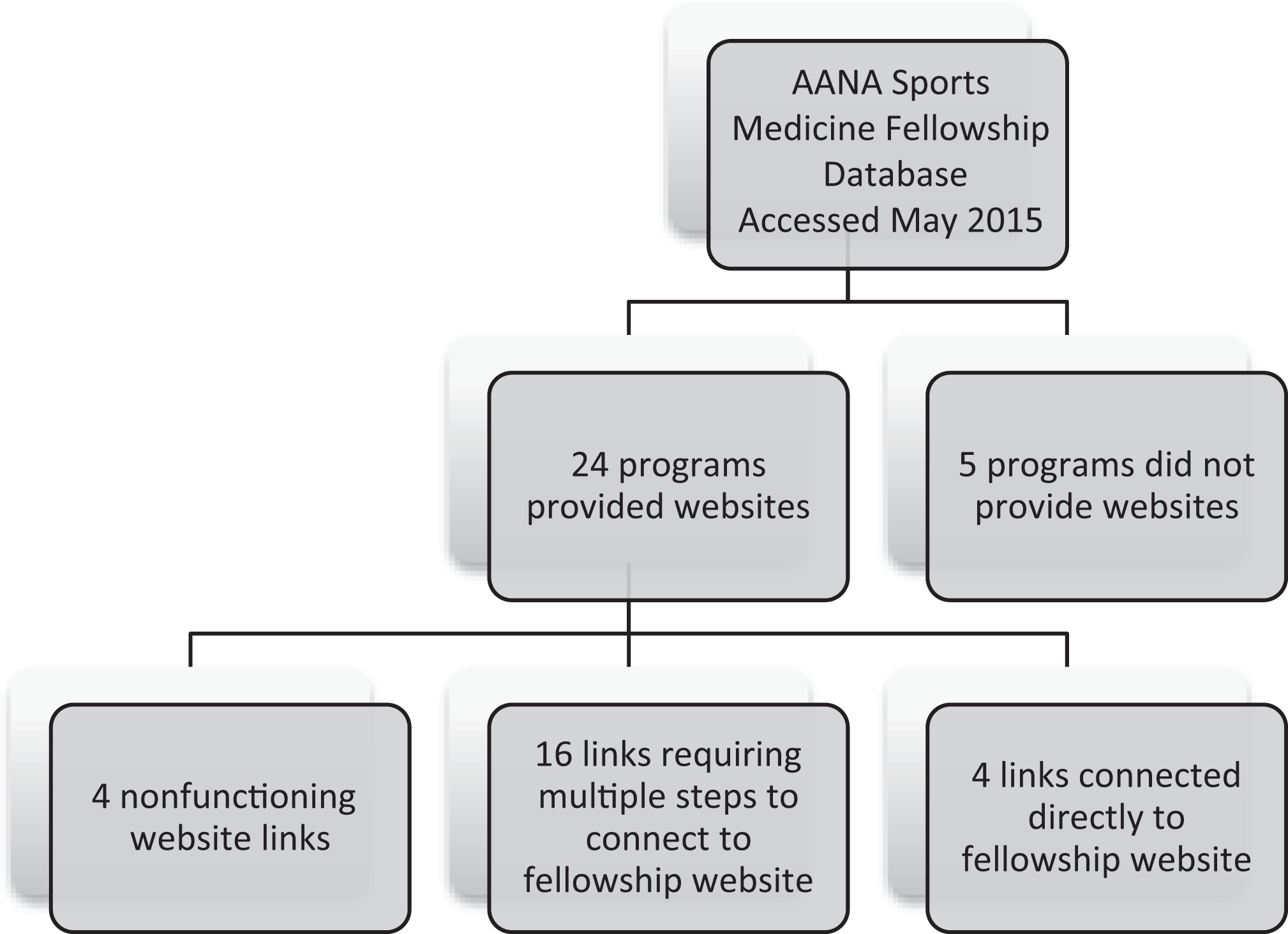
Accessibility of orthopaedic sports medicine fellowship websites provided on the Arthroscopy Association of North America (AANA) database.
Of the 93 programs in the SFM database, 89 programs listed a website, an increase of only 1 since 2012. Sixty-four (72%) of the websites listed were functional; however, only 8 (9%) connected directly to the fellowship web page. Twelve of the programs (13%) listed the SFM homepage as their program web page (Figure 3). Ninety-three (100%) of the programs listed a program name on SFM, 92 (99%) listed a contact person, 42 (46%) listed an application deadline, and 50 (54%) listed interview dates.

Accessibility of orthopaedic sports medicine fellowship websites provided on the San Francisco Match (SFM) database.
Links to 84 program websites (88%) were identified by searching “program name + sports medicine fellowship” on Google. Including the word “orthopedic” in the search was able to identify an additional 4 program website links (3%) for a total of 88 website links (93%) to fellowship programs found through searching on Google (Figure 4). All of these links connected directly to information about the fellowship programs.

Accessibility of orthopaedic sports medicine fellowship websites on Google.
Over all 3 databases, 70 functioning website links were found for the 95 programs. Of the remaining 25 programs, a Google search was able to find another 19 functioning links for a total of 89 (94%) fellowship website links for the 95 accredited orthopaedic sports medicine programs. One program had a website link listed on the SFM database, but a link to this website was not found within the first 10 search results on Google.
Recruitment
Of the 89 websites found, 89 (100%) provided a description of the program, 62 (70%) provided information on the selection process, 32 (36%) provided a list of current fellows, 18 (20%) provided information on recent graduates of the program, 40 (45%) provided a link to the San Francisco Match website, 27 (30%) provided salary information, and 14 (16%) listed the date that the website was last updated (Table 1).
Recruitment Content Provided by Orthopaedic Sports Medicine Fellowship Websites a

a AOSSM, American Orthopaedic Society for Sports Medicine; SFM, San Francisco Match.
Fellow Education
Of the eleven criteria considered important for fellow education, the majority of websites provided information for only 5. Sixty-one websites (69%) provided didactic information, 50 (56%) included information about journal club, 54 (61%) described research requirements, 57 (64%) described cases routinely performed by fellows, and 80 (90%) described team coverage responsibilities. Only 37 (42%) listed conferences or meetings that are attended by the fellows, 27 (30%) provided information regarding the fellows’ responsibilities in the office or clinic, and 25 (28%) provided information about the rotation schedule. The remaining 3 criteria were unlikely to be included in the fellowship website. Only 18 (20%) of the websites provided information regarding previous research from the program, 17 (19%) provided information about the call schedule, and 14 (16%) included a link to the AOSSM website (Table 2). Eighty-three (93%) of the websites listed the current faculty, and 61 (69%) of the programs are affiliated with an orthopaedic residency program.
Fellow Education Content Provided by Orthopaedic Sports Medicine Fellowship Websites

a Provided by a majority of programs.
b Unlikely to be provided on fellowship website.
c Increase from 2013 to 2015.
Discussion
Numerous studies have shown that potential residency and fellowship applicants rely heavily on program websites to gather the information necessary to create a list of where to apply, interview, and ultimately rank. 1,4,10,11 For a program website to be useful, it must both be easily accessible and provide information the applicant requires to make an informed decision. The AOSSM, serving as one of the primary sources of information for the orthopaedic sports medicine fellowship match, maintains a list of ACGME-accredited sports medicine fellowships. Our study, however, revealed that this list is incomplete, missing 5 of the 95 accredited programs. In addition, only 49 programs had websites listed on AOSSM, and 7 of these links were not functional.
AANA utilizes a recognition process for fellowship programs that requires completion of a detailed application, including information regarding the duration of the program, qualifications and responsibilities of the program director, qualifications of the teaching faculty, eligibility and selection of fellows, as well as clinical, basic science, and research experience. This recognition process limits the number of fellowship programs listed on their website to only 29 programs. 5 If AANA were to include all sports medicine fellowship programs and identify those that are AANA-recognized, then this database could become a useful resource for future applicants.
As the administrator of the Orthopaedic Sports Medicine Fellowship Match, the San Francisco Match serves as the central database for information regarding the matching process and participating programs. Similar to AOSSM, the SFM maintains a list of programs and relevant information, including website links, contact information, and application deadlines. Unfortunately, the SFM list was also incomplete, including only 93 programs, 89 (96%) of which listed a website link and only 64 (69%) of which were functional. This is not a substantial improvement over the 2013 study in which 88 (95%) programs provided a link, of which 65 (70%) were functional.
Google serves as another useful tool for applicants to find program web pages. Our evaluation of the accessibility of program websites through Google demonstrated that for the majority of programs (93%), a link was found within the first 10 search results, all of which connected directly to the fellowship website. Compared with 2012, where only 71% of links found connected directly to information about the fellowship, this is a clear improvement in accessibility.
A study by Gaeta et al 6 identified the aspects of program websites that emergency medicine residency applicants found most valuable. These components as well as additional criteria more specific to sports medicine fellowships were used to assess the content of orthopaedic sports medicine fellowship web pages. Our analysis found that 90% of websites provided information regarding team coverage responsibilities, but only 56% to 69% provided information concerning didactics, cases performed, research requirements, and journal clubs. Relatively few programs included any information regarding the call schedule (19%), conferences or meetings attended (42%), rotation schedule (28%), or clinic duties (30%). When compared with the study published in 2013, there has only been a marginal improvement in content of the sports medicine fellowship websites. There was an increase in only 9 (50%) of the content categories, ranging from a 2% to 12% increase from the previous study.
There were several limitations to this study. For comparability, the criteria used to assess web page content were the same criteria that were used in the 2013 study. Fellowship applicants may find areas of content not mentioned in this study to be important in their application process. Content criteria were assessed for their presence on the web page but not for the quality of the information they provided. In evaluating criteria for accessibility through a Google search, only the first 10 search results were used. It is possible that links to fellowship program web pages could have been present further down the list of results. In addition, it is possible that AOSSM, SFM, AANA, or some of the fellowship programs have updated their sites since this study was performed.
In comparing the results of this study with the original study published in 2013, there is an increase of 10% or greater in the number of fellowship programs who provide a description of cases performed, percentage of links on SFM and AOSSM databases that were functional, explanation of team coverage, a list of current fellows, and meetings or courses attended. However, there is a decrease of 10% or more in the number of programs that provide information on the selection process, salary, and office or clinic duties. Of the 21 data points collected in this study, there was an increase in 12, a decrease in 8, and no change in 1 from 2012 (when the data for the previous study were collected) to 2015 (Table 3). 11
Comparison of Current Orthopaedic Sports Medicine Website Accessibility and Content With Mulcahey et al 11 (2013) a
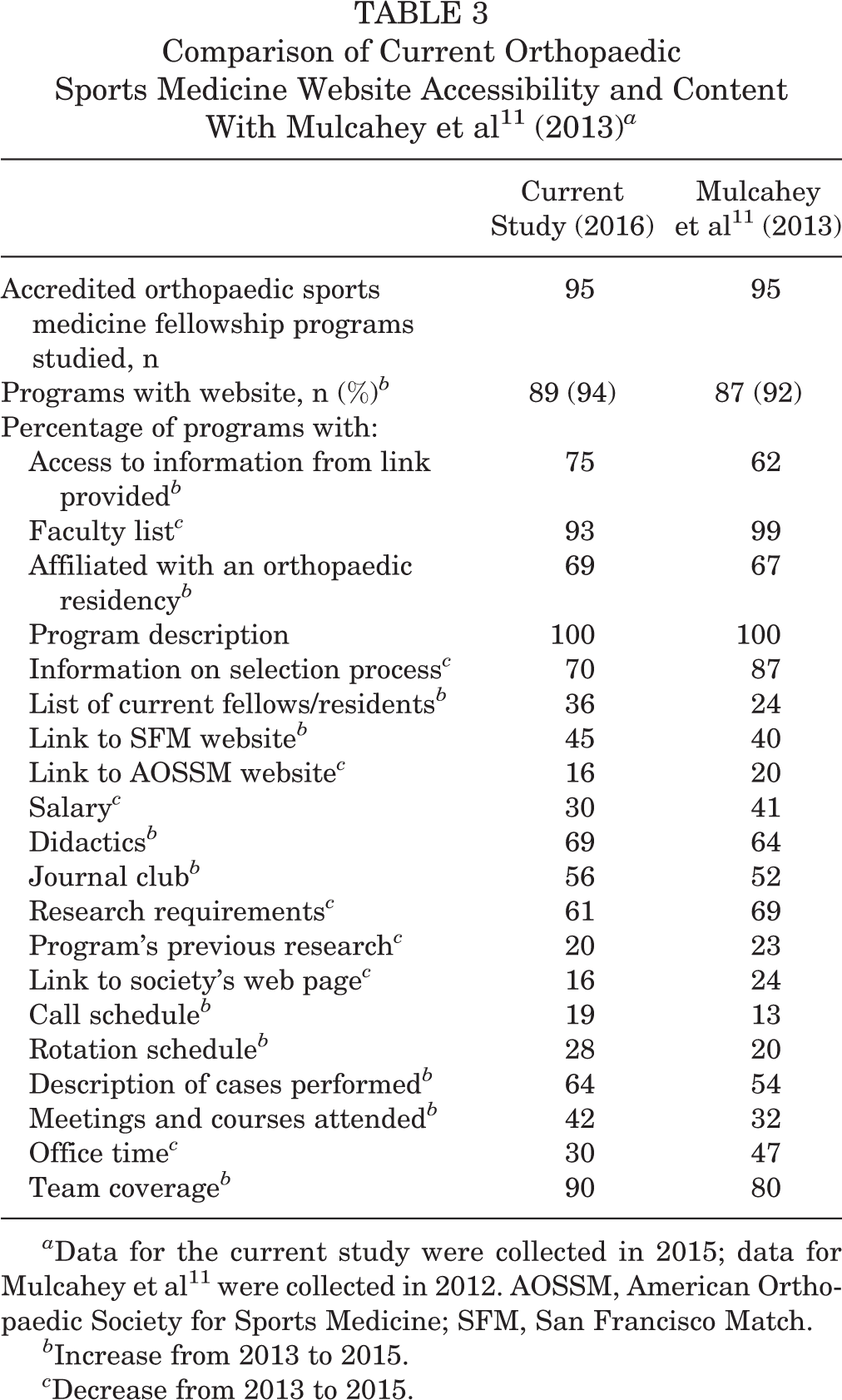
a Data for the current study were collected in 2015; data for Mulcahey et al 11 were collected in 2012. AOSSM, American Orthopaedic Society for Sports Medicine; SFM, San Francisco Match.
b Increase from 2013 to 2015.
c Decrease from 2013 to 2015.
The Internet can be one of the most influential sources of information for applicants applying to sports medicine fellowship programs, but only if the programs take full advantage of this resource by providing information that applicants deem important. Our study found that some orthopaedic sports medicine fellowship programs do not utilize this tool at all, as no web page was found for 6 of the 95 accredited programs. Of those who have a web page, none provided all of the information that applicants are looking for, and many lack the majority of information that applicants use to decide where to apply, interview, and ultimately how to rank programs. This appears to be true for other fellowships, but orthopaedic sports medicine is below average when compared with residencies. This may be due to the fact that fellowships tend to be smaller programs than residencies, and therefore, more resources may go toward maintaining residency web pages than fellowship web pages. It may be difficult to ensure that a web page always contains the most current information, but if fellowship programs updated their web pages at least once a year before the start of the application process, then potential applicants would have sufficient time to review the web page and make an informed decision about whether to apply and/or interview at a particular program. Creation of a central database on the SFM, AANA, or AOSSM websites would allow applicants to easily collect all important information about sports medicine fellowships. This could be accomplished by requiring participating programs to provide the designated central database (ie, SFM, AANA, or AOSSM) with the necessary information for applicants. Alternatively, the SFM or one of the sports medicine societies (AANA or AOSSM) could require that all programs participating in the match update their fellowship websites annually with information deemed particularly important for applicants and provide functional links on the central database.
Even if a web page is successful in providing all the information deemed important by an applicant, it is of little use if it cannot be easily accessed on the Internet. AOSSM, SFM, and AANA all maintain lists of accredited orthopaedic sports medicine fellowship programs as well as links to their web pages. Unfortunately, these lists are incomplete and many of the links provided are either nonfunctional or do not connect directly to program web pages. As with the program web pages, the databases on SFM, AOSSM, and AANA should be updated at least once a year so applicants can easily navigate to all available orthopaedic sports medicine fellowship websites.
Improving the accessibility to orthopaedic sports medicine fellowship websites as well as the quality and content of information available would benefit both the program and the applicant. With informative websites, fellowship programs would be able to attract more applicants and applicants would have an easier time identifying programs of interest. This, in turn, would make the application, interview, and match process more efficient.
Footnotes
The authors declared that they have no conflicts of interest in the authorship and publication of this contribution.
Ethical approval was not sought for the present study.