




Abstract
Background:
With childhood sports opportunities continuing to increase at an enormous rate along with participation starting at younger ages, the number of female participants in sports has increased in paramount fashion over the past few decades. A review of the current literature reveals a very small number of studies (<30) that document specific injuries suffered by competitive female gymnasts.
Purpose:
To retrospectively evaluate the incidence of various injuries and injury rates for different gymnast levels among young precollegiate female gymnasts over a 21-year period, from 1985 to 2005.
Study Design:
Descriptive epidemiological study.
Methods:
This institutional review board–approved study retrospectively evaluated young, precollegiate female gymnasts over a 21-year period. Gymnasts were stratified into 1 of 4 competition levels based on the number of hours spent training. In addition to the frequency of injuries and hours trained, data collected on each gymnast included the following: age at the time of injury, body part injured, laterality of the injury, and diagnosis.
Results:
Over the 21-year period, 3681 new injuries were evaluated by a single physician. The injury incidence (2.155 per 1000 exposure hours) was slightly lower when compared with previously reported injury rates. There were 1,452,574 total exposure hours documented from training facility records. The injury rate per 1000 exposure hours was 2.859 for elite, 2.820 for high-level, 1.667 for intermediate, and 0.687 for novice gymnasts. The lower extremity was injured more often than the upper extremity (60.9% compared with 22.6% of total injuries). This difference was statistically significant across all levels.
Conclusion:
The injury incidence in this study was 2.155 per 1000 exposure hours. This was slightly lower when compared with previously reported injury rates. Although those studies only lasted 3 years or less, the injury rates can be directly compared because they are reported as injuries per 1000 training hours.
Clinical Relevance:
With the variability in data available and limited studies reported, a conclusive analysis is needed because of the long-term effects of injury seen on gymnasts, such as early degenerative disorders, cost of injury treatment, and reduction of well-being. In our 21-year study, we found the incidence of injury was slightly lower than that shown in prior shorter studies. In addition, we were able to evaluate specific injuries seen in this population over that time period. Also, this extended study revealed the longitudinal nature of a series of injuries over a period of time that has not been seen in other studies, thus giving insight into the effects of increased gymnastics in the young, female, adolescent population, which could be potentially used in guidelines for gymnasts in the future.
Participation in high school sports by female students has increased dramatically over the years, with the ratio of males to females decreasing from 19:1 in 1985-1986 to 1.4:1 in 2000 17 and with 44% of all organized sports team members aged 6 to 17 years being female. 25 Since Title IX was enacted in 1972, participation in high school sports by females has doubled about every 10 years. 9 Similarly, girls are becoming involved in gymnastics at younger ages. The number of clubs that these young gymnasts train in has been increasing since 1980. 10 Not only is there increased participation, but young elite gymnasts also train more frequently and with greater intensity when compared with their peers. On average, they train 5.36 days per week and 5.04 hours per day. 19 As participation and training hours increase, so do injuries sustained among female athletes, making the injury rate of female gymnasts among the highest of all female sports, 21 and the injuries sustained require the greatest number of surgeries. 4 All these factors can have long-term effects on gymnasts, including early degenerative disorders, cost of injury treatment, and reduction of well-being. 1
The aim of this study was to retrospectively evaluate the incidence of various injuries and injury rates for different gymnasts among young, precollegiate female gymnasts over a 21-year period, from 1985 to 2005.
Methods
The study population consisted of young, precollegiate female gymnasts treated by a single physician. The physician was an orthopaedic surgeon trained in sports medicine associated with the Cleveland Clinic Foundation, with no ownership in the facility. The physician held clinic 1 day per week for the entire 21-year period. Gymnasts included in the study trained at a single facility that maintained yearly rosters with number of hours per week its athletes trained. Notes from each encounter allowed calculation of the injury frequency from 1985 through 2005, as well as the number of hours spent training. With institutional review board approval, the medical records of the athletes who sought medical attention from the physician were obtained to further classify the type of injury the gymnast suffered.
For this study and analysis, gymnasts were stratified into 1 of 4 competition levels based on the number of hours spent training each week. Gymnasts training 9 or fewer hours were considered novice, 12 hours per week were intermediate, 16 hours per week were high, and 20 or more hours per week were considered to be elite level. The same gymnast was able to progress in level from one year to the next within the data set. In addition to the frequency of injuries and hours trained, data collected on each gymnast included: age at the time of injury, body part injured, laterality of the injury, and diagnosis. Upper extremity injuries were defined as those affecting the shoulder, elbow, arm/forearm, wrist, and hand; lower extremity injuries were defined as those affecting the thigh, knee, leg, ankle, and foot.
A cumulative incidence rate of injury per 1000 hours trained was calculated for each of the 4 gymnast levels. Any gymnast who chose to be treated at a different facility and not by our primary physician was excluded from this study, and both training level and exposure hours were undocumented. Also, any gymnast for whom training hours were unavailable was not included in the injury rate calculation.
The overall rates of any injury, upper extremity injuries, and lower extremity injuries among gymnast levels were compared using analysis of variance (ANOVA). Wilcoxon Mann-Whitney tests with Bonferroni corrections were used to assess the statistical differences between the observed rates of injuries by each level. This process was repeated for the rates of upper extremity and lower extremity injuries by gymnast level as well. The frequencies of upper extremity and lower extremity injuries were also compared across gymnast levels using a chi-square test.
Results
Over the 21-year period, 3681 new injuries were evaluated. There were 1,452,574 total exposure hours from training facility records. The elite gymnasts totaled 306,000 hours, the high-level gymnasts totaled 515,904 hours, the intermediate gymnasts totaled 374,400 hours, and the novice gymnasts totaled 256,270 hours. There were 875 recorded injuries for the elite level, 1455 for the high level, 624 for the intermediate level, and 176 for the novice level. This produces an injury rate per 1000 exposure hours of 2.859 for the elite, 2.820 for the high level, 1.667 for the intermediate, and 0.687 for the novice gymnast. Of the 3681 new injuries, 3130 (85.03%) had a documented gymnast level. This produces an overall injury rate of 2.155 per 1000 exposure hours (Tables 1 and 2).
Frequency of Injuries a
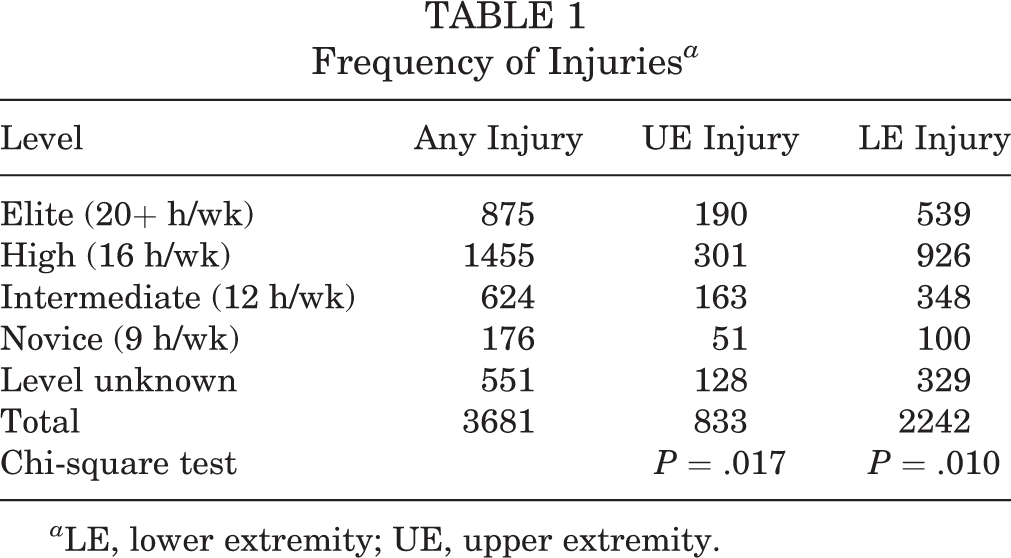
a LE, lower extremity; UE, upper extremity.
Rates of Injuries per 1000 Hours a

a ANOVA, analysis of variance; LE, lower extremity; UE, upper extremity.
There were 833 injuries of the upper extremity and 2242 injuries of the lower extremity. These accounted for 22.63% and 60.91% of overall injuries, respectively. When foot and ankle were combined, they accounted for 1226 injuries or 33.3% of all injuries. There was a significant difference in the injury rate at all levels of competition between upper and lower extremity injuries (Tables 1 and 2).
Overall injury rates were also compared across all levels. Comparison was also made between upper and lower extremity injuries for level of gymnast. There was a statistically significant difference in overall injury rate between novice and all other levels and between intermediate and all other levels. However, there was not a statistically significant difference between the high and elite level gymnasts. There were similar differences when upper and lower extremity injuries were compared across levels, with the exception of upper extremity injuries between intermediate and high-level gymnasts (Table 3).
Comparisons of Rates (P Values)

Most injuries in our study can be seen, with strains and sprains accounting for 1019 injuries (27.7% of overall injuries). Fractures represented a significant, but smaller number, with 330 injuries or 9.0% of overall injuries.
Injuries were also grouped into affected body part and specific injury. Included categories were head/neck, shoulder, back, chest/abdomen, arm/forearm, elbow, wrist, hand, hip/groin, thigh/buttocks, knee, leg/calf, ankle, and foot. These numbers are summarized in Table 4 and further broken down in Table 5, and demonstrated in Figures 1 and 2.

Numeric distribution of injuries classified by body part over 21 years.

Total percentage of injury breakdown over 21 years.
Injury Summary

Injury Breakdown by Body Part a

a AC, acromioclavicular; ACL, anterior cruciate ligament; ITB, iliotibial band; MCL, medial collateral ligament; OCD, osteochondritis dissecans.
b Percentage of all injuries.
Discussion
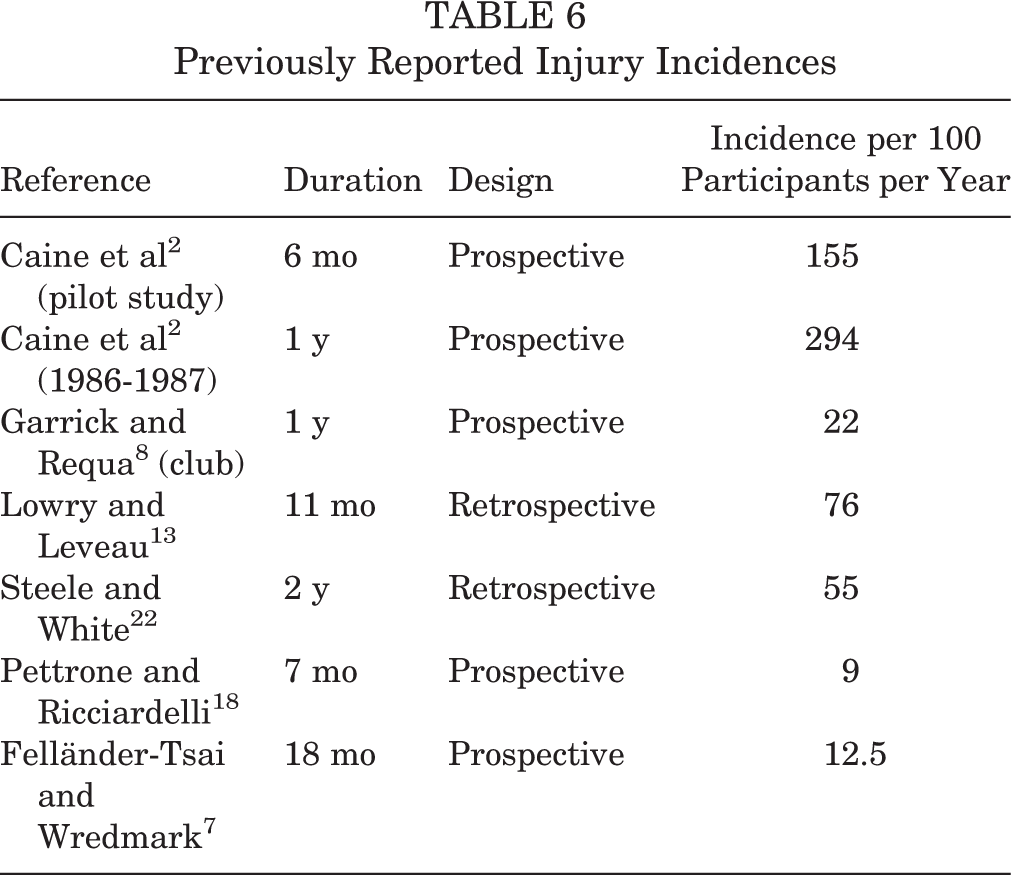
A review of the current literature reveals few studies researching specific injuries suffered by competitive female gymnasts. The majority of studies were short term and tended to categorize injuries into affected body parts, that is, wrist, back, knee. There has been a wide range of reported injury rates. Zetaruk 26 found that injury rates among female gymnasts ranged from 65 to 200 per 100 gymnasts per year, or from less than 1 to 3.66 per 1000 training hours. Cupisiti 6 reported an injury rate of 1.08 injuries per 1000 hours of training in a prospective study, while Lund and Myklebust 14 showed an astounding injury rate of 50.3 per 1000 hours of training with team gymnastics. Caine et al 2 found an injury rate of 155 to 294 injuries per 100 participants per year in a 6-month and 1-year prospective evaluation of elite young female gymnasts. Felländer-Tsai and Wredmark 7 reported an incidence of 6.25 injuries per 100 elite Swedish male and female gymnasts over an 18-month period. In a 5-year prospective study of a successful National Collegiate Athletic Association (NCAA) Division I women’s team, gymnasts experienced a new injury in 9% of exposures and trained with an injury 71% of the time. Most of these injuries were repetitive stress-type injuries. 20 In another prospective study on a NCAA Division I women’s team, there were 106 injuries over a 4-year period, for an average of 2.1 injuries per athlete per year. Forty-five percent of these injuries still bothered the gymnasts at an average follow-up of 38.5 months. 23 In a 16-year injury surveillance of NCAA gymnasts from 1988 to 2004, there was an injury rate of 15.19 per 1000 athlete-exposures during competition and 6.07 during practice. Of the 2739 total injuries in these collegiate women, 495 occurred during competitions and 2244 during practices 15 (Table 6). These rates are reported as injuries per 100 participants per year. Other studies reported injuries per 1000 hours of exposure (Table 7). This, unfortunately, can make comparison difficult. Of note, although Caine et al 2 reported a high rate of injury per 100 participants per year, the injury rate per 1000 exposure hours was comparable to other studies. 4
Previously Reported Injury Incidences
Previously Reported Injury Rates

Our injury incidence was 2.155 per 1000 exposure hours. This was slightly lower when compared with previously reported injury rates (Table 7). However, those studies only collected data over 3 years or less, but these rates can be directly compared with the present study as they are per 1000 training hours. We found a statistically significantly higher injury rate for higher level gymnasts, which is in agreement with the findings of Lowry and Leveau 13 and McAuley et al. 16 The more difficult techniques that these higher level gymnasts perform and practice likely lead to the increased rate of injury. Additionally, the higher rate may be due to fatigue secondary to longer training hours. Our numbers demonstrate a significant increase in injury rate when practice hours per week increase from 12 to 16 or higher, that is, intermediate versus high- or elite-level gymnasts. Perhaps high- and elite-level gymnasts could lower their injury rates if they limited their practice to 12 hours per week. This is currently unknown but is supported by the fact that overuse appears to be the cause of the majority of injuries. However, reducing practice hours may be beneficial as these injuries can also cause gymnasts to spend 29% of each season modifying their training as a result of injuries. 2
In the present study, the lower extremity was injured more often than the upper extremity (60.9% compared with 22.6% of total injuries). This difference was statistically significant across all levels of gymnasts. The majority of injuries occurred in the foot and ankle, accounting for one third of all injuries. The increased injury rate was probably a result of high-impact and high-energy dismounts and landings on the lower extremities. Also speaking to the significant impact of activities involved with gymnastics is the fact that 9.0% of all injuries were fractures.
When it is taken into consideration that 1000 exposure hours is essentially equivalent to an elite gymnast’s typical season, 20 hours per week for 48 weeks per year, and these gymnasts are suffering 2.155 injuries per season, clearly gymnastics is not as benign a sport as some may think. In fact, women’s gymnastics injury rates have previously been reported comparable to American football and wrestling. 16 Gymnasts and their parents should be counseled about their risk of injury prior to participation.
This study, like many, has limitations. First, it was retrospective. The records maintained by a single gym owner required calculation of total hours that may lead to performance bias. Second, review of the medical records showed that only 85.0% of injuries had an associated gymnast level, and there were 551 injuries not associated with a gymnast level. However, exposure hours for these gymnasts accounting for these 551 injuries were not available and not included in our total exposure hours. These 551 injuries were removed from our total injury pool when calculating injury rates, and our calculated injury rates per gymnast level were based on well-kept records.
The strengths of our study are the length of the study and number of injuries collected. Our injury incidence of 2.155 per 1000 exposure hours was lower when compared with previously reported injury rates. However, these studies were 3 years or less in duration. Additionally, in the vast majority of injuries, location of the injury and specific diagnosis were provided. Hopefully, this data collection allows for future follow-up and long-term clinical outcomes studies.
Footnotes
The authors declared that they have no conflicts of interest in the authorship and publication of this contribution.
Acknowledgment
The authors would like to offer a special thanks to Dr Garron Weiker, Mr Ron Gannin, and Gym World for all their help in assembling this article.