




Abstract
Background:
The trunk is a major contributor to the kinetic chain during baseball pitching by helping to transfer energy from the lower limbs to produce the desired ball speed. However, most of the research detailing the trunk’s contribution to the pitch is focused on rotational timing and coronal plane lean, with little attention focused on sagittal plane positioning of the trunk.
Purpose:
To determine the association between sagittal plane trunk motion and elbow varus moment and ball velocity in collegiate baseball pitchers.
Study Design:
Descriptive laboratory study.
Methods:
A total of 99 collegiate pitchers were recruited for this study and underwent a comprehensive biomechanical assessment of their pitching motion using 3-dimensional motion techniques. A random-intercepts, mixed-effects regression model was used to determine whether statistically significant associations were noted between sagittal plane trunk motion and the ball velocity and elbow varus moment.
Results:
There were a number of significant associations between sagittal plane trunk tilt and the elbow varus moment and ball velocity. Increased forward trunk tilt at the time of ball release was associated with an increase in elbow varus moment and a small increase in ball velocity; for every 10° of increased forward trunk tilt greater than 28° at ball release, the elbow varus moment increased by 2.9 N·m (P = .007), and the ball velocity increased by 0.7 m/s (P = .002).
Conclusion:
Sagittal plane positioning of the trunk plays a role in pitching mechanics, as it can affect both pitching performance and elbow moments. The results also indicated that there is a potential optimal trunk position and range of motion during the acceleration of the pitch that could limit the stress placed on the elbow joint. Implementing proper trunk mechanics from an early age could lead to a reduction in joint moments.
Clinical Relevance:
The results provide evidence for coaches and trainers to emphasize the importance of proper trunk positioning through the inclusion of core strengthening and motor control in their practice and coaching sessions in an effort to reduce the moments placed on the elbow during the pitch.
Recently, a dramatic increase in the incidence of shoulder and elbow pain and injuries in baseball pitchers has been a source of concern. 13,14 This increased injury rate has led to a number of directed research questions that attempt to determine the cause of these injuries and develop methods to reduce pitching-related injuries. Over the course of 3 decades, a number of theories have been put forth to explain this increase in injuries, including poor pitching mechanics, pitching before skeletal maturity, and sport specialization leading to overuse. 7,9,17 Of particular interest here is the idea that poor pitching mechanics can be a potential cause because once identified, nearly 50% of these flaws in the pitching delivery can be corrected. 8 This has led to a large body of literature utilizing 3-dimensional motion analysis to identify these flaws and determine their association with increases in elbow and shoulder stress. 3 –5,7,9,15,17,19 –21
Baseball pitching requires that a series of complex, rapid motions occur in a coordinated fashion to allow for an efficient transfer of energy from the lower legs up through the trunk, to the pitching arm, and eventually to the ball. Research has shown that through the kinetic chain, the energy of a pitch is created from the initial drive down the mound, and then this energy is increased and transferred to the pitching arm via the pitcher’s trunk. Therefore, the trunk is a major contributor to the kinetic chain, but it was not until recently that studies were performed to understand the trunk’s contribution to the pitch and its movement’s role in producing both ball velocity and upper extremity joint moments. Aguinaldo et al 1 investigated how the rotational motion of the trunk could affect the shoulder joint moment of baseball pitchers with different levels of experience. They were one of the first researchers to look past the pitching arm to other segments of the body that may play a major role in the pitch and to show that there was a link between the trunk’s rotational motion and the potential risk of injuries. Matsuo et al 15 performed a study regarding the relationship between shoulder abduction and lateral trunk tilt on the peak elbow varus moment in baseball pitchers. Oyama et al 19 and Solomito et al 21 both studied the effects of lateral trunk lean away from the pitching arm. Although both groups of researchers looked at different populations, with Oyama et al 19 choosing to focus on high school athletes and Solomito et al 21 focusing on collegiate athletes, both found that there was a significant increase in elbow varus moment when pitchers leaned away from their pitching arms. These findings led to potential injury prevention strategies to reduce the risk of injuries in baseball pitchers through the modification of pitching mechanics. 19,21 More recently, Escamilla et al 6 investigated the effect of arm position in relation to the body on pitching biomechanics and showed that the arm slot was dependent on a number of factors including trunk position, specifically lateral trunk tilt.
As mentioned above, most studies related to the trunk specifically looked at trunk rotation and lateral lean, as these are major components of a pitch. However, early descriptive studies noted that sagittal trunk motion in pitching is significant 5,18 ; yet, there is a paucity of literature specifically looking at the influence of sagittal plane trunk motion on the pitch. Therefore, the purpose of this study was to investigate the association between sagittal plane trunk motion and the ball velocity and elbow varus moment. It was hypothesized that greater anterior trunk tilt would increase both ball velocity and elbow varus moment (internal moment). It was also hypothesized that posterior trunk tilt would lead to a reduction in ball velocity and an increase in elbow varus moment.
Methods
This study was approved by the Connecticut Children’s Medical Center’s institutional review board, and all study participants signed consent forms before the start of their pitching assessment. A total of 99 pitchers currently pitching for National Collegiate Athletic Association (NCAA) Division I and Division III schools were recruited for this study. All participants in this study were required to have a minimum of 2 years of pitching experience. None of the participants recruited for this study had sustained a serious injury, defined as an injury that caused them to miss pitching in at least 1 game or practice, to their pitching arm within the preceding 6 months of the analysis. Additionally, none of the participants had a history of surgery to their pitching arm.
Data Collection
Before starting the analysis, anthropometric measures were collected to appropriately scale the inertial properties of the biomechanical model. A total of 38 reflective markers were attached over specific anatomic landmarks to create a 16-segment biomechanical model as described by Nissen et al. 18 An additional 2 markers were placed on the ball to determine the instant of ball release, calculate ball velocity, and allow for the computation of joint kinetics.
Once the markers were placed, the participants were given as much time as they needed to warm up and become comfortable pitching within the data collection space. All participants pitched from a 10-inch mound toward a pitching target with a designated strike zone 60 ft and 6 inches away. All participants pitched 7 fastball pitches as well as 7 of each additional pitch type (ie, curveball, slider, cutter, or change-up) that they felt comfortable pitching in a game setting, for a total of 21 to 28 pitches. Pitches were thrown in random order to better simulate a game setting; however, this work is limited to the results of the fastball pitches only. Motion data were collected at 250 Hz using a 12-camera motion capture system (Vicon 512; Vicon Motion Systems).
Data Analysis
The pitching motion was divided using 4 major time points as described by Fleisig et al 7 (Figure 1). The pitching cycle began at the instant of lead foot contact with the mound and ended with maximum internal rotation of the glenohumeral joint. The pitching cycle was further divided by 2 intermediate time points: the instant of maximum external rotation of the glenohumeral joint and of ball release. The trunk was defined using the Vicon Plug-in Gait marker configuration, in which 4 markers were placed on the pitcher’s torso: 1 each over C7, the clavicular notch, the xiphoid process, and T10. The specifics of this model have been previously described by Solomito et al, 21 but for completeness, a brief description of the trunk definition is included here.
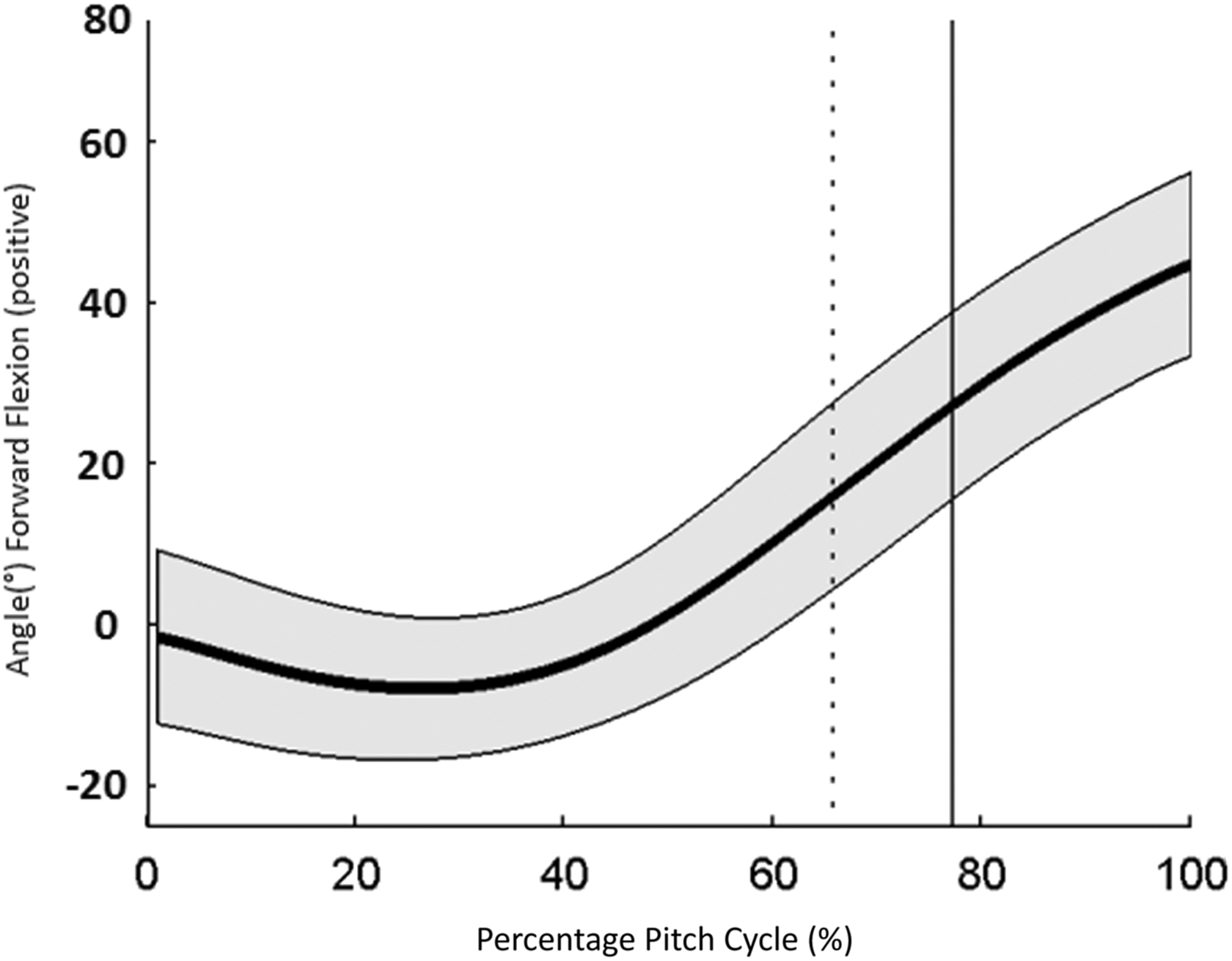
Sagittal plane trunk tilt over the entire pitching cycle. The thick black solid line is the mean of the group, and the gray shaded region is ±1 SD. The solid vertical black line is ball release, the dashed vertical line is maximum external rotation of the glenohumeral joint, 0% corresponds to foot contact, and 100% corresponds to maximum internal rotation of the glenohumeral joint. Forward flexion is positive.
Using the 4-marker trunk, the primary trunk axis was the z-axis, which was defined as the vector between the center points of the vectors between C7 and the clavicular notch and T10 and the xiphoid markers. The x-axis was defined as perpendicular to the z-axis and in line with the direction of forward progression, and the y-axis was the cross-product of the x- and z-axes. Joint angles were computed using a Vicon Workstation and BodyBuilder and were based on Euler’s equations of motion as previously described. 18 For the trunk, sagittal plane trunk tilt describing trunk flexion and extension was calculated as the relationship between the trunk coordinate system and the laboratory coordinate system in the x-z plane. Joint kinetics were computed with custom MATLAB code (MathWorks) using standard inverse dynamic techniques. 12 The calculations originated with the ball segment and moved proximally from the wrist to the glenohumeral joint, taking into account the inertial characteristics of each segment as the calculations moved proximally. Joint kinetics were calculated over the entire pitching cycle; however, data analysis for this study was limited to the maximum elbow varus moment. All kinetic data presented in this work are internal moments.
The first 3 fastball pitching trials for each participant in which all markers were present were used for data analysis. Although data were computed for all joints for each participant, the specific variables of interest for this study were ball velocity, sagittal trunk tilt at the 4 time points of the pitching cycle, sagittal plane trunk range of motion, maximum anterior and posterior trunk tilt, and elbow varus moment.
Statistical Analysis
Descriptive statistics were computed for all parameters of interest, and the means ± SDs are presented throughout. To determine the association between sagittal trunk tilt, ball velocity, and elbow varus moment, a random-intercepts, mixed-effects regression model was used. 10,11 This model is capable of taking into account repeated measures as well as making use of all the trials available rather than using a singular averaged trial, which increases the precision of the model. In the cases in which fewer than 3 trials were available for a pitcher, this model could account for variations in the number of trials for each pitcher by calculating the correct standard error based on the degrees of precision available. All statistical testing was performed using SAS software version 9.3 (SAS Institute).
Results
A total of 99 collegiate pitchers with a mean age of 19.9 ± 1.4 years were assessed as part of this study. The mean fastball velocity was 32.1 ± 1.9 m/s (71.8 ± 4.2 mph), and the mean maximum elbow varus moment was 75.2 ± 15.3 N·m. Sagittal plane trunk motion followed a similar pattern for all pitchers, in which trunk tilt was near 0° at lead foot contact and then moved into extension until around 40% of the pitching cycle before moving anteriorly, reaching 0° just before maximum external rotation of the glenohumeral joint and ending in nearly 45° of forward flexion (Figure 1 and Table 1).
Sagittal Plane Trunk Position at Specific Time Points in the Pitching Cycle a

a Negative values indicate extension.
The results of the regression analysis showed statistically significant associations between trunk forward flexion at ball release and both maximum elbow varus moment (P < .001) and ball velocity (P < .001). Results of this analysis demonstrated that for every 10° of forward trunk tilt beyond the median forward trunk flexion (28°), there was a 2.9-N·m increase in elbow varus moment (a 4% increase in the joint moment; P = .007) as well as a 0.7-m/s (1.5-mph) increase in ball velocity (a 2% increase in ball velocity; P = .002), indicating a substantial increase in the joint moment with a limited increase in ball velocity. The results also indicated that pitchers who had more than 54° of total sagittal plane trunk range of motion increased their elbow varus moment by 2.4 N·m for every 10° increase in trunk sagittal range of motion (P < .001), but there was no significant association between range of motion and ball velocity (P = .071).
Additional regression analyses demonstrated that an increase in peak trunk extension beyond the median (–10°) after 26% of the pitching cycle was shown to decrease elbow varus moment by 0.25 N·m per degree (P = .030), indicating that more forward flexion of the trunk resulted in a decrease in elbow varus moment but had no effect on ball velocity (P = .318). Interestingly, the regression analysis also showed that an increase in peak trunk flexion beyond the median (28°) after 76% of the pitching cycle, near ball release, resulted in an increase in elbow varus moment by 0.25 N·m per degree (P = .003) and increased ball velocity by 0.05 m/s per degree (P = .006), indicating that a more flexed trunk results in an increased elbow varus moment. These results indicate that there is a potential optimum range for sagittal plane trunk motion for pitchers. Essentially pitchers should try to maintain a sagittal plane trunk profile between −10° and 28° between 26% and 76% of the pitch cycle.
Finally, the regression analysis indicated that the timing of peak trunk flexion between maximum external rotation of the glenohumeral joint and ball release was significantly associated with ball velocity (P = .034) but was not shown to be associated with elbow varus moment (P = .231).
Discussion
The purpose of this study was to examine the implications of sagittal plane trunk motion on both a pitcher’s ball velocity and his elbow varus moment. The kinematic analysis of the pitchers indicated that all pitchers had a similar trunk motion profile, starting in a nearly neutral position at foot contact, moving into extension through the early portion of the acceleration phase of the pitching cycle before transitioning back into flexion around 40% of the pitching cycle, reaching neutral again near maximum external rotation of the glenohumeral joint, and ending in flexion at maximum internal rotation of the glenohumeral joint. The results of the study also found that sagittal plane motion of the trunk was significantly associated with both ball velocity and elbow varus moment. This is one of the first works to discuss the association between sagittal trunk motion and the risk of injury, as defined as an increase in joint moments, as well as pitching performance, as defined as ball velocity. The results are consistent with other works regarding the role of the trunk as a major contributor to the kinetic chain of pitching and its significant influence on pitching performance and injuries. 1,19,21
This work demonstrated that sagittal plane motion of the trunk, specifically flexion, was capable of increasing ball velocity, and therefore, flexion can be a benefit to pitching performance. This is not surprising given the fact that the trunk is a large body segment, and rapid trunk flexion can provide a great deal of momentum that can be translated into increased ball velocity. However, the results of the regression analysis give pause to the idea that increasing anterior tilt can improve a pitcher’s performance. First, the results showed that excessive anterior tilt of the trunk was associated with a substantial increase in elbow varus moment: 2.9 N·m per 10° of increased flexion. For example, a pitcher who reached 38° of anterior tilt could potentially increase his elbow varus moment by 3.3% while only increasing ball velocity by 2.1%. Although this increase in the joint moment is relatively small, cadaveric and biomechanical studies have indicated that an increase in joint moments of even 1 or 2 N·m could have negative effects on the ulnar collateral ligament. 2,16 Therefore, too much flexion may be a greater harm than benefit to their performance.
Second, the study results indicated that the more a pitcher delayed his forward flexion after ball release, the greater his ball velocity. Although this increase was only 0.3 m/s per 5% of the pitching cycle, which equates to a 1% increase in overall ball velocity, there is no tradeoff with an increase in joint moments. Maintaining a more neutral upright position until just after ball release can provide an improvement in performance, which is consistent with findings regarding lateral trunk lean that indicated improved performance with a more neutral posture with limited lean away from the pitching arm. 19,21 Therefore, pitching coaches and trainers should stress proper mechanics and improved posture through the incorporation of core strengthening in their pitching programs.
Of greatest significance is that the results indicated an optimum range for which baseball pitchers should try to function within when it comes to sagittal motion of their trunk. During the middle to late acceleration phase, there is a narrow range of acceptable trunk motion that can limit increases to joint stress. This points to the idea that a strong core with appropriate muscle control to maintain trunk positioning throughout the acceleration phase of the pitch is essential for a pitcher to reduce his chance of upper extremity injuries. Although not specifically researched in this work, increased trunk movement may also predispose pitchers to an increased risk of lower back pain.
This study is not without limitations. This is a laboratory-based study, and although every effort was made to mimic game settings as much as feasible, it was still a controlled environment, which may have affected participant performance. The markers placed on the ball may have been shown to slow ball velocity by 5 to 7 mph; however, this reduction in speed was consistent across all participants and therefore did not affect outcome data. The methods detailed in this study are consistent with other motion-based studies and are not currently viable as an on-field assessment. Additionally, the results of this work are based on healthy collegiate pitchers, and therefore, extrapolating these results to younger age groups or to professional pitchers may not be possible. Finally, although only a small number of pitches were collected for analysis in this study, the effect of fatigue was not accounted for.
Conclusion
The study data showed that sagittal plane trunk position is significantly associated with elbow varus moment and ball velocity. The results provide evidence for coaches and trainers to stress the importance of proper trunk positioning through the inclusion of core strengthening in their practice and coaching sessions in an effort to reduce the moments placed on the elbow during the pitch.
Footnotes
The authors declared that they have no conflicts of interest in the authorship and publication of this contribution. AOSSM checks author disclosures against the Open Payments Database (OPD). AOSSM has not conducted an independent investigation on the OPD and disclaims any liability or responsibility relating thereto.
Ethical approval for this study was obtained from Connecticut Children’s Medical Center.