




Abstract
The objective of this study was to identify determinants of human immunodeficiency virus (HIV) knowledge regarding mother-to-child transmission (MTCT) among pregnant women at Tijuana General Hospital, Baja California, Mexico. Between March and November 2003, patients from the prenatal care (n = 1294) and labor and delivery (L&D) units (n = 495) participated in a cross-sectional study to measure HIV knowledge. Less than one-third (30%) knew that HIV could be transmitted to a child during delivery, and 36% knew that HIV could be transmitted by breast-feeding. Only 27% knew that an MTCT could be prevented. Prenatal patients were more likely to know that MTCT was preventable (prenatal: 31% versus L&D 25%; P = .02). Logistic regression indicated that prenatal patients (odds ratio = 1.49, confidence interval 1.07-2.07) were more likely to know that HIV could be transmitted through breast-feeding. Overall, both groups had poor knowledge regarding MTCT of HIV.
Introduction
Worldwide, there were 330 000 children newly infected with HIV and an additional 230 000 child deaths from AIDS-related illnesses in 2011 alone. 1 In 2010, Joint United Nations Programme on HIV/AIDS initiated a worldwide program calling for the elimination of new HIV infections among children by the year 2015. While Mexico is not considered a high-priority country, data suggest that it is still far from achieving the goal of no new HIV infections among children. Estimates indicate that nearly 170 000 people are currently living with HIV in Mexico. 2 Regional studies conducted in Tijuana have shown that as many as 1 in every 125 persons of reproductive age is infected with HIV.3,4
The prevalence of HIV infection among pregnant women in Mexico varies between 0.09% and 1.2%.5,6 Higher prevalence has been consistently found in the border city of Tijuana, when pregnant women were screened during labor.6,7 Throughout Mexico, an estimated 12.9% of HIV-positive pregnant women gave birth to an HIV-infected child during 2011. 8 Despite national prevention of mother-to-child transmission (MTCT) recommendations, reports show that only 43.2% of HIV-positive pregnant women received the antiretroviral treatment necessary for the prevention of MTCT in Mexico. 8
The majority of HIV infection among children occurs through MTCT. An estimated 50% to 70% of MTCT occur late in pregnancy or during birth. Without intervention, the risk of MTCT is around 25%. Breast-feeding increases the risk of MTCT by 12% to 15%, for an overall risk of 40%.9,10 Knowledge of these modes of transmission is a vital component of prevention.
Tijuana General Hospital (TGH), in Tijuana, Baja California, Mexico, represents a socially and economically vulnerable population with significantly more risk factors for HIV infection. The obstetrics department attends approximately 800 deliveries each month. 11 Studies show that between 60% and 80% of the women giving birth at TGH receive some degree of prenatal care.6,11 The US Centers for Disease Control and Prevention recommends that HIV tests be routinely conducted during prenatal visits to ensure MTCT prevention. 12 However, it is common for uninsured women to seek only labor and delivery (L&D) services and not to receive the vital education that prenatal care provides. Self-advocacy is an essential part of preventing MTCT, yet without general knowledge of HIV and MTCT, women are unlikely to perceive themselves or their children at risk and to take precautionary measures.
The objectives of this study were to assess HIV knowledge among pregnant women, to compare differences in sociodemographic characteristics among prenatal patients and L&D patients, to compare differences in knowledge between the 2 groups, and to determine which variables are significantly associated with MTCT knowledge.
Materials and Methods
A cross-sectional study of pregnant women seeking prenatal care or who were admitted to the L&D department was conducted at TGH during March through November 2003. All pregnant women with unknown HIV status who arrived for prenatal or who were admitted to the L&D department with more than 28 weeks of gestation were invited to participate in the study. A survey was developed to assess general knowledge of HIV transmission and associated risk factors and symptoms. The questionnaire was validated through interviews with 12 women during prenatal care.
Ethical Consideration
The study protocol was approved by the University of California, San Diego, Human Research Protection Program, and the Tijuana General Hospital Committee of Medical Education and Research. All participants provided informed consent prior to the administration of the HIV test and questionnaire.
Data Collection
After obtaining informed consent, all participants were provided with HIV counseling from a senior obstetrics and gynecology resident. Subsequently, blood was drawn by venipuncture for a rapid HIV test using Determine HIV-1/2 (Abbott Diagnostics, North Chicago, Illinois). Women with a positive rapid test were informed of the preliminary results, and confirmatory Western blot (Focus Technologies, Cypress, California) was performed. A questionnaire assessing HIV knowledge, risk factors, and related symptoms was developed. Following each HIV test, data on demographic and HIV-associated risk factors were collected using the preformatted questionnaire.
Statistical Analysis
Survey data and test results were analyzed using SAS 8.2 (SAS, Inc, Cary, North Carolina). Chi-square tests were used to determine if significant differences existed between demographic characteristics and questionnaire responses between the prenatal and the L&D group. Tests of association were also performed to compare questionnaire responses stratified by education, self-reported income, reproductive history, including previous cesarean section, and spouse’s education. Statistical significance was designated at P < .05, and 95% confidence intervals (CIs) that excluded 1. Multivariate models were constructed for MTCT questions utilizing covariates that were significantly associated with a correct response to MTCT questions through chi-square analysis. These covariates included labor or prenatal group status, self-reported income, education level, history of cesarean birth, and spouse’s income and education level. Student t test was used to compare means of continuous variables including age, parity, and number of prenatal visits between the prenatal and L&D groups.
Results
A total of 1789 women consented to participate, of whom 1294 where prenatal patients and 495 were L&D patients. The mean age of participants was 24.6 years, with no significant difference in age between L&D patients (mean age = 23.8) and prenatal patients (mean age = 24.4). The L&D patients had a higher level of education (defined as secondary school or greater) than that of prenatal patients (L&D = 55.7%, prenatal = 50.21%; P = .04), as did their spouses (L&D = 59.2%, prenatal = 50.4%; P < .01). Reported spousal income was also greater (more than 300 dollars per month) among L&D patients (L&D = 51.6%, prenatal = 27.2, P < .01) than in prenatal patients. L&D patients had significantly more pregnancies (mean = 2.8) compared to prenatal patients (mean = 2.5, P = .01). Additionally, prenatal patients had significantly more cesarean deliveries (mean = 0.3) compared to L&D patients (mean = 0.2, P = .01). As expected, prenatal patients had a higher number of prenatal visits (mean = 5.1) compared to L&D patients (mean = 2.2, P < .01). There were no significant differences in the mean number of abortions or births, history of ever having had a cesarean delivery, or marital status between the prenatal and L&D groups.
High-risk behavior was more notable in L&D patients in comparison to prenatal patients. Use of injection drugs (2.9% versus 0.2%, P < .001), use of methamphetamines (7.6% versus 4.0%; P < .01), having a spouse who used injection drugs (9.2% versus 1.2%; P < .01), and having a spouse who had sex with other men (0.81% versus 0.46%; P < .01) were all more frequent among L&D patients. Prenatal patients were more likely than L&D patients to have a spouse who had used methamphetamines (18.7% versus 14.4%; P < .01).
Overall, general HIV knowledge varied broadly among participants. Over half knew that HIV was not curable (93.5%), that HIV/AIDS is deadly without medicine (56.9%), and that it is controllable with medicine (69.3%). Participants knew that having unprotected sex (91.7%) and receiving contaminated blood transfusions (76.9%) were risk factors for HIV transmission and that kissing and hugging (92.8%) and shaking hands (98.3%) were not risk factors. They also realized that HIV transmission is possible through heterosexual sex (65.1%; Table 1); however, this implies that one-third (35%) were not aware HIV can be transmitted through heterosexual sex.
General Knowledge of HIV: Percentage of Correct Responses.
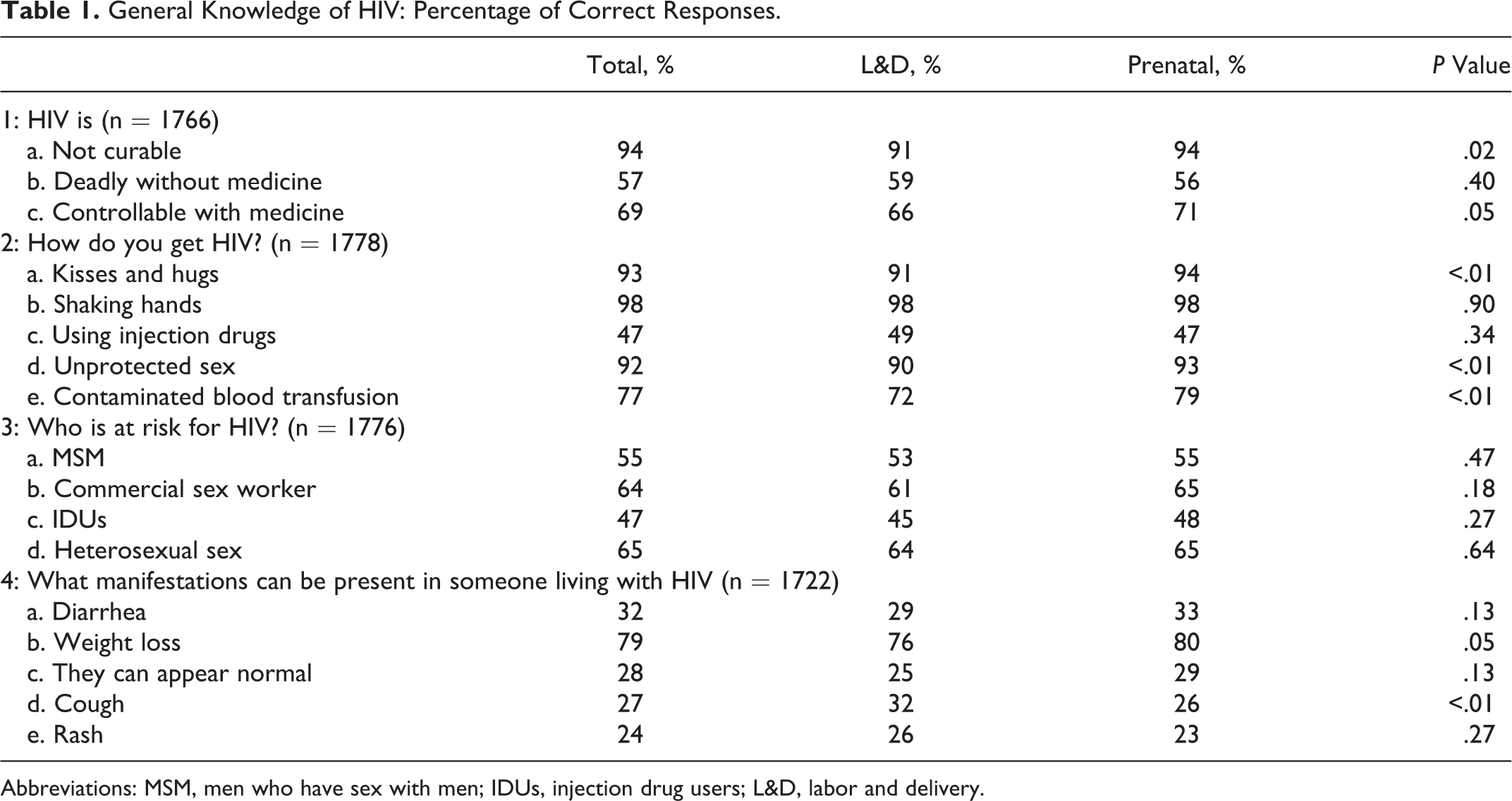
Abbreviations: MSM, men who have sex with men; IDUs, injection drug users; L&D, labor and delivery.
Some misinformation regarding HIV/AIDS was evident in this population regarding injection drug use. Less than half of participants recognized injection drug use as a risk factor (47.4%) or perceived injection drug users as a population at risk for HIV/AIDS (46.9%). Knowledge of HIV/AIDS symptoms was also low regarding signs and symptoms, such as diarrhea (31.7%), cough (27.4%), and rash (23.8%). Over three-fourths (78.7%) recognized weight loss as a possible sign, yet a much lower percentage recognized that someone with HIV/AIDS can appear normal (27.8%; Table 1).
Between the 2 groups, the prenatal group had significantly more knowledge of HIV. Prenatal group participants were more likely to know that HIV is not curable (94.4% versus 91.4%; P = .02), is controllable with medicine (70.6% versus 65.8%; P = .05), cannot be transmitted by kisses and hugs (93.9% versus 90.8%; P < .01), and can be transmitted by unprotected sex (92.5% versus 89.77%; P < .01) and through contaminated blood transfusions (78.8% versus 71.8%; P < .01; Table 1).
The majority (81.2%) of participants knew that HIV could be transmitted to a child during pregnancy. However, less than one-third (30.4%) of the study population knew that HIV could be transmitted to her child during the process of delivery, and only 35.7% knew that HIV could be transmitted by breast-feeding. Even less (26.9%) realized that a woman could avoid transmitting HIV to her child. Of these, prenatal patients were more likely to know that MTCT was preventable (prenatal: 31.0% versus L&D 25.3%; P = .02; Figure 1).

Correct responses to questions regarding mode of mother-to-child-transmission of HIV. L&D indicates labor and delivery patient group; MTCT, mother-to-child transmission.
In stratified analysis, women with a higher self-reported income were more likely to know that it was possible to prevent MTCT (37.0% versus 26.4%; P = .04), while women with a previous cesarean section were more likely to know that MTCT can occur during pregnancy (91.5% versus 81.2%; P < .01).
Multivariate regression analysis was conducted to determine the covariates that were independently associated with HIV MTCT knowledge. Women of the prenatal group (odds ratio [OR] = 1.49, CI 1.07-2.07) or who had a higher level of education (OR = 0.55, CI 0.40-0.74) were more likely to know that MTCT can occur through breast-feeding. Women in the prenatal group were more likely than those in the L&D group to know that MTCT is preventable (OR = 1.58, CI 1.12-2.25).
Discussion
This study identified that L&D patients and their spouses were more likely to engage in high-risk activities than women who had prenatal care. It was also found that L&D patients had less general knowledge of HIV. It is possible that the lack of awareness regarding HIV could be affecting this group’s ability to perceive these behaviors as risk factors for HIV transmission. This theory is supported by the higher seroprevalence among L&D patients versus prenatal care patients (1.12% and 0.33%, respectively; data not shown). 6 More research needs to be done to better define this relationship.
The majority of participants in this study knew HIV could be transmitted during pregnancy; however, a considerably lower number knew the modes of HIV transmission. Our results were consistent with studies that have been conducted around the world, indicating a low level of MTCT knowledge. Investigations in several countries, including Nigeria, Sudan, China, Ethiopia, and Kazakhstan, have all revealed a similar lack of knowledge about the means of MTCT.13 -17 As with our results, less than half of participants from other studies understood that HIV could be transmitted through birth or through breast-feeding. Furthermore, our data compares with nearly every other study in that two-thirds of the pregnant women were unaware that HIV MTCT could be prevented.
Higher education has been found to be a universal variable for increased HIV transmission knowledge, as was some kind of prenatal education.13 -17 This was true in our study as well. However, it is important to clarify that higher education was only associated with knowledge that HIV MTCT could be prevented. Although the L&D group had a higher level of education, they had less overall knowledge of HIV MTCT. As in our study, other investigations have shown that general HIV awareness is present in pregnant women, yet few are aware of the means of MTCT of HIV.13 -17
A comprehensive knowledge of HIV study in Mozambique concluded that prenatal care was a necessary tool in promoting awareness of MTCT of HIV. 18 Prenatal care programs have long been established as an essential part of the prevention of MTCT.19,20 The lower level of HIV MTCT knowledge among the L&D group in our study reinforces the belief that prenatal care is necessary for ensuring adequate HIV transmission prevention knowledge. Our research supports previous findings that not enough is being done to ensure that women get sufficient prenatal care necessary for developing the basic knowledge needed to protect themselves and their children.
Our evidence also brings to attention that there are many deficiencies with current prenatal care programs. Although general HIV awareness was higher among prenatal care patients, there continue to be misconceptions and deficiencies regarding MTCT of HIV. Alternative health education methods should be explored in order to convey key messages regarding MTCT HIV transmission prevention to similar populations. Renovating these programs will require highly motivated counselors and political and institutional support. 21 Additional research is necessary to identify the variables contributing to this lack of awareness in order to implement programs targeting specific populations. Community education programs need to be integrated into society as a routine part of pregnancy so that this vital opportunity can be taken advantage of to prevent HIV transmission. These revisions of current reproductive care programs are targeted in the Millennium Development Goals 5 and 6 and are considered essential in HIV transmission prevention. 22
Conclusion
Our study demonstrates that Mexico has in common with many other countries of the world, an immediate and pressing need for enhanced HIV prevention programs for pregnant women. Importantly, our study found that participants from the prenatal clinic were more likely than L&D participants to know that HIV transmission could be prevented. This finding reinforces the need for prenatal care and its vital role in HIV education. The evident trend of superficial knowledge regarding MTCT of HIV is alarming and demonstrates that measures need to be taken to address this problem.
Footnotes
Acknowledgments
The authors thank Dr Jorge Ruiz-Calderon and Patricia Gonzales for their work on questionnaire design and validation, and Diana Meier for her work with preliminary data analysis.
Declaration of Conflicting Interests
The author(s) declared no potential conflicts of interest with respect to the research, authorship, and/or publication of this article.
Funding
The author(s) disclosed receipt of the following financial support for the research, authorship, and/or publication of this article: Supported by the State of California’s University-wide AIDS Research Program IS02 SD 701.