




Abstract
Objective:
In 2006, the US Centers for Disease Control and Prevention recommended routine HIV testing in health care settings and called for HIV testing campaigns targeting African Americans. In a 2011 national survey, 63% of African Americans wanted information on HIV testing.
Methods:
In our study, 176 African Americans were surveyed to determine channels and spokespersons for an HIV testing campaign.
Results:
Among 9 media channels, the top 3 ranked as “very likely” to convince them to get HIV tested were television, poster, and brochure. Among 10 spokespersons, the top 3 were doctor, nurse, and “real person like me.”
Conclusion:
The media are a cost-effective strategy to promote HIV prevention. Posters and brochures are inexpensive and easy to reproduce for clinical settings. Television campaigns may be feasible in clinics with closed-circuit televisions. Research is needed on campaign messages. An effective health center HIV testing campaign may help mitigate the disproportionate toll HIV is having on African Americans.
Introduction
In 2006, the US Centers for Disease Control and Prevention (CDC) recommended routine HIV testing in health care settings for all persons aged 13 to 64 years living in high HIV prevalence communities. 1 Because of the disproportionate toll HIV is having on African-American communities, 2 the CDC called for a heightened response to the HIV epidemic in these communities and emphasized the importance of promoting HIV testing as a strategy to help mitigate the epidemic. 3 In a 2011 national survey, 26% of African Americans reported never having had an HIV test. 4 When African Americans are tested for HIV, they are tested late: more than 46% of African Americans receive an AIDS diagnosis within 3 years of their initial HIV diagnosis. 5 There are many reasons why African Americans are not being tested or are being tested late. Perhaps one underemphasized reason is lack of knowledge of who should be tested for HIV in the current era of routine opt out HIV testing. Initial findings from our small 2010 study of African-American patients in a community health center in a city with high HIV prevalence found that approximately one-quarter were unaware that healthy teenagers and healthy adults should be tested for HIV. 6 In a 2011 national survey, 63% of African Americans reported wanting more information on who should get tested for HIV. 4 Media may be an important source for providing African Americans with this information. A 2011 national survey found that African Americans cited the media as their number one source of HIV information. 4 Notably, use of the media has been shown to be an effective 7 -12 and cost-effective 13 intervention for promoting HIV prevention and HIV testing—including specifically within African-American communities. 14,15
We previously reported African-American patients’ beliefs about who should be tested for HIV. 6 We now report the preferred media channels and spokespersons for a health center HIV testing campaign.
Methods
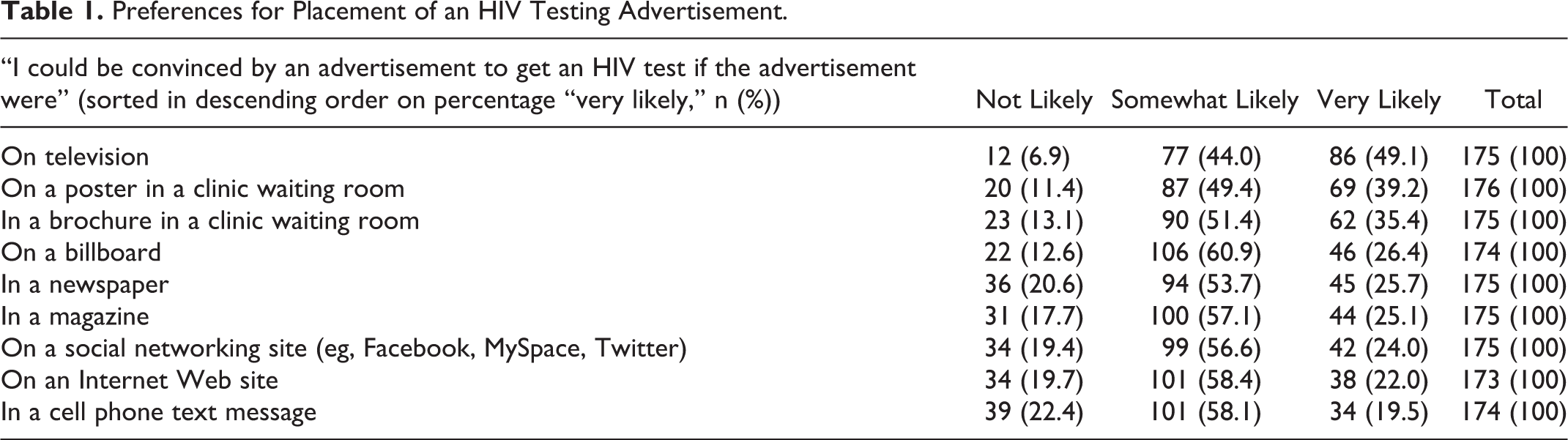
This study took place between October 2010 and March 2011 in a community health center in Houston, Texas, that serves a predominantly uninsured and publicly insured population. In the United States, the Houston metropolitan area has the eighth highest prevalence of people living with AIDS. 16 The community health center is located in Harris county, the county with more than 90% of the people living with HIV/AIDS in the Houston HIV Service Delivery Area. 17 Using a convenience sample of waiting room patients, we conducted a survey of African-American patients (age 18-64 years). Participants completed a paper-and-pencil anonymous survey containing questions about preferred media channels for an HIV testing campaign and preferred spokespersons for this HIV testing campaign. The survey’s channels and spokespersons are listed in Tables 1 and 2.
Preferences for Placement of an HIV Testing Advertisement.
Preferences for an HIV Testing Advertisement Spokesperson.

Results
One hundred seventy-six African-American adult participants completed the self-administered survey. Among those who reported their age, their average age was 37.1 years (standard deviation 11.0). Most (84.1%) participants were female. Among those who reported their educational attainment, only 6.9% reported having had only some high school education, while 60.0% reported having a high school diploma or general equivalency diploma; 33% had at least some college-level education.
Among 9 media channels listed for advertising an HIV testing campaign, the top 3 channels ranked by participants as “very likely” to be able to convince them to get an HIV test were television, clinic poster, and clinic brochure (see Table 1). The percentage of participants ranking these media channels as convincing was 49.1%, 39.2%, and 35.4%, respectively. No other channels listed were ranked as very convincing by more than 30% of respondents. Among 10 spokespersons listed to appear in an HIV testing campaign, the top 3 spokespersons ranked by participants as “very likely” to convince them to get an HIV test were doctor, nurse, and “real person like me” (see Table 2). The percentage of participants ranking these spokespersons as convincing was 47.4%, 43.7%, and 32.0%, respectively. No other spokespersons listed were ranked as very convincing by more than 30% of respondents.
Discussion
The HIV epidemic in the United States continues to disproportionately impact African Americans; undertesting and late HIV testing may be the contributing factors. 5 Notably, a 2011 national survey found that African Americans report wanting more information about HIV testing. 4 African Americans cite the media as their primary source of HIV information and simultaneously note that they currently are seeing less about HIV in the media than in previous years 4 ; therefore, the use of the media may be an intervention that could successfully provide African Americans with up-to-date HIV testing information. Our study of predominantly African-American women attending a publicly funded health center in a high-HIV prevalence city found that clinic posters and brochures may be effective ways to communicate the importance of HIV testing. Television advertisements may also be effective. Previous research has found that television is a prominent 18 -20 and trusted 20 media used by African Americans to obtain health information, which may explain why television was also highly ranked as a channel in this study. To improve the success of media campaigns, it is critical to utilize channels that would be easily accessible and persuasive for the intended audience; channel selection is an essential factor in delivering health information to the target audience. 18,21,22 Our findings suggest that posters, brochures, and television advertisements should be considered as the preferred media channels for an HIV testing campaign for community health centers serving predominantly African-American women. Notably, the use of a combination of media channels may be more effective for promoting behavior change. 20 Based on our current findings, the HIV testing campaign should feature a doctor, nurse, or person similar to the target audience in order for the campaign to be able to convincingly communicate its HIV testing message. Doctors are a trusted and influential source of health information. 23 Furthermore, previous research has found that a doctor recommending an HIV test plays an important role in patients’ HIV testing decisions. 24 -27
Our study is subject to several limitations. This single-site study may not reflect the preferences of African-American patients in other health care settings or in cities with a different HIV prevalence. Our study population was predominantly female, and there may be differences in media preferences across sex. Radio was unintentionally omitted from the survey questionnaire; this media channel may have been a preferred source of HIV information. In fact, radio was a preferred media channel in a study of an HIV testing campaign targeting African-American women aged 18 to 34 years. 12 It is possible and likely that 2 of the top 3 media channels chosen—namely, clinic poster and clinic brochure—reflect a population that accesses health care settings, as our study population did.
Conclusion
Use of the media is a cost-effective strategy to promote HIV prevention. 13 Posters and brochures, ranked highly convincing by our study population, are (1) relatively inexpensive and (2) easy to reproduce for many clinical settings. Notably, television campaigns may also be feasible for health centers with closed circuit televisions. Additional research is needed to design and pilot test a health center campaign based on our results. Although our study has identified possible channels and spokespersons for a health center media campaign, research is needed on the design of messages that will move people from awareness of the importance of HIV testing to motivation to test for HIV and then to HIV testing action. Previous research has found that embedding HIV messages in a cultural context relevant to African-American women can improve the campaign’s impact on HIV testing 28 ; as such, attention should be paid to developing themes that are culturally and personally relevant to the target audience. Attention should also be paid to both the sex and ethnicity of the characters featured in the campaign. Research has found that sex- and ethnicity-matched characters could have a positive impact on intentions to test for HIV. 14 Finally, limited research has shown that when behavior change theories and models are used in HIV testing campaign development, the campaign supports HIV testing behaviors. 12 An effective health center campaign to improve HIV testing may help mitigate the disproportionate toll HIV is having on African-American communities.
Footnotes
Acknowledgments
This publication resulted in part from statistical analysis support provided by the Design and Analysis Core of the Baylor-UT Houston Center for AIDS Research, an NIH funded program (AI036211). The views expressed in this article are those of the authors and do not necessarily represent the views of the Department of Veterans Affairs.
Authors’ Note
The corresponding author has the right to grant on behalf of all authors and does grant on behalf of all authors, an exclusive license (or nonexclusive for government employees) on a worldwide basis to the BMJ Group and co-owners or contracting owning societies (where published by the BMJ Group on their behalf), and its licensees to permit this article (if accepted) to be published in The Journal of the International Association of Providers of AIDS Care and any other BMJ Group products and to exploit all subsidiary rights, as set out in our license. Monisha Arya is the principal investigator of the research study, conceived of the initial study, was the lead in initial interpretation of survey results, was the lead author in drafting the manuscript, and was responsible for incorporating edits of all coauthors during manuscript preparation and finalization. Michael A. Kallen is a psychometrician, assisted in survey design and survey results interpretation, suggested ways to report survey results in the manuscript, and critically reviewed the results reporting section in the manuscript. Thomas P. Giordano is a senior mentor for the research study, assisted in the conception of the overall study research design, assisted in survey design, critically reviewed the entire manuscript to ensure the introduction is applicable for the intended readership audience and the conclusions are appropriate to stimulate further research by the medical and public health community. Richard L. Street Jr is a mentor for the research study, assisted in the conception of the research design, assisted in the survey design with particular focus on interpersonal communication (eg, who should be featured in a campaign), assisted in interpretation of survey results, and critically reviewed the entire manuscript. Kasisomayajula Viswanath is a mentor for the research study, assisted in the conception of the research design, assisted in survey design with particular focus on media channels (eg, what type of advertisement should be created), assisted in interpretation of survey results, and critically reviewed the entire manuscript.
Declaration of Conflicting Interests
The author(s) declared no potential conflicts of interest with respect to the research, authorship, and/or publication of this article.
Funding
The author(s) disclosed receipt of the following financial support for the research, authorship, and/or publication of this article: This research was supported by the Baylor-UT Houston Center for AIDS Research (CFAR), an NIH-funded program (AI036211; PI: Arya). This research was also supported by a NIH/NIMH K23 award (MH094235-01A1, P1: Arya). The content is soley the responsibility of the authors and does not necessarily represent the official view of the National Institutes of Health. This work was supported in part by the Center for Innovations in Quality, Effectiveness and Safety (#CIN 13-413).