




Abstract
Objective:
Difficulties in systematically monitoring HIV viral load in resource-limited settings prompt the search for alternate approaches. The authors aimed at assessing the correlation between the plasma levels of soluble forms of Fas receptors (Fas) and Fas ligands (FasL) with standard indicators of HIV disease progression in children.
Methods:
Twenty-two HIV-1-positive children were enrolled in Yaounde. CD4 counts, CD4% counts, plasma levels of Fas, FasL, and HIV-1 RNA levels were assayed.
Results:
The correlation coefficients (P values) between FasL levels and each of HIV-1 viral load, CD4 counts, and CD4% were, respectively, .56 (.01), −.29 (.18), and .30 (.18). On the other hand, the respective correlation coefficients (P values) with Fas levels were .12 (.60), −.30 (.18), and −.29 (.19).
Conclusion:
The significant correlation between levels of HIV-1 viral load and FasL suggests that the latter needs to be further studied as a potential biomarker to monitor HIV-1 disease progression in children in resource-limited setting.
Keywords
Introduction
HIV-1 infection causes a gradual and progressive CD4 depletion with an increase in viral load. 1,2 Children account for more than 20% of death related to HIV infections all over the world, 3 with sub-Sahara recording the highest death rate. HIV viral load is one of the main surrogate indicators used for monitoring and managing HIV disease progression and treatment success in adult and children all over the world. 4,5
In Cameroon, like many other sub-Saharan African countries, there is a difficulty in systematically implementing monitoring through HIV viral load. These difficulties have arisen due to lack of equipment and technology in the rural and some urban areas where more than 90% of new HIV-infected cases have been reported. 3,6 The limited service rendered by a few reference laboratories located in a few big cities are characterized by a huge cost price per testing. CD4 count and/or CD4% are now frequently used in managing and monitoring of HIV-1 disease progression in children. The guidelines for treating and monitoring children using these 2 immunological markers of CD4 and CD4% are not clear-cut as to when to begin therapy as well as monitoring treatment successes. This has prompted the search for an alternative, easily available, cheaper, and accurate means to be used in the managing and monitoring HIV -infected children in Cameroon and other sub-Saharan African countries. One of such potential being explored in this study is Fas, a mediator of cell apoptosis involved in HIV pathogenesis. 5 –7
T-cell apoptosis by Fas is one of the major mechanisms responsible for T-cell depletion during HIV infections. Many studies have shown that infected CD4 from HIV-1-infected individuals shows abnormal levels of apoptosis, both in vitro and in vivo. 7 –10 Increased rates of T-cell apoptosis in HIV-infected human individuals are known to be associated with an increase in the expression of the CD95 receptor and its ligand (CD95L) known to be involved in the pathogenesis of HIV. 9 –11 CD4 are more susceptible to Fas-induced apoptosis in HIV-positive individuals, and this is related to the regulation of surface levels of CD95 (Fas) and FasL. 12 –14 Peripheral blood mononuclear cells (PBMCs) from HIV-positive individuals express higher levels of CD95 and the proportion of these T lymphocytes increases with disease progression. 13 –16
In this study, we assessed the correlation between plasma levels of soluble forms of Fas receptor (Fas) and Fas ligands (FasL) with standard indicators used to monitor HIV disease progression in children (HIV viral load, CD4 counts, and CD4%). If a correlation was shown, then there could be a potential for soluble Fas and/or ligands to be used in the monitoring of HIV diseases in children in resource-limited settings where an enzyme-linked immunosorbent assay (ELISA) could be cheaper and more feasible as opposed to flow cytometry and/or viral load assays.
Methods
In a cross-sectional study, we enrolled 22 HIV-infected children from the Chantal Biya Foundation paediatric Hospital and from the Centre for the Study and Control of Communicable Diseases (CSCCD) HIV research institute, of the Faculty of Medicine and Biomedical Sciences in Yaoundé, Cameroon. All participants were naive to high active antiretroviral therapy at the time of enrollment. An ethical clearance was obtained from the Cameroon National Ethics Committee. Consent was obtained from the parents of the recruited children and demographic data for each participant were recorded using a standardized questionnaire.
Ten milliliter of blood was collected in EDTA anticoagulant tubes from each participant. Whole blood was used to analyze for CD4 count and CD4%. CD4+ count was done by Facscount (Becton Dickenson, Belgium) CD4% by Cell Dyne 3200 (Abbott, France) The blood was then centrifuged at 12 000 rpm for 5 minutes and plasma separated and stored in 2 vials of 1.5 mL each. One vial of plasma was then analyzed for Fas (CD95) and FasL (CD95 L) using 2 different quantitative sandwich ELISA kits (Quantikine, R&D Systems, UK). While the other vial was used for plasma HIV-1 RNA viral load, using a commercial quantitative reverse transcriptase polymerase chain reaction kit (Amplicor HIV Monitor version 1.5 Test, Roche Molecular Systems, Germany), with a minimum detection limit of 2.3 log10. All samples were analyzed based on the manufacturers’ guidelines.
Data were entered into a Microsoft Excel spreadsheet and analyzed using STATA version 10 (STATA Corps, Texas). Spearman rank correlation coefficients were used to quantify the correlation between each of FasL and Fas plasma levels with HIV-1 viral load, CD4 counts and CD4%.
Results
Participants’ Characteristics
Of the 22 participants enrolled in the study, 13 (59%) were females and 9 (40%) males. Their ages ranged from 9 months to 7 years. The mean HIV-1 viral load was 4.4 log10, copies/mL, with a range of 3.6 to 5 log10 copies/mL. The absolute CD4 count ranged from 77 to 2134 cells/mm3 (mean = 798) and CD4% ranged from 12% to 40% (mean = 24%) Fas Ligand Levels and Correlation with HIV Viral Load, CD4 Count, and CD4%
Fas ligand levels ranged from 36 to 299 (median = 126) pg/mL. The correlation coefficients (P values) between FasL levels with HIV-1 viral load CD4 counts and CD4% were, respectively, .56 (.01), −.29 (.18), and .30 (.18). These correlations are depicted in Table 1 and Figures 1 to 3.
Correlation between Each of Fas Ligand and Fas Receptor Plasma Levels with HIV-1 Viral Load, CD4 Counts and CD4% in 22 Children in Yaounde, Cameroon.

Abbreviation: r, Spearman rank correlation coefficients.

Correlation between plasma levels of Fas ligands and HIV-1 viral load in 22 children in Yaounde, Cameroon.

Correlation between plasma levels of Fas ligands and absolute CD4 counts in 22 children in Yaounde, Cameroon.
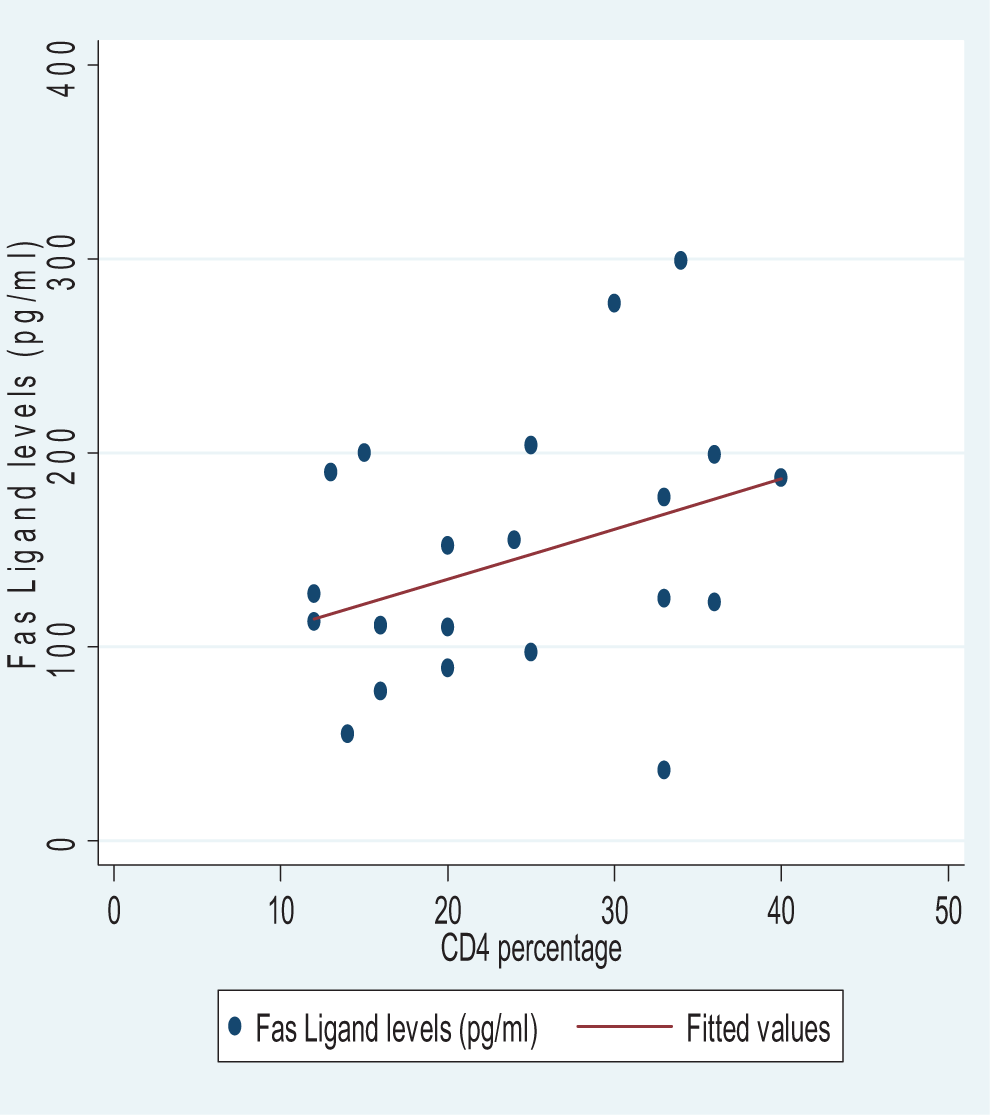
Correlation between plasma levels of Fas ligands and CD4% in 22 children in Yaounde, Cameroon.
Soluble Fas levels and correlation with HIV viral load, CD4 count, and CD4%
Soluble Fas levels ranged from 987 to 3217 (median = 1571.5) pg/mL. The correlation coefficients (P values) between soluble Fas levels and each of HIV-1 viral load, CD4 counts, and CD4% were, respectively, .12 (.60), −.30 (.18), and −.29 (.19). These correlations are summarized in Table 1 and Figures 4 to 6.

Correlation between plasma levels of Fas receptors and HIV-1 viral load in 22 children in Yaounde, Cameroon.

Correlation between plasma levels of Fas receptors and CD4 counts in 22 children in Yaounde, Cameroon.

Correlation between plasma levels of Fas receptors and CD4% in 22 children in Yaounde, Cameroon.
Correlation between FasL levels and soluble Fas levels
There was an inverse relationship between FasL levels and Fas levels (r = −.28; P value = .20).
Correlation between HIV-1 viral load and each of CD4 counts, and CD4%
There was a significant inverse correlation between HIV-1 viral load and CD4 counts (r = −.42; P value = .05). On the other hand, there was virtually no correlation between HIV-1 viral load and CD4% (r = .04; P value = .86).
Discussion
The immune systems in children and infants are slow in development compared to the adults. 17 Soluble CD95 (sCD95) and its corresponding ligand CD95 (sCD95L) are considered the immune activation markers involved in the pathogenesis of HIV-1 infection. 12,13 These immune activation markers have been shown to correlate with HIV-1 disease progression in adults and children. 12 –14 In the present study, we evaluated the potential of Fas or FasL as an affordable, available, and cheaper alternative to HIV-1 viral load to be used for early monitoring of HIV disease progression in children in Cameroon.
Fas as an immune activation marker has been reported to correlate better with the loss in CD4 count in HIV-infected individuals. 15,18 This suggests that the assessment of immune activation rather than HIV-1 viral load may be used to monitor the response to antiretroviral treatment. 17, 19,20
Our findings in this study suggest that monitoring HIV disease progression via their CD95 ligands signals in plasma may generate important information about the immunological and virological state of HIV disease in children. Fas ligands have direct correlation with HIV viral load. This could be explained by the fact that the higher the HIV-1 viral load, the more CD4 counts are being activated, thereby increasing FasL level or signals that are imminent signs of CD4 destruction by apoptosis.
There was no significant correlation of FasL levels with CD4 count or CD4%. This could be due to the fact that FasL production is highly generated by activated cell under pressure ready to undergo apoptosis.
Different studies have also shown a similar correlation between FasL and HIV viral load in adults and also its potential use in evaluating the effectiveness of antiretroviral therapy. 20 –24 Earlier studies carried out in Cameroon have shown the increase in plasma levels of Fas and FasL in HIV-positive adults compared to negatives in a population known for its high variability of subtypes. 25 Thus far, very limited studies have been done on these pathways in children.
The significant correlation between plasma levels of HIV-1 viral load and FasL suggests that the latter could potentially be an alternative approach to monitor HIV-1 disease progression in children. However, these findings will need to be confirmed in a larger, diverse study population of infants in further prospective studies.
The availability of an ELISA technique used to measure plasma levels of FasL in both the urban and rural areas may represent a feasible, cost-effective, simple immune activation marker, that could be considered for use in Cameroon, as well as other resource-limited settings, to manage and monitor HIV-infected children and infants. It is expected that ELISA tests could be more suitable in developing countries because the cost of installing a viral load machine and/or its technology in Cameroon is about 10 times compared with that of installing ELISA technology. Enzyme-linked immunosorbent aassay tests can thus be made more readily available even in the rural areas. Furthermore, the price per viral load assay is FCFA 20 000(US$40) while an ELISA test costs FCFA 2000 (US$4).
The major limitations of this study were its cross-sectional nature and the small sample size. Future studies ought to assess these immune markers in infants on antiretroviral therapy as well as drug resistance.
Footnotes
Declaration of Conflicting Interests
The author(s) declared no potential conflicts of interest with respect to the research, authorship, and/or publication of this article.
Funding
The author(s) declared the following financial support for the research, authorship, and/or publication of this article: The CSCCD laboratory, where this study was conducted, was supported by a training grant from the European Union. GMI, JA, MM and PMN's work was partially supported by a grant from the European and Developing Countries Trial Partnership (EDCTP) to the Central African Network against Tuberculosis AIDS and Malaria (CANTAM).