




Abstract
This study aims to empirically examine the factor structure and validity of psychological capital in the Indian context. Further, it also examines the linkage of psychological capital with learning orientation. A quantitative methodology was adopted, and data were collected using a questionnaire from 700 employees of public sector research organisations, information and communication technology companies, and academic universities and colleges in India. The findings reveal that psychological capital construct has a four-factor second-order structure and a synergetic effect on outcomes, and its four factors are related but distinct constructs. The findings also confirm that psychological capital has significant positive influence on the learning orientation of members of the organisation. Further, the level of psychological capital was found to vary across gender, age, work experience and executive level but not with qualification. This research will add into theory a detailed understanding about psychological capital and its relationship with learning orientation. The findings suggest that management should emphasise on preparing psychological capital interventions and trainings based on specific target groups in order to gain sustainable competitive advantage.
Introduction
Positive organisational behaviour, grounded in positive psychology, is an emerging paradigm with focus on the positive approach in managing people at the workplace, and it has psychological capital as a significant construct (Luthans, Avolio, et al., 2007; Uen et al., 2021). Psychological capital is a strategic (Alshebami, 2021), critical and valuable organisational resource (Luthans & Youssef, 2004) as well as a source of motivational energy (Wernsing, 2014) that builds competitive advantage for an organisation (Agrawal, 2020; Vilariño del Castillo & Lopez-Zafra, 2021). The literature suggests that psychological capital has various positive outcomes (Alshebami, 2021; Srivastava & Maurya, 2017) and, thus, its understanding can help the organisation to achieve its objectives by leveraging human motivational energy. Psychological capital enhances job performance, psychological well-being and organisational commitment (Avey et al., 2011) while being negatively linked to stress (Ahmad et al., 2019) and burnout (Cheung et al., 2011). Despite psychological capital being an important research area (Li et al., 2018) and having huge significance for academicians as well as practitioners (Vilariño del Castillo & Lopez-Zafra, 2021), it has not been fully explored in an organisational context (Jin, 2017). The scale for psychological capital (psychological capital questionnaire [PCQ]) was given by Luthans, Youssef, et al. (2007) and was first validated in the United States of America (USA) as four-factor second-order construct. PCQ has 24 items (PCQ-24). A shorter version of PCQ has 12 items (PCQ-12) and was first validated in New Zealand (Caza et al., 2010).
It is generally questionable whether managerial practices developed in one context are applicable to other contexts (Wernsing, 2014) because there are dissimilarities in social values, psychological attitudes and practices at work among various nations (Hofstede, 1980). Psychological capital involves psychological mechanisms (Wernsing, 2014); hence, there may be differences in the conceptualisation, understanding, interpretation and applicability of PCQs across various national cultures that may hinder its validity in different contexts. A question arises about universal acceptance of the four-factor second-order construct of psychological capital as its structure may vary in different contexts due to differences in belief system and culture (Sahoo & Sia, 2015). This was highlighted by the studies of Wernsigh (2014) and Du Plessis and Barkhuizen (2012) that revealed contradictory findings. Wernsing (2014) conducted a comprehensive study for examining the validity of PCQ-12 across 12 countries and found that psychological capital construct has a three-factor second-order structure in contrast to the four-factor second-order structure given by Luthans, Avolio, et al. (2007). Du Plessis and Barkhuizen (2012) also found a three-factor second-order structure of psychological capital construct in the South African context.
The psychological capital scale was originally developed and tested in the USA, and its application in the same form may also be questionable in India due to cultural difference with the USA. According to Hofstede’s national culture framework (Hofstede, 1980), the USA has low power distance, high individualism and low long-term orientation and is comparable in masculinity and uncertainty avoidance in comparison with India. India falls in the Southern Asia culture cluster in contrast to USA that falls in the Anglo culture cluster as per GLOBE framework (House et al., 2004). In the Indian context, the structure of psychological capital construct lacks enough support (Sahoo & Sia, 2015). While some of the studies examining psychological capital as a variable (e.g., Gupta et al., 2019; Mishra et al., 2019; Shukla & Singh, 2013; Totawar & Nambudiri, 2014) provided a four-factor second-order structure, the studies of Sahoo and Sia (2015) and Wernsigh (2014) found a three-factor second-order structure of psychological capital construct. Hence, the findings suggest different a structure of psychological capital construct in India as well as outside India. Further, there are very limited studies conducted explicitly to make comprehensive understating of the factor structure of psychological capital construct. This emphasises further investigation into the validity of four-factor second-order structure of psychological capital construct using more empirical studies. This study aims to empirically examine the factor structure and validity of psychological capital in the Indian context. Further, the influence of psychological capital on learning orientation is hardly examined. Hence, as nomological validity, this study investigates the linkage of psychological capital with learning orientation. India has become a prominent location for investment and for establishing research and development centres by multinational companies (Mishra et al., 2019) due to its economic growth, which makes it an important context to study about various concepts and phenomena developed in Western contexts. The article is organised as follows. The next section gives a conceptual understanding and frames the research objectives. The third section is on the methodology adopted. This section is followed by the results and analyses section. The last section talks about the outcomes and provides the conclusion.
Conceptual Understanding and Research Objectives
Positive organisational behaviour refers to ‘the study and application of positively oriented human resource strengths and psychological capacities that can be measured, developed and effectively managed for performance improvement’ (Luthans, 2002, p. 59). Psychological capital belongs to positive organisational behaviour, and it is defined as follows:
[A]n individual’s positive psychological state of development and is characterized by: (1) having confidence (self-efficacy) to take on and put in the necessary effort to succeed at challenging tasks; (2) making a positive attribution (optimism) about succeeding now and in the future; (3) persevering toward goals and, when necessary, redirecting paths to goals (hope) in order to succeed; and (4) when beset by problems and adversity, sustaining and bouncing back and even beyond (resiliency) to attain success. (Luthans, Youssef, et al., 2007, p. 3)
It is a second-order latent construct derived from positive psychological resources, namely, hope, efficacy, resilience and optimism; these are the motivational and behavioural tendencies of an individual (Luthans, Avolio, et al., 2007; Wernsing, 2014). Psychological capital characterises individuals’ motivational propensity and has a synergistic effect, that is, it has higher effect on performance outcomes as compared to its four components independently—the combined effect of all four components will be more impactful and broader (Luthans, Avolio, et al., 2007). The level of psychological capital differs across people (Jin, 2017) and it also varies over time (Peterson et al., 2011). McMurray et al. (2010) found that the level of psychological capital varies across age, qualification and executive level.
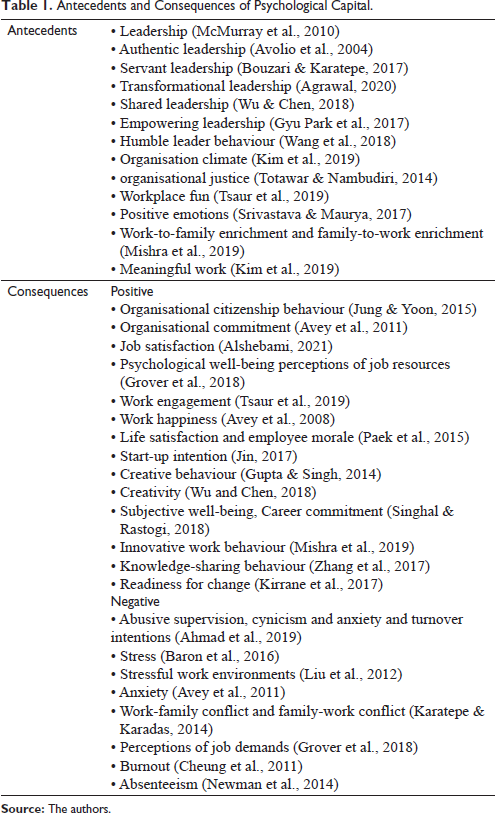
Psychological capital positively influences organisational commitment (Totawar & Nambudiri, 2014), organisational citizenship behaviour (Jung & Yoon, 2015), work engagement (Karatepe & Karadas, 2015), well-being (Avey et al., 2011; Poots & Cassidy, 2020) and job satisfaction (Alshebami, 2021). It has significant impact on creativity (Wu and Chen, 2018), innovative work behaviour (Alshebami, 2021; Uen et al., 2021) and self-directed behaviour (Choi, 2020). Psychological capital has negative relationship with cynicism and anxiety (Ahmad et al., 2019), and absenteeism (Newman et al., 2014). It is influenced significantly by leadership (McMurray et al., 2010) and organisation climate (Kim et al., 2019). Various styles of leadership such as authentic leadership (Avolio et al., 2004), servant leadership (Bouzari & Karatepe, 2017), transformational leadership (Agrawal, 2020), shared leadership (Wu & Chen, 2018) and empowering leadership (Gyu Park et al., 2017) have significant relationship with psychological capital. Table 1 summarises antecedents and consequences of psychological capital.
Antecedents and Consequences of Psychological Capital.
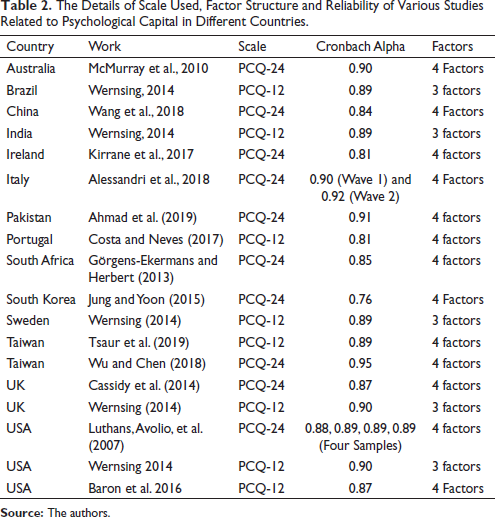
Psychological capital scale (PCQ) has two version: PCQ-24 (Luthans, Avolio, et al., 2007) that has 24 items where six items each belongs to efficacy, hope, optimism and resilience; and PCQ-12 (Caza et al., 2010; Luthans, Avolio, et al., 2007) that consists of 12 items where three items each belongs to assess efficacy and resilience, four items to assess hope and two items to assess optimism. Both PCQ-24 and PCQ-12 have been used widely by scholars in various parts of the world as shown in Table 2. Both scales have been found to have a four-factor second-order structure similar to Luthan, Avolio, et al. (2007). However, Wernsigh (2014) had contradictory findings. She investigated the factor structure of psychological capital construct using PCQ-12 in 12 countries and found that the psychological capital construct had a three-factor second-order structure in all of 12 countries. These three factors were hope, efficacy and resilience, that is, the optimism factor was not included. Similar to Wernsigh (2014), Du Plessis and Barkhuizen (2012) also found the three-factor second-order structure of psychological capital construct in the South African context. The three factors that emerged in their study were hopeful-confidence, resilience and optimism. The study of Wernsigh (2014) and Du Plessis and Barkhuizen (2012) indicate that cultural factors may have influence on the factor structure of psychological capital. Table 2 provides a summary of studies conducted in various countries with details related to scale used, factor structure and reliability of psychological capital construct.
The Details of Scale Used, Factor Structure and Reliability of Various Studies Related to Psychological Capital in Different Countries.
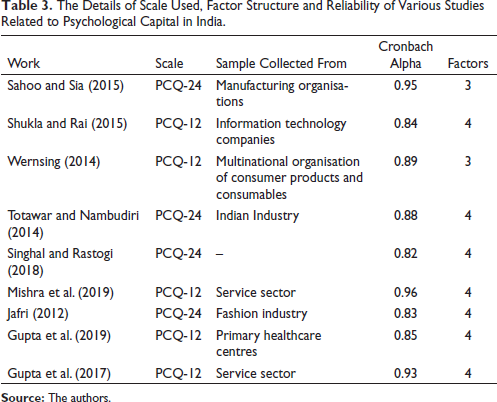
In the Indian context, researchers have used PCQ-24 (e.g., Sahoo & Sia, 2015; Singhal & Rastogi, 2018; Totawar & Nambudiri, 2014) as well as PCQ-12 (e.g., Gupta et al., 2019; Mishra et al., 2019; Wernsing, 2014). The studies of Sahoo and Sia (2015) and Wernsing (2014) were explicitly conducted to investigate the factor structure of psychological capital construct explicitly. Wernsing (2014) found that the psychological capital scale had a three-factor second-order structure for the Indian sample. Sahoo and Sia (2015) collected data from four manufacturing organisations of east Odisha and concluded that the psychological capital construct had a three-factor second-order structure instead of a four-factor second-order structure. The three factors of psychological capital that emerged in Sahoo and Sia (2015) study were hope, self-efficacy and optimism. In this study, items belonging to resiliency were found to be merged with self-efficacy factor and optimism factor. While the studies of Totawar and Nambudiri (2014) and Shukla and Singh (2013) used PCQ-24, the studies of Shukla and Rai (2015), Gupta et al. (2019) and Mishra et al. (2019) used PCQ-12; these studies found four-factor second order structure of psychological capital. Table 3 provides summary of studies conducted in India using PCQ.
The Details of Scale Used, Factor Structure and Reliability of Various Studies Related to Psychological Capital in India.
For nomological validity of psychological capital scale, the learning orientation construct was used. Learning orientation refers to the ‘concern for, and dedication to, developing one’s competence’ (Gong et al., 2009, p. 765) and the ‘desire of employees to strengthen and master their skills and capabilities in a continuous manner’ (Goswami & Agrawal, 2019, p. 13). Learning orientation provides competitive advantage to the organisation by enhancing innovation and problem-solving capabilities (Goswami & Agrawal, 2019), developing new technologies, and creating and using knowledge (Mahmoud et al., 2016). According to conservation of resource theory, people having sufficient internal resources, have more devotion towards work (Li et al., 2018) and make efforts to acquire numerous precious resources (Li et al., 2018). So, individuals who have positive psychological resources such as psychological capital may focus more on learning orientation in order to gain more such resources. Psychological capital has a development-focused nature that encourages employees to be involved in complex and challenging activities (Wang et al., 2018), causing creative behaviours (Sankowska, 2013) such as learning orientation. Psychological capital influences knowledge-sharing (Zhang et al., 2017), and knowledge-sharing affects learning orientation (Wu & Lin, 2013). This indicates a possible influence of psychological capital on learning orientation.
The following objectives have been framed for the study. The first objective is to examine internal validation of the four-factor second order structure of psychological capital construct in the Indian context. The second objective is to examine the external validation of the psychological capital construct in the Indian context. It includes the nomological validity that investigates the influence of psychological capital on learning orientation; The third objective is to probe the synergistic effect of psychological capital construct where it has higher effect on learning orientation as compared to all its four components, namely, hope, efficacy, optimism and resilience, independently. The fourth objective is to investigate whether the level of psychological capital varies across gender, age, work experience, management level and education.
Methods
Data Collection and Sample Demographics
The nature, structure and validity of psychological capital construct was examined using quantitative methodology. Questionnaire survey method was applied to gather data from employees of public sector research organisations, information and communication technology companies, and colleges and universities in India. Public sector research organisations belong to the public sector and are owned by the government. The chosen information and communication technologies companies were multinational companies belonging to the private sector. The chosen colleges and universities were from both public sector and private sector. The sources for the sample were chosen due to their huge impact on the growth and development of the country. The data were collected from different industries to incorporate different contexts while validating the structure of psychological capital. The use of different contexts makes the findings more generalisable. The chosen organisations have offices all over the country and, thus, the sample consists of responses from people of different parts of the country, having different cultural attributes. All items in the questionnaire were in English language. Random sampling technique was applied and identified respondents were approached in person as well as through online mode for data collection. A total of 2,000 questionnaires were circulated, out of which 815 responses were received, and after removal of incomplete questionnaires and outliers, 700 cases were selected for analysis. Thus, the response rate was 35%. The sample consists of 36% female and 64% male respondents. 33.10% of the respondents were below 30 years of age, 44.10% of respondents were between 30 and 39 years of age, 17.60% of respondents were between 40 and 49 years of age and 5.10% of respondents were more than 50 years of age. A total of 29.40% of respondents had work experience less than 5 years, 19.90% of respondents had work experience between 5 and 9 years, 25.60% of respondents had work experience between 10 and 14 years, 15.40% of respondents had work experience between 15 and 19 years and 9.70% of respondents had work experience of more than 20 years. While 36% of respondents were at lower management level, 58.30% of respondents were at middle-management level and 5.70% respondents were at top-management level. While 40.90% of respondents had undergraduate level qualification, 47.10% of respondents had postgraduate level qualification and 12% respondents had PhDs. To handle common method variance, a number of measures were employed, as emphasised by Chang et al. (2010), such as giving the assurance of confidentiality and anonymity and arranging of items in questionnaire in a random order.
Measures
A short version 12-item scale (PCQ-12) by Luthans, Avolio, et al. (2007) was applied to measure psychological capital. This study used PCQ-12 because it has fewer items than the PCQ-24 but has measuring capability similar to PCQ-24. Participants provided their preferences on a six-point Likert scale (1 = Strongly disagree to 6 = Strongly agree). The three-item scale of Gray and Meister (2004) was used to measure learning orientation. Participants gave their choices on a seven-point Likert scale (1 = Strongly disagree to 7 = Strongly agree).
Data Analysis Procedures
In order to examine the robustness of the PCQ-12 in different contexts, it was validated for the main sample consisting of 700 cases as well as sub-sample 1 (286; public sector research organisations), sub-sample 2 (248; information and communication technology companies), sub-sample 3 (166; colleges and universities), sub-sample 4a (252; only females) and sub-sample 4b (448; only males). Reliability of psychological capital, its four factors—hope, efficacy, resilience and optimism—and learning orientation were examined using Cronbach’s alpha and inter-item correlation of all the items of the scale. Structural equation modelling (SEM) was applied to find the answers of research objectives. A comparison was conducted to find the best suited model between four-factor model and three-factor model of psychological capital construct. Discriminant validity among four factors was examined using constrained and unconstrained models of SEM. Then, the discriminant validity and nomological validity of psychological capital construct were examined using another construct, namely, learning orientation. For nomological validity, a direct structural model representing the influence of psychological capital on learning orientation was tested on the data of all studies. The changes in the level of psychological capital along gender, age, work experience, managerial level and qualification were examined using analysis of variance (ANOVA).
Results and Analysis
First, Harman’s single-factor test on the fixed single factor consisting of all items of PCQ-12 and learning orientation explained less than 50% of the total variance, thus, discarding the potential impact of common method variance. While computing Cronbach’s Alpha, one item (‘I usually take stressful things at work in stride’) of PCQ-12 was removed because of low item total correlation equals to 0.246. The Cronbach’s Alpha of psychological capital and learning orientation were 0.85 and 0.78, respectively, for the main sample, and it was more than 0.70 for other sub-samples. This indicates the internal consistency of psychological capital and learning orientation.
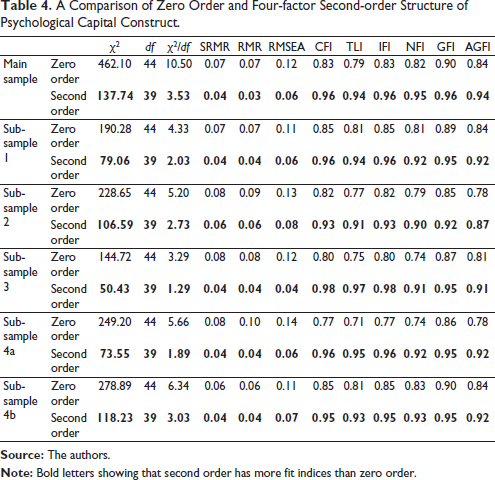
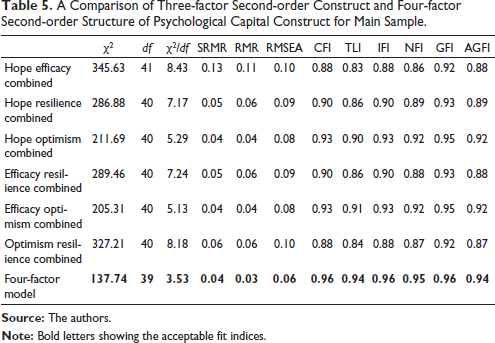
Two confirmatory factor analyses (CFAs) for psychological capital, namely, zero order CFA and second-order CFA, were conducted using maximum likelihood estimation method. Results suggested a desirable and better fit for second-order CFA as compared to zero order CFA for main sample as well as all sub-samples, thus, confirming the four-factor second-order structure of psychological capital construct. Model fit indices of both CFAs across all studies are shown in Table 4. Earlier studies in India as well as other countries (Du Plessis & Barkhuizen, 2012; Sahoo & Sia, 2015; Wernsigh, 2014) have found a three-factor second-order structure of psychological capital construct. Hence, six three-factor second-order CFAs were examined. These six CFAs were as follows: (a) hope and efficacy combined, resilience and optimism; (b) resilience and hope combined, optimism and efficacy; (c) optimism and hope combined, resilience and efficacy; (d) hope, efficacy and resilience combined, and optimism; (e) hope, efficacy and optimism combined, and resilience; and (f) hope, efficacy, and resilience and optimism combined. These six CFAs were compared with a four-factor second-order CFA. Results suggested sufficient evidences for a desirable and better fit for a four-factor second-order CFA as compared to a three-factor second-order CFAs, thus, further confirming the four-factor second-order structure of psychological capital construct. Model fit indices of these six CFAs are given in Table 5.
A Comparison of Zero Order and Four-factor Second-order Structure of Psychological Capital Construct.
A Comparison of Three-factor Second-order Construct and Four-factor Second-order Structure of Psychological Capital Construct for Main Sample.
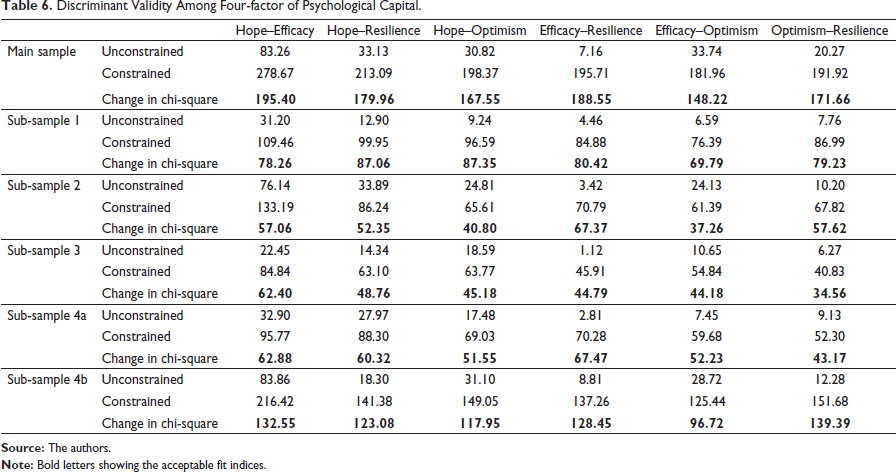
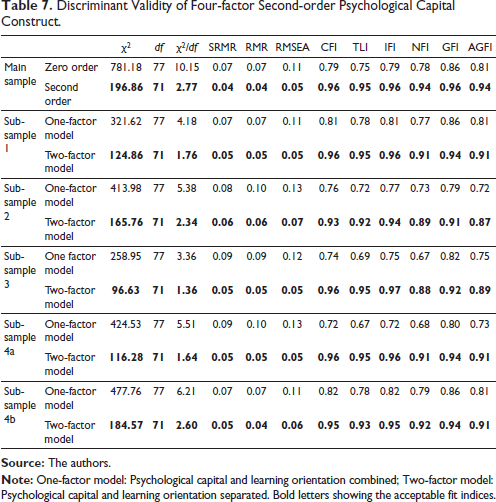
Discriminant validity among four components of psychological capital was measured using constrained and unconstrained models corresponding to each pair of components with respect to all studies. A total of six such pairs were examined: (a) hope and efficacy, (b) hope and resilience, (c) hope and optimism, (d) efficacy and resilience, (e) efficacy and optimism, and (f) resilience and optimism. Significant differences in chi-square values of constrained and unconstrained models of all pairs across the main sample and all sub-samples were found that provided evidences of discriminant validity among four components of psychological capital. The details are shown in Table 6. To measure discriminant validity of psychological capital, two alternative CFAs models were examined. These two alternative CFAs were one-factor CFA model (all items of psychological capital and learning orientation construct loaded to one factor) and two-factor CFA model (psychological capital and learning orientation construct as two separate factors). The result exhibited that hypothesised two-factor CFA had the best fit and significantly lower χ2 values as compared to one-factor model for main sample and all sub-samples. Thus, psychological capital had discriminant validity. The model fit indices of two alternative CFAs for all studies are given in Table 7.
Discriminant Validity Among Four-factor of Psychological Capital.
Discriminant Validity of Four-factor Second-order Psychological Capital Construct.
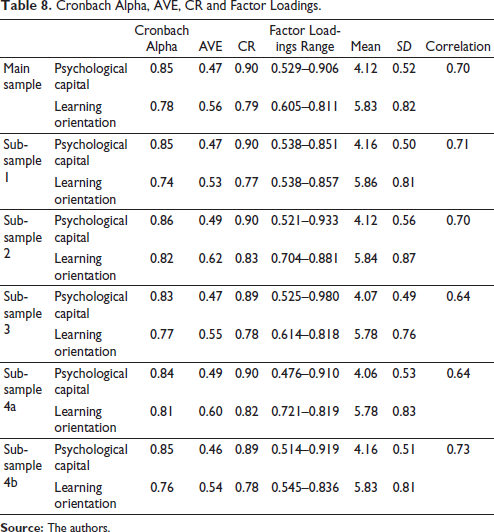
Learning orientation and four-factor second-order structure of psychological capital constructs had a composite reliability (CR) of 0.77 or higher and average variance extracted (AVEs) of 0.46 or higher for main sample and all sub-samples. Further, all items of both constructs had high factor loadings. The value of AVE above 0.40 is acceptable if a construct has a CR higher than 0.60 (Fornell & Larcker, 1981). This showed the convergent validity of psychological capital and learning orientation. AVE, Cronbach’s Alpha, composite reliability, factor loadings, and mean and SD of psychological capital and learning orientation are shown in Table 8. This table also shows corelation between psychological capital and learning orientation across all the samples.
Cronbach Alpha, AVE, CR and Factor Loadings.
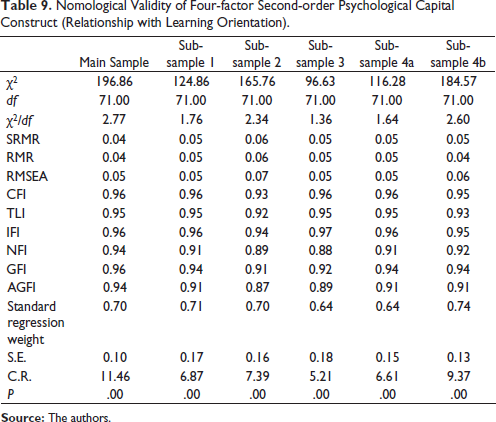
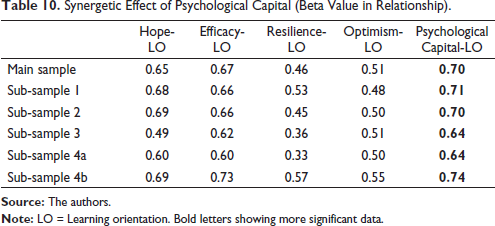
A structural model was examined for measuring the nomological validity of psychological capital scale where the influence of psychological capital on learning orientation was investigated. The fit indices were in acceptable range, thus indicating the structural model to be desirable fit in each study. The fit indices of structural models of the main sample and all sub-samples are shown in Table 9. The psychological capital was found to have significant influence on learning orientation. This indicated nomological validity of the psychological capital construct. The details of beta values and their significance are shown in Table 9. To examine the synergetic effect of psychological capital, beta values in the relationships of hope, efficacy, resilience, optimism and psychological capital with learning orientation were computed and examined. It was observed that beta value of relationship between psychological capital and learning orientation was higher as compared to corresponding beta values in relationships of efficacy, hope, optimism and resilience with learning orientation in the main sample and all sub-samples. It validates the synergetic effect of psychological capital. These beta values are shown in Table 10.
Nomological Validity of Four-factor Second-order Psychological Capital Construct (Relationship with Learning Orientation).
Synergetic Effect of Psychological Capital (Beta Value in Relationship).
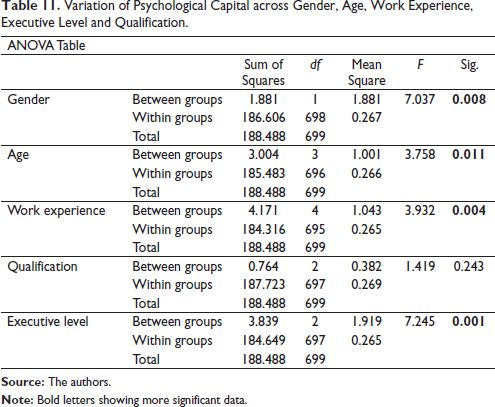
ANOVA was used to investigate the variation of level of psychological capital across gender, age, work experience, management level and education of employees. The results revealed that the level of psychological capital is significantly different across gender (p < .01), age (p < .05), work experience (p < .01) and executive level (p < .001), but not with qualification (p > .05). Table 11 provides all these details.
Variation of Psychological Capital across Gender, Age, Work Experience, Executive Level and Qualification.
Discussion
This research confirms the four-factor second-order structure of psychological capital construct in Indian samples as advocated by Luthans, Avolio, et al. (2007) for the USA context. This research also validates other studies conducted in India (e.g., Gupta et al., 2019; Jafri, 2012; Mishra et al., 2019; Singhal & Rastogi, 2018) as well as outside India (e.g., Alessandri et al., 2018; Cassidy et al., 2014; Kirrane et al., 2017; Wang et al., 2018). This finding is in contrast to outcomes of the studies of Sahoo and Sia (2015) in the Indian context, Du Plessis and Barkhuizen (2012) in the South African context, and Wernsing (2014) in context of 12 countries including India where they found psychological capital to be three-factor second order construct. Wernsing (2014) removed three items of PCQ-12 because of low factor loadings that resulted in nine items remaining. However, in this research, only one item was removed due to low value of item total correlation. The reason for this could be the lack of clarity of the item due to language related issue faced by people in Indian samples.
This study also confirms the discriminant validity among four factors of psychological capital, namely, efficacy, hope, optimism and resilience, highlighting that these four factors are highly related but distinct constructs. Further, the emergence of similar factor structure of psychological capital construct in India and other countries suggests that national cultural factors may not have significant effect on psychological capital. However, the relationship among national cultural factors and psychological capital needs to be investigated further. This research establishes the external validation of the psychological capital construct where psychological capital was found to have a significant positive effect on the learning orientation of employees in the organisation. This is an important finding because hardly any study has investigated this relationship. The research found that all four components of psychological capital, namely, hope, efficacy, resiliency and optimism, have a significant effect on learning orientation. However, the combined effect of all four components in the form of psychological capital is more than the individual effect. Thus, the research confirms the synergetic effect of psychological capital, that is, it has a higher effect on outcome as compared to all four components independently, as advocated by Luthans Avolio, et al. (2007).
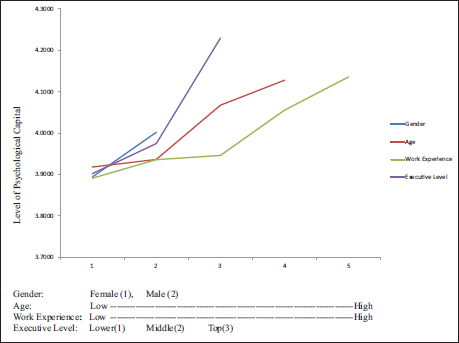
The research indicates the variation of level of psychological capital across gender, age, work experience and executive level but not with qualification. This finding validates that the level of psychological capital differs across people (Jin, 2017). The finding pertaining to variation of psychological capital across gender is contrary to previously reported results by McMurray et al. (2010). The finding regarding variation of psychological capital across age and executive level are similar to the findings of McMurray et al. (2010). The finding that psychological capital does not vary across qualification is similar to the finding of Luthans et al. (2005) but contrary to the finding of McMurray et al. (2010). Peterson et al. (2011) highlighted the variation of psychological capital across time. The time can be interpreted in terms of the years spent in the organisation, that is, work experience. This research validates Peterson et al. (2011) that psychological capital varies across work experience. Further, as shown in Figure 1, males have been found to have more psychological capital than females and the level of psychological capital increases with increases in age and work experience. Also, executives at a higher level have more psychological capital as compared to executives at a lower level.
Limitations
In spite of being a comprehensive work, this study has certain limitations. It used self-reported survey questionnaire in limited contexts. Future studies may investigate many other contexts and other research methods to further strengthening the findings of this article. This is a cross-sectional study that can be supplemented using longitudinal studies in future. this study has collected single-source data; however, multi-source data can be exploited by future studies.
Theoretical Implications
This research has significant theoretical implications. Earlier studies of Sahoo and Sia (2015) and Wernsigh (2014) established the three-factor second-order structure of psychological capital in the Indian context in contrast to Luthans, Avolio, et al. (2007). However, this study validates the original four-factor second-order structure of psychological capital found by Luthans, Avolio, et al. (2007) in contrast to the three-factor second-order structure found by Sahoo and Sia (2015) and Wernsigh (2014) in the Indian context. The probable reason for finding the three-factor second-order structure of psychological capital by the studies of Sahoo and Sia (2015) and Wernsigh (2014) could be the context as they conducted their studies in manufacturing organisations and multinational organisation of consumer products and consumables, respectively. However, the current study found four-factor second-order structure of psychological capital similar to studies of Shukla and Rai (2015), Totawar and Nambudiri (2014), Singhal and Rastogi (2018), Mishra et al. (2019), Jafri (2012), Gupta et al. (2019) and Gupta et al. (2017) in the Indian context conducted in information technology companies, fashion industry and other service sector organisations. The study enriches the literature of positive organisational behaviour by adding one more study that examined the validity and reliability of PCQ-12 in the Indian context. Another important theoretical contribution of this research is the establishment of a significant relationship between psychological capital and learning orientation. Thus, this study adds one more consequence to psychological capital and one more antecedent to learning orientation. This research contributes theoretically by providing insight about the variation of psychological capital across gender, age, work experience and executive level. This study is a comprehensive examination of psychological capital structure in the Indian context, which is a fast-emerging economy where various multi-national companies are operating. At the end, this study will provide a comprehensive conceptual understanding of psychological capital construct to novice researchers who want to venture in this fertile area. The relationship between psychological capital and learning orientation is also very significant during COVID times. During the pandemic, when companies were laying off employees, those who were optimistic, resilient, hopeful and efficacious, were more likely to learn and develop themselves, thus, displaying higher learning orientation.
Practical Implications
This research has many significant practical implications for organisations. This research has found psychological capital to have four-factor second-order structure that emphasises managers to think of psychological capital in a holistic manner. Managers need to focus on all the components of the psychological capital for enhancing it among employees for them to reach their maximum potential for the benefit of the organisation. They should use various interventions, and training and development programmes for strengthening psychological capital in a holistic manner. Web-based training (Luthans et al., 2008) and reading-based intervention (Zhang et al., 2014) are some of them. Hope can be enhanced by assigning challenging tasks and setting goals to employees and by asking them to make strategies and planning to achieve these goals and the identification of sub-goals and multiple pathways to meet the objectives (Streetman & Youssef-Morgan, 2019). Efficacy can be developed by using mastery experiences, observation and modelling (Bandura, 1997). Resilience can be developed by planning of handling setbacks, overcoming various obstacles and negative events (Streetman & Youssef-Morgan, 2019) and making them to learn how to bounce back in adverse situations. Optimism can be enhanced by incorporating positive outlook and an optimistic explanatory style (Streetman 7 Youssef-Morgan, 2019). Further, due to the varying nature of psychological capital across gender, age and work experience, manager should emphasise on various psychological capital interventions based on specific target groups to meet their peculiar requirements. In order to use psychological capital for employee performance mapping and their development, managers can use the shorter version of the scale (PCQ-12) with confidence and get benefits in saving their valuable time and energy in comparable with PCQ-24. In learning organisations, managers can strengthen the learning orientation of their employees by focussing on psychological capital.
Conclusion
In conclusion, this study aimed to empirically investigate the factor structure and validity of psychological capital construct along with its linkage with learning orientation in the Indian context using data collected from public sector research organisations, information and communication technology companies, and academic universities and colleges in India. Results of the study confirm the four-factor second-order structure and synergetic effect of psychological capital similar to Luthans, Avolio, et al. (2007) and establishes the significant positive relationship between psychological capital and learning orientation. The findings also reveal that the level of psychological capital varies across gender, age, work experience and executive level but not with qualification. This research is an important one regarding detailed understanding about psychological capital and its relationship with learning orientation in the Indian context. Hence, these findings may be exploited in the South Asian context, similar to the Indian context. Further, the findings suggest that management of organisations, specifically situated in South Asian countries, need to exploit various psychological capital interventions as well as trainings based on specific target groups in order to gain sustainable competitive advantage. The South Asian region is densely populated; hence, there is low per capita availability of resource, leading to tremendous pressure on national resources. This makes the life of people living in this region challenging. Therefore, psychological capital can play a key role in enhancing the performance of people in organisations in this region. South Asian economies are in an emerging stage; hence, psychological capital can be helpful in overcoming the challenges. These countries need to focus all four components of psychological capital together in order to reap the full benefits of synergetic effect. The South Asian region continuously attracts investment from developed countries, resulting in the adaptation of Western technologies, management practices and policies to align with the local context. It demands employees to be open towards learning new things. Hence, organisations in South Asian countries should focus on strengthening the psychological capital of employees in order to enhance their learning orientation. In conclusion, the findings of this study have significant relevance in the South Asian context.
Footnotes
Declaration of Conflicting Interests
The authors declared no potential conflicts of interest with respect to the research, authorship and/or publication of this article.
Funding
The authors received no financial support for the research, authorship and/or publication of this article.
