




Abstract
This study aims to examine perceived green human resource management (GHRM) influence on perceived in-role and extra-role green service behaviour. Specifically, drawing upon social identity theory, authors tested how green commitment mediates the relationship between GHRM and employees’ green behaviour. The study employed cross-sectional research design in a non-contrived setting for data collection from 203 responses of banking sector employees in Afghanistan. Partial least squares structural equation modelling is applied by using SmartPLS 3 software. The empirical results confirmed that green commitment mediates the relationship between GHRM and employees’ in-role and extra-role green service behaviour. This study explores green commitment as novel mechanisms through which GHRM practices influence employees’ in-role and extra-role green behaviour in organisations.
Introduction
Literature emerging on organisations’ environmental management suggests that human capital and green human resource management (GHRM) is a key enabler of organisation sustainability (Absar et al., 2021; Su & Swanson, 2019; Yong et al., 2020). GHRM refers to management of human resources while considering environment-friendly performance of organisations (Renwick et al., 2016; Yong et al., 2020). This includes employee hiring, staffing, training and performance assessments based on green standards (Dumont et al., 2017). In the GHRM framework, employees’ performance is measured and rewards are given based on the achievement of green targets (Renwick et al., 2016; Yong et al., 2020; Yusliza et al., 2017). GHRM seeks to mobilise and ensure employee participation in greater green competences that brings the cost to the minimum wherever possible, such as virtual interviews, online trainings, job sharing, teleconferencing and building energy efficient offices (Rubel et al., 2021). GHRM is applied when human resource management (HRM) actions are aligned with environment management (Gilal et al., 2019; Rubel et al., 2021). Prior studies have explored how GHRM can be beneficial in eliciting environment-friendly behaviours from the employees (Chaudhary, 2020; González-Rodríguez & Díaz-Fernández, 2020; Kim et al., 2019). Previous studies also have endorsed GHRM influence on employees’ green service behaviours (Guerci et al., 2016; Jabbour et al., 2016; Tang et al., 2018). Ramus and Killmer (2007) categorise green service behaviour as employees’ in-role and extra-role green service behaviour. In-role behaviour is an explicit job behaviour that requires employees’ green behaviour such as requiring employees not to mix toxic liquids with water, or there shall be well-defined procedures and guidelines for treating hazardous materials in line with the organisational and government policy (Dumont et al., 2017; Ramus & Killmer, 2007). Conversely, extra-role behaviour is implicit. For instance, turning off lights while not in use, shutting down laptops/desktops before leaving the office (Paille et al., 2014). Such green behaviours and activities are not job requirements, but these indicate their voluntary participation in environment protection (Ramus & Killmer, 2007; Tang et al., 2018). Both types of behaviour, in-role and extra-role, are important for achieving the green objectives of the organisation (Ramus & Killmer, 2007; Rubel et al., 2021). Thus, GHRM may realise these goals by inculcating in-role and extra-role green service behaviour among employees (Jabbour et al., 2016; Rubel et al., 2021).
GHRM for the sustainable performance of organisations is hardly examined in relation to employees’ in-role and extra-role green service behaviours (Rubel et al., 2021; Saeed et al., 2019; Yong et al., 2020). Therefore, it is necessary to understand the ways and the extent to which GHRM may affect employees’ in-role and extra-role green service behaviour positively. The present study is designed to fill this literature gap and examines GHRM in relation to employees’ in-role and extra-role green service behaviour. We believe that GHRM and employees’ in-role and extra-role green service behaviour are equally important for an organisation’s ecological performance. We further suggest that GHRM indirectly influences employees’ in-role and extra-role green service behaviour. We propose that this can happen through employees’ commitment to the environment.
The literature suggests that GHRM requires fulfilling many conditions; however, two important conditions that are needed are employees’ attitude towards GHRM and their commitment to it. Prior studies have reported that HRM influences employees’ environmental commitment that affects their performance (Bhatti et al., 2020; Hameed et al., 2020; Roscoe et al., 2019). This relationship justifies and supports the role of employees’ green commitment as a mediator of GHRM and their in-role and extra-role green service behaviour. A recent study by Rubel et al. (2021) suggests green commitment as a mediator for the future research on the relationship of GHRM and employees’ in-role and extra-role green service behaviour. The present study examines the indirect effect of green commitment on the relationship of GHRM and employees’ in-role and extra-role green service behaviour in the banking sector of Afghanistan.
The Afghan banking system currently consists of 12 banks—3 public banks, 7 private banks, and a branch each of 2 foreign banks. The principal distinction between public and private banks is that private banks have private shareholders whereas public banks have a single shareholder, the Afghan government. Da Afghanistan Bank (DAB) is the central money authority and financial regulator in Afghanistan. DAB is regulated by the Da Afghanistan Bank Law 2003. By far, most assets in the banking sector lie in private banks (67.36% in private banks; 26.87 % in public banks, and 5.77 % in foreign banks as of December 2020). Moreover, after the collapse of the internationally backed Afghan government on 15 August 2021, the new government Islamic Emirate of Afghanistan is established, and the new government maintains the previous government policies for sustainable banking policies. To promote sustainable banking, the central bank of Afghanistan is encouraging the banking sector to adopt sustainable/green practices. However, currently the banking sector in Afghanistan is passing from the difficult phase after freezing of Afghanistan’s reserve of $9 billion by the United States, $1.4 billion by the European Union and uphold of $1 billion by International Monetary Fund.
In the context of Afghanistan’s banking sector, green banking practices become more significant due to the much lower rank (168 out of 180 countries) of the country on the Environmental Performance Index of 2018. The emission levels of the country have increased tremendously since 1995 and crossed the threshold limit of air quality guidelines of World Health Organization. The increase in the emissions is due to many factors including local industries. As per the environmental act of 2007 by the National Environmental Protection Agency of Afghanistan, the DAB is encouraging all commercial banks to implement sustainable practices. Banks in this regard are required to focus on short- and long-term capacity-building programmes, including training courses for aligning banks’ plans and strategies for the achievement of sustainable development goals by encouraging human capital to adopt green behaviours in the banking sector. As per Absar et al. (2014, 2021), for years, organisations’ employees are alternatively indicated as ‘human assets’, ‘human resources’, ‘intellectual capital’ and ‘human capital’ for stakeholders’ satisfaction.
Therefore, we believe that there are various ways through which employees’ green behaviour can be influenced in the banking sector of Afghanistan. First, the banking sector has seen a significant growth in Afghanistan which has led to a high level of competition in banking services. Hence, employees’ service behaviour in banks can be influential in gaining a competitive advantage. Second, employees working in banks directly interact with customers; their actions can raise environmental awareness among the customers too. GHRM would inculcate green commitment among employees, which then conceivably would affect their green behaviour, organisational green performance which in turn would raise customer ecological awareness. Third, for ecological performance, every organisation operating in Afghanistan has to act as a responsible corporate citizen as per the environmental act of 2007, passed by the National Environmental Protection Agency of Afghanistan. Thus, it becomes the responsibility of every organisation in Afghanistan to adopt sustainable and environment-friendly business practices.
Our study uses employees’ green commitment as a meditating variable for the relationship of GHRM and employees’ in-role and extra-role green service behaviour using social identity theory (SIT). Following sections present theoretical foundations and its relevance to study variables, literature review and hypotheses. Afterwards, methodology and results of study. Finally, we conclude our study with a discussion of the results, implications and limitations along with providing directions for future research.
Theory and Hypotheses
SIT (Tajfel & Turner, 1979) provides the foundation for the current study. It states that people categorise themselves into groups and then develop membership with a specific group for their identity. Such identity among employees accelerates employee commitment, particularly when institutions and organisations positively affect their attitude and behaviour (O’Reilly & Chatman, 1986). On the bases of SIT, we believe that if an organisation advances green service behaviour through GHRM, then it is probably to improve external image to stakeholders. This improved image and reputation fortify the self-concept of employees. Hence, employees’ commitment towards their organisations increases. We suggest that GHRM practices consequently have a positive impact on employees’ identity with their green commitment and their in-role and extra-role green service behaviour. Organisations supporting such a culture possibly will be inspired to increase their employees’ green commitment, as well as their in-role and extra-role green service behaviour. This motivation facilitates the linkage of GHRM, in-role and extra-role green service behaviour via green commitment. This relationship of study’s variables has been depicted in Figure 1.
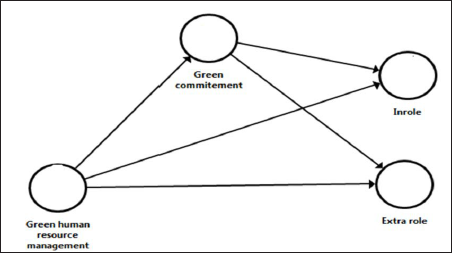
We propose that GHRM enhances green behaviour due to various reasons. First, GHRM defines the level of commitment towards sustainable performance. This directs and emphasises worker commitment and behaviour. As Carmeli et al. (2017) reported, social psychology research shows that perceived corporate social responsibility has a relationship with the legitimacy of organisational assurance to sustainability. Second, GHRM instils the sense of emotional attachment and participation in the employees who then begin to feel that they are part of a positive important change (Čincˇera, J., & Krajhanzl, 2013), and, lastly, GHRM involves and promotes an environment where it increases the level of employees’ green commitment for improved in-role and extra-role service behaviour.
GHRM and Green Service Behaviour
Literature suggests that HRM influences the performance of organisations through their employees’ attitude and behaviours (Alfes et al., 2013; Norton et al., 2014). So, GHRM also possibly impacts green behaviour in the workplace. This helps to improve the employees’ green values and will consequently lead to their environmental commitment and behaviour (Renwick et al., 2016). Likewise, employees’ job description and responsibilities can be associated with environmental responsibilities. Similarly, employees’ performance, promotion and rewards may be based on their green contribution in the organisation, which may inspire other staff to realise their green intentions by accomplishing green targets (Ansari et al., 2021).
It has been argued that workers’ views and thinking on why institutions and organisations accept various HRM policies describe how those actions will affect the employees’ behaviour (Rubel et al., 2018). In the same way, a structured, interconnected set of GHRM measures indicates employees’ green commitment to organisations. Subsequently, it is expected of them to exhibit behaviours in line with organisation policies. So, based on the literature, it is argued that GHRM may play a vital role in and enable employees’ achievement of in-role green behaviour and at the same time develop their extra-role green behaviour. Therefore, the following hypotheses are formulated:
H1: GHRM will have a significant positive relationship with in-role green service behaviour. H2: GHRM will have a significant positive relationship with extra-role green service behaviour.
GHRM and Green Commitment
Literature suggests that HRM policies have an effect on organisational performance through employees’ attitude and behaviours. GHRM emphasises green hiring of employees and their green attitude, green skills and green performance (Saeed et al., 2019). Thus, it shows the significant role of employees’ green commitment, which is understood as an individual commitment towards enhancement of the environment. SIT recommends that people organise and place themselves well and show more commitment to the groups they belong to and to the organisation and the society to improve their self-respect (Chaudhary, 2020). Therefore, when organisations implement pro-environmental practices via GHRM, this enhances their image for external and internal stakeholders. This improved image further strengthens the self-esteem of their internal stakeholders, or the employees. This positively impacts the employee commitment towards the organisation. Therefore, GHRM positively influences the green commitment of the employees. Previous studies such as Pham et al. (2019), Rubel et al. (2018) and Ren et al. (2018) have confirmed the positive relationship GHRM has with employees’ commitment. Therefore, we believe that if employees view GHRM as positive, this will lead to enhancing their green commitment. This gives us the following hypothesis:
H3: GHRM will have a significant positive relationship with green commitment.
Green Commitment and Green Service Behaviour
Green commitment is considered an employee’s bond, engagement, identification and apprehension for the ecological environment of the workplace (Afsar et al., 2020). If the workers have a weak commitment and less passion towards the environment, they are conceivably less worried about the ecological aspects during their daily activities in the workplace. Individual involvement and their affection have a positive effect on employees’ behaviour (Afsar & Umrani, 2020). So, a higher level of employee green commitment is related to their green behaviour with results in the practice of energy management (e.g., switching off extra lights), recycling of resources and an overall concern for the ecological issues (Afsar & Umrani, 2020). Prior studies have confirmed that emotional attachment with green commitment leads to pro-environment behaviour, and, when there is a higher level of green commitment, there is a greater in-role and extra-role green service behaviour. Hence, employees’ green commitment explains the relationship between green commitment and employees’ in-role and extra-role green behaviour. Therefore, we formulate the following hypotheses:
H4: Green commitment will have a significant positive relationship with in-role green service behaviour. H5: Green commitment will have a significant positive relationship with extra-role green service behaviour.
Green Commitment as Mediator
Literature suggests that HRM does not only directly affect the workers’ attitude and behaviours but there are also certain other factors and underlying mechanisms which too influence the employee behaviours (Boxall et al., 2016). Drafting a better policy of HRM affects workplace outcomes positively such as commitment (Ansari et al., 2021; Katou et al., 2021). We argue that employee green commitment conceivably mediates the relationship of GHRM and employees’ in-role and extra-role green service behaviour. Prior studies show that GHRM affects employees’ green commitment (Pham et al., 2019; Ren et al., 2018; Saeed et al., 2019). Likewise, previous studies also show the influence of green commitment on green behaviour (Rubel et al., 2018; Saeed et al., 2019). Moreover, green commitment has been recently studied as an underlying mechanism of GHRM and pro-environmental behaviour of the employees (Afsar & Umrani 2020; Ansari et al., 2021). However, green commitment has not been investigated as an underlying mechanism between GHRM and employees’ in-role and extra-green service behaviour. So, green commitment may be seen as employees’ willingness and commitment towards organisational ecological performance (Paille et al., 2014). Thus, this leads to the following hypotheses.
H6: Green commitment mediates positive relationship between GHRM and in-role green service behaviour. H7: Green commitment mediates positive relationship between GHRM and extra-role green service behaviour.
Based on the literature and hypotheses presented above, Figure 1 shows the relationship of the variables used in this study. It depicts a latent variable GHRM as a predictor of green commitment and in-role and extra-role green service behaviour as criterion variables. Moreover, it also shows green commitment as a mediating variable of GHRM and in-role and extra-role green service behaviour.
Research Method
Research Design, Sample and Data Collection
Cross-sectional research design is employed for data collection in the non-contrived setting of the banking sector in Afghanistan. The sample of our study consists of the employees from the banking sector of Afghanistan. This is justified with many significant reasons. First, with regard to environmental performance, every organisation operating in Afghanistan is required to act as a responsible corporate citizen under the 2007 Law of the National Environmental Protection Agency of Afghanistan. Second, employees working in banks have direct interaction with customers; their actions can increase customers’ ecological awareness. Third, GHRM will ingrain green commitments among bank employees, which may affect their green service behaviours. Therefore, the service behaviour of bank employees can influence the achievement of competitive advantage. We collected data online through Google Forms using convenience sampling. Data collection took 44 days (from 4 February 2021 to 20 March 2021), and we received a total of 203 responses, none of which was rejected as there was no missing data because the form could be submitted only after all responses were recorded. To find out the minimum sample size requirement, we used G-power software (Faul et al., 2009), which showed that our sample met the minimum requirement.
Measures
Three main variables used in the current study are GHRM, green commitment and green service behaviour. A five-point Likert scale (1 = strongly disagree and 5= strongly agree) was employed to enter the responses. Six measures of GHRM were adopted from Dumont et al. (2017). Six measures were adopted from Bissing-Olson et al. (2013) to measure green service behaviour with three measures for each in-role and extra-role green service behaviour. Employee green commitment was measured with eight items adopted from Raineri and Paillé (2016).
Respondents’ Profile
In demographic analysis, our sample shows that male respondents (150) were more than female respondents (53). Similarly, the oldest age group was 41–45 years. Moreover, we applied Leven’s test based on early and late responses to ensure adequate sample representation and homogeneity. Late responses were considered if received after a one-time reminder. We concluded that homogeneity of variance was not an issue, and our sample was the representative of the population based on Leven’s statistic (0.027, p > .871).
Results
Common Method Variance
Full Collinearity Testing.
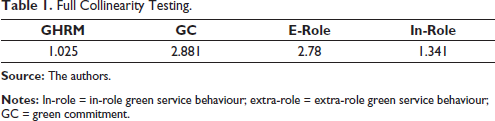
Moreover, we assessed data normality (Hair et al., 2017) by applying Mardia’s multivariate method of skewness (β = 2.770, p < .01) and kurtosis (β 28.135804, p < .01) through WebPower. The results showed multivariate non-normal data, therefore we employed SmartPLS 3 (Hair et al., 2019; Ringle, 2005; Ringle et al., 2015), as this software does not require assumption of data normality (Chin et al., 2003).
Measurement Model
Measurement Model.
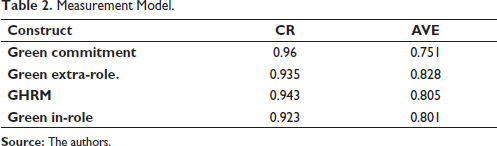
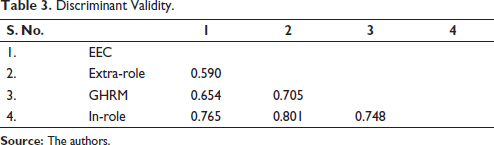
Discriminant Validity.
Structure Model
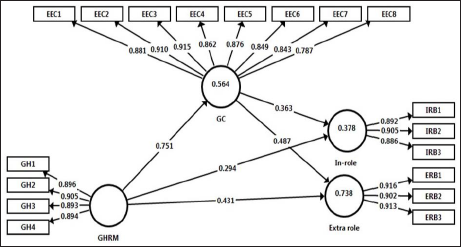
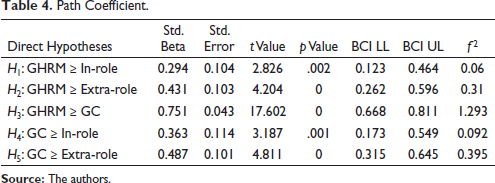
We followed recommendations made by Hair et al. (2019) and Ramayah et al., (2018) and applied 5,000 re-sample bootstrapping procedure to test the structure model. We also addressed the criticism by Hahn and Ang (2017) about reporting of only p values for concluding the results regarding the hypotheses. They proposed that p values along with confidence intervals and effect size should be used for the same, so all three criteria were considered to conclude the outcomes of our hypotheses.
Path Coefficient.
Mediation Analysis
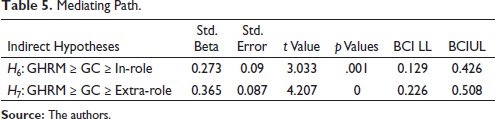
Mediating Path.
Discussion
We find that all seven of our hypotheses are supported. First, this study reveals a positive and direct effect of GHRM on employees’ in-role and extra-role service behaviour. This is consistent with earlier results such as from Dumont et al. (2017) and Rubel et al. (2021). The main findings of their studies also supported firms’ green practices as an instrumental and effective way for the employees’ environment-friendly behaviours. When organisations invest in GHRM, they in fact accept the efforts needed in green practices and encourage their staff to exhibit green behaviour.
Through this research, we justify and find support for how organisations may affect their workers’ in-role and extra-role green service behaviour. Second, this study also found a direct effect of green commitment on in-role- and extra-role green service behaviour of the employees. This is in line with previous research (Ansari et al., 2021; Yong et al., 2020). Moreover, we also found a mediating role of green commitment in the GHRM—green service behaviour linkage. Findings of this study corroborate previous literature (Rubel et al., 2021; Saeed et al., 2019).
Overall, the current research supports the notion that organisations should develop green commitment among employees through GHRM, which will lead to enhance their in-role and extra-role green service behaviour and to ultimately make the best move towards a sustainable environmental management of organisations to gain stakeholder satisfaction.
Theoretical Implications
The findings of our study contribute manifolds to the literature. First, this study provides strong argumentation in support of environmental management through GHRM. Second, this study explains employees’ responses to GHRM and its effect on green service behaviour. This study emphasises the influence of GHRM on individuals’ identity through the lens of SIT. It also supports and explains that individuals working in organisations that implement GHRM and employees working in organisations that do not have different meanings for their stakeholders. Organisations using GHRM practices encourage and enhance their employees’ green commitment to influence their green behaviours. This study sought support from SIT and explained on its basis that employees exhibit green commitment and green service behaviour. Furthermore, employees also influence their clients with whom they interact and thus create awareness among them and influence their environment-related behaviour. Thus, this study fills the empirical gap of examining green commitment as an underlying mechanism of GHRM in in-role and extra-role green service behaviour.
Practical Implications
The green management perspective adopted in this study is crucial for organisational sustainability and environmental management in general while south Asian context in specific. South Asian countries such as Afghanistan, Pakistan, Bangladesh and India are poorly ranked in the top 10 on the environmental performance index of 2020. Therefore, organisations of south Asian countries should devise strategies for GHRM implementation and should ensure their employees’ commitment towards green behaviour. This will help individuals inside and outside of the organisations and thus can add to social sustainability. Top management of organisations should devise a mechanism for GHRM and play a significant role in organisations’ environmental management. As found in this study, by considering GHRM, organisations can create green commitment among their employees and are more likely to influence their green service behaviours for environmental management.
Limitations and Future Research Recommendations
Although the current research has theoretical and practical implications, as is common in cross-sectional research, this study too has its limitations. First, using a cross-sectional research does not establish causality among the constructs. Future research may consider using panel data to tap causality of the same constructs in studying the same problem. Second, this study considered green commitment as a one-dimensional construct. Future research may explore the multidimensional perspective of green commitment. Third, the study has employed the quantitative method; future research may use a sequential exploratory study to explore environmental management factors in war-ravaged countries to triangulate the results. Moreover, future research may extend our model to a moderated-mediation model by including different personality types as moderating variables. Constructs such as internal and external locus of control, big-personality models and similar models may be tested with green service behaviour. Lastly, future studies may extend GHRM to empirically test green ability, green motivation, and green opportunity relationship through the lens of AMO theory.
Conclusion
The present study is a valuable addition to the existing literature on gaining higher environmental performance, specifically in the context of Afghanistan’s banking sector as a south Asian country. This study incorporates a few potential factors such as GHRM, green commitment and green behaviour which offer a solution to environmental issues in organisations. Our study has revealed that GHRM creates such an environment in the organisation that promotes green behaviours at workplace. We infer that GHRM predicts green commitment and green behaviour. Therefore, GHRM and green commitment both are equally important for employees and organisations. Moreover, limitations and implications of our study provide an opportunity for future research in the same domain.
Footnotes
Declaration of Conflicting Interests
The authors declared no potential conflicts of interest with respect to the research, authorship and/or publication of this article.
Funding
The authors received no financial support for the research, authorship and/or publication of this article.
