




Abstract
For more than two decades, academicians and practitioners have been theorising the role of people analytics in enhancing the efficiency, effectiveness and impact of the human resource (HR) management function, thereby prescribing people analytics as an enabler of HR strategic partnership. The objective of this study is to identify and synthesise existing literature on people analytics and its conceptualised efficacy. This is done with a view to assess how and why people analytics enhances HR as a field and elevates it to a function of strategic significance. The study uses the Preferred Reporting Items for Systematic Reviews and Meta-Analysis (PRISMA) framework for systematic literature review to address the research objective. A total of 90 articles on the subject are identified majorly from Scopus. The analysis of this literature reveals four significant themes underscoring the role people analytics can play in enabling HR as a field and function. These include the following: (a) application of people analytics leads to greater vertical, horizontal and external alignment of the HR function; (b) people analytics facilitates better integration of HR management with the organisation’s strategic planning process; (c) people analytics aids the demonstration of causal links between HR management and business performance; and finally (d) people analytics endows the field with scientific rigour, consistency and resulting credibility. The study contributes to the existing knowledge on people analytics and HR strategy linkage by building a foundation and offering specific propositions for empirical enquiry relating the two. The significance of the study also emanates from its focus on the efficacy of people analytics which is being viewed as an HR approach with immense potential.
Introduction
As human resource management (HRM) evolves as a field, it grapples with numerous challenges relating to the rigour it exercises as a field; the wherewithal it has to aid a firm’s strategy formulation and implementation; and furnishing accountability for contributions it makes towards the strategic ends of profitability, sustainability and growth. A considerable body of research in the field prescribes people analytics as a crucial development to surmount these challenges. People analytics encapsulates a systematic and logical approach to decision-making which uses data and employs scientific rigour as the basis of decision and action in HRM. The promise of people analytics is the better vertical and horizontal alignment of the human resource (HR) function, greater integration of human resources with the strategic planning processes, improved demonstration of causal linkages between HRM and critical organisational outcomes, and enhanced credibility of the field of HRM.
Despite significant theorisation on the subject, very little empirical investigation in the domain is available. This article seeks to further this pursuit by comprehensively reviewing the recent literature on the subject published over the past 20 years to examine the basis of claims about the efficacy of people analytics. The role played by people analytics in achieving HR strategic partnership is explored in relation to the following themes: aligning the HRM function; integrating HRM with the strategic planning process; demonstrating HR impact on business performance; and increasing the credibility of the HR function/field. In addition, the article summarises the research on outcome variables studied in the context of people analytics. The study differs from other literature reviews on the subject primarily because of its keen focus on exploring people analytics as an enabler of HR strategic partnership. Unlike more comprehensive scoping reviews on the subject, the study sifts and synthesises the literature on the efficacy of people analytics and offers propositions for empirical enquiry to this end. The study starts with an exploration of the connotation of HR strategic partnership and evident lacunae in the HRM field. Subsequently, the relevant literature on the role played by people analytics in enabling HRM to evolve as a function to become a strategic partner is discussed. This review culminates in four propositions for empirical enquiry. The article also contributes by identifying avenues for future research in the domain.
The article is organised on the following lines: background of the study; method; objective and research question; findings and discussion; recommendations for future research; limitations of the study; and conclusion.
Background of the Study
HR Strategic Partnership: What Does It Mean for the HRM Function to Be a Strategic Partner?
For decades now, academicians have been conceptualising and empirically establishing the role of HRM as a strategic partner. In a comprehensive meta-analytical work by Lengnick-Hall et al. (2009), some pertinent research themes which emerged from the reviewed literature on HR strategic partnership are internal alignment and integration of HR systems and subsystems, popularly known as contingency perspective; research relating to shifting of HR focus from managing people to strategic contribution; research seeking to expand the scope of strategy and HRM; research about achieving the execution of strategic HRM; research measuring and relating outcomes of strategic human resource to organisational performance; and finally research on evaluation of methodological issues about strategic HRM research. The latter is beyond the scope of this article; the remaining themes are briefly discussed below to arrive at an understanding of HR strategic partnership.
The contingency approach extends the idea that HRM practices need to fit with the organisation’s desired strategic outcomes and interests. In other words, this approach proposes that an effective HRM approach is contingent on the desired strategic outcomes of the organisation. Over the years, the concept of contingency in the domain of strategic HRM has seen an expansion. It started with a focus on alignment to the firm strategy (Baird & Meshoulam, 1988; Lengnick-Hall & Lengnick-Hall, 1988; Miles & Snow, 1984; Schuler & Jackson, 1987), and then emerged the idea of fit not just with the strategy but also with the external environment at large (Jackson & Schuler, 1995; Milliman et al., 1991). Latter entails legal, social and political environment, labour market conditions, industry features and national culture.
As the contingency perspective evolved, there was a growing realisation that this ‘fit’ between the strategy and HRM could render the system inflexible (Lengnick-Hall & Lengnick-Hall, 1988). Therefore, a more reciprocal relationship involving the role of human resources in both strategy formulation and implementation was emphasised. The proponents of this perspective view ‘fit’ as dynamic, as the organisation’s context and strategic priorities are constantly changing. Further, HRM is envisaged to actively influence strategy formulations, making the relationship bidirectional.
The second theme which emerged from the literature indicated a complete overhaul of expectations from the organisation’s HR function. If earlier it entailed maintenance and administration, today it involved accountability of human capital contribution, delivery of strategic capabilities and causal connection to the organisation’s competitive performance. Thus, a strategic partnership involves changing focus from mere people management to contributing towards strategic ends.
The third strategic partnership implies an expanded scope of the HR function which extends beyond the organisational boundaries (Boxall & Purcell, 2008; Colakoglu et al., 2006). This is reflected in Tsui’s (1987) ‘multiple constituency approach’, Gardner’s (2005) concept of ‘HR alliance’ and Lengnick-Hall and Lengnick-Hall’s (1999) inclusion of the customer in the domain of HRM.
Another critical theme in the literature on strategic HRM has been establishing causal links between HRM and the organisation’s strategic ends. This theme is evident in the ‘employee–customer profit chain’ (Rucci et al., 1998) or in the notion of ‘line of sight’ (Boswell, 2006). The line of sight entails making the connections between the function and corporate ends visible and comprehensible.
Measuring the impact of HRM has been a crucial theme in the HR strategic partnership realm. Becker et al. (2001) employed Kaplan and Norton’s (1996) balanced scorecard approach to HRM to link people, strategy and performance. Lawler et al. (2004) proposed that for human resources to play a role of strategic significance in the organisation, it would have to demonstrate how HR decisions affect business and vice versa. Lawler and Boudreau (2009) emphasised that information concerning the following three aspects needs to be furnished for the aforementioned reason: HR efficiency, HR effectiveness and impact of HR. In line with this research, considerable literature on HRM emphasises the need for scientific rigour in the field. Measurement embedded in robust frameworks gives the field credibility and foundation for effective strategic contributions through informational inputs and guideposts for strategy formulation and execution.
To summarise the research reviewed above, the following facets of strategic partnership have been discussed: the alignment and integration of human resources with its internal and external context and stakeholders; shift in focus towards meeting strategic ends from mere people management; scope of human resources widened to extend beyond organisational boundaries; demonstration of a causal link between human resources and organisational or strategic outcomes; and HR measurement as means to establish human resources’ credibility as a science. Lawler and Mohrman (2003) propose that human resources can have three kinds of roles as strategic partners. The three kinds include
That of strategy implementation, where the strategy has been formulated, HR aligns its practices to the same; Input and implementation role where HR plays an indirect role in strategy development by providing information or competitive intelligence on labor markets and helps in strategy implementation; and full partnership role which entails participating as the member of the strategic team that formulates policies. (Lawler & Mohrman, 2003)
Another analytical perspective to understand strategic partnership has been offered by Florkowski and Olivas-Luján (2016). The authors propose that being involved and possessing informational (through technology and data) and expert (knowledge and expertise on the part of HR professionals) power would ensure human resources’ influence on strategic decision-making.
Thus, research in the area points towards multiple yet interrelated facets of HR strategic partnership. The subsequent section briefly discusses the gaps in the field and how these make it fall short of its true potential as a strategic partner.
A Review of the Gap Between the Human Resources’ Grasp and Its Reach
A significant amount of research in the field has raised concern about how human resources as a function is falling short of realising its potential as a strategic partner. Human resources needs to align the services it offers inside the organisation with the expectations outside the organisation. From this perspective, every practice needs to be assessed based on the extent to which it creates value for various stakeholders. The multiple stakeholders include customers, employees—current and potential, investors, community, government and line managers. Ulrich and Dulebohn (2015) emphasise that the value that human resources creates needs to be aligned to the stakeholders’ expectations beyond the organisational boundaries.
Boudreau (2014) attributes human resources’ inability to realise its true potential to ‘stubborn traditionalism’, where stubborn traditionalism is this preoccupation with the administrative role and lack of flexibility in breaking this tradition to assume a more strategic role. Human resources’ inability to leverage its information power to advise and inform the decision-making of strategic significance is proving detrimental.
Boudreau further discusses that another major challenge faced by human resources as a profession is the lack of integration within the HR function. There has been a focus on new trends and practices such as employer branding, technology in human resources, use of big data in human resources and employing social media for talent acquisition, but these remain very much stand-alone initiatives. When it comes to an integrated response to broader issues such as globalisation, increasing uncertainty in the organisational environment, need for greater flexibility and leadership, human resources is rendered inadequate. The author expresses concern that this ‘contentment’ at the local level is the biggest threat to the profession.
Ascertaining and communicating causal links between human resources and strategic priorities and outcomes is another area where human resources is wanting (Boudreau, 2014). Lawler et al. (2004) suggested that measuring human resources’ impact on business would be necessary for human resources to become a strategic partner.
Cohen (2015) discusses the chasm between academic research and practice in the field of HRM. A more succinct explanation of theory and practice guiding each other is that ‘theory can inform practice; and practice needs to get better at laying out where they need stronger scientific underpinnings for designing HR practices’ (Vosburgh, 2017). For the field to achieve a status worthy of being a science and a credible practice, there has to be rigour, relevance and cumulative progress (Dipboye, 2007). Furthermore, the Society for Human Resource Management (2014) prescribes critical evaluation competencies coupled with business acumen as essential to the advancement of human resources as a field.
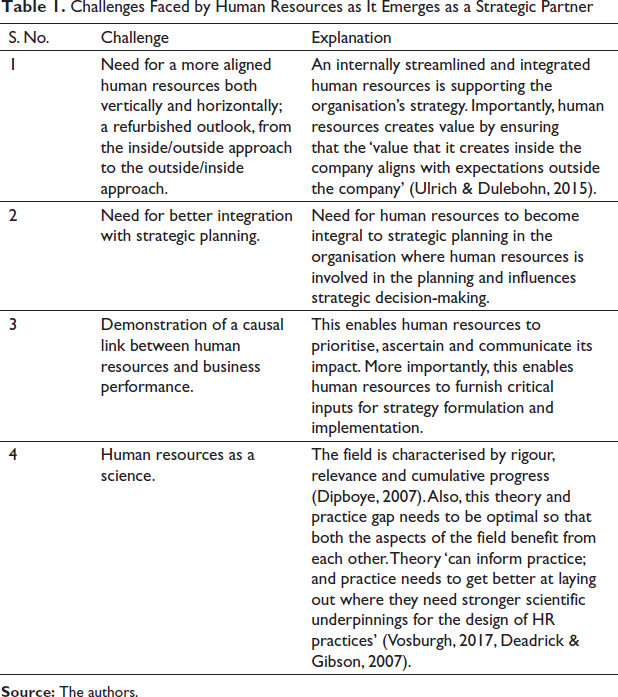
Based on the literature reviewed above, specific themes have been distilled. These indicate critical shortfalls in the field which demand address. Table 1 summarises the field’s challenges as it takes on a more vital and central role in business.
Challenges Faced by Human Resources as It Emerges as a Strategic Partner
People Analytics: Advent and Promise
Like most HR concepts, multiple terms are used to connote what we term ‘people analytics’. Keywords used interchangeably for people analytics include HR analytics, human resource analytics, talent analytics, workforce analytics, human capital analytics and employee analytics (Tursunbayeva et al., 2018).
People analytics in its limited avatar, as the measurement of human resources/HRM, can be traced back to the early twentieth century (Marler & Boudreau, 2017). More recently, Jac Fitz-enz has been considered a forerunner in the domain of HRM measurement. His book entitled How to Measure Human Resources Management was published in 1984. His later work provides a comprehensive understanding of people analytics. In his article entitled ‘Predicting People: From Metrics to Analytics’, he described human capital analytics (HCA) as a ‘method of logical analysis that uses objective data as a basis for reasoning, discussion, or calculation’ (Jac Fitz-enz, 2009). Simple metrics, such as quantity, quality and timeliness, were seen as the starting point of HCA. The next level entailed the analysis of data to predict, steer and drive business outcomes.
The term ‘analytics’ began to be associated with HRM in the early twenty-first century. The term was first introduced in an article titled ‘HR Metrics and Analytics: Use and Impact’ by Lawler et al. in the year 2004 (Marler & Boudreau, 2017).
Lawler et al. (2004) demarked people analytics from HR metrics by emphasising that people analytics is essentially a decision-making process or an analysis process which could deploy HR metrics for requisite ends of people and organisation performance. Boudreau and Ramstad (2004) defined people analytics as not just the use of statistics and research design but also identification and articulation of meaningful questions, gathering and using appropriate data from within and outside the HR function, setting the appropriate standards for rigour and relevance, and enhancing the analytical competencies of human resources throughout the organisation.
Levenson (2005) suggested that although research and statistical tools have been used earlier, the essence lies in when and how to apply these tools. He also provided an evolutionary framework of people analytics to include frameworks focused on description (typical data-based activities, scorecards, dashboards and so on); predictive or behavioural modelling—available data is searched for patterns and causal links, which is then used for predicting future outcomes; and, finally, impact analysis which deals with assessing the impact of human resources on crucial organisational outcomes.
Davenport and Harris (2007) described talent analytics as the use of big data in the workplace so that the talent decisions are based on statistical data rather than instinct. Talent analytics entails the application of statistical techniques to improve the precision of talent management decisions. Davenport et al. (2010) noted that the range of talent analytics applications constitutes ‘from simplest Human Capital facts to the most sophisticated statistical applications that optimize Talent Supply Chain’.
Bassi al. (2011) emphasised that ‘People Analytics is about taking an evidence-based approach to making decisions on the people side of the business. It consists of an array of tools and techniques ranging from simple reporting of HR Metrics to predictive modeling.’ More comprehensively, the author views people analytics as a means to improve the quality of people-related decisions by employing integrated processes and logical frameworks. This is done to improve individual and organisational performance.
Burdon and Harpur (2014) discuss the evolution of people analytics. They define Analytics 1.0 as the 1950s analytics dealing with the use of information systems to facilitate the understanding of company processes and actions. Analytics 2.0 company analyses the data beyond internal company operations. Analytics 3.0 company records, collects and analyses everything about itself and its industrial environment. The latter also employs prescriptive analytics, which deploys models to prescribe the right behaviours after factoring in the numerous contingencies and multiple variables.
Another comprehensive definition of people analytics has been compiled by Marler and Boudreau (2017). They conceptualise people analytics as ‘an HR practice enabled by information technology that uses descriptive, visual and statistical analysis of data related to HR processes, human capital, organizational performance, and external economic benchmarks to establish business impact and enable data-driven decision making’ (Marler & Boudreau, 2017).
Gill (2018) underscores the need for evidence-based management in the HR domain. The author defines evidence-based Human Resource Management as the use of those HR practices that have demonstrated links to organizational performance. formal practices to manage human resources that evidence demonstrates are linked to organisational performance. Her key argument is that if the practice is rooted in evidence/research, the impact would be more effective.
To summarise the research on the conceptualisation of people analytics, first, people analytics encapsulates a systematic and logical approach to carry out the function of HRM as against a largely intuitive approach; second, people analytics starts with raising relevant questions/defining decision opportunities and framing problems, followed by the use of research design, metrics and statistical tools in the service of these decisions and problems; third, people analytics relies on data—integral to the people analytics approach is the use of data, both qualitative and quantitative; fourth, an evolved people analytics ensures alignment and integration within human resources, of human resources with the organisation and consequently of human resources with the environment, which is achieved by gathering data from functions beyond human resources from the organisation’s larger context; and fifth, people analytics aims to equip human resources with effective HR decisions translating into robust HR performance, eventually leading to organisational performance.
The next section sheds light on the objective of this study and the research question that this study seeks to address.
Research Question and Objective of the Study
As discussed in the section above, HRM is increasingly seen as a critical function with immense potential to influence organisational strategy formulation and implementation. However, there is a concern if HRM is falling short of realising this potential (Boudreau, 2014; Cohen, 2015; Dipboye, 2007). The advent of people analytics promises to enable HRM to become a strategic partner. The objective of this study is to review the literature in order to explore and understand the efficacy of people analytics to enable the HR function to become a strategic partner. The study uses systematic literature review to address the following research question: How can people analytics enable HRM to become a strategic partner?
Method
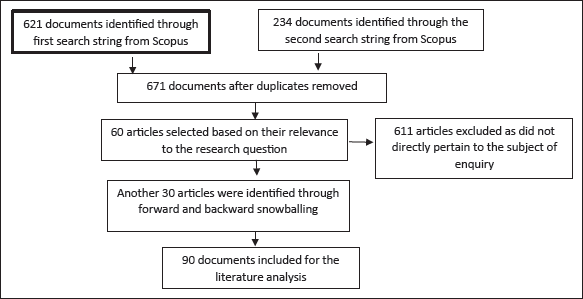
This article draws from seminal work in the area of people analytics. This review entailed the following steps prescribed by the Preferred Reporting Items for Systematic Reviews and Meta-Analysis (PRISMA) framework (Moher et al., 2010): identification of literature; preliminary screening of literature to assess its basic relevance to the study in question; critical appraisal of articles identified after preliminary screening; and, finally, creation of a relevant corpus of literature to address the research question. Scopus was the preferred database, given its comprehensive coverage of management and social sciences in general (Mongeon and Paul-Hus, 2016). The assembled literature was augmented using backward and forward snowballing (Wohlin, 2014). Figure 1 summarises the method followed for the study.
Recent seminal literature review articles were identified after extensive reading on the subject. This was done to have an insight into the ‘state of the field’ and set a robust foundation for the work. The outcome of this step was the identification of key terms or keywords used for the subject in question. The significant works identified in this pursuit were review papers by Qamar and Samad (2021), Tursunbayeva et al. (2018), and Marler and Boudreau (2017). With these as a basis, further exploration was carried out to identify more recent development in the field. Research articles by Ekawati (2019), Chalutz Ben-Gal (2019) and Gill (2018) were also reviewed. The following keywords for the topic in question were identified: employee analytics, workforce analytics, human capital analytics, HR analytics, talent analytics, human resource management analytics and people analytics (Tursunbayeva et al., 2018). The additional literature review suggested ‘Evidence-based management’ (Allen et al., 2010; Barends et al., 2014; Gill, 2018; Marler & Boudreau, 2017) and ‘HR Measurement’ (Barends et al., 2014; Boudreau & Ramstad, 2004) as frequently employed terms in the context of people analytics. These were also included in the search as keywords. Keywords so identified were employed to generate a corpus of relevant literature. Scopus was used to identify relevant articles. The following criteria were used for article identification.
Predefined criteria: Keywords—employee analytics, workforce analytics, human capital analytics, HR analytics, human resource management analytics, people analytics and HR measurement. Peer-reviewed academic journals were considered for the initial screening of articles. However, in addition to the academic literature, limited inputs were taken from a few industry reports and articles for this particular study. Tursunbayeva et al. (2018) suggested that a scoping review would be more meaningful, given the nascent stage of research in the area and the generation of pertinent knowledge outside academia. Literature published in the English language between 2000 and 2022 was included in the review. A wide gamut of subject areas beyond business management was identified, including decision sciences, social sciences and psychology, and arts and humanities. Areas such as pure sciences, engineering, computer sciences, medicine and environmental sciences were excluded to ensure the focus of the research. The criteria for inclusion and exclusion are similar to those applied by Qamar and Samad (2021) and Tursunbayeva et al. (2018). These studies were scoping reviews on the subject of people analytics. However, this study explored the literature more specifically for the impact and efficacy of people analytics.
The criteria above resulted in 621 articles on 21 August 2021. To ensure comprehensive coverage, a more specific keyword search was carried out, which further yielded 234 articles. The two sets of documents obtained through the two strings were compared, and duplicate documents were removed using Excel. Thus, after removing duplicates and the keyword and abstract screening, a corpus of 338 articles was found to be relevant to people analytics in general.
The shortlisted articles were thoroughly scrutinised to assess their relevance in addressing the stipulated research question. Based on our research question, further scrutiny of the shortlisted articles was carried out with the following criterion: If the research article discussed (a) the potential and efficacy of people analytics or/and (b) people analytics in the context of organisational strategy or outcome. The application of this criterion resulted in 60 articles which were finally identified as relevant. This was followed by backward and forward snowballing. Backward snowballing entailed tracing the citations for the articles shortlisted, and forward snowballing entailed perusing the articles which cited the shortlisted articles. This idea of going backward and forward for relevant literature identification was suggested by Webster and Watson (2002). This step resulted in 30 articles pertinent to the purpose of the study. The result was a set of 90 articles identified for the study.
Findings and Discussion
Based on the literature reviewed, four key themes emerged which address the research question: How can people analytics enable HRM to become a strategic partner? These themes include alignment of HR function; integration of HR function with the organisation’s strategic planning process; demonstration of a causal link between HRM and business performance; and increased HRM credibility. This section discusses the literature elucidating these themes.
People Analytics Enables HR Strategic Partnership by Aligning the HRM Function
HRM attains the status of a strategic partner only if its own house is in order. Alignment within the function, commonly known as horizontal alignment, entails all the HR sub-functions streamlined in a manner where they do not act on cross purposes and cater to the same goal (Baird & Meshoulam, 1988). Alignment for any system starts with its subsystems, which together need to be in line with the strategic inclinations and interests of the organisation. Latter is termed ‘vertical alignment’ (Schuler & Jackson, 1987). As discussed in the section above, human resources needs to be responsive to the context beyond the organisational boundaries (Lawler & Boudreau, 2009; Lawler & Mohrman, 2003; Ulrich & Dulebohn, 2015). The following statement illustrates the aforementioned: ‘We want to be the employer of choice to the employees our customers will choose’ (Ulrich & Dulebohn, 2015). The application of analytics to people management facilitates greater alignment of the HR function horizontally and vertically.
HR analytics has helped in streamlining the HR function. Harris et al. (2011) have documented the role people analytics has played in streamlining the recruitment function at Google. Google leveraged the tremendous amount of data available regarding employee attitude, behaviour, personality, biographical information, job performance and so on. The same data was collected from the job applicants. Algorithms based on the best predictors of job success in a role were then used to assess the new candidates. A score indicating their likelihood of success on the job/in the role was calculated. This score then became the basis for the hiring decision. Analytics has enabled the organisation to invest its time and energy in candidates who demonstrate high potential for the role, based on the predictors of success derived from the data specific to the organisation. More importantly, this efficient algorithm-based approach aligns the talent processes to the organisation’s growth needs by saving time and ensuring that the right talent does not slip through the cracks in the system. Ghosh and Basu (2020) discuss that a misaligned talent acquisition process in a highly competitive industry such as IT has severe implications in terms of quality of deliverables, high recruitment expenses and loss of revenue for the organisation. Authors employ a data-centric and analytics-based approach to examine the critical determinant of a streamlined talent acquisition process. The study was carried out in the Indian IT context. The following parameters emerged as the critical basis for assessing talent strategies—expected cost to the company, candidate sourcing channels and optimal joining period. Aral et al. (2012) found that companies which deployed people analytics in conjunction with performance-based compensation and software-enabled human capital management were more productive because these technologies enabled managers to streamline incentives and encourage desirable employee behaviour. McAbee et al. (2017) have discussed how predictive analytics and data mining techniques could be employed to explore the relative importance of the individual (knowledge, skills, abilities and other attributes), contextual (environmental conditions, workforce trends and so on) and organisational (goals, values and so on) factors to predict the need and success of the developmental initiatives.
People analytics has helped the HR function to align with the organisation’s strategic ends. An illustration by Harris et al. (2011) demonstrates better vertical alignment through people analytics. Convergys, an organisation which manages billing, payroll, pension and benefits of organisations across 40 countries, leveraged people analytics to align its human resources to changing business needs. Subsequent to the firm’s initial public offering in 1999, the need for a trained workforce went drastically up amid a very high turnover. The organisation employed predictive analytics to identify a mix of benefits which would help retain employees. As a result, they came out with customised benefits for the segments of employees situated in different locations. Interestingly, giving a partial salary increase bi-annually as against a complete salary hike annually positively impacted retention. According to a report published by the IBM Institute of Business Value (Fern et al., 2014), people analytics enables the HR function to serve an organisation’s strategic ends by aligning it in multiple ways. This study sampled employees with workforce analytics responsibility in around 41 firms across Europe, North America and the Asia-Pacific. These firms were from across industries. It was found that people analytics aligned the HR function to a myriad of business issues, including increasing sales, cost optimisation, encouraging innovation, transformation of the business model and enriching customer experience. People analytics helped achieve these ends by providing greater access to data and information, assisting them to achieve more transparency and more significant insights, and facilitating judicious resource utilisation. Escolar-Jimenez et al. (2019) highlight the role played by artificial intelligence in aligning talent decisions to organisational performance. They have proposed a compensation algorithm which helps in aligning the firm’s compensation and performance systems with the organisational objectives. This algorithm factors organisational policies and philosophies and ensures minimal scope for biases and irregularities. Cotes and Ugarte (2021) demonstrate and propose a framework which employs people analytics to align the training need analysis process and machinery in an international bank to its strategic goals.
Van der Togt and Rasmussen (2017) demonstrate how effective implementation of people analytics results in effective utilisation of human resources, which has significant implications for not-for-profit set-ups with minimal resources at their disposal. A similar prescription is made by Sharma and Bhatnagar (2017). They propose that talent analytics leads to strategic talent management outcomes such as consistent talent supply, talent engagement and talent retention. This further leads to business performance. Giermindl et al. (2021) emphasise that greater digitisation and people analytics optimise HR practices. However, they do express concern regarding the application of efficiency-driven logic to human beings. They find this approach precarious with the peril increasing with the analytical power of people analytics. Srivastava and Eachempati (2021) find deep neural networks to be robust predictors of churn in the organisation. McIver et al. (2018) demonstrate through a case study on Foot Locker retail organisation that how the application of people analytics translates into better hiring, reduced turnover, more employee selling time, double-digit increase in productivity, increased customer satisfaction and a significant increase in in-store sales. Sivathanu and Pillai (2020) employed a grounded theory approach to ascertain the role of people analytics in aligning HR systems. This study based in India sampled both national and international organisations and concluded that people analytics helped create high-performance work systems. These systems were further found to impact organisational performance positively. Vargas et al. (2018) found a prevalence of people analytics among high-performance work systems.
Ellmer and Riechel (2021) demonstrates how people analytics helps in more significant linkages and better alignment with the external environment. The author identified boundary spanning, customised dashboards and speaking a language of data and numbers as helping human resources align with the decision-maker’s perception of the business realities. Boundary spanning refers to linking internal knowledge on an issue with sources of information external to the organisation. For example, big data generated about customers, employees and competitors (sourced from social media) could be a rich source of external information. Customised dashboards refer to dashboards being flexible enough to accommodate customisation of analytical output to the decision needs of the Board. Speaking a language of numbers helps human resources correspond with the surrounding data-driven culture. Incorporating financial information into the analytics outcomes could help human resources get the attention of the Board.
In conclusion, the research reviewed above sheds light on the literature emphasising the role of people analytics in aligning human resources as a function. As discussed, this alignment entails streamlining HR sub-functions, aligning HR function/sub-functions with the strategic interests of the organisation and with the expectations beyond the organisational boundaries (Aral et al., 2012; Harris et al., 2011; Levenson, 2018; McAbee et al., 2017; McIver et al., 2018). Further, people analytics permits optimisation of the function (Fern et al., 2014; Giermindl et al., 2021; Ghosh & Basu, 2020; Van der Togt & Rasmussen, 2017) and aids human resources in aligning with the decision-makers’ perception of the business realities (Ellmer & Reichel, 2021; Fern et al., 2014). Levenson’s (2018) idea of diagnostic analytics is a great mechanism to achieve the alignment discussed above. He proposed that traditional workforce analytics be preceded by two diagnostic analytics: competitive advantage analytics and enterprise-related analytics. The former ensures that any group or individual-level analytics aligns with the specific business challenges. It also ensures that the business challenges are prioritised based on their relative value assessment. The enterprise-level analytics ensure that the organisation is viewed as a system focusing on its components in their entirety. Levenson (2018) cites the case of the merger between TD Bank and Canada Trust in 2001 to illustrate the significance of what he calls diagnostic analytics. Given the regulatory and competitive landscape, the competitive advantage analytics revealed that customer retention was imperative for the merger to succeed. Customer retention was explicated as more customers joining than leaving at any given period. Enterprise-level analytics revealed that to cater to customer retention, the culture of the acquired entity, Canada Trust, had to be retained. These inputs from the diagnostic analytics further channelised workforce analytics towards identifying the leadership competencies for the desired culture facilitating customer retention. The outcome of these analytics incarnated in the decision to have leaders from the acquired entity at some key leadership positions of the merged entity. The case demonstrated how the analytics at multiple levels could be leveraged to ensure vertical alignment of the HR function.
Thus, in the light of the reviewed literature, the following propositions have been presented for further empirical enquiry.
Proposition 1: People analytics enables HR strategic partnership through greater alignment of the HRM function. Proposition 1a: People analytics enables HR strategic partnership through greater vertical alignment. Proposition 1b: People analytics enables HR strategic partnership through greater horizontal alignment. Proposition 1c: People analytics enables HR strategic partnership through greater alignment with external stakeholder expectations.
People Analytics Enables HR Strategic Partnership by Integrating HRM with Strategic Planning
An aligned HR function is a necessary condition for HR strategic partnership. However, it is insufficient to ensure that human resources gets a seat ‘at the table’. Levenson (2011) has expressed concern that though there is no shortage of talent analytics applications, analytics finds lesser application to decisions which are likely to impact the most.
People Analytics Makes Human Resources Integral to Strategic Decision-Making
Boudreau and Ramstad (2006) emphasised that for the HR function to be strategically significant, it does not just have to justify its existence through numbers; it needs to play a vital role and enhance talent decisions wherever those are being taken across the organisation. They proposed the concept of decision science (discussed later) and suggested that this would enable the HRM function to unlock the potential of information technology in HRM.
People analytics furnishes HR information critical for strategic planning and decision-making. The role of people analytics in integrating HRM with strategic planning has been documented by Harris et al. (2011) in their article titled ‘Talent and Analytics: New Approaches, Higher ROI’. They discuss various developed analytics which should be employed to integrate human resources into business planning. One case study examines a USA-based oil refinery which grew from 2,000 employees and a revenue of $118 million to a colossus with 22,000 employees and revenue of $75 billion. Rapid growth coupled with increasing internationalisation was made possible through the analytical transformation of the talent sourcing processes. This transformation entailed creating a talent supply chain as the talent needs were pressing and talent sources much more diverse. This talent supply chain included analytics-enabled projection of future talent needs inferred from the past data and future business plans. Best sources of talent were identified using the data concerning the efficiency (cost and time) and effectiveness (quality of talent, fit with the organisation and reliability) of the potential talent suppliers. This analytics-based talent supply chain was revolutionary, as it enabled the organisation to forecast, years in advance, talent requirements for the business. This talent forecast was a critical input for strategic decisions—whether to hire new talent, subcontract work or outsource it completely. In another case study, Harris et al. (2011) illustrate how people analytics enables the integration of workforce planning into the company’s strategy, financial and other planning processes. This financial service provider intended to reduce the organisation’s operating costs by about $700 million, and part of this entailed workforce reduction by 2,000 people. To achieve these ends, a core team of 20 analysts worked with the executives, managers and analysts from different business units to model various business scenarios for each line of business. The team figured out the number of people required under each business scenario and the ideal staffing (internal or external candidates) and skill mix. Thus, analytics enabled the business to anticipate the workforce required for a given business scenario and commensurate talent cost for their choices. Minbaeva (2021) describes how the analytics function at Nokia charted the workforce demographic data against COVID-19 data from John Hopkins University’s Center for Systems Science and Engineering to create interactive maps which regularly provided the decision-makers with important information about the workforce with adequate actionable detail at any given time.
People analytics applications lead to frameworks which enable organisations to focus on people drivers which significantly impact business results. For example, Schiemann et al. (2017) proposed the ACE model which underscores the strategic significance of people analytics. The acronym ACE stands for alignment, capabilities and engagement. This model helps assess these three and identify areas to focus on by establishing a causal connection with the organisational performance. More importantly, these assessments and identifications help in creating optimised work units. A similar purpose is served by the service profit chain by Heskett et al. (1997) when employed to support functions; it demonstrates a positive relationship between the internal service and the critical outcomes of the internal stakeholders, such as the quality of service they deliver to the customers or their productivity. These models also point in the direction of matrices to be developed, information to be gathered and segments to be targeted. Cappelli (2011) emphasises that the future of human resources would require the application of tools which are currently being used for risk management. It is suggested that risk management applications can guide decisions such as subcontracting/outsourcing, creating surplus internal capacity and having contracts with external parties to take up the slack. He demonstrates how these provide managers with guideposts for assessing the costs and value of HR sourcing.
Stoian and Tohanean (2020), in their study on business model innovation, acknowledge the criticality of human capital in sustainable competitive advantage. HCA/people analytics informs critical insights about what makes people perform effectively and their contributions to business success. In a descriptive case study-based research, the authors concluded that HCA enables the development of competitively differentiating capabilities. Given that human capital is the internal business driver, HCA is becoming an authority in facilitating business opportunity identification and measuring business impact.
Liu et al. (2020) suggest that people analytics aids human resources in making a strategic contribution by supporting managerial decision-making. It provides a framework employing descriptive, predictive and entity sentiment analysis to enable strategic contributions by aiding decision-making. Ellmer and Reichel (2021) theorise that people analytics will create value if the analytical output is relevant to the decision-maker’s immediate business issues. Brédart et al. (2021) analysed the predictive performance of HR variables in corporate failure modelling. They found that HR variables in conjugation with account-based information had considerable predictive power in terms of corporate failure, especially during the initial symptoms of corporate failure.
People analytics enables human resources to demonstrate its impact through facts and data, allowing it to be involved in strategic conversations. These conversations about the impact further ensure support for the HR initiatives, triggering a virtuous cycle of ability to demonstrate impact leading to more ‘buy-in’, which results in more support from the management. More support leads to better results and a more significant impact so on and so forth. Mondore et al. (2011) propose that HR executives will be involved in conversations of strategic nature because the impact of human resources is now quantifiable. The authors prescribe process analytics. Process and integrated analytics have been illustrated as follows: Process analytics would link customer-related outcomes to employee engagement, satisfaction, commitment and so on, and integrated analytics would combine key talent processes such as employee surveys and 360-degree assessment for an integrated plan such as succession planning. Through an IBM case study, Varshney et al. (2014) explain the significance of human capital’s reliable and accurate representation for business decisions. They recommend the design and deployment of expertise analytics systems and illustrate how such a system has enabled IBM to reduce the manual processes. A remarkable contribution of the expertise analytics has been equipping human resources with robust information inputs for key business decisions.
Mitchell et al. (2021) underscore the relevance of integration of analytics in organisational culture. The authors emphasise that the integration of HR analytics specialists and corporate decision-makers is crucial. Bhatnagar (2007), in a case-based study, concluded that although very few Indian organisations exhibited transformational decision analytics based on human resources information system, analytics play a significant role in organisational learning (OL). Given a hyperdynamic context, OL is a strategic imperative. Analytics enable insight into the need for learning, level of learning, impact of learning and so on. Al-Ayed (2019) found that when employed as a strategic practice, HR analytics positively impacted organisational resilience in hospitals.
People Analytics Helps in the Identification of Strategic Talent Pools
Boudreau and Ramstad (2006) asserted that true strategy integration would mean ‘identifying talent pools with the most significant strategic effect and then measuring the changes in their actions that significantly enhance the key processes’.
Wang and Cotton (2018), based on the study of talent management in the domain of baseball, illustrate the role of social capital measures coupled with other performance indicators in differentiating the workforce. They demonstrate that social capital measurement in terms of experience ties helps the organisation decide which employees should take on strategic roles and which to occupy support positions. This differentiation has been found to positively impact team performance. The authors further recommend using differential people practices for support and strategic roles. The role played by people analytics in key talent identification has been emphasised in the literature (Strategic Direction, 2020). Differential investment in this talent in terms of consistent developmental feedback, customised training, provision of self-monitoring mechanisms, helping them relate their role to the larger corporate narrative and so on is believed to go a long way in integrating people management with the organisation’s strategy.
Hamilton and Sodeman (2020) observe that the advent of big data should have transformational implications for human resources, like in so many other domains. They recommend using big data to enhance the strategic human capital through highly specialised training which yields more significant returns in terms of increased effort and enhanced knowledge. They also suggest that HR analytics can be applied to the identification and cultivation of knowledge stars who make disproportionately high contributions to the organisation’s knowledge and help the organisation capitalise on the opportunities that its environment offers. The authors emphasise that big data allows for predictive analytics. Predictive analytics allows human resources to identify relationships which determine appropriate actions and how best to allocate resources. Three new sources of data which could be leveraged to this end include social media (LinkedIn could be a source of big data), video analytics (which could be useful in mapping safety practices) and the Internet of Things. Latter includes the data available in the product; sensors in the product being manufactured could furnish data concerning its reliability, such as the frequency of servicing it requires and so on. This could further be input for employee performance, plant performance, plant best practices and so on.
Jackson and Dunn-Jensen (2021) discuss the use of data and predictive analytics for succession planning in a leadership context defined by a dynamic competitive landscape. They recommend applying data and analytics consistently to leadership structures and practices which exploit core competencies yet allow for innovation.
Wassell and Bouchard (2020) argue that incorporating analytics and technologies in workflows, retention, turnover, employee sourcing and development would lead to a competitive advantage driven entirely by the number and quality of human resources in the organisation.
People Analytics Helps Human Resources in Realising the Strategic Goal of Inclusive Workforce and Building an Employer Brand
Boudreau and Ramstad (2006) emphasised that the twenty-first century is marked by an increased strategic focus on ‘emotions, global diversity, values, affiliation, significance, balance, meaning, and integrity’. Strategic success has a broader connotation entailing more constituents; ‘talent decision-makers’ will increasingly include- employees, government, communities and families. Boudreau (2014) emphasised that human resources is the only profession at the table which shoulders accountability for values such as justice, ethics and integrity. It becomes all the more critical for human resources to ensure this while rigorously demonstrating their impact on critical strategic outcomes.
Buttner and Tullar (2018) propose a diversity metric called the ‘D metric’ as a new metric in HR planning. Given a context that demands very high accountability in terms of inclusion and diversity, D metric helps the organisation furnish information on workforce inclusivity. It measures the demographic representativeness of the workforce in relation to the demographics of the relevant labour market in the different occupational categories. This measurement is imperative because a well-balanced internal representation of the labour market could provide a better understanding of a diverse customer base; the metric would help an organisation manage its legal and ethical compliance; communication of such information could be integral for a strong employer brand.
Kashive et al. (2020) demonstrated the role played by social media in employer branding. They illustrated how the data from social media platforms could be collected and processed to make inferences about employer brand. They collected data on 40 top-rated employers across industries. Using SAS, text and sentiment analyses were carried out to identify key themes which constituted employer value proposition.
Considerable evidence underscores that people analytics can be leveraged to integrate human resources with the strategic planning process. It is evident that people analytics integrates talent decisions with business strategy, holds potential for business opportunity identification, enables organisations to achieve strategic goals such as workforce inclusivity and diversity management, and makes it possible for the organisation to identify and capitalise on strategic talent. Thus, an empirical investigation of the role played by people analytics in integrating HRM with strategy formulation is proposed.
Proposition 2: People analytics enables HR strategic partnership through better HRM integration with strategic planning.
People Analytics Enables HR Strategic Partnership Through Demonstration of Causal Links Between HRM and Business Performance
The twenty-first century has underscored a need for a shift from practices and programmes towards supporting strategic talent decisions. Any human capital measurement system is envisioned to enhance decisions by explaining the logical relations between talent and desired organisational ends. Boudreau and Ramstad (2006) suggest that this focus on measurement is necessary for developing HRM as a decision science. However, these measurements need to be embedded in logical frameworks which spell out the linkages between talent decisions and an organisation’s strategic success to be of any value to the organisation. DiBernardino (2011) expressed a need for human resources to move beyond efficiency measures to effectiveness measures. Measuring critical strategic outcomes and providing a clear line of sight between human capital performance and business performance will bring human resources on the same page with the finance and strategy teams, speaking the same language and collaborating as true strategic partners. Lawler and Boudreau (2015), in an empirical study involving 416 HR leaders, concluded that the use and effectiveness of talent measures were significantly related to a stronger strategic role.
Coco et al. (2011) documented a case study illustrating the application of people analytics to demonstrate a causal connection between HR initiatives and business outcomes. They discussed how a home improvement retail chain, Lowe’s, used people analytics to establish a link between HR processes, employee engagement and store performance. As a result, people analytics helped demonstrate that highly engaged employees achieved higher average customer ticket sales per store.
Harris et al. (2011) discuss a case study of Sysco Corporation. The organisation deals with the marketing and delivery of food services to myriad institutions. Three metrics were devised and monitored across the Board: organisation climate and employee satisfaction, productivity, and retention. These metrics were monitored for years, and then causal links were demonstrated between effective talent management practices and business outcomes. The analysis revealed that organisations with satisfied employees have higher revenues, lower costs, higher customer loyalty and better retention. This causal link enabled the organisation to prioritise and manage employee satisfaction and thereby impact strategically critical outcomes.
Hamilton and Sodeman (2020) emphasise that the advent of big data has been transformative for many domains. Similar applications should be exercised for HRM as well. As per the authors, human resources should use big data to capture the strategic linkage between the human capital that the organisation possesses and its profitability. They recommend people analytics to be applied to assess human resources’ contribution to the skill and knowledge of the employees and relate the same to some measure of overall firm performance resulting from competitive advantage driven by enhanced employee knowledge and skill.
Larsson and Edwards (2021) assert that human resources still has a very long way to go when it comes to establishing a causal link between HR investment and organisational performance. According to the authors, people analytics could be helpful in this strategic endeavour. They recommend a combination of the business impact perspective of people analytics with insider econometrics (an approach that provides empirical estimates of the value of HR practices and is used in personnel economics) to aid the research exploring the link between HR investment and organisational performance.
Although these causal chains and linking models are very informative and compelling, these do run a risk of oversimplifying rather complex relationships and value chains. Nonetheless, based on the research reviewed on the strategic role of HRM, one cannot overemphasise the significance of the demonstration of causal links between HRM and business outcomes. Demonstration of these links does not only help in proving, ascertaining and justifying HR existence or contributions, but as discussed in the sections above, these also enable evidence-based practice and aid strategy formulation and implementation. People analytics is believed to go a long way in establishing and demonstrating these causal links with critical organisational outcomes (Cheng, 2017; Saraswathy et al., 2017). Thus, it would be meaningful to examine this claim’s efficacy empirically.
Proposition 3: People analytics enables HR strategic partnership by demonstrating a causal link between HRM and business outcomes.
People Analytics Enables HR Strategic Partnership Through Increased HRM Credibility
Boudreau and Ramstad (2003) emphasised that to be competitive, organisations compete in three markets: capital market, product market and HR /talent market. Except for the talent or HR market, the other markets have well-developed decision science. The future of HRM as a field will require a decision science that is ‘logical, reliable, consistent’ yet affords flexible frameworks, enhancing decisions about a critical resource; in this case, the resource is talent. As per the authors, people issues have been ‘at the table’ in the knowledge economy. However, being ‘at the table’ entails answering challenging questions from shareholders, investment analysts, communities, and present and prospective employees. Lawler et al. (2004) emphasised that applying analytics to ascertain the impact of HR practices and policies on critical organisational outcomes is a powerful way for the HR function to add value to the organisation. Mondore et al. (2011) endorse that impact quantification on the bottom line and top line is made possible through people analytics. Shrivastava et al. (2018) have used a case study to discuss the role of people analytics in quantifying HR activities and bringing transparency to HR processes.
Ulrich and Dulebohn (2015) propose that people analytics enables rigorous HR investments and outcomes tracking, thus enabling human resources to prioritise, justify and improve. Therefore, analytics holds the potential to enhance the credibility of human resources as a function. Metrics improve professional respectability and render rigour to the decision-making process. People analytics can be leveraged to measure HR activities such as communication, people, work and performance; intermediate outcomes such as individual competencies, organisational capability and leadership quality; and ultimate business outcomes such as financial earnings and shareholder values, customer commitment and so on. Patre (2016) notes that human resources has struggled to establish its credibility and value in the eyes of key stakeholders, be it the top management or the line managers. The author attributes this deficiency to the inability of human resources to present data-driven and business-oriented proposals. The author uses the six thinking hats approach to illustrate the relevance of people analytics.
As per Snell (2011), facts and figures are the language permissible in the boardroom. Without a data-backed causal linkage between effective people strategies and business performance, human resources is always at the risk of being underappreciated. Uen et al. (2012) revealed that rigorous and consistent HR services increased the prospect of strategic participation for human resources. Amalou-Döpke and Süß (2014) have proposed a striking framework to convey the instrumental role HR measurement plays in power dynamics in organisations. The management of any organisation enjoys formal legitimate power given its position, and therefore it has a great deal of control over critical entrepreneurial resources and decision-making. The other player in this power equation—the HR department—enjoys power based on the information and expertise on the critical organisational resource called human capital. This relationship is highly impacted by the HR department’s skill at measurement. Without robust scientific measurement, human resources will not be able to provide information to the management in a form understandable and actionable for decision-making purposes. Thus, measurement contributes to the professionalisation of the field and increases the perceived legitimacy in the organisation. King (2017) has illustrated how quantification and quantitative tools positively influence management.
Lawler et al. (2011) demonstrated that HR leaders who emphasised numbers experienced more significant gains in power and effectiveness of their HR function. Suryanarayana (2015) emphasises that lately, there has been increasing pressure on managers to justify their investments and defend their plans in measurable terms. The author proposes this using data, facts, analytics, scientific rigour and critical evaluation to support HRM proposals, decisions, practices and conclusions. A case is made for the need for evidence-based decision-making in human resources.
Barends et al. (2014) define evidence-based practice as ‘making decisions through the conscientious, explicit and judicious use of the best available evidence and multiple sources by asking, acquiring, appraising, aggregating, applying, and assessing to increase the likelihood of a favorable outcome’. A survey carried out by the authors which sampled 950 American practitioners showed significant discrepancies between what practitioners thought was effective and what scientific research ascertained as effective. Similar results were found in the studies conducted in other national contexts. Vosburgh (2017) indicated that people analytics could go a long way in bridging this gap between the practitioner and academician. The use of analytics aids in making practice robust and rigorous, and it makes academics much more receptive to practice.
Boudreau (2014) has presented a very interesting prescription. This overarching recommendation proposes that human resources develops mental models and cognitive frameworks which shape how people approach and solve business problems. These should then become the basis for all standardised measures. These should inform the leadership across the organisation concerning any human capital and strategy-related decisions. Measures without appropriate mental models would at best be ineffective and at worst be disastrous. Suitable mental models and standardised measures will bring more consistency and, therefore, greater credibility to the field. The beauty of these frameworks would be enabling human resources to have a shared language to transact across silos.
The application of people analytics has a long way to go, even though it renders credibility to the field. Wawer and Muryjas (2017), in a study based in Poland, conclude that although 50% of mid-high-level managers do not use people analytics, the ability to assess and measure business processes and people activities is key to determining organisational performance. Van der Laken et al. (2017) provided an extensive toolbox for HRM to increase the scope of HR research as it calls for more multi-level and longitudinal complexities. General linear models for measuring the impact of HR decisions might not be adequate or justified. Minbaeva (2018) shed light on human resources’ inability to move from operational reporting to HCA. The author attributes this inability to the lack of capability on the part of human resources to establish a credible HCA machinery within the organisation. It is recommended that human resources work at three levels—individual, process and structure—along the three dimensions of data quality, analytics capability and strategic ability to act.
Thus, a well-established people analytics machinery bequeaths human resources with credibility and confidence to take on the role of a strategic partner.
Proposition 4: People analytics enables HR strategic partnership by enhancing the credibility of the HRM function.
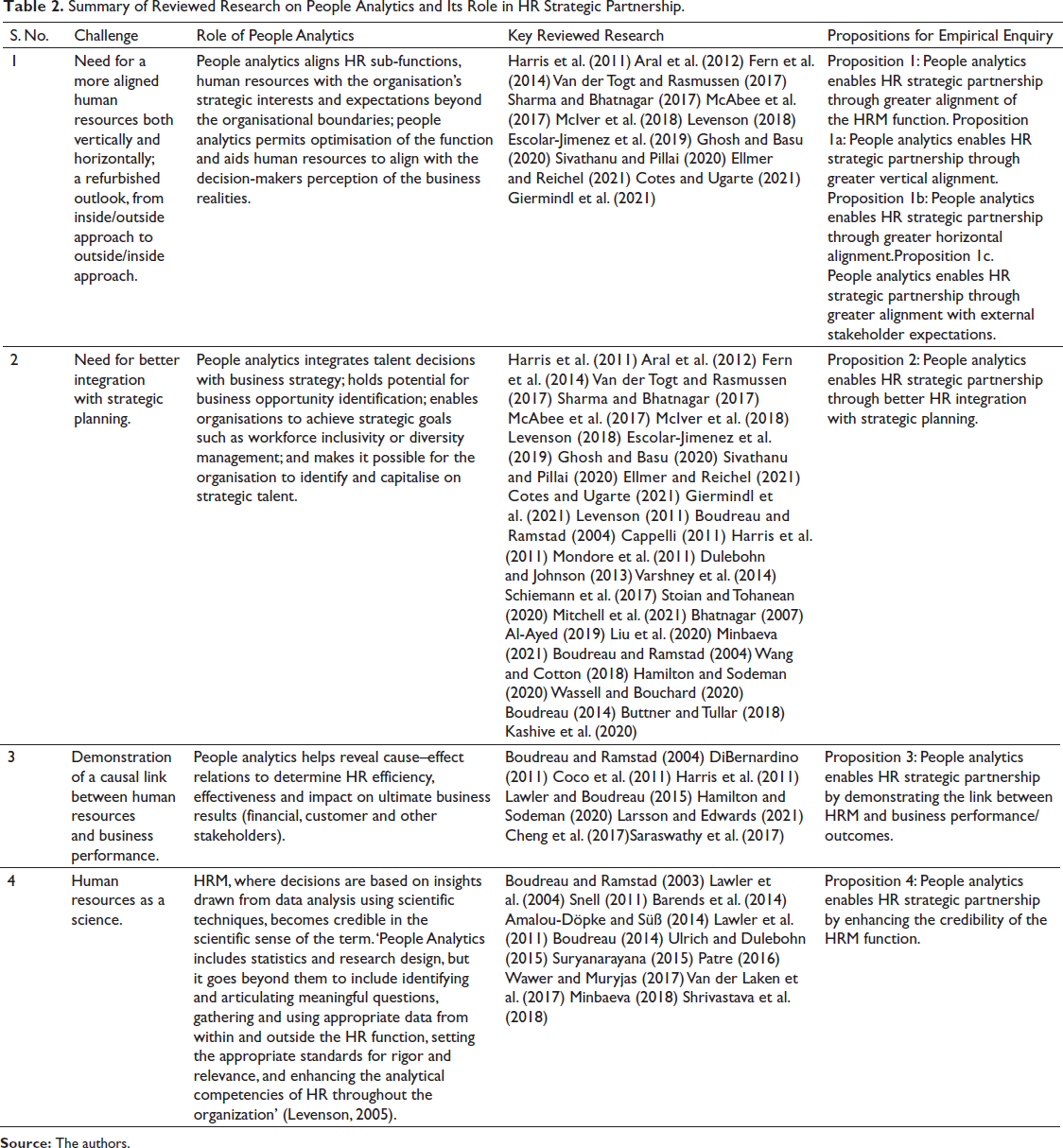
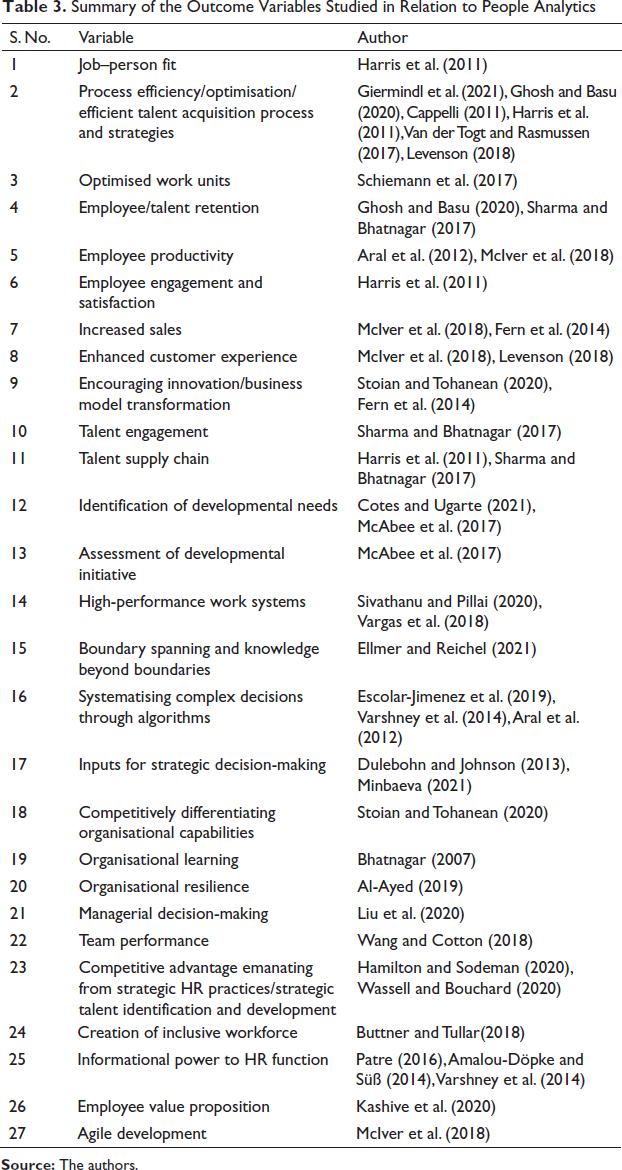
Table 2 summarises the research on why and how people analytics enables HR strategic partnership. Based on the review of the identified literature, the following themes have emerged that shed light on people analytics’ role in facilitating this partnership. First, the information generated through people analytics ensures horizontal, vertical and contextual alignment of the HR function. Second, the application of people analytics helps integrate HRM with the organisation’s strategic planning process by furnishing insight and foresight which is integral to the strategic planning process. It also aids in the identification and development of strategic talent pools. People analytics exhibits considerable promise in helping organisations accomplish their strategic goals of an inclusive workforce and a robust employer brand. Third, people analytics makes it possible to demonstrate causal links between HRM and critical organisational outcomes. This validates and reinforces management commitment to the function. Fourth, people analytics provides the field with scientific rigour and consistency, leading to enhanced credibility of the function. Table 3 summarises the outcome variables which have been either studied empirically or theorised in the literature with respect to people analytics.
Summary of Reviewed Research on People Analytics and Its Role in HR Strategic Partnership.
Summary of the Outcome Variables Studied in Relation to People Analytics
Recommendations for Future Research
The research reviewed above underscores the efficacy of people analytics. A significant observation of the authors is the need for future research in the area as it is replete with issues and opportunities. Some prominent ones are discussed below.
In a recent study by McCartney and Fu (2022), the authors report ‘missing’ evidence of people analytics’ impact. Given the dearth of empirical evidence ascertaining the efficacy of people analytics, it would be fruitful to operationalise constructs of HR alignment, HR integration, HR credibility and so on, and relate these to some measure of people analytics maturity in the organisations. Table 2 summarises certain propositions derived from the theory on the subject. These propositions, if empirically tested, could make immense contributions to research on the impact and efficacy of people analytics. There is ample case-based literature; however, the extent of generalizability of such studies needs further exploration.
Considerable research suggests that effective people analytics adoption is needed before it bears the desired fruit (Minbaeva, 2018). Identifying factors which mediate the relationship between people analytics adoption and its impact on critical organisational outcomes could be a rich area for further enquiry. Angrave et al. (2016) warn that unless and until HR analytics is embedded in more comprehensive analytical models, the likelihood of misinterpretation of information is high. This could result in substandard decisions at best and disastrous decisions at worst.
Tursunbayeva et al. (2021), in a review, express the need to address ethical issues in the field of people analytics. They recommend research on the following in the context of the use of people analytics: ‘transparency, diverse stakeholder inclusion, respecting privacy rights, fair and proportionate use of data, fostering a systemic culture of ethical practice, delivering benefits for employees including ethical outcomes in business models, ensuring legal compliance and using ethical charters’. Some of these issues emerge from the use of people analytics, while others could be addressed with the help of people analytics. This need for research concerning ethical issues in the application of people analytics is endorsed by McCartney and Fu (2022) and Qamar and Samad (2021).
Andersen (2017) discusses that HR analytics is still at a very nascent stage of development for it to be a true value generator. To truly add value, effort needs to be exerted along the following aspects: HR analytics maturity; analytics mindset; organisation conducive to analytics; and analytics competencies. Minbaeva (2021) found that human resources lag in terms of the adoption of HR analytics technologies. The author highlighted the following challenges on human resources’ part: data quality and integration, analytical competencies among HR professionals, and change management competencies to implement change initiatives based on the result and outcomes of people analytics. Thus, an investigation into people analytics maturity assessment and charting out paths for progression could be of immense value.
Limitations of the Study
Although an attempt was made to include the most relevant work on the subject, the studies were majorly sampled from Scopus with a few exceptions. Articles sampled for the research were academic peer-reviewed work. Given the nature of the subject, industry reports and articles could be a rich source of information and insight. There are disproportionately more case-based and conceptual studies on the subject. The inferences drawn and conclusions reached require empirical enquiry.
Conclusion
For a considerable period, human resources as a field has grappled with the gap between its existing capability and its potential to become a strategic partner. A significant amount of theoretical and limited empirical research prescribes the critical role of people analytics in helping human resources realise this potential. This article reviews literature over the last two decades on people analytics to address the research question relating to the ability of people analytics to enable the HR function to become a strategic partner. It can be inferred that analytics furnishes information, insight and foresight; renders logic and structure; and provides algorithms which incorporate immense complexities and augment human decision-making capacities. Four key themes emerged from the research literature on the subject, and these have been offered as propositions for further empirical enquiry. First, people analytics helps in aligning the sub-functions of human resources, human resources with the strategic interests and inclinations of the organisations, and human resources with the stakeholder expectations beyond the organisational boundaries. Second, people analytics integrates human resources with the strategic planning in the organisation by impacting strategic decision-making and business opportunity identification, making talent decisions integral to strategic planning, achieving organisational ends of the inclusive workforce, building an employer brand, and identifying and developing strategic talent pools. Third, people analytics helps demonstrate causal links between HRM and business performance. Fourth, people analytics helps human resources attain acceptability and credibility as a field by bringing in rigour, logic, consistency and systematisation.
South Asian nations are largely developing economies with considerable resource constraints. The research reviewed above suggests that people analytics enables a much more effective HR deployment and utilisation. An important implication for organisations operating in South Asian economies is to invest in organisational, technological, environmental and human factors which would help in the adoption of people analytics (Shet et al., 2021). South Asian nations such as India with rich HR data will benefit immensely from the use of people analytics. Increased transparency and accountability afforded by people analytics would result in better and more equitable employee–-employer relations. At a more macro level, people analytics can be employed to justify and encourage investments in human resources. The implication for the organisation heads and department heads is to commit resources and create a data-driven culture. HR managers and experts need to collaborate with the academic fraternity to develop HR models and frameworks or even deploy existing models for a more strategically aligned and integrated HRM. For HR professionals, a key implication is an investment in analytics competency development; research indicates that analytical skill and knowledge are the bedrock for the adoption of people analytics in organisations (Mitchell et al., 2021; Shet et al., 2021; Zeidan & Itani, 2020).
