




Abstract
Research has long recognised that employee withdrawal cognition is a critical issue for organisations due to the direct and indirect costs associated with that. Drawing upon social support theory, we examine the influence of three distinct types of support expatriates can receive, that is, organisation, co-workers and partner, on an expatriate’s turnover intention. Furthermore, we investigate if the effects of support types differ depending on the expatriate’s employment status. This study is based upon positivism research philosophy, and the research approach is deductive. Moreover, we used the survey method as the research strategy and used hierarchical linear regression to analyse the data. Results of a time-lagged (two-wave) study of 167 expatriates show that perceived organisational support (POS), co-worker support and partner support are negatively related to expatriates’ turnover intention. Moreover, results show that expatriates’ employment status interacts with POS and co-worker support in predicting turnover intention, implying that social support is more pronounced with expatriates with fewer resources. Thus, the present study enhances our understanding of the effects of different support types on expatriates’ turnover intention and elucidates the role of individual-level boundary conditions. The results of this study emphasize that social support is a stronger predictor of expatriate turnover intent, in particular, individuals with fewer resources. We suggest that managers of the companies should make a serious effort in creating a supportive culture and positive employee relationships.
Keywords
Introduction
Over the last five decades, a great deal of research has been emphasised that employee withdrawal from the organisation is a critical issue for organisations, given the costs of recruitment, selection, training of new hires, reduced performance (e.g., Huffman et al., 2014; Kacmar et al., 2006), loss of human capital (e.g., Huselid & Becker, 2011), loss of expertise and overworked for the remaining employees (Lambert & Hogan, 2009). Indeed, some employees still remain on the assignment but have a high intention to leave the organisation (psychological withdrawal), which is also a serious concern for organisations due to the indirect cost of reducing productivity, market share and deterioration of customer–supplier relationships (Black et al., 1992; Shaffer & Harrison, 1998). Prior research on employee withdrawal cognition is primarily based on domestic context (Bhaskar-Shrinivas et al., 2005), and much less is known about expatriates’ turnover intention. According to a recent study by Velocity Global (2019), the cost of hiring an expatriate is two to three times higher than hiring a local employee. Moreover, in his study, Jawad (2020) emphasised that managing international assignments are costly and challenging for organisations. Thus, the withdrawal of an expatriate from an international assignment is more costly and challenging than the withdrawal of a domestic employee from an organisation.
A growing body of research on employee turnover has explored a wide array of variables that influence turnover intent and actual turnover. For instance, research has found that job attitudes (e.g., job satisfaction & commitment) (e.g., Hitotsuyangi-Hansel et al., 2016; Mossholder et al., 2005), organisational identification and value congruence (e.g., Bozeman & Perrewe, 2001) and work–family conflict (e.g., Burke, 1988) as antecedents of employee turnover intention. Researchers (e.g., Fazio et al., 2017; Fong et al., 2018; Lambert et al., 2017; Yan et al., 2021) have also examined the role of social support in alleviating employee turnover intent. Social support is a multifaceted concept where employees can receive support from different sources, for example, organisation, supervisors, colleagues and family.
Unlike domestically relocated employees, expatriates face a number of challenges abroad due to cultural novelty, loneliness, language incompatibility, value differences and missing the network ties in the home country (Farh et al., 2010). Further, prior research has emphasised the importance of social support to alleviate distress and better adjustment to the host country, in particular, under awful circumstances (e.g., Farh et al., 2010; Lazarova et al., 2015; van der Laken et al., 2019). Thus, social support is increasingly important for expatriates than domestic employees. However, regardless of the importance of social support to alleviate distress and maladjustment, these studies have not explained well which types of social support are important to reduce expatriate turnover intention. A clear implication of expatriate literature is that expatriates’ mental health has a strong effect on withdrawal cognition (Bhaskar-Shrinivas et al., 2005). Individuals who receive psychological and material support from their partners, friends and work colleagues show a better health condition than those with less supportive resources (Cohen & Wills, 1985; for more review, see Broadhead et al., 1983). Moreover, prior researchers such as Takeuchi et al. (2005) and Lauring and Selmer (2010) emphasised the important role played by the spouse/partner in expatriate success. In particular, we expect that support from work-related sources (organisation and co-workers) and support from non-work sources (partner) is important for expatriates’ success. However, prior research on social support extensively investigated the influence of organisational support, that is, perceived organisational support (POS), on employee success; as such, researchers have yet to consider the effects of support from work-related and non-work-related sources on expatriates’ success. Moreover, social support theory explains that social support is more pronounced with individuals who are seeking support (Cohen & Wills, 1985). Thus, social support might not be equally important for all expatriates. For example, expatriates with fewer resources need more support than other expatriates. However, the existing empirical evidence has not explained well who needs more support. Thus, this study attempted to answer the question of which types of social support are more important to alleviate the turnover intention of expatriates and how these relationships vary with expatriate employment status.
The present study was designed to contribute to the literature in the following ways. First, this study provides a contribution to the literature on social support and expatriation by providing empirical evidence on the types of support (support from three different sources, organisation, co-workers and partner) expatriates need, which helps better understand what contributes to retaining the expatriates within the organisation. Second, this study also makes a contribution to the literature by illuminating expatriate employment status as an individual-level moderator between social support and turnover intent. Moreover, the findings of this study provide implications for the practitioners of human resource management in particular organisations which employ expatriates to reduce expatriate turnover intent.
Literature Review and Hypotheses Development
Literature Review
International relocation disturbs expatriates’ well-established social network and support resources in the home country, which in turn results in distress, social isolation and loneliness (Copeland & Norrell, 2002; van der Laken et al., 2019). Scholars have long argued that social support received from different domains helps individuals to overcome psychological strain and better adjust to the international assignment (Canhilal et al., 2020; Kossek et al., 2011). Although there is no universally accepted definition of social support (Lin et al., 2015), a most common theorisation of social support came from House (1981), which explains individuals primarily receive emotional support, instrumental support, informational support, affirmation of the self and appraisal of the situation.
In seeking to little agreement on the meaning of social support (Cohen, 1992; Cohen & Syme, 1985; Turner & Brown, 2010), researchers have concluded that social support is a multifaceted concept that involves perceived, structural (network relationships) and received support.
Expatriate research on social support mainly discussed sources of support that expatriates received and functions of support. Scholars have shown co-workers, organisations, host country nations, families and other expatriates as the main sources of expatriate support (Canhilal et al., 2020). However, except for a few studies (e.g., Kraimer et al., 2001; Malek et al., 2015), most of the prior studies focused on support received from a single source, that is, organisation or supervisors. The main conceptualisation of functions of social support came from the prominent study by House (1981). Functions of social support refer to an individual’s inner sense of social support (Canhilal et al., 2020). In particular, expatriates may feel supported when they are less uncertain about the international assignment, host country culture and the people in the host country. House (1981) distinguished between four main functions of social support, that is, informational support, instrumental support, emotional support and appraisal support. Later, Cohen and Wills (1985) classified social support into four elements: informational support, instrumental support, esteem support and social companionship. However, the most cited support functions in the expatriate literature are emotional support, informational support and instrumental support (e.g., Caligiuri & Lazarova, 2002; Farh et al., 2010). Expatriate’s emotional support (esteem support) refers to resources that help individuals overcome negative feelings and experiences (Caligiuri & Lazarova, 2002). Expatriates receive emotional support mainly from their family, friends and colleagues at the workplace. Informational support helps reduce uncertainty arising due to a lack of knowledge about living and working in a new culture (Farh et al., 2010). The organisation generally provides this kind of information during the initial socialisation process and mentoring programmes (Canhilal et al., 2020; Mezias & Scandura, 2005). The third dimension of support refers to instrumental support, which is about providing necessary resources (e.g., financial aids and material resources) (Caligiuri & Lazarova, 2002) or modification of the environment to help in the completion of tasks (House, 1981). Expatriates received instrumental support from the organisation, supervisors and peers (Chiaburu & Harrison, 2008). Although theoretically, expatriates received different types of support during their expatriation, in reality, most of the expatriates received financial inducements such as housing allowances, support for children’s education and tax benefits (Canhilal et al., 2020).
Social support theory (Cohen & Syme, 1985; House, 1981; Lin et al., 1985) has shown that social support has a direct beneficial effect on mental health and well-being (direct effect) (e.g., Antonucci & Akiyama, 1987; Cohen & Syme, 1985; Sarason et al., 1990, pp. 127–139) and buffering effect (Cohen & Wills, 1985), that is, support from others helps individuals to assess a stressful life event as less stressful and to safeguard from the negative consequences of a stressor (Helgeson, 2003). However, in this study, we focused only on the direct effect of social support.
Researchers have investigated the effect of social support on employee turnover, but most of these studies are based on domestic employee samples. For instance, Fazio et al. (2017) found a positive and significant effect of POS and perceived supervisor support on turnover intention. A recent meta-analysis by van der Laken et al. (2019) reported a negative effect of expatriate social support on turnover and withdrawal.
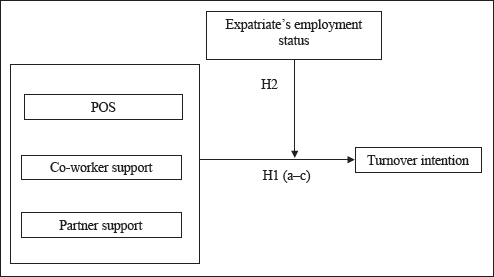
In this study, we focus on expatriates’ turnover intention as a consequence of social support. In particular, we focus on support from three main sources, that is, organisation, co-workers and the partner. Based upon social support theory (Cohen, 1992; House, 1981), we propose that social support (POS, co-worker support and partner support) helps to effectively deal with stressful situations, which in turn, lessens turnover intention. As social support is argued to be need-specific (Cohen & Wills, 1985), we propose that social support is particularly pronounced with low-status expatriates irrespective of high-status expatriates, as low-status expatriates possess relatively fewer resources. The theoretical model of the study is displayed in Figure 1. We explain the relevant variables and develop our hypotheses in more detail in the following section.
Hypotheses Development
POS and Turnover Intention
Drawing from social support theory (Cohen & Wills, 1985; House, 1981), we anticipate that POS negatively affects expatriates’ turnover intention. POS refers to ‘concerning the extent to which the organisation values their contributions and cares about their well-being’ (Eisenberger et al., 1986, p. 501). POS helps to reduce negative feelings and stressors at the workplace as available support resources at the workplace aid in successfully dealing with the demands at work (Rhoades & Eisenberger, 2002). Prior expatriate research has demonstrated that organisations provide different resources (e.g., informational and instrumental), which reduce expatriates’ feelings of psychological distress and uncertainty at work, which will eventually help expatriates to meet the demands of a new workplace (Farh et al., 2010; Shaffer et al., 2006; Wu & Ang, 2011). According to the reciprocity norm of social exchange theory (Blau, 1964), if employees receive resources from another party, that is, an organisation, employees feel obligated to return the favour. Likewise, when expatriates receive favourable job conditions and rewards, adhere to a norm of reciprocity (Eisenberger et al., 2001), they may be paying back an obligation through staying on assignment (Maertz & Griffeth, 2004; Robinson et al., 1994).
Related empirical evidence supports our theoretical argument that POS is negatively related to turnover intention. For instance, Guzzo et al. (1994) have found that POS has a negative effect on the intention to quit through organisational commitment. Moreover, Wayne et al. (1997) found a negative relationship between POS and intention to quit. Thus, we hypothesise the following:
H1a: POS is negatively related to expatriates’ turnover intention.
Co-worker Support and Turnover Intention
Co-worker support can be defined as the care and consideration that individuals receive from others in an organisation (Mossholder et al., 2005). Social support theory shows that employees who obtain more support resources experience less stress (Cohen & Wills, 1985; House, 1981) and reduce potential withdrawal cognition (Price & Mueller, 1986). Expatriates who are well connected to counterparts tend to obtain more support (e.g., informational support and emotional support) than less well-connected expatriates (Johnson et al., 2003). Thus, expatriates who obtain support from co-workers may feel less stress as they can easily navigate the work and non-work settings in the host country. On the other hand, Mossholder et al. (2005) suggested that care and consideration cause an emotional bond between the individual and sources of support, which in turn increases the individual’s attachment to support sources. Thus, we further assume that expatriates who receive support from co-workers create an emotional bond between expatriate and their respective co-workers. In other words, when employees receive co-workers’ support, they increase their direct attachment to respective co-workers, which is typically indicated as indirect attachment to the organisation (Maertz & Griffeth, 2004; Mossholder et al., 2005). Thus, we expect expatriates to stay longer on the assignment, as bonds between relational parties are relatively durable.
In support, prior research (e.g., Iverson, 1999; Mitchell et al., 2001; Mossholder et al., 2005) suggested that co-worker support reduces employee turnover. Given these expected rational effects, we hypothesise the following:
H1b: Co-worker support is negatively related to expatriates’ turnover intention.
Partner Support and Turnover Intention
We explained above how support from work-related sources influences an expatriate’s turnover intention. However, turnover research has emphasised that factors outside the organisation (e.g., family variables) influence withdrawal cognition (e.g., Maertz & Griffeth, 2004; Shaffer & Harrison, 1998). This is plausible because crossover and spillover theories (Westman, 2001) show that borders between work and non-work are permeable and transform from one domain to another (e.g., work to non-work). Indeed, research has demonstrated that partner support help to overcome the negative feelings and experiences experienced by expatriates at the workplace (Kraimer et al., 2001; Lauring & Selmer, 2010; Takeuchi et al., 2005). Applying the social support theory (Cohen, 1992; House, 1981) and related expatriate studies (e.g., Lauring & Selmer, 2010; Takeuchi et al., 2005), we anticipate that partner support lessens the expatriate’s turnover intention.
We expect that expatriates’ partners provide emotional, instrumental and informational support, which may help reduce workplace strain. For example, expatriates’ partners may listen to expatriates’ unpleasant work experiences and may provide support to deal with logistic issues in the host country, which may be freeing expatriates’ time to focus on work. In support, in their study, Mäkelä et al. (2011) have found that partners often provide emotional support by discussing their career plans and sharing concerns about everyday workplace issues and problems. As another example, Takeuchi et al. (2005) found that an expatriate’s partner provides logistics and physical support at home. This would result in reducing strain at the workplace. Based on these arguments, we propose the following:
H1c: Partner support is negatively related to expatriates’ turnover intention.
Moderation Effect of Expatriate’s Employment Status
Finally, we anticipate that expatriate employment status moderates the association between social support and turnover intention. One of the fundamental assumptions of social support theory (Cohen, 1992; Cohen & Wills, 1985; House, 1981) is that social support is more pronounced with people who are in need of support. In other words, social support is important to protect the persons from a stressful life event and relatively less important for unexposed individuals (Cohen et al., 1985). Moreover, extant research has shown a negative/weak association between received/perceived support and well-being when people receive support than they expected (Melrose et al., 2015). In particular, expatriates need support when they feel a loss of resources and network connections in the home country, isolation and loneliness. However, high-status managerial employees have self-esteem (Hitotsuyangi-Hansel et al., 2016), power to control over valued resources (Magee & Galinsky, 2008), high job security, extended social networks (e.g., Brass, 1984; Trank et al., 2002) and psychological empowerment (Koberg et al., 1999). Thus, we assume that top managerial expatriates can effectively deal with demands in the host country and feel less distress. In contrast, low managerial employees have fewer resources and power, thus feeling helpless and unable to cope with demands in the host country. Therefore, we hypothesise the following:
H2: Expatriate’s employment status moderates the negative relationship between social support, that is, (2a) POS, (2b) co-worker support and (2c) partner support and turnover intention, such that this relationship is more robust when the expatriate’s employment status is low than when it is high.
Method
Sample and Procedure
To test hypotheses, we collected survey data from Sri Lankan expatriates who are working and living in three South Asian Countries; Bangladesh, India and the Maldives. The survey was designed in English and then translated to Sinhala (the main official language of Sri Lanka) with the support of a professional translator to ensure translation equivalence; the back-translation method was used (Brislin et al., 1973). Thus, surveys were available in both English and Sinhala.
To identify the Sri Lankans who work and live in the selected countries, we searched LinkedIn and social media profiles. Initially, we were able to identify 743 participants. Thus, we sent out 743 survey invitations along with the cover letter, which explains the purpose of the study and the confidentiality of the data. We designed the survey as a time-lagged (data were collected at two points in time) study to reduce the common method bias (CMB). At T1, we received 297 usable responses, which is equal to a 40% response rate. After two months’ time-lag (approximately), we launched the follow-up survey (T2 survey) and contacted T1 survey participants. At T2, we received 176 responses. However, we matched 167 surveys using the identification code, yielding a retention rate of 56.22%.
All participants of the study were married or in a permanent relationship. Among the participants, 51.5% (N = 86) were working in the Maldives, 25.75% (N = 43) were working in Bangladesh and 22.75% (N = 38) were working in India. The average length in the host country was 36.9 months; 98.3% were male. Of all respondents, 9% completed postgraduate qualifications, 44% completed a bachelor’s degree, 20% completed professional qualifications, 26% had a lower vocational background and 57% of expatriates worked in middle-/high-level managerial positions.
Measures
Perceived organisational support (measured at T1). POS was measured using a six-item scale developed by Eisenberger et al. (2001), including items such as ‘the organisation takes pride in my accomplishments at work’ and ‘the organisation is willing to help me if I need a special favour’. Participants responded on a six-point Likert scale ranging from 1 (strongly disagree) to 6 (strongly agree). The six items were averaged to form a composite (α = 0.910).
Co-worker support (measured at T1). To measure co-worker support, we adopted seven items (highest factor loading items) from the scale developed and validated by Wang (2001). An example item is ‘your colleagues/co-workers give you information and help you to understand a situation’. The anchor points of the scale used to measure co-worker support ranged from 1 (none) to 6 (quite a lot). Responses of the seven items were averaged to form a composite (α = 0.912).
Partner support (measured at T1). To measure partner support, we adapted the scale developed by Vinokur and Van Ryn (1993). A sample item is ‘your partner/spouse provide you with encouragement’. These items were scored from 1 (none) to 6 (quite a lot). Responses to the six items (one item deleted due to low factor loading) were averaged to form a composite (α = 0.830).
Turnover intention (measured at T2). In line with George and Jones (1996), we measure turnover intention using the three items from Cammann et al. (1979). A sample item is ‘I often think about quitting’. A six-point Likert scale ranging from 1 (strongly disagree) to 6 (strongly agree) was applied. The three items were averaged to form a composite (α = 0.906).
Expatriates’ employment status (measured at T1). We assessed the expatriate’s employment status in four categories, that is, non-management position, lower management position, middle management position and top management position. For subsequent analyses, we dummy coded the expatriate employment status (1 = none/low management, 2 = middle/top management).
Control variables. Prior research suggests that withdrawal cognition (e.g., turnover) is related to job satisfaction (Kraimer et al., 2011). Therefore, we controlled for job satisfaction. Job satisfaction was measured using a three-item scale developed by Cammann et al. (1979). A sample item is ‘all in all; I am satisfied with my job’. In addition, in line with prior research, we also controlled for several demographics including age (1 = ‘<20 years’, 2 = ‘20–29 years’, 3 = ‘30–39 years’, 4 = ‘40–49 years’, 5 = ‘50–59 years’, 6 = ‘60 years or above) and education (1 = vocational training, 2 = professional qualification [e.g., chartered accountants], 3 = bachelor degree, 4 = postgraduate degree) (Griffeth et al., 2000; Kraimer et al., 2011). Moreover, in line with Cao et al. (2014), we controlled for length in the host country. Due to the multi-categorical nature of variables of age and education, we created dummy variables to test the main model. All the control variables except for job satisfaction (measured at T2) were measured at T1. A detailed instrument is available in the Appendix.
Analysis and Results
Statistical Analysis
We first conducted a confirmatory factor analysis (CFA) to demonstrate the discriminant validity of our measures. Based on modification indices, we had to drop one item from partner support (your spouse/partner provides useful information about local customs) due to a low factor loading (<0.40). Moreover, we had to covariate one error in terms of co-worker support. We then assessed the overall model fit using the comparative fit index (CFI), Tucker–Lewis index (TLI), root mean square error of approximation (RMSEA) and standardised root means square residual (SRMR). According to Brown and Moore (2012), Finney and DiStefano (2013) and Hu and Bentler (1999), a model has a reasonably good fit if (a) RMSEA values are ≤0.06 and (b) CFI and TLI values are ≥0.95 and SRMR values are ≤0.08. After doing these modifications, the complete four-factor model fits the data well and better than any lower factor models (see Table 1), providing evidence for the distinctiveness of our constructs.
Results of CFA Analysis.a
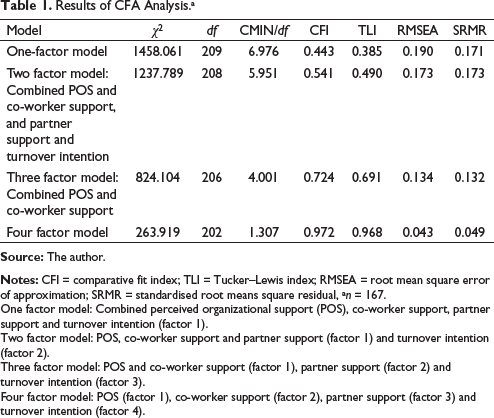
One factor model: Combined perceived organizational support (POS), co-worker support, partner support and turnover intention (factor 1).
Two factor model: POS, co-worker support and partner support (factor 1) and turnover intention (factor 2).
Three factor model: POS and co-worker support (factor 1), partner support (factor 2) and turnover intention (factor 3).
Four factor model: POS (factor 1), co-worker support (factor 2), partner support (factor 3) and turnover intention (factor 4).
Moreover, composite reliabilities were greater than 0.70 for all constructs, suggesting convergent validity based on the threshold of Hair et al. (2010). Further, the average variance extracted (AVE) is greater than 0.5 for all constructs (Fornell & Larcker, 1981), confirming the discriminant validity. In order to attenuate the risk of multicollinearity, we standardised all predicting variables before analyses.
To reduce CMB, in line with Podsakoff et al. (2003), we separately measured independent variables (T1) and the dependent variable (T2). In addition, we ran a second CFA specifying four theoretical constructs and an unmeasured (common) latent factor (CLF) (Podsakoff et al., 2003). We are allowed to estimate all the scales on CLF freely, however, not every item on every scale, as the model produces unidentifiable solutions (Spector & Brannick, 2009). The model converged with the following fit indices (χ2 (181) = 222.019; CMIN/df = 1.227; CFI = 0.982; TLI = 0.977; RMSEA = 0.037; SRMS = 0.0397). Although two of the items had a significant loading on CLF, all the items loaded significantly on respective theoretical factors. Moreover, the standardised factor loadings on theoretical factors were at least twice the magnitude of the loadings on CLF. Further, we performed Harman’s single factor test (Podsakoff et al., 2003), which indicated the first factor accounted only for 34.27% of the variance, well below the threshold of 50%. Mean, standard deviation and inter-item correlations are depicted in Table 2.
Descriptive Statistics, Reliability Coefficients and Correlations.a
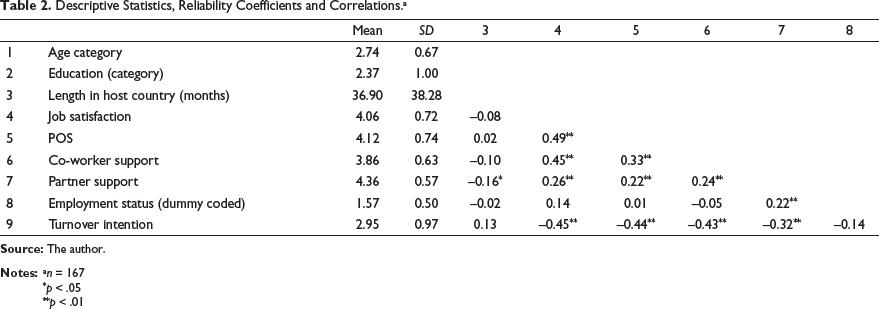
*p < .05
**p < .01
Hypotheses Testing
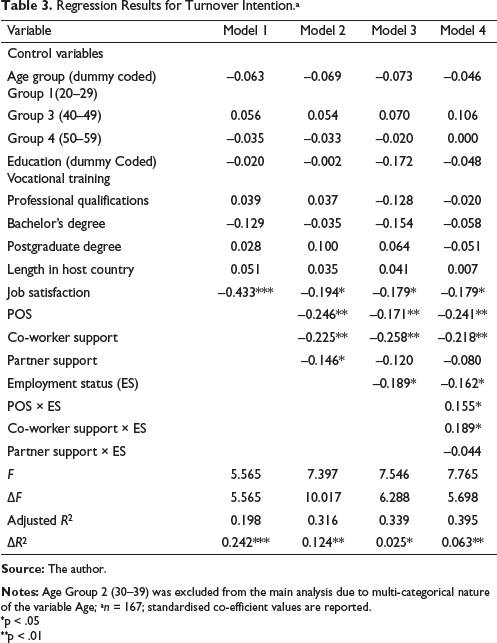
To test the hypotheses, we used hierarchical linear regression. H1a–1c predicted that social support has a significant impact on turnover intention. The results provide support for H1a (β = –0.246, p = .002), implying that POS significantly and negatively related to expatriate’s turnover intention. Supporting our H1b, the results show that co-worker support is significantly and negatively related to turnover intention (β = –0.225, p = .003). Results provide support for H1c (β = –0.146, p = .037) and corroborate our presumption that there is a negative impact of partner support on expatriate turnover intent.
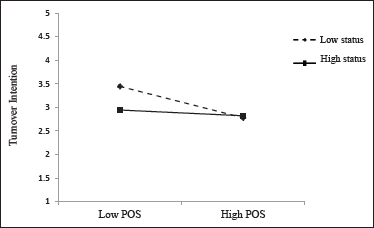
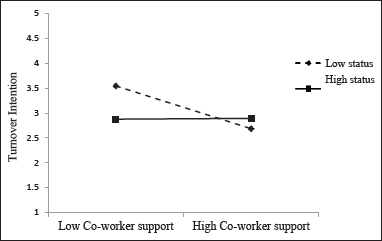
H2a–2c predicted moderating effect of expatriate employment status on the relationship between social support and turnover intention. Providing support for H2a, the interaction terms of POS and expatriate’s employment status on turnover intention was significant (β = 0.155, p = .036). As we expected, expatriate’s employment status significantly moderates the relationship of co-worker support and repatriation intention (β = 0.189, p = .019). Thus, H2b was supported. Finally, H2c was not supported. The moderation effect of expatriates’ employment status on the relationship of partner support and turnover intention (β = –0.044, p = .541) failed to reach significance. Using the procedure proposed by Aiken and West (1991), we illustrated the interaction plots in Figures 2 and 3. The regression results are shown in Table 3.
Regression Results for Turnover Intention.a
*p < .05
**p < .01
To further understand the nature of the interaction effects, we ran simple slope testing using PROCESS for SPSS version 4 (Preacher & Hayes, 2004). Results indicated that effect of POS on turnover intention was significant only for low status expatriates (–1 SD below the mean) (β = –0.7806, SE = 0.1293, t = –6.0355, p = .0000; 95% CI [–1.0361 to –0.5251]), while the effect was insignificant for high status expatriates (+1 SD above the mean) (β = –0.0528, SE = 0.1304, t = –0.4044, p = .6865; 95% CI [–0.3105 to 0.2049]). Thus, H2a is further supported. A similar PROCESS analysis was used to test the moderating effect of expatriate’s employment status on co-worker support and turnover intention. Providing further support to the results above (H2b), results showed that the effect of co-worker support on turnover intention was significant only for low status expatriates (–1 SD below the mean) (β = –0.8557, SE = 0.1442, t = –5.9331, p = .0000; 95% CI [–1.1406 to –0.5708]), but not for high managerial status expatriates (+1 SD above the mean) (β = –0.0536, SE = 0.1515, t = –0.3541, p = .7238; 95% CI [–0.3529 to 0.2457]).
Supplemental Analysis
To further corroborate the results of the moderation analysis, we performed a multi-group analysis. Accordingly, the results of the multi-group analysis showed the group differences at the model level (Δx2 = 26.195, Δdf = 7). As the results showed the significant group difference among high- and low-status expatriates, we checked the path differences. Accordingly, only co-worker support showed a significant path difference among the two groups.
Discussion
Most of the extant research on employee turnover focused on domestic samples, and less attention was received to expatriates’ turnover. Thus, drawing upon social support theory (Cohen, 1992; House, 1981), this study examined the impact of social support on expatriates’ turnover intention and the boundary conditions of social support, which focuses on who needs social support. As hypothesised, the findings of this study revealed that social support that expatriates received from three different sources, that is, POS, co-workers and partner, was negatively related to expatriates’ turnover intention. Moreover, these findings are comparable with previous researchers (e.g., Guzzo et al., 1994; Lambert et al., 2017; Lobburi, 2011; Mossholder et al., 2005; Wayne et al., 1997) who reported a negative association between social support and employee turnover. Overall, these results highlighted the importance of social connectedness in reducing expatriates’ turnover intent.
The results of moderation analysis have shown that social support is more need specific. Supporting our hypotheses, the results showed that expatriates’ employment status moderates the association between social support (POS & co-worker support) and turnover intention. Prior research emphasised (e.g., Hitotsuyangi-Hansel et al., 2016; Magee & Galinsky, 2008) that high-status employees are rich with resources and power compared to low-status employees. Thus, in line with our findings, we emphasised that support from the organisation and co-workers less influences high-status expatriates’ decision to leave the organisation. However, the influence of partner support on expatriates’ turnover intention does not diverge from the expatriate’s employment status. This is because, irrespective of employment status, all expatriates seek support from their partners. The study contributes to theory and practice.
Theoretical Implications
Our results make several theoretical contributions. First, we contribute to a deeper understanding of expatriates’ turnover intention by considering support from work (POS and co-workers) and non-work (partner) sources. This is a novel finding insofar as most of the prior turnover research has mainly focused on work attitudes and cross-cultural adjustment (AlMazrouei & Zacca, 2021; Bhaskar-Shrinivas et al., 2005; Harrison et al., 2004) as antecedents of expatriate’s withdrawal cognition, compared to social support. Thus, based on social support theory (Cohen & Wills, 1985; House, 1981), our study shows that support from both work and non-work sources is important to retain the expatriates on the assignment. These results lend support to the findings of Rhoades et al. (2001), Guzzo et al. (1994), Tews et al. (2013) and Wayne et al. (1997), which showed the negative effect of POS and co-worker support on turnover intention. Moreover, extending the findings of Takeuchi et al. (2005) and spillover theory (Westman, 2001), our results show that partner support is significantly related to expatriates’ turnover intention. Second, this study offers a vital contribution to social support theory (Cohen & Wills, 1985; House, 1981) by exploring the boundary conditions. Although social support theory explains that social support is need-driven, there is a lack of empirical evidence to support this theoretical explanation. By examining the expatriate’s employment status as an important moderator, this study helps to expand the current understanding of social support. We hypothesised that social support is more important for low-status expatriates than high-status expatriates as they own fewer resources compared to high-status expatriates. In line with our hypotheses, the results of this study showed that low-status expatriates have less intention to leave the organisation when the organisation and co-workers are available to support them. This suggests that POS and co-worker support are more pronounced with low-status expatriates, as they have relatively fewer resources than high-status expatriates. Overall, these findings enhance social support research by highlighting the importance of considering the individual-level variables when providing social support.
Third, the findings of this study enhance research on turnover intent by exploring expatriates’ turnover intention as an important outcome of social support, in particular, in the expatriate’s context. Prior research on withdrawal cognition mostly depends on domestic context (Bhaskar-Shrinivas et al., 2005), and we provide new insights into how social support relates to expatriates’ turnover intention. Unlike the local employees, expatriates face immense challenges due to unfamiliar culture and work and non-work settings in the host country (Farh et al., 2010). Thus, they are more inclined to psychologically withdraw from the assignment (Caligiuri, 1997; Shaffer & Harrison, 1998). Thus, our results provide evidence to claim that social support help to reduce expatriates’ turnover intention.
Practical Implications
This study also provides some implications for managers in organisations. First, our findings clearly indicate that support from work and non-work sources lessen expatriates’ turnover intention. Thus, organisations should make a serious effort to provide support to expatriates. This may include ongoing career counselling and psychological counselling (Kraimer et al., 2001) and recognising their contribution, as they will reciprocate with attitudes and behaviours favourable to the organisation (Takeuchi et al., 2009). In addition, organisations should provide information regarding living and working in the host country. As our results suggested, social support is highly beneficial for low-status expatriates. Thus, organisations need to be sensitised towards the requirements of these expatriates. To this extent, human resource (HR) managers and international recruitment officers need to survey the needs of these expatriates prior to starting their international assignment. Similarly, organisations should provide pre-departure cross-cultural training and in-country training (Puck et al., 2008) to foster working and living in the host country as the sequence of training helps improve the expatriate’s awareness about the host country.
Second, it emphasises the importance of co-worker support to alleviate the expatriate turnover intent. Thus, we recommend that managers in the organisations should facilitate and encourage expatriates to network with peers, as network ties provide expatriates with informational and emotional support (Farh et al., 2010).
The boundaries between work and non-work are preamble and crossover from one partner to another in a close relationship (Westman, 2001). Our results suggested that partner support has a negative effect on expatriates’ turnover intention, which informs managers in organisations to consider partners as an important source of support for expatriate success. However, not all married expatriates have accompanied their families abroad due to reasons such as children’s educational needs, partner employment and cost savings (Crown World Mobility, 2015; McNulty, 2015). Thus, organisations should provide facilities to create virtual communication platforms which enable split families to interact with their families and share their emotions and information (Canhilal et al., 2020; Sessions, 2010).
Moreover, our results suggest that the association between social support and turnover intention is stronger for the expatriates who hold low employment status instead of high employment status. Thus, it suggests that organisations should develop policies and procedures that address the special needs of low-status expatriates.
Limitations and Avenues for Further Research
This study also has several limitations. Although we collected data over two time waves and measured different perspectives of support, we collected data only from expatriates. Instead of collecting data only from expatriates, we recommend that future researchers collect data from different sources, including co-workers and partners. Moreover, compatriots and other expatriates are the other two key stakeholders who can be a source of support for expatriates (Takeuchi, 2010). Therefore, future research needs to consider support from compatriots, expatriates and supervisors to understand which support resources are more important to lessen the expatriate’s withdrawal cognition.
Second, Farh et al. (2010) suggest that expatriates’ motivation to seek support (learning goal orientation & sociability) is more likely to influence the expatriate’s support relationships in the host country. Nevertheless, we have not integrated these variables into our theoretical model. Thus, we recommend that further researchers assess the expatriate’s sociability as a moderator.
Another limitation of our study is that our sample comprises mainly male Sri Lankan expatriates living and working in three South Asian countries. Insofar, limited scholars looked into psychological and behavioural issues of South Asian expatriates. Thus, this feature is a strength of this study. However, some observed effects might be different in other cultures and with female expatriates. Thus, we suggest that future researchers test the association between support and withdrawal cognition with a different sample to generalise our findings.
Conclusion
Based on the social support theory, this study focused on examining the effect of different support sources on expatriate turnover intention. Further, the study examined the moderating effect of expatriate employment status as support is more pronounced with the individuals in need. The results demonstrated that work-related and non-work-related support helps expatriates to remain in the organisation. However, this relationship varies across expatriates’ employment status. Thus, the findings of this study are theoretically and practically significant.
Appendix
Instrument
Perceived Organisational Support
The organisation takes pride in my accomplishments at work. The organisation really cares about my well-being. The organisation values my contributions to its well-being. The organisation strongly considers my goals and values. The organisation shows a great deal of concern for me. The organisation is willing to help me, if I need a special favour.
Co-worker Support
The following statements refer to the social support you have obtained from your co-workers during your overseas assignment.
How much do your colleagues/co-workers;
… listen to you when you need to talk. … give you good advice about a crisis. … give you information to help you understand a situation. … talk to about yourself or your problems. … advice you really want. … provide you suggestions about how to deal with a personal problem. …understand your problems.
Partner Support
The following statements refer to the social support you have obtained from your spouse/partner during your overseas assignment.
How much does your spouse/partner;
… provide you with encouragement. … provide useful information about local customs. … say things that raise your self-confidence. … listen to you when you need to talk. … show that he/she cares about you as a person. … provide you with direct help, that is, do or give you things you need. … (how much do you) talk with him/her when you are upset, nervous, or depressed about something.
Turnover Intention
I will actively look for a new job in the next year. I often think about quitting. I will probably look for a new job in the next year.
Job Satisfaction
All in all, I am satisfied with my job. In general, I like my job. In general, I like working here.
Footnotes
Declaration of Conflicting Interests
The author declared no potential conflicts of interest with respect to the research, authorship and/or publication of this article.
Funding
The author received no financial support for the research, authorship and/or publication of this article.
