




Abstract
This article aims to examine the experiences of human resource professionals (HRPs) in managing crises posed by the COVID-19 pandemic. Employing qualitative research methodology, in-depth interviews with 24 HRPs of different industries were carried out. The findings indicate how the HRPs have navigated through five phases of the crisis as (a) anticipatory; (b) crisis; (c) adjustment; (d) rebounding; (e) continuance or reverting to old ways, struggling with many decisions and actions. The periods that companies took to navigate these different stages and the success of how they faced the crises posed by the pandemic mainly depend on factors such as the level of preparedness, nature of the industry, availability of resources, and role of the HRPs. The learning from the experiences of the HRPs and the phases they have navigated through will help to successfully manage similar crises in the future.
Introduction
COVID-19 pandemic has undoubtedly changed the way of life for most, forcing countries, societies, companies and individuals to rethink how they live and work. While crisis is not new to any organisation, COVID-19 (Coronavirus) pandemic posed an unexpected challenge of unparalleled proportion, even for the most vigilant, responsive, adaptive and crisis-prepared organisations. With employees’ lives at risk and lockdowns imposed—sometimes overnight—organisations are grappling with the unknown and a multitude of decisions to be made. Organisations worldwide—and more specifically, those that were hit most hard by the pandemic—face threats to their vitality and survival. While some organisations struggle to exist by rethinking and re-strategising their operations and even business directions, few have lost the battle.
Human resource management (HRM) is particularly placed at the core of this mayhem, with the impact COVID-19 has on the employees and the need to ensure their health and safety as well as the need to manage employees in a new setting. There were many actions and decisions, random and strategic, that the HRPs had to make and enforce, such as ensuring employee safety and health, implementing new work arrangements, upholding employee morale and engagement, and handling retrenchments and layoffs.
Recent research extensively discusses how COVID-19 has changed the way of work, setting new norms (Meister, 2020). These studies talk about how companies have been forced to alter work structures by moving to work from home (WFH), new challenges WFH poses for the organisations and employees, how training is provided on WFH and employee wellbeing during COVID-19, and how HRPs are dealing with layoffs and terminations. There are also studies providing insights on handling HRM during this trying time. For example, Caligiuri et al. (2020) provide insights on how to solve pandemic-related challenges in international human resource management, specifically looking at selection, training and employee support, and health and safety. Similarly, Carnevale and Hatak (2020) discuss HRM challenges and opportunities in the era of COVID-19, highlighting the erosion of ‘fit’, disproportionate work–family effects, and disproportionate effects on alternative family structures. While these studies provide important insights into a mostly enigmatic crisis, they are mainly conceptual and theoretical. Detailed accounts of how HRPs have faced and acted during the pandemic in different industries, based on empirical evidence, are lacking.
Further, while COVID-19 pandemic has been studied extensively from a crises perspective, they are mainly focused on the public health system and policy (Salvador-Carulla et al., 2020), family businesses (Kraus et al., 2020) and small enterprises (Alves et al., 2020). Studies have also explored general crisis management strategies during the pandemic (Kraus et al., 2020; Rapaccini et al., 2020; Wenzel et al., 2020). However, we were unable to locate any studies that have attempted to understand how HRPs have managed the many crises posed by the pandemic, even though crisis management is an integral part of the job role of any HRP (e.g., Zagelmeyer & Gollan, 2012).
Knowledge of how HRPs handled crises during the initial stages of the COVID-19 pandemic would undoubtedly be useful to identify what specific actions of HRPs would be helpful and what would not, as well as how to be resilient in a crisis such as this. In essence, it will provide HRPs lessons for future crisis management, because how HRPs manage crisis can inevitably affect a company's operations, reputation, profitability and survival.
Within this backdrop, this article aims to explore in detail how and in what ways the HRPs handled and managed the COVID-19 crises in Sri Lanka, an upper-middle-income South Asian country in the Indian Ocean, during the first wave of the pandemic (initial stages of the pandemic—December 2019 to July 2020). This period was especially vital for companies due to the novel and unexpected nature of the pandemic as well as the unanticipated impact the pandemic had on the business operations. The immediate lockdown imposed in the country for 52 days from 17 March 2020, the travel restrictions and other government controls such as import curbs and health guidelines were extremely unusual for companies in Sri Lanka, forcing HRPs to look into the human aspects of a multitude of crises.
As such, in exploring how HRPs handled these multitudes of crises and navigated through different stages of a crisis, we will use crisis theory as our theoretical base. We will mainly look at the process of crisis management, highlighting the various actions and inactions of HRPs during each stage of the crisis management process and the resultant outcomes and impacts to companies in different industries studied, as well as various HRM issues and challenges the HRPs faced. This knowledge would be a definite learning experience (Bundy et al., 2017) for the HRPs in managing similar crises in the future. As Bundy et al. (2017), rightly assert, crisis serves as a learning source that brings new knowledge at the individual, group and organisational levels with a potential opportunity to grow.
COVID-19 in Sri Lanka
Sri Lanka has seen an array of crises over the years such as a 30-year-old civil war that ended in 2009, Tsunami in 2004 which resulted in about 10,000 deaths, floods, landslides, droughts, and a recent act of terrorism on Easter Sunday in 2019 killing 259. All these events have inevitably affected businesses—certain businesses and businesses in certain areas were affected more so than the others—at varying levels. Sri Lanka was not affected by previous pandemics such as SARS and Ebola to the extent some other countries were. Hence, COVID-19 is the first instance in recent history that the country was affected by a pandemic of this magnitude and shape.
The first COVID-19 patient in Sri Lanka was identified on 27 January 2020, and the second patient on 10 March. After identifying the second patient, the number of COVID-19 cases and suspected individuals rapidly increased, prompting the government to take serious steps to curtail the situation. The government initially imposed a lockdown on 17 March 2020, for two days in the form of a public holiday and then having given a day’s break, again, imposed a lockdown-style curfew from 20 March 2020, which continued until 11 May 2020. While certain districts of the country were locked down for the whole duration of the curfew period, certain other districts had an intermittent curfew with banns of travel between districts. The imposing of the curfew, compulsory quarantine, international airport shutdown, social distancing and other health measures compelled most businesses to stop operations.
Crisis Management
Summary of Crisis Management Models and Frameworks.
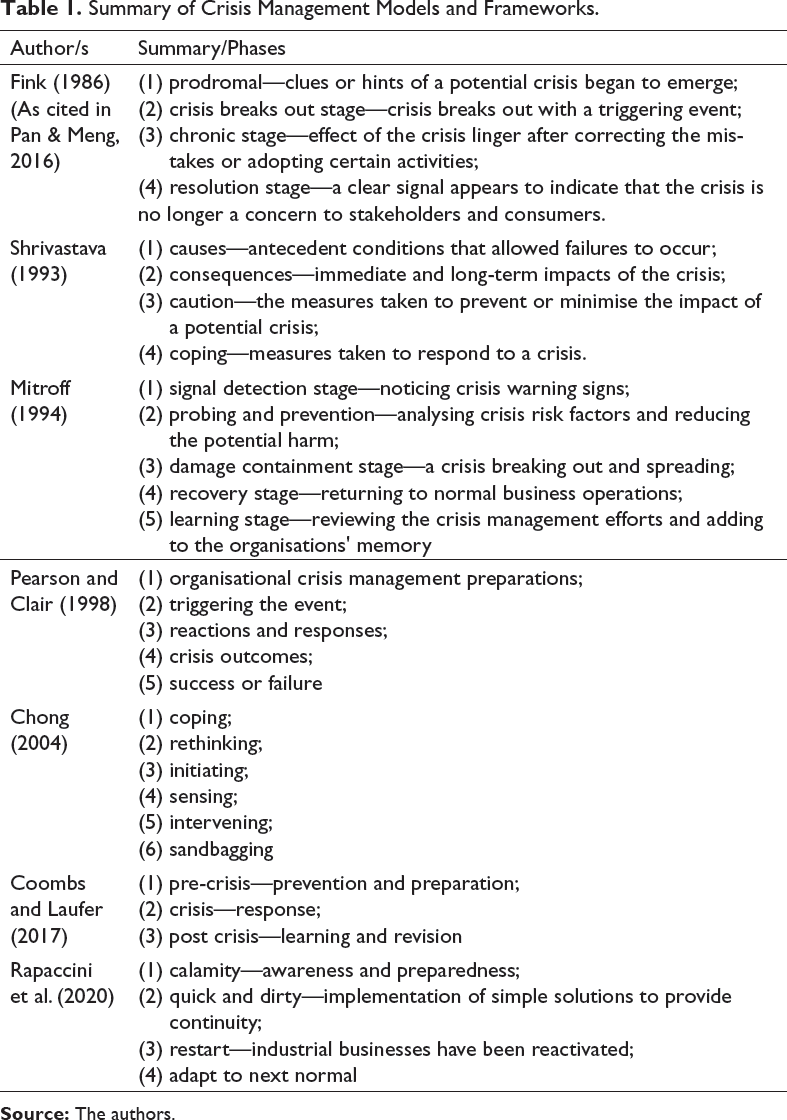
While several of these models highlight how a crisis is managed (e.g., Chong, 2004), others highlight crisis stages (e.g., Coombs & Laufer, 2017). However, there is criticism towards these models, suggesting that crisis is more chaotic and complex, and cannot be illustrated as a linear process (e.g., Speakman & Sharpley, 2012). In this study, we have attempted to combine crises management and stages of crisis by exploring how HRPs managed crisis during its different phases, specifically been mindful of the complex and chaotic nature of the process, in our need to avoid the criticisms towards a linear process.
HRM During Crises
Even with the ever-present crises in the modern business world and the several major crises that have affected companies during the last few decades, there appears to be very little research on how HRM practices have been implemented during crises and how HRPs have handled crises. In their review paper, Hutchins and Wang (2008) have analysed the role of human resource development (HRD) during a crisis. Wang et al., (2009) have investigated the strategic role of HRD during a crisis. Sparrow et al., (2013) have documented the role of corporate human resource in global talent management concerning the 2008 global financial crisis. Also, a few studies have been conducted on areas such as the influence of the global financial crisis on HRM (Gunnigle et al., 2019) and the influence of 1997 Asian financial crisis on HRM (Rowley & Bae, 2004; Smith & Abdullah, 2004; Zhu, 2005).
Similarly, very little had been studied about health pandemics in managing organisational crisis (e.g., the recent crisis experiences such as AH1N1 influenza, Severe Acute Respiratory Syndrome (SARS), and Ebola Outbreak). The study of Lee and Warner (2005) helps understand the impact of epidemic SARS on HRM, where they have investigated the effect of SARS on HRM in the hotel sector in Hong Kong. However, COVID-19 pandemic is unparalleled to all the prior financial crises as well as health crises in its severity, spread, extent and nature. On the one hand, it is a global crisis affecting many countries worldwide (unlike other health crises). On the other, it had affected many industries at varying levels. Hence, it is indisputable that COVID-19 had created far more challenges for HRPs. With the core role HRPs play during a crisis, we must understand how HRM practices have been implemented and how HRPs have handled it.
Research Methodology
Background of Companies and HRPs.
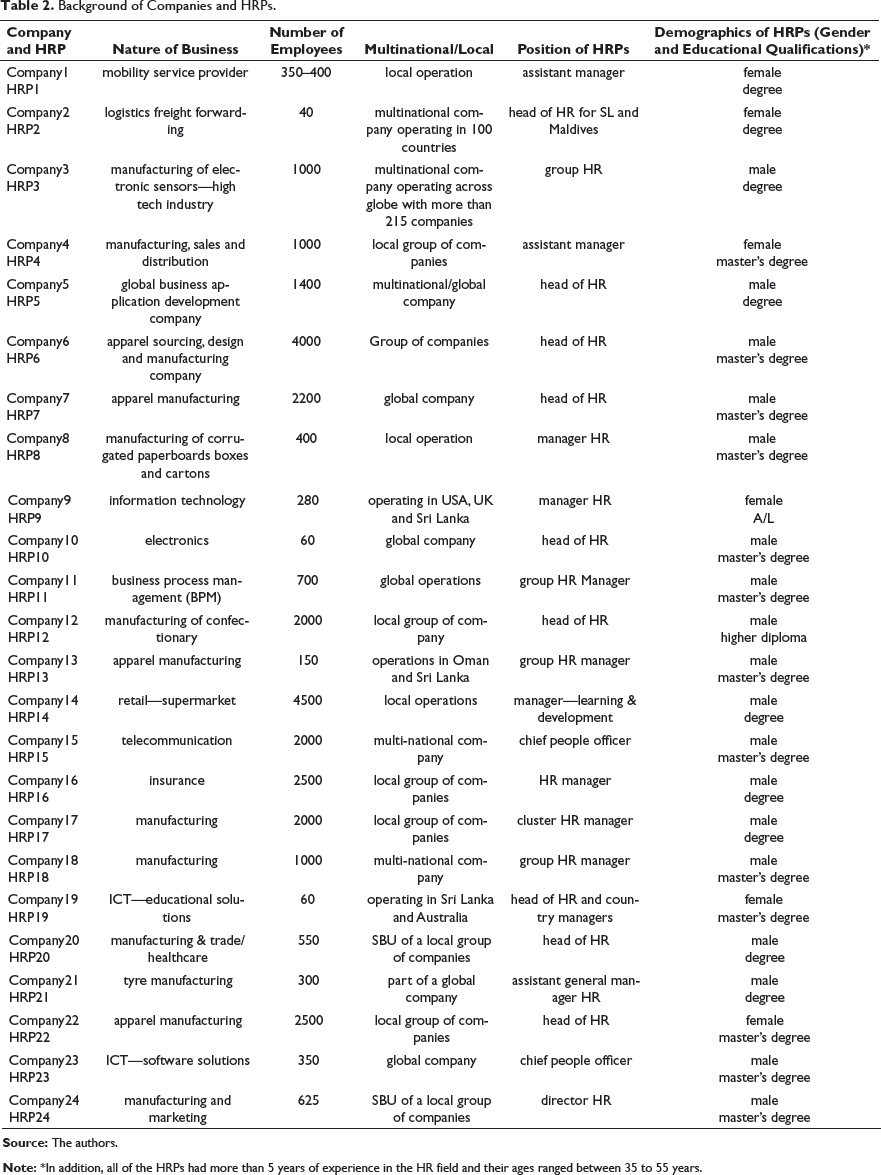
We contacted the HRPs through our connections and informed them of the study’s objectives and sought their informed consent to participate in the study. All the interviews were conducted over the phone or through zoom meetings to ensure social distancing. On average, the interviews took one hour to one and a half hours. The interviews were recorded with the consents of the interviewees and later transcribed verbatim. All three of us conducted the interviews, sometimes together as interviewers and mostly separately. We used an interview guide (see Appendix A) to ensure consistency to a certain extent on the data we gathered and shared our experiences throughout the data collection process by sharing important findings, new questions that needed to be added, and areas that needed further probing. As data saturation was achieved after about 20 interviews, we carried out four more interviews for more accuracy and completed our data collection with 24 interviews.
After transcribing the interviews, we conducted the initial analysis separately, through a sentence by sentence inductive coding process. During this process, we were particularly mindful of the context within which the interviewees shared their experiences (to ensure that we understood the intended meaning in coding) as well as the crisis theory and the phases of crisis management. The codes were both emergent and borrowed, and the coding was done in a shared codebook which made it easier to see the coding of each other as we proceeded with the coding. After the initial analysis and coding, we shared our preliminary codes and discussed them in detail to arrive at a certain consensus. Through several rounds of intense discussions, we were able to refine and categorise our initial codes into broader themes that emerged as phases of crisis management.
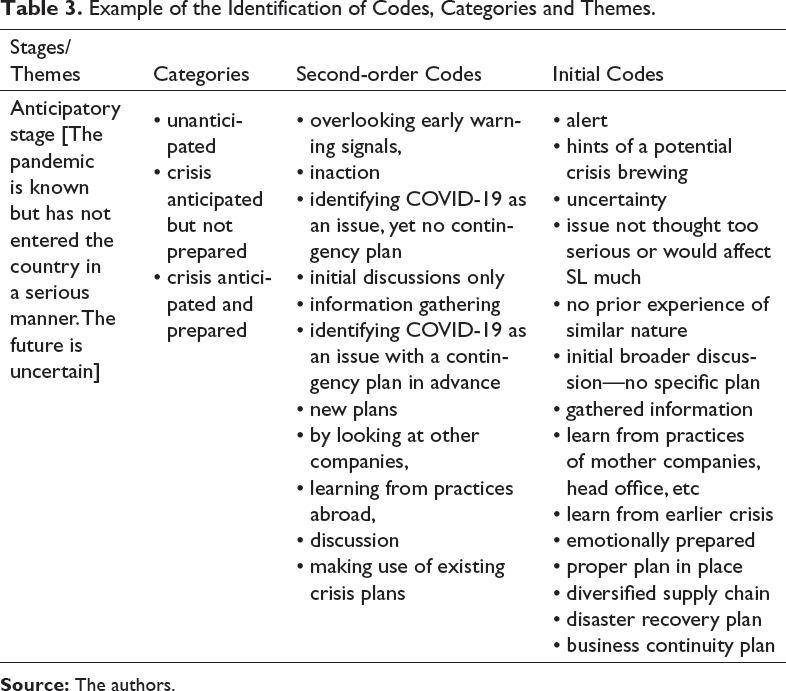
At the initial stages, as we explicitly looked at our data through existing crisis management literature, we were able to collate the codes and categories into existing crisis phases. For example, in identifying the anticipatory stage (see Table 3) we proceeded through several stages of coding and categorising. From the initial coding of the transcripts, second-order codes were derived, which ultimately led to the identification of broader categories (e.g., unanticipated; crisis anticipated but not prepared; and crisis anticipated and prepared). Most of these categories had dimensions and properties that further illustrated the categories as to how, why and when these took place, and at what levels and what specific actions the HRPs engaged in at each stage. These broader categories were then collated to a theme (e.g., anticipatory stage—the first stage of the crisis management lifecycle of the HRPs), in line with prior literature (for example, anticipatory stage is similar to signal detention stage of Mitroff, 1994; organisational crisis management preparations of Pearson & Clair, 1998; and pre-crisis stage of Coombs & Laufer, 2017). Carrying out a similar process of coding and categorising, other themes were identified, indicating five phases of crisis management. Some of these phases are quite similar to findings of literature, as shown in Table 1 (with different terms being used). Yet, given the difference of the existing literature/models with what we were attempting to identify; that is, how the HRPs have handled the crisis, our themes were inevitably not wholly similar to the existing literature. In other words, the processes or stages of prior studies (e.g., Table 1) were related to more general handling of crises and not connected to HRM. Hence, while previous literature did provide us with a basis to identify the main themes (the phases of crisis management of HRPs), our coding and categorising, in a way, unearthed unique explanations to the themes/phases connected to HRPs’ management of crisis. The five themes thus emerged are explored and illustrated in the findings section as the phases of the crisis management process/life cycle of HRPs. An example of how the main phases of the crisis management were identified through the analysis process of coding and categorising is illustrated in Table 3 by indicating the identification of the anticipatory phase of the process.
Example of the Identification of Codes, Categories and Themes.
Findings
The interviews with the HRPs indicated how they have to navigate through several crises the companies had to encounter simultaneously due to COVID-19. On the one hand, the companies were faced with the health and safety crisis of COVID-19, and the quest to protect the employees from the pandemic and ensure that the virus is not spread. On the other hand, the sudden compulsory lockdown that the government imposed led to, first an abrupt and complete closure, and then disruptions to the operations of businesses posing the predicament of continuing the business operations for survival. HRPs thus had to grapple with obtaining permissions from authorities to recommence businesses, putting in place alternative work arrangements and ensuring employee engagement. Then, finally, with the pandemic’s impact, many organisations lost their customers and businesses, creating a financial crisis for the organisations, propelling HRPs to handle aspects such as layoffs, staff benefits and employee morale.
In managing this array of crises, the HRPs have steered through five phases: (a) anticipatory stage; (b) crisis stage; (c) adjustment stage; (d) rebounding stage; (e) continuance or reverting to old ways. Hence, based on our analysis, we present and illustrate our 5 phases of crisis management related to COVID-19, in what follows.
Anticipatory Stage
While it is said that a quick and comprehensive assessment is needed to effectively intervene and handle a crisis (Tiong, 2004), it is not always possible or easy, especially when the situation is unique and completely unexpected. COVID-19 being a novel situation to Sri Lanka, many of the HRPs have not been able to anticipate or assess the situation comprehensively or accurately. The level, accuracy and time frames of the anticipation, assessment and planning for the crisis differed among the HRPs interviewed.
On 30 January 2020, the World Health Organization (WHO) declared the outbreak of COVID-19 as a Public Health Emergency of International Concern. The first COVID-19 case in Sri Lanka was confirmed on 27 January 2020 and by 15 March 2020 the number had risen to 18 patients. However, during this time, there were countries such as China that were in critical conditions under lockdown, and the seriousness of the pandemic was gaining the public's attention. Some companies had their offices and businesses in countries that were severely affected by COVID-19, such as Italy. Against this backdrop, companies started initial discussions on preparing and handling the situation in their companies by January or February and at the least by the beginning of March 2020. HRPs, of course, has been at the forefront of these discussions in many companies. At this initial stage, the core concern and the main point of discussion for many companies and HRPs have been employees’ health and safety and avoiding the spread of the virus.
Only a few companies such as Company2 had started discussions in advance (in January) and had a systematic plan to face possible outcomes of COVID-19, including a lockdown. Being a global company operating in more than 100 countries, Company2 had been well aware of COVID-19’s impact on other countries and how those countries have handled the crises and hence had a ‘business continuity plan’ to face a crisis. As the HRP2 stated:
We had a slight advantage in this situation since we are a company with a global presence and with a significant presence in China, we understood the impact of this, way before other Sri Lankan companies.
The discussions the company had at a global and regional level had helped them understand the severity of the situation and learn from the best practices of other countries.
Singapore had started facing it well. So, before they went into a real big-time lockdown they were, even before that, they were functioning in teams…. So they divided the entire company into two teams, Team A and Team B, and made sure that one team works in the office in a particular week while the other team works from home. So that there was distancing, as these two teams didn’t meet each other for months.
In a way, having faced SARS and influenza, Singapore had experience handling a health crisis. Taking cues from these other countries, Company2 had also divided the staff into three teams and had been ready to implement a team-based work system if the need arises. They have also had discussions about WFH. All these discussions were part of the business continuity plan of the company. Hence, when the sudden lockdown was enforced, the company had been ready to face it comparatively well.
Company15 had created a COVID response team in February and had prepared a plan to face the crisis. As a result, by the time the crises hit them, they were ready with several actions. Like Company2, they also divided the entire company into two teams as Teams A and B to ensure social distancing by engaging the two teams on a rotation basis. The necessary resources for WFH were provided to employees and had meticulously planned for actions if an employee contacts COVID-19. As HRP15 stated:
We planned everything in detail. For example, what would we do if we found a person with COVID symptoms, what if a person is confirmed with COVID? So I would say, we captured around 10–12 different kinds of possible scenarios and were prepared
HRP5 stated how the company have been prepared to manage a crisis with their disaster recovery plan, which had existed in Company5 from a decade or so back, initially developed to handle the disruptions to business due to the civil war of the country and the resultant terrorist activities and situations such as curfews. Being a global company and majority of their critical support staff being based in Sri Lanka, HRP5 stated how they needed to have a disaster recovery plan as ‘it’s not an option for us to close down the company’. Hence, according to the plan, all the employees have always been equipped to WFH with access to all the necessary facilities. As HRP5 stated:
When Colombo [capital of Sri Lanka] was under attack [during the time of the civil war] and curfew was implemented, we started thinking about disaster recovery. We have had the plan, if something goes wrong, how can we handle things? So, as a result of that, all the staff is given laptops. Even a new employee will get a laptop and if needed a dongle and connection as well. So, when actually the government imposed curfew, we started working from home from the first day itself. So, everyone, the entire organisation went on to work from home because they had all the infrastructure, and our corporate information technology (IT) and network infrastructure were well prepared too for the people to log in from home and work from home.
Company3 has also started discussing the pandemic in January and had mainly looked at their supply chains to analyse possible impacts, especially with 90% of their raw material being supplied from abroad. They have thus diversified their supply sources to ensure that they are not dependent on a few suppliers.
However, only a few companies had anticipated the full impact of the pandemic and had plans to face business crises as well as health crises. Many other companies seemed to have anticipated and prepared mainly for a health crisis. These companies, either have overlooked possible business crises, did not seriously think that businesses will be severely affected or have not accurately anticipated the pandemic’s impact on the businesses. For example, HRP1 stated how they have started identifying COVID-19 as a possible future crisis for the organisation and had started discussions on possible future repercussions and preventions in February and had started looking around at other companies to see how they are handling the issue. And with that, by 12–15 March (right before the sudden lockdown was imposed) they have started implementing specific measures to ensure that employees are safe and the virus is not spread by providing transport to employees (so that they do not use the public transport) and using alternatives for fingerprint-based attendance systems.
For many other companies, the discussions were just initial-level deliberations on the world’s current situation and the possibility of the pandemic entering the country and affecting businesses. However, they have not had any plans in place and thus, their reactions to the crises of the lockdown and the impact on the business bottom-line were slow and ineffective. For these companies, while there were some anticipation and minimal preparedness, there was more denial in the form of ‘the problem isn’t that bad’ or ‘it wouldn’t affect us’.
There were a few companies such as Company4, where no discussion nor preparedness has taken place at all. As a result, HRP4 stated how their manufacturing arm had been inactive until the last week of April, and even the other areas of businesses have been slow to recommence. Their unpreparedness was especially highlighted vis-á-vis companies such as Company3, which had been quite reactive or has recovered more quickly. It was also interesting to note that the HRPs in Company4 had not been involved in any strategic decisions taken about COVID-19 and had played a relatively passive role in handling the pandemic and the crises, just following the orders from the CEO.
This passivity and unpreparedness of some of the HRPs to the crises were interesting, given that the pandemic was gaining momentum and publicity internationally and nationally by this time. In a way, this is not surprising, as Sri Lankan companies have not faced similar health crises in the past. Yet, the recent crises the country witnessed such as the Tsunami and the Easter Sunday terrorist attack, should have taught a lesson to the HRPs to prepare for the unexpected and to consider the possibility of a crisis more seriously. Moreover, with many similar pandemics in Asia, such as SARS and the spread of highly pathogenic avian influenza (H5N1), companies should have been more prepared for COVID-19 crises.
Crisis Stage
This is the stage where the actual crises broke out or hit the companies impelled by COVID-19. The severity of these crises depended on the nature of the industries and the extent to which the HRPs were prepared for crises. First and foremost, organisations were faced with a health crisis, where they had to ensure that the employees are safe from the virus, and the virus is not spread in the organisation. This was also the main crisis many HRPs anticipated and prepared for during the anticipatory phase. Lack of proper government guidelines, unawareness about COVID-19 and its magnitude, and procrastination in taking action made it a more perplexing crisis for some HRPs than for others. With COVID-19 contacted and suspected persons progressively increasing, at this stage, the HRPs were thus tackling how to ensure health and safety of employees, when they are exposed to the virus outside the organisation such as at social settings and in using public transport, and also when they interact with each other at the office.
Then, with the curfew being imposed rather abruptly to curtail COVID-19, the other crisis of unexpected and haste closure of the businesses took place. While the initial curfew started as a few days quarantine, it was gradually extended to 52 days. HRPS, we interviewed stated how the first few days of the crisis phase were filled with severe disorganisation and tension, even when they have anticipated a similar crisis and had been prepared. The pressure was more for the HRPs who have not prepared for crises or have only been prepared for a health crisis. Hence, many of the companies have been inactive during the first few days of the lockdown, and the lockdown impacted the operations of the companies in different ways.
The crisis was more severe for manufacturing companies than service companies as the employees’ physical presence was mandatory for their operations, which was impossible during the lockdown; and as such, these manufacturing companies were struggling to make sense of the lockdown and was grappling with government regulations, and safety requirements to find ways to recommence the operations. According to HRPs, during this time, they were mainly involved in numerous online discussions and planning as well as in reaching out to their networks to understand what is happening and how to commence operations.
The crisis of the lockdown was not severe for many service companies and technology companies. Due to these companies’ very nature, the physical presence of employees on the premises was not mandatory in most instances, and hence, they could quickly and smoothly shift to WFH practices. Some of these companies, especially IT companies and IT departments of companies, were either practising WFH at different levels or were contemplating WFH practices even before the crisis. Further, many such companies already had resources such as laptops, computers and Wi-Fi facilities provided to employees, to implement WFH immediately. Hence, these companies were not affected by the crisis as much as the others were, in terms of continuing the business operations.
The lockdown crisis was yet another different experience for companies such as Company14, which was in the supermarket business. These companies also had to manage panic buying before the lockdown, which in itself was a crisis, especially when there had not been any prior anticipation and preparation from the companies and HRPs. Since supermarkets were in the essential service category, they were also required to continue business from day one of the lockdown, by physically organising business operations in outlets and remodelling the business from offline to online selling and door-to-door delivery system.
More severe than the lockdown with a more prolonged impact is the financial crises the companies have to face. Businesses of both the local and global companies have been severely affected by the scale back of production and consumption due to lockdowns and travel restrictions. Also, the global supply chain has been disrupted, and the flow of goods and capital has been hindered (Liu et al., 2020). Companies were thus struggling for survival. Many HRPs stated how their customers have withdrawn from them or have not received any new production orders. HRPs stated how they foresee this effect on the business lasting for a few more months. As HRP5 stated:
Some customers, for example, we were doing a lot in the airline industry…and since the industry got hit…. And then, some customers are delaying their customisations, upgrades, affecting our business…the business impact will be there for at least to another 6 to 7 months.
HRPs also stated of disruptions to supply chain affecting production and distribution, with the impact of COVID-19 around the globe as well as due to certain restrictions imposed by the government on imports and exports as a response to the impact of COVID-19 on the economy. With this business and financial crises, the HRPs were specifically faced with many employee-related dilemmas such as payment of salaries, excess staff and employee engagement.
Adjustment Stage
A few days into the lockdown crisis, companies have slowly started adjusting to the new situation and were resuming work in different ways and strides. The period that took companies to adjust varied depending on the level to which they anticipated the crisis, how prepared the companies were to face the crisis, quick thinking, agility and industry type.
Again, some service companies and all the IT companies could adjust more rapidly to the crisis than the manufacturing companies. Some of these companies could fully operate through WFH mode (especially the IT companies), while others could engage only a certain category of employees on WFH. The time framework of the adjustment and the smoothness of the adjustment depended to a certain degree on the companies’ ability to WFH as well as the readiness of these companies to WFH (with the necessary infrastructure and resources in place, such as Wi-Fi and laptops). It was interesting to note that IT companies such as Company9 had been able to smoothly and quickly (within a few days of curfew) adjust to WFH, even without any prior anticipation or preparation. In a way, this indicates how the nature of the industry might supersede the need for preparation for a company to adjust during specific crises.
In certain other companies, the departments that could WFH had done so while the others, especially the operational level employees, have not been able to engage in their jobs immediately during this phase. HRPs stated how some companies have not been ready for WFH at all and had been forced to shift to WFH due to the crisis. When the employees had been given laptops such as in Company5, 9 and 23, it was easy to shift to WFH. However, many companies had not provided all employees with laptops, and many operational level employees in service companies were using desktop computers. As such, the companies have had to transport the desktops to the employees’ residences during the few hours of curfew shift declared in getting the employees to work from home.
The manufacturing companies were struggling the most to recommence their operations during this time. Company3, 7 and 22 stated how they have had to complete the manufacturing of orders that were already accepted and in the production process, on time. If not delivered on time, they faced the risk of the orders being cancelled or rejected. Faced with this dilemma, the HRPs have been intensely involved in planning on how to get employees to report to work to complete these orders on time. Almost all of the HRPs of manufacturing companies we interviewed indicated how they have meticulously planned many aspects during this phase, to recommence their operations, mainly focusing on the two key areas.
On the one hand, they have had to plan and implement mechanisms to ensure that employees will report to work, that the work environment is safe and the health guidelines are adhered to, and that they are motivated and engaged. On the other hand, the HRPs were also involved in obtaining the necessary approvals, deciding the level of capacity to operate at, deciding which employees to call for work, and sorting out other administrative matters such as payment of salaries. Obtaining approvals involved obtaining the curfew passes (permission) for workers, and drivers who provided transport facilities as well as obtaining the approval of the Public Health Officers (PHIs) to recommence operations. In a context where whoever broke the curfew rules was taken into custody, obtaining permission for employees to report to work was vital but was extremely difficult and cumbersome. The HRPs had to prepare lists with various information on each of the employees expected to report to work. At the initial stages of the lockdown, the companies also had to prove that the work they were involved in was essential. Initially, the government instructions were also not clear on the process of obtaining these curfew passes. Hence, the HRPs were struggling to prepare the background for the operations to recommence. Many HRPs stated how they had to be at the police station the whole day to obtain the passes and visit several places and police stations to receive the passes. Some of the HRPs have had to call for personal favours and networks to get the permissions.
Also, the HRPs had to ensure that the safety and health instructions are maintained, and the PHI’s approval was obtained to recommence operations. This involved procuring safety equipment, re-structuring the work stations to ensure required social distance, and arranging health checks and monitoring systems. As HRP3 stated:
We had to take a lot of precautions. We had to purchase face masks and thermometers, and we also needed to purchase disinfection chambers. We needed chemicals for the disinfection chambers, and we had to make sure everything was in place to recommence work.
All the HRPs who had to request employees to report to work stated how they have carefully analysed the employees’ backgrounds and decided first to call the employees residing close to the organisation/factory to report to work. The HRPs then had to determine the means through which the employees can report to work. Public transport was not operating during the curfew. It was also not safe to use any other modes of transport. Private transport was either not available to these employees or not allowed due to the curfew. Hence, HRPs also had to provide transportation to the employees during this time. Certain companies had provided transportation to the employees as a practice before the pandemic, and hence for them, the process was not as difficult as for the others. Others thus had to arrange transport facilitates anew by finding reliable transport providers and ensuring that the safety measures and social distancing were maintained inside the vehicles. Besides, they had to decide the routes for the pickups and drops meticulously.
Some HRPs also stated how they had to motivate employees to report to work. Some employees have informed the HRPs of the resistance they are facing from their families and neighbours in reporting to work, due to the panic the whole country was experiencing during this time. As HRP12 stated, convincing employees and those around them of the safety in reporting to work was the biggest challenge he faced.
We had to go to those respective villages [of the employees] and talk to them [villagers], even the local politicians got involved. So we had to use different techniques in managing them. Convince people that we have a safe environment to work; you are safe here, to come and work, was the biggest challenge.
As another means of encouraging employees to report to work during this time, many manufacturing companies have paid additional payments (especially to blue colour workers) on their attendance. There were also issues such as providing meals and boarding facilities that the HRPs had to sort out for employees.
After overcoming these many challenges, and obtaining the permissions from the authorities and the other infrastructure put in place, the manufacturing companies have recommenced the operations, initially with a small number of employees at a lower capacity level (mostly at 10%–20% capacity level). With the new processes and practices in place, and armed with success in those processes and practices, the companies have slowly increased their levels of operations. Understandably, none of the production companies reported operating at full capacity during this phase.
Companies in the retail sector such as the Company 14 also had to go through similar processes as the manufacturing companies in ensuring the health, safety and welfare of employees as well as obtaining approvals to commence businesses. In addition, they had to undergo a quick and significant transformation of their business model from physical service from within the supermarket to online and door-to-door service during the lockdown. As HRP14 noted:
It was not a situation that we could continue our normal business operation where customers would walk into the store. It was an online operation that we had to start where we would take orders from the customers, the staff would pick the orders and deliver the goods to the customer’s doorstep.
HRP16 reported how their company, being an insurance company, had to temporarily shift their business focus from canvassing for new customers to maintaining the existing portfolio during this phase in facing the crisis of lockdown, which impacted their bottom line. Companies such as Company4 had taken a relatively long time to adjust to the crises and recommence their operations. These are mostly the companies that have not anticipated the crisis and had not engaged in any preparations for a crisis.
In facing the business and financial crisis, companies have taken decisions to impart pay cuts, layoffs and freeze new recruitments in addition to implementing other cost-cutting measures. HRP9 stated how they have implemented companywide pay cuts up to 50% for the management, HRP1 stated how their pay cuts have been only for the management. HRP5 stated that their pay cuts had been 15% for those drawing a salary above Rs.400,000/. HRP16 has initiated a 7.5% to 15 % pay cut for those who were drawing salaries above Rs.50,000/ per month.
All of the companies financially affected have frozen their recruitments, and some have even implemented a few layoffs and retrenchments. HRP3 stated how they retrenched their probationary employees and the trainees, promising them that they will be the first to be considered for recruitment when the situation comes back to normal. Without any new orders during this time, many manufacturing companies stated how they will not be employing any new employees and will not provide any increments for the existing employee until the situation becomes better. In adjusting to the financial crisis, all the companies have also engaged in various other cost-cutting initiatives to face the financial crisis during this phase such as cut downs on training and development, withdrawing certain facilities given to employees, and closing down certain business premises.
Rebounding Stage
Many companies have rebounded after the unexpected and complicated adjustments and have started operating at considerably higher productivity and capacity. Here again, some companies have recovered more quickly and/or more smoothly than the others. During this stage, the HRPs were not making critical strategic decisions as they did in the adjustment phase. Instead, they were making sure that the companies were slowly returning to their regular operations. The HRPs were primarily involved in putting in place systems and practices to continue the new norms that have been put in place during the previous phases to overcome the crises. For example, the companies that had practised WFH had systems to monitor and support the employees. These employees were more trained and used to the system of WFH and hence operated at full productivity. The government procedures for obtaining curfew passes were more relaxed and more streamlined by this time, and therefore it did not become the main activity of the HRPs. They had the in-house documents and systems for obtaining curfew passes as well as transport, health and security, and other activities, which took a lot of their time and effort, in place.
Some companies could reach full capacity of production and productivity while others could not reach full capacity due to a significant loss of orders. Many companies were still struggling with a lack of business. Others had orders in place for another month or so, and hence was attempting to fulfil the orders while being mindful of a future loss of business and impact on business survival. It was interesting to note that according to the HRPs, many companies have had higher productivity, even way above the normal. Indicating the reasons for this higher productivity, HRPs stated that the additional payments the employees have received for reporting to work during the curfew, the gratitude they felt towards companies for their salaries and job security during these tiring periods were the main reasons for the higher productivity of employees of mainly the manufacturing companies. Fewer distractions or lack of other social engagements due to lockdown was the main reason for the higher productivity of the employees who WFH.
During this time, companies such as retail businesses, insurers, internet service providers have also explored and implemented innovative marketing strategies to reach their customers. The marketing departments were more rigorously attempting to bring in businesses during this time. HRP8 stated how they could get more orders and new customers, as they were the only company in their industry that had been in operation from the beginning of the lockdown. As such, they have gotten many commendations from their existing customers for supplying products on time, and new customers have joined the company as their competitors have not been able to meet the customer demands during the lockdown.
Continuance or Reverting to Old Ways
After 52 days of a lockdown, on 11 May 2020 the curfew was lifted, and things started slowly getting back to normal, but still with the shadows of the dangers of the pandemic and a second wave of COVID-19. Slowly but steadily, the companies too, have started getting back to normal during this stage. For some companies, this normal has now become the new normal.
Some of the initiatives that most companies will continue are health and safety standards, WFH initiative, online training and readjusting reward systems. Though the provisions for health and safety standards is an extra burden in terms of cost, companies are, for the foreseeable future, ready to provide appropriate health and safety measures including social distancing, temperature checking, masks, dedicated health rooms for any infected personnel, plans to behave in case of infections, and disciplinary actions against violation of health and safety standards.
Some HRPs stated how they would continue with the WFH (Company5, 9 & 16) for another few months or till the end of the year. Others stated how they had requested the employees to report to work, but with changes in policies where there are now provisions of WFH for a few days of the week. HRP5 stated how they have phased out the work setting to bring the company to normal operations slowly.
We’ll be continuing this [WFH] until the end of June, and from July onwards, there’ll be the next phase where we’ll bring only one-third of the staff. And then two-third of the staff after two months. Like that, it’s like phased out. Now, though the country is back to normal, we only operate about three days per week physically. The other two days we work from home. Now, for this whole year, it would be the same. The next year, let’s see what would happen (HRP16)
As HRP9 stated, WFH is something that they have been anyway planning to do but had taken time. Yet, when the crisis had propelled them to quicken an otherwise delayed shift to WFH, they have embraced the change and will make that a part of their work setting in the future. With the impact of the business crisis, WFH is primarily a means of cost-cutting for the company, where they have already closed one office premises.
Company2 stated how according to their initial plan they would be getting the employees to report to work in teams (where all the employees have been divided into three teams) alternatively (with the employees who would not be physically reporting to work engaging in WFH), to ensure social distancing and safety from contracting the virus. They plan to continue this practice for some time. HRP18 emphasised the continuation of online training programs since it facilitates group-wise training programs at a low cost. Also, short term online training programs create the feasibility of training employees without hampering the operations as in sending employees for half-day or full-day traditional training programs.
Manufacturing companies have been anxious to operate as usual, with full capacity. Some HRPs stated how they have now withdrawn the free transportation provided to the employees as well as the extra payments and the other exceptional facilities provided to the employees during the adjustment and rebound stages. However, while the operations have, or are returning to normal, companies are still facing many uncertainties in terms of their business developments. Hence, the companies that had imposed pay cuts, withheld the bonuses and stopped new recruitments, have plans to continue them for another few months to see how the situations would be. Simultaneously, some companies have come back to normal in terms of business operations and markets, and are ready to offer deferred bonuses and other rewards to employees. The companies are still very cautious and are now better prepared with more robust plans to face similar future crises based on learning during COVID-19.
Discussion
Our study's findings highlight several important aspects related to the experiences of HRPs in handling the crises posed by COVID-19. Looking at these experiences of HRPs, it is clear that many of the companies have gone through 5 stages of pandemic/crisis management, while a few companies have only gone through 4 stages having not anticipated any crises or being entirely unprepared for the impact of the pandemic. For example, companies such as Company1, 4 and 9 had not been prepared for the crises that the pandemic posed and hence did not go through an anticipatory phrase. However, while the importance of pre-crisis preparedness and proper planning to successfully manage crisis has been repeatedly highlighted (Bundy et al., 2017; McConnell & Drennan, 2006), most of the companies we studied have not precisely anticipated a compulsory lockdown and a resultant cessation of business operations. The discussions at the anticipatory phase for most companies have been on the pandemic’s safety and health aspects and how to protect the employees, without robust contingency planning or crisis management planning. While the companies that had been proactive and engaged in pre-planning had fared well in managing the crisis, some companies have managed the crisis without such preparedness. Even when companies had prepared for the crisis, the operational realities during the actual crisis were much more complex and different (McConnell & Drennan, 2006) than what was expected or planned. Pre-preparations and planning have not been as successful as these companies have expected, even though their readiness for the crisis made them more agile and flexible.
Uncertainty being a characteristic of ‘crises’ (Bundy & Pfarrer, 2015), preparedness, while vital, was not the only aspect that had led to the successful handling of the crises. According to Rapaccini et al. (2020), agility, redundancy and elasticity are also crucial in being resilient to crisis. Our findings indicated that the nature of the industry (whether manufacturing, technology-based, or service, as well as whether the companies were multinational or local), availability of the resources, and most importantly the role the HRPs played could also be important in successful crisis management. For example, even though both Company4 and 9 were unprepared for the crisis, Company4 struggled for a considerably long period to resume its businesses when Company9 had quickly and smoothly adjusted to the crisis of lockdown by transforming fully to WFH because of the nature of their operations and the availability of resources.
Not only the success of crisis management but also the time frames each company took to navigate through the crisis management phases differed depending on these factors. It was specifically interesting to note how disparate the crisis management was for companies that were similar in terms of their main business activities and the number of employees. For example, when Company3 recommenced normal operations by the end of March, Company7 recommenced on 24 April. The main difference observed in these two companies was the strategic role and the active involvement of the HRP3 in planning and implementing during the crises.
Overall, the companies where the HRPs have played a more strategic role, getting involved in all the phrases at a strategic level, in making decisions, developing strategies and in implementing them appear to have fared well and quickly in managing the crises and in bouncing back, and the transitions appear to be smoother. In many companies, HRPs also had to get involved in many administrative activities as well, such as obtaining the curfew passes, ensuring the health and safety measures are in place, arranging transport and paying salaries. Clearly, the HRPs of manufacturing companies, retail companies and certain service companies where employees had to report to work to recommence businesses during the curfew physically, were the most challenged and most involved, than the HRPs in companies where WFH could be implemented comparatively effortlessly. However, irrespective of the company's nature, some HRPs were very passive, just following orders from the top management and merely getting involved in mundane administrative work only.
Albeit criticisms about linear prescriptive frameworks indicating different steps of phases from prediction to recovery (e.g., Speakman & Sharpley, 2012), our findings too indicated a linear process of crisis management. Nevertheless, our findings depart from the similar linear processes presented on crisis management in several ways. First, our findings focus on the experiences and crisis management by the HRPs while companies face crises, which has not been the focus of other linear processes. None of the existing crisis management processes or lifecycles that we came across was able to capture the experiences of the HRPs. Second, with each crisis's uniqueness, there is no ‘one size fits all’ model or framework on handling crises (Speakman & Sharpley, 2012). Hence, the process we have presented provides a detailed illustration of how this particular crisis of COVID-19 has impacted the businesses and how the crises were handled by HRPs adding to the existing knowledge of crisis management and the role of HRPs in a crisis. Third, we have not merely explained a step-by-step process (which Speakman & Sharpley, 2012 criticise, as most linear crisis management processes do), but rather, have illustrated the complexity and chaos in the crises management process by delving deep into different experiences of HRPs, multiple industries and unique contexts.
It is also important to remember that crisis is not only about danger, chaos or disaster. Crises can also provide opportunities for change and growth if handled well (Kraus et al., 2020; Tiong, 2004). Hence, some of the changes that the companies had made in handling COVID-19 will help companies to change or grow.
Theoretical Implications
Findings of the present study have several contributions and implications to the theory. First, our study contributed new knowledge by presenting an empirically driven explanation of the different stages encountered by HRPs during the crisis COVID-19 and how the HRPs have managed each stage of the crisis. Second, our study findings imply that a crisis is neither purely chaotic (Speakman & Sharpley, 2012) nor linear (Elsubbaugh et al., 2004), but rather, a combination of both, highlighting the importance of the preparedness and adjustment to spontaneous and unforeseen challenges in managing a crisis. Crises models or frameworks must be enriched by including both chaotic and linearity aspects to capture crisis realities. Third, though some authors (e.g., Evans & Elphick, 2005) argue that crisis prevention is nearly impossible, our findings imply the importance and applicability of crisis prevention through robust anticipation with pre-planning, implementing, monitoring and re-planning. Yet, we also identify other factors such as the nature of the industry, agility and quick thinking as factors that would influence a crisis management’s success. Fourth, our study points to the critical role the HRPs play in managing crisis and, as such, the need to identify the ‘Crisis Manager’ role as part and parcel of a contemporary HR manager’s role. This adds to the existing frameworks on the HR manager's role, such as Ulrich and Dulebohn (2015). Finally, through our explanations of how HRPs have changed work practices in responding to a crisis, our findings provide further proof that crisis brings changes and innovations to the organisations as a blessing in disguise (Kraus et al., 2020; Pearson & Clair, 1998; Tiong, 2004; Ulmer & Sellnow, 2002).
Practical Implications
Our findings also reveal insights on how HRPs can manage and navigate through crisis effectively. Looking at how HRPs have handled crises through different stages, it is clear that the success of how they faced the many crises of COVID-19 depended on the level at which they anticipated the crises, how prepared the HRPs were to face them with a proper plan in place, quick thinking and agility. It is vital to learn quickly from these experiences of HRPs to improve the crisis management process (Wang et al., 2009) to survive and thrive ultimately. Besides, the strategic role of human resource development (HRD) in crisis management is indisputable. As such, the learnings from how the HRPs handled crisis during the pandemic can be specifically used in developing strategic HRD initiatives.
As our findings indicate, many companies have not engaged in effective crisis management through systematic prior planning. How does the lack of prior planning impact crisis management's success is demonstrated in previous studies (McConnell & Drennan, 2006; Wang et al., 2009). According to McConnell and Drennan (2006), organisations fail to engage in crisis management because of a lack of knowledge of systematic planning. Further, as Wang et al. (2009) highlight, ‘[c]risis management requires the development of firm-specific capabilities and learning and performance interventions that enable stakeholders to identify, respond to, and recover from crisis events’ (p. 3). In this background, HRPs should be trained on crisis management, specifically looking at systematic pre-planning and planning during a crisis. In addition, learning from the HRPs experiences can be used to develop the capabilities, capacities, flexibility and confidence of HRPs to identify, handle and quickly respond to and recover from crisis events. These are capabilities and capacities that organisations should look for in HRPs, and what should be developed in HRPs within the highly turbulent, volatile and crisis-driven business environment of modern organisations. Findings also point towards the importance of strategic agility and creating and promoting an agile workforce with agile work practices to create agile work organisations that can face crisis successfully.
Limitations and Directions for Future Research
Inevitably, our study has some limitations that indicate opportunities for future research. First, although our study investigated how HRPs managed the crisis of COVID-19 in general, it did not delve deeper into how HRPs managed the specific HR functions (such as recruitment, performance appraisals and compensation) during the crisis. Hence, future researchers can investigate, in more detail, how the different HR functions were managed across the crisis lifespan. Second, as our study was conducted across diverse industries to capture the crisis management process in its entirety, we did not specifically identify the uniqueness or variations across the industries in how HRPs managed the crisis. Hence, further studies can be conducted in specific industries to explore crisis management's nature in different industries. Third, the rigidity and flexibility (Staw et al., 1981) of HRPs can influence the way of navigating through the crisis, which future studies can explore in detail. Finally, it would be useful to explore how the crisis is managed during the second and third waves of the pandemic and compare such findings with how the crisis was managed during the crisis's initial stages.
Conclusion
The impact of COVID-19 on businesses is indisputable. We are looking at a relatively long term phenomenon compared with other similar pandemics in the past—such as SARS and Ebola—and COVID-19 would not be the last pandemic that the world will be facing. Certain countries have already embarked on a second and third wave of COVID-19 crisis. At a time when concepts such as agile HRM, artificial intelligence (AI) has gained centre stage, has HRM used them to be prepared for a crisis such as this? It appears not, as the process of crisis management we have illustrated indicates more of a crisis response process rather than a crisis management process from the HRM perspective. Hence, our illustration of the crisis management process and how HRPs have handled the crisis presents lessons for the HRPs in handling crises using the modern concepts of HRM and crisis management principles.
