




Abstract
The further education sector is a challenging working environment with expectations to deliver high-quality education against a backdrop of continuous policy and structural reforms. Further education managers play a key part in how further education institutions respond to this dynamic operating environment. However, despite the importance of this role there is an absence of an agreed set of professional expectations for further education middle managers.
Sector bodies have commissioned research to address recruitment challenges and support workforce development, but this is often directed towards teachers. As a result, the credibility of further education teachers has increased markedly, which is welcomed. However, further education middle managers who are responsible for the management of teachers and operationalisation of organisational strategies have not benefited from comparable opportunities for professionalisation. In contrast, they suffer from a lack of support when assimilating into the role. This paper investigates the role of further education middle managers through the lens of those responsible for their recruitment and development, human resource managers. Through the administration of a national survey of human resource managers, drawing on quantitative and qualitative data, this paper establishes a new theoretical framework: four pillars of professional expectations for further education middle managers. Furthermore, it highlights the value in a contextualised approach, moving away from generic management standards.
Introduction
In 1999, the Further Education National Training Organisation (FENTO) published a set of national occupational standards for the management of further education (FE) which Briggs (2005a: 29) summarised as four areas ‘developing strategic practice; developing and sustaining learning and the learning environment; leading teams and the individual; and managing resources’. These standards were not widely adopted. Furthermore, there is a lack of reference to them in journal articles researching FE; even Briggs’ reference is a single short descriptive reference. Lucas et al. (2012) explain that in 2005 FENTO was abolished, in part due to conclusions reached by the Office for Standards in Education, Children’s Services and Skills (Ofsted) that the standards published for FE teachers did not result in positive outcomes. FENTO was then replaced by a new organisation, Lifelong Learning UK (LLUK), which focused on ensuring that the quality of teachers was improved. In 2006, LLUK published a new framework of professional standards for FE teachers. Unlike teaching standards, with the demise of FENTO the occupational standards for FE managers were not updated or repurposed. These standards hold limited credence as there is little evidence to suggest they were regarded as an accurate tool. In fact, the omission from academic literature and difficulty in locating a set of published management standards for FE suggests the little value placed on them. Furthermore, in the 20 years since their publication the sector has faced a series of policy changes which means the macro environment is quite different. However, the role of FE middle manager is one that still exists and has significant influence on how FE organisations operate, not least mediating between the expectations of senior leaders and teachers (Gleeson and Shain, 1999).
The lack of national professional standards and/or expectations for FE middle managers limits the FE sector’s ability to provide consistent and systemic support to those occupying the role and can result in a lack of appropriate training and development (Thompson and Wolstencroft, 2015). This can lead to post-holders being unprepared for the role (Page, 2013). In order to address these issues, this paper sets out to investigate the professional expectations of the role from a human resource (HR) manager’s perspective. By eliciting the professional opinions of HR managers this study will gain a unique perspective, compared with prior studies. The data collected from HR managers will seek to respond to the overarching research question set out by this paper: what are the contemporary professional expectations of FE middle managers in England?
Using existing literature and empirical research this paper reviews FE middle management practice with consideration of both the past and present. It goes on to consider what are the key expectations for those who assume the role of FE middle manager from the perspective of those who design and recruit to the job role: HR managers. This provides a unique perspective from which to consider the role. HR managers are a central point of contact for a wide variety of stakeholders in the recruitment and selection of a middle manager. Furthermore, they are responsible for ensuring the job description is accurate and reflects the needs of the organisation. This provides them with a holistic and somewhat objective perspective of the role. As a result, the paper is able to establish a framework for professional expectations, which it refers to as the Four Pillars of Professional Expectations. This framework provides the cornerstones for the development of professional standards for FE middle managers.
As this paper investigates middle management as a role it intentionally avoids using the terms ‘leadership’ or ‘middle leader’. This is not to suggest managers may not require attributes akin to leadership; however, as explained by Bush (2008), leadership is more than the functionality of management – that is, budgets and managing staff. The traditional view of leadership suggests it is a set of values and behaviours (Day, 2000). However, as highlighted by Greenfield (1991), values are not measurable, which can be a limiting factor when seeking to establish professional expectations that could be used to assess an individual’s suitability for a role or determining development needs.
While this paper’s focus is within the FE sector in England, the findings are not necessarily limited to it. This paper considers middle management practice where there is an absence of agreed-upon professional expectations for managers. Therefore, it is suggested this paper will be beneficial for other education sectors where there are similar paucities in management expectations.
A brief overview of the FE sector
The FE sector has a long history. Simmons (2009) suggests that the provision of FE equivalent education and training dates back to Victorian times, though he also explains that the 1944 Education Act was the first step in the formalisation of the FE sector (Simmons, 2009). While it is appreciated that reforms took place prior to 1944, analysis of these reforms are beyond the scope of this paper as it considers a more contemporary perspective and because in the post-World War II era a number of neo-liberal reforms were introduced, which impacted upon the sector and the FE manager role. The 1944 Education Act’s implementation commenced in post-war society, and local education authorities (LEAs) were mandated to ensure that the FE provision in their remit was adequate (Simmons, 2014). This reform was a pivotal point in history for the growth of the FE sector. FE providers engaged with employers to form programmes which met their needs and trained students in vocational study relevant to the region in which the FE provider was based. While local education authorities (LEAs) were required to ensure FE provision was adequate, they had a relative level of autonomy from state control (Simmons, 2014). Simmons (2014) explains that by the 1960s, concerns grew due to a declining economy and it was felt that greater intervention and regulation were required in the sector. By the 1990s it was suggested by the then government that LEA control of FE providers stifled innovation and so the 1992 Further and Higher Education Act was introduced (Simmons, 2009). This legislation released FE providers from local authority control and required them to become freestanding public bodies known as further education corporations or sixth form college corporations. Thompson and Wolstencroft (2018) highlight this as the initiation of a managerialist era in education that focuses on key performance indicators (KPIs), converting education into units of measurement. In the subsequent years the FE sector experienced a range of reforms to improve its performance and make it fit for purpose (Corbett, 2017). However, Donovan (2019) highlights that these perpetual reforms underline a distrust in FE institutions to chart their own course for long-term success.
Since the incorporation of FE providers, the sector experienced a series of policy changes that impact on those who operate in the sector. Spours et al. (2007) discuss what they call policy levers and suggest that the impact of national policies can be complex; as a result, different management approaches are used to implement them. Change within the FE sector is not limited to policy reforms alone. The bodies which were established to support the FE sector have risen and fallen through the years. In 2006, FENTO was replaced by LLUK which was then closed in 2011. Some of LLUK’s remit moved to the Institute for Learning (IfL) and the Learning Skills Improvement Service (LSIS), both of which became defunct, and in 2014 the Education & Training Foundation (ETF) was founded, later being joined by the Society for Education and Training (SET). More recently the FE sector was subject to structural change via the Area Review process administered by the Department for Business, Innovation and Skills (BIS). Area Reviews sought to ensure that FE providers had the capacity (structural and financial) and capability to deliver on the UK’s industrial strategy (BIS, 2015b).
The FE sector which exists today services a range of student educational needs categorised in a variety of ways. Broadly, FE providers categorise students in terms of age as this has the greatest variance in terms sources of funding. According to statistics provided by the Department for Education (DfE, 2018), in 2017/18 the FE sector delivered qualification-based education and training to 1.13 million students aged 16–18 years old and 2.23 million adults aged over 19. In addition to these figures, there were 814,800 apprentices and 504,500 adults on community courses as well as students with special educational needs or disabilities (SEND) who also undertook study in FE providers. Furthermore, the Association of Colleges (AoC, 2018a) highlights that in 2017/18 the FE sector employed 120,000 full-time equivalent staff. In 2015 a government report calculated the net present value and return on government investment in FE students. The report states there are ‘strong economic returns to a range of publically-funded [sic] qualifications’ (BIS, 2015a: 5), which is further underpinned by the AoC (2018a) statement that, collectively, FE students aged over 19 years will boost the economy by £70b over their lifetime. This demonstrates the FE sector’s significance, not only as a function of education, but also as a key contributor to the UK’s economy. Despite its contribution, both educationally and economically, the FE sector has not been protected against fiscal reforms. In 2013, post-16 education funding reforms altered the method for calculating funding. A House of Commons impact assessment highlighted that these reforms would likely result in a cut in funding for FE providers (Hubble, 2014). More recently, the DfE facilitated a structural review of the FE sector. This review sought to establish recommendations to ensure financial stability in the sector. The outcome of the review was comparable to the academisation of schools, bringing colleges together into groups in an effort to create greater efficiencies in their running costs. One of the outcomes of this review was a 26% reduction in the number of individual FE institutions (DfE, 2019).
Navigating change: support and challenges for the sector
As already established in this paper, there have been a range of support bodies operating in the FE sector. It is unfortunate, though, that these bodies have an average life span of five years. This is not to suggest that their existence has been wholly ineffective. Important discussions have taken place throughout this time which have facilitated the development of modern-day teaching practices in the FE sector. Some scholars discuss the professionalization of the FE sector (Avis, 2005; Bathmaker and Avis, 2013; Lucas, 2013; Simmons and Thompson, 2008), being a range of measures brought in to enhance its performance. Unfortunately, consistency has been a continuous challenge for the FE sector; for example, in 2001 a new regulation was introduced which required all FE teachers to be suitably qualified to support their students. This was then reaffirmed in 2007 when, depending on their role, FE teachers were expected to possess a specific teaching qualification. However, in 2013 the requirement to possess a teaching qualification was revoked, although the DfE (2016) does highlight that there is a general expectation of – and value given to – FE teachers possessing a good teaching qualification. There have been some further advancements in this area. In 2014 the ETF established the Professional Standards for FE Teachers and Trainers; while the preceding sector support bodies had developed standards for teaching, the ETF’s standards are the first to be incorporated into external quality assurance frameworks (Ofsted), initial teacher training qualifications and recognition of professional teacher status (Qualified Teacher Learning and Skills (QTLS)), thus providing a more systemic approach to professional standards for FE teachers.
Unfortunately, there is less consistency of expectation for management roles in the FE sector. As explained by Briggs (2005b), in 1999 FENTO introduced professional standards for management which were not widely adopted, nor did subsequent sector support bodies attempt to redevelop them. While there is a range of management training programmes offered more broadly, these often lack contextualisation and have no standards per se to be grounded in (Corbett, 2017). Some scholars do suggest there is a broad agreement regarding the remit of FE middle managers. Studies by Beresford and Michels (2014), Briggs (2005a) and Leader (2004) discuss the range of duties undertaken by FE middle managers. Combined, their studies conclude that perceptions of the role are shared and agreed upon within their organisations. In its most basic form, the role is one that implements strategy set by senior management. This does highlight the multifaceted nature of the FE middle manager role, as organisational strategy is all-encompassing. It also means that the role of an FE middle manager requires a level of filtration between senior management and teaching staff (Briggs, 2005b; Spours et al., 2007). The diversity of skills and knowledge required for the role creates challenges for the post-holders of it. Their role is multifaceted and complex; as such, generic management training is not sufficient. Unfortunately, this point is supported by research, which has shown that FE middle managers are often ill-prepared for the role and this is further exacerbated by the lack of appropriate/applicable training (Briggs, 2005b; Thompson and Wolstencroft, 2015). Furthermore, there is an almost Darwinian approach to surviving the role, illustrated by Page’s (2013) research into how FE middle managers cope with undertaking their role. The ‘sink or swim’ approach presented by Page (2013) could account for the annual 13% staff turnover of those in FE middle management roles (ETF, 2020).
During the early periods of change in the 1990s, senior managers of FE providers developed strategies to respond to the incorporation of FE. Leader (2004) highlights the challenges for providers, in particular operating as a business; she explains that FE middle managers with business knowledge were recruited by providers. It might be fair to say that for the providers that still exist today these strategies were successful. However, the historic practices of FE middle managers come under scrutiny by scholars. As providers were released from LEA control and became incorporated, they needed to be financially independent. Furthermore, there was a greater focus on their performance in educating students. Avis (2005) raised concerns about the drive to meet funding targets resulting in aggressive management practice and high staff turnover. McTavish and Miller (2009) suggest that FE middle managers adopted a more business-orientated approach driven by a need to meet KPIs. Simmons and Thompson (2008) explain that this approach did not blend well with the ideology of many of those working in the FE sector and resulted in a demoralised workforce.
Avis (2005) and Thompson and Wolstencroft (2015) propose indications that elements of historic poor management practice were eroded through an increase in the number of female managers. However, this erosion may not have been sufficient, as studies into FE management practice many years after the incorporation of FE providers indicate that issues may still be present. An ethnographic study by Boocock (2014) in an FE college’s business department suggests that the issue of managers focusing on policy rather than staff and students does still operate in at least some providers. Furthermore, Edward et al.’s (2007) study across 24 FE learning providers concluded that managers were target- and funding-focused. There is also a possibility that this practice may become reinvigorated when radical structural changes are introduced. Elliott (2016) explains that the business approach has been exacerbated by sector-wide college restructuring. Given the implementation of structural change in the FE sector arising from Area Reviews (BIS, 2015b), it seems that now, more than ever, FE middle managers need clarity of expectations and support in achieving these expectations. Otherwise, we are in danger of repeating the mistakes of the past.
Research method
Previous studies have provided valuable insights into the role of FE middle manager. These studies have considered FE middle managers through a range of perspectives, such as teachers’ assessment of their managers (Beresford and Michels, 2014; Boocock, 2014; Edward et al., 2007), managers’ own reflections (Page, 2013; Thompson and Wolstencroft, 2015, 2018) or considerations of senior leaders (Elliott, 2015; Lambert, 2011). This paper sought to build on the work of scholars by providing a different perspective, that of HR managers. As explained by Sharabi (2010), functions of an HR manager role include recruitment, support and development of all staff. This requires them to possess an understanding of both the strategic and operational expectations of their organisation with an expectation to ensure the organisation has a workforce that will achieve the organisation’s strategic ambitions (Chang and Chi, 2007). Therefore, a HR manager’s perspective of the FE middle manager role is an important component in further understanding the role and responding to this paper’s research question: what are the contemporary professional expectations of FE middle managers in England?
When developing a research design it is important to consider the study’s integrity. Robson (2011) suggests four threats to data reliability: participant error, participant bias, observer error and observer bias. These categories informed the research design and strategy of this study. As the research question set out to establish professional expectations for FE middle managers in England, it was necessary to collate responses from HR managers throughout England. Therefore, a national data sample, representative of the data population, was required. Furthermore, the data collection tool needed to enable collection and analysis of a large data sample while also being convenient and flexible for participants to complete (as they would have competing demands on their time). Anonymity of respondents was considered important to elicit open and honest answers; this also meant that participants did not have the opportunity to discuss their responses with each other or the researcher, thus avoiding response coercion and collusion. These considerations resulted in the development of an online questionnaire. This questionnaire was distributed across all FE colleges based in England. The survey population was calculated using the assumption that each college had one HR manager. As there were 269 FE colleges the survey population was calculated as: 269 providers x 1 HR manager per FE college = 269 survey population
The responses provided by HR managers provided the following factors for analysis: Demographic information: this data was collated and compared with the ETF Workforce data report to analyse whether the survey response is representative of the FE workforce population. (The demographic workforce data is only available for the whole workforce rather than HR managers specifically.) Skills selection: this section provided participants with 33 skills, knowledge and attributes that might feature in a FE middle manager’s role. These were provided in a grid which was set out to mirror the categories which would be used in a person specification, a format familiar to HR managers. Participants were required to choose one of four possible categories: essential, desirable, optional and not required. This data could then be analysed using statistical methods and cross-referenced with participants qualitative responses. Qualitative feedback: respondents were asked to provide their judgement as to what makes a person a successful FE middle manager. This was then analysed to establish an insight into expectations of the role which may not be present in current literature.
Data analysis: respondent demographics
The demographic data collected is used to confirm whether the research sample is representative of the survey population. As there are no sector-specific survey population demographics for HR managers in the FE sector, the population demographics are derived from whole-sector data where appropriate. Table 1 collates published demographic data (AoC, 2018b; ETF, 2017) and compares it with the survey respondents’ demographics. The data presented shows a reasonable level of equivalence for most variables. The key conclusions are as follows: Gender: there are no definitive figures for UK HR managers. As such, this study has drawn on Rocheleau’s (2017) findings, which are based in the USA, and Burt’s (2017) reference to Chartered Institute of Personnel and Development (CIPD) member data demographics, thus providing an indication of proportions. In addition to USA based data there are several UK news articles which also indicate that the proportion of females in HR is significantly higher than males, providing some level of assurance these proportions assumed are broadly accurate. This does mean there is a variation between population (15.5%) and respondents in terms of demographics. As women make up the majority of employees in the HR profession – 75% according to Rocheleau (2017) and 79% according to Burt (2017) – it is reasonable to assume that fewer male respondents in this study is not a significant limitation. Ethnicity: this is compared to the FE workforce ethnic profile in published data (ETF, 2017). There is a variation of 3% which is considered proportionate to the published data. For the purpose of data analysis, ethnicity can only be used as confirmation that the respondents’ population is representative. Due to the low proportion of non-white ethnic respondents (8%) it is not possible to elicit statistically significant data through analytical tests. Age: this is compared to the published data for the FE workforce (ETF, 2017), which can result in some disparity. It is suggested that an acceptable assumption is that the manager workforce would be older compared to the entire workforce as it will take time for an individual to gain suitable experience and expertise to assume a management role. This is demonstrated in the survey respondents’ demographics. Location: this variable has some significant deviation compared to the published data. There are comparative responses for the Midlands (3% variance) and the North of England (3% variance). However, there is a disproportionate number of responses for London and the South with fewer responses being elicited from London and a higher response rate from the South.
HR manager population and survey respondent demographic comparison.
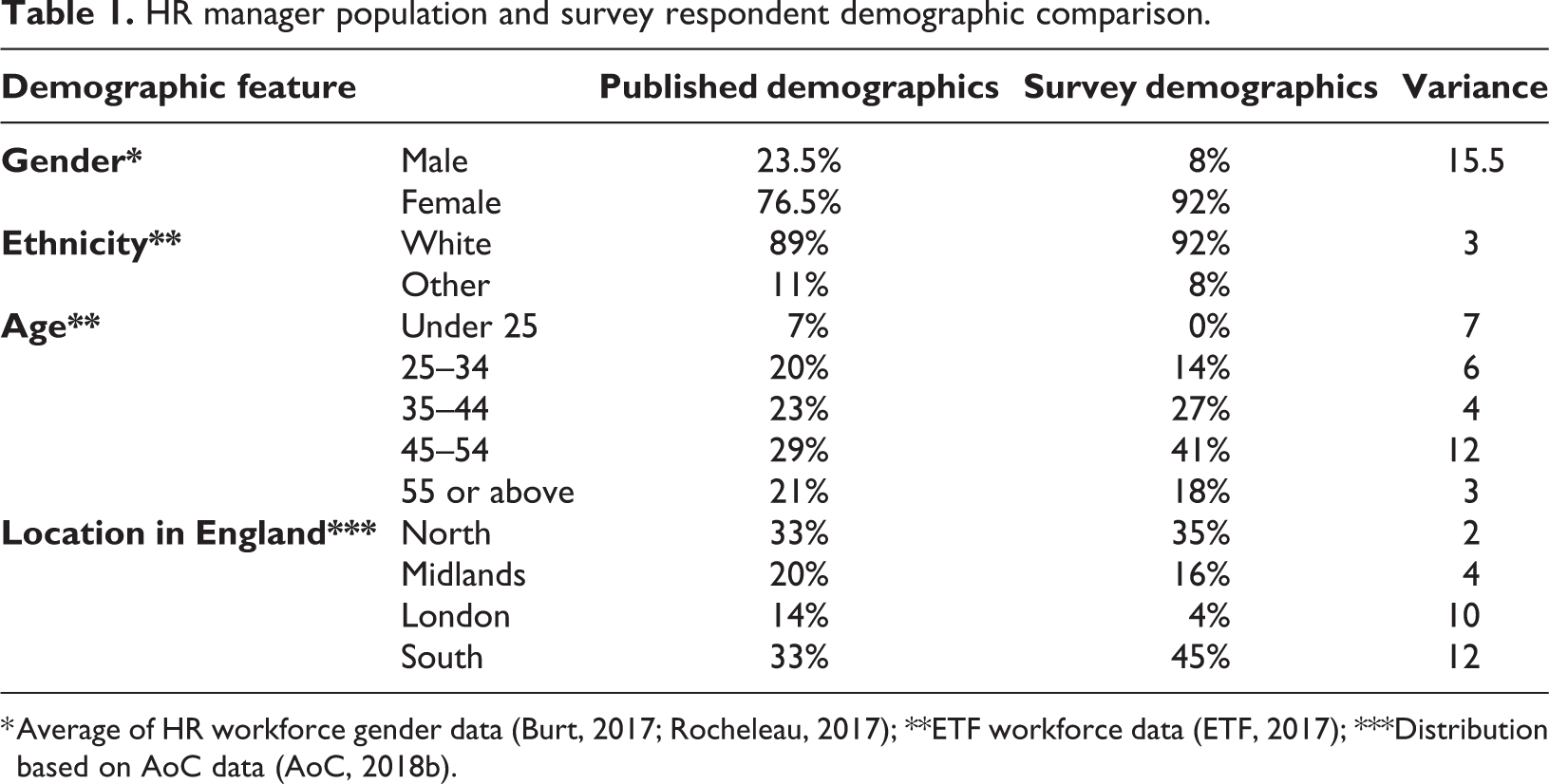
* Average of HR workforce gender data (Burt, 2017; Rocheleau, 2017); **ETF workforce data (ETF, 2017); ***Distribution based on AoC data (AoC, 2018b).
Data analysis: responses
Participants were provided with a list of 33 skills, knowledge and attributes that might feature in an FE middle manager’s role. This list was derived from analysing academic journals and professional body reports that discuss the role. From the list, participants were asked to select the five most important role requirements of being an FE middle manager. The role requirements that were most selected are: (a) managing and developing team and individual performance (62.7%); (b) developing and sustaining service for learners (49.0%); (c) managing quality in the delivery of services (47.1%); (d) managing change and continuous improvement (41.2%); and (e) being resilient (39.2%).
Participants were also asked an open-ended question: ‘What do you believe makes a person successful as a Further Education Middle Manager?’ Fifty-five percent of participants responded to this question. This data was subject to a two-stage analysis. The first stage provides a frequency analysis of words used in the responses of HR managers. The second stage used the principles of thematic analysis.
The results of the first stage of analysis, frequency analysis, shows the most frequently used words were: ability (24 times); change (11 times); team (9 times); resilience (7 times); effective (7 times); learner (7 times); staff (7 times).
The second stage draws on the principles of thematic analysis as explained by Guest, et al. (2012). They explain that this type of analysis is used to draw out themes in qualitative data, going beyond calculating the frequency of words. The data is reviewed to consider implicit and explicit meaning that can then be collated into themes. Guest et al. (2012) acknowledge the potential difficulty in processing larger quantities of qualitative data as the analysis is based on consistent interpretation by the researcher. However, the data set for this study is within acceptable size parameters to ensure a high confidence for consistency of interpretation.
Thematic analysis of the qualitative responses highlighted four themes within the responses. The majority of responses aligned with one of the following themes: (a) a good understanding and commitment to the FE sector; (b) a focus and drive to ensure learners/students are successful; (c) an ability to lead and foster team working relationships; and (d) resilience and an ability to respond to change.
There were seven responses aligned to the first theme responses. The responses present expectations of sector knowledge and an intrinsic motivation to work in and for the sector. The responses that aligned to the first theme included: Combination of good FE sector knowledge/understanding of student delivery e.g. study programmes. (Respondent 18) (P)assionate about the sector. (Respondent 21) Putting the learners first, building a cohesive, positive team who can achieve good results and retention. (Respondent 25) Someone who has a willing to listen, learn and reflect and has the learner’s best interests at heart. (Respondent 20) Instilling and maintaining the passion to deliver a quality service to learners. (Respondent 5) Commitment to the success of their learners. (Respondent 4) An ability to understand people and know what motivates them. (Respondent 24) The ability to motivate staff to navigate through the constant change. (Respondent 5) (B)uilding a cohesive, positive team who can achieve good results and retention. (Respondent 25) Cognizant of the importance of engaging with staff to share vision and how to get there, performance management of underperforming staff. (Respondent 22) A great communicator and motivator. (Respondent 21) Look after your people and the rest looks after itself. This doesn’t mean doing what the staff want, it is about providing an environment of trust, support and guidance to achieve the organisation objectives. (Respondent 9)
Finally, the fourth theme received 14 responses. The responses often referred to either coping with change, exhibiting attributes of resilience or both. Examples of responses include: Growth mindset, accepting of change. (Respondent 1) Strong emotional intelligence. (Respondent 17) Resilience – in the face of constant change. (Respondent 4) Resilience and the ability to cope with a fast moving, very dynamic and changeable environment. (Respondent 12) They must be resilient and emotionally mature. (Respondent 16) Ability to adapt to change. (Respondent 8)
Discussion
Prior studies into the role of FE middle managers provide valuable insights; as previously established in this paper, these studies considered the role from a range of perspectives: teacher, manager and senior leader. However, this paper provides a different and unique perspective (HR manager) from which to consider the role. It proposed that the HR manager has a central role with responsibility for the recruitment and development of FE middle managers and so is well placed to provide an objective assessment of the FE middle manager role.
The Four Pillars of Professional Expectations
The findings of this paper congregate HR managers’ responses into four pillars from which the professional expectations of FE middle managers should stem. These pillars are established by considering the statistical and thematic analysis of HR manager responses. This synthesis provides a clear prioritisation of the pillars for professional expectations; this is illustrated in Table 2. Prioritisation has been determined by considering the responses to both elements (quantitative and qualitative) of the questionnaire holistically. Firstly, the number of statements aligned to each thematic area. Secondly, the percentage agreement with the five skills, knowledge and attributes. The frequency of words used by participants was not used as it is embedded into the thematic analysis.
Thematic areas prioritised.
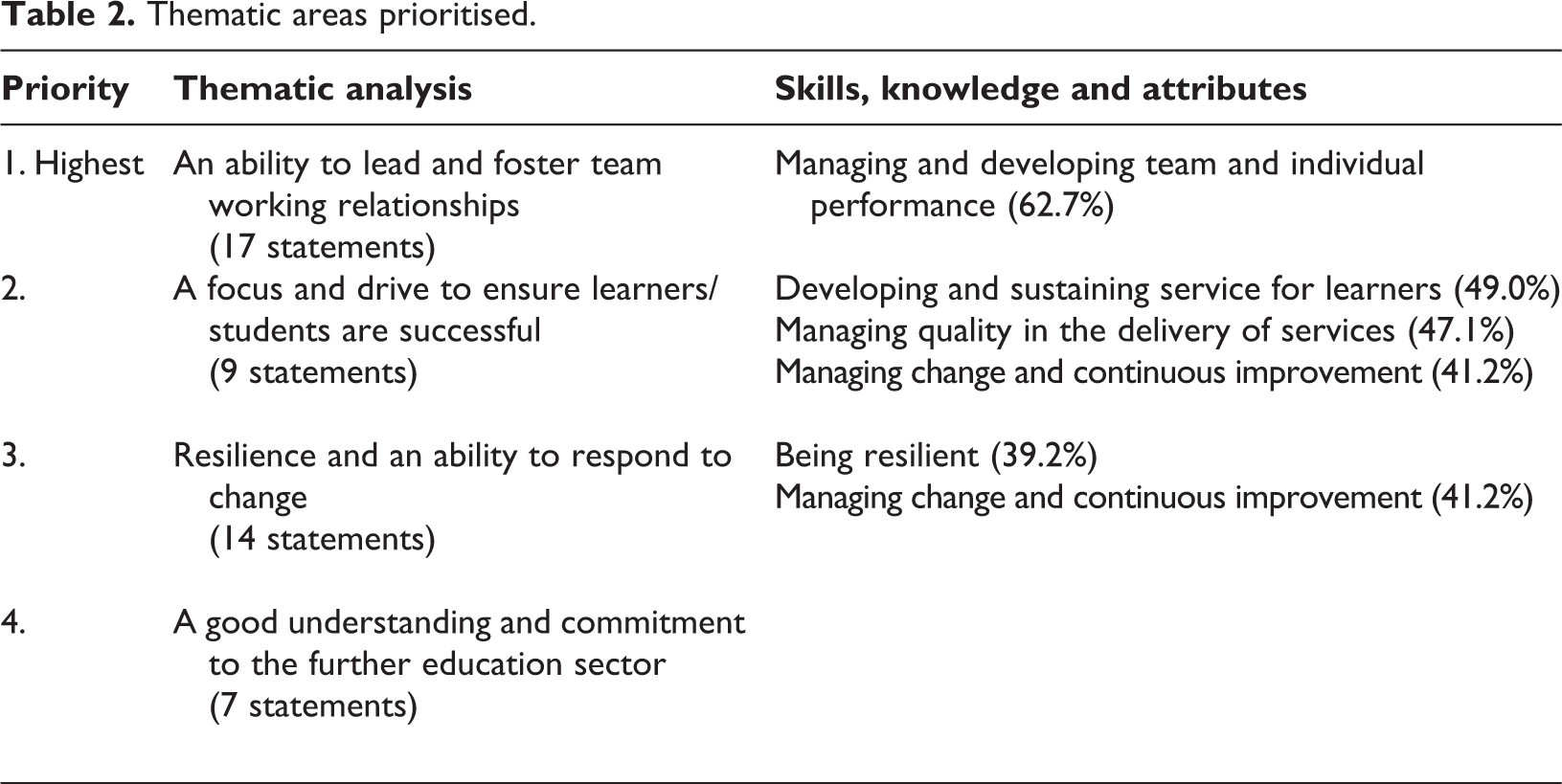
The highest priority pillar for professional expectations is the ability to lead and foster team working relationships. To an extent this is unsurprising when considering the studies published to date with regard to FE middle management practices. Poor practice in the management of staff was historically a key failure of the sector (Avis, 2005). Other scholars have iterated the importance of staff management as a core function of the FE middle manager role (Beresford and Michels, 2014; Briggs, 2005a). This paper supports prior research and provides quantifiable data from HR managers, responsible for the job design and recruitment of FE middle managers, who rate staff-centred attributes as highly important, positioning this attribute as a key expectation and priority (being an effective manager of people) for FE middle managers. However, this needs to be supported by a set of values. Often the criticism of FE middle managers is they are goal orientated with a private sector approach driven by national and local policies (Boocock, 2014; Edward et al., 2007; Simmons and Thompson, 2008). This is caused by a focus on meeting targets, rather than holistically enhancing the quality of educational provision.
The second priority pillar initially seems less apparent. This is because the thematic analysis elicits a higher number of statements that support resilience yet the two lowest-ranking skills, knowledge and attributes. In comparison, three of the skills, knowledge and attributes, all of which are ranked higher than those linked to resilience, feature in the thematic analysis for students. It is for this reason that the second priority pillar is considered to be the focus and drive to ensure learners/students are successful. While not the focus of this paper, the quality of teaching and learning does feature in FE management research and its importance is evident in the responses of HR managers to this study. Simmons and Thompson (2008) highlight the challenges faced by teachers through increasing workload, which can be the result of management actions. Beresford and Michels (2014) and Briggs (2005a) discuss the challenge of managers having to ensure that the quality of provision (de facto teaching and learning) is to the highest standard, against a backdrop of ensuring that all other aspects of an FE institutions business are also attended to. This can be very challenging, especially for new managers who are transitioning from teacher to manager (Corbett, 2017; Page, 2013). Yet despite these competing priorities, this paper has found that HR managers agree that quality of provision is a key priority for someone to be an effective FE middle manager.
The third pillar is resilience and an ability to respond to change. As discussed above, there is strength of opinion from HR managers that a key attribute of FE middle managers is to be resilient. In turn, this enables them to respond to and manage change. It is likely that HR managers are mindful of the rates of staff turnover within the FE sector; while a certain level of staff attrition is to be expected, rates for teachers and middle managers were reported at 13% in the academic year 2018–2019, compared to 11.2% for teachers and 11.9% for middle managers in 2015–2016. An increasing staff turnover combined with national teacher shortages (National Audit Office (NAO), 2016) is potentially a factor that HR managers are mindful of as they are tasked with recruiting to vacant positions. The focus on resilience is likely, in part, to be a reassurance that an FE middle manager can cope with the role so to reduce staff turnover. The Darwinism approach to surviving the FE middle manager role suggested by Page (2013) combined with Thompson and Wolstencroft’s (2015) assessment that FE middle managers are often ill equipped reinforces that the need for resilience is important, albeit not necessarily for the right reasons.
The other aspect of the third pillar is the ability to respond to and manage change. The dynamic nature of the FE sector and its impact on the working environment is featured within most, if not all, published FE research. The challenges are wide ranging and include changes in policy, financial austerity, new professional standards, revisions to the structure of the FE sector, updates in external auditing and evaluation methods. The culmination of these external factors affects those who operate in the sector, and to navigate them an FE middle manager needs to have a good working knowledge of the FE sector. FE middle managers are required to develop entrepreneurial solutions (Beresford and Michels, 2014) in an effort to avoid shortfalls on KPIs linked to financial outcomes. This can lead to ambiguity and a feeling of requiring teachers to do more for less (Simmons and Thompson, 2008), which can lead to resentment and the development of an ‘us and them’ culture. Furthermore, it exacerbates a perceived over-reliance on bureaucracy and targets, which is considered by several scholars to be to the detriment of staff (Avis, 2005; Edward et al., 2007; Simmons and Thompson, 2008; Thompson and Wolstencroft, 2015). Corbett’s (2017) study identified that it is not unusual for managers to be targeted as the ‘problem’, as there is a lack of appreciation that they are trying to initiate a solution. The pressures placed on FE middle managers to meet targets, support staff and respond to external pressures require a high level of resilience and agility to respond to change. While this in itself is not a new contribution, the recognition and value placed on resilience and responding to change are often inferred in research rather than empirically evidenced. Therefore, it is important that this is affirmed as a key expectation of the FE middle manager role.
The final pillar is a good understanding of and commitment to the FE sector. While this pillar was not represented in the responses to skills, knowledge and attributes, it was a feature of several responses to the open-ended question ‘What do you believe makes a person successful as a Further Education Middle Manager?’ This finding illustrates that there is a professional expectation that FE middle managers require both knowledge and appreciation of the sector in which they are operating. This finding is both useful for the development of professional standards in FE middle managers and an interesting contribution to management theory. The implication could suggest that in order to be a successful manager one needs to possess a contextualised skills set. This moves away from generic management models that draw on the principles of scientific management and human relations theory and move more towards an open systems theory-style model, whereby managers need to consider factors beyond their organisation and consider the environment in which their organisation is operating. A study into managerial competencies conducted in the USA by Dierdorff et al. (2009) supports this by highlighting that a generalised approach is not sufficient when considering the capabilities of managers. After analysing 8633 manager roles they developed a framework of managerial competencies, but highlighted that for it to be of value it needed to be contextualised to the operating environment. Given the dynamic nature of the FE sector, illustrated by a range of scholars (Avis, 2005; Leader, 2004; Simmons, 2014), in which FE middle managers need to be responsive (Beresford and Michels, 2014), it is would appear necessary that those managers would need to understand the FE sector and value what it is setting out to achieve.
Conclusion
Middle management roles are challenging. However, when combining the pressure of middle management with a highly changeable operating environment and a lack of clarity of expectations there is a high potential for issues to occur. Historically, the FE sector has experienced a range of policy changes that have resulted in structural, fiscal and pedagogical reforms. While these reforms may have been necessary and in some cases beneficial, they also bear a weight on those who work in the sector. Strategies to support the sector have varied and sector support bodies responsible for implementing them have lacked longevity, thus hampering the ability to embed systemic support systems. There are, however, indications that the most recent sector support body (ETF) is beginning to have an impact on some roles in the sector. Unfortunately, more is needed to ensure a holistic approach.
This paper has focused on a role that is subject to much criticism. However, the importance of this role should not be understated. FE middle managers are responsible for translating the vision set out by senior managers into day-to-day operations. They manage their teams to ensure a high quality of provision delivered to students while also working across their institutions, engaging with a variety of stakeholders with consideration of daily management tasks such as curriculum development, timetabling, budget management, safeguarding, health and safety. To fulfil such a complex role with little or no relevant training is unreasonable (at best).
This paper set out to respond to one overarching research question: what are the contemporary professional expectations of FE middle managers in England? It sought to answer this by seeking the professional opinions of HR managers from across England. The study provided a robust quantitative and qualitative data set from which to draw conclusions. The findings of this paper provide both a greater understanding of the FE middle manager role and a theoretical framework and starting point from which a contemporary set of national professional expectations can be developed. This contribution to both theory and practice not only presents four pillars of professional expectations, but also a prioritisation of the pillars, which are: (a) an ability to lead and foster team working relationships; (b) a focus and drive to ensure learners/students are successful; (c) resilience and an ability to respond to change; and (d) a good understanding and commitment to the FE sector.
It is suggested that HR managers can use the four pillars as criteria for decision-making when recruiting new FE middle managers. Furthermore, the pillars can be used as expectations that govern behaviours and inform professional development. This contribution is unique as the professional expectations are grounded in research and contextualised through the responses of those working and recruiting in the FE sector. Furthermore, the professional expectations presented in this paper provide the cornerstones from which to develop a set of professional standards for FE middle managers, something that has not existed since the now defunct FENTO professional standards for managers were developed in 1999.
This paper highlights the challenging and uncertain nature of the FE sector, illustrated by policy churn, fiscal challenges and structural reforms. By presenting professional expectations which draw upon existing research and a new unique perspective (that of HR manager), this paper provides a research-informed approach to practice from which FE institutions can consider the development and support needs of current and aspiring FE middle managers. The FE middle manager role is integral to FE institutions turning their strategy into an operational reality. Therefore, investing in the FE middle manager role will benefit FE middle managers, their teams and institutions in navigating current and future challenges faced by the FE sector.
While this paper has grounded its findings within the English FE sector, it is suggested that the theoretical framework it has established (the Four Pillars of Professional Expectations) could provide a platform for further investigation in vocational education sectors globally as well as having wider application to other sectors in England that have a lack of professional expectations for middle management.
Footnotes
Declaration of conflicting interests
The author declared no potential conflicts of interest with respect to the research, authorship and/or publication of this article.
Funding
The author received no financial support for the research, authorship, and/or publication of this article.
