




Abstract
Notwithstanding the globally significant progress in reducing poverty over the last two decades, many people still live in poverty. Consequently, social protection remains key to welfare sustainability. In this article, we used longitudinal data from Malawi to examine the impacts of farm input subsidies on poverty convergence. Convergence is coined here as the reduction in the persistence of poverty over time. We specifically estimated the response of poverty convergence in a current period to farm input subsidies that were provided in a prior period to understand if the programmes build sustainable welfare resilience among poor households. We analyse the convergence in two opposing land rights regimes: matrilocal settlements, where only women hold rights to land, and patrilocal settlements, where only men hold rights to land. Matrilocal and patrilocal settlements offer varying incentives to household heads, who are often men, of investing in familial land. We find that farm input subsidies lead to poverty convergence only in settlements where men hold rights to land and receive the subsidies on behalf of their households. Poverty convergence is non-responsive to the subsidies in settlements where men receive the subsidies on behalf of their households, while women, together with their extended families, hold rights to the land. We further find that the impact of farm input subsidies on poverty convergence is significant in a year when Malawi faced drought, suggesting that the subsidies built sustainable resilience against an unanticipated climatic shock in poor households. The article calls for anti-poverty policies to target poor people while paying attention to their landholding traditions if shared prosperity is to be achieved.
Introduction
Poverty remains one of the pressing issues in the current development policy (The World Bank, 2018), despite numerous efforts to curb its spread at both national and international levels (Government of Malawi, 2012, 2017; United Nations, 2015). In Malawi, poverty stagnated at around 50 per cent during the implementation of the Millennium Development Goals (MDGs) (Government of Malawi & National Statistical Office, 2014). Malawi’s poverty remains around 50 per cent as the country pursues Sustainable Development Goals (SDGs) (NSO, 2021). Like in most poor sub-Saharan African countries, Malawian poverty is closely linked to climate variability (Asfaw et al., 2016; The Economist, 2019). Particularly, because 84 per cent of the Malawian population depends on rain-fed agriculture (Asfaw et al., 2016), droughts expose the country to abject poverty (Winsemius et al., 2018). Social protection, especially in periods before such negative climatic shocks occur, should therefore not only be viewed as a distributional virtue but also a long-term investment in building resilience against welfare losses among vulnerable households.
Farm Input Subsidy Programmes (FISPs) are government social protection policies touted to reduce poverty through sustained food security (Chibwana et al., 2014; Chirwa & Dorward, 2013). In Malawi, a FISP targets poor farmers through household heads (Djurfeldt et al., 2018). By targeting the poor, the programme is hoped to reduce poverty and induce shared prosperity through the reduction of the welfare gaps between the wealthy and the poor (Mwale, von Fintel et al., 2021). The Government of Malawi established the FISP in 2006 (Harou, 2018) and has implemented it to date. The stagnant poverty amidst continued implementation of the FISP, therefore, invites questions that until the present remain under-investigated in the FISP literature. Does the subsidy not reduce poverty and inequalities at all, or does it selectively do so with no aggregate country effects? These questions suggest that the context in which the FISP is implemented needs adequate understanding.
One of the important contextual factors that has the potential to mediate the impacts of the FISP on poverty and inequality is the rights to land. Malawian land is mostly held under customary law (Berge et al., 2014), and it is acquired through inheritance (Lovo, 2016). Only a child who settles in their natal community when they reach a certain age inherits land (Benjamin, 2020). The settlement patterns follow either matrilineal or patrilineal kinship traditions (Kishindo, 2011). Upon marriage, patrilineal couples reside in the groom’s village, a settlement pattern known as patrilocal, while matrilineal couples can live either in the natal village of the bride, in a settlement pattern called matrilocal, or reside in a patrilocal settlement (Lowes, 2020). Therefore, only one partner in the marriage owns land at a time, and it can only be the man or the woman, depending on post-marriage settlement practices at play.
Malawian households are predominantly patriarchal: men make most of the decisions about resource use and allocation (Chikapa, 2021). By implication, men control how FISP inputs are used and how produce, as a result of FISP, is distributed within households (Mwale, von Fintel et al., 2021). Moreover, the FISP programme directs that inside households, the recipient should be the husband (Djurfeldt et al., 2018). Therefore, the impacts of the FISP on household welfare could manifest, conditional on men’s farm investment behaviour. However, due to land insecurity, matrilocal men often make little investment in land because it is owned and largely controlled by wives and the wives’ clans (Place & Otsuka, 2001; Walther, 2018). Matrilocal men could then be less willing to invest the FISP in the familial land 1 or, at least, be less inclined to provide adequate labour in household farms to complement the FISP inputs. The impacts of the FISP on poverty and inequality could therefore be limited to patrilocal settlements, where FISP holders (men) are motivated to invest largely in familial land since they own the land and fully control its produce.
A small literature in economics quantifies the impacts of farm input subsidies on poverty (Arndt et al., 2016; Funsani et al., 2016; Mason et al., 2017; Mkwara, 2013; Smale et al., 2019; Wossen et al., 2017). While there is agreement that the subsidies reduce poverty, these studies ignore a number of aspects that could inform the design, implementation and evaluation of social protection policies like the FISP. First, they do not investigate whether inequalities in poverty reduce due to the subsidies. Nevertheless, it is possible that some poor people progress out of poverty even when they do not move above the poverty line, which is a sign of progress towards shared prosperity. Second, they ignore the role of land rights in mediating the impacts of subsidies on poverty inequalities. However, the absence of land rights is well known to affect investment decisions (Deininger et al., 2019; Engblom & Isacsson, 2019; Hall & Kepe, 2017), and therefore could limit the impacts of the subsidies on poverty inequalities. In addition, the literature is limited to examining changes in poverty in response to instantaneous subsidy receipt. However, building resilience to current poverty shocks demands a social protection investment base of earlier periods (Johnson & Krishnamurthy, 2010). Otherwise, the remedial impacts of instant subsidies on contemporary negative shocks to welfare could only be short-lived.
In this article, we analyse the impacts of farm input subsidies on poverty convergence among Malawian households. We define convergence as whether, over time, poverty became less persistent among households that were poor at the baseline. To understand the mediating role of land rights on the impacts of FISP on poverty convergence, we split the analysis by matrilocal and patrilocal settlements. Assuming households have homogeneous preferences, poverty should reduce over time at a higher rate in patrilocal settlements than in matrilocal settlements because the patrilocal FISP is the responsibility of men who could have an interest in investing it in the household farm. This is unlike the FISP that is with their matrilocal counterparts. We use the Malawi Integrated Household Panel Survey (IHPS), which provides four waves of longitudinal data for the years 2010, 2013, 2016 and 2019. This time period is key because, in 2016, Malawi experienced drought, which instantaneously eroded livelihoods. The year 2016 therefore allows investigating whether subsidy programmes in the past built resilience to unanticipated climatic shocks of the future within poor recipient households. Comparing the 2016 results to the other years that had more stable rains also allows understanding whether the subsidies are key to poverty convergence in either good or bad economic environments.
We found that in years where Malawi did not experience drought, poverty convergence was non-responsive to the FISP, which was provided to the poor in a prior period. Prior FISP did not adequately thrust the welfare of the poor to catch up with that of the wealthier in a good economic environment. However, in the year in which Malawian households faced a drought (2016), FISP that was provided in a prior period led to high poverty convergence for the poor beneficiaries. This was likely because the FISP built resilience that cushioned its beneficiaries against the impacts of the drought on their welfare. The impacts of the subsidy on poverty convergence were limited to patrilocal settlements; we did not find similar impacts of the subsidy in matrilocal settlements. We argue that the stagnation of poverty in matrilocal settlements confirms that the FISP is under-invested in these areas because its holders have less interest in enriching the household land, whose proceeds are controlled by their wives and the extended family of the wives (Walther, 2018). Considering that matrilocal settlements dominate Malawi (Johnson, 2018), our results could illuminate why poverty has stagnated in the country despite numerous agriculture policy efforts that fight poverty at the household level.
Our article contributes to several strands of literature. First, we add to scholarly work on the impacts of farm input subsidies on poverty. While previous evidence (Funsani et al., 2016; Mason et al., 2017; Smale et al., 2019; Wossen et al., 2017) reveals that the subsidy programmes reduce poverty on aggregate, we show that heterogeneity in the impacts of the subsidies on poverty exists. Particularly, the Malawi FISP cushions poor farmers against adverse climatic shocks only in settlements where land rights and entitlement to the subsidies intersect. Second, we add to the literature on targeting the efficiency of welfare programmes. While previous evidence (Mason & Jayne, 2013) suggests that targeting welfare programmes towards women unambiguously increases household welfare, we argue that if farm input subsidies are to attain such household welfare benefits, targeting only women is not a panacea, but rather targeting them while enforcing women’s rights to land is key. This is because, in communities where women only de jure own land but do not de facto own and control the land, poverty remained persistent in our sample. In addition, we speak to the literature on social protection. While studies (Brugh et al., 2018; Mason et al., 2020; Miller et al., 2010; Pauw et al., 2016) show that government programmes are merited on their ability to either eliminate or fail to eliminate poverty, we argue that progress out of poverty across different arrays of welfare stress should also be included as an evaluation criterion. We show that even without inducing poverty convergence in normal times, the Malawi subsidies cushioned poor farmers against drought.
In the second section, which follows this one, we describe the data that we used to establish our findings. The emphasis is also placed on describing the context for the study and the variables of interest that we examine in the analysis. In the third section, we outline a conceptual framework that suggests how the mediating role of FISP on poverty convergence could manifest. We shed more light on how land rights regimes could lead to heterogeneity in the mediating role of FISP. In the fourth section, we present methods that we adopted, and the fifth section presents the results. The sixth discusses the results, while the seventh section concludes the article.
Related Literature
Social Security Measures and Its Impact on Welfare
In this study, FISP is considered one of the social security measures that the Malawi government implemented to improve the income and welfare of farming households. This is based on existing evidence of the crucial role that government social security measures play on welfare in many developing countries. A number of studies have suggested that increasing expenditure on the social sector improves welfare. For instance, using longitudinal data from 55 low-income and middle-income countries from 1990 to 2009, Haile and Niño-Zarazúa (2018) found that when governments increased social expenditure on health, education and social protection, there was strong evidence of associated improvements in aggregate welfare in these developing countries. Similarly, Schmidt et al. (2024) found that from a sample of non-OECD countries, this welfare measure, such as social safety nets and social protection spending, exerts a positive and significant effect on a range of well-being outcomes, including life satisfaction, longevity, human capital, gender empowerment and gender inequality. In fact, other studies suggest that it is not merely an increase in spending that matters for improved welfare but also the systematic nature of the increase. Equity in social spending (measured by the share of social protection spending going to the bottom quintile) is a significant and strong predictor of improved distributional outcomes and hence more improved welfare for the poorest segments of the population (Popova, 2023). Social cash transfers have been linked to a reduction in monetary poverty; an increase in school attendance; an improvement in health and nutrition; improvements in saving, investment and production; and improved women empowerment (Bastagli et al., 2016).
In Malawi, social protection programmes have a positive impact across different measures of welfare. For example, the social protection programme of unconditional cash transfers has been found to build resilience among the ultra-poor in addition to protecting their current consumption (Otchere & Handa, 2022). In fact, in comparison with other countries such as Ghana and Zimbabwe, Malawi has documented the largest and most consistent impacts of social protection programmes on welfare, and its transfer values are in line with international best practices (Handa et al., 2022). Other studies in Malawi have linked social protection to climate sustainability. For instance, Scognamillo and Sitko (2021) underscore that participation in public works programme such as the Malawi Social Action Fund (MASAF) increases the probability that farmers adopt resource-intensive climate-smart agricultural practices.
Farm Input Subsidies and Poverty Reduction
There is a large set of literature that documents the role input subsidies have had on poverty across sub-Saharan Africa. Jayne and Rashid (2013) have synthesised evidence highlighting that input subsidies have mixed results on poverty. While in some countries, subsidies have been taunted to have had positive effects on reducing poverty, some studies debate these assertions (Lunduka et al., 2013).
There are a number of studies that document the positive effects of input subsidies on poverty reduction. Evidence from Zambia and Kenya, for example, shows that input subsidies have reduction effects on poverty headcount as well as poverty severity (Mason et al., 2017, 2013, 2020). An improvement in annual household income and per capita consumption expenditure and a reduction in poverty due to a seed voucher subsidy were established in Nigeria (Awotide et al., 2013). Furthermore, e-voucher-based input subsidy programmes have been found to have a positive effect in reducing poverty headcount ratios in Nigeria (Wossen et al., 2017). However, other studies have also highlighted that input subsidies did not have poverty reduction effects. For example, evidence from Tanzania and Zambia shows mixed results and very limited results on poverty reduction (Hemming et al., 2018; Kato & Greeley, 2016).
FISP and Its Impact on Welfare Among Households in Malawi
Just as evidence from other sub-Saharan African countries has shown, the effects of input subsidies have been mixed in Malawi. For example, as noted earlier, studies have shown that FISP has a positive effect in reducing poverty, improving the welfare of poor households and increasing income (Chibwana et al., 2014; Chirwa & Dorward, 2013; Mkwara, 2013). However, other evidence also suggests that the effects of FISP have had mild effects on poverty (Lunduka et al., 2013), failed to improve women’s agency (Mwale, von Fintel et al., 2021) and that the spatial delivery of FISP may have contributed to the popular perception of widespread maize improvement (Messina et al., 2017).
Context and Data
Malawi is a country that is well known for high levels of poverty, and its main livelihood is subsistence farming on small pieces of land (The World Bank, 2018). Malawian farming is largely rain-fed, such that climate variability is highly correlated with poverty in the country (Asfaw et al., 2016; IMF, 2017). In the past 36 years, Malawi has experienced major droughts, with a more recent one in the 2015/2016 growing season (The World Bank, 2016; Katengeza & Holden, 2021). The negative impacts of drought are more pervasive in rural Malawi (Ajefu & Abiona, 2020; Asfaw & Maggio, 2018), where most farmers reside (GoM, 2020).
The data used in this article are from four rounds of the IHPS, an ongoing longitudinal research of Living Standards Measurement Study-Integrated Household Surveys (LSMS-ISA), which collects most of its information from rural Malawi. With technical support from the World Bank, the Malawi National Statistical Office (NSO) administers the IHPS. The IHPS is nationally representative across all regions and districts of Malawi. The baseline year was 2010, and the research is due to continue in the coming years. A cohort of 3,104 households residing in 204 enumeration areas (EAs) was followed in 2013 from the baseline of 2010. After 2013, split households increased.
Household split occurs when some members of the original living structure form their own homes in subsequent survey waves, often because of new marriages among members who were unmarried in the previous waves. Due to the rising cost of tracing the newly-formed households, in 2016, the Malawi NSO reduced the number of households that were targeted for interviews. From the 2010 baseline, 1,989 households were traced in 2016. These households resided in 102 out of the original 204 EAs. Following all 1,989 households, including their split households, increased the sample to 2,508. The final wave of 2019 followed these 2,508 into their locations, including their split households, which further increased the final sample to 3,178.
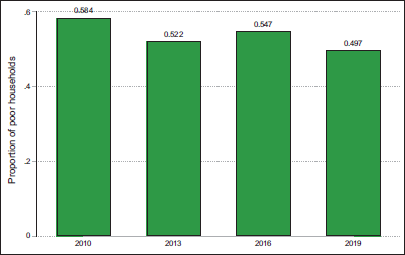
Poverty was captured as a dummy for headcount. Households that were below the poverty line were assigned a value of 1, while those above the poverty line were assigned a value of 0. We used poverty at time t as a dependent variable. Figure 1 shows the poverty distribution in our sample. Limited progress towards poverty reduction occurred between 2010 and 2019. From 2010 to 2013, poverty reduced by 12 per cent. In 2016, poverty increased by 5 per cent, before reducing by 10 per cent in 2019. The hike in poverty for 2016 likely resulted from the drought that occurred in the year (The World Bank, 2016). This outcome also confirms that climate variability closely associates with poverty in Malawi due to the country’s dependence on agriculture and rain-fed farming in particular. It is therefore not surprising that Malawi’s anti-poverty policy mainly targets agriculture, with FISP as the key strategy.
The IHPS captured FISP participation using a dummy variable, which we used as the main treatment: 1 represented beneficiary households, while 0 represented non-beneficiary households. The Malawi FISP is a package that contains four vouchers. Two of these vouchers can be used to redeem 100 kg of maize fertiliser: 50 kg of basal dressing fertiliser and 50 kg of top dressing fertiliser (Mwale, Kamninga et al., 2021). The other two vouchers can be used to redeem maize seeds. The Malawian Government covers about 80 per cent of the market cost for the subsidised inputs, and farmers contribute the remaining 20 per cent (Harou, 2018). 2 FISP beneficiaries are productive poor farmers who are permanent residents of their communities and hold land for maize cultivation (Basurto et al., 2020).
Since 2008, FISP changed its goals from increasing productive efficiency of maize to social protection (Lunduka et al., 2013). The social protection focus increased the proportion of poor farmers in the beneficiary list (Lunduka et al., 2013). However, the total number of beneficiaries declined over time (Mwale, Kamninga et al., 2021), until 2020 when the FISP was replaced by the Affordable Inputs Programme (AIP) (Malawi Anti-Corruption Bureau, 2021). The AIP aims to abolish targeting and extends the programme to all smallholder farmers in Malawi (GoM, 2020).
Figure 2 shows the distribution of FISP beneficiaries over time in our sample. We split this distribution by settlement patterns, which also represent different land rights regimes. Figure 2 confirms that FISP reduced the proportion of beneficiaries between 2010 and 2019. More beneficiaries, as a proportion of the total population within a settlement, were selected from matrilocal communities in comparison to patrilocal communities.
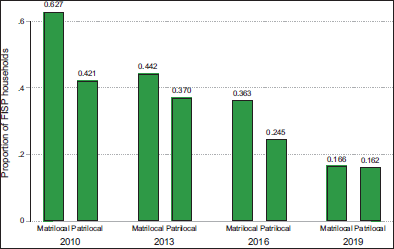
The difference in the proportion of FISP beneficiaries between matrilocal and patrilocal settlements is larger in the period from 2010 until 2016. In 2019, the two settlement patterns received FISP in similar proportions. In Table B1 of Appendix B, we present the characteristics of matrilocal and patrilocal settlements across years. In 2010, more matrilocal households than patrilocal households were poor, and the proportion of FISP beneficiaries was significantly higher in matrilocal relative to patrilocal settlements. In 2013, poverty reduced in matrilocal areas such that there were no significant differences in poverty by settlement type. However, the FISP still selected more beneficiaries from matrilocal settlements. In 2016, poverty increased in matrilocal settlements and became statistically higher for matrilocal settlements when compared to poverty in patrilocal settlements. In 2019, there were no statistical differences in either poverty or FISP distribution by settlement patterns. This is confirmed by Table C1 of Appendix C, which shows that all years but 2019 had differences in the distribution of FISP across the settlement patterns. However, without differentiating by these settlement patterns, more FISP beneficiaries were poor than non-FISP beneficiaries, as revealed in Table C1.
In general, these outcomes suggest that poverty and matrilocal settlements intersected strongly to determine the distribution of FISP. Moreover, Table B1 of Appendix B confirms that FISP is a social protection strategy. Particularly, matrilocal settlements have low annual average rainfall across all 4 years, suggesting that they are prone to negative climatic shocks. Matrilocal settlements are also generally found in communities that are densely populated, which implies that they hold the smallest pieces of land. In addition, most matrilocal settlements are found in remote areas with poor access to roads. Furthermore, in 2016 and 2019, matrilocal settlements were highly targeted by the MASAF, a programme that finances self-help projects and transfers cash to vulnerable households (Kishindo, 2001).
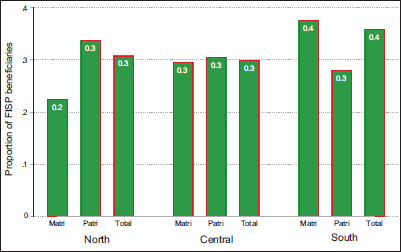
Malawi has three regions: north, central and south. The northern region of Malawi is predominantly patrilocal, the central region is mixed, while the southern region is largely matrilocal. Malawian poverty distribution also follows these unique spatial patterns. Across many years, poverty has been highest in the southern region, seconded by the northern, then the central region (NSO, 2012, 2021). As such, Malawian anti-poverty interventions, such as FISP, mainly focused on households in the matrilineal-matrilocal predominant southern region.
Figure 1 shows that between 2010 and 2019, 40 per cent of households in the southern region received FISP, while 30 per cent of households received FISP in the northern and central regions during the same period.
Regarding spatial patterns of poverty by settlement customs, Figure 1 reveals that the southern recipients were predominantly matrilocal, while the northern recipients were predominantly patrilocal. The central region had no custom differences in the distribution of FISP.
It is therefore evident that matrilocal settlements comprise more vulnerable households and receive more social welfare support relative to patrilocal settlements. Nevertheless, whether social welfare support through programmes such as FISP affects poverty inequalities differently within these two settlement types remains an empirical question that we conceptualise below.
Conceptual Framework
To understand how FISP impacts poverty convergence among different land rights regimes, we draw insights from the general economic convergence hypothesis (Rassekh, 1998), which is a key implication of neoclassical growth modelling (Solow, 1956; Swan, 1956). The economic convergence hypothesis, particularly its branch of the income convergence hypothesis, states that the welfare differential between the wealthy and the poor countries should systematically diminish over time (Rassekh, 1998; Lyncker & Thoennessen, 2017). Several authors (including King & Ramlogan-Dobson, 2015; Lichtenberg, 1994; Oh & Evans, 2011; Rivas & Villarroya, 2017) tested the hypothesis at the macro level. Micro economic studies conducted in 2013 and 2021 have extended the hypothesis to examine convergence in non-income indicators. An example is the medical literature that examines nutrition convergence among children under the age of five (see Balla et al., 2021; Outes & Porter, 2013). In this article, we adapt the income convergence hypothesis to estimate changes in poverty over time within households. Our important contribution to this framework is establishing whether farm input subsidies accelerate the reduction in poverty stagnation differently under opposing land rights regimes.
Therefore, consider two homogeneous households i1 and j1 residing in community c1 that differ only in their liquidity constraints. If both households receive a uniform resource transfer from the government that can be invested in time t − 1, and household i1 faces larger liquidity constraints than household j1, the marginal increase in consumption due to the resource in time t should be higher in j1 than i1. This assumption has been empirically proven for the Malawi FISP by Mwale, Kamninga et al. (2021). The authors show that poor Malawian households that benefited from FISP in prior periods increased consumption in their contemporary period by a larger magnitude than wealthier households that benefited from the FISP.
Since the resource must be invested to produce enduring consumption effects in the long run, let us add another two households i2 and j2 that are identical to i1 and j1, respectively, but reside in a community c2 that offers lower investment incentives for the government resource than community c1. The enduring effects of the resource on future consumption could be weak or non-existent in households i2 and j2, such that a large consumption gap between the wealthy and the poor could remain persistent because the impacts of the resource are too weak to allow welfare to catch up, or at least to make significant progress towards catch up. In Malawi, Walther (2018) confirmed that communities offer differing incentives for investment in household farms due to variations in land inheritance customs. This could therefore alter how FISP is invested, hence the magnitude of its impacts against poverty persistence within beneficiary households relative to non-beneficiary households.
Particularly, matrilocal land inheritance customs provide land rights to women, but not to their husbands (Berge et al., 2014), while the opposite is true for patrilocal customs that confer land rights to husbands, but not to wives (Walther, 2017). Matrilocal men are therefore well known for being less supportive of investing in household farms relative to their patrilocal counterparts (Walther, 2018). However, husbands receive the Malawi FISP on behalf of their households in either custom (Djurfeldt et al., 2018). Consequently, FISP is in the hands of men who are willing to invest it in familial land in patrilocal but not matrilocal settlements. Therefore, poverty convergence, also coined here as a lower degree of poverty persistence over time, likely accelerates due to FISP in patrilocal but not matrilocal settlements.
However, poverty convergence could happen because the poor, who are targeted by FISP, experience a consumption growth rate that is higher than that of the relatively wealthier in an economically stable environment. Alternatively, poverty convergence could result from a reduction in the consumption growth rate of the relatively wealthier due to a negative economic shock, when that of the poor who are targeted by FISP remains the same in the same economically unstable environment. Thus when the poor beneficiaries are resilient due to the FISP cushion. A third possibility is where convergence happens only in an economic crisis because, in normal circumstances, FISP fails to propel the poor by a magnitude that is large enough to catch up with the wealthier people’s consumption growth rate. Therefore, the FISP convergence that we anticipate in patrilocal settlements could manifest as any of the three possibilities, subject to the prevailing economic environment. We employ quantitative methods to uncover the possibility which is at play in our data.
Methodology
Empirical Strategy
To estimate the impact of FISP on poverty convergence along different land rights regimes, we build econometric models specified as follows:

In Equation 1, Poor it shows whether a household i is below the poverty line in year(t), while Poor it −1 shows whether it was below the poverty line in year(t–1). FISP it −1 entails whether in year(t–1), a household benefited from FISP. Poverty convergence is captured by the parameter β1. If β1 is close to 1, households that were poor in the previous period t − 1 more likely remained poor over time: poverty was persistent. A β1 that is close to 0 entails that households that were poor in period t − 1 more likely became less poor: poverty became less persistent. Less persistent poverty entails the presence of convergence over time, while more persistent poverty shows that there is no poverty convergence over time. When poverty is perfectly persistent (β1 = 1), the poor are stuck in a poverty trap, while when poverty is perfectly convergent (β1 = 0), the poor catch up with the non-poor: the poor move above the poverty line. Any value between 0 and 1 entails partial convergence. Assuming convergence exists, one would wish to understand factors that necessitate the transition out of poverty. In models such as that in Equation (1), this transition is captured as a change in the probability of falling into poverty (β1) as a household is exposed to other factors on the right hand side of the equation.
In this article, we choose FISP as the mediating factor of interest. To understand how FISP mediates poverty convergence, we interact FISP at time t − 1 with baseline poverty status, Poor it −1× FISP it −1. β3 captures the impact of FISP received in time t − 1 on poverty in time t for households that were poor in time t. The reference category is households that were poor at time t − 1 but did not receive FISP. Poverty convergence for the poor households that received FISP is therefore measured by β1 + β3. If β3 is negative, then FISP contributes to a reduction in poverty persistence, thus increasing the probability that the poor catch up with the wealthy by moving consumption up towards the poverty line. Whether this FISP pushes households above the poverty line is captured by β2 + β3. If β3 is insignificant, then the poverty convergence observed in β1 is not mediated by FISP.
Measuring FISP with a lag attains two methodological advantages. First, it allows matching the baseline FISP to the point at which convergence is calculated because baseline poverty is also captured at a similar time. Second, lagged FISP evades estimation bias that is caused by reverse causality. Thus, households could essentially be beneficiaries of FISP at point t because of their poor status in period t, but poverty at point t cannot influence selection into FISP at time t − 1 in reverse.
Considering that the effects of FISP on poverty convergence could generally differ by how effectively the households invest the subsidised inputs under different land rights regimes, we estimate separate Equation (1) for matrilocal and patrilocal settlement arrangements.
X j,c,t −1 contains control variables for household j that reside in community c at time t − 1 added in the estimations, while ϵit−1 is the error term. The inclusion of the control variables aims to reduce estimation bias. 3 However, some bias that is unobserved by the researchers could emerge because, in either land rights regime, the selection of FISP beneficiaries is non-random. Specifically, the productive poor (Basurto et al., 2020) attribute of selecting FISP beneficiaries could entail that our treatment variable is prone to other vulnerability traits that could confound the impacts of FISP on poverty convergence. We minimise this additional bias using a propensity score re-weighting procedure. 4
Identification
The empirical problem faced by studies that examine the impacts of FISP on welfare outcomes is that selection into the programme is non-random. Recipients must be poor farmers (Basurto et al., 2020). The poor can be poor because they lack adequate capital to change their welfare status. Holding production capital constant, the poor can also be poor due to low ability in agricultural productivity. Therefore, the counterfactual for our estimations could be systematically different from the treatment group in ways that are unobservable to researchers. However, other attributes that signal poverty can be matched between the treatment and control groups to improve the quality of the counterfactual.
Therefore, to identify the impacts of FISP on poverty convergence, we follow Karamba and Winters (2015) who re-weight models on the impacts of FISP using inverse propensity weights (IPW) (More details on the theoretical foundations of the IPW can be found in Hirano and Imbens (2001)). IPW is appropriate because it reduces estimation bias. IPW creates probability weights of participation in a treatment group and applies their inverse to the control group. This enables the characteristics of the two groups to resemble each other, allowing variation in the two groups to emerge only from the treatment.
The first step of the IPW involves estimating a Probit function of factors that affect household selection into FISP, as shown in Table C2 of Appendix C. The function is employed on baseline characteristics of households. 5 The coefficients are used to generate propensity scores of FISP selection (pj,c,t−1) that re-weight Equation (1) to reduce estimation bias.
Observations that are treated (received FISP in time t − 1) are re-weighted by 1. The untreated (did not receive FISP in time t − 1) are re-weighted by
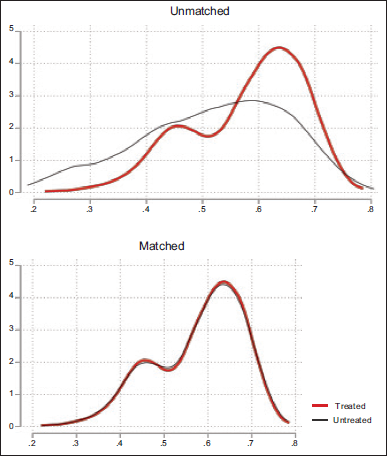
Figure 4 shows how the propensity scores are spread between households that benefited from FISP (treated) and those that did not (untreated) in time t − 1. The top panel shows the distribution before re-weighting. Most observations are within the region of common support. However, the means of the distributions do not perfectly overlap. The bottom panel shows the distribution after re-weighting. The means of the households that received FISP and those that did not receive FISP now coincide after the re-weighting. Figure 4, therefore, confirms that re-weighting Equation (1) using IPW reduces estimation bias.
Kernel Density Distribution of Propensity Scores of Farm Input Subsidy Programme (FISP) and Non-FISP Households.
Results
Table 1 presents results for the test of poverty convergence and the mediating role of FISP on the convergence in different land rights regimes among Malawian households. For parsimony, we only present the main effects interest, while details that include coefficients of control variables are included in Table D1 of Appendix D. Columns 1 and 2 show the relationship within a household between poverty in 2010 and poverty in 2013. There is a 30 per cent chance that matrilocal households that were poor in 2010 remained poor in 2013, while those of patrilocal households remained poor by 32 per cent in 2013. Because these two probabilities are close to but not equal to zero, households in either settlement experienced partial poverty convergence between 2010 and 2013. Because the interaction between the programme and poverty in 2010 is not significant, this partial convergence that we observe in both settlements is not due to FISP.
The Impact of Farm Input Subsidy Programme (FISP) on Poverty Convergence in Different Settlements.
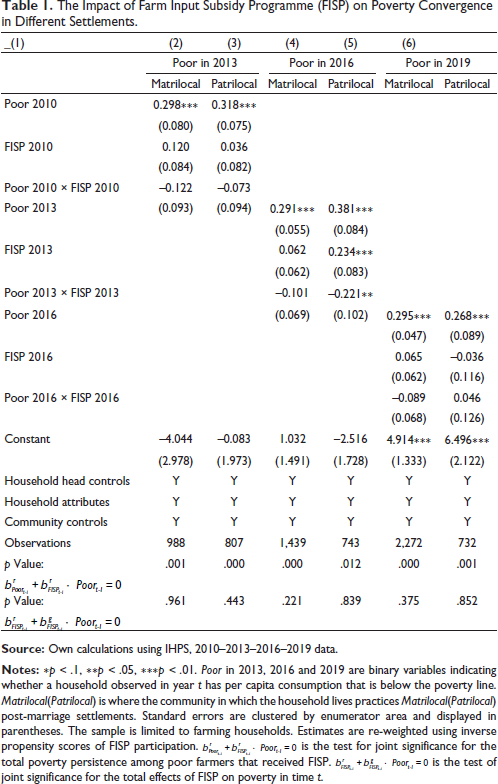
Columns 3 and 4 present results for the test of poverty convergence using 2013 as the base year and 2016 as the end year. In matrilocal settlements, households that were poor in 2013 likely remained poor by 29 per cent in 2016, while there is a 38 per cent chance that patrilocal households that were poor in 2013 remained poor in 2016. Thus, either of the two settlement patterns experienced partial poverty convergence within this period. The convergence remains insensitive to FISP in matrilocal settlements. However, FISP mediates convergence in patrilocal settlements. Particularly, patrilocal households that received FISP in 2013 had only a 17 per cent (0.38 + (–0.21)) chance of remaining poor in 2016. The test for joint significance, p value:
Therefore, inequalities in poverty reduced among patrilocal households due to FISP in 2016, such that the poor that received FISP in 2013 were catching up with the relatively wealthier. However, as earlier highlighted in the fourth section, this catch-up could emerge because the welfare of poor FISP recipients increased while that of the wealthier remained the same. Alternatively, it could result from reduced welfare of the wealthier while that of poor FISP beneficiaries remained the same. Column 4 reveals that the total effects of FISP received in 2013 on poverty in 2016 are null. This is because the test for joint significance, p Value:
Columns 5 and 6 show results using 2016 as the base year and 2019 as the end year. Between these two periods, convergence was 30 per cent in matrilocal settlements and 27 per cent in patrilocal settlements. This partial convergence in either of the two settlements is, however, not related to FISP.
Discussion
In this article, we establish that FISP led to poverty convergence in patrilocal settlements—where men hold rights to land and receive FISP on behalf of their households. More specifically, we find that there is only a 17 per cent chance that patrilocal households that were poor in 2013 remained poor in 2016 when they obtained FISP, while their counterparts who did not receive FISP remained poor with a probability of 38 per cent. The convergence that is mediated by FISP is only evident in 2016 and does not extend to matrilocal settlements, where women hold rights to land under the command of the women’s maternal uncles (Berge et al., 2014), while men receive FISP on behalf of their households (Djurfeldt et al., 2018). Further, we find evidence that non-FISP poverty convergence occurs across all years in the sample. However, both FISP and non-FISP convergence are partial, since their coefficients are not equal to zero.
Because the FISP convergence occurred in 2016, a year when Malawi experienced drought (The World Bank, 2016; Katengeza & Holden, 2021), it is likely that recipient households were resilient to the adverse welfare impacts of the negative climatic shock. The resilience was built through enduring effects of the FISP over time since we measured the impacts of the FISP received in 2013 by poor households on their probability to remain poor in 2016. The enduring effects of FISP on household welfare were also found by Ricker-Gilbert and Jayne (2017). These authors showed that households that received FISP in prior periods increased usage of fertiliser in the subsequent years; hence, maize production also increased in response over time. This could suggest that FISP has multiplier effects that sustain beyond the year in which a household benefited from the programme. In our results, FISP might have improved the welfare base for poor households who benefited from it, such that their consumption remained high under the 2016 drought stress in comparison to that of non-beneficiary households. The finding that this progress towards equality in welfare is limited to patrilocal settlements highlights how different rights to land affect the impacts of FISP on poverty reduction.
Patrilocal rights to land are in the hands of husbands in nuclear families (Berge et al., 2014). Because decisions about resource use and consumption inside households are dominated by husbands, not wives, in both matrilocal and patrilocal settlements (Djurfeldt et al., 2018), the FISP becomes the responsibility of men. More likely, patrilocal husbands invest the FISP in the household farms and provide labour to the farms to ensure effective use of the FISP resources. Moreover, Walther (2018) confirms that patrilocal husbands spend a great deal of time in household farms because their ownership and control of land guarantee them access to the farm produce. This is unlike matrilocal husbands, who spend much of their labour hours working off household farms, where they fully control the proceeds of their labour (Walther, 2018). Only women hold rights to matrilocal land (Johnson, 2018); thus, the women, together with their extended family, largely control produce from household farms in matrilocal settlements (Walther, 2018).
Because the FISP comes to the nuclear family through husbands who, in matrilocal settlements, benefit less from the production process (Djurfeldt et al., 2018; Lunduka et al., 2013), it is likely under-invested in the matrilocal familial land. 7 Mwale, von Fintel et al. (2021) confirm this hypothesis, showing that FISP has no impact on household maize productivity in matrilocal settlements, while positive gains in maize productivity due to FISP exist in patrilocal settlements. This could explain why FISP builds resilience to negative climatic shocks only in patrilocal settlements.
Our article not only provides compelling evidence about the impacts of FISP on poverty convergence but also illuminates areas for further investigation. For instance, we show that non-FISP partial convergence occurs across all years under study in both patrilocal and matrilocal settlements. Future research should investigate the effects of alternative social protection programmes, such as public works, on poverty convergence. Furthermore, the impacts of non-social welfare programmes, such as access to free primary education on poverty convergence, need to be investigated. In addition, how these programmes dampen the possible negative effects of non-agriculture, negative shocks on poverty convergence, such as pandemics, needs to be considered. Understanding how to induce poverty convergence amidst pandemics is now more necessary than before as since 2019, the world has been fighting the coronavirus disease (COVID-19), which has negatively affected most livelihoods across the globe (Bargain & Aminjonov, 2021; Diop & Asongu, 2021).
Conclusion
Poverty remains stagnant in most poor countries, justifying the inclusion of anti-poverty objectives in the global 2030 agenda of SDGs, despite poverty being the primary target of the SDGs’ predecessor MDGs. Using data from Malawi, our article has established that farm input subsidies reduce inequalities in poverty through building household resilience against negative climatic shocks. We specifically showed that among poor households that benefited from the subsidies in periods prior to a drought, poverty became less persistent during the drought. Poor households that did not benefit from the programme in the same period experienced more persistent poverty. The results are limited to settlements where men hold rights to land and receive subsidies on behalf of their households, but not where women hold rights to land while men receive the subsidies on behalf of their households. Therefore, land rights and farm input subsidies intersect to induce household poverty convergence.
We argue that FISP does not build resilience to warrant poverty convergence in settlements where women, together with their maternal uncles, hold rights to matrilocal land because the holders of the subsidies inside nuclear households are husbands who have less interest in investing in familial land. Considering that the Malawi subsidy FISP goes to household heads (Djurfeldt et al., 2018), who are often men, could directly targeting the FISP towards women in matrilocal settlements derive the much-needed welfare improvements that could lead to poverty convergence? Although our article does not provide an answer to this question, the organisational structure of matrilocal settlements led us to conclude otherwise.
Matrilocal rights to land are de facto held by the women’s maternal uncles, even though women are the de jure landowners (Berge et al., 2014). FISP that is transferred to women could therefore more likely end up in the hands of their uncles. Assuming targeting the nuclear households of the women was based on dire vulnerability, the FISP will be less effective in inducing poverty convergence as some resources move to the women’s extended family. Therefore, if subsidies are to be relied upon as a strategy that should also induce poverty convergence in matrilocal settlements, perhaps women’s rights to land need to be asserted. Thus, matrilocal women, not their uncles, should de facto control land, and the subsidy should be given directly to the women who cultivate the familial land, not their husbands, who often work outside the household farm (Walther, 2018).
Footnotes
Declaration of Conflicting Interests
The authors declared no potential conflicts of interest with respect to the research, authorship and/or publication of this article.
Data Availability Statement
The study uses data from the World Bank, publicly available on
Declaration of Conflicting Interests
The authors have no conflicts of interests to declare. The authors, however, would like to acknowledge that the working paper version of this article is available online on the MPRA repository paper number 112431, University Library of Munich, Germany.
Funding
The authors received no financial support for the research, authorship and/or publication of this article.
Notes
Appendix A: The Poverty Methodology
Appendix A explains our poverty methodology. Household consumption was used as our poverty metric and included a number of food and non-food items obtained from the Malawi IHPS data. The food items include: (a) cereals, grains and cereal products such as maize flour, rice, bread and spaghetti; (b) roots, tubers and plantains such as cassava tubers, sweet potato, bananas and cocoyams (masimbi); (c) nuts and pulses such as beans, groundnuts and soya macadamia; (d) vegetables such as onions, cabbages, cucumbers, tomatoes, okra and mushrooms; (e) Meat, fish and animal products such as eggs, fish, beef, pork, goat and termites; (f) fruits such as mangoes, avocado, papaya and wild fruits; (g) cooked foods from vendors such as boiled maize, samosa, doughnuts, mandazi, kalongonda and boiled groundnuts; (h) milk and milk products such as fresh and powdered milk, chambiko, yoghurt and margarine; (i) sugar, fats and oils such as sugar, sugarcane and cooking oil; (j) beverages such as tea coffee, sobo squash and fruit juices maheu, kachasu, chibuku and freezes; (k) spices and miscellaneous such as salt, yeast, jam, sweets and honey.
Non-food items include charcoal, paraffin, candles, newspapers, public transport, soap, toiletries, vehicle spare parts, wages paid to servants, clothes, mosquito nets, mattresses, cement, paint, bricks funeral costs, marriage ceremony costs, lobola, desks, computer equipment, satellite dish and generators. This is the full list of the items as listed in the IHPS household questionnaire and can be found on the World Bank micro-data portal (The World Bank, n.d.).
We adjusted nominal consumption values for cost of living to enable the poverty analysis. These adjustments were spatial and temporal, and all were adopted from the IHPS. The spatial adjustments dealt with differences in the cost of living over locations. IHPS spatial price indices adjusted the cost of living across regions. Temporal adjustments were implemented by combining unit values of food items from the IHPS data and NSO non-food consumer price indices (CPI). A unit price was generated by dividing total household expenditure on the food and non-food items by the total quantity of the items purchased on the market. We generated unit prices for food expenditure and non-food expenditure separately.
The questions in the data use recall. Subjects were asked to provide their expenditure in the past 1 week, 1 month or 3 months. To generate total annual household expenditure, we multiply weekly expenditure by 52.143 weeks, monthly expenditure by 12 months and quarterly expenditure by 4 months. The total annual consumption expenditure, therefore, is the sum of both food and non-food expenditure across all three recall questions. Using the total annual consumption expenditure, we generated total annual household per capita consumption by dividing the expenditure by household size.
A household was considered poor if its annual per capita consumption fell below the basic needs basket, which cost K37,000 in 2010, K85,852 in 2013, K137,428 in 2016, and K137,428 in 2019. Except for the 2010 poverty line, which we obtained from the IMF bulletin (IMF, 2017), the poverty lines for the remaining years (2013, 2016, 2019) were readily provided in the IHPS data across the waves.
Appendix B: Descriptive Statistics
Appendix C: Determinants of Household Selection Into the FISP Programme
FISP was established to enhance household income through sustained food self-sufficiency (Chibwana et al., 2014; Chirwa & Dorward, 2013). As such, the selection of beneficiaries into the programme has often emphasised targeting vulnerable households. The main attribute is that beneficiaries must be poor farmers who cannot afford market-priced fertiliser and hybrid seeds (Holden & Fisher, 2015; Ricker-Gilbert & Jayne, 2017). To emphasise the vulnerability, in 2008, FISP included explicit pro-poor characteristics for selection that include female-headed households and households of the elderly (Chibwana et al., 2014). At regional and district levels, FISP originally provided more vouchers to areas with more maize land until 2008. After 2008, the emphasis on vulnerability led to an increased number of beneficiaries in areas with large numbers of households, often in the southern region district of Malawi, which are predominantly matrilineal and matrilocal (Berge et al., 2014; Mtika, 2007).
 shows differences in the characteristics of FISP and non-FISP beneficiaries across the 4 years under study—2010, 2013, 2016 and 2019. FISP beneficiaries are significantly poorer than non-beneficiaries. Despite the FISP’s emphasis on vulnerability to include female-headed households as an important attribute, there are no differences in the gender of the household head by FISP. However, the emphasis on the elderly is visible, with older household heads being more in the FISP group than in the non-FISP group across all years. The beneficiaries’ group had larger households than the non-FISP group, but only in 2013 and 2019. Other factors that differed between beneficiaries and non-beneficiaries included road accessibility, availability of a daily market and availability of a microfinance institution in a community, which signals the remoteness of residents. While the FISP group lived in areas with more MASAF programmes than the non-FISP group in 2010 and 2013, there was no difference in FISP distribution between these areas in 2016 and 2019. Across all years, rainfall patterns were similar in areas where FISP beneficiaries and non-beneficiaries lived. Except in 2019, the FISP group had more households living in matrilineal and matrilocal communities than the non-FISP group.
shows marginal effects from a probit estimation of factors that affect FISP participation in 2010. The year is our baseline on which propensity scores of FISP participation were generated. There are no differences in the likelihood of receiving FISP by gender of the household head. Households with older heads have a 0.5 per cent chance of being included in the FISP. Selection into the programme is non-related to household size, number of households in a community and accessibility to the community through an all-seasons road. Households that reside in communities where there is a daily market face a 41 per cent less likelihood of receiving FISP in comparison to households in communities that do not have a daily market. Whether a community has a microfinance institution does not relate to its households’ likelihood of receiving FISP. Households that reside in communities where MASAF programmes are implemented face a 42 per cent less likelihood of obtaining FISP than households in communities where MASAF programmes are non-existent. Finally, most beneficiaries are from matrilineal-matrilocal settlements.