




Abstract
Background
Widows still face immense barriers in owning land and get inferior reliable rights to land than males across most Kenyan communities. The objective of this study, therefore, was to establish the sociocultural and economic factors that continue to bar widows from owning land in rural Western Kenya.
Methods
A cross-sectional study employing qualitative data collection methods was adopted in this study where six widows participated in Case Narratives (CN), and two Focus Group Discussions (FGDs) each with five widows and one FGD comprising eight men were conducted. In addition, six widows were identified from the FGD participants for in-depth interviews (IDIs) and 10 key informant interviews with stakeholders were carried out. Data from the qualitative interviews were transcribed for coding and analysis. The thematic content analysis method was used to identify themes related to sociocultural and economic factors hindering women from land ownership.
Results
Economic marginalisation, traditional land ownership structures, and practices such as the skewed land inheritance that disfavour women due to the deep-rooted patriarchy, low level of education and lack of awareness of existing land laws were found to be the major hindrances to land ownership by widows. In addition, the tedious process of accessing land documents and widow inheritance is also to blame.
Conclusion
The study concludes that the existence of a legal regime that accords women and widows the right to own land may not be sufficient in realising the intended gains for women if it is not backed up with an effective implementation and awareness creation on the laws as well as economic empowerment of the widows through targeted social protection schemes.
Introduction
The gendered roles of men, as heads of households and controllers and managers of land, have often led to gender disparities concerning ownership of land and other productive resources. Nonetheless, gendered land rights are acknowledged as a crucial component of decreasing poverty, achieving food safety and increasing health, and fostering social inclusion and empowerment in the Sustainable Development Goals 1, 2 and 5 (The World Bank, 2019). Beijing Declaration and Platform of Action of the World Conference on Women (UNDP, 2020), emphasises the importance of providing women with equal opportunity for economic benefits, accessing, operating, managing and owning land.
While international, regional and national laws have been put in place, women are still deprived of equitable rights to, use of, inheritance, administration and ownership of land. States must change laws, cultural habits and societal practices that prevent women from accessing and controlling land for women to exercise their land and property rights. Widows in various sub-Saharan African nations such as Mozambique, Zambia, South Africa, Malawi and Zimbabwe are still being disinherited and expelled from their family houses and property (Nnoko-Mewanu et al., 2020).
Regardless of whether a woman lives in a rural or an urban setting, land rights have major implications for the achievement and enjoyment of her human rights such as the right to equality, food, health, housing, water, work and education (United Nations, 2013). Therefore, lack of access to land and other productive resources has a negative impact on the enjoyment of women’s various human rights. Since women most often gain access to land and housing through their relationship with a man, widowhood and domestic violence present a serious concern from the point of view of women’s security of tenure.
Objectives of the Study
Despite the existence of a formal regulatory framework, discriminatory sociocultural practices continue to obstruct women in Kenya, particularly widows, from enjoying their liberties. There is, however, a shortage of information on why despite the available legal frameworks such as the constitution of Kenya 2010 and other supportive laws, widows still find it difficult to own land. Hence, the need to revisit the sociocultural and economic factors that continue to bar women from owning land within the context of the enabling legal frameworks in order to understand their nexus with the legal regime.
Literature Review
Kenya is patriarchal, meaning that it is the men who hold the land on behalf of others and customary practices often discriminate by allowing the opposite gender to access land only through spouses or men in their lineage (Deininger et al., 2014). A widow, because of perceived discrimination from her late husband’s family regarding land and other property inheritance, continues to live in poverty together with her children.
Kenyan law makes it illegal to forcibly evict a widow from her matrimonial home and land. The law prohibits a widow’s husband’s relatives from taking her inheritance illegally. However, this is rarely implemented, and justice is difficult to come by, especially in rural areas. The Matrimonial Property Act of 2013 asserts that an asset or ownership in marriage may not be detached in any form, whether by sale, gift, lease, mortgage or otherwise, for the course of a committed relationship and without the validation of both parties (Republic of Kenya, 2013), while part V of the Marriage Act of 2014 regulates customary marriages (Government Printer, 2014).
Methods
This was a qualitative cross-sectional study that triangulated case narratives, focus group discussion, in-depth and key informant interviews to find out the sociocultural and economic factors that continue to bar widows from accessing and owning land.
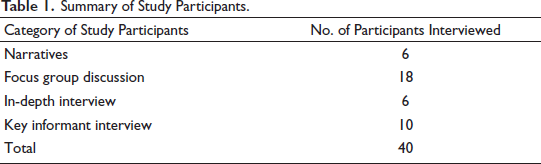
Table 1 presents the category of study participants and the total number of participants who took part in the study.
Summary of Study Participants.
Study Site
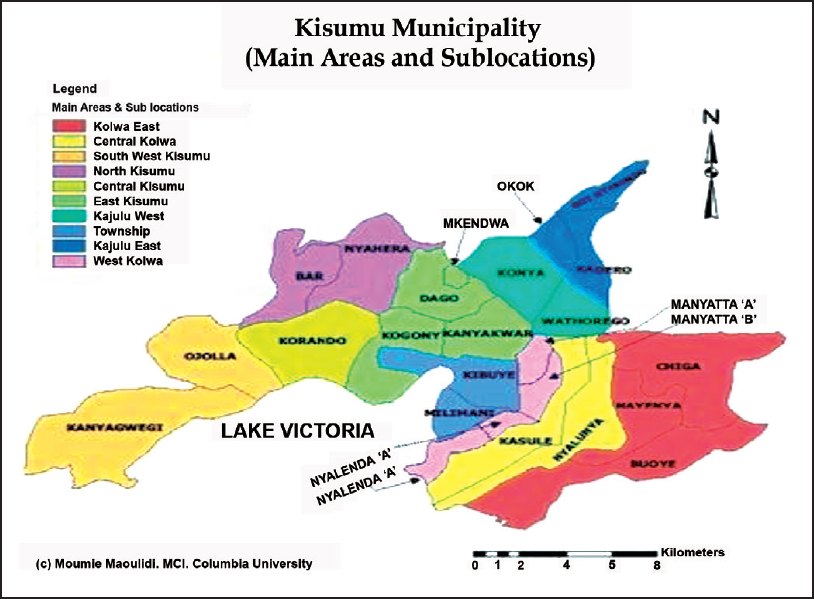
The study was conducted in Kolwa East Ward in Kisumu County. The County of Kisumu covers approximately 2,086 km square land area and 567 km square of water. This represents 0.36 per cent of the total land area of Kenya’s 580,367 km Square (County Government of Kisumu, 2018).
The study area is selected considering that, women and girls make up about 50.1 per cent of the total population of Kisumu County, and the inequalities and gender-based barriers to access and control of resources they face present real concerns for prospects for fair treatment and access to justice by women (KNBS, 2019).
Socioeconomic Profile of the Area of Study
The major economic activities in the area of study include subsistence farming, livestock keeping, fishing, rice farming, sugarcane farming and small-scale trading. Gender disparities still exist in cultural, social and economic spheres, and access to and control over resources and opportunities with the overall poverty rate for female being at 34.4 per cent while for male at 32.2 per cent (KNBS, 2019).
Majority of women have limited access to productive resources such as land, and discrimination against daughters in land inheritance are also pressing challenges. While women own only 1 per cent of property titles, men own 99 per cent of the titles. Property ownership should thus be a concern to all duty bearers and the right holders since property ownership issue is one of the exacerbating factors to unemployment among the female gender. The imbalance in access to education, wealth and capacity to make decisions push to the fore the need to enhance equity among the genders for development of the county (Kisumu County Gender Mainstreaming Policy, 2020).
Map
Kisumu East Sub-County.
Study Design
The study employed a qualitative cross-sectional study design where interview guides were used to generate open conversations with participants on several issues pertaining to the subject matter of study. The study participants had varied characteristics and demographics and the qualitative design helped the researcher to further probe for both congruent and incongruent findings as well as give the participants a free hand to share on their daily experiences with land matters.
Sampling Strategy
A purposive sampling procedure was used to select participants whereby study participants who were knowledgeable on land issues that affect the widows in the study area were recruited into the study. The main method of data collection for this study was the narrative method. A sample size of 22 widows were purposively selected for participation in the study out of which six widows participated in the narrative method, 10 widows participated in two FGDs (each had five widows), while six widows were further identified and participated in in-depth interviews (IDIs). Ten key informants were also purposively sampled and comprised of the chief, assistant chiefs, village elders, land official, court clerk, widows and an advocate.
Methods of Data Collection
The objectives of the study were addressed through six case narratives, three focus group discussions, six IDIs and 10 key informant interviews.
The narrative was used as the main method of data collection since it helps to capture data within stories of widows who had faced hurdles and challenges of registering land in their names, those who have managed to register their land and have title deeds as well as widows who had sought legal support to obtain their rights (IOM, 2016).
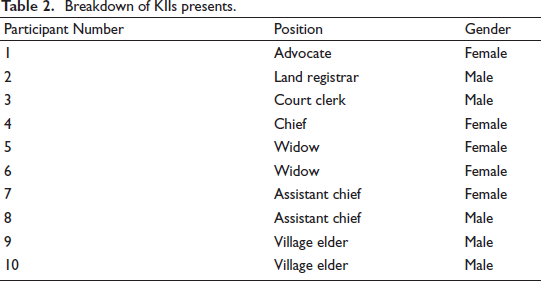
Table 2 presents the breakdown of study participants who took part in the study as Key Informants.
Breakdown of KIIs.
Ethical Consideration
The ethical approval for the study was obtained from the National Commission for Science, Technology and Innovation (NACOSTI/P/21/12568). The study participants were all briefed about the purpose of the study and the right to refuse to answer any question or withdraw from the interviews at any time. They were further requested to express their opinions and thoughts freely and were assured that there were no ‘right’ or ‘wrong’ answers and their opinion will be treated with respect. They were informed of anonymity and assured that their names will not appear in any publication or report resulting from the study. A verbal and written consent to collect data was sought from the participants before commencing any interview and taking notes.
Data Analysis
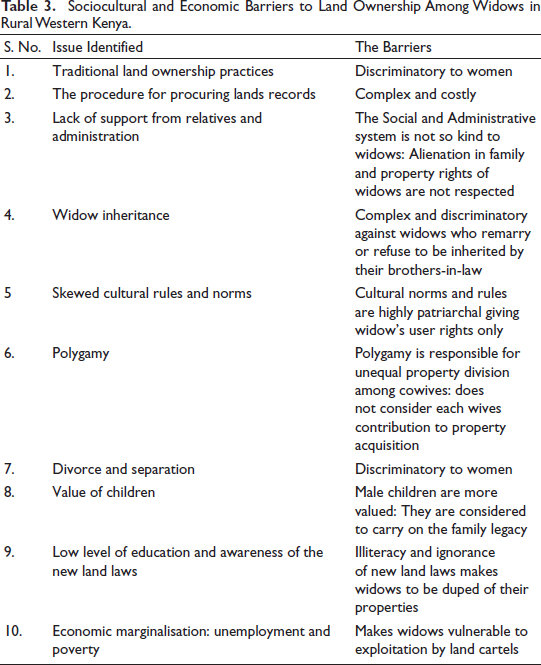
This section presents the key findings of the study by first presenting the summary of the findings in a table format followed by a discussion of the findings.
Interviews were conducted in Dholuo (the local language in the study site since the researcher also speaks the language), Swahili and English. These were recorded, transcribed verbatim and translated after each session for coding and analysis. The qualitative data were organised into themes in line with the study objectives. Some of the information in the discussion was captured verbatim to emphasise the issue being put forward by the informant(s) with each participant given a pseudo name in form of a serialised abbreviation code.
Traditional Land Ownership Practices
According to the study findings, there is the notion and fear that if women are allowed to own land, they are likely to dispose of it and misuse the proceeds, a notion that tends to cast doubts on women’s ability to manage productive resources. In addition, there was consensus among the widows that land is often used as a measure of wealth and therefore belongs to the men as opposed to women. The quotations below bring out these findings:
‘The fear about women and land ownership is that they may dispose of it and misuse the money’ (KII7). ‘Women are never invited into family meetings to discuss how land is to be divided. We only wait to be informed by our husbands of the parcel of land that he has been given. It is even worse if your husband is dead, or you don’t have a male child since you will wait for them to inform you about your piece when they wish to’ (KII14).
A widow only acts as the custodian of the land, while the ownership and control are with the children as demonstrated in the quotes below.
‘The ancestral land should be divided equally amongst the children’ (FGD8). ‘The widow is supposed to inherit the husband’s property and the land should be divided equally amongst the sons’ (FGD10).
Tedious Procedures in Processing Land Documents for Titles
Case narratives from widows unveiled that procedures and requirements for processing land documents for title deed acquisition present the widows with a magnitude of challenges. These include succession procedures, which involve securing family members’ consent for estate administration, securing witnesses, paper works by the local administrators and court officials, and the high costs involved in land surveying and title processing fees among others. Dampening the situation further is the revelation by key informants that in several cases, the widows often do not have any document show that the land belongs to them or their late husband. Some of these challenges are presented verbatim hereunder:
‘The government should be truthful to their word of helping widows. If you report your matter to the Chief/Assistant Chief, you realize that they collude with the person who is refusing to cooperate for you to get your piece of land and so they do not solve your case. They are biased’ (CN5). ‘I did not have any document given to me by my husband, that is why my brother In-law took the land and sold it. Where and how do I start following up on the documents?’ (FGD3). ‘I am jobless and do not have an employed son or daughter who can help me with money to follow up on the title deed’ (CN1). ‘I do not have money for following up on the land that was taken away and sold…’ (CN3). ‘My plight worsened when I sought help from the Assistant Chief, who told me that the land belongs to my father-in-law, and he is at liberty to do whatever he wants with it’ (CN3 & CN5).
These tedious procedures hinder most widows who are poor from owning land and enjoying their full rights. For example, on average, it takes about three months for a widow to secure a letter of administration for her late husband’s estate. This is because the court must place a public notification in form of an advertisement on the intended transfer of the estate to ascertain that there is no objection to the transfer. Thereafter, the widow embarks on lengthy procedures of acquiring a title deed.
Lack of Support from Relatives and Local Administrators
After the husband’s death, a widow relies on male family members, village elders and the local administration to help with the transfer of the deceased property into her custody for ownership and management purposes. This however is not guaranteed as evidenced in this study that relatives, as well as the area authorities, do not afford widows the much-needed support to access and own land. Widows lack knowledge on how they can access the land’s office or the courts for help. The local authority, as well as the close relatives, have not provided the much-needed help. Even so, there were a few widows who were hopeful of a successful process in getting their title deeds.
‘ I reported to the Assistant Chief, he told me to go to the lands office and I do not know how to approach the matter’ (CN2). ‘My father-inn-law sold the land that belonged to my late husband and when I asked him why he did so and asked to be given another piece of land, my brother and sisters-in-law told me to stop disturbing their father over his property that he has sold. I presented my case to the FIDA-Kenya office in Kisumu, but I was disappointed when they told me that the land belongs to my father-in-law and there is no way they can help me get back the land’ (CN6). ‘My father-in-law said that I’m a promiscuous woman who does not deserve to be given any land’ (CN4). Widow’s plights are further advanced by the lack of support by the local authority as intimated in the following excerpt. ‘The assistant chief told me that land belonged to my father-in-law, and he is at liberty to do whatever he wants with it’(CN3). ‘A day will come when I get the title deed and only then will I have peace of mind’(CN3).
Widow Inheritance
Most focus group discussants were unanimous that culturally among the Luo community if a widow is not inherited by her brother-in-law within the extended family, then chances are high that she may not inherit her late husband’s land or if at all she is given land then just a small portion. The widows who happen to get children with men outside the extended family of the late husband additionally face a lot of hindrances. This is because such children are regarded as strangers; hence, their mother cannot lay claims on her late husband’s land and property. The quotations below bring out these findings.
‘They keep telling you that the person who inherited you has your land’ (FGD2). ‘If you have given birth to a boy after your husband’s death, then your husband’s family will not give you land unless you take the child back to his father’ (FGD2). ‘If you give birth after the death of your husband, the child is discriminated against by fellow children, even your children, and they are always looked at as outcasts’ (FGD3). If a widow declines to be inherited by her in-laws for one reason or another, then her in-laws will sideline her and not involve her in any family matters, or they may give her a small piece of land but retain the land documents. Nonetheless, a minority of the discussants denied the existence of forced widow inheritance in the study site indicating that. ‘ Forced widow inheritance is not happening anymore in Kolwa East however, it is common to hear widows being reminded that the land does not belong to them, and they should hand it back to the larger family’ (FGD11). Key informants expressed that a woman is expected to get inherited after burying her husband, and if that is not the case, then, the family members will summon the widow to a meeting where they will let her know of the man, they want to inherit her or else they are not given family land. ‘I am suffering because I was never inherited. They constantly refer to me as a squatter and want to take back land given to me by mother- in-law’ (KII4). Others reported that if you remarry, then you must forego land given to you by your husband. However, your children remain entitled to inherit the property. Key informant interviews confirmed the contribution of wife inheritance in land ownership by widows. ‘You are to get inherited immediately after burying your husband and if you refuse, then your in-laws will sermon you to a meeting and let you know of the man who should inherit you or else you are not given any family land’ (KII3).
Skewed Cultural Rules and Norms on Land Ownership
Study findings pointed out that the Luo community is highly patriarchal, and men have almost exclusive rights to land ownership. This is in keeping with the skewed dictates of cultural rules and norms that prescribe that properties and assets are inherited through the male line only. Hence, men as opposed to women are the only ones recognised as the inheritors of the land. Women only have access rights on their husband’s land, but even so, they remain voiceless on matters touching on the resource. These rules and norms seemed to also account for the invisibility of women in the constitution of local land boards and their meetings.
“I was asked why I attended a land division meeting and told that neither my child nor I have any right to claim land. My brother in-laws told me that the land belongs to their father and so I should keep it off. Men disrespect women. You are not considered part of the family once you lose your husband. Do not expect to be given land if your husband died before the subdivision was done” (FGD2). ‘Land belongs to men. A widow can be given a small piece compared to the men. Ancestral land is normally in the father’s name and so they are at liberty to sell without consulting you. If you ask for your share, you will be told that you did not come with land from your maiden home’ (FGD6).
Despite the existence of a legal framework that gives women the right to also own or inherit their parents’ property, patrilocal residence arrangement among the Luo was found to still play a big role in the way women are perceived when it comes to land ownership. It is the considered opinion of most community members that girls/women would benefit twice compared with the other gender when they inherit land and property from both their parents and husbands’ families, a situation that is considered unfair. The new law allowing girls to inherit their parents’ land is still not known by many in the community. Hence, traditions and Luo customary rules, norms and practices override and form the foundation of the widows’ problems regarding land.
‘Men do not recognize their sibling sisters or even the widows as heirs to parents’ properties. Everything in the home belongs to them’ (KII3). ‘It is the sons who inherit land from their fathers. Women and daughters do not. That is our tradition and rule on land’ (KII2). Moreover, because of patriarchy, land documents are always in the name of the man, and it is only the men who are allowed to discuss land matters, women/widows are never involved or consulted even if the land is to be sold neither do they get any money from the sale. ‘Men control everything in the home. Their sisters recognize them as the decision makers and we the wives or widows are never invited to family meetings discussing land matters. I feel that I’m not part of that family’ (KII3).
Polygamy
Polygamy forces the man to divide his hard-earned matrimonial properties and assets among his several co-wives and their offspring, each of whom is obligated to receive a smaller portion of the resources. According to the study, when a husband dies in a polygamous family, it is only the woman who was closer to or loved by the deceased and the last-born son who inherit a bigger portion of the property and land as illustrated in the following quotes:
‘In a polygamous family, the lastborn son stays in his father’s home and inherits the whole parcel of land where the home stands’ (FGD6). ‘If you were three wives and he only favoured one wife, then when he dies, the favoured/ loved wife who has the property will refuse to share it with the other wives’ (FGD1). ‘Even if the land is divided equally, the house with more male children will suffer with land being divided according to the number of children’ (FGD7 & FGD14). Most key informant participants cited polygamy as one of the ‘enemies’ of widow’s land and property rights since there are always wrangles regarding land division in any polygamous home. ‘According to the customs of Luo people, it is the first wife that is normally given priority regarding family property division. The second wife will only get land after the first wife has been given her adequate share’ (KII2). ‘It all depends on which house is more blessed with money. They are the ones who will control the land and decide on how division is done’ (KII3). ‘Polygamy brings a lot of land issues/problems upon the death of the man’ (KII8).
The role of polygamy in land ownership among widows was widely discussed by male discussants who brought in a different perspective by revealing that contrary to popular opinion, sometimes it is not the first wife who is advantaged in terms of land inheritance. In most cases in a polygamous family, it is the second wife who is advantaged and therefore troublesome. This view was supported by some of the key informants who affirmed that the elders/men always favour the second wife by making her assume full control of all the property and this leaves the first wife vulnerable and marginalised.
Divorce and Separation Before the Death of a Husband
A woman’s access to the property is determined by her relationship with her husband such that when the relationship is dissolved before the death of her husband, the chances of the woman losing her home, land and any other household goods is high. The children may lay claim on their late father’s land but not the woman’s. This makes widows fear pursuing their property rights due to threats and violence that they are likely to receive from their in-laws. The situation is further compromised if the woman at the point of divorce or separation did give birth to a child with the late:
‘The late husband’s family will not give you land easily especially if you are childless’ (IDI4). A few members questioned the legal stance in case a woman is widowed amid divorce/separation. Women who are separated from their husband’s face discrimination from their in-laws when they come back after their husband’s death. However, this is different when there is support from at least some members of the in-laws, particularly the father-in-law: ‘What does the law say about this?’ the discussant enquired. ‘If we separated and you’ve come back and found when the land has been divided, then you need to appeal for a favour from your late husband’s family and they will decide whether to give you land or not’ (FGD13). ‘When your brothers-in-law realize that you are having affair with other men, then they will refuse to give you land’ (IDI6). ‘I was given land and assisted to build the house by my father-in-law’ (FGD8). Other widows accounted that if you divorced or separated with your husband and land is divided in your absence, then it becomes difficult for one to report and follow up the case even with the authority. ‘If you separated with your husband and married elsewhere, if the children come back to their father’s home, then it becomes difficult for them to get land if it has already been divided amongst the family members. They might just be given a small portion. I live on my husband’s piece of land though I do not have the title deed. I have the allotment number’ (IDI2). ‘If you are childless and separated with her husband and come back after he is dead, often, your husband’s family will not give you any piece of land but instead ask you to go back to where you remarried or have been living’ (IDI4). ‘If you remarry after your husband’s death then you are not given land. However, if the children are boys, they are often given the portion that belonged to their father since it is considered that they will carry on their father’s legacy’ (KII2).
The Value of Children in Land Ownership
Data from most focus group discussants indicated that it is hard for a woman to be given land if she is childless. They added that in some instances, even a woman/widow who has borne girls only will be asked why she needs the land.
‘…If you only have girls, they do not give you. They tell you that the girls should follow their mother’ (FGD6). ‘If you go back to your parents, you are not given land instead your parents together with your brothers tell you to leave their home’ (FGD7). ‘They will point to you a small place where you can build your house if you don’t have a child’ (FGD12).
The land division depends on the number of sons in each house or which house is considered wealthier than the other. However, in some instances, the man is expected to divide the land equally amongst his wives irrespective of the number of sons that each wife has given birth to.
‘If you have given birth to girls only then you do not get any land except where you have built your house. You are considered someone who has not given birth. However, there are some families who despite having girls only give the women/widows land’ (KII4). ‘ On land division, it is men who are entitled to inherit land from their fathers. This is according to Luo customs. Things are however starting to change slowly, and girls are now being involved in land division’ (KII5).
However, there are instances where land has been divided among the deceased wives and their children as well as cases of girls who have been given land by their fathers and have built on the land or sold it and bought land elsewhere. However, in such scenarios, the case is always that the girls are either single or separated or divorced from their husbands.
‘I’m happy that my father gave me this land where I am living before, he died. My story would have been different if I didn’t have land considering that I have children’ (IDI1). ‘What I have seen is that they are always involved in land succession matters and when asked if they want their share, almost all of them say that they do not want. I think they normally fear their brothers. There is only one girl who asked for her share of the land and later sold it to get money for building a house where she is married’ (KII1). ‘I have witnessed where the men have died and, the family land is divided amongst their wives and the sisters-in-law’ (KII6). ‘There are families in my location where girls have succeeded in inheriting their parents’ land’ (KII7).
Low Level of Education and Awareness of New Kenyan Land Laws
Many of the respondents agreed that widows do not know the process of getting their property documents due to literacy limitations. As a result, their in-laws often take advantage of the situation by asking them thumbprint documents in the pretext that they are helping them process the title deed only for the widows to realise later that they were duped changing ownership of their land.
‘They, later, change their agreement and deny the widow their share of the land. This mostly happens if the widow is illiterate and not able to pay the land processing fee. They are threatened by the in-laws to consent to their demands. She also sees the arrangement/agreement as a form of security only to realize when it’s late that she was cheated’ (KII6).
This study established that some relatives often ask for a widow’s national identity card in the pretext that they are helping them process the land documents only for the widow to learn that her land has been sold or they have registered the land in their name. Making the matters worse, the study has shown that most of the widows are unaware of the current legislations that give rights to women including widows to inherit land from their husbands and parents.
‘Lack of education is a big problem. They do not know the procedures to follow to secure the title deed. At times even the Assistant Chiefs do not give relevant advice, so it is good for them to go to the land’s office. The land registrar can summon the area chief and give directives on how the widow can be helped since the land registrar’s word is final. The land registrar can as well engage the County Commissioner to help solve the case’ (FGD 8). ‘Most women get married and do not bother to find out who the legal owner of the land is or even the parcel number and so when displaced, widows find themselves in situations of not knowing where to start from since they do not know the parcel number or whom to consult’ (KII6). ‘Many people are yet to accept the law on gender equality that women should also be given land just like men. Surprisingly, women themselves feel bad when their sister In-law comes back to ask for a piece of land’ (KII2). ‘The chief never used to involve the man’s wife when sealing a sale agreement, before the promulgation of the new constitution. This has since changed and both wives and children who are above the age of 18 years must be involved in any land transaction be it sale or succession’(KII6).
Economic Marginalisation: Unemployment and Poverty
The study indicated that unemployment and poverty play a key role in the access and ownership of land by widows. Widows find the costs of processing land documents too exorbitant to afford due to a lack of income. This leaves them vulnerable to exploitation by land cartels some of whom are their in-laws. Land processing procedures are also riddled with corruption and those without finances are unable to get their titles.
‘Majority of widows living in the rural areas are poor and so they are unable to pay for the required fees for land titles. They are also not able to pay bribes to land officers and get the title deed’ (KII8). ‘It is poverty that demoralizes them from following up on the land documents. They will tell you that they do not have money for buying food so where do you expect them to get money for processing the title deed’ (KII6).
Discussion
The qualitative study has shown that economic marginalisation, skewed cultural rules and norms on land ownership, the value of children in land ownership, tedious procedures in processing land documents, widow inheritance, and low level of education and awareness of land legislations are among the barriers that hinder widows from owning land in rural Western Kenya.
The study has indicated that economic marginalisation inhibits widows from owning land in the study location. Many of the widows affirmed that they are poor and therefore unable to pay the high fees required to process land documents after the death of their husbands. This finding supports that of Human Rights Watch (2009), which also found that poverty is a source of burden for women to finance the costs of pursuing property claims.
The finding is further supported by a post-conflict Rwanda report by Rose (2005), who also found out that poor women were unable to meet the legal price services and documentation required for their property claim, as well as travel to the courts or land offices.
Skewed cultural rules and norms on land ownership were also mentioned as one of the barriers that hinder widows from owning land. The study established that it is only men who are allowed to discuss land matters and women/widows are never involved even when they are claiming land that had been sold by their in-laws without their knowledge. Land documents are always in the name of the man who is at liberty to use them at will. Women are never consulted even if the land is to be sold and they also do not get any money from the sale. The findings confirm that of Joireman (2008) who also found out that men inherit property outright, while women only have secondary rights to land access meaning that they can only farm on the land but not own or claim it.
Most participants emphasised the value of children in land ownership pointing out that a childless woman would never be given land and, in some instances, even a woman/widow who has borne girls only will be asked why she needs the land. The value attached to a male child of continuing his father’s lineage saw women/widows with male children given a bigger piece of land compared to a widow who bore girls only. The finding demonstrates that a lot of consideration is made with the boy child in mind since a huge percentage of the property is held in trust by the widow for the children. The findings are similar to that of Chabeda (2008) that confirm that the inheritance of land and property among the Luo was through a patriarchal system whereby sons inherited from their fathers.
Lack of possession of land title deeds by widows occasioned by the tedious and expensive procedures involved in the acquisition of the documents denies widows the right to claim ownership of any property given to them by the husband. The main reason highlighted by most participants is that the local authorities are reluctant to help the widows to process the documents. Furthermore, the fact that land transfer involves payment of legal and processing fees keeps widows away from the benefit of land ownership since most of the are poor and are unable to raise the fees required. This finding confirms that of Human Rights Watch (2020) who also found out that the process of claiming the land is always time-consuming and expensive and that women often face a lot of stigmas if they attempt to claim land or property.
Widow Inheritance
Participants were unanimous that the chances of a widow getting land are slim if she is not inherited by her brother-in-law. Even if she wins the favour of the in-laws, she gets a very small portion. Findings from the study also indicated that a widow is never involved in family matters if she is not inherited by her brother in-laws and is often regarded as a squatter. These findings support that of Gunga (2009) who also found out that the fear of being excommunicated from their matrimonial homes and losing the estate of their deceased husbands make it difficult for the widows to resist undergoing the ritual of inheritance. Similar findings were reported by Human Rights Watch (2009) who emphasised that widows are often stripped of their possessions and left with no choice, thereby opting to engage in risky sexual behaviours and practices to safeguard their property.
Low level of education and awareness of land legislations was cited by interviewees as a major barrier to widows’ access and control of land. Widows do not know the procedures to follow when disposing of their property or how to get the land title deed. This study established that most of the widows interviewed are illiterate and have no clue on the current land law that gives them rights to inherit and own their parents and husbands’ properties. In the absence of this knowledge, they turn to their relatives for help and eventually lose hope should they fail to get the support. The findings are consistent with that of the Federation of Women Lawyers (FIDA) (2019) who also found out that low socioeconomic females who are uneducated and do not have access to the constitution, which protects their land and property rights, are frequently unable to successfully claim their land and other assets when the need comes.
Conclusion
This study has unveiled the sociocultural and economic barriers to land ownership among widows in rural Kenya. Even though the study participants acknowledged that changes have started to emerge where girls, women and widows are taking advantage of the new progressive land legislation that gives them rights to inherit and own land, many widows still suffer from the shackles of these barriers. Therefore, it can be concluded that the existence of a legal regime that accords women and widows the right to own land may not be sufficient in realising the intended gains for women particularly widows if it is not backed up with effective implementation and awareness creation on the laws as well as economic empowerment of the widows through targeted social protection schemes.
Sociocultural and Economic Barriers to Land Ownership Among Widows in Rural Western Kenya.
Footnotes
Acknowledgements
The authors would like to acknowledge all the participants and informants for their immense contribution to this study by providing information.
Declaration of Conflicting Interest
The authors declared no potential conflicts of interest with respect to the research, authorship and/or publication of this article.
Funding
This manuscript has been produced from a research project that was self-sponsored by Ms Beatrice Otieno as part of her Master of Arts Degree in Gender and Development Studies at the Institute of Anthropology, Gender and African Studies, University of Nairobi, Kenya.
Data Availability Statement
The datasets used for the article and the study are not publicly available because personal confidentiality may be compromised, and data and materials can be obtained from the corresponding author upon reasonable request.
